ÉRASME, Van Baerland (Adriaan).Livre Rare Book

133 résultats
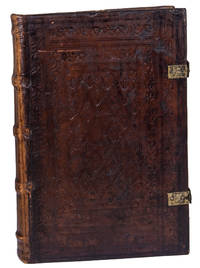
152344374Cologne, Eucharius Cervicornus pour Gottfried Hittorp, s.d. , (1523). In-8 de 139-(13) ff., sign. a-s8, *8, table, titre à encadrement gravé, bois gravé, caractères grecs et romains.ÉRASME. Parabolarum, seu Similium liber elegantissimus. Argentinae, apud J. Knoblouchum (Strasbourg, Johann Knobloch) 1521. 103-(5) ff., sign. A-O8, titre à encadrement gravé, caractères italiques.ÉRASME. Opus de conscribendis epistolis, quod quidam & mendosum & mutilum ediderant, recognitum ab authore, & locupletatum. Argentorati (Strasbourg) Knobloch, 1522. 178 (i.e. 180) ff., sign. A-Y8, Z4, titre à encadrement gravé, caractères italiques.3 pièces reliées en 1 vol. in-8 (105 x 170 mm), peau de truie sur ais de bois biseautés, décor estampé à froid à encadrement de motifs floraux et animaliers, dos à trois nerfs, titre manuscrit au dos, deux fermoirs (reliure de l'époque).
1531049721Basel: Officina Frobeniana Froben 1531. First Edition. Hardcover Vellum. Very Good Condition. Contemporary rolled pigskin worn and discolored with old repairs to spine ends and edges but quite sound. Clasps intact. Early notes and an old bookseller catalog entry to front pastedown. The notes appear to be in two hands one contemporary in the same or similar ink to Chripstoph Binder's signature to the title and the other a little later. Title page printer's device with early coloring. Neat marginal notes and underlining throughout heavier early on and at the end neat interlinear notes and notes to the Erasmus letter. Many of the later notes written in triangular format. Scattered stains tiny wormtrails heavier early on some marginal dampstaining at beginning and end. A nice copy. Separate title page for the Chronologia.<br /> <br /> 8 244 243 210 91 74 45 1 p.<br /> <br /> Provenance: With the signature on the ttitle page of Württemberg theologian Christoph Binder 1519-1596 the first Protestant abbot of Adelberg Abbey. Size: Folio. Quantity Available: 1. Shipped Weight: Under 1 kilo. Category: History; Antiquarian & Rare. Inventory No: 049721. Officina Frobeniana (Froben) hardcover
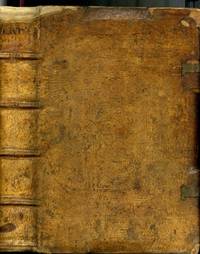
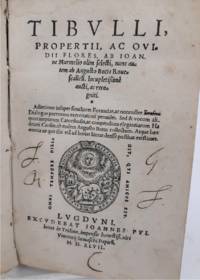
15471328082Lugdunum: Ioannes Pul Ioannes Pullonus 1547. Other. Tibulli propertii ac Ovidii flores ab Ioanne Murmelio olim selecti nunc autem ab Augusto Botta Rouescallen. Iocupletissimè aucti ac recogniti. Edited by Ioannes Murmellius and Augustus Botta Rouescallen. Lugdunum: Ioannes Pullonus 1547. 117 pp. Text in Latin. Duodecimo in early vellum boards. A partial title has been written on the spine in faded ink. The initials F.R.G.F.C. appear in ink on the title page and the name Erasmus has been crossed out in two instances. A book stamp likely placing this volume in a library or collection in Bologna in the 19th century appears on the final page of text. Condition: Very Good. The boards are very thin and have become cockled. The vellum is somewhat darkened with age and light staining and shows minor insect damage. There is evidence of a closure device now absent on both boards. Both paste downs are partially detached but the binding is overall very solid. The pages are somewhat age-toned with occasional foxing. There are a handful of small ink marks to the textblock. Dimensions 4.25 x 6.375 x 0.625 inches<br /> <br><br /> <br><br /> shelved case 3. 1328082. Shelved Dupont Bookstore. Ioannes Pul [Ioannes Pullonus] unknown books
15471328082Lugdunum: Ioannes Pul Ioannes Pullonus 1547. Other. Tibulli propertii ac Ovidii flores ab Ioanne Murmelio olim selecti nunc autem ab Augusto Botta Rouescallen. Iocupletissimè aucti ac recogniti. Edited by Ioannes Murmellius and Augustus Botta Rouescallen. Lugdunum: Ioannes Pullonus 1547. 117 pp. Text in Latin. Duodecimo in early vellum boards. A partial title has been written on the spine in faded ink. The initials F.R.G.F.C. appear in ink on the title page and the name Erasmus has been crossed out in two instances. A book stamp likely placing this volume in a library or collection in Bologna in the 19th century appears on the final page of text. Condition: Very Good. The boards are very thin and have become cockled. The vellum is somewhat darkened with age and light staining and shows minor insect damage. There is evidence of a closure device now absent on both boards. Both paste downs are partially detached but the binding is overall very solid. The pages are somewhat age-toned with occasional foxing. There are a handful of small ink marks to the textblock. Dimensions 4.25 x 6.375 x 0.625 inches<br /> <br> <br /> <br> <br /> shelved case 3. 1328082. Shelved Dupont Bookstore. Ioannes Pul [Ioannes Pullonus] unknown
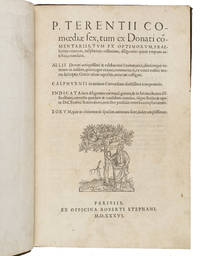
1536ABC_49923Paris: Robert Estienne 1536. Late 17th-century calf sewn on five supports with corresponding raised bands richly gold-tooled spine with the author title and year lettered in gold and red and-brown sprinkled edges. Small folio 20.2 x 30.3 cm. With Estiennes small woodcut device ona small woodcut the title page. Second edition of Terences Comoediae published by the French humanist and printer Robert Estienne 1503-1599. Publius Terentius Afer also known as Terence ca. 195-ca. 159 BCE was a Roman playwright of North African origin and one of the foremost authors of Latin comedy. The present work includes the commentary of Aelius Donatus 4th century CE based on a manuscript provided by Estiennes father-in-law Josse Bade 1462-1535. Donatus was a Roman grammarian and teacher of rhetoric best known for his grammatical works Ars Minor and Ars Maior. Building on Estiennes earlier 1529 folio edition this one was printed in the new Roman types and divided into acts and scenes a notable innovation. In addition Estienne incorporated Erasmus treatise on comedic metres which provided a scholarly analysis of the rhythmic and metric structures of classical comedies enhancing readers understanding of Terences original cadence and comedic effect.The boards are severely rubbed light foxing and staining throughout the title page is very slightly browned the head margin is cut slightly short. Otherwise in good condition.l Adams T 326; BM STC French p. 416; De Reuck 512; Inventaire chronologique des editions Parisiennes du XVIe siecle V 314; Renouard Estienne I 43 no. 15; Schreiber 52; USTC 147028 9 copies; Vander Haeghen II 55. Robert Estienne, hardcover
15672733Basileae : Apud haeredes Nicolai Brylingeri M. D. LXVII. 1567 1567. Hardcover. Good. 26 643 1 p. the last page blank ; 17 cm. 8vo ; References: Adams; T-361; VD16; T-466 ; OCLC: 35196231 ; preface by Desiderius Erasmus dated 1532 ; includes commentary on each play by Giovanni Calfurnio ; Title vignette; initials ; Signa tures: a-z8 A-T8 Nota Bene: incomplete volume : A-B are missing pages 339-375 comprising Actus II Scena I - Actus III Scena II of Adelphi ; Contemporary panel-stamped cream/butter-colored pig-skin binding ; raised bands ; green speckled fore-edg e ; two-tone silk headband ; bookplate "E Bibliotheca Collegii Cremsensis" dated 1818 with ownership written in ink across title page ; large crayon pencil mark in red "LVIII29" on lower portion of title page ; text in Latin italic type font f or the text of the plays ; only one other known institution copy held by the Newberry Library ; slight worm damage to top of spine ; soiling ; marginalia on some pages in a contemporary humanist hand on pages 2-5 17-19 439-40 445 478-79 491-92 529-30 615 640-42; name and text on back ep in a German hand writing Frakturschrift consisting of a paraphrased quote from the Psalms ; Contents : Terentii Vita -- Andria -- Evnvchvs. Eunuchus -- Heavtontim. Heautontimorumenos -- Adelph. A delphi -- Hecyra. -- Phormio. ; also contains a poem in Latin iambs by Erasmus printed on the reverse of title page ; G <br/> <br/> Basileae : Apud haeredes Nicolai Brylingeri, M. D. LXVII. (1567) hardcover
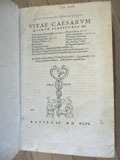
1556LLV2641Lugduni Lyon:: Seb. Gryphium 1556. 1556. Small 8vo. Pagination: 473 23 pp. Signatures: a-z8 A-H8. Printer’s device on the title page woodcut initials printed marginalia; editor’s name on title and p. 2 are lined out in ink three small worm holes from title-page. Nineteenth century quarter gilt-ruled calf red paper board boards. Early ink name on title of "Carolus . . ." and occasional marginalia pp. 58 61 62 80-83 heavy notes - in the same hand. Very good. Beautifully printed early pocket edition printed by Sebastianus Gryphius 1493-1556 of Suetonius’ most famous work and one of the few of his texts that survive with excellent annotations by Desiderius Erasmus of Rotterdam. Commonly known as The Twelve Caesars the work contains a set of twelve biographies of Julius Caesar and the first eleven emperors of the Roman Empire Augustus Tiberius Caligula Claudius Nero Galba Otho Vitellius Vespasian Titus Domitian. It is a primary source for the study of Roman history. <br /><br /> The first edition of Suetonius with Erasmus’ annotation was issued in 1533. <br /><br /> Baudrier Henri L. Bibliographie lyonnaise VIII p. 284; Gultlingen V p. 215: I369; French Books III & IV: Books published in France before 1601 . . . edited by Andrew Pettegree Malcolm Walsby Leiden: Brill 2012 87100. <br /><br /> Locations: BYU lacks everything after p. 340 and title is damaged; NYPL. Seb. Gryphium, 1556. hardcover books
1556LLV2641Lugduni Lyon:: Seb. Gryphium 1556. 1556. Small 8vo. Pagination: 473 23 pp. Signatures: a-z8 A-H8. Printer's device on the title page woodcut initials printed marginalia; editor's name on title and p. 2 are lined out in ink three small worm holes from title-page. Nineteenth century quarter gilt-ruled calf red paper board boards. Early ink name on title of "Carolus . . ." and occasional marginalia pp. 58 61 62 80-83 heavy notes - in the same hand. Very good. Beautifully printed early pocket edition printed by Sebastianus Gryphius 1493-1556 of Suetonius' most famous work and one of the few of his texts that survive with excellent annotations by Desiderius Erasmus of Rotterdam. Commonly known as The Twelve Caesars the work contains a set of twelve biographies of Julius Caesar and the first eleven emperors of the Roman Empire Augustus Tiberius Caligula Claudius Nero Galba Otho Vitellius Vespasian Titus Domitian. It is a primary source for the study of Roman history. <br /><br /> The first edition of Suetonius with Erasmus' annotation was issued in 1533. <br /><br /> Baudrier Henri L. Bibliographie lyonnaise VIII p. 284; Gultlingen V p. 215: I369; French Books III & IV: Books published in France before 1601 . . . edited by Andrew Pettegree Malcolm Walsby Leiden: Brill 2012 87100. <br /><br /> Locations: BYU lacks everything after p. 340 and title is damaged; NYPL. Seb. Gryphium, 1556. hardcover
1566129831Lugduni (Lyon) apud Antonium Gryphium M.C.LXVI (1566). 682, (30 von 38) Seiten. Mit einer Titelvignette. Geprägter, brauner Ledereinband auf vier Bünden mit vergoldetem Rückentitel. (Die nicht nummerierten letzten 8 Seiten "Annotata fehlen! Titelblatt mit alten handschriftlichen Eintragungen. Mehrere Blätter an den Rändern etwas ausgefranst, jedoch ohne Textverlust. Papier teils gering fleckig. Einige Textunterstreichungen). 12,5x7,5x3,3 cm
155050048London: imprynted at London by Iohn Day dwellinge ouer Aldersgate beneth saint Martyns. And are to be sold at his shop by the litle conduit in Chepesyde at the sygne of the Resurrection 1550. First edition small 8vo 139 x 86mm ff. 116 collating A-O⸠Pâ´; printed in Black Letter throughout; woodcut initials; later vellum-backed marbled boards; title leaf torn at the top margin no loss; the binding lightly rubbed. Early ownership signature of Thomas Ferrar on the title page; ex-Earls of Macclesfield with their North Library bookplate on the front pastedown and their blindstamp at the top of the title page. Part of this is a translation of the De civilitate morum puerilium. libellus of Desiderius Erasmus which was regularly reprinted throughout the 16th century. Rare: ESTC records only 6 copies of this translation only the Huntington and Yale in the U.S. STC 22484; Alston VI 8. Sherry's work "is a mirror of one variation of rhetoric which came to be called the rhetoric of style. As a representative of this stylistic school.it carries forward the medieval concept that ornateness in communication is desirable; it suggests that figures of speech are tools for achieving this ornateness; it supplies examples of ornateness to be imitated in writing and speaking; it supports knowing the figures in order to understand both secular and religious writings; it proposes that clarity is found in the figures. In short the work assisted Englishmen to understand eloquence as well as to create it" Herbert W. Hildebrandt in his introduction to the 1977 facsimile reprint. <br/><br/> imprynted at London by Iohn Day dwellinge ouer Aldersgate, beneth saint Martyns. And are to be sold at his shop by the litle con hardcover books
1515ABC_49919Basel: Johann Froben 1515. Contemporary blind-tooled calf over wooden boards with brass and leather clasps along the fore edge professionally re-backed with later blank pastedowns. Folio. With the title set in a splendid woodcut frame by Urs Graf including Froben's small woodcut device woodcut decorations in the fore-edge and gutter margins of the table of contents verso of the title page and another elaborate woodcut frame on the first page of the dedication. Further with some woodcut initials and Froben's large woodcut device below the colophon on the last page. Senecas complete works here carefully prepared by Erasmus and printed by the renowned Basel publisher Johann Froben are remarkable both for its scholarly rigor and its historical significance. The present work represents one of the earliest Renaissance printings of Senecas writings presenting essays letters and philosophical dialogues that guide the reader toward virtue wisdom and a well-examined life. Erasmus thorough editorial care ensured that the texts were largely purged of errors making this edition an important reference for both humanist scholars and students of classical literature.In addition to the main works this volume includes a number of supplementary writings added by Erasmus reflecting his deep engagement with Senecas philosophy and his commitment to moral and linguistic improvement. The preface encourages attentive reading promising both the refinement of language and the betterment of ones life.The work entitled Ludus de morte Claudii Caesaris includes marginal commentary by Beatus Rhenanus a German humanist and reformer who was a friend of Erasmus and actively involved in the publishing activities of Johann Froben.With printed ex libris bookplate mounted on the front pastedown manuscript waste visible between the front and back endpapers a few manuscript annotations in the margins and some of the text underlined. The binding shows signs of wear the boards have been rubbed some loss of material a small worm hole in the back board the pages are cut slightly short at the head not affecting the text and some occasional slight staining and browning. Otherwise in good condition.l BM STC German p. 808; USTC 667432; Vander Haeghen II 49; VD 16 S5758; not in Bezzel; De Reuck. Johann Froben, hardcover
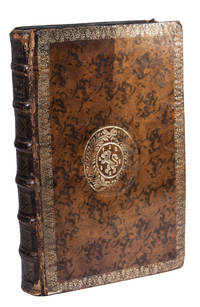
1514ABC_49925Paris 1514. Folio. Jodocus Badius 18th-century gold-tooled mottled calf sewn on 6 supports with corresponding raised bands on the spine the author and title lettered in gold on the spine both boards show a gold-tooled armorial centre piece incorporating the arms of the city of Nevers or the arms of the Conflans family from the Champagne region Rietstap I plate CXVIII within a gold-tooled floral frame blind-tooled board edges marbled edges. With a woodcut border and printers device on the title page printed in red and black along with numerous woodcut decorated initials throughout. 6 CCLXVII 1 ll. 1514 Paris edition of Senecas tragedies printed and edited by the humanist printer Jodocus Badius 1462-1535 with contributions from Erasmus and others. Although Erasmus had permitted Badius to use his preparatory work in his autobiographical letter to Botzheim he reflects on the painstaking effort that went into this preparation and subtly expresses his irritation at seeing Badius nostra cum alienis miscuisse that is having mixed Erasmus contributions with those of others. The present work comprises nine dramatic works and extensive scholarly commentary by leading Renaissance philologists.With a printed book plate of the Fossé d'Arcosse family and a manuscript presentation note dated 1828 Emilien Fossé Darcosse donné par Mr B. V. le 10 septembre 1828 on the front pastedown. On the first free endpaper an 18th-century Latin manuscript inscription records the awarding of a prize to Franciscus Vermeil a noble student at the Jesuit College of Nevers in France for his scholarly achievements. The prize which included an award for a Latin oration was granted on 4 September 1746 by virtue of a perpetual endowment from the city of Nevers. The award is formally attested by the Praefectus Studiorum director of studies J. Petrus Coriou whose autograph and the official seal of the college are present. The corners of the boards are bumped the front hinge is weakened the ends of the spine are slightly damaged with some minor loss of material and with some minor loss of material on the back board. The front board is slightly rubbed the outer half of both boards is slightly faded from sun exposure. The lower margin of the title page and the outer margin of the sixth preliminary leaf have been reinforced. The final privilege leaf blank on the verso except for some manuscript annotations has been mounted on the recto of the adjacent blank flyleaf. The first and last leaves are slightly water stained and the upper margins have been cut somewhat short. Otherwise in good condition.l De Reuck 497; Moreau and Renouard 967; Renouard Badius III 252-53; USTC 144361; Vander Haeghen II 49; not in Kossmann. hardcover
1514047405Paris: Jodocus Badius Ascensius 1514. First Edition. Hardcover Full Leather. Very Good Condition. Later ca. late 17th century or early 18th speckled paneled calf edges sprayed red. Front hinge cracked and a little loose but held by cords endpapers browned at edges two old bookplates contemporary signature and an old note to title. Title printed in red and black with an elaborate border with printed some red to the figures. Scattered very minor browning - a clean bright wide margined copy. 6 CCLXVII 1 leaves. Two blanks at front and two at rear. <br /> <br /> An important edition of Seneca the first with the new critical material by Erasmus including an account in the preliminaries of Seneca by Crinitus. Erasmus had done new critical work on the tragedies and supplied it to Bade who without his knowledge or consent commingled it with the criticism and notes of Caetani and Marmita. The Wrest Park copy.<br /> <br /> Bookplates of Anthony Earl of Kent 1702 and Thomas Philip Earl of Gray - Wrest Park. Old signature to title Jean Ma. and "sum I.ger amicorum" at bottom of title. <br /> <br /> Adams S 901 Size: Folio. Quantity Available: 1. Shipped Weight: 1-2 kilos. Category: Literature & Literary; Inventory No: 047405. Jodocus Badius Ascensius hardcover
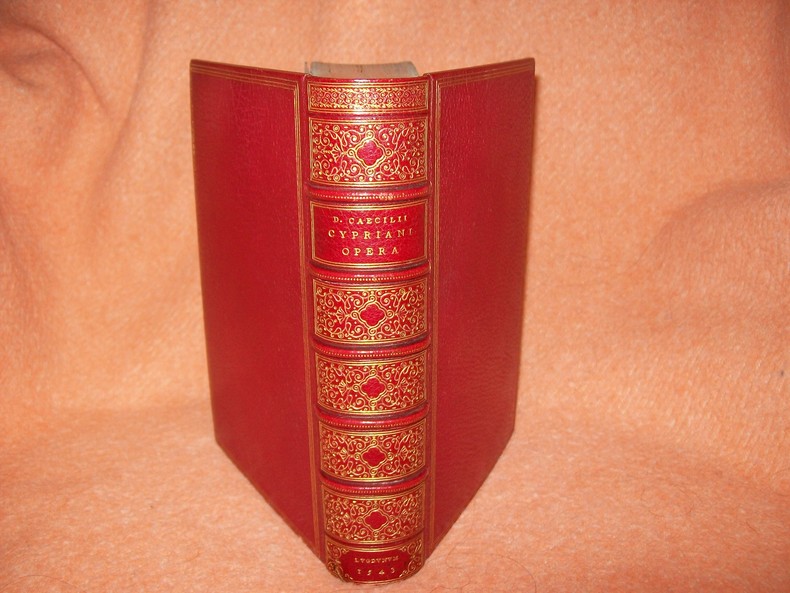
1543GITa719Lugduni apud Seb Gryphium 1543. 2 tomes en 1vol in-8 16ff n ch 1-395pp 6ff n ch et 1f n ch 3-422pp 4ff n ch. Plein maroquin rouge, dos à 5 nerfs rehaussés d'un filet perlé, compartiments dorés aux petits fers, plats encadrés d'un triple filet doré, coupes filetées, belle dentelle dorée sur bordure intérieure, tranches dorées sur marbrure, relié v1850 (Auguste Petit). Belle marque typographique des Gryphe sur la page de titre des deux tomes et sur le dernier feuillet du dernier, jolies lettrines.
152920903bâle Johann Froben 1529 -in-folio plein-veau 2 Parties en 1 Volume, reliure plein veau brun raciné in-folio (binding full calfskin in-folio) (37,6 x 26 cm), RELIURE D'EPOQUE avec le dos entièrement restauré au 19ème, dos à nerfs (spine with raised band) décoré "or" et à froid (gilt and blind stamping decoration), auteur et titre frappés "or" avec filet "or" de part et d'autre, filet "or" en place des nerfs avec un filet or et un filet à froid de part et d'autre des nerfs, filet or en tête et en pied, plats avec les armoiries "or" (au centre) de Claude PELLOT, 1er Président au Parlement de Normandie (Ex-Libris aux mêmes Armes gravées sur cuivre en noir à l'envers du titre), roulette "or" sur les coupes avec manque de dorure (blurred gilding) et manque de cuir, toutes tranches lisses jaspées rouges, Ex-Libris gravé en noir sur sur papier velin crème au dos de la couverture : aux armes de LE FILLEUL des GUERROTS, Chateau des Guerrots [ Heugleville sur Scie (Seine-Maritime, Normandie, France)] + Ex-Libris : "Ex libris Monasterii Sanctae Mariae de Petra Gyrante"Abbaye Sainte-Marie de la Pierre-qui-Vire (Congrégation des Bénédictins de Subiaco) illustré en rouge sur etiquette crème , Texte en Latin, sans illustrations (no illustration) excepté une marque de l'Editeur FROBEN en bas du titre gravée sur bois en noir et la même en fin de volume (même chose pour la 2ème partie) + orné de Lettrines historiées (and illuminated of dropped initials) gravées sur bois en noir, (24 + 596 [i.e. 610] + [2]) + (190 p. d' INDEX) pages, 1529 Basileae : [Johann Froben], (Basileae : in officina Io. Frobenij, 1528) Editeur,
1519PHO-1100Haguenau, apud Thomas Anshelm, 1519 (M.D.XIX Mense Maio). Pet. in-4, cartonnage postérieur ,titre encadré , LXXIX f.,3ff.n.ch. (R 6),( table et marque d’imprimeur) .Exemplaire très frais, écriture sur le titre .
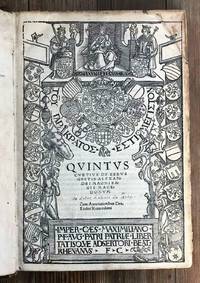
1518curtius<b>Erasmus Finds His Vacation Reading Deficient So He Prepares a New Critical Edition</b><b> <br /></b><br />Folio. 4 LXXXIX leaves; 10 124 pages. Late sixteenth century leather; light scuffing hinges cracked but cords holding tightly; insect damage to text block with loss of text throughout; margins in Orosius trimmed close affecting title image. First printing of Erasmus' critical edition of Quintus Curtius. This first century Roman biography of Alexander the Great was an early Renaissance bestseller with editions from at least a dozen printers throughout Europe by 1517. Erasmus brought it as reading material on a voyage to England in 1517 and finding the text incomplete and corrupt he prepared his own critical edition. This was first published by his friend Strasbourg printer Matthias Schürer in 1518. Erasmus' version proved so popular that five more printers had issued their own editions of his text by 1541; these in turn were reprinted a total of five more times by 1575. This first edition is scarce on the market with Rare Book Hub locating only one sale at auction since 1971 at PBA in 2008 for $2400. <br /><br /><b>Bound with</b>: Paulus Orosius <i>Adversvs paganos historiarvm libri septem</i>. Cologne: Eucharius Cervicornus 1526. An attractive copy of this first universal history by a Christian writer Paulus Orosius c 375-c 418 a Hispanic student of St Augustine who traveled widely throughout the Mediterranean. Elaborate title page border depicting the labors of Hercules signed "AW" Anton Woensam 1493-1541 a prolific painter and woodcut artist whose work was favored by the booming publishing industry in Cologne. Other page borders and initials are also by Woensam as described by Merlo 1864.<br /><br /><br /><br /> Schürer hardcover books
156615871Paris, Hieronymus de Marnef, 1566. Petit in-8 de 540 (pour 542)-[2] pages (a-y-z8; A-L8), plein vélin souple à rabats. Au recto de la page de garde, on trouve une petite photographie XIXe, portrait d'un homme agé, portant moult médailles.
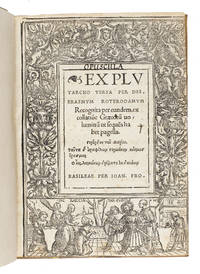
1520ABC_49876Basel: Johann Froben 1520. Modern gold-tooled half calf and marbled paper sides with the author title and year of publication lettered in gold on the spine red sprinkled edges. 4to. With the title set within an elaborate woodcut frame a smaller woodcut frame on the verso of the title page and the first page of the first text. Further with 9 woodcut decorated initials woodcut headpieces and a small woodcut illustration incorporating Frobens device on the last page. This finely printed 1520 Basel edition presents a collection of Erasmus earliest translations from the works of the Greek moral philosopher Plutarch. The volume presents eight of Plutarch's shorter treatises addressing themes such as friendship health and the nature of the human soul.One of the most notable inclusions is De discrimine adulatoris et amici How to tell a flatterer from a friend a treatise Erasmus translated during his time in Cambridge and dedicated to King Henry VIII. The text which explores the subtle art of distinguishing true friendship from sycophancy resonated in an era when rulers were often surrounded by flattering courtiers. With characteristic tact Erasmus hoped the work might serve both as philosophical instruction and as a gentle warning to the young English king particularly in light of those who had encouraged Henrys war with France.Furthermore the present work includes two of Plutarchs important medical treatises in Erasmus translation: De tuenda bona valetudine Advice on keeping well and Utrum graviores sint animi morbi quam corporis Are diseases of the soul more serious than those of the body. The latter contains strikingly early and thoughtful reflections on what we now recognise as mental illness. Other works included in this volume are: Quo pacto quis efficere possit ut capiat utilitatem ab inimico reflections on transforming enmity into wisdom and personal growth. In principe requiri doctrinam on the necessity of wisdom and education in a prince. Cum principibus maxime philosophum debere disputare a meditation on the philosophers role in advising those in power. Num recte dictum sit e ßsa on the meaning of the maxim lathe biosas: to live quietly and modestly. De cupiditate divitiarum a discourse on avarice and the moral corruption born of greed.With a small manuscript note added above the title opuscula and a 17th- or 18th-century owners inscription by an otherwise unidentified Johannes below the colophon on the final page. Slightly foxed and browned throughout the fore-edge and lower margins are cut slightly short barely affecting the printed marginalia. Otherwise in good condition.l Adams p. 654; Ledo pp. 260-66; USTC 655014 6 copies; Vander Haeghen II 46; VD 16 P 3718; not in BM STC German; De Reuck. Johann Froben, unknown
15256388Basel: Johannes Froben 1525. Very Good/Erasmus's edition of Pliny's Natural History conserving the notes from Ermolao Barbaro's edition of 1492 printed by Johannes Froben at the height of his powers. Froben's title page is effectively a billboard: "We give you the work of the Divine Pliny called History of the World more emaculate than any edition ever produced before starting with the annotations of erudite men first among them Ermolao Barbaro and then exemplary contributions by learned people which are still worth correcting with faith in the oldest codices from which we have restored many faults do difficult to find that no one no matter how learned could find them or had found them. We have nothing to envy. We have defeated all of our elders. And if someone now takes this prize from us we will not envy them but we will be grateful for the improvement of public education. Go reader and be fruitful. And by the way we added an index that lacks for nothing. Folio 37 cm; 18 leaves 671 143 pages. Woodcut printer's device the double-headed caduceus designed by Holbein on title page on verso of p. 671 on the title page of the index and on the final page. Holbein's detailed chiaroscuro woodcut initials throughout. Bound in vellum over boards titled in manuscript on spine. Old jottings in manuscript on upper board apparently an Italian and Latin vocabulary list including the names of foodstuffs. Portion of vellum near head of spine replaced. Erasmus's name on running head of dedicatory letter aggressively inked over! Occasional scattered very light foxing in a generally bright and unblemished text. References; Adams P-1560; van der Haeghen Biblioteca Erasmiana p. 45. For the initials among Holbein's largest see Schneeli and Heitz table V #II and table LXXXIII #XL. Johannes Froben hardcover books
15238509Argentorati Strasburg: Iohannes Cnobloch execudebat Quinto Idus Iunias Anno. M.D.XXIII. 1523. 1523 20 130 i.e. 120; 107 1 leaves ; 16 cm. Collates Aa8 Bb4CC8 a-p8 A-N8 O4. D&M 6103a. Recently bound in calf to style with blind decoration to the boards. The spine has raised bands and is titled in gilt. Marginal annotations thoughout. Part title to Epistolae Apostolicae and Cnobloch's device printed at the end of both parts. The imprint and date are supplied from the colophon. The text of each book begins with a 14 line rubricated initial including one decorated with three parrots at the start of Evangelium Secundum Ioannem. PROVENANCE: The title page verso has the bookplate of the Nuremburg bookseller collector and bibliographer of alchemical literature Friedrich Roth-Scholtz 1687-1736. The title page and part title have a neat 19th century stamp of the Univerity of Erlangen now Erlangen-Nuremberg. an excellent early printing of Erasmus' important NT. Argentorati (Strasburg): Iohannes Cnobloch execudebat Quinto Idus Iunias Anno. M.D.XXIII. hardcover
15791306270053Parisiis: Sumptibus Herculis Francois 1579-01-01. Hardcover. Acceptable. Early black pigskin raised bands. 12mo. 1296 25 pp. Later part of index bound in front. Title page in facsimile. Lacking first 24 pages of preface. Minor foxing marginal dampstaining affecting text. Restoration to final leaves. 1095-1296 is Parabolae sive similitudines: Des. Erasmi Roterodami. <br><br> The Alsatian humanist Conrad Lycosthenes Conrad Wolffhart compiled this collection of classical anecdotes. Lycosthenes was a noted populizer of classical science and medicine. Parisiis: Sumptibus Herculis Francois hardcover
1538046897Frankfurt: Christianum Egenolphum 1538. First Edition. Hardcover Full Leather. Very Good Condition. Contemporary rolled pigskin a bit stained lacking ties wear at edges page edges a little stained but quite sound and attractive overall. Scattered minor browning staining minor worm holes early marginalia. Tear to edges of leaf 142 with loss to some marginalia chipping to bottom right corner of following pages. Attractively printed with historiated initials. 349 leaves with the rear blank with the printer's device. Graesse L280 Adams L 1611 1543 reprint.<br/><br/>First edition of this Latin translation it was reprinted in 1543. Size: Folio. Quantity Available: 1. Shipped Weight: Under 1 kilo. Category: Literature & Literary; Antiquarian & Rare. Inventory No: 046897. Christianum Egenolphum hardcover books
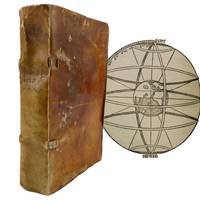
1558800Wittenberg: Krafft 1558. Softcover. Fair. Misc. A remarkable survivor clearly a student's copy of Sacrobosco's Libellus de Sphaera printed in 1558 with the student's inscription at the bottom of the title page and a question and answer styled study guide bound at the rear 1560 by Hartmann Beyer. The shared shelfmark from the title page to the binding indicates the wallet-style binding may be contemporary to the book. Also this copy still retaining its broadside with the locations of the sun updated since the 365.25 days per calendar year causes yearly drift in the location of the sun by day since the true day is slightly shorter. Sacrobosco's work was first produced around 1230 a text book dedicated to spherical astronomy. Although Sacrobosco did use the Earth as central to all rotation his methods of finding the locations of stars the sun and moon based on elliptical patterns was fairly reliable and became the standard of students for centuries to come. He also correctly identified the world as a sphere. By 1558 the idea of the Earth as the center of the universe was largely dispelled but Sacrobosco's calculations and tables were so good that they were yet to be replaced so academies were updating to accommodate the new science. This copy has the commentary and editing of several 16th century scholars Philip Melanchthon and Erasmus Reinhold as well as a second book with commentary of Hartmann Beyer. The university usage of this copy is clear and to be noted. The scholar one Wolfgang notes at the bottom of the title page that he is studying physics. The 17th century date of study denotes that an older book was still acceptable in studies. Yet despite the later date the binding contains both the 1558 Sacrobosco and essentially a 1560 study guide posing the question ""Has this book been used for study before Wolfgang wrote in it"" A mystery is the Cistercian monastery also holding the work. Did they possess the book before or after Wolfgang Or was it from a different Cistercian monastery that was dissolved during the protestant reformation years leading up to Wolfgang's study Bibliographic Details - 1558 Sacrobosco - Universal Short Title Catalogue USTC number 668014 6 copies recorded in the world's libraries. 1560 Quaestiones. - Universal Short Title Catalogue USTC number 689026 5 copies recorded in the world's libraries and USTC 689025 recording four more copies. Physical Attributes - Measures approx. 15 x 9 x 3 cm. Vellum wallet-style wrapper. Spine with two bands. Spine with author/title in old hand. Sacrobosco's work is illustrated throughout some with diagrams that could be used as the base for moving parts. Sacrobosco - Pages - Not paginated Collation - A-R8 with last two blank leaves present. Collates complete. Beyer - Pages - xxxii 302 2 blank pages last leaf blank Collation - aa8 a8 b-u8 collates complete. Condition - See pictures. Wallet-style vellum binding with wear and cockling waviness. Bottom of flap corner chipped away. Top front strap missing from binding to text block causing looseness still connected in back. No pastedowns used. Matching library number to title page written on front board inner as well as bookseller notes of date/publication and ex libris of Gingerich. 1st gathering almost loose chipping to top edge. Title page heavily annotated with two ex libris. One is the library of a Cistercian monastery and the other is of an early 16th century student. The title page has heavy toning and some chipping along edges. Bottom corner of front of text block dog eared. Throughout text block there is use consistent with student usage. Occasional thumbing dog-eared corners annotations page-edge chips/tears fox spots candle ember marks etc. Occasional moisture mark from edge second half from upper corner worst at last page. Occasional faded page E gathering ink light. Krafft