Erasmus Roterodamus, Desiderius, edBiblio.com
75 résultats
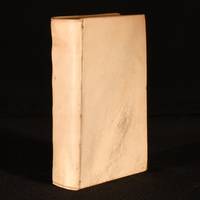
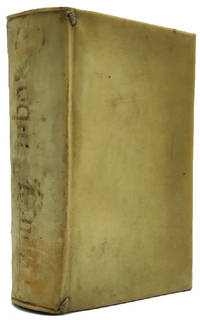
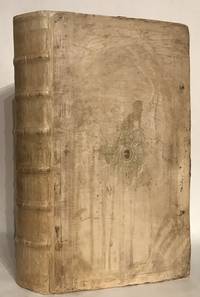
164620149Francofurti: Johannis Pressii 1646. 1646. First edition thus. Small folio. Title page printed in black and red illustrated with a vignette engraving. 13 pp.; 776 pp. 32 pp. Index Proverbiorum 41 pp. Typographus Lectori 53 pp. Index Proverbiorum Erasmi Jun II Cogati. . . 32 pp. Rerum et Verborum in Hoc Adagiorum Opere. Bound in full contemporary velum with six raised spinal bands; decoration blind stamped front and rear covers. Text in Latin and Greek. The velum has some typical soil but no erosion. Interior hinges very firm some light wrinkles title page. There is a light damp stain that extends up from the base at the gutter at the front materials for a maximum of about 2 1/2" tapering down to nil by the hundredth page of the text. Page toning and some foxing exists on some of the pages others not. Overall a very good book. 1st Edition. Hardcover. Very Good. Francofurti: Johannis Pressii, 1646. hardcover
1656617675Francofurti: Sumptibus Johannis Wilhelmi Ammonii Apud Nicolaum Schumannum 1656. Full leather. 4to In slightly worn original calf. Rebacked in speckled calf contrast spine with period blind ornaments raised bands. Repaired hinges early owners' names within heavy foxing slight worming text unaffected. Otherwise in good condition. 12 776 158 pages. Francofurti: Sumptibus Johannis Wilhelmi Ammonii, Apud Nicolaum Schumannum hardcover
16518563Deventer Johannes Colomp 1651. 'engraved titlepage 248 p. Contemporary cardboard Binding 12° spine is worn Rare fourth edition of the translation into Latin of Erasmus Alberus' Der Barfusser Monche Eulenspiegel und Alkoran a prose satire to which Martin Luther wrote the postscript. The first edition of the German original appeared in Wittenberg by Hans Luft in 1542 followed by the Latin translation in Frankfurt a year later. The second and third Latin edition were published resp. in 1560 and 1578. This parodic adaptation of the Liber conformitatum of the Franciscan Bartolommeo Rinonico or Albizzi of Pisa is written by Erasmus Alberus ca. 1500-1553 a German humanist reformer and poet who was born in the village of Bruchenbrücken near Frankfurt am Main. Although his father was a schoolmaster his early education was neglected. Ultimately in 1518 he found his way to the University of Wittenberg where he studied theology. He had the good fortune to attract the attention of Martin Luther and Philipp Melanchthon and subsequently became one of Luther's most active helpers. Not only did he fight for the Protestant cause as a preacher and theologian but he was almost the only member of Luther's party who was able to confront the Roman Catholics with the weapon of literary satire. After Luther's death Alberus was for a time a deacon in Wittenberg he became involved however in the political conflicts of the time. In 1552 he was appointed Generalsuperintendent at Neubrandenburg in Mecklenburg where he died on the 5th of May 1553. Deventer, Johannes Colomp unknown
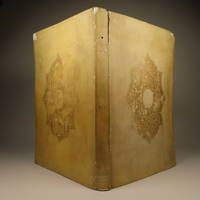
16536648<p>Full yapped vellum; large gilt arabesque decor to boards; particulars debossed in blind to spine. Encased in 1566 edition of J.L. Vives 1493-1540 De Officio Mariti published in Frankfurt.</p><p>Text and plates from the original 1609 printing but now with the Frankfurt 1653 title page. Without additions or corrections but lacking two tables "amphitheatri aeternae" & "primordialiter constituunt mundum". Maintains same curious pagination as 1609 editon 61-42-63; 145-146-145-146-147; 190-192-193-193. No missing pages.</p><p>Eleven plates from the 1609 edition 9 of which are folding attached to rear and twelfth plate at 1653 title page.</p><p>Rear plates most wholly or partially rebacked include: original 1609 title page portrait of Khunrath Tablet of Jesus Tablet of Adam Table of Rebis Laboratorium Designation of the Pyramids or Designatio Porta Amphitheatri Adumbratio Gymnasii Hypotposis Arcis and Feinde Figure of the Panel of Enemies this last with creature-caused losses to top peripheral text see image. Minor loss to upper margin of center fold of plates 8 & 9. Peripheral dampstaining to upper margin of plates 3 4 & 7. Watermark of a crest with 3 towers in a shield over a moat to plate 5. This reissue bound without the elusive wise owl.</p><p>Peripheral worming throughout margins with two exceptions; one of which travels without side-tracking from a2 through z4 see images. Wear and moderate soiling to boards. No previous owners' names or other markings. 222 pp. 1. 8 1/4 x 12 1/4 inches; 20 x 31 cm.</p> Tobiam Gundermannum; Guilielmus Antonius hardcover
1671203398Amstelodami: Apud Ioannem Ravensteinium 1671. -. Previous owner's inscription to front endpaper; discreet stamp in rear; leather spine rubbed and a bit worn at hinges. 12mo engraved frontispiece 642pp; 18th century 1/2 calf and boards marbled endpapers. A handsome little edition complete in one volume. Apud Ioannem Ravensteinium unknown
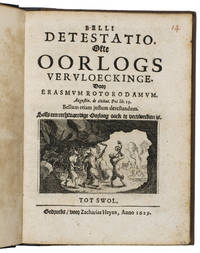
16292941Zwolle 1629. 4to. for Zacharias Heyns colophon: printed by Frans Jorrijaensz 19th century half brown morocco with the author title and imprint lettered in gold on the spine brown cloth sides. With a large engraved emblem on the title page 5 decorated woodcut initials a woodcut headpiece 2 headpieces built up from typographical ornaments a woodcut tailpiece and a tailpiece built up from typographical ornaments. 28 ll. First edition of Zacharias Heyns' new Dutch translation of Erasmus' famous anti-war essay Dulce bellum inexpertis. This essay was originally part of the 1515 edition of the Adagia but was first published as an independent work by Johann Froben in 1517 with the title Bellum. The present Dutch edition is quite rare as we have not been able to find any other copies in sales records of the past hundred years.The Adagia was first published in 1500 but Erasmus continued to edit the work until his death. The 1515 edition published by Froben was greatly expanded but the essay for the proverb Dulce bellum inexpertis war is sweet to the inexperienced was the longest and most remarkable addition. In the essay Erasmus argues that war is senseless unchristian and contrary to human nature. He also critiques the militaristic culture of his time which glorified violence and aggression and advocates instead for diplomacy and negotiation. The essay became so popular that Froben published it separately. Within ten years it had been reissued at Louvain twice at Strasbourg twice at Mainz at Leipzig twice at Paris twice at Cologne at Antwerp and at Venice. German translations of it were published at Basel and at Strasbourg in 1519 and 1520 and an English translation followed in 1533. The first Dutch translation was made in 1622. The present second Dutch translation made during the Eighty Years' War shows how the work continued to inspire more than a hundred years after it was first written.The spine has been slightly rubbed. The end paper are browned the work is lightly browned throughout. Otherwise in good condition.l Knuttel 3921; Bibl. Belgica E 247; Erasmus Bibl. Rotterdam p. 29; Erasmus Online 465; STCN 831153881; USTC 1026760; Vander Haeghen I p. 22. hardcover
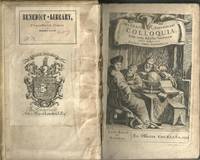
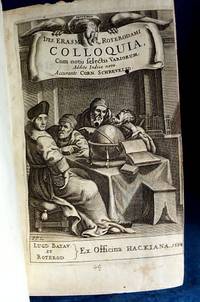
1693GT802Amsterdam: Blaviana 1693. Original issue . Hardback. Vg. 8vo. xii78420pp index. Original full pannelled calf. Apine lacking some copmpartment calf but a sound copy. The outer edges have been near a damp wall at some point affected the front edges but a complete copy. Attractive engraving as a frontis. with Erasmus seated with scolars at his table. A globe rests between them. <br/> <br/> Blaviana hardcover
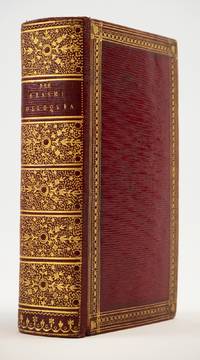
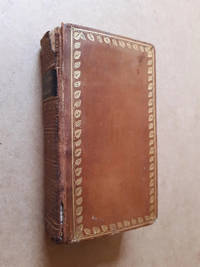
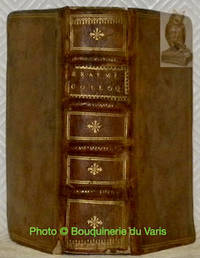
1643ST20492Lugduni Batavorum Leyden: Bonaventura Elzevier and Abraham Elzevier 1643. Second Elzevier Edition. 137 x 78 mm. 5 1/2 x 3". 12 p.l. 672 44 pp. 2 leaves. <br/> ELEGANT EARLY 19TH CENTURY RED STRAIGHT-GRAIN MOROCCO VERY ELABORATELY GILT BY BOZERIAN unsigned but see below covers framed by bead-and-star roll enclosed with double gilt fillets leaf tools at corners. smooth spine in compartments with large central fleuron of floral lancets emanating from central circlet in a richly stippled ground small circles at corners one compartment with gilt lettering cresting tulip and violet roll at foot of spine turn-ins with bead-and-star roll marbled endpapers vellum flyleaves all edges gilt. Woodcut initials headpieces and tailpieces numismatic portrait tondo fine engraved title page by C. C. Dusend showing Erasmus gazing through a telescope at the Godly orb seen through parted clouds. Willems 552; Rahir 546; USTC 1027918. For the binding: Culot "Jean Claude Bozerian" Roulette 9 Plate I and Palette 12 Plate X. Just barely perceptible rubbing to joints and extremities one leaf with tiny burn hole affecting a couple of words intermittent minor foxing negligible ink spots here and there other trivial imperfections but an extremely attractive copy the text fresh and clean and the very well-preserved binding with lustrous leather and bright gilt.<br/> <br/> This is a remarkably pretty copy of an extremely influential but generically elusive work printed by a legendary press and bound by the founder of a celebrated French binding dynasty. First published in 1524 the "Colloquia" comprise 63 conversations originally written for Erasmus' students on varied and overlapping topics but these urbane meditations soon became widely read as they covered subjects that intrigued the important thinkers of the day. Their influence was so profound that it is not saying too much to claim that they helped to speed the Reformation. Although they are difficult to classify precisely one could categorize them as including in general terms exposure of ritualistic fallacies invective against corruption within the church examination of popular imposture deploring of contemporary personal sins practical advice for laymen and miscellaneous discussion of amusing topics. In specific terms the text takes on such controversial topics as the value of pilgrimage celibacy and abstinence from meat on Fridays and other prescribed days. Erasmus' "Colloquia" was frequently published by the Elzeviers once in French and a total of nine times in Latin. The text was universally adopted for school use up through the 18th century. Although our lovely little binding is unsigned Culot firmly identifies its tools as those used by Jean-Claude Bozerian 1762-1840. He was the elder of the Bozerian brothers François is referred to as "le jeune" and was active in Paris from 1795 to about 1810. He began his career in Lyon as an apprentice bookseller printer and bookbinder eventually deciding to focus on the latter craft. Marriage to the widow of binder Pierre Boulier allowed him to establish a binding workshop in Paris where he was joined by his brother. His bindings were soon much in demand by French bibliophiles who appreciated their superior materials tasteful design and flawless execution--all characteristics that are plainly evident in the present case. Bonaventura Elzevier and Abraham Elzevier unknown
1693960Z11Amsterdam: Ex Typographia Blaviana 1693. Leather. Very Good Indeed. 8" by 5". None stated. A collection of Latin works from the historic humanist philosopher and theologian Desidarius Erasmus bound in full vellum. A collection of works from Erasmus first published as 'Colloquia Familiaria' in 1518. With a fantastic monochrome wood engraved title page. A collection of dialogues and works by the historic late fifteenth-early sixteenth century philosopher humanist Catholic theologian Desiderius Erasmus. This collection often referred to as the 'Colloquies' features discussions on a wide variety of topics and were first intended as Latin school dialogue exercises and includes notable works such as 'Naufragium' which describes a shipwreck 'Amicitia' which is a collection of folk stories involving animals and 'Epicureus' which discusses ancient Greek philosophical movements. The register runs continuously as -6 A-Z8 Aa-Zz8 Aaa-Eee2. Collated complete. Written in the original Latin. Bound in contemporary full vellum. Bound in full contemporary vellum. Original endpapers and blanks retained. Externally very smart with handling marks and slight fading to the text to the spine. Bookplate of 'Sir John Eliot Bart' to the front pastedown with closed tears to the pastedowns. Internally firmly bound with generally clean and bright pages with minimal age toning and the odd minor spot only. Very Good Indeed Ex Typographia Blaviana hardcover
1664020084Lugduni Batavorum et Roterodami: Ex Officina Hackiana 1664. Inteira de Pergaminho. Bom / Good / Bon. In-8º190x122. 1 vol. de 12-784-18 pp. Portada gravada a buril em chapa de cobre representando Erasmo sentado a uma mesa sobre a qual está um globo e alguns livros e à sua volta três personagens que ouvem e comentam entre si o que diz o mestre. Encadernação em inteira de pergaminho Ex-libris armoriado inglês. Humanista holandês Erasmo de Roterdão foi educado com os padres augustinianos estudou teologia na Holanda e em Paris e doutorou-se em Turim em 1506. Trabalhou como perceptor privado preparando para os seus alunos uns opúsculos pedagógicos que com o tempo se converteram em importantes livros da cultura europeia. Em Itália foi discípulo de Lorenzo Valla. Viajou para Inglaterra onde foi hospede de Tomás More onde escreveu o célebre Elogio da Loucura e estudou a língua grega. Em Veneza trabalhou com Aldo Manuccio numa composição de provérbios os Adagia. Preparou uma edição grega do Novo Testamento que causou escândalo. Realizou depois diversas edições comentadas de textos clássicos. Afastando-se das posições de Lutero saíu de Basileia entretanto adepta do protestantismo e foi viver para Friburgo durante alguns anos onde escreveu estes Colloquia. Brunet II 1041 <br/> <br/> Ex Officina Hackiana unknown
16516823Amsterdam: Jodocum Janssonium 1651. Hardcover — Tapa dura. 134x72mm. 5¼x2¾". Amsterdam Jodocum Janssonium 1651. En 12º 134 x 72mm. Frontispicio grabado 24 672 44 pp. 1 grabado a toda página. Encuadernación de la época en pergamino a la romana. Temprana edición de los <em>Coloquios</em> de Desiderio Erasmo que contienen un manual de enseñanza de latÃn incluyendo ejercicios y juegos de palabras con fines educativos y un documento sobre cómo la cultura clásica podrÃa servir como modelo en la vida renacentista; finalmente un folleto religioso de tintes reformistas. Buen ejemplar. Jodocum Janssonium hardcover
1636#BIBLIO-1180<p>Des. Erasmi Roterod. Colloquia nunc emendatiora; cum Coronis Apologetica Pro Colloquiis Erasmi ex ipsius scriptis quantum per otium licuit fideliter collecta a p. s. accedit ejusdem de colloquiorum vtilitate dissertatio</p><p><em>Desiderius Erasmus Roterodamus of Rotterdam - Colloquies now emendated/corrected; with an Apologia on the Usefulness of the Colloquies of Erasmus from his writings as far as leisure permitted faithfully collected by P. S. with the same dissertation on the usefulness of colloquia.<br /></em><br />Lvgd. Batavorvm: ex officina Elzeviriana <em>Leiden Netherlands: Elzevir Press</em>. Anno 1636. Believed to be first Elzevir printing. Hardback later full calf binding perhaps late 18th century or 19th century with black title label gilt-blocked title decoration and bands. Blue cloth ribbon bookmark sewn into binding. Duodecimo/12mo measures around 3" x 5 1/8" x 1 3/8". Pagination: 4 xxiv 672 44 8 pp. Title page contains woodcut of Erasmus using a telescope by Cornelius Claesz Dusend. An attractive volume.<br />Boards in good condition for age only minor scuffing and marking very clean and gilt detail vivid though a little bumping to corners and tearing to front outer corner. Spine torn at head and a little at tail extending onto hinges with some loss at head of spine a little darkening to torn areas possible signs of repair attempts. A little discolouration and a lot of rubbing to gilt detail on spine which has faded to some degree as a result. Binding firm. All page edges gilt some scuffing and dulling especially to upper edges which show some marking but mostly clean and still quite vivid to lower and fore-edges. Attractive marbled endpapers. A little writing to verso of front free endpaper. Minor light foxing and staining to preliminary and hindmost pages. A little scattered light foxing and to some pages and occasional other marking but otherwise very clean for age and very crisp with no apparent underlining marginalia etc. See pictures for further information. About the author/work: <em>Desiderius Erasmus Roterodamus; 28 October c. 1466 – 12 July 1536 commonly known in English as Erasmus of Rotterdam or simply Erasmus was a Dutch Christian humanist Catholic priest and theologian educationalist satirist and philosopher. Through his works he is considered one of the most influential thinkers of the Northern Renaissance and one of the major figures of Dutch and Western culture. </em> <em>Erasmus was an important figure in classical scholarship who wrote in a spontaneous copious and natural Latin style. As a Catholic priest developing humanist techniques for working on texts he prepared pioneering new Latin and Greek scholarly editions of the New Testament and of the Church Fathers with annotations and commentary that were immediately and vitally influential in both the Protestant Reformation and the Catholic Reformation. He also wrote On Free Will The Praise of Folly The Complaint of Peace Handbook of a Christian Knight On Civility in Children Copia: Foundations of the Abundant Style and many other popular and pedagogical works.</em> <em>Erasmus lived against the backdrop of the growing European religious reformations. He developed a biblical humanistic theology in which he advocated the religious and civil necessity both of peaceable concord and of pastoral tolerance on matters of indifference. He remained a member of the Catholic Church all his life remaining committed to reforming the church from within. He promoted what he understood as the traditional doctrine of synergism which some prominent reformers such as Martin Luther and John Calvin rejected in favour of the doctrine of monergism. His influential middle-road approach disappointed and even angered partisans in both camps.</em><br /><em>Colloquies Latin title Colloquia familiaria is one of the many works of the "Prince of Christian Humanists" Desiderius Erasmus. First published in 1518 as Latin dialogues for schoolboy exercises the work expanded over the following decades with witty but more serious and controversial content. Among other things the pages ".held up contemporary religious practices for examination in a more serious but still pervasively ironic tone" </em><em>Source: Wiki</em></p> Elzeviriana / Elzevir hardcover
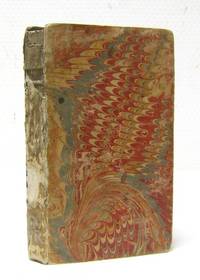
1661647Paris: Apud Claudium Thiboust 1661. Third edition. Contemporary full speckled calf gilt-tooled spine in six compartments with raised bands and gilt title “Colloq. Erasmi.†Binding is complete but well worn with rubbing edge wear and chipping at head and tail of spine; corners rounded joints starting yet sound. <br /> <br /> A mid-17th-century Parisian edition of Erasmus of Rotterdam’s famous Colloquia FamiliarÃa one of the foundational works of Renaissance humanism and early modern pedagogy. Originally written as conversational exercises for students learning Latin Erasmus’s dialogues evolved into a brilliant and witty critique of contemporary morals superstition and scholastic excess. Through satirical exchanges on everyday subjects—friendship marriage travel religion and education—Erasmus offers insight into both Christian ethics and humanist reform. The Colloquia enjoyed immense popularity for two centuries as both a language text and a guide to civility and it remains a monument of Renaissance learning style and social commentary.<br /> <br /> This 1661 edition edited by Nicolas Mercier includes scholarly notes a Latin–French life of Erasmus and extensive commentary designed for academic study. The volume opens with an elaborate engraved frontispiece portrait of Erasmus at his desk beneath cherubs holding a banner the emblematic motto Nulli cedo “I yield to no one†above him. The typography and ornamentation typify Parisian classical printing of the reign of Louis XIV with woodcut initials and headpieces throughout. The book closes with Mercier’s biographical essay Vita Desiderii Erasmi Roterodami and an index of the numerous colloquies—each a mirror of Erasmus’s wit and moral philosophy.<br /> <br /> Condition: Text block solid pages evenly toned with occasional foxing and light damp staining. Small early ink inscriptions on endpapers and title some early marginal notes. Engraved frontispiece crisp and well preserved. Overall- good. Apud Claudium Thiboust unknown
168114642Genève 1681. Nunc emendatora quibus accedunt notae recognitae & auctae a Davide Constantino Namenseintrag auf Innenseite d. Vorderdeckels 16°. Pgt. Literatur unknown
1664V48001Leiden and Rotterdam: Hackius 1664. Hardcover. Very Good. Copperplate illustrated titlepage engraved by P.P. . Octavo contemporary full vellum washed more recent neat MS spine label All Edges Rouge. Engraved illustrated TP 12pp prelims dedication by Erasmus to Froben dated Basel 1524 undated autobiographic "Vita Erasmi" and epitaph dated 1536 784pp 20pp Index. Text in Latin. Titlepage lightly browned at edges small ink spot and number 49 written at foot neat underlining in faded brown ink on most pages up to p454 else crisp and clean throughout. One of 2 editions by Hackius in same year this notable for last page of "Vita Erasmi" with 27 lines. Referenced by Graesse II.495 Van der Haeghen I 40. Bibl. Erasmiana Colloquia 416. Collection of dialogues colloquia written by Erasmus edited by Dutchman Cornelis Schrevel 1608-1661 who added footnotes by various authors and the index. Hackius hardcover
166428655Lugdunum Batavorum et Roterodami Leiden and Rotterdam: Ex Officina Hackiana 1664. Hardcover. 10 784 20pp. Contemporary full vellum with title handwritten in ink on the spine panel edges sprinkled red. Engraved title page head-pieces initials. Light soiling to covers short tear to vellum on the edge of the front board two small wormholes to the inner margin of the first twenty-five leaves not affecting text. Internally clean but for minor old annotations on the margins of a couple of the leaves. A very good copy. Graesse II.495.; Octavo. Ex Officina Hackiana hardcover
164315177Lugd. Batavorum i.e. Leiden: Elzeviriana 1643. 16mo pp. 24 672 44; engraved title page woodcut head- and tail-pieces woodcut medallion full contemporary vellum red morocco label; very good. Copinger 1624; Willems 552. Elzeviriana unknown
166813964Danielis Elzevirii. Very Good with no dust jacket. 1668. 1st Thus. Hardcover. A small 12cm x 6.5cm volume showing rounded corners with boards exposed threads showing at endpapers extensive prior ownership notations on fixed endpapers - some contemporary to publication. Head and foot of elaborately decorated spine are missing .5 to 1 cm of leather. 4 raised bands. Solidly bound nevertheless. This edition is rare though Erasmus' works have been widely reprinted over the centuries. A very nice copy. . Danielis Elzevirii hardcover
165012687Amstelodami Amsterdam: Typis Ludovici Elzevirii 1650. Acceptable. From Elzevir the Renaissance scholar's press 1650. In 'pocket' format 3"x5" in full leather. Pictorial title page. Lower third of spine missing board detached but present. Text has been trimmed at top edge. In cloth box. Shadrach Munnings armorial bookplate and bookplate of "Collegii Sti Augustini". The great Christian humanist scholar and teacher evolved the Colloquies as a collection of dialogues on a wide variety of subjects. They began in the late 1490s as informal Latin exercises for Erasmus' own pupils. In about 1522 he began to perceive the possibilities this form might hold for continuing his campaign for the gradual enlightenment and reform of all Christendom. Typis Ludovici Elzevirii hardcover
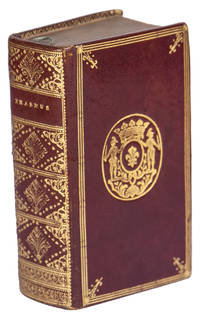
165818897Amsterdam: Joannes Janssonius 1658. 18th-century richly gold-tooled red morocco both boards show a triple fillet frame with small cornerpieces in the inside corners and an oval armorial centrepiece crowned fleur-de-lis flanked by two knights gold-tooled spine with "Erasmus" lettered in gold gold-tooled board edges and turn ins gilt edges marbled endpapers. 12mo. With an engraved title page a full-page engraving showing Erasmus woodcut decorated initials and several woodcut head- and tailpieces. Including: Coronis apologetica pro colloquiis Erasmi ex ipsius scriptis quantum per otium licuit fideliter collecta à P.S. accedit ejusdem De Collequiorum utilitate dissertatio. Montanus' edition of a renowned famous Latin schoolbook written by Erasmus one of the most used Latin schoolbooks for centuries as it discusses all basic scholarly and moral issues. With Erasmus' preface-letter to Froben at Basel dated 1524 and the Vita Erasmi preceding the Colloquia as well as two indices of authors and dialogues. Included at the end is a short essay explaining the usefulness of the book.With a few 17th-century annotations on the engraved and letterpress title pages resp. "1662" and "Besnier". The engraved title page is cut slightly short not affecting the engraving. Otherwise in very good condition.l Bibl. Belg. II E 572; Erasmus Coll. City Library Rotterdam p. 50; STCN 850071909 9 copies; Vander Haeghen p. 40. Joannes Janssonius, hardcover
16502327061Amstelodami Amsterdam: Typis Ludovici Elsevirii Lodowijk Elzevir 1650. Full-Leather. Good/No Jacket. Spine toned with drying leather and some loss from head joints beginning to split with 2 inch chip from spine base but all sewings holding firmly ink name and date B. Bridges 1689 on front free endpaper which is loose but included ink name on title page minimal ink marginalia pencil notes on rear free endpaper. 1650 Full-Leather. 589 3 pp. A-Mm8 Nn4 Oo8 Pp4. 4 7/8 x 2 5/8. Full leather blind-stamped borders and decorations gilt rules on spine. Engraved title page showing a scribe seated with two other men with an archway in the background. 63 colloquies in the original Latin with a brief biographical sketch of the life of Erasmus preceding text footnotes throughout text. House of Elzevir edition printed by Lodowijk Elzevir who met Galileo in 1636. His grandfather founded the publishing company in the 1580s. One of the many works of the philosopher and Catholic theologian known as the 'Prince of Christian Humanists.' Published in 1518 the pages 'held up contemporary religious practices for examination in a more serious but still pervasively ironic tone' Coffin/Stacey Western Civilizations. Christian Humanists viewed Erasmus as their leader in the early 16th century. Erasmus' works had greater meaning to those learned few who had a larger knowledge of Latin and Greek. Colloquies in Latin means a formal written dialogue thus in his book Erasmus explores man's reaction to others in conversations. The Colloquies is a collection of dialogues on a wide variety of subjects. They began in the late 1490s as informal Latin exercises for Erasmus' own pupils. In about 1522 he began to perceive the possibilities this form might hold for continuing his campaign for the gradual enlightenment and reform of all Christendom. Between that date and 1533 twelve new editions appeared each larger and more serious than the last until eventually some fifty individual colloquies were included ranging over such varied subjects as war travel religion sleep beggars funerals and literature. All of these works were in the same graceful easy style and gentle humor that made them continually sought as schoolboy exercises and light reading for generations. "Originally written in his early days at Paris as dialogues illustrating the art of polite conversation they were afterwards expanded into conversation pieces in which all the topics of the day were discussed with a freedom which ensured their popularity. Later in the century and up to the eighteenth century they were a set book in schools and there are lines in Shakespeare which directly recall Erasmus's words." - Printing and the Mind of Man 53 referencing the 1524 original Typis Ludovici Elsevirii [Lodowijk Elzevir] hardcover
164350089Lugd. Batavorum Leiden Ex Officina Elzeviriana 1643. 12mo. Contemp. full vellum. Some browning to spine and covers. Ms title on spine. Engraved title-page mounted. 2267244 pp. Some old underlining to the first 150 pp. A faint dampstain to some upper right corners of some leaves in the middle of the book. A few scattered brownspots. Angraved medaillon of Ersamus in the text foreword. <br/><br/><em>Second Elzevier-edition the first 1636. - Willems: 552. </em> hardcover
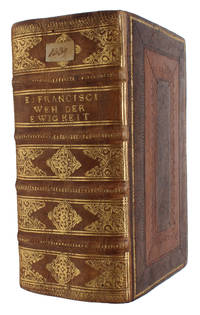
168260722Nürnberg W.M. Endters 1682 8vo. In a nice contemporary Cambridge-style mirror binding with four raised bands and richly gilt spine. Small paper-label pasted on to top of spine. A very nice copy. 28 1195 5 pp. frontispiece and 51 engraved plates. <br/><br/><em>Rare first edition of Franciscus' extensive work richly illustrated with exotic depictions of the road to hell. A second edition was published in 1686. German Emblem Books 1531-1888: 290. </em> hardcover
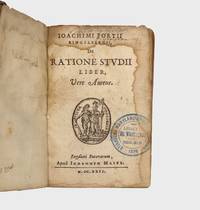
1622373794Leiden: Joannes Maire 1622. 8 198 pp. 1 vols. 12mo. Contemporary vellum. Worn and soiled some staining to textblock. Good. Owner signature of Thos. Fletcher 1693; H Wragham 1815; Henry D. Gilpin bookplate partly covered; "ex libris G.R.W. 1879" William R. Whittingham. 8 198 pp. 1 vols. 12mo. At the back of this book is the essay by Erasmus De ratione studii pp. 161-198.<br /> <br /> William R. Whittingham 1805-1879 graduated the General Theological Seminary in 1825 and was named librarian of the newly founded school. He later accepted a position on the faculty in 1836. Whittingham was consecrated the fourth Bishop of Maryland in 1840 and served in that capacity until his death. Bishop Whittingham's important theological library became the core of the Maryland Diocese library which was in turn transferred to the General Theological Seminary. The ownership signature of Bishop Whittingham is dated 1879 a very late acquisition for him. Provenance: William R. Whittingham; Maryland Diocesan Library; General Theological Seminary bookplates and inkstamps Joannes Maire unknown
163698528Lugd. Batavorum Leiden : Ex Officina Elzeviriana 1636. 130x75mm. titre grav 11 ff - 672 44 pages bandeaux lettrines culs-de-lampe reliure veau de lÕpoque avec titre auteur fleurons encadrements et filets dors au dos quatre nerfs usures aux coiffes autrement bon tat. Tranches marbres. 259 Ex Officina Elzeviriana unknown