12 résultats
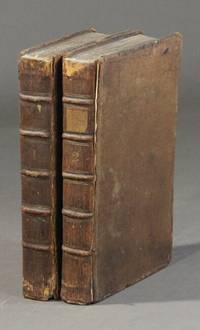
1793M13879Edinburgh:: Adamus Neill 1793. 1793. 2 works in one. Small 4to. 6 52; viii 54 pp. Half-title errata. Original full gilt-stamped tree-calf dark red gilt-stamped spine labels. Very good. First work: INSCRIBED "Mr. William Berkeley from his Affectionate Friend Brother the Author." Dedicated to Nelson Berkeley. Berkeley born in Virginia educated at the University of Edinburgh submits his doctoral thesis on the human body. Both Berkeley and Minor following studied under William Robertson 1721-1793 FRSE FSA was Principal at the University a noted scholar of Scotland and its history. Second work: MINOR Charles Carolus. Disputatio medica inauguralis: de typho: quam annuente summo numine Ex Auctoritate Reverendi admodum Viri D. Gulielmi Robertson S.T.P. Academiae Edinburgenae Praefecti; necnon Amplissimi Senatus Academici consensu Et nobilissimae Facultatis Medicae decreto; pro gradu doctoris summisque in Medicina Honoribus ac Privilegiis rite et Legitime consequendis ; eruditorum examini subjicit Carolus Minor Virginiensis; Societ. Phys. Americ. Soc. Extraord. Necnon Societ. Reg. Phys. Soc. Hon. Ad diem 24. Junii hora locoque solitis. Edinburgi: Excudebat Adamus Neill cum sociis 1793. PARISH HISTORY NOTES 22: DR. CARTER BURWELL BERKELEY. Here is a brief account of the life of Carter Burwell Berkeley a devout and highly admired member of the Fork Church congregation during the early nineteenth century: He was born at Airwell Virginia on February 20 1768 and performed his early studies under the tutelage of a Mr. Bell an Irish scholar in a small log cabin near Offley Mill. His higher education was completed in 1793 with the receipt of a degree in medicine from the University of Edinburgh. / Dr. Berkeley returned to Virginia and practiced medicine from his old home until his marriage to Catherine Spotswood Carter. In the year of their wedding 1796 they built Edgewood which was to remain his residence and office well beyond her death. Each Sunday neighbors were invited to dine at Edgewood after church services and this event became a grand social and intellectual tradition along Ridge Road. / It was Dr. Berkeley's philosophy to practice faith and medicine together. One patient described waking late one night during a serious illness to find Dr. Berkeley kneeling by her bed and praying for her recovery. According to Brief Biographies of Virginia Physician by L. B. Anderson 1889 a patient was quoted as saying "We prefer Dr. Berkeley to anyone else because what he failed to accomplish by his medical skill he would secure by his prayers." / On Sunday morning November 3 1839 Dr. Berkeley was involved with his duties as chief warden when he was asked by two other doctors to visit a sick man as early as possible. "He was introduced into the room of the patient and seating himself by the bed gently grasped the wrist to feel the pulse. Not a word was uttered not a movement was made except to incline his head as was his custom during profound thought." In time the other doctors found that life has passed from the good doctor. "Thus like the faithful sentinel he fell with his armor on and in the exercise of the noble functions of his high calling." theforkchurch – Dr Carter Burwell Berkeley. Adamus Neill, 1793. unknown books
174439792Dublin & London: W. Innys and C. Hitch 1744. 8vo. 174 2pp. 18th cent. calf rebacked corners worn endpapers renewed. Light toning. Bridgewater Library bookplate. New edition. W. Innys and C. Hitch unknown books
1744401896London: W. Innys and C. Hitch 1744. Second first London edition. Repairs to binding; title slightly soiled ink inscriptions in Greek on rear flyleaves a handsome copy/From the Collection of Allan B. Kirsner M.D. 8vo. 174 2 pp. Near-contemporary vellum-backed marbled boards. Berkeley's most popular work espousing the myriad uses of tar water to treat everything from fevers to cancers from infant to elderly and from human to animal. "The work begins as an investigation of the medicinal virtues of tar-water and ends with a disquisition on Platonic philosophy - a blend of science and metaphysics. While in America Berkeley experimented with tar-water for many ailments including dysentery rheumatism and asthma. The treatment proved so successful that he set up an apparatus for manufacturing it" Rootenberg. Blake 43; ESTC N12567; Keynes 64; Kress 4685; Wellcome II:149. <br/><br/> W. Innys and C. Hitch hardcover books
1732WRCLIT65559London: Printed for J. Tonson 1732. 141-356;821812215-351pp. Two volumes. Octavo. Contemporary calf. Engraved title vignettes. Three bookplates in each volume along with a faint old seminary stamp on each title scattered foxing joints a bit worn and cracked but cords sound; a good set. Second London edition of Berkeley's attempt at the refutation of the current forms of free-thinking composed while he was resident in America and including some important observations relevant to that part of the world. The second volume also includes what is functionally the fourth edition of his ESSAY TOWARDS A NEW THEORY OF VISION first published in 1709. KEYNES 17. PRINTING AND THE MIND OF MAN 176n. ESTC T86055. Printed for J. Tonson unknown books
173226337London: J. Tonson 1732. 2 vols. 8vo pp. 14 356; 8 218; engraved vignette title-pp.; bound with as issued An Essay towards a New Theory of Vision pp. 12 215-351; several woodcuts in the text; full contemporary calf double gilt rules on covers unlettered spines in 6 compartments volume designations in 1; some moderate chipping and cracking of the spines but all in all a good and reasonably sound set. Rothschild 372 citing the first edition of the same year: "Alciphron was written in America where Berkeley had gone to await funds which never came for his projected College in the Bermudas." <br/><br/> J. Tonson unknown books
1732WRCLIT35680London: Printed for J. Tonson 1732. 101-350;6358pp. Two volumes. Octavo. Contemporary calf. Engraved title vignettes. Ownership signature "J. Payne Jan. 24 1732/3" in each volume on front pastedown with authorship ascription in same hand in first as well as careful correction of the errata. Hinges cracked one board detached occasional light foxing otherwise a crisp large very nice set. First edition of Berkeley's attempt at the refutation of the current forms of free- thinking composed while he was resident in America and including some important observations relevant to that part of the world. The second volume also includes what is functionally the third edition of his ESSAY TOWARDS A NEW THEORY OF VISION first published in 1709. ROTHSCHILD 374. PRINTING AND THE MIND OF MAN 176n. ESTC T86056. Printed for J. Tonson unknown books
1746WRCLIT65696Dublin Printed London Re-printed: For W. Innys C. Hitch and M. Cooper . 1746. 1742; 45-88pp. Octavo. Modern half-calf and marbled boards. Faint blindstamp and ink shelf number the latter on verso of title of The Library of the Society for the Home Study of Holy Scripture and Church History first title leaf a trace foxed otherwise a very good copy. New i.e. Third London edition of the first title Keynes's variant A1b with "A Letter to T.P. ." on the verso of the title. This copy has p. 160 misnumbered '610'. The second title is also a "New Edition" i.e. the second London edition and exhibits Keynes's second corrected state of the title leaf: 'Holbourn'. Berkeley first noticed the use of tar-infused water during his residence in America and although cautious in his initial conclusions he soon became an advocate of its use as an economical aid for the betterment of the health of the Irish people. Although by no means wanting in exposition of Berkeley's larger philosophical considerations the practical aspects of SIRIS led to its being his most popular work and the investigation of tar-water generated a significant body of pamphlet literature in response well delineated by Keynes among which Prior's work is one of the most significant. ESTC cites Bowyer's ledger in reporting the edition of the first title consisted of 1000 copies and that of the second title 2000 copies. KEYNES BERKELEY 68 & 104. ESTC T45794 & T125698. For W. Innys, C. Hitch, and M. Cooper .. hardcover books
180025312Philadelphia: Way & Groff 1800. First edition. 34pp. 1 vols. 8vo. Disbound and resewn. Apart from some staining a very good copy. First edition. 34pp. 1 vols. 8vo. The author argues that the class of medicines commonly known as 'sedatives' are actually stimulants.<br/>He considers the likes of digitalis opium nitre and saccharum.<br/><br/>Scarce: OCLC locates 5 copies. Evans 36942 Way & Groff unknown books
1750JC14358London: Printed for J. Whiston. R. Dodsley. and W. Russel. / W. Innys and C. Hitch. and C. Davis. / W. Innys C. Davis C. Hitch W. Bowyer. / M. Cooper 1750 et al see below. First Edition. Hardcover. Very Good. Contemporary calf handsomely rebacked with gilt-stamped lettering in red leather spine label in second compartment 5 raised bands; four works bound together in one volume 8vo; TIME 1750 First Edition pp. xxvii 1 130 2 ads; SIRIS 1747 London reprint of the Dublin edition pp. 174 1 contents; QUERIST 1750 First Edition pp. 4 83 1; MORALS 1751 First Edition pp. 30. Boards scratched and scuffed. Contemporary handwritten notes on FFEP listing the volume's contents; contermporary ownership signature on title-page of TIME and QUERIST; contemporary marginalia in QUERIST. Otherwise an excellent clean copy nice and tight text block just a bit tanned and brittle along the edges more pronounced on first and last few leaves. <br/><br/> Printed for J. Whiston... R. Dodsley... and W. Russel... / W. Innys, and C. Hitch... and C. Davis... / W. Innys, C. Davis, C. Hi hardcover books
1752284380London: J. & R. Tonson 1752. First. hardcover. very good. 8vo contemporary calf with leather spine label. London: J. &. R. Tonson and S. Draper 1752. First Edition<br/><br/> The book contains 11 tracts each with a separate title page & date but only one continuous pagination. The subjects include Thoughts on Tar-water Proposal for converting the Savage Americans to Christianity by a College to be erected.in Bermuda Exhortation to the Roman Catholic Clergy of Ireland Discourse to Magistrates etc.<br/><br/> J. & R. Tonson unknown books
173235809London: J. Tonson 1732. First Edition. 8vo pp. xiv 350; viii 358. Tipped to the front blank is an engraved portrait of the author by Aveline. There is an ownership signature of "Twells" in the right margin of each title-page and the note: "Given by the author" in a contemporary although unknown hand along the top margin of the title-page in volume 1. Engraved scene on each title-page. Ex-Library copy with stamps on the bottom margin of the first two pages of text. Bound in modern calf backed boards. A very good clean set. Rothschild 374. Printing and the Mind of Man 176n. First edition of Berkeley"s attempt at the refutation of the current forms of free-thinking composed while he was resident in America and including some important observations relevant to that part of the world. The second volume also includes what is functionally the third edition of his ESSAY TOWARDS A NEW THEORY OF VISION first published in 1709. Praised by Adam Smith as "one of the finest examples of philosophical analysis that is to be found either in our ownor in any other language" the New theory of vision was accepted in France by Voltaire Condillac and Diderot Keynes pp. 7-8<br/> Bishop Berkeley was an influential Irish philosopher whose primary philosophical achievement is the advancement of what has come to be called subjective idealism summed up in his dictum "Esse est percipi" "To be is to be perceived". The theory states that individuals can only directly know sensations and ideas of objects not abstractions such as "matter J. Tonson unknown books
17342390London: Tonson 1734. first edition. contemporary calf. Very Good. VERY RARE FIRST EDITION OF ONE OF THE MOST INFLUENTIAL WORKS IN THE HISTORY OF CALCULUS. In 1731 Berkeley returned to England from the New World where he had spent years working to open a new college with the support of a royal charter. Despite having funds earmarked for the college no funds were ever released and he had grown tired of the whole affair - and of those who held the money he was meant to receive. Moreover "reports of growing infidelity in English society to which he was always liable to give credence were fueled by the continuing bad faith of the government in failing to lodge the funds he considered legally his." Stewart.<br /> <br /> Perhaps pushed by this diminishing opinion of the English gentry he revisited his earlier attacks on the secular 'freethinkers' and composed The Analyst "an acute and influential critique of the foundations of Newton's calculus." Downing. As Stewart explains "Berkeley considered the theory incoherent and a disservice to mathematics but one which if unchecked might reinforce prevailing views on the divisibility of matter and support infidelity."<br /> <br /> Within the criticism Berkeley raises careful arguments which often employ sophisticated philosophical distinctions. For example as Andersen explains "Berkeley acknowledged that mathematicians who applied Newton's method of fluxions or Leibniz's calculus ended up with valid results. However . he considered their calculations to be based on incorrect assumptions and to violate the rules of logic." As such he wished "to explain why this may come to pass and show how Error may bring forth Truth though it cannot bring forth Science." Berkeley.<br /> <br /> However between these arguments we find marvelously snide often comedic complaints about the whole approach. For example: "Now to conceive a Quantity infinitely small that is infinitely less than any sensible or imaginable Quantity or than any the least finite Magnitude is I confess above my Capacity. But to conceive a Part of such infinitely small Quantity that shall be still infinitely less than it and consequently though multiply'd infinitely shall never equal the minutest finite Quantity is I suspect an infinite Difficulty to any Man whatsoever". Berkeley.<br /> <br /> The concepts of the infinitesimal quantities of calculus haunted Berkeley and he returned to it repeatedly in his criticism most notably in his famous passage near the end of the book where he memorably referred to such infinitesimals as "ghosts of departed quantities". <br /> <br /> Note: This is the true first edition printed in London in 1734. A Dublin edition was also published in 1734 but appears to be a reprinting with some changes of the London first see Wilkins 2002. These were the only editions published in Berkeley's lifetime.<br /> <br /> References: Andersen K. 2011 "One of Berkeley's arguments on compensating errors in the calculus." Historica Mathematica 38. Cajori F. 1919 A History of Mathematics. 2nd ed. revised and enlarged. Macmillan 1919; Downing Lisa 2020 "George Berkeley" The Stanford Encyclopedia of Philosophy Spring 2020 Edition Edward N. Zalta ed.; Stewart M. 2005. Berkeley George 1685-1753 Church of Ireland bishop of Cloyne and philosopher. Oxford Dictionary of National Biography.; Wilkins D. 2002 edited version of The Analyst.<br /> <br /> London: J. Tonson 1734. Octavo contemporary full calf; custom box. Without errata leaf and final blank but with fragment of interesting binder's scrap showing ghost of part of the title page and partial blank bound in rear. With two manuscript corrections as usual on p. 85. Repairs to joints and spine; some spots of scattered foxing but text generally very clean. RARE. Tonson unknown books