BERKELEY, GeorgeBiblio.com
2 955 résultats
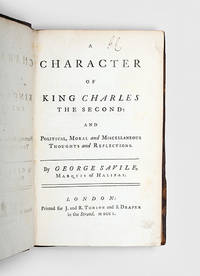
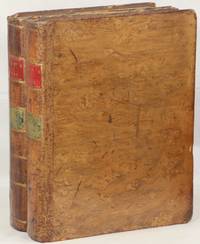
17346310London: printed for Jacob Tonson 1734. First edition. <p>Rare first edition first issue of Berkeley's renowned critique of Newton and Leibniz's calculus famously described by historian Florian Cajori as "the most spectacular event of the century in the history of British mathematics." Contemporaneously bound with Berkeley's influential Theory of Vision 1733 his Defence of Free-Thinking in Mathematics 1735 and five additional pamphlets.</p>. <p>BERKELEY'S FOUNDATIONAL CRITIQUE OF THE CALCULUS</p> . <p>First edition of Berkeley's famous attack on the calculus of Newton and Leibniz which the historian Florian Cajori described as "the most spectacular event of the century in the history of British mathematics" History of the Calculus p. 57 bound with Berkeley's important Theory of Vision 1733 and Defence of Free-Thinking in Mathematics 1735 and five further pamphlets. "The Analyst is a criticism of the calculus in both its Newtonian and Leibnizian formulations arguing that the foundations of the calculus are incoherent and the reasoning employed inconsistent. Berkeley's powerful objections provoked numerous responses and the task of replying to them set the agenda for much of British mathematics in the 1730s and 1740s" Jesseph p. 121. Perhaps the most famous passage in the book p. 59 and a vivid example of Berkeley's wit is his response to the idea that fluxions could be defined using ultimate ratios of vanishing quantities: 'It must indeed be acknowledged that Newton used Fluxions like the Scaffold of a building as things to be laid aside or got rid of as soon as finite Lines were found proportional to them. But then these finite Exponents are found by the help of Fluxions. Whatever therefore is got by such Exponents and Proportions is to be ascribed to Fluxions: which must therefore be previously understood. And what are these Fluxions The Velocities of evanescent Increments And what are these same evanescent Increments They are neither finite Quantities nor Quantities infinitely small nor yet nothing. May we not call them the Ghosts of departed Quantities' Modern historians have argued that the expression 'Ghosts of departed Quantities' was intended to address both Leibnizian infinitesimals and Newtonian fluxions. "Berkeley's attack on the calculus pointed out real deficiencies . his attack was also incisive witty and infuriating. Many mathematicians were moved to try to answer it. In fact several important eighteenth-century discussions of the foundations of the calculus can be traced back to Berkeley's attack. For instance Maclaurin's monumental two-volume A Treatise ofFluxions began as a reply to Berkeley. Berkeley's attack had a more lasting effect than simply stimulating an immediate set of replies; it served to keep the question of foundations alive and under discussion and it pointed to the questions which had to be answered if a successful foundation were to be given. D'Alembert and Lazare Carnot both used some of Berkeley's arguments in their own discussions of foundations and Lagrange took Berkeley's criticisms with the utmost seriousness" Grabiner p. 27. Despite these 18th century attempts calculus was not placed on a secure foundation until around 1820 with the work of Bolzano and Cauchy on the theory of limits. The 'Infidel Mathematician' in the title is thought to be Edmund Halley 1656-1742. "As a result of the publication of The Analyst there appeared within the next seven years some thirty pamphlets and articles which attempted to remedy the situation. The first appeared in 1734 a pamphlet by James Jurin Geometry No Friend to Infidelity . Berkeley answered Jurin in 1735 in A Defence of Freethinking in Mathematics bound in the offered volume and justly asserted that the latter was attempting to defend what he did not understand. In this work Berkeley again appealed to the divergence in Newton's views - as presented in De analysi the Principia and De quadratura - to show a lack of clarity in the ides of moments fluxions and limits . In the meantime however numerous attempts some noteworthy and others insignificant were made to find new and more satisfactory forms and arguments in which to present Newton's method. By far the ablest and most famous of these was made by Colin Maclaurin. In his Treatise of Fluxions in 1744 he aimed not to alter the conceptions invlolved in Newton's fluxions but to demonstrate the validity of his method by rigorous procedures of the ancients - to deduce the new analysis from a few 'unexceptional principles'. Maclaurin professed in the preface of this work that the Analyst controversy had given occasion to his treatise" Boyer. Berkeley's Theory of Vision 1733 also bound into this volume is a follow-up and defence of his earlier Essay towards a New Theory of Vision 1709 in which he had attacked Newton's cosmology. Keynes describes the 1733 as a work "of major importance". </p> <br /> <p>"Most mathematicians who dealt with calculus techniques in the early 18th century did not worry overmuch about foundational questions. Indeed it is significant that the first intensive discussion on the foundations of the calculus was not caused by difficulties encountered in working out or applying the new techniques but by the critique of an outsider on the pretence of mathematicians that their science is based on secure foundations and therefore attains truth. The outsider was Bishop George Berkeley 1685-1753 the famous philosopher and the target of his critique is made quite clear in the title of the present work. In sharp but captivating words he exposed the vagueness of infinitely small quantities evanescent increments and their ratios higher-order differentials and higher-order fluxions para. 4: 'Now as our Sense is strained and puzzled with the perception of Objects extremely minute even so the Imagination which Faculty derives from Sense is very much strained and puzzled to frame clear Ideas of the least Particles of time or the least Increments generated therein: and much more so to comprehend the Moments or those Increments of the flowing Quantities in statu nascenti in their very first origin or beginning to exist before they become finite Particles. And it seems still more difficult to conceive the abstracted Velocities of such nascent imperfect Entities. But the Velocities of the Velocities the second third fourth and fifth Velocities &c. exceed if I mistake not all Humane Understanding. The further the Mind analyseth and pursueth these fugitive Ideas the more it is lost and bewildered; the Objects at first fleeting and minute soon vanishing out of sight. Certainly in any Sense a second or third Fluxion seems an obscure Mystery. The incipient Celerity of an incipient Celerity the nascent Augment of a nascent Augment i.e. of a thing which hath no Magnitude: Take it in which light you please the clear Conception of it will if I mistake not be found impossible whether it be so or no I appeal to the trial of every thinking Reader. And if a second Fluxion be inconceivable what are we to think of third fourth fifth Fluxions and so onward without end'</p> <br /> <p>"Further on comes the most famous quote from The analyst: 'And what are these Fluxions The Velocities of evanescent Increments And what are these same evanescent IncrementsThey are neither finite Quantities nor Quantities infinitely small nor yet nothing. May we not call them the Ghosts of departed Quantities' para. 35. Berkeley also criticised the logical inconsistency of working with small increments which first are supposed unequal to zero in order to be able to divide by them and finally are considered to be equal to zero in order to get rid of them.</p> <br /> <p>"Of course Berkeley knew that the calculus notwithstanding the unclarities of its fundamental concepts led with great success to correct conclusions. He explained this success - which led mathematicians to believe in the certainty of their science - by a compensation of errors implicit in the application of the rules of the calculus. For instance if one determines a tangent one first supposes the characteristic triangle similar to the triangle of ordinate sub-tangent and tangent which involves an error because these triangles are only approximately similar. Subsequently one applies the rules of the calculus to find the ratio dy/dx which again involves an error as the rules are derived by discarding higher-order differentials. These two errors compensate each other and thus the mathematicians arrive 'though not at Science yet at Truth For Science it cannot be called when you proceed blind-fold and arrive at the Truth not knowing how or by what means' para. 22" Grattan-Guinness pp. 88-9.</p> <br /> <p>"Aside from calling the rigor and coherence of the Newtonian fluxional calculus into question Berkeley argued that there was no useful distinction between it and the Leibnizian calculus differentialis. This charge had a significant ad hominem effect in the context of Newtonians' claims for the superior rigor of their procedures in comparison with those of the Leibnizian school. After remarking that Newton's method is 'in effect the same with that used in the calculus differentialis' because it requires a 'marvellous sharpness of Discernment to be able to distinguish between evanescent Increments and infinitesimal Differences' Section 17 Berkeley echoes the Newtonian complaints against Leibnizian infinitesimal differences by arguing that the Leibnizians make 'no manner of scruple first to supposed and secondly to reject Quantities infinitely small: with what clearness in the Apprehension and justness in the reasoning any thinking man who is not prejudiced in favour of these things may easily discern' Section 18. The result is that Newtonian criticisms of the Leibnizian calculus are turned against the calculus of fluxions itself and the foundations of the calculus are rendered obscure and burdened with apparent self-contradiction" Jesseph p. 128.</p> <br /> <p>"Berkeley's publication of The analyst took up two themes that had long been of concern to him one mathematical and the other theological. Mathematically it continued the reservations about the foundations of the calculus that Berkeley had voiced in an early essay 'Of infinites' that he presented to the Dublin Philosophical Society in 1709 and reprised in arts. 130-132 of the Principles. Theologically The analyst was part of Berkeley's battle against freethinking and his principal argument intends to show that freethinkers who deride revealed religion for its mysteries cannot consistently accept the calculus since it contains suppositions at least as extravagant and incomprehensible as anything in revealed religion. This aspect of his criticism is indicated in the full title of The analyst which characterizes the work as A Discourse addressed to an infidel mathematician; wherein it is examined whether the object principles and inferences of the modern analysis are more distinctly conceived or more evidently deduced than religious mysteries and points of faith and attributes it to 'The Author of The minute philosopher'.</p> <br /> <p>"Whether the work was directed at a specific 'infidel mathematician' is somewhat uncertain although there is evidence that Berkeley intended it for Edmond Halley. According to Berkeley's 18th-century biographer Joseph Stock the London physician Samuel Garth had declined the last rites in his final illness on the grounds that 'my friend Dr. Halley who has dealt so much in demonstration has assured me that the doctrines of Christianity are incomprehensible and the religion itself an imposture'. According to Stock Berkeley 'therefore took arms against this redoubtable dealer in demonstration and addressed the Analyst to him with a view of shewing that Mysteries in Faith were unjustly objected to by mathematicians who admitted much greater Mysteries and even falsehoods in Science of which he endeavoured to prove that the doctrine of fluxions furnished an eminent example' Stock pp. 29-30. Whomever The analyst was intended to address immediately its broader audience was unmistakably those mathematicians who regarded the calculus as a rigorous and properly founded method that compared favorably with the mysterious tenets of revealed religion" Jesseph pp. 123-4.</p> <br /> <p>"As a result of the publication of The Analyst there appeared within the next seven years some thirty pamphlets and articles which attempted to remedy the situation. The first appeared in 1734 a pamphlet by James Jurin Geometry No Friend to Infidelity . Berkeley answered Jurin in 1735 in A Defence of Freethinking in Mathematics and justly asserted that the latter was attempting to defend what he did not understand. In this work Berkeley again appealed to the divergence in Newton's views - as presented in De analysi the Principia and De quadratura - to show a lack of clarity in the ides of moments fluxions and limits. Jurin's reply in the same year in The Minute Mathematician was again evasively tautological . Berkeley now dropped out of the controversy but the unsatisfactory nature of Jurin's arguments was pointed out by Benjamin Robins in A Discourse Concerning the Nature and certainty of Sir Isaac Newton's Methods of Fluxions and of Prime and Ultimate Ratios 1735 as well as in articles in current journals . numerous attempts some noteworthy and others insignificant were made to find new and more satisfactory forms and arguments in which to present Newton's method. By far the ablest and most famous of these was made by Colin Maclaurin. In his Treatise of Fluxions in 1742 he aimed not to alter the conceptions involved in Newton's fluxions but to demonstrate the validity of his method by rigorous procedures of the ancients - to deduce the new analysis from a few 'unexceptional principles'. Maclaurin professed in the preface of this work that the Analyst controversy had given occasion to his treatise" Boyer p. 228-33.</p> <br /> <p>According to Fraser The Works of George Berkeley III 1871 p. 257 the first edition of The Analyst was published in March 1734. Almost all copies including ours have the last two of the three instances of the word 'Science' in Query 36 p. 85 corrected by hand to 'Evidence'. That this is also the case in a presentation copy in the J. M. Keynes Collection King's College Cambridge leaves Keynes notes "no doubt as to Berkeley's intention"; this correction has been made in the version printed in the Works 1784. A second edition was published at Dublin later in the same year Keynes notes that Berkeley did not leave London for Ireland until April and that two of the three errata were corrected in the Dublin edition; it was advertised on 4 June in the Dublin Journal as "just published". The two texts are not identical; e.g. in para. 5 "of a plain an infinitely little plain" in the London text is corrected to "of a plane an infinitely little plane" in the Dublin text this is not noted in the errata to the first edition. Another edition was published at London in 1754.</p> <br /> <p>"A NewTheory of Vision 1709 reckoned by Brett's History of Psychology to have been 'the most significant contribution to psychology produced in the eighteenth century' being 'the first instance of clear isolation and purely relevant discussion of a psychological topic'. The main problem examined in this work is the factors that determine our ability to see things at a distance the assumption being that the sense of vision itself is incapable of doing so. Rather seeing distant objects requires the suggestions supplied by other senses especially that of touch as well as such other experiences as visual distortion caused by failure of eye accommodation. We do not 'judge' by means of quasi-optica1 calculation of the distance of objects the traditional account of Berkeley's predecessors; rather we let one group of sensations suggest another in virtue of experience and custom. Moreover from saying that all visual sensations 'seem to be in the eye' Berkeley moves to his basic contention later generalized in his Principles of Human Knowledge 1710 that visual ideas are in our minds. Given his general doctrine that the 'being' of things amounts to their being perceived i.e. being ideas in a mind the ultimate reference is to the divine mind he infers that external space is not basic but is 'only suggested' to us by visual ideas via tactile and other ideas" DSB.</p> <br /> <p>"Critics seized upon the inconsistency that Berkeley highlights by portraying objects of touch as outside the mind while objects of vision are within the mind. In at least nine sections of the New Theory Berkeley described tactile properties as if they correspond to real substance. Although these sections were written prior to Principles Berkeley likely understood later in life how these passages undermined the essence of immaterialism. Such incongruities came to haunt him in 1732 when he republished New Theory as an appendix to a theological work called Alciphron. Later that year an abrasive critique of the republished thesis appeared as an anonymous letter in a prominent newspaper the Daily Post-Boy. After reading the critique Berkeley decided to write a supplement to New Theory of Vision clarifying why it was consistent with the philosophy articulated in Principles and Three Dialogues. His rebuttal was published the following year and was titled An Essay Towards a New Theory of Vision Vindicated and Explained. This 71-paragraph essay skirts the thorny issues of immaterialism by conceding that materialists and immaterialists cannot have an honest conversation about vision to begin with. Berkeley reaffirms the consistency of ideas as reality in New Theory by rejecting matter exists outside the mind but did so without proposing any new metaphysical argument" Margo & Harman p. 230.</p> <br /> <p>The five other pamphlets bound in this volume are: </p> <br /> <p>BERKELEY George. Siris: a chain of philosophical reflexions and inquiries concerning the virtues of tar water and divers other subjects. . A new edition with additions and emendations. London printed for W. Innys C. Hitch C. Davis 1744. </p> <br /> <p>PRIOR Thomas and George BERKELEY. An authentic narrative of the success of tar- water: In curing a great number and variety of distempers with remarks. And occasional papers relative to the subject. To which are subjoined two Letters from the author of Siris. Dublin printed by Margt. Rhames for R. Gunne 1746. </p> <br /> <p>BERKELEY George. A discourse addressed to magistrates and men in authority: occasioned by the enormous license and irreligion of the times. London J. Roberts 1738. </p> <br /> <p>LYTTELTON George Baron. The court secret: a melancholy truth. Now first translated from the original Arabic. By an adept in the oriental tongues. London T. Brown 1742. </p> <br /> <p>CAREY Henry. A learned dissertation on dumpling: its dignity antiquity and excellence. With a word upon pudding. And many other useful discoveries of great benefit to the publick. . To which are added A poetical receipt to make an oatmeal pudding by the late Mr. John Dryden. The art of making hasty pudding by the late Dr. William King. Apple-pye. A poem by Mr. Welsted. And an essay on good eating by an eminent hand. The sixth edition. London T. Read 1744. </p> <br /> <p>Analyst: Barchas 167; ESTC T21863; Richard Green 31; Stanitz 52A; Honeyman 287; Keynes 32. Theory of Vision: Keynes 4. Defence of Free-Thinking in Mathematics: Keynes 36. Keynes Bibliography of George Berkeley 138a; Richard Green 31; Sotheran I 347; Stanitz 52A; Wallis 245.42. Boyer The History of the Calculus and its Conceptual Development 1949; Cajori A History of the Conceptions of Limits and Fluxions 1919; Grattan-Guinness From the Calculus to Set Theory 1630-1910 1980; Grabiner The Origins of Cauchy's Rigorous Calculus 1981; Jesseph 'George Berkeley The Analyst 1734' pp. 121-30 in Landmark Writings in Western Mathematics 1640-1940 Grattan-Guinness ed. 2005; Margo & Harman 'George Berkeley and the New Theory of Vision' Historia Ophthalmologica Internationbalis 2 2019 pp. 227-231. Stock An Account of the Life of George Berkeley 1776.</p> <br/> <br/> Eight works in one volume 200 x 125 mm. Theory of Vision: pp .64; Analyst: pp. x 3-94 2 errata; Defence of Freethinking: pp. 71 1 blank; Siris: pp. 174 2 table of contents; Authentic Narrative: pp. 4 248 2 corrigenda et addenda; A Discourse: pp. 32; Court Secret: pp. 24; Learned Dissertation: pp ii ii 3-33 1 blank. Eighteenth-century quarter calf marbled boards spine and sides lightly rubbed hinges cracked but holding firmly some wear at extremities. printed for Jacob Tonson unknown
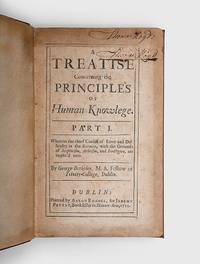
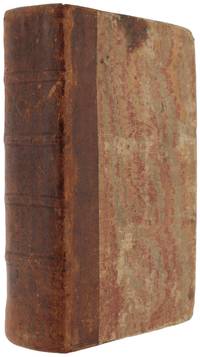
1710171378Dublin: printed by Aaron Rhames for Jeremy Pepyat 1710. A cornerstone of 18th-century philosophy First edition of the author's major work "the classic exposition of Berkeley's philosophy of immaterialism as an antidote to infidelity" ODNB in which he famously puts forward the idea that "no object can exist without a mind to conceive it". Part Two of the work was lost while still in manuscript form. Although Berkeley's works did not initially prompt much reaction they came to have a profound effect on the intellectual life of the later 18th century. The Treatise "set out his idealistic philosophy in detail arguing that the concept of 'material substance' is at once absurd and explanatorily useless. He pointed out that even philosophers who posit the existence of material bodies cannot explain how matter can produce ideas in the mind or how purely mental phenomena like ideas could resemble or correspond to non-mental material substances. Perhaps his most shocking claim in favour of his metaphysics was his oft-repeated contention that his principles were in strict accord with common sense and inimical to skepticism" Grattan-Guinness p. 122. Octavo 205 x 128 mm. Complete with the final blank 2E4. Rebound to style in full panelled calf red morocco spine label raised bands and spine ends ruled and tooled in blind. Ink ownership signature of one Thomas Lloyd on title page and p. i upper margin of the former excised not affecting lettering but shaving the printed rules. Contents browned and occasionally spotted title leaf chipped at lower outer corner a few ink marginal marks crosses lines small tear at upper outer corner of 2B4. Overall a very good copy. Keynes Berkeley 5; Norman 196; Printing and the Mind of Man 176. Ivor Grattan-Guinness Landmark Writings in Western Mathematics 1640-1940 2005. hardcover
193686243London: Selwyn & Bount 1936. First edition first impression a Haycraft-Queen cornerstone. Stamped on the title page in purple ink "With the Publisher's Compliments". An interesting variation on the conventional detective fiction anthology in which the six authors contribute stories featuring supposedly foolproof murders each followed by an exposition of the flaws in the criminal scheme by the recently retired detective George W. Cornish of Scotland Yard. Octavo. Original salmon pink cloth titles to spine in black. With dust jacket. Slight rubbing to ends and board edges spotting to edges and early leaves a very good copy in the jacket with faint dust-soiling to rear panel and small chips to ends and corners. hardcover
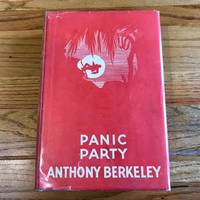
1934006516UK: Hodder & Stoughton 1934. 1st Edition 1st Printing. Hardcover. Fine/Fine. Panic Party by Anthony Berkeley First Edition Hodder & Stoughton 1934. A fine copy. Contents and edges unblemished. No inscriptions or signs of ownership. Covers are unmarked and have no bumping or rubbing to corners. In a bright fine and remarkably well preserved dust jacket that has no loss or tears and no fading to spine. Priced at 7/6. An excellent copy. For further images please see Brought to Book Ltd. <br/> <br/> Hodder & Stoughton hardcover
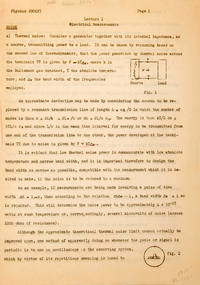
115600Berkeley CA University of California at Berkeley c. 1950. . 14 mimeographed typescript lectures on 144 leaves rectos only; diagrams throughout the text some pencilled notes contents a little toned; brown pressboard binder housed in a custom brown cloth folding case later manuscript title to upper cover some sticker residue edges a little rubbed corners bumped very good condition.<br /> A rare set of mimeographed lecture notes from an experimental physics course connected with Berkeley's Radiation Laboratory with chapters by three Nobel Prize winners. Mimeographed lecture notes of this kind were made by students for themselves and their colleagues and exist in very small numbers. We have located only two auction records for this set the present one sold in 2018 and a copy at Christie's in 2002. <br /><br />Berkeley's '290' physics courses are 'graduate level courses that feature a weekly seminar on physics topics' 'many of which are open to the public' generally meaning the research community Berkeley website. The present lectures are all labelled '290f' what was then a course in experimental physics connected with the Berkeley Radiation Laboratory. Now known as the Lawrence Berkeley National Laboratory this research centre was established in 1931 by Ernest Lawrence and centred around his development of the cyclotron a new and more powerful type of particle accelerator for which he was awarded the Nobel Prize. The laboratory has remained a leader in physics research up to the present day and was responsible for numerous twentieth century breakthroughs including electronic enrichment of uranium for the Manhattan Project the discovery of the transuranic elements and the anti-proton and measurement of the cosmic microwave background radiation.<br /><br />Taking place around 1950 none of the reference sources listed in the text have publication dates past 1949 the present course begins with relatively basic concepts in electrical engineering necessary for anyone doing hands-on experimental work at the Radiation Laboratory and proceeds to linear accelerators the cyclotron and beta ray spectrographs. Of the fourteen lectures three were presented by Nobel Prize winners:<br /><br />Chapter 7 Ionization: Emilio Segré 1905-1989 discovered the antiproton and the elements technetium and astatine. An Italian Jew he was made stateless by the Mussolini government in 1938 while on a visit to Berkeley and was offered a position at the Radiation Laboratory. Between 1943 and 1946 he worked at Los Alamos after which he returned to Berkeley until his retirement in 1972.<br /><br />Chapter 10 General Accelerator Considerations: Edwin McMillan 1907-1991 was with Glenn Seaborg the first to produce a transuranic element neptunium. He joined the Radiation Laboratory in 1933 and during the Second World War worked on microwave radar and the Manhattan Project. When hostilities ended he returned to Berkeley co-developed the synchrotron and became director of the laboratory after Lawrence's death in 1958.<br /><br />Chapter 12 Linear Accelerators: Louis Alvarez 1911-1988 was a pioneer who made fundamental discoveries in physics through his development of the hydrogen bubble chamber. He joined the laboratory in 1936 and worked with the experimental team headed by Robert Oppenheimer. During the war he contributed significantly to radar research joined the Manhattan Project and then returned to Berkeley.<br /><br />The full contents are as follows: 1. Electrical Measurements no author listed; 2. Vacuum Tubes and Amplifiers by A. Bratenahl; 3. Pulse Circuits by R. Mozely; 4. Oscillators by D. Gow; 5. Rectifiers and Power Supplies by D. Gow; 6. General Considerations of Particle Counters by B.J. Moyer; 7. Ionization Chambers by Emilio Segré; 8. Geiger Counters by R. Chasson; 9. Proportional Counters by H.F. York; 10. General Accelerator Considerations by E. McMillan; 11. Van de Graaf Electrostatic Accelerators by A.J. Hudgins; 12. Linear Accelerators by Louis Alvarez; 13. The Cyclotron by R.L. Thornton; 14. Beta Ray Spectrographs by A.C. Helmholz.<br /> Berkeley, CA, University of California at Berkeley, c. 1950. hardcover
1934355490718020London: Hodder & Stoughton 1934. First Edition. Hard Cover. Dust Jacket. First UK Edition. Publisher's light blue cloth black lettering to the front board and spine. An excellent near fine copy without the discolouration and mottling so often seen with H & S blue cloth first editions of this period with clean contents and no previous owner's inscriptions. In the VERY RARE D/W priced 7/6 net to the spine as called for. The D/W is a bright and attractive example with a touch of fraying at the spine tips but with no loss. The rear flap is blind-stamped: The Circulating Library Harrods Ltd SW1. The rear flap is creased with minor chipping and with a couple of closed tears. One of the rarest Berkeley first editions from the 1930's in our experience. The dark pink/red D/W "shows Guy Pidgeon's body falling backwards over a cliff silhouetted against the moon and framed by trees" Cooper and Pike. Rare. Photographs/scans available upon request. Hodder & Stoughton hardcover
1961ZB394410Blackwell Publishers 1961-1999. volumes 1-38; lacks volume 25. 1961-1999. partly bound library markings textually clean & tight PRICE IS FOR THE LOT. - If you are reading this this item is actually physically in our stock and ready for shipment once ordered. We are not bookjackers. Buyer is responsible for any additional duties taxes or fees required by recipient's country. Photos available upon request. Blackwell Publishers unknown
2053Berkeley: University Relations 2008. First edition. Hardcover. Fine/Very good. An uncommon photo book that commemorates the launch of the Campaign for UC Berkeley in 2008 highlighting the campus in pictures and in words from renown alumni and others. This is Joan Didion's copy with a university notecard to her laid in from one "Mary Kay" likely someone in University Relations. It reads in full: "Dear Joan Greetings from Berkeley! We have found yet another way to use your inspirational words about Berkeley. The enclosed book include the summary of your essay in 'There Was Light'--the version you approved for the television spot--as well as another well-used quote of yours at the end of the book. Should you ever want to read your essay again there are many people who have asked about it and would love to hear you read it again--or for the first time. I continue to follow your work and life and admire your strength and optimism. I hope this note finds you filled with hope for the new year. With warmest regards Mary Kay." There Was Light: An Autobiography of a University: Berkeley 1868-1968 referenced in the note was published in 1970 and featured essays about the university from thirty-one notable alumni including Didion. She attended Berkeley from 1953-1956 and went on to become one of California's greatest chroniclers as literary journalist and essayist. See photos for the pages that hold Didion's words. A short quarto in denim blue cloth with the title stamped on the front board; dark blue endpapers and a transparent page guarding the half-title; 130 pages. A short introduction from Chancellor Robert J. Birgeneau on the photo-illustrated jacket's front flap. The jacket depicts the campus's famous Sather Tower The book is fine; the jacket is very good with rubbing to all edges and some faint dampstaining at the center of its spine mainly visible from the jacket's interior and with no discernible effect on the book itself. An incredible UC Berkeley association copy and keepsake; we dare say this would make a one-of-a-kind graduation gift. University Relations hardcover
1937801P49London: The Amalgamated Press 1937. Magazine. Very Good Indeed. 11.5" by 9". various. Six lovely consecutive issues of the exciting 'Thriller Library' magazine containing the complete story 'The Great Knock-Over' by Dashiell Hammett all in the original wraps. Six consecutive issues of 'The Thriller Library' magazine.Each issue is present in the original colourful wraps with in-text illustrations throughout. This run includes the entirety of 'The Great Knock-Over' by Dashiell Hammett. It is very rare to find a complete Hammett story in the original parts.The Continental Op featured in 'The Great Knock-Over' also published as 'The Big Knockover' became the prototype for the tough-guy detectives of the generations to come.'The Thriller Library' was a weekly newspaper in circulation from February 1929 to May 1940 containing a variety of exciting stories of detectives solving simple murder cases and even gang warfare.No. 457 November 6th 1937. 'The Adventure of the Night Watchman' by Walter Macleod.No. 458 November 13th 1937. 'The Dictator' by Berkeley Gray.No. 459 November 20th 1937. 'The Rogue of Harley Street' by Anthony Skene.No. 460 November 27th 1937. 'Island of Fear' by George Rochester.No. 461 December 4th 1937. 'Odds on Murder!' by John Hudlestone.No. 462 December 11th 1937. 'The Man From Manhattan' by Leonard Gribble. In the original publisher's paper wraps. Externally smart with some light age-toning and spots to the wraps. Staples are a little rusted. Minor edge wear to the wraps and pages. Ring mark to the first wrap of No. 462. Internally generally firmly bound. Pages are age-toned and clean with some odd spots. Small mark to the last leaf of No. 458 and some heavier spots to the last leaf of No. 461. Very Good Indeed The Amalgamated Press unknown
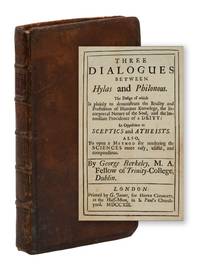
171355993London Printed by G. James for Henry Clements 1713. 8vo. Contemporary marbled full calf boards prettily rebacked in period style with gilt title-label raised bands and gilt ornamentations to spine. During the re-backing new end-papers have been inserted but the original front end-paper containing old owners' inscriptions has been preserved and is still withbound. Three old owners' names to title-page two of them crossed out. The title-page had been repaired at the outer margin affecting three letters in the last three lines of the subtitle To open a Method for rendering the/ SCIENCES more easy useful and/ compensious namely the "he" in "the" and the "d" in "and" as well as part fo the double-ruled border which has been drawn up again. The final leaf with a somewhat crode repair causing loss of some words towards the hinge. A small hole in A3 not repaired. A bit of brownspotting mostly at beginning and end. With its flaws still and overall acceptable copy of this extremely rare title. 10 166 pp. <br/><br/><em>The very scarce first edition of Berkeley's other magnum opus his great work of metaphysics second in importance only to his "Treatise Concerning the Principles of Human Knowledge" 1710. The present work is not only a popularized version of the "Treatise" though it is a fact that it was more widely studied and more easily understood - being written as an almost Platonian dialogue between Hylas Greek for "matter" - thought to be the representative for John Locke and Philonous Greek for "the lover of reason" - Berkeley's spokesman - it also constitutes a thorough and elaborated explanation of Berkeley's central ideas and the emergence of many of the principal thoughts that we now associate with him and his anti-materialist philosophy."In this Treatise which does not presuppose in the Reader any Knowledge of what was contained in the former i.e. the "Treatise" it has been my Aim to Introduce the Notions I advance into the Mind in the most easy and familiar manner; especially because they carry with them a great Opposition to the Prejudices of Philosophers which have so far prevailed against the common Sense and natural Notions of Mankind.If the principles which I here endeavour to propagate are admitted true; the Consequences which I think evidently flow from thence are that Atheism and Scepticism will be utterly destroyed many intricate Points made plain great Difficulties solved several useless Parts of Science retrenched Speculation referred to Practise and Men reduced from Paradoxes to common Sense" Preface pp. 7-8.In the present work Berkeley one of the greatest thinkers of early modern philosophy sets out to alter the direction of philosophy and set straight the boundaries of man's knowledge of himself and the world around him. He seeks to bring back man to common sense and to bring back science and knowledge to that which is essential and factual. In the present work he famously defends the idealism because of which he is still considered one of the greatest metaphysicians ever. As his "Treatise" is remembered today for the famous phrase "Esse est percipi" - to be is to be perceived - so his "Dialogues" is remembered for the introduction of the perceptual relativity argument stating that the same object can have different characteristics e.g. shape colour etc. depending on the perspective of the observer e.g. distance angle light etc. Furthermore as Berkeley had used God in the "Principles" as the CAUSE or originator of our ideas of sense in the "Dialogues" he brings God a very important step further stating that our ideas must EXIST IN God when not perceived by us thus seeing this as the warrant for the continuity of our ideas God being unchanging. This leap from claiming that God must cause our ideas to claiming that our ideas must exist in God that Berkeley thus takes in the "Dialogues" is among the most important within his philosophy guaranteeing continuous existence to physical objects. The work is considered the foremost representative of Berkeley's phenomenalism."George Berkeley Bishop of Cloyne was one of the great philosophers of the early modern period. He was a brilliant critic of his predecessors particularly Descartes Malebranche and Locke. He was a talented metaphysician famous for defending idealism that is the view that reality consists exclusively of minds and their ideas. Berkeley's system while it strikes many as counter-intuitive is strong and flexible enough to counter most objections. His most-studied works the Treatise Concerning the Principles of Human Knowledge Principles for short and Three Dialogues between Hylas and Philonous Dialogues are beautifully written and dense with the sort of arguments that delight contemporary philosophers. He was also a wide-ranging thinker with interests in religion which were fundamental to his philosophical motivations the psychology of vision mathematics physics morals economics and medicine. Although many of Berkeley's first readers greeted him with incomprehension he influenced both Hume and Kant and is much read if little followed in our own day." SEP.Berkeley published his first important philosophical work "Essay Toward a New Theory of Vision" in 1709 aged 24. The book was well-received and a second edition came out later that same year. The following year he published "A Treatise Concerning the Principles of Human Knowledge" in which he sought to lay out a complete philosophical system based on the idea that the only existing entities in the world are ideas and the mind that perceives them. The work was not very well received however. This did not affect his search for truth though and he continued the outlay of his philosophical system in his "Three Dialogues between Hylas and Philonous" which was printed in 1713. Though neither of the two works were well received and appeared in small numbers they are by far the most important and enduring of all of his works. The view that he presents in the "Dialogues" is that which he called "immaterialism" now "idealism". He considered this anti-materialism the perfect answer to and refutation of skepticism and atheism and his theories later became the foundation of much idealistic philosophy."Upon the common Principles of Philosophers we are not assured of the Existence of Things from their being perceived. And we are taught to distinguish their real Nature from that which falls under our Senses. Hence arise Scepticism and Paradoxes. It is not enough that we see and feel that we taste and smell a thing. Its true Nature its absolute external Entity is still concealed. For tho it be the Fiction of our own Brain we have made it inaccessible to all our Faculties. Sense is fallacious Reason defective. We spend our Lives in doubting of those things which other Men evidently know and believing those things which they laugh at and despise." Preface p. 6.The first edition of this important work is very difficult to find. It was published in an edition together with the "Treatise" in 1734 which though also scarce is the edition of the work that most libraries and institutions have in their holdings seeing that the first editions of both works are of even greater scarcity. We have only been able to locate three copies in libraries worldwide. </em> hardcover
1932156657London: Victor Gollancz 1932. First UK Edition and true first. Basis for Alfred Hitchcock's 1941 classic film noir "Suspicion" starring Cary Grant and Joan Fontaine.<br /> <br /> Near Fine in a Very Good plus dust jacket. Book has a tiny nearly imperceptible tear at the front hinge. Jacket is slightly sunned at the spine with only a few nicks and tiny closed tears plus a few small archival tape mends to the verso. Scarce in jacket. In a custom maroon quarter-leather clamshell box.<br /> <br /> The Dark Page I: 1940-1949 p. 20. Victor Gollancz unknown
1936355490719747London: Selwyn & Blount 1936. First Edition. Hard Cover. Dust Jacket. London: Selwyn & Blount n.d. 1936. First UK Edition. Publisher's salmon pink cloth with the spine lettered in black. The book is dated by the 32-page Spring Catalogue at the rear. Faint offsetting to both sets of end-papers and light foxing to the first few pages of the book overall a bright and clean near fine copy. In the RARE D/W priced 7/6 net to the spine by Youngman Carter which is two-toned each half showing a different scene: to the left in blue has Scotland Yard; to the right in red has a scene on the Thames Embankment with a policeman. The D/W has a slither of loss at the head and tail of the spine not affecting any lettering and has a short 1 cm closed tear and associated crease to the bottom edge of the front panel. Six short stories by leading Detection Club authors each illustrating a perfect murder. Each story is then followed by a superb commentary by Ex-Superintendent Cornish CID detailing how the seemingly perfect murder could have been solved. A much nicer copy than normally seen of this rare book and a very nice copy indeed. Haycraft Queen Cornerstone. Photographs/scans available upon request. Selwyn & Blount hardcover
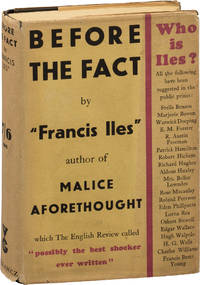
1931764L13London: Mundanus Ltd Victor Gollancz 1931. First edition. Cloth. Very Good Indeed. 7.5" by 5". None. A very scarce first hardback issue of this important 'inverted detective story'. Written by Anthony Berkeley Cox under the pen name Francis Iles. The first edition of this scarce crime fiction novel written by Anthony Berkeley Cox. The murderer's identity is revealed in the first line of the novel which provides the reader with insights into the workings of the murderer's mind as his plans progress. Cox loosely based this novel on the real-life case of Herbert Armstrong and includes elements of Doctor Crippen. Issued under the Gollancz imprint of 'Mundanus' which they produced as a 3/- paperback series in an attempt to initiate a paperback revolution. This hardback edition was published simultaneously with the wrappers issue as was a library issue. Copies of the hardback edition are extremely scarce. An extremely scarce copy of this important novel. In the publisher's original cloth binding. Externally very smart. A few light marks to the boards. Bumping to the head and tail of spine. Internally firmly bound. Pages are bright. Scattered spotting to the fore-edge and heavy spots to the first and last few pages. Otherwise occasional light spots. Very Good Indeed Mundanus Ltd, Victor Gollancz hardcover
174731752AB1747. First English Edition. London Printed for R.Dodsley 1747. Octavo. 72 pages. Modern cloth. The bookblock with signs of stitching to the inner margin possibly used to be part of a Sammelband. Last three leaves with paper-restoration and manuscript inscription to last page looks like a 18th century gift-inscription. With numerous manuscript - annotations in the tracts of George Berkeley namely in "A Word to the Wise" "Farther Thoughts on Tar-Water" "The Querist". From the library of Daniel Conner Manch House County Cork. Bound with: "Berkeley George Bishop of Coyne - "A Miscellany Containing Several Tracts on Various Subjects. By the Bishop of Cloyne. London Printed for J. and R. Tonson and S.Draper 1752. VI 267 1 pages. Title-page witme minor paper-restoration. This wonderful collection by the eminent ANglo-Irish Philosopher includes the following Pamphlets / Tracts as called for: 1. Farther Thoughts on Tar-Water 2. An Essay towards preventing the Ruin of Great-Britain 3. A Discourse addressed to Magistrates and Men in Authority. Occasioned by the enormous Licence and Irreligion of the Times. 4. A Word to the Wise - Or an Exhortation to the Roman Catholic Clergy of Ireland This section "A Word to the Wise" includes several interesting annotations: a. an underlining of the sentence: "Seeing you are obnoxious of the Law" with a comment "Oh! infamous" b. annotation: "the catholic clergy cannot be accused even by there greatest enemies of having been influenced by interested motives therefore this hint of his lordship was not of much avail" 5. A Letter to the Roman Catholics of the Diocese of Cloyne 6. Maxims concerning Patriotism 7. The Querist - Containing several Queries proposed to the Consideration of the Public 8. Verses on the Prospect of Planting Arts and Learning in America 9. A Proposal for the better supplying of Churches in our Foreign Plantations and for converting the Savage Americans to Christianity by a College to be erected in the Summer Islands otherwise called The Isles of Bermuda 10. A Sermon preached before the Incorporated Society for the Propagation of the Gospel in Foreign Parts; at their Anniversary Meeting in the Parish-Church of St.Mary-le-Bow in 1731 11. De Motu ; sive de motus principio & natura & de causa communicationis motuum ______________________________________________________________________________ hardcover
1784158340Dublin: printed by John Exshaw 1784. Subjective idealism First edition first issue containing all of Berkeley's major works. This Dublin issue precedes the London issue of the same year which used the same sheets with a variant title page. The biography of Berkeley which is prefaced is a revised version of Joseph Stock's Account of the Life 1776. 2 vols quarto. Portrait frontispiece in vol. I 2 plates in vol. II of which 1 folding. Uncut in 19th-century boards recently rebacked and recornered in blue pebbled cloth. Light foxing chip at head of vol. I leaf 4M1 not affecting text. A very good copy. ESTC T142562; Keynes 142. hardcover
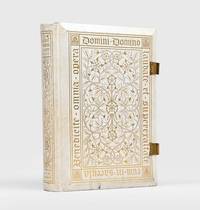
189377995New York: Printed for the General Convention at the Theodore De Vinne Press 1893. Canonical Edition. Hardcover. Very Good. 37 x 26.5 cm. Folio. 28 566 2 pp. Bound into full vellum over boards decorated with gilt botanical design ornate brass clasps. Printed on American hand-made paper. TEG others deckled. Text printed in black and red. With elaborate foliated borders designed by D. B. Updike throughout the work. <br /> <br /> It was printed for the General Convention of the Episcopal Church of 1892. This convention decided on the second major American edition of the prayer book being the first major revision since the edition of 1789. Three different versions of this work were issued. This is one of only 75 copies of the "canonical edition" which were distributed to Episcopal dioceses. On the verso of the title page it is signed by 13 of the people involved in the revision approved by the Convention of 1892. This includes financier and banker J. P. Morgan. Morgan supported the Protestant Episcopal Church throughout his life and commissioned this work. Other signers include William Croswell Doane Henry Cadman Potter Samuel C. Hart Joseph Packard Jr Samuel Eliot and others. The title page does not have a foliated border. <br /> <br /> There was a similar "subscriber's edition" done limited to 500 copies which reproduces the signatures in facsimile and its title page has foliated decorations. Another edition in a smaller format edition distributed to attendees of the 1892 Convention.<br /> The Plan of Symbolism and method of decoration were arranged by Daniel Berkeley Updike founder of the Merrymount Press. The preparatory studies of plants were made by William Wells Bosworth. The floral designs for the borders and cover were by Bertram Grosvenor Goodhue and the final drawings for reproduction were by Joseph Eliot Hill. <br /> Closed ~7 cm tear at top of front cover hinge. There is some damp staining to the foredge as well as to the edges of some of the pages. This is most noticeable on the last dozen or so pages but at no point do the stains reach the text. This also affects the edges of the front and back cover. References: Griffiths Bibliography of the Book of Common Prayer 1893:6. Printed for the [General] Convention at the Theodore De Vinne Press hardcover
1713140947370London: Henry Clements 1713. First Edition Third Edition. First edition first printing of George Berkeley's work of philosophy. x 166 vi 44 pp. Octavo bound in full contemporary mottled calf laced in boards. Blindstamped ruled borders red morocco title label to spine all edges speckled red. Bound together with the third edition of another work by Berkeley also published by Henry Clements in 1713: Passive Obedience Or the Christian Doctrine Of Not Resisting the Supreme Power Proved and Vindicated upon the Principles of the Law of Nature. In a Discourse Deliver'd at the College-Chapel. <p>Very Good with moderate wear to boards cracking to leather at extremities minimal chipping at head and tail of spine and rounded and bumped corners. Joints repaired leather coated with preservative. Previous owner names have been torn from free endpapers cut more carefully from upper margins of first two leaves. Several 18th century ink markings and inscription "Owner / 1720" remain on the endpapers. <p>The two books are printed on different paper stock. Three Dialogues is slightly tanned with scattered foxing to margins; Passive Obedience is heavily toned. Both books collated complete. From the library of William A. Strutz with his small bookplate to the front pastedown. <p>George Berkeley 1685 - 1753 was an Anglo-Irish philosopher and clergyman who advocated the view that objects cannot exist without being perceived. He wrote Three Dialogues in order to expand on the ideas expressed in his most notable work A Treatise Concerning the Principles of Human Knowledge. Passive Obedience is a call to obey established authorities God above all. That a third edition was published just one year after the first is testament to the intensity of Enlightenment debates about the relationships between individuals and church and state. Henry Clements unknown
1893174802New York: Printed at the De Vinne Press for the Committee 1893. The flowering of American Arts and Crafts sensibilities First Updike edition deluxe limited issue one of 500 large copies on handmade paper. Planned by the distinguished printer Daniel Berkeley Updike 1860-1941 this issue features pages framed with garlands of various plants each appropriate to the text it adorns. The deluxe binding is similarly gilt with thistles and Tudor roses alluding to the British origins of the Episcopal church. Updike's rationale for the decoration is elucidated in the loosely inserted pamphlet which accompanies this copy. While his initial intention was to emulate medieval devotional volumes he was limited by the typography common to the entire first edition which would not allow for the introduction of ornate initials. Since the borders could not be illuminated it was decided that the simple monochrome patterns must be elevated by the use of symbolism. This would be botanical befitting the style of the Middle Ages. Bertram Grosvenor Goodhue an architect who often lent his skills to publishing created the designs for the binding and the borders. Although Updike's Merrymount Press was also founded in 1893 they were not prepared for the printing of The Book of Common Prayer and the presswork went to Theodore Low De Vinne 1828-1914 one of the founders of the Grolier Club. While Updike subsequently moved away from Kelmscott-inspired printing this early project is part of his cultivation of Arts and Crafts book production in late 19th-century America. Folio. Elaborate foliate borders throughout text printed in red and black. Original vellum spine and front cover lettered in gilt Gothic script and elaborately decorated with gilt foliate design with Tudor roses and Scottish thistle cornerpieces twin metal clasps endpapers patterned with gilt rose and thistle design top edge gilt fore and bottom edges uncut white bookmarker. Near-contemporary bookplate recording the volume as part of J. William Smith's bequest to Syracuse Public Library. Gilt bright vellum a little soiled small puncture to foot of front board a couple of minor bumps to extremities contents clean. A very good copy. Griffiths 1893/7. hardcover
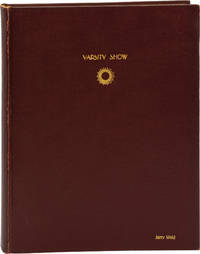
1937161377N.p.: N.p. 1937. Second Revised Final Draft script for the 1937 film musical. Specially bound copy belonging to screenwriter Jerry Wald with his name in gilt on the bottom of the front board with manuscript ink and pencil annotations on eight pages. <br /> <br /> Jerry Wald is best remembered for his long and successful association with Warner Brothers as both a screenwriter and producer of a number of notable films including "Mildred Pierce" 1945 "Humoresque" 1946 "Key Largo" 1948 and "Flamingo Road" 1949. In the 1950s he moved to Twentieth Century-Fox and was the producer there for "An Affair to Remember" 1957 "Peyton Place" 1957 and "Sons and Lovers" 1960. <br /> <br /> College students rebel when their professor doesn't allow swing music in their varsity show. They enlist the help of an alumni a big Broadway star not knowing his last three productions were flops. The film's Busby Berkeley finale was nominated for an Academy Award for Best Dance Direction.<br /> <br /> Bound in maroon leather with gilt title on the front board and spine. Distribution page present with receipt intact. Distribution page integral with the title page dated 4/23/37 noted as 2ND REV. FINAL. 157 leaves with last page of text numbered 154. Mimeograph duplication rectos only. Pages Near Fine binding with light rubbing to the extremities else Near Fine. N.p. unknown
1750175832London: for J. and R. Tonson and S. Draper 1750. Presented to and initialled by the Enlightenment thinker George Berkeley First edition presentation copy to the idealist philosopher George Berkeley inscribed by the Countess of Burlington on the initial binder's blank "To the Bishop of Cloyne from his most humble servant D. Burlington" and with Berkeley's ownership initials George Cloyne to the title page. Dorothy Countess of Burlington 1699-1758 was the granddaughter of Halifax a leading statesman of Charles II's time. She owned several manuscripts from Halifax which were edited here for publication by Alexander Pope. She was one of Queen Caroline's Ladies of the Bedchamber a patron of artists including David Garrick and Handel and a portrait painter. Berkeley was first introduced to her husband by Alexander Pope and he became close friends with them. Berkeley wrote to the Countess to thank her for the volume: "Madam Permit me to thank your Ladyship for a present very valuable in it self and much more so on account of the giver who is so good as to remember an humble servant in this remote corner; where to my sorrow I am haunted with a taste for good company and fine arts that I got at Burlington house the worst preparative in the world for a retreat at Cloyne" 2 April 1750. The volume came into the possession of the bookseller and bibliographer John Stephens 1948-2006 and has his bookplate. Stephens identified the letter and sourced a photocopy from Chatsworth House which had the original the photocopy is included as is a letter from Chatsworth sending it. He published an article on the volume and its presentation "Berkeley and Lady Burlington: A Footnote" in Berkeley Newsletter Number 12 1992 pp. 16-17. He quoted the letter and commented: "It is a rather sad letter: he may then have been depressed but worse was to happen. In February 1751 his son William died and the following October his friend Thomas Prior followed. The next year he sailed for England never to return to Ireland. Berkeley shared Burlington's interest in architecture but he had certainly not been in Burlington House since he had last been in London in 1734. It has very much the tone of someone pleasantly surprised that he should be remembered after so long an absence". Octavo 199 x 120 mm pp. 8 183 1. Contemporary mottled calf rebacked with black morocco label later double gilt rule to covers marbled endpapers red speckled edges. Bookplate to front pastedown of British modernist architect Marshall Sisson 1897-1978 alongside his pencilled signature and notes on the book on the front free endpaper verso. Covers a little worn with patches of calf infill superficial split to front inner hinge some light foxing to contents still a very good copy. ESTC T130907. unknown
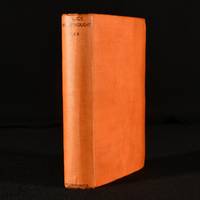
194813436London England: Thomas Nelson and Sons 1948. First of this edition. Hardcover. Very Good/Good . London: Thomas Nelson and Sons 1948-1957. 9 volumes complete works as published. Scarce set. Very good in red Oxford cloth bright gilt. Light bumping to a few corners. In good-very good dust jackets with light even sunning to spines minor wear. Now in mylar. A handsome set. No former owner marks. Prof. Luce reprints from the fourth and last edition correcting errors of past editions and indicating all alterations with the editor's introduction to the works. Published over a period of 10 years the edition is cited as definitive. Contents: Vol. 1 Philosophical Commentaries An Essay Towards A New Theory Of VisionThe Theory Of Vision;Vol. 2 A Treatise Concerning The Principles Of Human Knowledge First Draft Of The Introduction To The PrinciplesThree Dialogues Between Hylas And PhilonousPhilosophical Correspondence Between Berkeley And Samuel Johnson 1729-30; Vol. 3 Alciphron;Vol. 4 De MotuThe AnalystA Defence Of Free-thinking In Mathematics Reasons For Not Replying To Mr. Walton's Full AnswerArithmetica And Miscellanea Mathematica Of Infinites Writings On Natural History; Vol. 5 Sris A Chain Of Philosophical Reflexions And Inquiries Four Letters And Farther Thoughts On Tar-water; Vol. 6 Passive Obedience Advice To The Tories Who Have Taken The Oaths An Essay Towards Preventing The Ruin Of Great Britain The Querist And Other Writings On Economics A Discourse Addressed To Magistrates And Men In Authority Two Letters On The Occasion Of The Jacobite Rebellion 1745 A Word To The Wise Maxims Concerning Patriotism; Vol. 7:Sermons Letter To Sir John James On The Roman ControversyBerkeley's Primary Visitation Charge And An Address On ConfirmationBerkeley's Essays In The Guardian Journals Of Travel In Italy A Proposal For The Better Supplying Of Churches In Our Foreign Plantations and Berkeley's PetitionVerses On AmericaVaria; Vol. 8 Letters Vol. 9 Addenda. Extra shipping charges may apply. Thomas Nelson and Sons hardcover
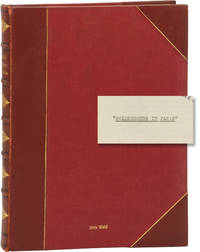
1938161238Burbank CA: Warner Brothers 1938. Final script for the 1938 film musical. Specially bound copy belonging to story writer Jerry Wald with his name in gilt on the front board. <br /> <br /> Jerry Wald is best remembered for his long and successful association with Warner Brothers as both a screenwriter and producer of a number of notable films including "Mildred Pierce" 1945 "Humoresque" 1946 "Key Largo" 1948 and "Flamingo Road" 1949. In the 1950s he moved to Twentieth Century-Fox and was the producer there for "An Affair to Remember" 1957 "Peyton Place" 1957 and "Sons and Lovers" 1960.<br /> <br /> The fifth and last film in Warner Brothers' series of successful and gorgeously choreographed "Gold Digger" films. Dance sequences directed by Busby Berkeley. <br /> <br /> Set in Paris shot on location in Paris and New York.<br /> <br /> Bound in red cloth with red quarter leather binding with five raised bands and gilt titles on the spine and front board. Title page integral with distribution page dated 1/4/38 noted as FINAL with a Warner Story Department stamp. 155 leaves with last page of text numbered 139. Mimeograph duplication rectos only with blue revision pages throughout variously dated 1/27/38 through 3/24/38. Pages Near Fine binding Near Fine. Warner Brothers unknown
1878000011096London: William Tegg & Co 1878. First Simon edition. Hardcover. Good. Small 8vo. 5 vi-lii 5 6-220 pp. Bound in green cloth with both boards bordered in blind lettering and rule stamped in gold on the front board. Yellow/green endpapers and pastedowns. Algaier Reconstructing the Library of William James; Gay Wilson Allen William James; Mead 18. This is the first edition edited and with introduction and appendix by Simon. The free front endpaper has two ownership stamps of philosopher and psychologist William James the first is crossed out being the older 18 Garden Street address where James resided until moving to his new house in 1889 the second is the 95 Irving Street address in Cambridge where he lived from 1889 until his death in 1910. There is also a slip of paper tipped in to the front endpaper with "PHILOS. III." printed on it. This book is not in Algaier who lists all of James' books and pamphlets that were donated to Harvard University by James and others 2554 items nor is it listed in the catalogue of The Hocking Collection at the University of Massachusetts-Lowell. Therefore this book must be one of the many that were given away as gifts to colleagues or sold at the "yard sale" held in 1923. The photographs of James' library circa 1923 see Algaier p. 4-5 suggest that it consisted of at least 4000 volumes Algaier suggests it may be double that so a large portion of James' personal library is either lost or privately held. The book does contain underlining and light marginalia vertical bars to emphasize passages and reference numbers mostly in pencil but we are unable to ascertain if this is the work of James himself or a later owner. James is one of the most important American philosophers of the nineteenth century and books from his personal library are scarce in commerce. The book is in Good-only condition with rubbing and wear to the boards and the binding although holding is in jeopardy. William Tegg & Co hardcover
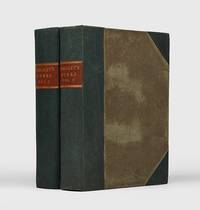
1784000014056London: G. Robinson and John Exshaw 1784. Later edition. Hardcover. Very Good. 2 vol. 4to. 7 iv-ci 3 3-646 2; 4 3-666 pp. Contemporary marbled calf with the spines in seven compartments a red and a green morocco label on each spine lettered in gold gold rules on the spines. Volume one illustrated with an engraved frontispiece portrait of Berkeley; volume two with two plates one of which is a folding plate. Both volumes with a few in-text woodcuts throughout. Completing the title page: "To which is added an account of his life and several of his letters to Thomas Prior Esq. Dean Gervais and Mr. Pope &c. &c." Keynes 143. This set contains Berkeley's most widely read works except The Theory of Vision Vindicated Advice to the Tories and Essays in the Guardian. Keynes lists the Dublin edition also published in 1784 first in his bibliography. Berkeley was the most famous proponent of immaterialism. He wrote philosophical treatises on metaphysics philosophy of mathematics perception sensation and on the philosphy of science. A large and attractive set of the philosopher's works. Corners gently rubbed through the joints renewed. An armorial bookplate and a twentieth-century bookplate on each front pastedown. G. Robinson and John Exshaw hardcover
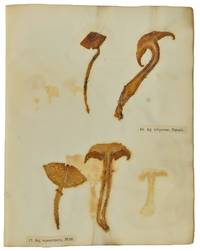
41976London: Longman Rees Orme Brown Green and Longman 1836-1843. First edition 4 vols. small 4to 245 x 200 mm printed titles and indices 350 original mounted specimens of Fugi with printed labels volumes 1 and 2 contemporary morocco-backed boards one cover detached worn volumes 3 and 4 publisher's boards one lacking spine. A remarkable work in the of mycology providing a visual and physical record of British fungi. Miles Joesph Berkeley 1803-1889 a Church of England clergyman and naturalist and to be later known as the father of British mycology. He contributed the section on British fungi to Sir James Edward Smiths The English Flora which was published in 5 volumes from 1824 to 1836. Here he presents the dried specimens which he had described in Smiths work. For obvious reasons fungal exsiccatae are much rarer than other species of the genus and complete set are seldom meet with. This being the only complete set to appear at auction in the past 70 years. Provenance: Andrew Fountaine library; the library of Michael Walpole 1933-2009 founding member of the Loughborough Naturalists Club. London: Longman, Rees, Orme, Brown, Green, and Longman, 1836-1843 hardcover