397 résultats
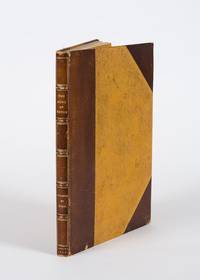
188744570AB1887. Philadelphia J.B. Lippincott Co. 1887. 25 cm x 32 cm. 47 pages of verses juxtaposed to 24 fine etchings the additional two etchings are the frontispiece and a smaller signet etching to the titlepage. All of the fine etchings mounted to stiff paper. Original hardcover / Decorative quarter morocco with gilt lettering and ornament on spine. Very few of the etchings with foxing. Very good condition of this extremely rare edition no.129 of 250 copies only with only very minor signs of external wear / some rubbing to the binding and bumping to the corners. Some corners very slightly fingerstained and with a hint of a faded dampstain. Name of former owner on endpaper: "Martin F. Jackson - 501 - 5 ave. New York City". The Song of Songs also known as the Song of Solomon Canticles or the Canticle of Canticles is one of the "scrolls" megillot of the Writings Ketuvim the last section of the Tanakh or Hebrew Bible. It is also the fifth book of Wisdom in the Old Testament of the Christian Bible. In Sephardic Jewish tradition the Song of Songs is read every Friday night for the divine loving union they see in it; Ashkenazim chant it on the Sabbath during Passover marking the beginning of the grain harvest and commemorating the Exodus from Egypt. Scripturally the Song of Songs is unique in its celebration of sexual love. It gives "the voices of two lovers praising each other yearning for each other proffering invitations to enjoy". The "daughters of Jerusalem" form a chorus to the lovers functioning as an audience whose participation in the lovers' erotic encounters facilitates the participation of the reader. Jewish tradition reads it as an allegory of the relationship between God and Israel. Christian tradition in addition to appreciating the literal meaning of a love song between man and woman has read the poem as an allegory of Christ and his "bride" the Christian Church. hardcover
2006x-0415395607Routledge 2006. Hardcover. New. 1st edition. 208 pages. 9.25x6.25x0.75 inches. Routledge hardcover
195614713basil blackwell 1956 hardback book and dust jacket in very good condition1/8th inch chip missing across top of spinespine age darkenedbook itself has slight curve towards the top.first editionsecond impression.signed by the author on first blank page john wisdom 16 jan 1958. Signed by Authors. 1st Edition. Hardcover. Very Good/Very Good. basil blackwell hardcover
2022ASAP-9781839374708Lone Star Tannery Inc. 2022. New. Lone Star Tannery Inc. unknown
2022ASAP-9781839374708Lone Star Tannery Inc. 2022. New. Lone Star Tannery Inc. unknown
1913585855Edmund Seale 1913. Signed Presentation Copy; 242 text pages with 3 pages of ads in front and 5 pages in back; cover lightly soiled/rubbed/bumped; pinholes in first six pages; light foxing on first and last few pages; binding tight cover edges and interior intact and clean except where noted; text block exceptionally clean; an entertaining little book. . Signed by Author. First Edition. Hard Cover. Very Good/No Jacket. 12mo - over 6¾" - 7¾" tall. Edmund Seale Hardcover
B0GNT652GRNew. Brand new and still unused unknown
a605351962-1998 Oxford University Press. 37 years of this quarterly publication. Each quarterly issue has fascinating articles and forums. Octavos institutional buckram some volumes have gilt spine lettering others white; most volumes cover cloth is tan some volumes are greyish-green; some volumes are about 1/3 inch taller than other volumes with all covers for individual issues bound in. Ex-university library with name stamps on all fore-edges and on issue covers no bookplates no pockets no spine numbers. Fine. Clean; appear unused/unread. 37 hardcover volumes. Wonderful reading! Articles as: Could a Machine Perceive by Alan Gauld; "A New Look at the problem of Innate Ideas" by Nicholas Rescher; "Turing machines and the MInd-Body Problem" by J J Clarke. . hardcover
20131-0262019345Mit Pr 2013. Hardcover. New. 256 pages. 9.00x6.00x0.43 inches. Mit Pr hardcover
19672110502150903929Daihonzan Sojiji Temple Edition 1967. Soft Cover. Fine. Volume: 1 Daihonzan Sojiji Temple Edition paperback
2016Star-97818393703972016. Hardcover. New. hardcover
2016Star-97818393703972016. Hardcover. New. hardcover
16952090202122800613Chojiya Kuroemon 1695. Soft Cover. Fine. Size: Large Edition Number of copies: 2 Chojiya Kuroemon paperback
1935016513DoubledayDoran & Company 1935. Book. Fine. Cloth in Box. 1st Edition. 4to - over 9¾ - 12" tall. Fine Copy in Like Jacket With Original Matching Box With Label. First Edition $5.00 On Flap. Given As A Gift In School With Many Signatures Of Classmates on Front Blank. Gorgeous Copy Rare In This Condition. Amazing Great Classic. Doubleday,Doran & Company Hardcover
26295Kennington’s letters: 11 June 26 September and 7 October 1956; all on his letterhead of Homer Ipsden Oxon. Replies of 20 June and 3 and 10 October 1956. See Kennington’s entry in the Oxford DNB. All six items in good condition lightly aged. Previously pinned together with Kennington’s letters folded for postage and all three are 1p 8vo and signed ‘Eric Kennington’. ONE: Kennington ALS 11 June 1956. Having conferred with Ackroyd’s clerk ‘Mr. Osborne’ he explains that he cannot give his attention to the portrait until September. ‘I habitually visit my sitter for that takes less of his time & energy & he is more at ease in his own surroundings.’ He explains the arrangements he would prefer ending ‘I do much more than the 5 hours so shall need a cover to work alone when you are not sitting.’ TWO: Kennington ALS ‘Wed 26’ September 1956. Begins: ‘In uncertainty I approached Osborne with your suggestion of an oil painting different in conception & size. His answer is surprisingly definite. They want only the head & shoulders like those at Skinners’ Hall.’ He explains that what he has done ‘supplies their demand so I will take it to them before painting as I expect their architect will be instructive about the frame. Then I will bring it to you.’ He assumes that as a result the arranged sittings will not be secretary and hopes that ‘you & others will not be put out’. He ends by thanking him for ‘making a portrait possible in your immense activity. From impressions here it seems to have unusual force but I know it is only one vision. Less charming than commanding I think’. THREE: Kennington ALS 7 October 1956. He apologises ‘having evidently made a mess & trying to do the correct thing. / The Carpenter’s sic may not at all like this portrait! I can never be certain. The delay is caused by framers. This week I shall take it to them boxed securely but unframed.’ He thanks him for ‘suggesting a frame from The Guildhall Library. Again I cannot decide. I have found the architects of City Companies always definite on this point.’ He ends with thanks for Ackroyd’s ‘good wishes re Clerkendon Church. The Parish has become filled with joy & keenness in their pride at saving their own roof. There are even 8 men carving new decorations for the renewed roof and wonderfully efficiently. / Wishing complete success to St. Mary-le-Bow’. ITEMS FOUR to SIX: Unsigned carbons of replies the first from ‘Vice-Admiral T. B. Drew CB. CVO. OBE.’ In Item Five 3 October 1956 Ackroyd writes expresses regret that Kennington ‘approached the Clerk regarding the painting because of course his answer would conform to the instructions given him by the Committee and I would have wished that you had left it to me to have dealt with the matter’. After suggesting that he should not ‘waste any money upon a frame’ he apologises again: ‘I was hoping that together we could have produced something worthy of a great Company’. He concludes with wishes for ‘every success in your work and in the work of the Church which you serve with such enthusiasm’. Kennington’s letters: 11 June, 26 [September] and 7 October 1956; all on his letterhead of Homer, Ipsden, Oxon. Replies of 20 unknown
18502111902160600064Not Available 1850. Soft Cover. Fine. The book is in fine condition. Not Available paperback
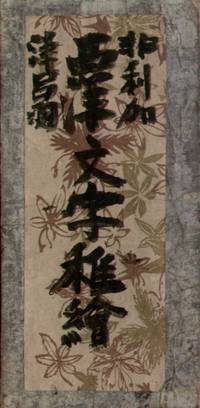
98119401Japan 1875. A small folding album 8 x 17 cm. original blue covers 18p. accordion folded soiled covers verso blank but evidence of a Japanese practicing his attempt at writing in English alphabet128 color woodcut illustrations. A very charming early attempt to teach the Japanese English alphabetical letters and numerals. Folded and reading from traditional left to right this work shows the Japanese the familiar "IROHA" alphabet in both Katakana & Romanized alph- abetical letters Romaji with Hiragana above. The most fa- scinating part are the profuse color woodblock illustrations of familiar Japanese objects each with Romanized letters & the appropriate Japanese. Such cute things as Inu Roonin Hato Niwatori Potsukkuri Pokkuri Hyotan Tonbo Ringo Dobin Soroban Taiko DaikonYoroi Wakizashi Kani Katsuo and a plethora of others. This work basically was used to train the Japanese to read Romaji first for familiar objects and thus begin the process of learning English ultimately to read English letters. Works of this subject are now quite RARE and seldom come to market many were basically used up in the learning process. This example well used cover soil bit thumbed but remarkably complete. Back cover has the Sumi penned date: Meiji 7 nen with a later cover title slip pasted on and Sumi ink title written. Brief commentary on the English language some text worn away balance complete. unknown
196830537England: The Shrine of Wisdom. As New. 1968. Hardcover. FREE UPGRADE to Courier/Priority Shipping Upon Request - IN STOCK AND IMMEDIATELY AVAILABLE FOR SHIPMENT - 68 pages. -- with a bonus offer-- . The Shrine of Wisdom hardcover
197237307New York: Shepherd Gallery Associates. As New. 1972. Paperback. FREE UPGRADE to Courier/Priority Shipping Upon Request IN STOCK AND IMMEDIATELY AVAILABLE FOR SHIPMENT - AS NEW THE TEXT BLOCK IS PRISTINE CLEAN UNMARKED AND IN EXCELLENT CONDITION - Among the artists represented: Dore Cazin Th. Rousseau Jules Dupre Diaz Valenciennes Michel Bertin Jacque and others. -- with a bonus offer-- . Shepherd Gallery, Associates paperback
197851403Chapel Hill Nc U. S. A.: University of North Carolina. As New. 1978. Paperback. FREE UPGRADE to Courier/Priority Shipping Upon Request IN STOCK AND IMMEDIATELY AVAILABLE FOR SHIPMENT - Text block pristine pages tight to spine - 62 works catalogued and illustrated in lovely black and white plates. Among the artists represented: A. Vollon Rousseau Troyon Bonnat Gericault and others. -- with a bonus offer-- . University of North Carolina paperback
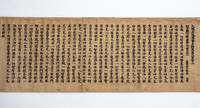
1077822-23 columns per sheet 17 characters per column column height 205 mm. printed on 19 joined sheets 263 mm. high; sheet lengths ranging from 428-443 mm.; total length including front endpaper: 8480 mm. attached at end to a wooden roller. Nara: Kamakura era.<br /> <BR> <BR> A rare early woodblock-printed sutra issued on high-quality thick paper gampi or mulberry fibers and printed in bold thick strokes using black sumi ink typical of Kamakura and Muromachi kasuga-ban printings kasuga-ban is a general term for publications of the Nara monasteries.<br /> <BR> <BR> The Mahaprajnaparamitasutra is a massive compilation of scriptural literature said to have been preached by the Buddha in four different places to 16 discrete assemblies. It includes seminal works such as the Prajnaparamita in One Hundred Thousand Lines and the Diamond Sutra. “This recension of the scripture is only extant in a Chinese translation made in six hundred rolls by Xuanzang and his translation team between the years 660 and 663. Xuanzang’s recension is by far the largest of all the prajnaparamita scriptures in the Chinese Buddhist canon…The Mahaprajnaparamitasutra also often holds pride of place as the first sutra found in many traditional East Asian Buddhist scriptural canons.â€â€“Buswell & Lopez eds. The Princeton Dictionary of Buddhism p. 505.<br /> <BR> <BR> The translator of the Perfection of Wisdom Xuanzang 596-664 was a Chinese Buddhist pilgrim monk scholar and patriarch of the Chinese Yogacara tradition. Along with Kumarajiva 344-413 Xuanzang was one of the two most influential and prolific translators of Indian Buddhist texts into Chinese. In 627 he embarked on an epic journey to India where he studied Sanskrit and returned to China in 645 with over 600 Sanskrit manuscripts in his luggage along with images relics and other artifacts. Settling in the Tang capital of Chang’an he established a translation bureau where he oversaw a team of monks who transcribed the texts and in the process made translations polished the renderings clarified texts and certified both their meaning and syntax.<br /> <BR> <BR> A very good copy preserved in a modern box. Minor worming some of which is carefully repaired.<br /> <BR> <BR> ⧠K.B. Gardner “Centres of Printing in Medieval Japan: late Heian to early Edo period†in British Library Occasional Papers 11. Japanese Studies ed. by Yu-Ying Brown London: 1990 p. 159–“The term Kasuga-ban became used more loosely in a wider sense to denote publications of the Nara monasteries in general not only of the Kofukuji. The printing of Kasuga-ban in this broader sense flourished throughout the Kamakura period and up to the end of Muromachi ca. 1570.†KÅgen Mizuno Buddhist Sutras. Origin Development Transmission pp. 178-79. unknown
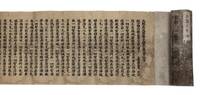
973319 joined sheets mostly 23 columns per sheet 17 characters per column. Scroll 263 x 8301 mm. & front endpaper 230 mm. wooden roller. Nara: 12th-14th century.<br /> <BR> <BR> A fine early printed sutra which we are unable to date. It is clearly a kasuga-ban printed on highest-quality thick paper gampi or mulberry fibers with bold thick strokes using black sumi ink typical of kasuga-ban printings a term for publications of the Nara monasteries in general.<br /> <BR> <BR> The Mahaprajnaparamitasutra is a massive compilation of scriptural literature said to have been preached by the Buddha in four different places to 16 discrete assemblies. It includes seminal works such as the Prajnaparamita in One Hundred Thousand Lines and the Diamond Sutra. “This recension of the scripture is only extant in a Chinese translation made in six hundred rolls by Xuanzang and his translation team between the years 660 and 663. Xuanzang’s recension is by far the largest of all the prajnaparamita scriptures in the Chinese Buddhist canon…The Mahaprajnaparamitasutra also often holds pride of place as the first sutra found in many traditional East Asian Buddhist scriptural canons.â€â€“Buswell & Lopez eds. The Princeton Dictionary of Buddhism p. 505.<br /> <BR> <BR> The translator of the Perfection of Wisdom Xuanzang 596-664 was a Chinese Buddhist pilgrim monk scholar and patriarch of the Chinese Yogacara tradition. Along with Kumarajiva 344-413 Xuanzang was one of the two most influential and prolific translators of Indian Buddhist texts into Chinese. In 627 he embarked on an epic journey to India where he studied Sanskrit and returned to China in 645 with over 600 Sanskrit manuscripts in his luggage along with images relics and other artifacts. Settling in the Tang capital of Chang’an he established a translation bureau where he oversaw a team of monks who transcribed the texts and in the process made translations polished the renderings clarified texts and certified both their meaning and syntax.<br /> <BR> <BR> A fine and fresh copy. There is some worming touching characters throughout but we do not find it offensive. Some sporadic discoloring at the beginning of the scroll.<br /> <BR> <BR> ⧠K.B. Gardner “Centres of Printing in Medieval Japan: late Heian to early Edo period†in British Library Occasional Papers 11. Japanese Studies ed. by Yu-Ying Brown London: 1990 p. 159–â€The term Kasuga-ban became used more loosely in a wider sense to denote publications of the Nara monasteries in general not only of the Kofukuji. The printing of Kasuga-ban in this broader sense flourished throughout the Kamakura period and up to the end of Muromachi ca. 1570.†Mizuno Buddhist Sutras. Origin Development Transmission pp. 178-79. unknown