1 551 résultats
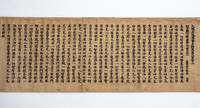
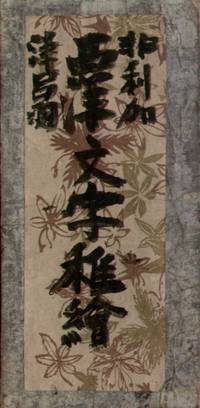
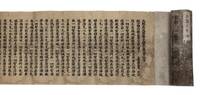
973319 joined sheets mostly 23 columns per sheet 17 characters per column. Scroll 263 x 8301 mm. & front endpaper 230 mm. wooden roller. Nara: 12th-14th century.<br /> <BR> <BR> A fine early printed sutra which we are unable to date. It is clearly a kasuga-ban printed on highest-quality thick paper gampi or mulberry fibers with bold thick strokes using black sumi ink typical of kasuga-ban printings a term for publications of the Nara monasteries in general.<br /> <BR> <BR> The Mahaprajnaparamitasutra is a massive compilation of scriptural literature said to have been preached by the Buddha in four different places to 16 discrete assemblies. It includes seminal works such as the Prajnaparamita in One Hundred Thousand Lines and the Diamond Sutra. “This recension of the scripture is only extant in a Chinese translation made in six hundred rolls by Xuanzang and his translation team between the years 660 and 663. Xuanzang’s recension is by far the largest of all the prajnaparamita scriptures in the Chinese Buddhist canon…The Mahaprajnaparamitasutra also often holds pride of place as the first sutra found in many traditional East Asian Buddhist scriptural canons.â€â€“Buswell & Lopez eds. The Princeton Dictionary of Buddhism p. 505.<br /> <BR> <BR> The translator of the Perfection of Wisdom Xuanzang 596-664 was a Chinese Buddhist pilgrim monk scholar and patriarch of the Chinese Yogacara tradition. Along with Kumarajiva 344-413 Xuanzang was one of the two most influential and prolific translators of Indian Buddhist texts into Chinese. In 627 he embarked on an epic journey to India where he studied Sanskrit and returned to China in 645 with over 600 Sanskrit manuscripts in his luggage along with images relics and other artifacts. Settling in the Tang capital of Chang’an he established a translation bureau where he oversaw a team of monks who transcribed the texts and in the process made translations polished the renderings clarified texts and certified both their meaning and syntax.<br /> <BR> <BR> A fine and fresh copy. There is some worming touching characters throughout but we do not find it offensive. Some sporadic discoloring at the beginning of the scroll.<br /> <BR> <BR> ⧠K.B. Gardner “Centres of Printing in Medieval Japan: late Heian to early Edo period†in British Library Occasional Papers 11. Japanese Studies ed. by Yu-Ying Brown London: 1990 p. 159–â€The term Kasuga-ban became used more loosely in a wider sense to denote publications of the Nara monasteries in general not only of the Kofukuji. The printing of Kasuga-ban in this broader sense flourished throughout the Kamakura period and up to the end of Muromachi ca. 1570.†Mizuno Buddhist Sutras. Origin Development Transmission pp. 178-79. unknown
1077822-23 columns per sheet 17 characters per column column height 205 mm. printed on 19 joined sheets 263 mm. high; sheet lengths ranging from 428-443 mm.; total length including front endpaper: 8480 mm. attached at end to a wooden roller. Nara: Kamakura era.<br /> <BR> <BR> A rare early woodblock-printed sutra issued on high-quality thick paper gampi or mulberry fibers and printed in bold thick strokes using black sumi ink typical of Kamakura and Muromachi kasuga-ban printings kasuga-ban is a general term for publications of the Nara monasteries.<br /> <BR> <BR> The Mahaprajnaparamitasutra is a massive compilation of scriptural literature said to have been preached by the Buddha in four different places to 16 discrete assemblies. It includes seminal works such as the Prajnaparamita in One Hundred Thousand Lines and the Diamond Sutra. “This recension of the scripture is only extant in a Chinese translation made in six hundred rolls by Xuanzang and his translation team between the years 660 and 663. Xuanzang’s recension is by far the largest of all the prajnaparamita scriptures in the Chinese Buddhist canon…The Mahaprajnaparamitasutra also often holds pride of place as the first sutra found in many traditional East Asian Buddhist scriptural canons.â€â€“Buswell & Lopez eds. The Princeton Dictionary of Buddhism p. 505.<br /> <BR> <BR> The translator of the Perfection of Wisdom Xuanzang 596-664 was a Chinese Buddhist pilgrim monk scholar and patriarch of the Chinese Yogacara tradition. Along with Kumarajiva 344-413 Xuanzang was one of the two most influential and prolific translators of Indian Buddhist texts into Chinese. In 627 he embarked on an epic journey to India where he studied Sanskrit and returned to China in 645 with over 600 Sanskrit manuscripts in his luggage along with images relics and other artifacts. Settling in the Tang capital of Chang’an he established a translation bureau where he oversaw a team of monks who transcribed the texts and in the process made translations polished the renderings clarified texts and certified both their meaning and syntax.<br /> <BR> <BR> A very good copy preserved in a modern box. Minor worming some of which is carefully repaired.<br /> <BR> <BR> ⧠K.B. Gardner “Centres of Printing in Medieval Japan: late Heian to early Edo period†in British Library Occasional Papers 11. Japanese Studies ed. by Yu-Ying Brown London: 1990 p. 159–“The term Kasuga-ban became used more loosely in a wider sense to denote publications of the Nara monasteries in general not only of the Kofukuji. The printing of Kasuga-ban in this broader sense flourished throughout the Kamakura period and up to the end of Muromachi ca. 1570.†KÅgen Mizuno Buddhist Sutras. Origin Development Transmission pp. 178-79. unknown
52199Millanges.1601.Rarissime édition originale en veau d'époque,dos avec titre et caissons ornés.(Desgraves 164.Graesse II 123).772 p.Table des matières.Fautes.Tranches dorées.Bel exemplaire avec charnières fragiles et papier bruni.
Druck der Ashendene Press in 328 Exemplaren auf Bütten. Durchgehend in Rot und Schwarz gedruckt. Die 178 Initialen wurden von Graily Hewitt und Mittarbeiterinen in verschiedenen Größen und Farben mit der Tuschfeder eingemalt. Einer der schönsten Drucke der Presse. "In my humble jugment it is one of the most satisfactory books of the Press (St. J. Hornby)". Tadellos erhalten.
1783002461Paris, Bastien, 1783
1881123Paris, Société générale de librairie catholique, 1881. In-8 (232 x 150 mm) en feuilles, 4 fnc + 106 pp. + 1 fnc, couverture et dos, étui-chemise d' époque recouvert de papier marbré, pièce de titre au dos. ÉDITION ORIGINALE. 1 des 500 exemplaires, celui-ci en cahiers libres avec la couverture en deux parties, le dos attaché au second plat, préparé pour être relié. Inclus le feuillet (qui disparaît toujours à la reliure) annoté et paraphé par l'éditeur ou l'imprimeur, avec le n° de l'exemplaire noté au crayon rouge. Absolument non rogné. L'exemplaire est accompagné d'une belle photographie de Paul Verlaine (168 x 112 mm), tirée à l'époque (Otto & Pirou, Place de la Madeleine, Paris).
7400Paris, Vrille, 1952. In-4 en feuilles non paginé sous chemise gaufrée, titre gravé, sous chemise et étui noirs. Quelques légères marques à l'étui, ceci mis à part, en parfaite condition.
196830537England: The Shrine of Wisdom. As New. 1968. Hardcover. FREE UPGRADE to Courier/Priority Shipping Upon Request - IN STOCK AND IMMEDIATELY AVAILABLE FOR SHIPMENT - 68 pages. -- with a bonus offer-- . The Shrine of Wisdom hardcover
197237307New York: Shepherd Gallery Associates. As New. 1972. Paperback. FREE UPGRADE to Courier/Priority Shipping Upon Request IN STOCK AND IMMEDIATELY AVAILABLE FOR SHIPMENT - AS NEW THE TEXT BLOCK IS PRISTINE CLEAN UNMARKED AND IN EXCELLENT CONDITION - Among the artists represented: Dore Cazin Th. Rousseau Jules Dupre Diaz Valenciennes Michel Bertin Jacque and others. -- with a bonus offer-- . Shepherd Gallery, Associates paperback
197851403Chapel Hill Nc U. S. A.: University of North Carolina. As New. 1978. Paperback. FREE UPGRADE to Courier/Priority Shipping Upon Request IN STOCK AND IMMEDIATELY AVAILABLE FOR SHIPMENT - Text block pristine pages tight to spine - 62 works catalogued and illustrated in lovely black and white plates. Among the artists represented: A. Vollon Rousseau Troyon Bonnat Gericault and others. -- with a bonus offer-- . University of North Carolina paperback
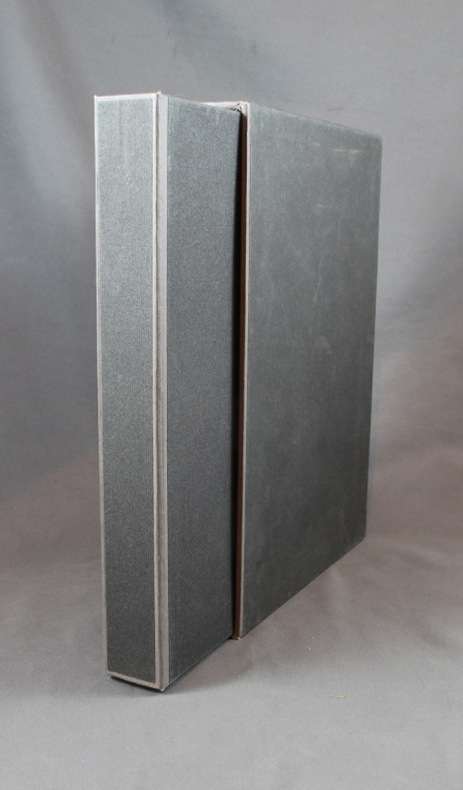
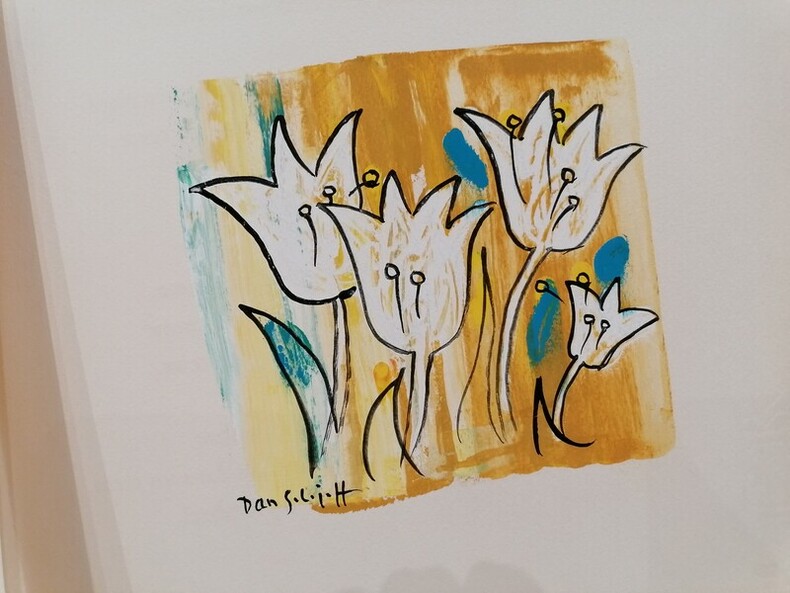
38253Editions Vialetay,18 Mai 1966. In-folio en feuilles, sous chemise, étui et emboîtage, illustré par Dan Solojoff. Chaque exemplaire comporte 30 illustrations originales peintes à la gouache et signées par Dan Solojoff. Ex.n°22/50 , sur Rives, signé par l'artiste et l'éditeur. Etat parfait. Gouaches aux couleurs éclatantes.
1767002377Paris Barrois 1767
165916567Leide, Jean Elsevier, s.d. (circa 1659) ; petit in-12, maroquin grenat, dos à faux nerfs, décors et titre dorés, roulette d’encadrement des plats et roulette d’intérieur, tranches dorées, gardes de tabis bleu (reliure ancienne) ; (12) ff. liminaires y compris le frontispice, 621 pp., (12) pp. de table.
Six volume set bound in blue cloth. Dust jackets show light wear, ink smudges, discoloration, and small tears at edges, with volume six having a large closed tear. Volume I: Cosmogenesis. Volume 2: Cosmogenesis Parts 2 & 3. Volume 3: Anthropogenesis Part 1. Volume 4: Anthropogenesis Parts 2 & 3. Volume 5: [No Title]. Volume 6: Index and Glossary.
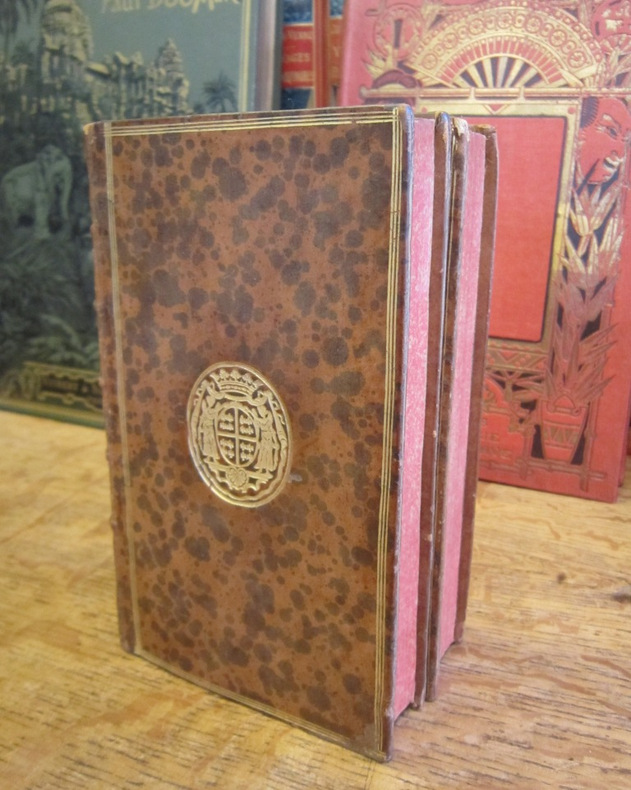
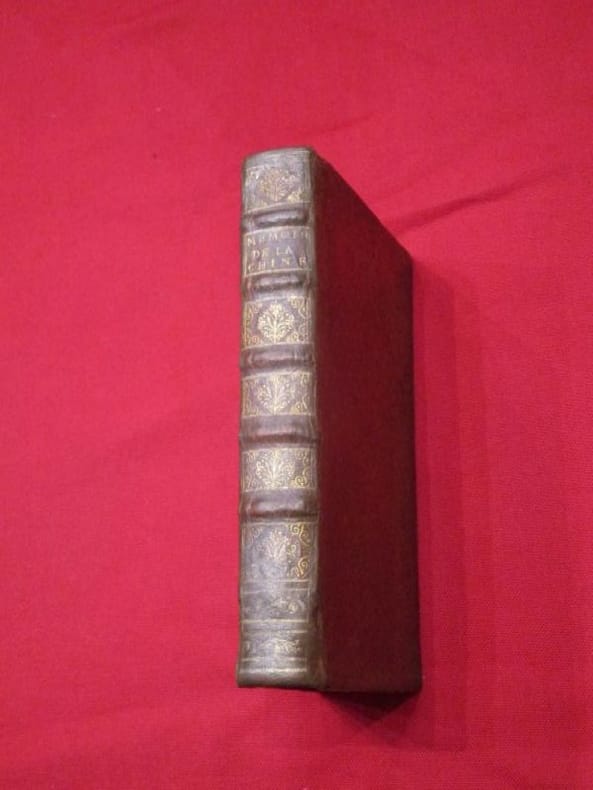
1698118024paris Jean Anisson 1698 A Paris, Chez Jean Anisson, 1698, 1 volume in-12, [16] ff., 322 pages, [5] ff. Pleine reliure mouchetée, dos à cinq nerfs portant titres dorés, caissons ornés, roulette dorée sur les coupes, tranches mouchetées de rouges, gardes blanches. Reliure restaurée (coiffes, dos, coins et coupes), inscription à l'encre sur la page de titre, rares rousseurs, sinon bon état général.
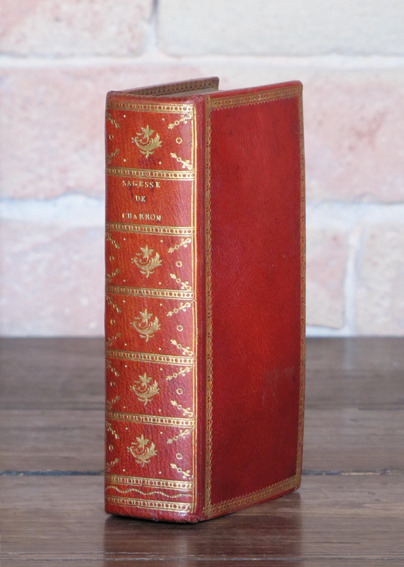
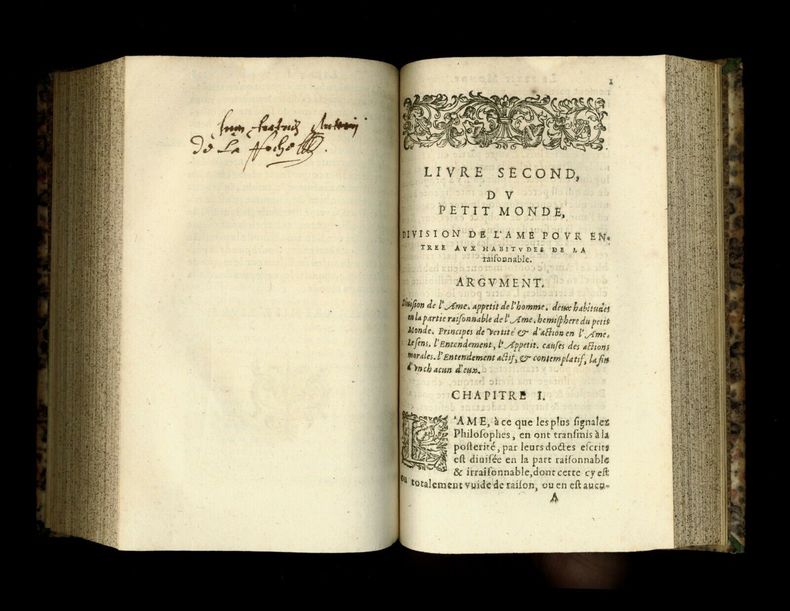
1604AMO-3383Par Me. David Chabodie, Docteur en médecine. A Paris, chez Toussaint Du Bray, 1604 2 parties reliées en 1 volume petit in-8 (17 x 11 cm) de 1 feuillet de titre, 15 feuillets non chiffrés (épitre à Messire Charles de Pierre-Busière et de Combort, baron de Chateauneuf, Peirac, etc., lieutenant général pour sa Majesté au haut et bas pays de Limousin ; extrait du privilège, etc.) ; 128 feuillets + 86 feuillets. Collationné complet (à noter une interversion de cahier (G - p. 49 à 57) passées du livre I au livre II (et inversement). Légères mouillures sans gravité. Reliure demi-basane du milieu du XIXe siècle. Reliure bien conservée. intérieur frais malgré quelques petits travaux de vers dans les marges de quelques feuillets. La page de titre est ornée d'une belle marque gravée sur bois (le bas de la page de titre a été éraflé avec pour conséquence la perte d'une partie de la date et de la mention de privilège. Edition originale. L'exemplaire de la Bibliothèque nationale de France début par un titre frontispice gravé mais ne possède pas de page de titre typographique. Il s'agit pourtant, comparaisons faites pages à pages, du même tirage que notre exemplaire. Ce petit traité de morale va en réalité bien au delà. Si le premier livre traite des aspects de la foi, de la morale et du salut de l'âme, la seconde partie traite quant à elle de la philosophie, des sciences et de la métaphysique. On y trouve une multitude de chapitres traités assez succinctement tels que la médecine, les mathématiques, la musique, la géométrie, l'astronomie, les arts (dont l'alchimie ou Spagirie), les notions morales telles que la sagesse, l'intelligence, la prudence, la vertu. La fin du livre contient un chapitre consacré à la résurrection des corps. Ce livre semble avoir été peu étudié et les exemplaires semblent fort rares. On ne sait que très peu de choses sur David Chabodie, médecin exerçant à Limoges à la fin du XVIe siècle (vers 1595) et né à Rochechouart. Il était diplomé de la faculté de médecine de Montpellier. Il fut atteint de la peste en 1596. Il est noté dans un ouvrage que son seul ouvrage (qui semble celui-ci) s'attache plus à la métaphysique qu'à la médecine. Il existerait une autre édition de 1607. Chabodie aurait été un protestant converti, probablement en 1627 (Bulletin de la Société archéologique et historique du Limousin, vol. 42). Il serait mort vers 1640. Le Petit monde de Chabodie est à rapprocher, toutes proportions gardées, de La Sagesse de Charron (Bordeaux, 1601), basé sur la même étude de l'homme-microcosme. L'influence des Essais de Montaigne n'est également pas loin. "Ouvrage devenu assez rare." (Dictionnaire encyclopédique des sciences médicales, 1873, tome 14, p. 629 "Curieux et rare" (Bulletin du bouqiniste, Janvier 1863, n° 2.534) Bon exemplaire.
153 pages. Signed and inscribed by author (dated 1952) upon second blank leaf. Prior owner's signature upon same page. Average wear. Binding sound. Dr. Drown "... produced stunning photographs of soft and hard tissue anywhere within the body using only a dried drop of the patient's blood on a piece of blotter paper." - Trevor Constable. A very rare signed item by this incredibly gifted woman. Book
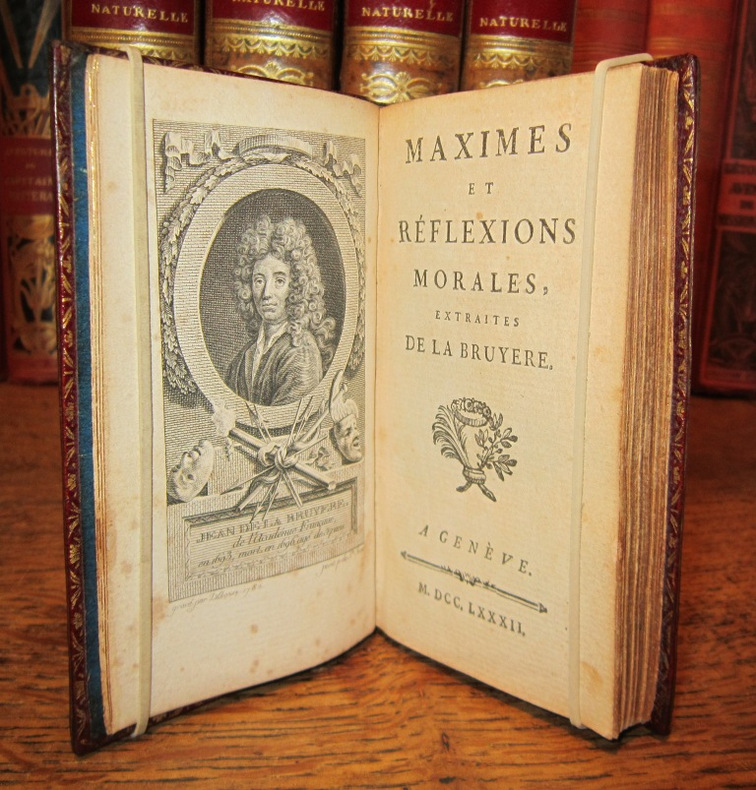
1782001556Genève s.n. 1782
98119401Japan 1875. A small folding album 8 x 17 cm. original blue covers 18p. accordion folded soiled covers verso blank but evidence of a Japanese practicing his attempt at writing in English alphabet128 color woodcut illustrations. A very charming early attempt to teach the Japanese English alphabetical letters and numerals. Folded and reading from traditional left to right this work shows the Japanese the familiar "IROHA" alphabet in both Katakana & Romanized alph- abetical letters Romaji with Hiragana above. The most fa- scinating part are the profuse color woodblock illustrations of familiar Japanese objects each with Romanized letters & the appropriate Japanese. Such cute things as Inu Roonin Hato Niwatori Potsukkuri Pokkuri Hyotan Tonbo Ringo Dobin Soroban Taiko DaikonYoroi Wakizashi Kani Katsuo and a plethora of others. This work basically was used to train the Japanese to read Romaji first for familiar objects and thus begin the process of learning English ultimately to read English letters. Works of this subject are now quite RARE and seldom come to market many were basically used up in the learning process. This example well used cover soil bit thumbed but remarkably complete. Back cover has the Sumi penned date: Meiji 7 nen with a later cover title slip pasted on and Sumi ink title written. Brief commentary on the English language some text worn away balance complete. unknown
Roy. 8vo., First Edition thus, with portrait frontispiece, 47 plates by Kennington, Rothenstein, Roberts and others, 6 illustrations in the text and 4 folding maps, endpapers faintly spotted; original decorative brown buckram gilt, gilt back, uncut, brown top, backstrip very lightly sunned else a near fine copy. The first publicly available edition of this literary classic, following private publication in 1926 and the limited edition of 1935. Winston Churchill believed that it 'ranks with the greatest books ever written in the English language'. The work also formed the basis of David Lean's multiple Oscar-winning feature film 'Lawrence of Arabia' starring Peter O'Toole and Omar Sharif. Enser, p.191; O'Brien A042.
18502111902160600064Not Available 1850. Soft Cover. Fine. The book is in fine condition. Not Available paperback
PHO-2150Sd, sl, se. In-8 (20 × 14,5 cm), demi-basane du XIXe siècle, dos lisse orné de pièces de titre et d’auteur rouges, frottements, mouillures marginales sur quelques feuillets, ancien travail de vers, un feuillet replié.
26295Kennington’s letters: 11 June 26 September and 7 October 1956; all on his letterhead of Homer Ipsden Oxon. Replies of 20 June and 3 and 10 October 1956. See Kennington’s entry in the Oxford DNB. All six items in good condition lightly aged. Previously pinned together with Kennington’s letters folded for postage and all three are 1p 8vo and signed ‘Eric Kennington’. ONE: Kennington ALS 11 June 1956. Having conferred with Ackroyd’s clerk ‘Mr. Osborne’ he explains that he cannot give his attention to the portrait until September. ‘I habitually visit my sitter for that takes less of his time & energy & he is more at ease in his own surroundings.’ He explains the arrangements he would prefer ending ‘I do much more than the 5 hours so shall need a cover to work alone when you are not sitting.’ TWO: Kennington ALS ‘Wed 26’ September 1956. Begins: ‘In uncertainty I approached Osborne with your suggestion of an oil painting different in conception & size. His answer is surprisingly definite. They want only the head & shoulders like those at Skinners’ Hall.’ He explains that what he has done ‘supplies their demand so I will take it to them before painting as I expect their architect will be instructive about the frame. Then I will bring it to you.’ He assumes that as a result the arranged sittings will not be secretary and hopes that ‘you & others will not be put out’. He ends by thanking him for ‘making a portrait possible in your immense activity. From impressions here it seems to have unusual force but I know it is only one vision. Less charming than commanding I think’. THREE: Kennington ALS 7 October 1956. He apologises ‘having evidently made a mess & trying to do the correct thing. / The Carpenter’s sic may not at all like this portrait! I can never be certain. The delay is caused by framers. This week I shall take it to them boxed securely but unframed.’ He thanks him for ‘suggesting a frame from The Guildhall Library. Again I cannot decide. I have found the architects of City Companies always definite on this point.’ He ends with thanks for Ackroyd’s ‘good wishes re Clerkendon Church. The Parish has become filled with joy & keenness in their pride at saving their own roof. There are even 8 men carving new decorations for the renewed roof and wonderfully efficiently. / Wishing complete success to St. Mary-le-Bow’. ITEMS FOUR to SIX: Unsigned carbons of replies the first from ‘Vice-Admiral T. B. Drew CB. CVO. OBE.’ In Item Five 3 October 1956 Ackroyd writes expresses regret that Kennington ‘approached the Clerk regarding the painting because of course his answer would conform to the instructions given him by the Committee and I would have wished that you had left it to me to have dealt with the matter’. After suggesting that he should not ‘waste any money upon a frame’ he apologises again: ‘I was hoping that together we could have produced something worthy of a great Company’. He concludes with wishes for ‘every success in your work and in the work of the Church which you serve with such enthusiasm’. Kennington’s letters: 11 June, 26 [September] and 7 October 1956; all on his letterhead of Homer, Ipsden, Oxon. Replies of 20 unknown
Roy. 8vo., First US Trade Edition, with a portrait frontispiece, 47 plates by Kennington, Rothenstein, Roberts and others, 6 illustrations in the text and 4 folding maps coloured in outline; handsomely bound in red full morocco, back gilt with five raised bands, second and fourth compartments lettered and ruled in gilt, all other compartments tooled and ruled in gilt, uncut, pictorial gilt from original board preserved and mounted on new leaf at front, a most attractive copy ideal as a gift or for presentation. The first publicly available US edition of this literary classic, following private publication in 1926 and the limited edition of 1935. Winston Churchill believed that it 'ranks with the greatest books ever written in the English language'. The work forms the basis of David Lean's multiple Oscar-winning feature film 'Lawrence of Arabia' (1962) starring Peter O'Toole and Omar Sharif. Enser, p.191; O'Brien A42.
1935016513DoubledayDoran & Company 1935. Book. Fine. Cloth in Box. 1st Edition. 4to - over 9¾ - 12" tall. Fine Copy in Like Jacket With Original Matching Box With Label. First Edition $5.00 On Flap. Given As A Gift In School With Many Signatures Of Classmates on Front Blank. Gorgeous Copy Rare In This Condition. Amazing Great Classic. Doubleday,Doran & Company Hardcover