397 résultats
2004Q-1579123686Black Dog & Leventhal 2004-08-31. paperback. New. In shrink wrap. Looks like an interesting title! Black Dog & Leventhal paperback
2004DADAX15791236862004-09-01. Open market ed. paperback. New. 10.50x0.88x13.75. Buy with confidence. Excellent Customer Service & Return policy. paperback
197982197Fintry Brook: The Shrine of Wisdom 1979. Pages clean and bright boards slightly cocked but binding firm some staining and wear to dust jacket. Hard. Good/Fair. 8vo. The Shrine of Wisdom Hardcover
1979013866Fintry Brook Near Godalming Surrey UK: The Shrine of Wisdom 1979. 1st Edition . Hardcover. Fine/No Jacket. Blue cloth with gilt lettering to fr. and sp. with gilt logo to fr. pristine. 88 pp.; all edges lightly tanned but this probably common to all copies as due to paper stock used. No ISBN number issued apparently. Scarce. 14 cm x 22 cm <br/> <br/> The Shrine of Wisdom hardcover
Q-1552381757University of Calgary Press 2016-02-15. Hardcover. New. In shrink wrap. Looks like an interesting title! University of Calgary Press hardcover
B0GNT652GRNew. Brand new and still unused unknown
1450089844.Ghardcover. Good. Access codes and supplements are not guaranteed with used items. May be an ex-library book. hardcover
1465386637.Ghardcover. Good. Access codes and supplements are not guaranteed with used items. May be an ex-library book. hardcover
18502111902160600064Not Available 1850. Soft Cover. Fine. The book is in fine condition. Not Available paperback
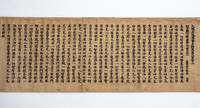
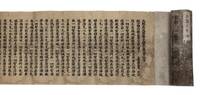
1077822-23 columns per sheet 17 characters per column column height 205 mm. printed on 19 joined sheets 263 mm. high; sheet lengths ranging from 428-443 mm.; total length including front endpaper: 8480 mm. attached at end to a wooden roller. Nara: Kamakura era.<br /> <BR> <BR> A rare early woodblock-printed sutra issued on high-quality thick paper gampi or mulberry fibers and printed in bold thick strokes using black sumi ink typical of Kamakura and Muromachi kasuga-ban printings kasuga-ban is a general term for publications of the Nara monasteries.<br /> <BR> <BR> The Mahaprajnaparamitasutra is a massive compilation of scriptural literature said to have been preached by the Buddha in four different places to 16 discrete assemblies. It includes seminal works such as the Prajnaparamita in One Hundred Thousand Lines and the Diamond Sutra. “This recension of the scripture is only extant in a Chinese translation made in six hundred rolls by Xuanzang and his translation team between the years 660 and 663. Xuanzang’s recension is by far the largest of all the prajnaparamita scriptures in the Chinese Buddhist canon…The Mahaprajnaparamitasutra also often holds pride of place as the first sutra found in many traditional East Asian Buddhist scriptural canons.â€â€“Buswell & Lopez eds. The Princeton Dictionary of Buddhism p. 505.<br /> <BR> <BR> The translator of the Perfection of Wisdom Xuanzang 596-664 was a Chinese Buddhist pilgrim monk scholar and patriarch of the Chinese Yogacara tradition. Along with Kumarajiva 344-413 Xuanzang was one of the two most influential and prolific translators of Indian Buddhist texts into Chinese. In 627 he embarked on an epic journey to India where he studied Sanskrit and returned to China in 645 with over 600 Sanskrit manuscripts in his luggage along with images relics and other artifacts. Settling in the Tang capital of Chang’an he established a translation bureau where he oversaw a team of monks who transcribed the texts and in the process made translations polished the renderings clarified texts and certified both their meaning and syntax.<br /> <BR> <BR> A very good copy preserved in a modern box. Minor worming some of which is carefully repaired.<br /> <BR> <BR> ⧠K.B. Gardner “Centres of Printing in Medieval Japan: late Heian to early Edo period†in British Library Occasional Papers 11. Japanese Studies ed. by Yu-Ying Brown London: 1990 p. 159–“The term Kasuga-ban became used more loosely in a wider sense to denote publications of the Nara monasteries in general not only of the Kofukuji. The printing of Kasuga-ban in this broader sense flourished throughout the Kamakura period and up to the end of Muromachi ca. 1570.†KÅgen Mizuno Buddhist Sutras. Origin Development Transmission pp. 178-79. unknown
973319 joined sheets mostly 23 columns per sheet 17 characters per column. Scroll 263 x 8301 mm. & front endpaper 230 mm. wooden roller. Nara: 12th-14th century.<br /> <BR> <BR> A fine early printed sutra which we are unable to date. It is clearly a kasuga-ban printed on highest-quality thick paper gampi or mulberry fibers with bold thick strokes using black sumi ink typical of kasuga-ban printings a term for publications of the Nara monasteries in general.<br /> <BR> <BR> The Mahaprajnaparamitasutra is a massive compilation of scriptural literature said to have been preached by the Buddha in four different places to 16 discrete assemblies. It includes seminal works such as the Prajnaparamita in One Hundred Thousand Lines and the Diamond Sutra. “This recension of the scripture is only extant in a Chinese translation made in six hundred rolls by Xuanzang and his translation team between the years 660 and 663. Xuanzang’s recension is by far the largest of all the prajnaparamita scriptures in the Chinese Buddhist canon…The Mahaprajnaparamitasutra also often holds pride of place as the first sutra found in many traditional East Asian Buddhist scriptural canons.â€â€“Buswell & Lopez eds. The Princeton Dictionary of Buddhism p. 505.<br /> <BR> <BR> The translator of the Perfection of Wisdom Xuanzang 596-664 was a Chinese Buddhist pilgrim monk scholar and patriarch of the Chinese Yogacara tradition. Along with Kumarajiva 344-413 Xuanzang was one of the two most influential and prolific translators of Indian Buddhist texts into Chinese. In 627 he embarked on an epic journey to India where he studied Sanskrit and returned to China in 645 with over 600 Sanskrit manuscripts in his luggage along with images relics and other artifacts. Settling in the Tang capital of Chang’an he established a translation bureau where he oversaw a team of monks who transcribed the texts and in the process made translations polished the renderings clarified texts and certified both their meaning and syntax.<br /> <BR> <BR> A fine and fresh copy. There is some worming touching characters throughout but we do not find it offensive. Some sporadic discoloring at the beginning of the scroll.<br /> <BR> <BR> ⧠K.B. Gardner “Centres of Printing in Medieval Japan: late Heian to early Edo period†in British Library Occasional Papers 11. Japanese Studies ed. by Yu-Ying Brown London: 1990 p. 159–â€The term Kasuga-ban became used more loosely in a wider sense to denote publications of the Nara monasteries in general not only of the Kofukuji. The printing of Kasuga-ban in this broader sense flourished throughout the Kamakura period and up to the end of Muromachi ca. 1570.†Mizuno Buddhist Sutras. Origin Development Transmission pp. 178-79. unknown
2025x-026205289XMit Pr 2025. Paperback. New. 248 pages. 9.00x6.00x9.00 inches. Mit Pr paperback
2025SKU1741291MIT Press 2025-05-27. paperback. New. 6x0x9. New Book Ships with Tracking MIT Press paperback
20131-0262019345Mit Pr 2013. Hardcover. New. 256 pages. 9.00x6.00x0.43 inches. Mit Pr hardcover
2024x-0262553457Mit Pr 2024. Paperback. New. 2nd edition. 578 pages. 9.00x6.00x9.00 inches. Mit Pr paperback
2024SKU1712128MIT Press 2024-11-26. paperback. Good. 6x1x9. Textbook May Have Highlights Notes and/or Underlining BOOK ONLY-NO ACCESS CODE NO CD Ships with Tracking MIT Press paperback
2024SKU1716845MIT Press 2024-11-26. paperback. New. 6x1x9. New Book Ships with Tracking MIT Press paperback
2024SKU1741784MIT Press 2024-11-26. paperback. New. 6x1x9. New Book Ships with Tracking MIT Press paperback
2001201231002The MIT Press 2001-03-19. Hardcover. Like New. Hardcover. New unused with minor shelf wear only. Free of any markings and no writings inside. For any additional information or pictures please inquire. The MIT Press hardcover
2013DADAX1304593657Lulu 2013-11-29. paperback. New. 4.25x0.11x6.89. Buy with confidence. Excellent Customer Service & Return policy. Lulu paperback
2090502113709235Not Available N.A. Soft Cover. Fine. The book is in fine condition. Not Available paperback
19522092902140300082Otori mei-sha 1952. Soft Cover. Fine. Number of books: 1 Otori mei-sha paperback
19672110502150903929Daihonzan Sojiji Temple Edition 1967. Soft Cover. Fine. Volume: 1 Daihonzan Sojiji Temple Edition paperback
19582110502151102420Sojiji Temple 1958. Soft Cover. Fine. Number of books: 1 Sojiji Temple paperback
19282111902154605265Hikari Toru-kan 1928. Soft Cover. Fine. The book is in fine condition. Hikari Toru-kan paperback