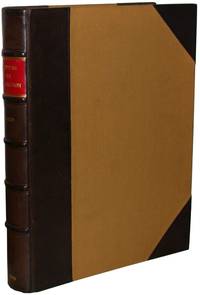
Locke JohnABAA

243 résultats
1722302488London: printed for A. Churchill and A. Manship and sold by W. Taylor in Pater-noster-Row 1722. The second edition. Frontispiece portrait by George Vertur after. 3 vols. Folio. Contemporary paneled calf neatly and almost imperceptibly rebacked preserving the original backstrips and spine labels. Bookplate of John Pollexfen Bastard and the signature of Charles Wymondesold whose widow married Bastard on the front free endpapers. Fine attractive copy. The second edition. Frontispiece portrait by George Vertur after. 3 vols. Folio. ESTC T128551 printed for A. Churchill, and A. Manship, and sold by W. Taylor in Pater-noster-Row unknown books
17271508179Arthur Bettesworth London 1727. 3rd Edition. Hardcover. Very Good/No Jacket. Three volumes Folio. Very good condition clean inside. Third edition of Locke's collected works including the Essay Concerning Human Understanding Two Treatises of Government Some Thoughts Concerning Education and his Letters Concerning Toleration. Contemporary leather binding six raised bands. Arthur Bettesworth, London hardcover books
1706Embry 149827Printed for Awnsham and John Churchill at the Ship in Cornhill near the Royal Exchange London: 1706. "Fifth edition with large Additions." Inked name to front pastedown and with handsome engraved portrait of John Locke adhered to front pastedown inked notations to lower margin of title page overall a clean wide-margined and handsomely restored copy. Restoration by Glenn Fukunaga. Full dark brown speckled calf with with onlay panel of light calf decoratively edged with blind rolls. Pages 259-262 mis-paginated 260 261 255 263 but with catchwords correct and no text lacking. Pagination 285-344 lacking but once again catchwords indicate not text lacking. Printed for Awnsham and John Churchill, at the Ship in Cornhill, near the Royal Exchange, London: 1706. "Fifth edition w unknown books
1777261203London: Printed for W. Strahan J.F. and C. Rivington L. Davis W.Owen . 1777. Eighth edition & second quarto edition after the 1768 Hollis Edition. Engraved copperplate frontispiece portrait of Locke by Cipriani. Folding chart in vol. I. 4 vols. 4to. Full contemporary polished calf red and green title labels. Joints neatly repaired. Unobtrusive labels on pastedowns. Front joint of vol. I tender. Handsome copy. Eighth edition & second quarto edition after the 1768 Hollis Edition. Engraved copperplate frontispiece portrait of Locke by Cipriani. Folding chart in vol. I. 4 vols. 4to. "This edition of Locke's Works is generally considered the best" Christophersen. Yolton 370; Christophersen pp. 88-89 Printed for W. Strahan, J.F. and C. Rivington, L. Davis, W.Owen .. unknown books
1693LV2329London:: Awnsham & John Churchill 1693. 1693. Small octavo. Collation: A4 B-R8 S4. Pagination: viii 262 2 pp. Modern antique-style spotted paneled calf red morocco spine label edges speckled red old endpapers preserved; some marginal worming G3-N8 with occasional effect to printed text but confined to lower margin some abrasion to fore-edge. Otherwise a fine copy. First Edition "corrected" issue. There has been much discussion of the "states" of the first edition. This copy has the square ornament on the title-page the rules are 13mm below the type and ‘patronage’ on A3v line 19. In addition this copy has the catchword "I" found on A2v indicative of a first printing and not the reprint wherein one finds the catchword altered to "I my". "Locke was known to be concerned at the quality of the printing of his writings and to try to read the sheets before they were finally printed . . . I think the Churchills completed printing the first edition before Locke had made corrections; that he was so incensed by the errors that he insisted the whole first edition be suppressed and the barely distinguishable second edition be made." - Yolton. This copy has most of the corrections but lacks a few at the front of the volume and apparently is made up of some mixed sheets from the first printing. // It quickly became one of his most popular and influential works and is more or less a direct application of Locke’s empiricism as expressed in his Essay Concerning Human Understanding. // From the beginning Some Thoughts Concerning Education was initiated in 1684 with a correspondence with Locke’s friend Edward Clarke. The letters offered to Clarke advice for raising his son and heir. But it was not until William Molyneux encouraged Locke in 1693 to publish this book based on the advice given and even then issuing the first edition without his name on the title. // This work is a cornerstone in educational theory and is further considered a foundation of the principles of modern developmental psychology. "His thought was marked by a ready understanding of and warm sympathy with children. Three main thoughts dominate the work. First the individual aptitudes capacities and idiosyncrasies of the child should govern learning not arbitrary curricular or rote learning taught by the rod. Second Locke placed the health of the body and the development of a sound character ahead of intellectual learning. In the third place he saw that play high spirits and the ‘gamesome humor’ natural to children should govern the business of learning wherever possible. . . His influence on educational thought was enormous and is still very much with us in its fundamental outlook and method." - Encyclopedia of Philosophy. REFERENCES: Alston 10:111; Attig 523; ESTC r213714. T.C. II467; Pfortzheimer 612; Norman 1381; Wing L2762; Yolton 165-6. A[wnsham] & J[ohn] Churchill, 1693. unknown books
1765JL002bLondon: A. Millar 1765 Modern three-quarter dark brown calf over tan cloth boards with five raised bands and red morocco spine label lettered in gilt. A very good or better copy with some foxing and soiling to frontispiece and title page small chip to top corner of frontispiece text block otherwise clean and complete boards slightly bowed binding bright and unworn. Letters Concerning Toleration is a collection of four letters written by Locke on the subject of religious tolerance in which the English philosopher argues that the acceptance of multiple religious groups is necessary in society to prevent civil unrest. Although each letter had previously been published individually as well as together in Locke's Collected Works this 1765 edition is the first time in which the four letters have been published together as an independent volume. Hard Cover. Very Good. London: A. Millar hardcover books
1801117649London: Printed for J. Johnson 1801. Finely bound edition of the collected works of John Locke "the most worthy. of the indisputably great philosophers." Octavo nine volumes bound in full contemporary calf gilt titles to the spine morocco spine labels raised bands. Frontispiece of John Locke and fold-out table. In very good condition. Rare and desirable in contemporary calf. John Locke is regarded as one of the most influential of Enlightenment thinkers and the Father of Classical Liberalism. "Locke was the first to take up the challenge of Bacon and to attempt to estimate critically the certainty and the adequacy of human knowledge when confronted with God and the universe" PMM 164. This is the first edition of the first collected edition of his work and the earliest to put his name to "Two Treatises on Government" as well as the letters on "Toleration"and "The Reasonableness of Christianity". Contents include: Volume 1: An Essay concerning Human Understanding. In Four Books; A Letter to the Right Reverend Edward Lord Bishop of Worcester concerning some Passages relating to Mr. Locke's Essay of Human Understanding in a late Discourse of his Lordship's in Vindication of the Trinity; Mr. Locke's Reply to the Right Reverend the Bishop of Worcester's Answer to the Letter; Mr. Locke's Reply to the Bishop of Worcester's Answer to his Second Letter. Volume 2: Some Considerations of the Consequences of the lowering of Interest and raising the Value of Money. In a Letter send to a Member of Parliament. 1691; Short Observations on a printed Paper entitled For encouraging the coining SilverMoney in England and after for keeping it here; Further Observations concerning raising the Value of Money. Wherein Mr. Lowndes's Arguments for it in his late Report concerning An Essay for the Amendment of the Silver Coin are particularly examind'd; Two Treatises of Government. In the Former the false Principles and Foundation of Sir Robert Filmer and his Followers are detected and overthrown. The Latter is an Essay concerning the true Original Extent and End of Civil Government; A Letter concerning Toleration; A Second Letter concerning Toleration; A Third Letter for Toleration: To the Author of the Third Letter concerning Toleration; The Reasonableness of Christianity as deliver'd in the Scriptures; A Vindication of The Reasonableness of Christianity From Mr. Edwards's Reflections; A Second Vindication of the Reasonableness of Christianity. Volume 3: Some Thoughts concerning Education; A Paraphrase and Notes on the Epistles of St. Paul to the Galatians I and II. Corinthians Romans and Ephesians. To which is prefix'd An Essay for the Understanding of St. Paul's Epistles by consulting St. Paul himself; Posthumous Works viz. I. Of the Conduct of the Understanding. II. An Examination of P. Malebranche's Opinion of Seeing all things in God. III. A Discourse of Miracles. IV. Par of a Fourth Letter for Toleration. V. Memoirs relating to the Life of Anthony first Earl of Shaftesbury. VI. A new Method of the Common-Place-Book written originally in French and translated into English; Some familiar Letters between Mr. Locke and Several of his Friends.The work was published ten years after his death and is the first time his works were published as a collection. Printed for J. Johnson hardcover books
1939140939610Baltimore: The Baltimore Museum of Art 1939. First Edition. Very Good. First edition. 24 pp. Original orange stapled wraps. Very Good with a single vertical crease to wraps and all pages additional crease to back wrap corner a few ink checkmarks to margins. Contents bright with six black-and-white reproductions of paintings therein. Scarce with no other copies for sale in the trade currently a total of three copies found at auction and only 17 institutional copies found in a recent OCLC search. An important catalog of one of the first exhibitions of African American art and apparently the very first to be held in the South. The exhibition was historically significant for its contents and style as well; it was the first to frame Black art as "modern." Over 12000 visitors saw the 116 works by 29 artists including Jacob Lawrence Dox Thrash Samuel Joseph Brown Elton Clay Fax Archibald Motley James Lesesne Wells and Hale Woodruff. Over 80 years later the Baltimore Museum of Art commemorated this occasion with the exhibition "1939: Exhibiting Black Art at the BMA. The Baltimore Museum of Art unknown books
1751111216London: S. Birt D. Brown T. Longman 1751. 1751 edition of the collected works of John Locke "the most worthy. of the indisputably great philosophers." Folio three volumes bound in full contemporary brown calf raised bands gilt titles and tooling to the spine morocco spine labels copper-engraved frontispiece portrait by George Vertue to volume one. In very good condition text clean with large margins. John Locke is regarded as one of the most influential of Enlightenment thinkers and the Father of Classical Liberalism. "Locke was the first to take up the challenge of Bacon and to attempt to estimate critically the certainty and the adequacy of human knowledge when confronted with God and the universe" PMM 164. This is the first edition of the first collected edition of his work and the earliest to put his name to "Two Treatises on Government" as well as the letters on "Toleration"and "The Reasonableness of Christianity". Contents include: Volume 1: An Essay concerning Human Understanding. In Four Books; A Letter to the Right Reverend Edward Lord Bishop of Worcester concerning some Passages relating to Mr. Locke's Essay of Human Understanding in a late Discourse of his Lordship's in Vindication of the Trinity; Mr. Locke's Reply to the Right Reverend the Bishop of Worcester's Answer to the Letter; Mr. Locke's Reply to the Bishop of Worcester's Answer to his Second Letter. Volume 2: Some Considerations of the Consequences of the lowering of Interest and raising the Value of Money. In a Letter send to a Member of Parliament. 1691; Short Observations on a printed Paper entitled For encouraging the coining SilverMoney in England and after for keeping it here; Further Observations concerning raising the Value of Money. Wherein Mr. Lowndes's Arguments for it in his late Report concerning An Essay for the Amendment of the Silver Coin are particularly examind'd; Two Treatises of Government. In the Former the false Principles and Foundation of Sir Robert Filmer and his Followers are detected and overthrown. The Latter is an Essay concerning the true Original Extent and End of Civil Government; A Letter concerning Toleration; A Second Letter concerning Toleration; A Third Letter for Toleration: To the Author of the Third Letter concerning Toleration; The Reasonableness of Christianity as deliver'd in the Scriptures; A Vindication of The Reasonableness of Christianity From Mr. Edwards's Reflections; A Second Vindication of the Reasonableness of Christianity. Volume 3: Some Thoughts concerning Education; A Paraphrase and Notes on the Epistles of St. Paul to the Galatians I and II. Corinthians Romans and Ephesians. To which is prefix'd An Essay for the Understanding of St. Paul's Epistles by consulting St. Paul himself; Posthumous Works viz. I. Of the Conduct of the Understanding. II. An Examination of P. Malebranche's Opinion of Seeing all things in God. III. A Discourse of Miracles. IV. Par of a Fourth Letter for Toleration. V. Memoirs relating to the Life of Anthony first Earl of Shaftesbury. VI. A new Method of the Common-Place-Book written originally in French and translated into English; Some familiar Letters between Mr. Locke and Several of his Friends.The work was published ten years after his death and is the first time his works were published as a collection. S. Birt, D. Brown, T. Longman hardcover books
169166937A Founding Document of Democracy The First of John LockeÃs Works to be Translated from His Native English LOCKE John. Du gouvernement civil ou l'on traitte de l'origine des fondemens de la nature du pouvoir et des fins des societe politiques. Traduit de l'Anglois. Amsterdam: Chez Abraham Wolfgang 1691. First edition in French of LockeÃs groundbeaking work and the first of his works to be translated from his native English. Twelvemo 5 7/16 x 3 inches; 138 x 75 mm. 12 321 1 blank pp. Title page with printerÃs woodcut device. Short marginal tears to M7 & 8 repaired and with no loss. Contemporary light salmon paper over boards rebacked at a very early date in similar paper manuscript spine lettering red speckled edges. Small number of upper blank of title and front endpaper. Housed in a quarter morocco clamshell case. Overall an excellent copy; very clean and in a contemporary binding. Originally published in 1690 as ëTwo Treatises of GovernmentÃ. ìLockeÃs anonymous text is here an anonymous translation traditionally attributed to David Mazel. ëOne of the Huguenot pastors living in Hollandà of the second treatise in its 1R version with the first chapter omittedì Yolton. ìThe second treatise contains a plain statement of the principles of democracy. In an age and country in which the practice of democracy had just been triumphantly vindicated LockeÃs theories although anticipated to some degree by the ëWhigà tradition of political thought-Aristotle Aquinas Hooker Grotius-had all the freshness of novelty. Like Hooker Locke presupposes an original and necessary law of reason and bases the constitution of society on it rather than on the de facto existence of a government based on the actual submission of the governed to the rulers. This consent is thus a prior condition of the ësocial contractà not a result of it so that the civil rulers hold their power not absolutely but conditionally; government being essentially a moral trust which lapses if the trustees fail to maintain their side of the contract. Locke was to reinforce these liberal opinions by his Letters on Tolerance and they combine with the Treatises on Government to provide a classic example of the empirical approach to the social and political economy which has remained ever since the basis of the principles of democracyî PMM. Its influence on the development of French and American political though cannot be overstated. Graesse IV 243. Printing and the Mind of Man 163. Yolton Locke 46. No copies of this edition have come up at auction in the last thirty years and OCLC only located twelve copies. HBS 66937. $6000 Chez Abraham Wolfgang hardcover books
176567041First Collected Edition of LockeÃs " Letters Concerning Toleration" LOCKE John. Letters Concerning Toleration. London: Printed for A. Millar. 1765. First collected edition of LockeÃs four letters on toleration. Quarto 11 3/8 x 8 3/4 inches; 289 x 222 mm. 8 399 1 blank pp. Includes the Latin ìEpistola de tolerantiaî pp. 1-28 ìA Letter Concerning Tolerationî pp. 29-66 ìA Second Letter Concerning Tolerationî pp. 67-116 ìA Third Letter for Tolerationî pp. 117-379 and ìA Fourth Letter for Tolerationî pp. 381-399. Edited by Thomas Hollis and Richard Baron. Engraved frontispiece portrait of Locke by F.B. Cipriani after Kneller with a Cap of Liberty beneath the portrait. Another Cap of Liberty at foot of last page of text. Bound to style in full modern calf for front board matching rear board and spine. With the contemporary rear board still present. Boards ruled in gilt. Spine ruled in gilt. With original black morocco spine label lettered in gilt. Marbled endpapers. All edges dyed yellow. Previous owner's old ink signature on title-page dated 1789. A few light pencil marking throughout. Frontispiece portrait a bit foxed. A few neat tiny holes to title-page and final leaf not affecting text. Small previous owner Peter Laslett Trinity College Cambridge plate on front pastedown. Overall a very good copy. ìLockeÃs concern for the toleration of religious dissent for the interaction of individual conscience and public authority was long-standing. In his early tracts on the civil magistrate.he had felt that the need for order in society justified the authority of the magistrate over matters indifferent to salvation. Under the influence of Shaftesbury and of his own investigations of the scope of certain knowledge his emphasis changed. Without certainty in matters of religion the conscience must be allowed liberty; the authority of the magistrate must be confined to preserving the existence of society and the safety and property of the citizen. LockeÃs thoughts on this subject as on so many others matured during his stay in Holland where his circle of friends consisted primarily of dissenters from the established church such as the Remonstrant pastor and theologian Philippus van Limborch. In 1686 Locke drafted a letter in Latin to his friend which was published probably by Limborch in 1689î Attig p. 12. The Epistola de tolerantia was almost immediately translated into English and published in London. It was ìimmediately attacked in two anonymous pamphlets the most significant of which was ProastÃs Argument March 1690. LockeÃs own response was equally swift and his Second letter appeared in June. Proast replied to LockeÃs Second letter with his Third letter concerning toleration 1691. Locke in response published A third letter for toleration the following year. Proast did not return to the attack until 1704 when he published his Second letter to the author of the three letters for toleration. Locke was defended by an anonymous author probably John Shute Barrington in the postscript to The rights of the Protestant dissenters. At the time of his death that same year Locke had begun his own reply. The draft was published by his executors Peter King and Anthony Collins in 1706î Attig pp. 18-19. Attig 93. Rothschild 2733. Yolton 28. HBS 67041. $6000 Printed for A. Millar... hardcover books
165426966Oxoniæ: Leonardus Lichfield Academiæ Typographus 1654 1654. First edition. Yolton 251; Wing O-902; NCBEL II 1836; ESTC R203114. Blue morocco faded in spots on the boards; edges a little worn; very good copy with generous margins; rare in the trade. Small 4to 19th century straight-grain blue morocco blind and gilt decorations and lettering a.e.g. Title-page with a border of printer's ornaments. ¶ A collection of over 90 poems in various languages Latin Greek Hebrew English French Anglo-Saxon etc. written by Oxford students and graduates in celebration of Oliver Cromwell's Treaty of Westminster which brought to a conclusion the First Anglo-Dutch War. The most notable contributor is John Locke and his two poems - one in Latin eight lines and one in English 44 lines - constitute his first publication. ¶ Bookplate of Robert S. Pirie on the front paste-down. <br/><br/> Oxoniæ: Leonardus Lichfield Academiæ Typographus, 1654 hardcover books
1693106030London: Printed for A. and J. Churchill 1693. First edition of Locke's seminal treatise on the education of gentlemen which for over a century was the most important philosophical work on education in England. Octavo bound in full calf with morocco spine label lettered and decorated in gilt raised bands and ruling to the spine. ruling and floral cornerpieces to the front and rear panels stamped in blind all edges speckled red. In very good condition. Housed in a custom cloth clamshell box. A scarce and important work. While in political exile during the 1680s Locke wrote letters to his friend Clarke of Chipley about the education of his children. These letters form the substance of his influential Thoughts on Education considered a classic in the subject. "Clarke had spoken of the letters to Thomas Molyneux then studying medicine at Leyden. A correspondence began between Locke and Molyneux's brother WIlliam who insisted that the letters be published"DNB XII 33. It was translated into almost all of the major written European languages during the eighteenth century and nearly every European writer on education after Locke including Jean-Jacques Rousseau acknowledged its influence. Printed for A. and J. Churchill hardcover books
169666981First Collected Edition of Locke's Writings on the Fundamentals of Economics LOCKE John. Several Papers Relating to Money Interest and Trade &c. Writ upon several Occasions and Published at different Times. London: Printed for A. and J. Churchill 1696. First collected edition of Locke's important writings on the fundamentals of economics. Small octavo 6 5/16 x 3 3/4 inches; 159 x 95 mm. 4 4 192; 24; 16 111 1 advertisement 1 eratta 1 blank pp. With general title-page and separate title-pages for Some Considerations and Further Considerations. Contemporary full speckled calf rebacked to style. Boards stamped in blind. Red morocco spine label lettered in gilt. Boards a bit chipped and bumped. Overall a very good copy. Comprised of: The Second edition Corrected of: Some Considerations of the Consequences of the Lowering of Interest and Raising the Value of Money. In a Letter to a Member of Parliament 1691. London: for Awnsham and John Churchill 1696. and Short Observations on a Printed Paper Intituled For encouraging the Coining Silver Money in England and after for keeping it here. 1695 and Further Considerations Concerning Raising the Value of Money. Wherein Mr. LowndesÃs Arguments for it in his late Report concerning An Essay for the Amendment of the Silver Coins are particularly Examined. London: Printed for A. and J. Churchil 1695. ESTC lists two variants: one has "By John Locke Esq;" on the title-page 'Further Considerations' dated 1695 and 111 pages. The other issue has "By Mr. John Locke" on the title-page "Further Considerations" dated 1696 and 112 pages. This copy is a combination of the two with 'Further Considerations' dated 1695 and "By Mr. John Locke" on the title-page. ìëThe Great Recoinageà controversy of the 1690s was the impetus for LockeÃs writings on mercantile and monetary theory. In the 1660s Sir Josiah Child had argued that the legal rate of interest should be lowered. It was still a topic for political discussion in the early 1690s: Child was still pressing the argument and was supported by London merchants. Locke however defended a legal rate of interest but refused to fix it below the current rates. This was the occasion for his publishing Some Considerations of the Consequences of the Lowering of Interest and Raising the Value of Money in 1692. When William Lowndes Secretary of the Treasury proposed in 1695 to raise the nominal value of coins Locke slightly revised Some Considerations and also published two further pamphlets Short Considerations and Further Considerations. At that time gold and silver coins had a value equivalent to their metal content representing nothing but their silver or gold quantity. Locke rejected devaluation basing his argument on this ëcommodity theoryà of money. He considered ëraising of the denomination or the increase of alloyà to be debasement and fraudî Yolton. ìLockeÃs second major essay Further Considerations Concerning Raising the Value of Money 1695 while it reiterated many of his earlier arguments was mostly concerned with the issue of recoinage. Locke took issue with a proposal to devalue the official coinage by 20 per cent and argued strongly for recoining at the old standard the currently circulating coins debased by clipping and normal wear and tear. Money Locke argued was equivalent to gold and silver. People contracted for gold and silver and a government stamp was simply an assurance of the specie content of official coins. Hence a devaluation would only confuse trade and cause an increase in prices denominated in terms of pounds and shillingsî The New Palgrave. Einaudi. Goldsmiths'. Kress. HBS 66981RSL. $11000 Printed for A. and J. Churchill hardcover books
1714122652London: John Churchill and Sam. Manship 1714. Rare first edition of the collected works of John Locke "the most worthy. of the indisputably great philosophers." Folio three volumes bound in full contemporary brown calf gilt titles and tooling to the spine morocco spine labels raised bands rebacked. Frontispiece of John Locke to volume one. In very good condition. John Locke is regarded as one of the most influential of Enlightenment thinkers and the Father of Classical Liberalism. "Locke was the first to take up the challenge of Bacon and to attempt to estimate critically the certainty and the adequacy of human knowledge when confronted with God and the universe" PMM 164. This is the first edition of the first collected edition of his work and the earliest to put his name to "Two Treatises on Government" as well as the letters on "Toleration"and "The Reasonableness of Christianity". Contents include: Volume 1: An Essay concerning Human Understanding. In Four Books; A Letter to the Right Reverend Edward Lord Bishop of Worcester concerning some Passages relating to Mr. Locke's Essay of Human Understanding in a late Discourse of his Lordship's in Vindication of the Trinity; Mr. Locke's Reply to the Right Reverend the Bishop of Worcester's Answer to the Letter; Mr. Locke's Reply to the Bishop of Worcester's Answer to his Second Letter. Volume 2: Some Considerations of the Consequences of the lowering of Interest and raising the Value of Money. In a Letter send to a Member of Parliament. 1691; Short Observations on a printed Paper entitled For encouraging the coining SilverMoney in England and after for keeping it here; Further Observations concerning raising the Value of Money. Wherein Mr. Lowndes's Arguments for it in his late Report concerning An Essay for the Amendment of the Silver Coin are particularly examind'd; Two Treatises of Government. In the Former the false Principles and Foundation of Sir Robert Filmer and his Followers are detected and overthrown. The Latter is an Essay concerning the true Original Extent and End of Civil Government; A Letter concerning Toleration; A Second Letter concerning Toleration; A Third Letter for Toleration: To the Author of the Third Letter concerning Toleration; The Reasonableness of Christianity as deliver'd in the Scriptures; A Vindication of The Reasonableness of Christianity From Mr. Edwards's Reflections; A Second Vindication of the Reasonableness of Christianity. Volume 3: Some Thoughts concerning Education; A Paraphrase and Notes on the Epistles of St. Paul to the Galatians I and II. Corinthians Romans and Ephesians. To which is prefix'd An Essay for the Understanding of St. Paul's Epistles by consulting St. Paul himself; Posthumous Works viz. I. Of the Conduct of the Understanding. II. An Examination of P. Malebranche's Opinion of Seeing all things in God. III. A Discourse of Miracles. IV. Par of a Fourth Letter for Toleration. V. Memoirs relating to the Life of Anthony first Earl of Shaftesbury. VI. A new Method of the Common-Place-Book written originally in French and translated into English; Some familiar Letters between Mr. Locke and Several of his Friends.The work was published ten years after his death and is the first time his works were published as a collection. John Churchill and Sam. Manship hardcover books
169019072London: Awnsham and John Churchill 1690 1692. First editions of both volumes of Locke's Second and Third Letter Concerning Toleration. Two volumes bound in one. Octavo contemporary calf rebacked. In excellent condition with the text clean contents clean except for light browning rebacked. From the library of James Stonhouse with his signatures and armorial bookplate. Exceptionally rare. The Second Letter Concerning Toleration is a response to the attack on A Letter concerning Toleration Locke's The Argument of the 'Letter concerning Toleration' Briefly Consider'd and Answer'd. In the first letter Locke had claimed 'Toleration to be the chief Characteristical Mark of the True Church'. His views on religious toleration continued to be the subject of controversy and he penned two more letters the fourth of which was published posthumously. Awnsham and John Churchill unknown books
169064538The First Modern Attempt to Analyze Human Knowledge LOCKE John. An Essay Concerning Humane Human Understanding. In Four Books. London: Printed by Elizabeth Holt for Tho. Basset and sold by Edw. Mory 1690. First edition title-page containing the inverted ìSSî of ìEssayî the type ornament composed of twenty-three pieces and without Elizabeth HoltÃs name in the imprint. With the dedication undated and with the errata uncorrected. It was once thought that the Holt imprint was the priority but recent studies have noted that the priority cannot be established. In his introduction to the Clarendon Press edition of the"Essay" Peter Nidditch changes his former opinion that the Holt imprint is the first issue and John Attig's bibliography records it as a varient. Folio 12 5/8 x 7 7/8 inches; 320 x 200 mm. 12 362 22 Contents pp. Pages 287 296 and 303 misnumbered 269 294 and 230 respectively. Contemporary brown mottled calf. Boards ruled in blind. Spine in six compartments lettered in gilt on brown calf spine label. Edges speckled red. Expertly rebacked to style with corners repaired. Title page is short at the fore-edge by half an inch due to the stub being turned behind A4. Marginal paper flaws on D1 P 3 and Dd3 not affecting text. Very small marginal hole on Hh not affecting text. The errata are corrected by a contemporary hand with ink and there are two contemporary ink notes on the back free endpaper. Locke's name is written in a contemporary hand on the title page as "IOHN LOCK: Gent:" Previous owner's name Brockett on the back pastedown. Previous owner's name Samuel Gaskell on the top margin of title page and previoue owner's name Roger Gaskell dated 1813 on front free endpaper. A very clean and crisp copy in an excellent contemporary binding. Locke 1632-1704 considered the father of English empiricism ìwas the first to take up the challenge of Bacon and to attempt to estimate critically the certainty and the adequacy of human knowledge when confronted with God and the universe. In the past similar enquiries had been vitiated by the human propensity to extend them beyond the range of human understanding and to invent causes for what it cannot explain. Therefore LockeÃs first task was to ascertain ëthe original certainty and extent of human knowledgeà and excluding ëthe physical consideration of the mind to show how far it can comprehend the universeÃ. His conclusion is that though knowledge must necessarily fall short of complete comprehension it can at least be ësufficientÃ; enough to convince us that we are not at the mercy of pure chance and can to some extent control our own destinyî Printing and the Mind of Man. LockeÃs investigation was continued by Hume and Kant. John Stuart Mill considered him to be the founder of the analytic philosophy of mind. Attig 228. Grolier 100 English 36. Grolier Wither to Prior 527. Pforzheimer 600. Printing and the Mind of Man 164. Wing L2739. HBS 64538. $32500 Printed for Tho. Basset, and sold by Edw. Mory hardcover books
16901752London: by Eliz. Holt for Thomas Basset 1690. First edition. Elizabeth Holt imprint the first issue according to Yolton 61A; PMM 164; Pforzheimer 599. Current scholarship is mixed as to priority between this and the Basset imprint. Folio pages: 313 x 190 mm collates complete: A4; a2; B-Ccc4; 198 leaves misnumbered at 76 77 287 296 and 303. With the two emendations in Locke's hand on leaves A3 and A4. Yolton 61A. <br/><br/>Bound in full contemporary calf rebacked and recornered with the original spine laid down. Title page with a small previous owner's name removed and professionally repaired but with some staining around the area. Second leaf with some offsetting in the same place. Two other leaves Ccc2 and Ccc3 with upper margins restored no text affected just touching top rule. Otherwise an excellent set internally. Page block tight with well-margined crisp leaves generally unblemished and unmarked.<br/><br/>A monolith in the landscape of philosophical treatises Locke was the first "to attempt to estimate critically the certainty and the adequacy of human knowledge when confronted with God and the universe" and concludes that man has a means of controlling his own destiny and is thus not the pure victim of chance PMM 164. He advanced the concept of people born "tabula rasa" and filled through their lives by experiences. This concept formed the basis for the empiricist camp in modern philosophy later expanded by Hume and Berkeley. "An Essay" was placed on the Catholic Index in 1700 for its controversial content where it remains to this day Height.<br/><br/>From the collection of Michael Ernest Sadler father of the famous collector and bibliographer Michael Sadleir. Grolier One Hundred Books famous in English Literature 36. by Eliz. Holt, for Thomas Basset unknown books