Locke JohnABAA

243 résultats
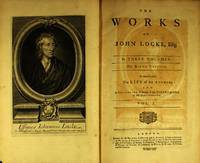
1722302488London: printed for A. Churchill and A. Manship and sold by W. Taylor in Pater-noster-Row 1722. The second edition. Frontispiece portrait by George Vertur after. 3 vols. Folio. Contemporary paneled calf neatly and almost imperceptibly rebacked preserving the original backstrips and spine labels. Bookplate of John Pollexfen Bastard and the signature of Charles Wymondesold whose widow married Bastard on the front free endpapers. Fine attractive copy. The second edition. Frontispiece portrait by George Vertur after. 3 vols. Folio. ESTC T128551 printed for A. Churchill, and A. Manship, and sold by W. Taylor in Pater-noster-Row unknown books
1777261203London: Printed for W. Strahan J.F. and C. Rivington L. Davis W.Owen . 1777. Eighth edition & second quarto edition after the 1768 Hollis Edition. Engraved copperplate frontispiece portrait of Locke by Cipriani. Folding chart in vol. I. 4 vols. 4to. Full contemporary polished calf red and green title labels. Joints neatly repaired. Unobtrusive labels on pastedowns. Front joint of vol. I tender. Handsome copy. Eighth edition & second quarto edition after the 1768 Hollis Edition. Engraved copperplate frontispiece portrait of Locke by Cipriani. Folding chart in vol. I. 4 vols. 4to. "This edition of Locke's Works is generally considered the best" Christophersen. Yolton 370; Christophersen pp. 88-89 Printed for W. Strahan, J.F. and C. Rivington, L. Davis, W.Owen .. unknown books
175927045London: D. Browne C. Hitch et al. 1759. 3 volumes folio pp. iii-xv 1 12 xvii-xxxii 587 16; 2 719 12; 6 757 12; engraved frontis portrait by Kneller after George Virtue engraved dedication; recent full brown niger morocco spines in 7 compartments red and black morocco labels in 2; minor toning of the text newspaper shadow between pp. 268-69 of vol. I else fine. The last of the folio editions. Alston VII 117; Yolton 368. <br/><br/> D. Browne, C. Hitch [et al.] unknown books
172726392London: Arthur Bettsworth Edmund Parker et al. 1727. 3 volumes folio pp. 8 xxviii 575 1 blank 16 index; 2 671 14 index; 6 668 15 index; engraved frontis portrait by Kneller after George Virtue engraved dedication; full contemporary calf red morocco labels on gilt-paneled spines; joints cracked cords holding; internally fresh and clean. Yolton 365. <br/><br/> Arthur Bettsworth, Edmund Parker, et al. unknown books
17592808London: Printed for D. Browne et al. 1759. Folio 14-1/4" tall. 3 vols. xvixxxii58816;272012;675713pp. Indices. Illustrated with an engraved frontis. portrait and the epitaph plate. 19th cent. 1/2 red morocco over marbled boards rebacked orig. spine strips laid down spine of Vol. III a bit discolored. A.e.g. The last 18th century folio edition and notable for having the typographic errors of earlier editions corrected. Yolton #368. Printed for D. Browne et al. hardcover books
1714122652London: John Churchill and Sam. Manship 1714. Rare first edition of the collected works of John Locke "the most worthy. of the indisputably great philosophers." Folio three volumes bound in full contemporary brown calf gilt titles and tooling to the spine morocco spine labels raised bands rebacked. Frontispiece of John Locke to volume one. In very good condition. John Locke is regarded as one of the most influential of Enlightenment thinkers and the Father of Classical Liberalism. "Locke was the first to take up the challenge of Bacon and to attempt to estimate critically the certainty and the adequacy of human knowledge when confronted with God and the universe" PMM 164. This is the first edition of the first collected edition of his work and the earliest to put his name to "Two Treatises on Government" as well as the letters on "Toleration"and "The Reasonableness of Christianity". Contents include: Volume 1: An Essay concerning Human Understanding. In Four Books; A Letter to the Right Reverend Edward Lord Bishop of Worcester concerning some Passages relating to Mr. Locke's Essay of Human Understanding in a late Discourse of his Lordship's in Vindication of the Trinity; Mr. Locke's Reply to the Right Reverend the Bishop of Worcester's Answer to the Letter; Mr. Locke's Reply to the Bishop of Worcester's Answer to his Second Letter. Volume 2: Some Considerations of the Consequences of the lowering of Interest and raising the Value of Money. In a Letter send to a Member of Parliament. 1691; Short Observations on a printed Paper entitled For encouraging the coining SilverMoney in England and after for keeping it here; Further Observations concerning raising the Value of Money. Wherein Mr. Lowndes's Arguments for it in his late Report concerning An Essay for the Amendment of the Silver Coin are particularly examind'd; Two Treatises of Government. In the Former the false Principles and Foundation of Sir Robert Filmer and his Followers are detected and overthrown. The Latter is an Essay concerning the true Original Extent and End of Civil Government; A Letter concerning Toleration; A Second Letter concerning Toleration; A Third Letter for Toleration: To the Author of the Third Letter concerning Toleration; The Reasonableness of Christianity as deliver'd in the Scriptures; A Vindication of The Reasonableness of Christianity From Mr. Edwards's Reflections; A Second Vindication of the Reasonableness of Christianity. Volume 3: Some Thoughts concerning Education; A Paraphrase and Notes on the Epistles of St. Paul to the Galatians I and II. Corinthians Romans and Ephesians. To which is prefix'd An Essay for the Understanding of St. Paul's Epistles by consulting St. Paul himself; Posthumous Works viz. I. Of the Conduct of the Understanding. II. An Examination of P. Malebranche's Opinion of Seeing all things in God. III. A Discourse of Miracles. IV. Par of a Fourth Letter for Toleration. V. Memoirs relating to the Life of Anthony first Earl of Shaftesbury. VI. A new Method of the Common-Place-Book written originally in French and translated into English; Some familiar Letters between Mr. Locke and Several of his Friends.The work was published ten years after his death and is the first time his works were published as a collection. John Churchill and Sam. Manship hardcover books
1801117649London: Printed for J. Johnson 1801. Finely bound edition of the collected works of John Locke "the most worthy. of the indisputably great philosophers." Octavo nine volumes bound in full contemporary calf gilt titles to the spine morocco spine labels raised bands. Frontispiece of John Locke and fold-out table. In very good condition. Rare and desirable in contemporary calf. John Locke is regarded as one of the most influential of Enlightenment thinkers and the Father of Classical Liberalism. "Locke was the first to take up the challenge of Bacon and to attempt to estimate critically the certainty and the adequacy of human knowledge when confronted with God and the universe" PMM 164. This is the first edition of the first collected edition of his work and the earliest to put his name to "Two Treatises on Government" as well as the letters on "Toleration"and "The Reasonableness of Christianity". Contents include: Volume 1: An Essay concerning Human Understanding. In Four Books; A Letter to the Right Reverend Edward Lord Bishop of Worcester concerning some Passages relating to Mr. Locke's Essay of Human Understanding in a late Discourse of his Lordship's in Vindication of the Trinity; Mr. Locke's Reply to the Right Reverend the Bishop of Worcester's Answer to the Letter; Mr. Locke's Reply to the Bishop of Worcester's Answer to his Second Letter. Volume 2: Some Considerations of the Consequences of the lowering of Interest and raising the Value of Money. In a Letter send to a Member of Parliament. 1691; Short Observations on a printed Paper entitled For encouraging the coining SilverMoney in England and after for keeping it here; Further Observations concerning raising the Value of Money. Wherein Mr. Lowndes's Arguments for it in his late Report concerning An Essay for the Amendment of the Silver Coin are particularly examind'd; Two Treatises of Government. In the Former the false Principles and Foundation of Sir Robert Filmer and his Followers are detected and overthrown. The Latter is an Essay concerning the true Original Extent and End of Civil Government; A Letter concerning Toleration; A Second Letter concerning Toleration; A Third Letter for Toleration: To the Author of the Third Letter concerning Toleration; The Reasonableness of Christianity as deliver'd in the Scriptures; A Vindication of The Reasonableness of Christianity From Mr. Edwards's Reflections; A Second Vindication of the Reasonableness of Christianity. Volume 3: Some Thoughts concerning Education; A Paraphrase and Notes on the Epistles of St. Paul to the Galatians I and II. Corinthians Romans and Ephesians. To which is prefix'd An Essay for the Understanding of St. Paul's Epistles by consulting St. Paul himself; Posthumous Works viz. I. Of the Conduct of the Understanding. II. An Examination of P. Malebranche's Opinion of Seeing all things in God. III. A Discourse of Miracles. IV. Par of a Fourth Letter for Toleration. V. Memoirs relating to the Life of Anthony first Earl of Shaftesbury. VI. A new Method of the Common-Place-Book written originally in French and translated into English; Some familiar Letters between Mr. Locke and Several of his Friends.The work was published ten years after his death and is the first time his works were published as a collection. Printed for J. Johnson hardcover books
1751111216London: S. Birt D. Brown T. Longman 1751. 1751 edition of the collected works of John Locke "the most worthy. of the indisputably great philosophers." Folio three volumes bound in full contemporary brown calf raised bands gilt titles and tooling to the spine morocco spine labels copper-engraved frontispiece portrait by George Vertue to volume one. In very good condition text clean with large margins. John Locke is regarded as one of the most influential of Enlightenment thinkers and the Father of Classical Liberalism. "Locke was the first to take up the challenge of Bacon and to attempt to estimate critically the certainty and the adequacy of human knowledge when confronted with God and the universe" PMM 164. This is the first edition of the first collected edition of his work and the earliest to put his name to "Two Treatises on Government" as well as the letters on "Toleration"and "The Reasonableness of Christianity". Contents include: Volume 1: An Essay concerning Human Understanding. In Four Books; A Letter to the Right Reverend Edward Lord Bishop of Worcester concerning some Passages relating to Mr. Locke's Essay of Human Understanding in a late Discourse of his Lordship's in Vindication of the Trinity; Mr. Locke's Reply to the Right Reverend the Bishop of Worcester's Answer to the Letter; Mr. Locke's Reply to the Bishop of Worcester's Answer to his Second Letter. Volume 2: Some Considerations of the Consequences of the lowering of Interest and raising the Value of Money. In a Letter send to a Member of Parliament. 1691; Short Observations on a printed Paper entitled For encouraging the coining SilverMoney in England and after for keeping it here; Further Observations concerning raising the Value of Money. Wherein Mr. Lowndes's Arguments for it in his late Report concerning An Essay for the Amendment of the Silver Coin are particularly examind'd; Two Treatises of Government. In the Former the false Principles and Foundation of Sir Robert Filmer and his Followers are detected and overthrown. The Latter is an Essay concerning the true Original Extent and End of Civil Government; A Letter concerning Toleration; A Second Letter concerning Toleration; A Third Letter for Toleration: To the Author of the Third Letter concerning Toleration; The Reasonableness of Christianity as deliver'd in the Scriptures; A Vindication of The Reasonableness of Christianity From Mr. Edwards's Reflections; A Second Vindication of the Reasonableness of Christianity. Volume 3: Some Thoughts concerning Education; A Paraphrase and Notes on the Epistles of St. Paul to the Galatians I and II. Corinthians Romans and Ephesians. To which is prefix'd An Essay for the Understanding of St. Paul's Epistles by consulting St. Paul himself; Posthumous Works viz. I. Of the Conduct of the Understanding. II. An Examination of P. Malebranche's Opinion of Seeing all things in God. III. A Discourse of Miracles. IV. Par of a Fourth Letter for Toleration. V. Memoirs relating to the Life of Anthony first Earl of Shaftesbury. VI. A new Method of the Common-Place-Book written originally in French and translated into English; Some familiar Letters between Mr. Locke and Several of his Friends.The work was published ten years after his death and is the first time his works were published as a collection. S. Birt, D. Brown, T. Longman hardcover books
2010564842010. ISBN-13: 9781616190347; ISBN-10: 1616190345. One of the Great Treatises on Government Locke John. Two Treatises of Government: In the Former The False Principles and Foundation of Sir Robert Filmer and His Followers are Detected and Overthrown. The Latter is an Essay Concerning the True Original Extent and End of Civil Government. Originally published: London: Printed for Awnsham and John Churchill 1698. 6 358 pp. Reprinted 2010 by The Lawbook Exchange Ltd. ISBN-13: 9781616190347; ISBN-10: 1616190345. Paperback. New. $14.95 Reprint of the third edition. Published after the Glorious Revolution of 1688 brought William of Orange and Mary to the throne but written in the throes of the Whig revolutionary plots against Charles II in the early 1680s John Locke offers a theory of natural law and natural rights which distinguish between legitimate and illegitimate civil governments and argues for the legitimacy of revolt against tyrannical governments. These radical ideas remain influential today. In these two treatises the political philosopher John Locke espouses radical theories which influenced the ideologies of the American and French revolutions and became the basis for the social and political philosophies of Rousseau Voltaire and the United States founding fathers. In the first treatise Locke aims to refute the doctrine of the patriarchal and absolute right of the Divine Right of Kings doctrine put forth by Sir Robert Filmer's Patriarcha. He examines key Biblical passages to prove that scripture does not support Filmer's premise. The second treatise offers Locke's positive theory of government in which he establishes a theory which reconciles the liberty of the citizen with political order. His basic premise is founded on the independence of the individual. He declares that men are born free and equal in their rights and that wealth is the product of labor. In his revolutionary theory of the social contract he proposes that a legitimate civil government must preserve the rights to life liberty health and property of its citizens and prosecute and punish those in violation of those rights. JOHN LOCKE 1632-1704 a leading philosopher of the Enlightenment is widely considered to be the father of liberalism. He was initially trained as a physician receiving a doctorate in medicine at Oxford. He was an important influence on Monte. unknown books
2010423402010. ISBN-13: 9781584776024; ISBN-10: 1584776021. One of the Great Treatises on Government Locke John. Two Treatises of Government: In the Former The False Principles and Foundation of Sir Robert Filmer and His Followers are Detected and Overthrown. The Latter is an Essay Concerning the True Original Extent and End of Civil Government. Originally published: London: Printed for Awnsham and John Churchill 1698. 6 358 pp. Reprinted 2006 2010 by The Lawbook Exchange Ltd. ISBN-13: 9781584776024; ISBN-10: 1584776021. Hardcover. New. $39.95 Reprint of the third edition. Reprint of the third edition. Published after the Glorious Revolution of 1688 brought William of Orange and Mary to the throne but written in the throes of the Whig revolutionary plots against Charles II in the early 1680s John Locke offers a theory of natural law and natural rights which distinguish between legitimate and illegitimate civil governments and argues for the legitimacy of revolt against tyrannical governments. These radical ideas remain influential today. In these two treatises the political philosopher John Locke espouses radical theories which influenced the ideologies of the American and French revolutions and became the basis for the social and political philosophies of Rousseau Voltaire and the United States founding fathers. In the first treatise Locke aims to refute the doctrine of the patriarchal and absolute right of the Divine Right of Kings doctrine put forth by Sir Robert Filmer's Patriarcha. He examines key Biblical passages to prove that scripture does not support Filmer's premise. The second treatise offers Locke's positive theory of government in which he establishes a theory which reconciles the liberty of the citizen with political order. His basic premise is founded on the independence of the individual. He declares that men are born free and equal in their rights and that wealth is the product of labor. In his revolutionary theory of the social contract he proposes that a legitimate civil government must preserve the rights to life liberty health and property of its citizens and prosecute and punish those in violation of those rights. JOHN LOCKE 1632-1704 a leading philosopher of the Enlightenment is widely considered to be the father of liberalism. He was initially trained as a physician receiving a doctorate in medicine at Oxford. He. unknown books
17271508179Arthur Bettesworth London 1727. 3rd Edition. Hardcover. Very Good/No Jacket. Three volumes Folio. Very good condition clean inside. Third edition of Locke's collected works including the Essay Concerning Human Understanding Two Treatises of Government Some Thoughts Concerning Education and his Letters Concerning Toleration. Contemporary leather binding six raised bands. Arthur Bettesworth, London hardcover books
30825<p>quarto two pages plus stamp-less address leaf in very good clean condition.</p><p> Locke writes:</p><p> "… in case I get any money for I am distressingly short just now … I have provided myself with a ticket for the Roxbury Lyceum course of lectures which began last evening. Introductory by Mr. Webster on popular education. It was a very good one but the views were not sound. He attributed the general increase of popular knowledge to the application of science… and to general use of labor saving machines or rather as he called them <u>Labordoing</u> machines which by doing up the work afford much time for the improvement of the mind. He then went on to state that the more of these things the better and advocate the encouragement of monopolies and corporations for the purpose of carrying on all sorts of Business manufactures and machinery operations – Now that is just the trouble with his whig principles. The poor man forgot to mention that in England the land of monopolies and of corporations and of capital and of Laboring machines the poorer laboring classes are in a far less agreeable situation than the same are with us. How ignorant and degraded are they in comparison to ours. Poor man he forgot that in the land where his favorite system is in the fullest operation there its effect which sounds so well in theory in practice has a most unfavorable effect. Webster knows better than to stick so closely to the miserable English system of Political Economy He does it all to compliment the Boston people…"</p> Little is known about the astute 21 year-old writer whose life was sadly short. Born in Fitzwilliam New Hampshire he came to Massachusetts to care for a farm owned by his family. Less than ten years later he died in Arkansas at age 29. As for Daniel Webster his 1836 speech at Roxbury may have been a rehearsal for an address he delivered two years later on the floor of the United States Senate in which he lauded Massachusetts as the most "highly civilized society" on earth with the greatest "equality in the condition of men" all of whom might be called "aristocrats". He also praised science for "creating millions of laborers in the form of machines all but automatic" surely one of the earliest American tribute to automation in the era of the British Luddites. books
19232221731<p>WITH RARE DUST JACKET</p><p>First edition first impression July 1923. Octavo. Color frontispiece and four full page b/w plates by Charles L. Meister. Original gilt stamped red cloth with design in black and baby blue. Original pictorial dust jacket which replicates the design unclipped; chips lower front panel; few small edge nicks. Very good. 315 pages 8 pages of ads. Rare thus.</p><p>Locke 1887- Boston Public Library librarian.</p><p>Hagen page 240.</p> L. C. Page & Company hardcover books
1972142092London: Ferret Fantasy 1972. Octavo pp. 1-2 1 2-76 77-78: ads printed self wrappers. First edition. Limited to 400 copies. Articles on fantasy and SF most of the volume pages 22-76 comprising Locke's annotated addendum of approximately 300 titles not recorded in the Bleiler 1948 and Day 1963 checklists. A fine copy. #142092 Ferret Fantasy unknown books
1972167235London: Cornmarket Reprints 1972. Octavo pp. 1-12 1-180 illustrations cloth. First edition. Anthology collecting Victorian and Edwardian interplanetary fiction reproduced in facsimile from popular British periodicals of the period including the original version of George Griffith's "Stories of Other Worlds" a six-part serial rewritten as HONEYMOON IN SPACE 1901. Partial tape ghost at upper and lower edges of front and rear free endpapers else a fine copy in fine dust jacket. #167235 Cornmarket Reprints unknown books
197240262London: Cornmarket Reprints 1972. Octavo pp. 1-12 1-180 illustrations cloth. First edition. Anthology collecting Victorian and Edwardian interplanetary fiction reproduced in facsimile from popular British periodicals of the period including the original version of George Griffith's "Stories of Other Worlds" a six-part serial rewritten as HONEYMOON IN SPACE 1901. A fine copy in fine dust jacket. #40262 Cornmarket Reprints unknown books
197821418London: Ferret Fantasy Ktd 1978. Limited edition. Hardcover. Fine/Fine. 8vo. 96pp. Black cloth gilt spine title. A fine copy in a fine dustwrapper. One of 49 copies signed by the author of a total edition of 56 copies. This is copy No. 45. Introduction by Nelson Bond who also signed at the beginning of the Introduction. This edition is interleaved for notes though we find none present. Addenda and Corrigenda leaf is laud in. "a select bibliography and notes for the collector" Ferret Fantasy Ktd hardcover books
196051841Stanford:: Stanford University Press. Very Good in Very Good dust jacket. 1960. Hardcover. B000UHLHL4 . First edition. Very good in a very good age darkened dust jacket. ; 126 pages . Stanford University Press, hardcover books
1960029511Stanford: Stanford University Press 1960. vii 126p. original cloth half-dozen pages with a bit of ink annotation. Stanford University Press unknown books
1916012504Milford N.H.: W.B. And A.B. Rotch 1916. Front cover lettered in bright gilt. "Geography and geology of Amherst life and character of General and Lord Jeffery Amherst reminiscences of "Cricket Corner" and "Pond Parish" districts by Prof. Warren Upham archaeologist of the Minnesota Historical Society". Illustrated throughout in black and white one folded plate of "The Second Church". Historical poem entitled "Fragrant Memories or The Dead of the Hundred Years 1760-1860" By Edfward D. Boylston at the end. A crisp clean copy of a scarce title. 122pp. First Edition. Brown Cloth. Light Edge Wear./No Jacket. Thin Octavo. W.B. And A.B. Rotch Hardcover books
196714212Camp LaGuardia NY 1967. Original 2pp typed letter on two sides of a sheet of hotel letterhead dated 31 July 1967. Addressed: Dear Ben Shahn signed in ink "Ed Locke." Three old folds else fine. A warm and personal letter from Shahn's old friend and fellow FSA photographer including and commenting on two poems Locke has written: ".a bit of formal verse has crowded into my mind four-square.I'd not send you these trivia except as evidence that my heart is beating in some fashion.I'm inflicting the verses upon you not just because you encouraged me but because they are a sort of safety-valve. What an ancient square I am! I slip into a villanelle as though it were my own coat. Do you ever doodle with your brush" <br/><br/>Though his talents lay more in the realm of writing and editing than photography Edwin Locke worked for three years as Roy Stryker's main assistant at the FSA where in addition to editorial tasks he participated in a number of documentary photo shoots including an important collaboration with Walker Evans to document victims of the 1937 Arkansas Flood. His association with Shahn would have dated from this period as Shahn and Stryker were extremely close colleagues in Washington first in the Special Skills section of the Resettlement Administration and later in the art section of the FSA. unknown books
199470970Canton: Harlequinade Press 1994. First edition. 85 pp. Fine in illustrated wrappers. Poems. Canton: Harlequinade Press, unknown books
198112689Wilmington MA:ZBR Publications 1981. 1st edition. Fine in near fine dust jacket. Review copy with letter laid in SIGNED by Locke. Wilmington, MA:ZBR Publications, unknown books
199448781Canton: Harlequinade Press 1994. First edition. 65 pp. Fine in illustrated wrappers. Promotional letter laid in. Canton: Harlequinade Press, unknown books
1995113248Canton MA: Harlequinade Press 1995. stiff paper wrappers. small 8vo. stiff paper wrappers. viii 76 pages. First edition. Blurbs by Stephen Spender X.J. Kennedy. Wrappers with a half-inch closed tear on the back wrapper. Harlequinade Press unknown books