Locke, JohnBiblio.com
105 résultats
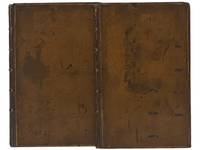
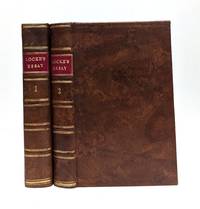
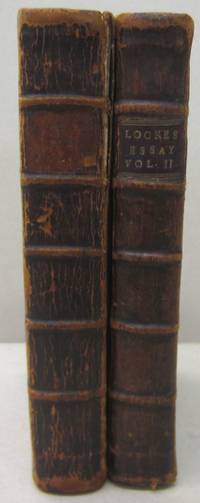
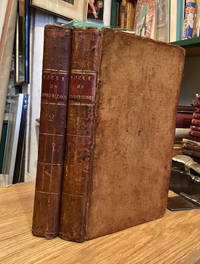
176871725London: H. Woodfall A. Millar et al. 1768. 8vo. Vol 1: 32 372 pp. Vol 2: 16 340 28 - index pp. Full contemporary speckled calf. Red title-labels with gilt lettering and ruling to spine. Top edge stained black. Small loss to base of front joint of Volume 1. Wear to surface of spines edges and spine ends. Corners bumped. Binding firm and boards solid and intact. Laid paper. Internally generally clean with the odd bit of light foxing. Locke's 'Essay concerning human understanding' is one of the primary texts of empiricism in modern philosophy its thesis being to reject the rationalist philosophers' notion of innate ideas and set forth new grounds for ideas based in experience. These volumes cover Locke's refutation of rationalist thinking his theory of ideas theory of personal identity language and knowledge. This work was influential to Enlightenment thinkers such as George Berkeley and David Hume. . Very Good. Speckled Calf. 1768. H. Woodfall, A. Millar, et al. 1768 unknown
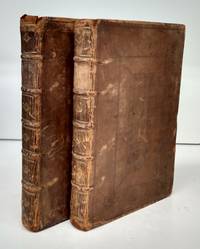
17352346391Edinburgh: Mundell & Son; and J. Mundell 1735. Eleventh Edition. Full-Leather. Good/No Jacket. 1735 eleventh edition. Three volumes bound in two. Large discolored area on rear board of second volume a few spots on boards otherwise evidence of repair along joints of both spines corners a bit rubbed a few pages lightly foxed ink names on title page of each volume C.J. Forbes Florence; Tho. Storer. xxxii 372; xvi 340 27 pp. 8vo. Contemporary full calf black and red morocco spine labels five raised spine bands gilt titles and rules with decorations in compartments speckled edges and marbled endpapers. First published in 1689 this is a foundational work in the influential British school of empiricism of which Locke was among the leading proponents. Empirical philosophy argued that knowledge stemmed from subjective experience a posteriori rather than the operation of objective reason a priori. As such this work contains commentary on how the formation of ideas relates to sensation and perception. This edition includes an extensive index. Mundell & Son; and J. Mundell hardcover
1726151156London: Printed by T. W. for A. Churchill; And Edm. Parker 1726. Vol. I states Ninth edition with large additions. Hardcover. Good. 2 vols.: iii 26 372; 16 340 25 p. 20 cm. Frontispiece engraving. Full leather with blank impressing. Spine labels missing cracks to spine corners and edges worn. Bookplates on front pastedowns for William Wilson Surgeon in Greenock. Vol. I bookplate is loosening and front free endpaper has rough edge. Rear endpapers are also roughened and rear pastedown is lifting up.Tear in spine head of vol. II and front pastedown of vol. II loosening. Paper is unusually bright and clean with only a few minor marks. <br/><br/>English philosopher and physician John Locke is widely regarded as one of the most influential of Enlightenment thinkers and sometimes as "father of liberalism." This is an early printing of his great treatise on human knowledge and understanding that first appeared in 1689. Printed by T. W. for A. Churchill; And Edm. Parker hardcover
1753mon0000145146London S. Birt et al. 1753. Hardcover. Acceptable. in x in x in. Volume 2 only book is missing front cover printed in 1753 rest of book is good condition London, S. Birt et al. hardcover
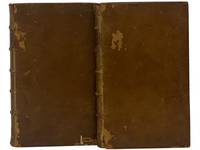
1753652421Printed for S. Birt et al. 1753. Fourth Edition. Leather Binding. Near Fine. 2 volumes. Beautifully rebound in period style in full brown calf spines with raised bands red morocco labels and gilt rules some leaves have marginal staining - binding is fine. The Fourteenth edition. Printed for S. Birt, et al. unknown
17412350909London: Printed for C. Hitch in Pater-noster-Row; J. Pemberton in Fleetstreet; J. Beecroft in Lombard-Street; and S. Symon in Cornhill 1741. Twelfth Edition. Full-Leather. Very Good/No Jacket. Twelfth edition. Spines a bit faded corners rubbed with minor loss bookplate removal marks on front endpaper of each volume minor pencil marginalia. 1741 Full-Leather. iv 26 372; xiv 340 27 pp. 8vo. Contemporary full calf red morocco spine labels five raised spine bands gilt titles and rules with decorations in compartments. First published in 1689 this is a foundational work in the influential British school of empiricism of which Locke was among the leading proponents. Empirical philosophy argued that knowledge stemmed from subjective experience a posteriori rather than the operation of objective reason a priori. As such this work contains commentary on how the formation of ideas relates to sensation and perception. This edition includes an extensive index. Printed for C. Hitch in Pater-noster-Row; J. Pemberton in Fleetstreet; J. Beecroft in Lombard-Street; and S. Symon in Cornhill hardcover
1726060949London: T.W. for A. Churchill & C. Hitch in Pater-Noster Row. 1726. Reprint . Hardcover. Very Good. 8vo. Engraved Portrait Frontispiece. LONDON : 1726 1741. Two Volumes Complete; not a matching set. Hardbacks. Engraved portrait frontispiece to the first volume. Contemporary full dark-brown calf-leather not matching but similar. Raised bands; dark-red Morocco labels. Bright tight and clean. Neat owner name and bookplate. No internal markings. Hinges cracking slightly. Minor wear; strong and sound. VERY GOOD. i xxxii 372 340 xxviii pages. Index to vol 2. Scarce. 8vo. PLEASE NOTE: If wanting to buy just one volume to match one you already have; we are happy to sell separately; please ask. Extra postage needed for both vols if ordering outside the UK. Will be well-packed for posting/shipping. London: T.W. for A. Churchill & C. Hitch in Pater-Noster Row. SCARCE. <br/> <br/> T.W. for A. Churchill & C. Hitch in Pater-Noster Row. hardcover
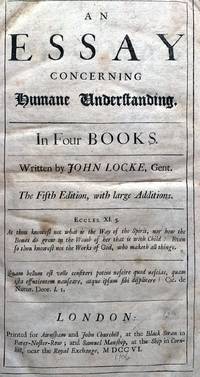
1706149827London: Printed for Awnsham and John Churchill at the Ship in Cornhill near the Royal Exchange 1706. Fifth edition with large Additions. Full dark brown speckled calf with with panelled onlay of tan calf decoratively edged with blind rolls and decorations red calf spine compartment titled in gilt plain endpapers. Inked name to front pastedown and with handsome engraved portrait of John Locke adhered to front pastedown inked notations to lower margin of title page overall a clean wide-margined and handsomely restored copy. Restoration by Glenn Fukunaga. Large quarto. xliv 604pp. Pp. 259-262 mis-paginated 260 261 255 263 but with catchwords correct and no text lacking. Pagination 285-344 lacking but once again catchwords indicate not text lacking. 14" x 9.25. A foundational work of Enlightenment philosophy Locke’s Essay first published 1690 reshaped the intellectual landscape of Europe and the Americas by rejecting innate ideas and grounding all human knowledge in sensory experience. With his doctrine of the mind as a tabula rasa Locke challenged traditional metaphysics laying the groundwork for empiricism and influencing thinkers from Hume to Jefferson. His nuanced treatment of personal identity language and the limits of human understanding offered a blueprint for liberal political thought and the modern scientific method. First editions and early issues are cornerstones of any serious collection of philosophy or political theory prized both for their historical impact and enduring relevance to debates on human reason. Printed for Awnsham and John Churchill, at the Ship in Cornhill, near the Royal Exchange unknown
172670120London: T. W. for A. Churchill 1726. Ninth Edition with large additions. Full Leather. Good - minus. Four books bound as a two volume set. 20 x 12.5 cm. Octavos. 3 ii-xxvii 372pp 16 340 27 index. Portrait frontispiece in volume one. Bound in full leather. Several previous owner's names Robert Denovan and 18th century notations. Chipping to the top of the first few pages including to the portrait though Locke himself is not effected. Front fixed endpaper of volume 1 mostly gone. Rubbing to the edges of the board. Front hinge of volume 1 is weak. Spine label of volume 1 missing vol 2 has a red spine label. Tear and wear to back cover of vol 1. ESTC T63946. T. W. for A. Churchill unknown
170617416London: Printed for Awnsham and John Churchill 1706. FIFTH EDITION. Index bound after Contents and before text. Contemporary full-paneled calf panels blind-stamped on front and rear boards edges partially rubbed with corners reinforced rebacked; interior excellent. Fifth edition containing expansions of all four books. This edition includes the final textual changes by Locke though it was published posthumously. It was also the last edition printed in folio format. Locke’s 1632-1704 famous work of empirical philosophy deals with the fundamental issues of how we think perceive and express ourselves through language logic and religion. All later editions were based upon this 1706 printing. Printed for Awnsham and John Churchill unknown
173177508London: SyMON 1731. VOLUME ONE FRONT COVER IS MISSING.VOLUME TWO FRONT COVER IS DETACHED BUT STILL PRESENT. BINDING IS TIGHT. Leatherbound. Worn Condition. SyMON Hardcover
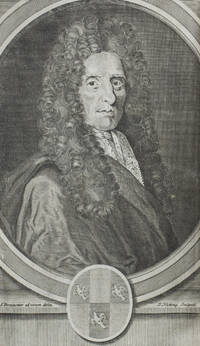
171642019London: J. Churchill Vol. 1; A. and J. Churchill Vol. 2 1716. Seventh Edition with large Additions. Hardcover. fair to vg. Octavo 8 x 5". 32 372 1; 16 340 25 index 1pp. Contemporary full calf with modern white lettering on spine. Raised bands. Previous owner's gift inscription on front free endpaper: "To the Edinburgh Academical Club This Book Is Presented By One of its Original Members John M. Balfour. 1829." Engraved frontispiece portrait of John Locke by J. Nutting after a painting by S. Brounower. Title page for each volume.<br /> <br /> Seventh and enlarged edition of John Locke’s Essay "Concerning Human Understanding" a philosophical landmark originally published in 1689 although dated 1690.5<br /> <br /> One of the principal sources of empiricism in modern philosophy this essay presents a detailed systematic philosophy of mind and thought and wrestles with fundamental questions about how we think and perceive and it even touches on how we express ourselves through language logic and religious practices. In the introduction entitled 'The Epistle to the Reader' Locke describes how he became involved in his current mode of philosophical thinking. He relates an anecdote about a conversation with friends that made him realize that men often suffer in their pursuit of knowledge because they fail to determine the limits of their understanding. <br /> <br /> The Essay is divided into four books two per volume:<br /> <br /> First volume:<br /> <br /> - Book I is devoted to an attack on nativism or the doctrine of innate ideas. Locke allowed that some ideas are in the mind from an early age but argued that such ideas are furnished by the senses starting in the womb: for instance differences between colors or tastes. If we have a universal understanding of a concept like sweetness it is not because this is an innate idea but because we are all exposed to sweet tastes at an early age. One of Locke's fundamental arguments against innate ideas is the very fact that there is no truth to which all people attest. He took the time to argue against a number of propositions that rationalists offer as universally accepted truth for instance the principle of identity pointing out that at the very least children and idiots are often unaware of these propositions. <br /> <br /> - Book II: Whereas Book I is intended to reject the doctrine of innate ideas proposed by Descartes and the rationalists Book II explains that every idea is derived from experience either by sensation - direct sensory information - or reflection - "the perception of the operations of our own mind within us as it is employed about the ideas it has got". Furthermore Book II is also a systematic argument for the existence of an intelligent being: "Thus from the consideration of ourselves and what we infallibly find in our own constitutions our reason leads us to the knowledge of this certain and evident truth that there is an eternal most powerful and most knowing being; which whether any one will please to call God it matters not!" <br /> <br /> Second volume:<br /> <br /> - Book III focuses on words. Locke connects words to the ideas they signify claiming that man is unique in being able to frame sounds into distinct words and to signify ideas by those words and then that these words are built into language. Chapter ten in this book focuses on "Abuse of Words." Here Locke calls out metaphysicians for making up new words that have no clear meaning. He also criticizes the use of words which are not linked to clear ideas and to those who change the criteria or meaning underlying a term. Thus he uses a discussion of language to demonstrate sloppy thinking. Locke followed the Port-Royal Logique 1662 in numbering among the abuses of language those that he calls "affected obscurity" in chapter 10. Locke complains that such obscurity is caused by for example philosophers who to confuse their readers invoke old terms and give them unexpected meanings or who construct new terms without clearly defining their intent. Writers may also invent such obfuscation to make themselves appear more learned or their ideas more complicated and nuanced or erudite than they actually are. <br /> <br /> - Book IV and last focuses on knowledge in general - that it can be thought of as the sum of ideas and perceptions. Locke discusses the limit of human knowledge and whether knowledge can be said to be accurate or truthful. Thus there is a distinction between what an individual might claim to "know" as part of a system of knowledge and whether or not that claimed knowledge is actual. For example Locke writes at the beginning of Chap. IV Of the Reality of Knowledge: "I doubt not my Reader by this Time may be apt to think that I have been all this while only building a Castle in the Air; and be ready to say to me To what purpose all of this stir Knowledge say you is only the Perception of the Agreement or Disagreement of our own Ideas: but who knows what those Ideas may be . But of what use is all this fine Knowledge of Man's own Imaginations to a Man that enquires after the reality of things It matters now that Mens Fancies are 'tis the Knowledge of Things that is only to be priz'd; 'tis this alone gives a Value to our Reasonings and Preference to one Man's Knowledge over another's that is of Things as they really are and of Dreams and Fancies." In the last chapter of the book Locke introduces the major classification of sciences into physics semiotics and ethics.<br /> <br /> Binding heavily rubbed along edges with closed tears along joints. Head and tail of spine slightly chipped. Hinges reinforced with binder's tape. Previous owner's bookplate on inside of front cover James A. Young. Stamp of the Edinburgh Academical Club at lower margin of front free endpaper and on both title pages. Moderate and sporadic age-toning throughout and minor and sporadic creasing along paper margin not affecting lettering. Binding in overall fair interior in good to very good condition. "John Balfour 1750-1842 was a Scottish politician and a civil servant in the East India Company with connections to the Orcadian island of Shapinsay." From Wikipedia. J. Churchill (Vol. 1); A. and J. Churchill (Vol. 2) hardcover
176862367London: Printed for H. Woodfall A. Millar J. Beecroft Etc. 1768. Sixteenth ed. Leather rubbed and bumped with minor loss. Hinges cracked owner bookplates to front pastedowns worm damage to base edge of vol 1 throughout affects some text but mainly just to bottom page margin occasional smudge mark or browining else text clear and bright. Full Leather. Good Minus. 8vo. Printed for H. Woodfall, A. Millar, J. Beecroft, Etc. Hardcover
179818190Edinburgh: Mundell & Son; and J. Mundell. Near Fine with No dust jacket as issued. 1798. Reprint. First Printing. Leather. Contemporary calf rebacked gilt lettering on burgundy and gilt labels on spines. First appearing in 1689 although dated 1690 "An Essay Concerning Human Understanding" by John Locke concerns the foundation of human knowledge and understanding. He describes the mind at birth as a blank slate filled later through experience. The essay was one of the principal sources of empiricism in modern philosophy and influenced many enlightenment philosophers such as David Hume and George Berkeley. Expertly rebacked unmarked tight square and clean. A very attractive set. NEAR FINE. 12mo 7" - 7½" tall. liii 271; xvi 264; xiv 308 pp . Mundell & Son; and J. Mundell hardcover
170655247London: Printed for Awnsham and John Churchill 1706. Fifth edition. four books in one. Modern tidy rebind new endpapers which are lightly browned. Title page a little rubbed with some browning to verso. Contents slightly wrinkled but very clean and tidy the odd spot some pages have a bottom corner crease p.445 has loss to bottom corner not affecting text p.589 has small ink correction. Otherwise clean bright and sturdy. . Cloth. Very Good. Folio. Printed for Awnsham and John Churchill Hardcover
1753766861753. LOCKE John. AN ESSAY CONCERNING HUMAN UNDERSTANDING. In Four Books. London S. Birt et al. 1753. Octavo. Two volumes. xxx372; xiv34028pp. Fourteenth edition complete in two volumes. Engraved frontispiece portrait by Vertue after Kneller detached and torn at edges. Portions of flyleaves torn off; a few pages toned but on the whole clean within. Early speckled calf raised bands to spine. Scuffed and worn at extremities; small losses to spine ends. unknown
17155003694London: A & J Churchill 1715. Hardcover. Good-. 12mo. Wear to extremities.Some shrinkage to spine at bands. Some surface loss to spine titles and rear board. Rust marks to rear feps from floral items. <br/> <br/> A & J Churchill hardcover
17686375London Printed for H. Woodfall and 22 others 1768. 1768 8vo. Two volumes. 2 iv 26 372; 16 340 28 p. Contemporary sprinkled calf worn on corners and spine ends. Joints cracked but boards firmly attached. p68-69 in Vol. I have loss of a few words due to sealing wax adhesion otherwise the contents clean and tight. London, Printed for H. Woodfall, [and 22 others], hardcover
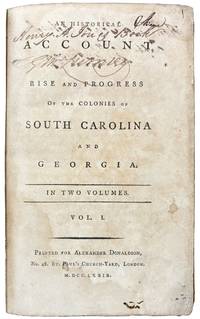
1799068560London: Printed for Alexander Donaldson 1799. First Edition. Hardcover. Very Good. 8vo. respectively. FIRST EDITION 1779. TWO VOLUME COMPLETE SET. The First History of South Carolina. Howes H452. Printed for Alexander Donaldson London 1779. Matching hardcover set. Rebound in black cloth covers are plain. Spines bear orange leather labels stamped in gilt along with the volume numbers. Top edges gilt. Endpapers are gray. Leaves are printed on laid paper. Includes "The first set of the fundamental constitutions of South Carolina / as compiled by Mr. John Locke"/ pages 321-347. Vol. I: xiv 347 pp; Vol II: ix 309 pp. On a shelf this set spans 2.5 inches. <br><br>ABOUT THIS SET: The "earliest history of the region" Howes H452. "Justin Winsor calls this work the 'earliest account of South Carolina cast in a sustained retrospective spirit'. Hewatt an Englishman who at one time lived at Charleston was a keen collector of historical documents". Streeter II 1133. "In Volume I Hewatt gives a sympathetic and balanced account of Indian life and customs based in part on his own observations. He describes the climate soil natural resources fauna snakes and insects; how to make turpentine tar and pitch; and how to cultivate silk cotton and especially rice. In Volume II he describes and criticizes slavery in the colonies and the treatment of slaves; he maintains that slaves should be given some instruction in morals and religion. He discusses diseases in Carolina and describes the cultivation of indigo in some detail. His factual account of the 'present state and condition of the colony' probably refers to the latter 1760s or early 1770s; he quotes some statistics of 1776." Clark I 225. De Renne 217. Turnbull I 223. <br><br>ABOUT THE AUTHOR: Alexander Hewatt came to Charleston in 1763 as minister of the Scots First Presbyterian Church there. Fascinated with the history of South Carolina he soon became a keen collector of historical documents. When the British fleet arrived at Charleston in 1776 Hewatt and other ministers were required to renounce their loyalty to the king. When he refused Hewatt was given sixty days to leave the colony. He sailed for Great Britain where he devoted the next two years to completing his history. In 1780 he was awarded the Doctor of Divinity form the University of Edinburgh an indication of the esteem in which he and his work were held. "Hewatt's account reflects the influence of William Robertson and the Scottish school of historiography. less concerned with a strict chronology of events Hewatt instead focused on the interrelatedness of those events and their various causes and effects. His goal in doing so was to provide moral political and practical instruction to the colonists and to those in England" both of whom he hoped would see the importance of continuing South Carolina's close ties to the Crown" ANB. The work includes detailed descriptions of the climate topography and fauna of South Carolina as well as discussions of slavery there. He warned that the mistreatment of slaves was likely to "fire them with desires of liberty and vengeance." Chapter 5 in the first volume includes a full account of the Yamasee War while chapter 10 is devoted to the war with the Cherokee. <br><br>CONDITION: This set is overall VG with general shelf wear. Removal of bookplate on the front pastedown on both volumes and clipped rectangular front endpaper removed in both volumes. Leaves are in remarkable condition with extremely minimal foxing. Completely free from marginalia or annotation. Bindings are tight. An incredible set. <br><br>Additional photographs available upon request. This set will be delivered with "adult signature required". Full refund if not satisfied. Printed for Alexander Donaldson hardcover
177940925London: Printed for Alexander Donaldson No. 48. St. Paul's Church-Yard London 1779. 8vo. 8 1/4 x 5 inches. First edition. Volume I: a-b4 A-Uu4 Xx2. i-xiv 2 1-347 1. 364 pp. Title Preface Contents Chapters I-VI The First Set of the Fundamental Constitutions of South Carolina as Compiled by Mr. John Locke. Volume II: a4 b1 A-Ss4 x1. i-ix 1 1-329 1. 340 pp. Last page misnumbered 309. Title Contents Chapters VII-XI With inscriptions of "Henry A. Jones" on both volumes unclear if it is the playwright of the same name. Bound to style in 18th-century calf spines with raised bands forming compartments gilt lettered red morocco lettering pieces in second compartments. Restoration to the the last text leaf in volume one<br/> <br/> First edition of the fundamental historical account of South Carolina and Georgia which Howes calls "the earliest history of this region" and Winsor states is the "earliest account of South Carolina cast in a sustained retrospective spirit." Streeter<br/> <br/> Hewatt or Hewat was a Scottish-born Presbyterian minister educated at Edinburgh who presided over the Scots First Presbyterian Church in Charleston when it was Charlestown South Carolina from 1763 to 1777. When the British fleet arrived at Charlestown in 1776 Hewatt and other ministers were forced by Patriots to renounce their loyalty to the king. When he refused Hewatt was given sixty days to leave the colony. His property was seized and he returned to the British Isles and wrote this historical account in London. Considered by Howe to be the earliest and best account of Colonial South Carolina and Georgia the book is bolstered by as Streeter states Hewatt being a "keen collector of historical documents." However his work remains important today because it is also based on his personal observations as a first-hand source from over a decade of lived experience in the region. Hewatt discusses the immigration of British French and other European migrants to the Carolinas due to religious persecution at home. He examines the lives they then created in the New World and the economies they built while doing so. But Hewatt also pays especial detail to the customs and cultures of those people these settlers displaced: the indigenous Native Americans of the region. "Hewatt gives a sympathetic and balanced account of Indian life and customs. He describes the climate soil natural resources fauna snakes and insects; how to make turpentine tar and pitch; and how to cultivate silk cotton and especially rice." De Renne An opponent of slavery as many Presbyterians were he chronicles the introduction of enslaved people from Africa and the ensuing social and economic problems it caused. He criticizes slavery in the colonies and the treatment of enslaved people while maintaining that they should be given instruction in morals and religion. He also warns that to mistreat enslaved people was to "fire them with desires of liberty and vengeance." Also covered in Volume I is the Yamasee War and in Volume II the War with the Cherokee. In 1780 after the publication of this work Hewatt was awarded the Doctor of Divinity from the University of Edinburgh an indication of the success of the present book. "Hewatt's account reflects the influence of William Robertson and the Scottish school of historiography. Less concerned with a chronology of events Hewatt instead focused on the interrelatedness of those events and their various causes and effects. His goal in doing so was to provide moral political and practical instruction to the colonists and to those in England." ANB His work especially his comments on Native Americans and enslaved people were used as the basis for David Ramsay's history though it went uncredited. The first volume includes the "first set of the fundamental constitutions of South Carolina" which have been attributed to the English political philosopher John Locke because he at the time was working as a paid secretary for one of the Province of Carolina's proprietors Anthony Ashley Cooper. The historian David Armitage and the political scientist Vicki Hsueh argue he was a co-author along with Cooper the 1st Earl of Shaftesbury. The constitutions reflect Locke's classical liberalism safeguarding religious freedom while also setting up a reactionary neo-feudal form of government.<br/> <br/> Clark I 255. De Renne 217. Howes H452 b. Sabin 31630. Servies 522. Streeter Sale 1133. Turnbull I 223. Printed for Alexander Donaldson, No. 48. St. Paul's Church-Yard, London unknown
1709097678Lipsiae: Sumptibus Theophili Georgie 1709. Book measures 6 3/4 x 4 1/4 inches. Collation 591943pp engraved frontis. Bound in full period vellum yapp edges title in manuscript. Vellum dust/dirt marked. Binding in very good solid condition. Internally light tanning throughout. Pages in good clean condition. A very nice copy in an attractive period binding. Text in Latin. Period Vellum. Very Good. 8vo. Sumptibus Theophili Georgie Hardcover
1737100726Amsterdam Herman Vytwerf 1737. Volumi due riuniti in uno piena pelle coeva con tracce d'uso nervi e titoli al dorso. Frontespizi in rosso e nero con bella marca tipografica pp. XX 4 n.n. 468 continuate ritratto inciso in antiporta testo in buono stato di conservazione preced. proprietà privata al risguardo Amsterdam, Herman Vytwerf unknown
1743010726Amstelædami: Chez J. Vander Kloot 1743. Book measures 16.5x10.5.cm. xxiv 4407pp. Bound in full period mottled calf raised bands ornate gilt fleur-de-lis tooling full coloured edges marble endpapers. Calf rubbed wear loss on headtail of spine and corners of boards hinge joints split but boards holding firm. Generally a nice binding. Internally pages clean. A nice clean copy in an attractive period binding. . Full Calf. Near Very Good. 12mo - over 6¾" - 7¾" tall. Chez J. Vander Kloot Hardcover
1783116444Londres - Paris : Chez Serviere 1783. 167x100mm. 326Êpages avec le portrait gravÂŽ reliure ˆ bradel de lՎpoque demi-basane avec piÂce rouge de titre et tomaison dorÂŽ au dos et filets dorÂŽs au dos. Plat papier marbrÂŽ. Bel exemplaire. 448 Chez Serviere unknown
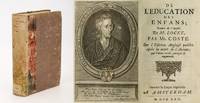
173029248AB1730. Édition pirate de Suisse. Amsterdam 1730. Octavo 11 cm x 16.5 cm. Frontispiece - Portrait of John Locke 6 3-24 468 12 pages. Hardcover / Reliure originale. Un peu taché frotté et heurté par endroits le dos collé avec des bandes de papier et des étiquettes en papier. Globalement un très bon exemple de cette importante publication. John Locke Bibliography No.584 - "A pirated edition published in Switzerland" / Not in Y; copies at Univ. of Michigan and Illinois "Some Thoughts Concerning Education" is a 1693 treatise on the education of gentlemen written by the English philosopher John Locke. For over a century it was the most important philosophical work on education in England. It was translated into almost all of the major written European languages during the eighteenth century and nearly every European writer on education after Locke including Jean-Jacques Rousseau acknowledged its influence. In his Essay Concerning Human Understanding 1690 Locke outlined a new theory of mind contending that the gentleman's mind was a tabula rasa or "blank slate"; that is it did not contain any innate ideas. Some Thoughts Concerning Education explains how to educate that mind using three distinct methods: the development of a healthy body; the formation of a virtuous character; and the choice of an appropriate academic curriculum. Locke wrote the letters that would eventually become Some Thoughts for an aristocratic friend but his advice had a broader appeal since his educational principles suggested anyone could acquire the same kind of character as the aristocrats for whom Locke originally intended the work. Wikipedia __________________________________________________________________________________________________________ "De leducation des enfans" étaient le résultat final des années productives de Locke en Hollande. Le travail a commencé par une série de lettres écrites en 1684 à son ami Edward Clarke donnant des conseils sur léducation des enfants de Clarke. Bien quil ne se soit jamais marié Locke semble avoir eu une attirance mutuelle pour les enfants damis - le petit-fils de Shaftesbury le futur 3e comte les enfants de Clarke les jeunes Masham dOates. Les lettres à Clarke étaient pleines de conseils pratiques du médecin pragmatique sur des questions telles que les vêtements et l'alimentation. Locke sinquiétait également du développement moral de lenfant soulignait limportance des habitudes desprit et mettait en garde contre la volonté et «lamour de la domination». Il était moins préoccupé en comparaison avec d'autres auteurs sur l'éducation de proposer un programme détaillé de lecture et d'étude. Les lettres de Locke à Clarke ont servi de base à Quelques réflexions sur léducation. En janvier 1685 il compila des copies des lettres de cette époque mais continua à y ajouter du matériel pendant plusieurs années. Il n'y revint qu'à l'hiver 1689/90 après les manuscrits de Deux traités de gouvernement et Un essai concernant la compréhension humaine avait été envoyée à la presse. Les réflexions sur l'éducation furent achevées en mars 1690 mais Locke ne savait pas s'il devait publier. Finalement il fut convaincu par William Molyneux et le livre parut en juillet 1693. Il s'avéra être l'une de ses uvres les plus populaires Bibliographie de John Locke hardcover