185 résultats
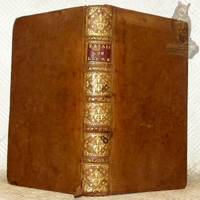
17242570# AUTEUR: Locke John # ÉDITEUR: Du Villard & Jaquier - Genève # ANNÉE ÉDITION: 1724 # COUVERTURE: Plein vélin - dos rond - pièce de titre rouge décor doré # DÉTAILS: In 12° relié 4ff (pdt et avertissement) + 365pp.+ 2ff. Nouvelle édition, traduit de l'Anglois. Le gouvernement civil de la véritable origine, de son étendue, de la fin. 1er traité du gouvernement civil (1690), qui est un des temps forts de l'histoire théologico-politique du XVII ème siècle. # PHOTOS visibles sur www.latourinfernal.com
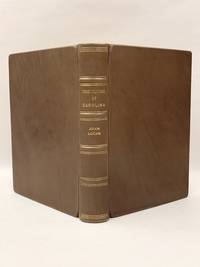
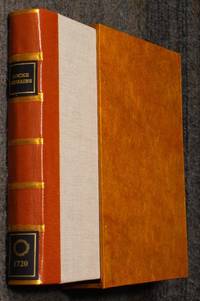
172040126London: J Betttenham for R. Franklin. Very Good with no dust jacket. 1720. First Edition; First Printing. Leather. 62 362 Index and Errata pages; Sabin states " Contains the fundamental Constitutions of Carolina" the first instrument ever digested and written out for the entire and perfect government of a political body. The plan was laid out by Lord Shaftesbury but the labor of it's composition was accomplished by Mr Locke. Though impracticable in many particulars it undoubtedly suggested to the colonists many hints which were beneficial in their civil and political organization." Rebound in 3/4 leather. The copper plate of the Solar System is there in facsimile. Otherwise VG complete contents an appealing binding ensconced in a matching slip case covered with handmade paper. A thoroughly attractive copy. . J Betttenham for R. Franklin hardcover
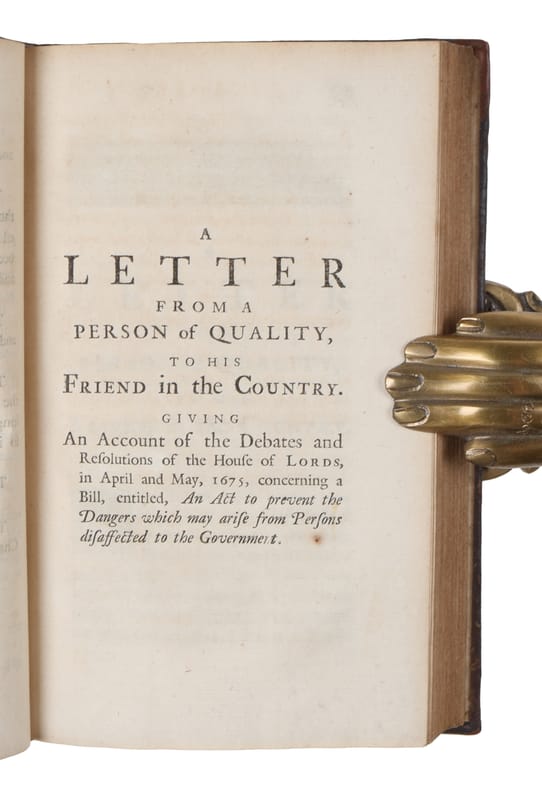
17391609070041London Printed for R. Francklin 1739-01-01. Hardcover. Very Good. Second edition issued without frontis and plate. Folio. 10 x 118 pp. 2. Modern blue paper covered boards paper spine label. Library stamps to several pages. Table of contents bound at end of volume. <br> Contents: The character of Mr. Locke. By Mr. Peter Coste.--The fundamental constitutions of Carolina.--A letter from a person of quality to his friend in the country.--Remarks upon some of Mr. Norris's books.--Elements of natural philosophy.--Some thoughts concerning reading and study.--Several letters to Anth. Collins esq; and other persons.--Rules of a society. Attig 787; Sabin 41726; Yolton 316B 316A. ref. to 1720 edition London, Printed for R. Francklin hardcover
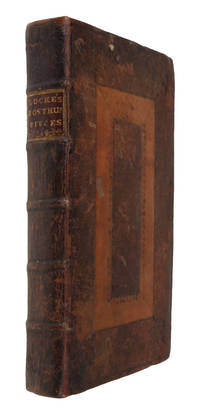
172049627London: Printed by J Bettenham for R Francklin 1720. First Edition. Full calf. Very good. 362p index errata. old stain through some of the middle portion otherwise a very good copy rebound in modern calf with new end papers and fly leaves gilt title. Cherub cartouche on the title page. "Contains the Fundamental Constitutions of Carolina" Sabin 41726 <br/><br/> Printed by J Bettenham for R Francklin unknown
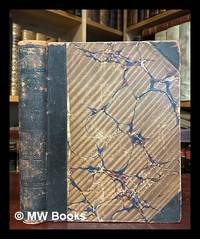
1739BOOKS099458ILondon: R. Francklin. Very good copy. 1739. 2nd ed. 1/4 leather. 4to 119 pp. Edited by Pierre Desmaizeaux under the direction of Anthony Collins. The second edition. Probably rebound in the 19th century; spine darkened and chipped at the top; front board rubbed; contents very good. . R. Francklin hardcover
172041467London J. Bettenham 1720. 8vo. Nice contemporary English Cambridge-style full calf binding with five raised bands and gilt title-label to spine. Neat minor repair to extremities. A bit of overall wear but a nice and tight copy. Internally nice and clean with only some occasional soiling that is very light. Engraved title-vignette 36 - i.e. title-page dedication XXIV i.e. "The Character of Mr. Locke" by Peter Coste 2 - i.e. contents 362 18 - i.e. index 4 - i.e. errata advertisements pp. one plate "The Solar System". <br/><br/><em>First edition of this important collection of hitherto unpublished works by Locke containing the first printing of his unique work on Natural philosophy "The Elements of Natural Philosophy" as well as first printings of other important works. Assisted by Anthony Collins in 1720 the journalist Pierre Desmaizeaux brought out a new collection of Works and pieces by John Locke that had not previously been published. This collection "A Collection of Several Pieces" came to play a great role in the Locke scholarship not least in recent times and not least because it contains the first printing of his "Elements of Natural Philosophy"The "Elements of Natural Philosophy" constitutes Locke's main work in natural philosophy and it is a work that pas puzzled Locke scholars and readers ever since its appearance. The work seems to need some further explanation; at a firsthand glance it doesn't look very much like Locke - the greatest of the English philosophers who has so frequently been accused of not understanding the exact sciences and who even encouraged the youth not to learn these but to educate themselves in superficial and useful party-conversation. Thus numerous attempts have been made to establish the influence that resulted in this educational work of natural science. The two dominating answers to the question of influence are now: Newton and Descartes. It now seems to be fairly commonly recognized that Newton a personal friend of Locke even contributed directly to the work. "When Locke himself at the end of his life came to compose a treatise on natural philosophy for a pupil we have reason to believe that he obtained the advice and help of the most brilliant scientist of the century his close friend Isaac Newton. As we shall see this unique educational work itself "The Elements of Natural Philosophy" belies the myth of Locke the scientific smatterer." Axtell Locke Newton and the Elements of Natural Philosophy p. 244. However Descartes influence also seems to be obvious; "The influence of the "Principles" by Descartes is also obvious in Locke's posthumously published "Elements of Natural Philosophy". There is a striking similarity in the order of exposition although there are also considerable differences: Locke carefully eschewed Descartes' "a priori" metahpysics of nature. We find him rather emphasizing the essential role of experience. For example Locke introduced Newtonian universal gravitation as follows:. Thus according to Locke empirical support was necessary to establish the law of nature. Although the exposition looks quite similar to Descartes' "Principles" the "Elements" in fact contain several anti-Cartesian remarks in favour of the experimental philosophy." Aoki Descartes and Locke on the Nature of Matter. In: Hutton and Schuurmann edt. Studies on Locke p. 77."Elements of Natural Philosophy" was printed in no less than nine times during the 1th century and appeared in both Russian and French during the 18th century as well.The present "Collection of several Pieces" furthermore included a collection of letters from Locke to Anthony Collins "Remarks upon some of Mr. Norris's Books." "Some Thoughts concerning Reading and Study for a Gentleman." and "Rules of a society." all printed here for the first time as well as an English translation of Coste's Eulogy "The Character of Mr. Locke" originally published in French in 1705 and reprints of "The fundamental Constitutions of Carolina" and "A Letter from a person of Quality."."Remarks upon some of Mr. Norris's books." is the third of Locke's replies to Norris. "Some thoughts concerning reading and study for a gentleman" constitutes Locke's reply to Samuel Bold's question on behalf of a parishioner on how to create a course of reading and study. "Rules of a Society" constitutes the rules that Locke set up for a small group of friends who met once a week to discuss "useful Knowledge" and to promote "Truth and Christian Charity". Throughout his life Locke created several of these "societies" one of which led to his "An Essay Concerning Human Understanding" another one being "The College" in London after the Revolution. </em> hardcover
172041467London, J. Bettenham, 1720. 8vo. Nice contemporary English Cambridge-style full calf binding with five raised bands and gilt title-label to spine. Neat minor repair to extremities. A bit of overall wear, but a nice and tight copy. Internally nice and clean with only some occasional soiling that is very light. Engraved title-vignette (36 - i.e. title-page + dedication), XXIV (i.e. ""The Character of Mr. Locke"" by Peter Coste), (2 - i.e. contents), 362, (18 - i.e. index), (4 - i.e. errata + advertisements) pp. + one plate (""The Solar System"").
1766442990London : Printed for T. Osborne 1766. 5th edition. Hardcover. Very good copies in marbled boards backed in gilt-blocked full calf. Spine and boards dust-toned bumped and rubbed as with age. Somewhat nicked pages. Stretched hinges with loose pages. Scattered foxing. Physical description; xii 360 p. ; 27 cm. Subjects; Bible ; Indexes ; Early works to 1800. Bible ; Index ; Ouvrages avant 1800. John Locke critical studies. Common-place-book. London : Printed for T. Osborne hardcover
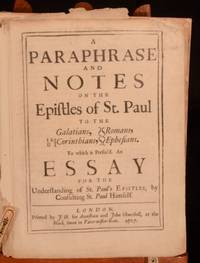
1707EXP2-E-7London: J H Awnsham and John Churchill 1707. First edition. Leather. Fair. 9.5" by 7.5". None. A scarce collection of works by John Locke. The first collected edition compiled of various editions of earlier shorter works. Each work with a separate title page and pagination. Collated: Complete. With publisher's advertisements bound out of order to BL copy. Contains: An Essay for the Understanding of St Paul's Epistles by Consulting St. Paul himself 1707 First Edition A Paraphrase and Notes on the Episdtle of St. Paul to the Galatians 1706 Second Edition A Paraphrase and Notes on the First Epistle of St Paul to the Corinthians 1706 First Edition A Paraphrase and Notes on the Second Epistle of St Paul to the Corinthians 1706 First Edition A Paraphrase and Notes on the Epistle of St Paul to the Romans 1707 First Edition A Paraphrase and Notes on the Epistle of St Paul to the Ephesians 1707 First Edition John Locke was an influential English philosopher and physician of the Enlightenment. His work greatly influenced the development of political philosophy and the works of figures such as Voltaire and Rousseau. His religious beliefs varied over his lifetime and were rarely displayed in his writings. These works published posthumously provide important insight into his theology and the final years of his life. In a calf binding. Externally worn both boards detached but present. Loss to head at tail of spine and to leather at extremities. Light rubbing and worming to boards. Lacking front free-endpaper. Internally generally firmly bound although binding strained to Romans about half way through the volume. Title page and front blank detached but present. Title page with slight loss not affecting text. Pages bright with handling marks and dusting throughout occasional spotting. Marginal age toning and offsetting to first and last few pages. Pink ink annotations roman numerals indicating chapter numbers throughout. Light marginal worming to final work Ephesians not affecting text. Closed tear to page 29 of Ephesians. Overall: FAIR binding GOOD internally Fair J H Awnsham and John Churchill hardcover
1707007735London: Printed by J.H. for Awnsham and John Churchill at the Black Swan in Pater-noster-Row 1707. This volume is compose of five parts each with its own title page and pagination the whole is proceeded by two volume title pages both dated 1707 and a preface. i-ii iii-xviv Galatians 1706 second edition title page2 publisher's message to the reader and publisher's adverts2pages 43 pages. I Corinthians 1706 advertisment2 title page1-2107 pages 208blank. II Corinthians 1706 : title page123-58 2adverts. Romans 1707 : title page1-23-142 pages. 2adverts. Ephesians 1707 : title page1-23-60 pages. 8 X 9.7 inches. Bound in contemporary full calf with tooled ruled borders and decorations title label to spine with only fragments remaining. externally very rubbed with wear to corners spine ends and edges cracking along outer and inner hinges both boards attached. Inside all complete as described here Initial "P" in ink on corner of front free endpaper and a name and date 1734 at the top of the title page. Browning and offsetting to endpapers Some browning and foxing to the pages of the preface and a water stain on the margin of several pages of the preface. Therafter all quite clean throughout with no further foxing or marking. No annotations. First Edition. Hard Cover. Good/No Jacket. Printed by J.H. for Awnsham and John Churchill, at the Black Swan in Pater-noster-Row Hardcover
1772100721Pamphlet 8vo half title 51 pp. Removed dbd half title detached last two pages detached trimmed but no impact on text normal aging; otherwise very good. Samuel Locke 1731-1778 was a Congregational clergyman and after being a pastor in Sherborn Massachusetts he was made president of Harvard College 1770-1773. After he left that post he returned to Sherborn where he died a few years later. Shipton & Mooney 12436 Richard Draper unknown books
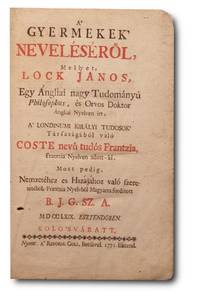
17712918Kolozsvar Cluj: Reform Coll 1771. First Hungarian edition. In contemporary half leather. With old owner's name inscriptions worn in good condition. First Hungarian edition. In contemporary half leather. 4 308 2 p. Some Thoughts Concerning Education is a 1693 treatise on the education of gentlemen written by the English philosopher John Locke. For over a century it was the most important philosophical work on education in England. It was translated into almost all of the major written European languages during the eighteenth century and nearly every European writer on education after Locke including Jean-Jacques Rousseau acknowledged its influence. Reform Coll unknown
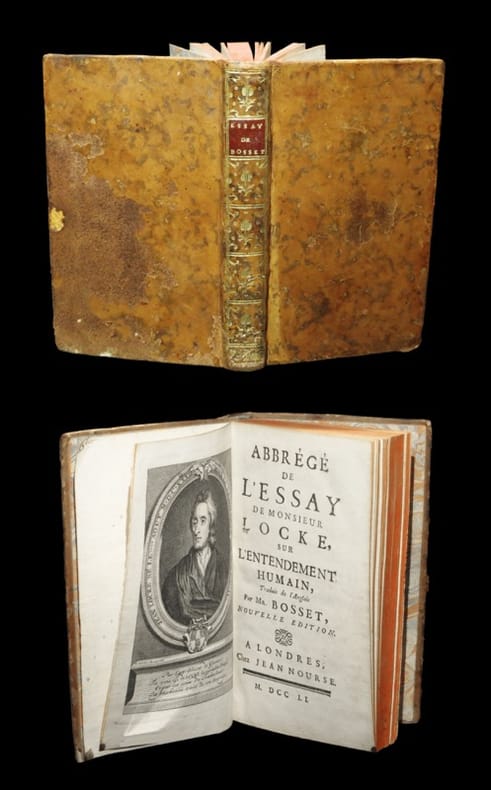
1751314561751. A Londres chez Jean Nourse 1751. Un vol. au format in-12 168 x 103 mm de 1 f. bl. xvi - 376 pp. 3 ff. n.fol. et 1 f. bl. Reliure de l'ÂŽpoque de plein veau marbrÂŽ blond plats jansÂŽnistes dos lisse ornÂŽ d'un double filet d'encadrement dorÂŽ doubles filets dorÂŽs fleurons dorÂŽs semis de petits cercles et petits fleurons dorÂŽs piÂce de titre de maroquin acajou tire dorÂŽ palette dorÂŽe en queue filet dorÂŽ sur les coupes tranches saumon. L'ouvrage s'agrÂŽmente de jolis ornements typographiques et s'ouvre sur un frontispice gravÂŽ signÂŽ Kneler et Duflos. ''Il n'y a jamais eu d'AbrÂŽgÂŽ plus exact que celui dont je donne la traduction. Toutes les pensÂŽes essentielles de Locke s'y trouvent exprimÂŽes dans les propres termes de l'original. On n'a fait ici que retrancher le superflu''. Ouvrage ÂŽtendard de la philosophie empiriste LÕEssai sur lÕentendement humain traite des fondements de la connaissance et de lÕentendement humains. Il dÂŽcrit lÕesprit ˆ la naissance comme une table rase ensuite remplie par lÕexpÂŽrience. Constituant lÕune des principales sources de lÕempirisme en philosophie moderne lÕEssai a influencÂŽ beaucoup de philosophes des LumiÂres tels que Hume ou Berkeley. QuÂŽrard I La France littÂŽraire p. 426. Abrasions et desquamations affectant les plats ; plus particuliÂrement le second. Papier lÂŽgÂrement oxydÂŽ. PrÂŽsence de quelques rousseurs dans le corps d'ouvrage. Petite t‰che en marge de rares feuillets. Du reste bonne condition. b42961 unknown
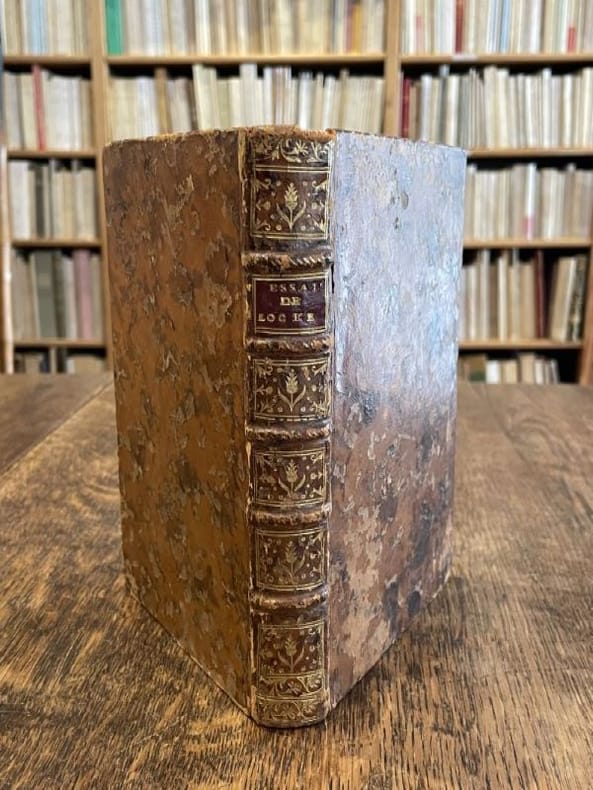
175131456A Londres, chez Jean Nourse, 1751. Un vol. au format in-12 (168 x 103 mm) de 1 f. bl., xvi - 376 pp., 3 ff. n.fol. et 1 f. bl. Reliure de l'époque de plein veau marbré blond, plats jansénistes, dos lisse orné d'un double filet d'encadrement doré, doubles filets dorés, fleurons dorés, semis de petits cercles et petits fleurons dorés, pièce de titre de maroquin acajou, tire doré, palette dorée en queue, filet doré sur les coupes, tranches saumon.
175116560Londres, Jean Nourse, 1751 in-12 basane brune granitée, dos lisse orné de fers dorés, pièce de titre rouge, tranches marbrées. XVI + 376 pp. (Reliure de l'époque. Manque une page de garde, minimes rousseurs aux pages liminaires).
1741114758Londres : Chez Jean Nourse 1741. 165x100mm. frontispice XVI - 376 pages - 3 ff. lettrines bandeaux culs-de lampe reliÂŽ veau havanne de lՎpoque fleurons dorÂŽs piÂce de titre tranches rouge gardes marbrÂŽ. Belle reliure. Bel exemplaire. 299 Chez Jean Nourse unknown
1741105523Geneve : Chez Henri-Albert Gosse & Comp. 1741. 195x125mm. XXIV - 283 pages 2 ff. lettrines bandeaux culs-de-lampes reliure cartonnage marb muet. Intrieur propre. 349 Chez Henri-Albert Gosse & Comp. unknown
17923890<p>Uppsala: Veuve du directeur Jean Edman 1792. Rare French edition printed in Uppsala of the abridgement of the Essay on Human Understanding by John Wynne the format in which Locke's thought was most effectively popularized at English universities and in Europe. "In the last decade of the seventeenth century English culture held a frustrated fascination for the continental Republic of Letters. Frustrated because few Europeans could approach English ideas in the English language. Gabriel Bonno1 has shown how Locke's continental readers were dependent initially upon reviews in French-language journals – Basnage de Beauval's Histoire des ouvrages des savans Bernard's Nouvelles de la r�publique des lettres and particularly Le Clerc's Biblioth�que universelle and its successors. Interested parties such as Limborch and Leibniz did not really come to grips with the Essay until it had been translated into French. This was accomplished in 1700 by Pierre Coste.Coste was like Le Clerc a French Protestant refugee in Holland. In 1695 he translated Locke's Some thoughts concerning education into French and sent the author a copy. Locke was pleased and Le Clerc encouraged the young man to begin translating the Essay. In 1697 Coste was invited to Locke's retreat at Oates as tutor to the Masham children and as Locke's assistant. The translation was completed under Locke's supervision and was published in June 1700 prefaced with Locke's recommendation. Coste remained at Oates until Locke's death in 1704. Thereafter in the midst of a busy literary career he continued his work on the Essay bringing out a revised edition in 1729." AttigThe first French edition of Wynne's abridged Essay came out in 1720 translated by Jean-Paul Bosset and with the first book given in Le Clerk's summary reprinted from his 1690 Bibliot�que universelle rather than Wynne's. It was published several times in London 1720 1741 1746 1751 as well as Geneva 1738 1741 1788 Dresden 1788 and finally Uppsala 1792.OCLC: Harvard UCLA York.Hollis record. 8vo 17 x 11 x pp. including title with half-page engraved portrait of Locke 284 4 pp. Bound in contemporary half calf and speckled boards gilt morocco title label and raised bands on spine spine and corners of covers worn old ownership inscription on front end pastedown light toning throughout very good.</p> Veuve du directeur Jean Edman hardcover books
17923890<p>Uppsala: Veuve du directeur Jean Edman 1792. Rare French edition printed in Uppsala of the abridgement of the Essay on Human Understanding by John Wynne the format in which Locke's thought was most effectively popularized at English universities and in Europe. "In the last decade of the seventeenth century English culture held a frustrated fascination for the continental Republic of Letters. Frustrated because few Europeans could approach English ideas in the English language. Gabriel Bonno1 has shown how Locke's continental readers were dependent initially upon reviews in French-language journals – Basnage de Beauval's Histoire des ouvrages des savans Bernard's Nouvelles de la r�publique des lettres and particularly Le Clerc's Biblioth�que universelle and its successors. Interested parties such as Limborch and Leibniz did not really come to grips with the Essay until it had been translated into French. This was accomplished in 1700 by Pierre Coste.Coste was like Le Clerc a French Protestant refugee in Holland. In 1695 he translated Locke's Some thoughts concerning education into French and sent the author a copy. Locke was pleased and Le Clerc encouraged the young man to begin translating the Essay. In 1697 Coste was invited to Locke's retreat at Oates as tutor to the Masham children and as Locke's assistant. The translation was completed under Locke's supervision and was published in June 1700 prefaced with Locke's recommendation. Coste remained at Oates until Locke's death in 1704. Thereafter in the midst of a busy literary career he continued his work on the Essay bringing out a revised edition in 1729." AttigThe first French edition of Wynne's abridged Essay came out in 1720 translated by Jean-Paul Bosset and with the first book given in Le Clerk's summary reprinted from his 1690 Bibliot�que universelle rather than Wynne's. It was published several times in London 1720 1741 1746 1751 as well as Geneva 1738 1741 1788 Dresden 1788 and finally Uppsala 1792.OCLC: Harvard UCLA York.Hollis record. 8vo 17 x 11 x pp. including title with half-page engraved portrait of Locke 284 4 pp. Bound in contemporary half calf and speckled boards gilt morocco title label and raised bands on spine spine and corners of covers worn old ownership inscription on front end pastedown light toning throughout very good.</p> Veuve du directeur Jean Edman hardcover
1794848581794. LOCKE John ed. John WYNNE. AN ABRIDGEMENT OF MR. LOCKE'S ESSAY CONCERNING HUMAN UNDERSTANDING. Boston: Printed by Manning & Loring for J. White Thomas & Andrews D. West E. Larkin J. West and the Proprietor of the Boston Bookstore 1794. First American edition. 250 pp. A6 - W6 last page blank. 12mo. brown calf with gilt spine rules and gilt red morocco spine label. Joints cracked spine shallowly chipped at heel and crown corners and edges worn. Label gilt lettering slightly rubbed. Light to moderate occasional foxing. Offset tanning to title page. Ink ownership dated "June '97" to blank recto preceding title page. Overopened at title page; contents page through p. 10 partially detached. The last four blank pages are dampstained. The only 18th century edition published in America; the full text was not published in America until 1803. Benjamin Franklin called it 'the best Book of Logick in the World" LCP First American Editions Exhibit 1984. Evans 21227. Quite scarce. unknown books
17384556Geneve / Geneva: Chez Pellissari & Comp. 1738. New edition / First edition Thus. This work is an abridgement of John Locke's "Essay Concerning Human Understanding" not to be confused with Hume's "Enquiry". Originally published in English in 1689 the first French edition of the essay was published in 1700 and this was the first abridgement of it. One of the first works of empiricism in philosophy. Contemporary full leather binding with gilt decorated spine and gilt titles to a leather label. The binding is in good condition but with chipping to the head of the spine and some cracking to the rear edge of the spine. Rubbing to the corners of the boards. Marbled end papers. Titles printed in red and black. Internally mainly clean and tidy with just a touch of marking / darkening to the pages. There are manuscript annotations to the first two pages of the abridgement in contemporary ink. In the rest of the work there are a few emphasis lines only. Overall a very nice copy of an uncommon work. XII 280 iv. pages. 200 by 120mm 7¾ by 4¾ inches. . Nouvelle édition / Première édition. Cet ouvrage est un abrégé de l'"Essai sur l'entendement humain" de John Locke à ne pas confondre avec l'"Enquête" de Hume. Publié à l'origine en anglais en 1689 la première édition française de l'essai parut en 1700 et c'est le premier abrégé qui en est tiré. L'un des premiers ouvrages d'empirisme en philosophie. Reliure contemporaine en plein cuir avec dos décoré et titres dorés sur une étiquette en cuir. La reliure est en bon état mais la tête du dos est ébréchée et le bord arrière du dos est fissuré. Les coins des planches sont frottés. Papiers de fin marbrés. Titres imprimés en rouge et noir. A l'intérieur l'ouvrage est propre et bien rangé avec juste un peu de marques et de noircissement sur les pages. Les deux premières pages de l'abrégé portent des annotations manuscrites à l'encre de l'époque. Dans le reste de l'ouvrage il n'y a que quelques lignes d'emphase. Dans l'ensemble un très bel exemplaire d'un ouvrage peu courant. XII 280 iv. pages. 200 par 120mm. Chez Pellissari & Comp. hardcover
1741118771Genève Henri-Albert Gosse 1741 1 vol. relié in-8, veau fauve marbré, dos à nerfs, pièce de titre de maroquin bordeaux, caissons ornés de feurons, dentelles et filets dorés en encadrement, tranches marbrées, XXIV + 283 pp. + 2 ff. non chiffrés. Nouvelle édition (troisième) de cet abrégé réalisé avec l'assentiment de l'auteur par le Dr. Winne d'Oxford. Petites marques d'usure aux coiffes et aux mors, mais bon exemplaire en reliure de l'époque avec ex-libris gravé.
17389507A genève, Chez Pellissari & comp., 1738. Petit in-8 de XII-280-[4] pages, demi-basane mouchetée à coins, dos lisse avec filets doré et étiquette de titre tabac (frottée), tranches mouchetées. Dos frotté.
17384556Geneve / Geneva Chez Pellissari & Comp. 1738 Nouvelle édition / Première édition. Cet ouvrage est un abrégé de l'"Essai sur l'entendement humain" de John Locke (à ne pas confondre avec l'"Enquête" de Hume). Publié à l'origine en anglais en 1689, la première édition française de l'essai parut en 1700, et c'est le premier abrégé qui en est tiré. L'un des premiers ouvrages d'empirisme en philosophie. Reliure contemporaine en plein cuir, avec dos décoré et titres dorés sur une étiquette en cuir. La reliure est en bon état, mais la tête du dos est ébréchée et le bord arrière du dos est fissuré. Les coins des planches sont frottés. Papiers de fin marbrés. Titres imprimés en rouge et noir. A l'intérieur, l'ouvrage est propre et bien rangé, avec juste un peu de marques et de noircissement sur les pages. Les deux premières pages de l'abrégé portent des annotations manuscrites à l'encre de l'époque. Dans le reste de l'ouvrage, il n'y a que quelques lignes d'emphase. Dans l'ensemble, un très bel exemplaire d'un ouvrage peu courant. XII, 280 [iv]. pages. 200 par 120mm.