1 résultat
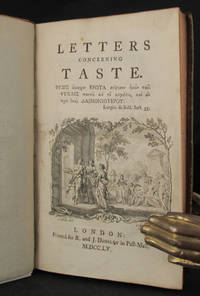
175533167London: Printed for R. and J. Dodsley in Pall-Mall 1755. First Edition. A copy with fine provenance having belonged to John Rutherfurd Senator for the State of New Jersey from 1791-1798. With beautifully engraved title-page by the renown artist Samuel Wale engraved head and tail-pieces throughout. 8vo contemporary polished calf the spine with raised bands gilt ruled red morocco lettering label gilt. xiv 143 pp. A fine copy beautifully preserved tight strong clean crisp and unpressed. RARE FIRST EDITION IN FINE CONTEMPORARY CALF. Letters Concerning Taste is considered the first volume on the subject of taste. Written in an epistolary style the work sets out letters to classical figures such as Euphemius Philemon Leonora and Eugenio. Writings about art and creativity can be traced to the texts of classical antiquity but aesthetics as a separate and systematic area of philosophy is almost wholly a product of the 18th century. It was at that time that philosophers began to treat notions about creativity and our responses to it with a kind of philosophical rigour found in epistemology and metaphysics. 18th-century authors such as John Gilbert Cooper sought to define what poetry literature painting and sculpture were and to determine the links between the various forms of artistic expression.<br> John Gilbert Cooper who lived from 1722 until 1769 was a British poet and writer. He first published poetry in 1742 and occasionally until he became a regular contributor to "The Museum" which was published by Robert Dodsley. His contributions to Dodsley's journal was under the nom de plume of "Philaretes". Cooper's claim to notability comes from his prose poetry and a public row he had with William Warburton.<br> He also inspired a noted painting by Joseph Wright of Derby. The painting entitled Miravan Breaking Open the Tomb of his Ancestors was based on a story in these LETTERS CONCERNING TASTE. Cooper had recounted a story where a greedy nobleman despoils his ancestor's grave in search of riches to find himself cursed by his ancestor. The work was "highly praised by Johnson". Pickering<br> Samuel Wale became one of the original members of the Society of Artists of Great Britain in 1765 and of the Royal Academy in 1768 and was the first professor of perspective to the Academy. He exhibited drawings of scenes from English history. A significant part of his artistic work was in designing vignettes and illustrations for the important booksellers of the day; a large number these were engraved by Charles Grignion the Elder. Among them were the illustrations to the ‘History of England’ 1746–7; ‘The Compleat Angler’ 1759; ‘London and its Environs described’ 1761. <br> John Rutherfurd attended the College of New Jersey which is now Princeton University where he studied law. After graduating Rutherfurd practiced law in New York City for several years. In 1787 he moved to a farm near Green Township New Jersey in Sussex County New Jersey. He entered politics in 1788 serving in the New Jersey General Assembly until 1790. He was then elected as a Federalist to the United States Senate from New Jersey and served in the Senate from 1791 to 1798. In 1808 Rutherfurd moved with his family to a farm on the banks of the Passaic River near what is now Rutherford New Jersey which was a least partially named after him. He lived at this place for the rest of his life naming it "Edgerston". And it is the "Edgerston" plate that is in the book confirming its provenance. Printed for R. and J. Dodsley in Pall-Mall hardcover