108 résultats
Scholar's bookplate to inner cover (Robert Brown). Very light shelfwear to book and DJ. ; 100 pages
Scholar's bookplate to inner cover (G. P. Goold). Light shelfwear to book and DJ. DJ is price-clipped. ; 100 pages
Scholar's name on inner cover (David Furley). Very minor shelfwear. ; Contents: Philosophic Revolutions: Philosophy in the Early Hellenistic Period; Philosophy in the Age of Cicero; Primary Focus of Epicurus's Philosophy; Structure of Epicurean Reality; Cognitive Process in Epicurus; Ethical Reasoning in Epicurus; Furhter Ethical Process and the Structure of the Sciences; Epicurean Conception of Choice; Beginning of Process and the concept of Limitation; Lucretius: Transformation of Epicurean Canonic. ; 176 pages
Minor creasing to bottom back corner. Light rubbing to wraps. ; 209 pages
Pages tanned. Scholar's bookplate to inner cover (Robert Brown). Scholar's blindstamp to ffep (Robert Brown). Some rubbing to wraps with a bit of edgewear and light creasing. ; Reprint of Ethica and of Lettere di Epicuro e dei suoi, both published in 1946 and of Letere di Epicuro agli amici di Lampsaco a Pitocle e a Mitre originally published in Studi italiani di filologia classica n. S. , v. 23, fasc. 1-2, 1948. Includes bibliographical references (p. [3]-4 (1st group) ) and indexes. 193 + 43 + 12 pp; 248 pages
Blindstamp on titlepage. Book has edgewear with light chipping. Mild tanning to pages. Some pages uncut. ; 193 pages
cm. 17 x 24, viii-108 pp. Corrispondenze (le) letterarie, scientifiche ed erudite dal Rinascimento all'et? moderna - Subsidia L?Autore studia la fortuna di due traduzioni del poeta-scienziato Alessandro Marchetti (1633-1714): Della natura delle cose (basata sul De rerum natura di Lucrezio) e l?Anacreonte (basato sui carmi anacreontici). Furono condannate entrambe per il materialismo epicureo e per l?amore greco, come risulta dalla ricca documentazione inedita, pubblicata in appendice, che proviene dall?Archivio della Congregazione per la Dottrina della Fede, Citt? del Vaticano. Costa examines the fortune of two verse translations by Alessandro Marchetti (1633-1714), a distinguished scientist and an elegant poet, who is considered a minor Italian classic: Della natura delle cose (based on Lucretius?s On the Nature of Things) and Anacreonte (based on the Anacreontics). Both of them were condemned by the Roman Catholic Church for their Epicurean materialism and sexual perversion, as appears from the documents published in the appendix, that come from the Archive of the Holy Office (now the Congregation for the Doctrine of Faith). 268 gr. viii-108 p.
This is a fine hardcover copy with a fine dust jacket with no wear at all. Complety clean. Stated first edition. Not illustrated. Bibliography. 9" high X 6" wide, 242 pages. This book will be securely wrapped and packed in a sturdy box and shipped with tracking.
237pp. + portrait out of text, 23cm., softcover, good condition, F105128
Light bump to top corner. Minor shelfwear. Scholar's blindstamp to ffep (Robert Brown). Scholar's bookplate to inner cover (Robert Brown). ; Pubblicazioni Dell'istituto Universitario Di Magistero Di Catania. Serie Filosofica. Testi E Documenti. N. 11; 369 pages
116785Paris, Hermann 1965, 190x140mm, 205pages, broché. Couverture à rabats. Très bel exemplaire.
“L'essenziale per la felicità è la nostra condizione intima, di cui siamo padroni noi.” (Epicuro, Frammento 109) Autori: Francesco Adorno. Curatori: Franco Paris, Armando Girotti.
440pp., 25cm., publisher's hardcover in grey cloth, in the series "Ancient and Medieval Philosophy, De Wulf-Mansion Centre" series I volume 48, text in Italian (with a summary in English), fine condition, [Content: this work provides a philological analysis of the primary sources (Epicur. Ep. Hrdt. 56-59 / Lucret. DRN I 599-634; II 481-499) concerning the theory of minima, an analysis of the likely historical background to this theory (Xenocrates, Aristotle and Diodorus Cronus), and a study of the development of this doctrine within the Garden, based on an examination of the question whether it is legitimate to speak of an 'Epicurean geometry'], F97925
2013F97925Leuven, Leuven University Press 2013 440pp., 25cm., publisher's hardcover in grey cloth, in the series "Ancient and Medieval Philosophy, De Wulf-Mansion Centre" series I volume 48, text in Italian (with a summary in English), fine condition, [Content: this work provides a philological analysis of the primary sources (Epicur. Ep. Hrdt. 56-59 / Lucret. DRN I 599-634; II 481-499) concerning the theory of minima, an analysis of the likely historical background to this theory (Xenocrates, Aristotle and Diodorus Cronus), and a study of the development of this doctrine within the Garden, based on an examination of the question whether it is legitimate to speak of an 'Epicurean geometry'], F97925
118pp., in the series "Zetemata. Monographien zur klassischen Altertumswissenschaft" volume 57, 25cm., softcover (with small vague stain), good condition, F105183
Scholar's bookplate to inner cover (Robert Brown). Scholar's blindstamp to half-title (Robert Brown). Tiny stain to rear wrap. Light shelfwear. ; Zetemata Monographien Zur Klassischen Altertumswissenschaft Heft 57; 118 pages
1973F105183München, C.H. Beck 1973 118pp., in the series "Zetemata. Monographien zur klassischen Altertumswissenschaft" volume 57, 25cm., softcover (with small vague stain), good condition, F105183
Firenze, Succ. Le Monnier, 1868, in-16, br., pp. IX, 413, (3). Qualche fioritura.
In 4° (19,5x15 cm); V,(4), 167, (9) pp. e una c. di tav. con ritratto calcografico di Epicuro al verso della c. segn. *8. Legatura coeva in piena pergamena con titolo chiosato da mano coeva al dorso. Qualche traccia lieve di sporco ai piatti. Haga Comitum è la latinizzazione di Den Haag nei Paesi Bassi. Frontespizio stampato in rosso e nero contenente testo tratto dal cap. xiii del Liber de vita beata di Seneca. Dedica di Pierre Gassendi a François Luillier. Antica firma di appartenenza privata seicentesca in parte abrasa al margine basso del frontespizio e due forellini di tarlo al margine basso bianco del volume a cominciare dalla pagina 1 che nelle ultime carte divengono due piccoli tunnel, in ogni caso mai fastidiosi ed insignificanti e a parte questo, nel complesso, esemplare in buone condizioni di conservazione. Seconda rara edizione, ancor più rara della prima del 1647, dalla quale differisce per le numerose parti aggiunte e le notevoli correzioni, di quest’opera del grande astronomo, astrologo, matematico, teologo e filosofo francese, l'abate Pierre Gassend, detto Gassendi (Champtercier, 22 gennaio 1592 – Parigi, 24 ottobre 1655). Amico di Galileo, con il quale intrattenne una fitta corrispondenza, Gassendi studiò il movimento delle comete, la topografia e le eclissi lunari, oltre all’evoluzione delle macchie solari. Lo scienziato francese fu il primo a dare una descrizione scientifica del fenomeno luminoso dell’atmosfera da lui chiamato “aurora boreale”, partendo dall'osservazione, il 12 settembre, ad Aix-en-Provence, di un'eccezionale aurora polare. Applicò il metodo scientifico anche alla filosofia, recuperando il metodo baconiano, mettendo in dubbio tutte le “auctoritates” antiche a partire da Aristotele ed arrivando a rivalutare l’epicureismo che seppur attaccato dalla Chiesa, Gassendi sente molto vicino alla sua concezione di cristianesimo. Per il suo sensismo empiristico di ispirazione epicurea espresso nella sua opera “Syntagma” è considerato un precursore di John Locke. Gassendi arrivò ad ipotizzare la possibilità che corpuscoli infinitesimi, gli atomi, possano essere alla base della realtà tutta e sempre come operatori della creazione agli ordini di Dio. Le sue teorie atomiche furono riprese poi da Boyle nella sua chimica e da Newton nell’elaborazione della sua filosofia meccanica. La sua “Vita di Epcuro” è considerata una delle più importanti fonti di studio di Epicuro, che riletto da Gassendi, sulla base delle concezioni filosofiche del suo tempo ne ricostruisce non solo la vita ma anche il pensiero e le intuizioni. J.H. Randall nel suo “The Career of Philosophy”, Vol. I, pp. 521-23 scrive: “Before Galileo and Descartes had succeeded in combining mathematics with mechanics, the chief refuge of hard-headed opponents of scholastic verbalism and Renaissance Platonism was the tradition of Greek atomism...Its chief representative during the period of Cartesian domination was Gassendi, who stands both as the climax of Epicurean atomism of the Renaissance in its accommodation to a mathematical science of nature, and as the first of the explorers of the implications of that science for the traditional empirical philosophy of knowledge. Gassendi is thus with Hobbes one of the fathers of 'scientific' empiricism...Gassendi indeed fancied himself the creator of the great rival scientific system to that of Descartes, the system founded on sound experience. History has reserved that distinction for Hobbes; yet it probable that Gassendi contributed far more to the actual advance of scientific ideas than his more consistent and gifted British fellow-worker.”. Seconda assai rara edizione, notevolmente corretta ed aumentata rispetto alla prima. Rif. Bibl.: gl. Goldsmith G 186, DSB V, 289 und Ziegenfuß/Jung I, 377 (EA 1647).

In-4 (225 x 160 mm), plein vélin souple ivoire de l’époque, (4) f., [-5], 236 p., (18) p., grande vignette de titre à la marque de l'imprimeur, bandeaux, lettrines, culs-de-lampe, portrait d'Epicure gravé sur cuivre hors texte (entre les p. 8 et 9). Edition originale de ce texte fondateur, bien complète du rare portrait d'Epicure gravé sur cuivre. Rédigée dès 1634, cette réhabilitation d’Epicure et de l'atomisme circula à l’état de manuscrit et ne fut imprimée qu’à l'instigation de François Luillier, contre l’avis même de Gassendi qui lui dédia cependant le livre. "L'écriture de cette apologie conduit Gassendi à se projeter dans le personnage d'Épicure et à s'identifier à lui, et c'est un peu son propre portrait qu'il dessine. La méthode érudite qu'il met en oeuvre offre des vues nouvelles et saisissantes sur les libertins érudits du XVIIe siècle, qui incarnent un moment de la 'crise de conscience européenne'. Elle illustre à merveille les chemins difficiles qu'emprunte la liberté de penser pour se frayer un chemin à l'époque de Gassendi, comme à toute époque" (Sylvie Taussig, Ed. des Belles Lettres, 2005). Par cette oeuvre, Gassendi jette les fondements de la nouvelle science et de ses méthodes empiriques. La descendance en sera immense. (Cioranescu, 32419. Partington, II, p. 458-66. Pintard, ‘Libertinage érudit’, n°760). Auréoles claires plus prononcées sur quelques feuillets. Quelques cahiers uniformément brunis. Bon exemplaire, relié à l'époque.
In 8, pp.58. Br. ed. con bruniture. Qualche marmorizz. alle ultime pp. Intonso
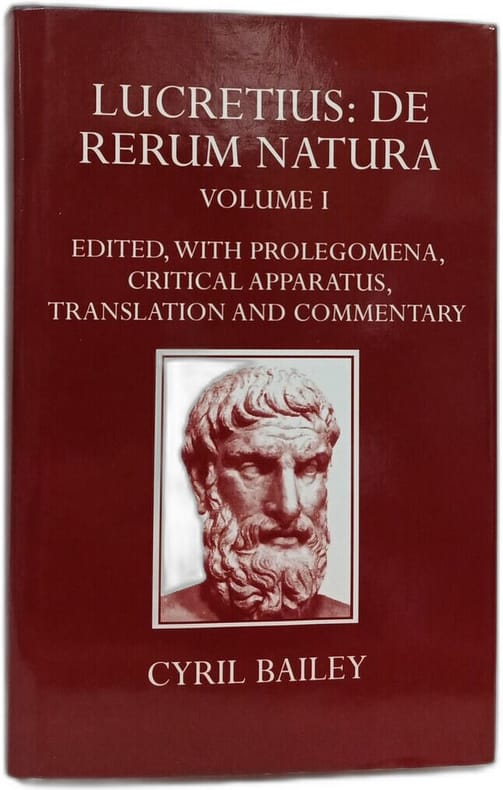
1947100143555Oxford University Press 1947 1804 pages 26x36x10cm. 1947. Cartonné. 3 volume(s). 1804 pages. Il s'agit d'une édition critique du poème philosophique de Lucrèce 'De rerum natura' (De la nature des choses) en six livres publiée par Oxford University Press sous la direction de l'éditeur Cyril Bailey. L'ouvrage présente le texte latin accompagné probablement de notes commentaires et appareil critique destinés aux études classiques
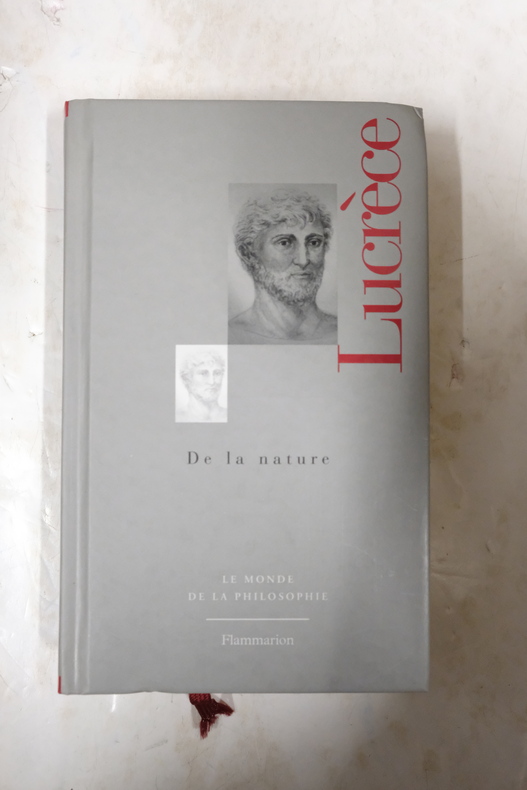
2008LIT9572MFlammarion, 2008. Collection Le Monde de la Philosophie. In-8 relié 460 pages. Très bon état.
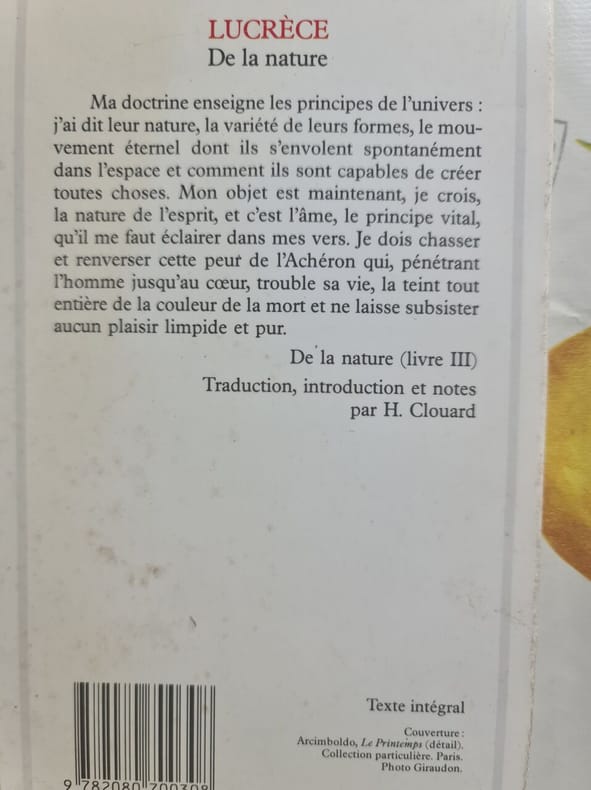
500360517GF Flammarion Sans date. Lucrèce poète et philosophe romain du Ier siècle av. J.-C. est l'auteur du 'De rerum natura' (De la nature) un poème didactique en six chants qui expose la philosophie épicurienne. Il y explique de manière matérielle la formation des objets et du vivant par des combinaisons aléatoires d'atomes dans le vide unissant science et poésie
191325353Librairie Hachette et Cie 1913 168 pages Paris. in-8. 1913. Cartonnage toilé noir et titré au dos en lettes dorées. 168 pages. Texte latin publié d'après les travaux les plus récents de la philologie avec un commentaire critique et explicatif un avertissement et un préambule par E. Benoist et Lantoine / 2ème édition