Plato; Niccolo (Nicolao) LiburnioBiblio.com
15 résultats
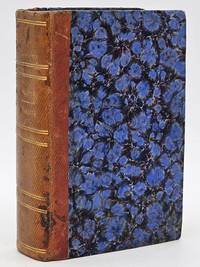
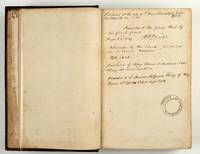
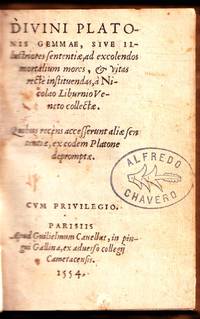
1554liburnio1554<p>Hardcover 1554 Paris edition. Condition is very good. 19th century full leather binding all edges gilt marbled endpapers. Paginates by leaves 1 leaf=2 pages: 127 plus 1 leaf index. 2 blanks front and back look like they are from the old rebind. Title page and last page of index are pages with the most wear: title page has old ownership stamp and a few stains. All other pages are near fine or fine. Paper is excellent quality: supple lightly toned not fragile. Binding is sound. Front blank endpaper has two inscriptions in Spanish. One is dated April 23 1880. The other is earlier and signed by Alfredo Chavero same as ownership stamp. No other writing or markings. A small book approximately 4.5 x 3.25 inches. Please see scans of the book you will receive. Feel free to inquire. Notes: I think first edition of this collection is 1530 see OCLC: 925369798. And just so you know: the English translation of the title is my own and could be completely wrong.</p> Guillaume Cavellat. Apud Guilielmum Cauellat, in pingui Gallina, ex aduerso collegii Cameracensis. Parisiis. hardcover
1574357232Vinegia.: Giouanni Varisco. 1574. 8vo. Nineteenth century textured calf over blue marbled boards gilt ruled bands and spine title old blue paper wraps bound in printer’s device on title page. Very good light foxing to edges contents tight bright and unmarked. 15.5x10.5x4 cm. Italian text. Scarce. Plato’s most important dialogues translated from the Greek. A well-preserved copy. weight: 0.9 lb. Giouanni Varisco. paperback
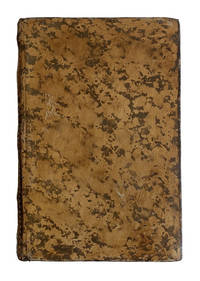
1554PA10<p>8° mm 158x93. Collation: -8 A-Z8 AA-FF8 GG6. 32 451 i.e. 471 1 pp. Woodcut printer's device on the title page. Large woodcut animated initials. 18th-century mottled calf smooth spine decorated with gilt floral tools title in gold on lettering piece. Pastedown in a nice decorated paper. Red edges. A good copy scattered foxing waterstain on the lower blank margin of the last quires a small ink stain on l. 7r. Manuscript <em>marginalia </em>on l. A2r.</p><p>Provenance: Vincenzo Maria Carafa della Roccella 1739-1814; ex libris engraved by G. Cataneo on the front pastedown 'Ex libris Vinc. M. Kar. Ca. St. Pr. Amphiss'.</p><p>The rare first Italian-language edition of <em>The Republic</em> one of the most influential works of philosophy and political theory both historically and intellectually.</p><p>The Italian translation was prepared by the physician Panfilo Florimbene of Frossombone who based his work on a Greek source text. He dedicated the translation to the Florentine nobleman Francesco Clementi accompanying it with a lengthy and important dedicatory letter. To aid comprehension Florimbene provided an <em>Argument</em> before each book summarizing the key teachings of the corresponding dialogue Bongi I 454.</p><p><em>The Republic</em> is Plato's best-known work offering a profound examination of political and ethical justice alongside a detailed vision of the ideal state and its governance.</p><p>Bongi I 454; Nuovo-Coppens <em>I Giolito e la stampa</em> p. 546 n. 218; Adams P 1468.</p> Gabriele & brothers Giolito de Ferrari
15573087Venice: Comin da Trino 1557. Graesse V.325 giving 1558 imprint; a second issue; the Italian Union Catalogue Catalogo Unico lists only 5 copies in Italian libraries. Rare first Italian-language edition of this Platonic dialogue somewhat anomalous in the Platonic corpus because of its extended treatment of the nature of physical matter and cosmology and a favorite among Renaissance readers for its myth of Atlantis which influenced other Renaissance utopias. The 1550s or thereabouts saw the first Italian translation of the most popular Platonic dialogues whether directly from Greek as here or via Ficinos Latin translation; the prestige of Ficinos Latin translation and wider readership for the original Greek probably explains why this Italian edition came so relatively late. The edition was translated by the littérateur Sebastiano Erizzo 1525-1585 a prolific writer of poetry fiction and belles lettres who provides some commentary in the way of printed marginal annotations; he would later translate a further selection of dialogues into Italian in which the Timaeus was reprinted 1574. NUC lists UNC and OCLC adds Duke. Comin da Trino
15573087Venice: Comin da Trino 1557. Graesse V.325 giving 1558 imprint; a second issue; the Italian Union Catalogue Catalogo Unico lists only 5 copies in Italian libraries. Rare first Italian-language edition of this Platonic dialogue somewhat anomalous in the Platonic corpus because of its extended treatment of the nature of physical matter and cosmology and a favorite among Renaissance readers for its myth of Atlantis which influenced other Renaissance utopias. The 1550s or thereabouts saw the first Italian translation of the most popular Platonic dialogues whether directly from Greek as here or via Ficinos Latin translation; the prestige of Ficinos Latin translation and wider readership for the original Greek probably explains why this Italian edition came so relatively late. The edition was translated by the littérateur Sebastiano Erizzo 1525-1585 a prolific writer of poetry fiction and belles lettres who provides some commentary in the way of printed marginal annotations; he would later translate a further selection of dialogues into Italian in which the Timaeus was reprinted 1574. NUC lists UNC and OCLC adds Duke. Comin da Trino books
155119411Basel: Froben 1551 colophon: Basileae Apud Hier. Frobenium et Nic. Episcopium An. MDLI Mense Martio. A highly important edition with the commentary of Simon Grynaeus the celebrated Swiss astronomer and geographer. Replete with large historiated and figurative capital letters throughout. Folio in a very handsome binding of antique calf over boards. 12 952 48 index. A handsome copy in pleasing condition well preserved fresh and unpressed internally. A FINE AND HANDSOME COPY. Cited ‘for the elegance of the impression’ by Froeben. THE KING OF PHILOSOPHERS. ONE OF THE SUPREME TEXTS OF THE RENAISSANCE. Preceded with the dedication of the great curator S. Grynaeus the proem dedication to Lorenzo de Medici and the important Life of Plato written by Ficino the original translator of the manuscripts into Latin; index at the end; 36 of the Platonic dialogues and worksthe Dialogues 10 books of the Republic 12 books of the Laws and 12 of the Letters edited and with the commentary of Marsilio Ficino. A highly important edition of the Opera of Plato with the translation of Marsilio Ficino the first and most important of the modern epoch in itself one of the primary movers of the humanism of the Renaissance. In 1462 by order and gift of Cosimo de Medici and with support of the Academy the manuscript translations were begun. They were concluded under the beneficence of Lorenzo the Magnificent. The translation which was completed in the 1470's contributed in great measure to the rediscovery of critical thinking and of the disciplines of Greek scholarship. Ficino had began his translation under the patronage of Cosimo de Medici in 1463. The work was completed five years later and circulated in manuscript for several years before finally being printed in parts beginning in 1484. It wasn't until 1491 that and edition brought together for the first time the fundamental text of Plato with Ficino’s PLATONICA THEOLOGIA the most important Renaissance interpretation of the great philosopher. In this groundbreaking work Ficino sets out to prove that a harmony can be found between Christian theology and Platonism. The conversion of these two modes of thought the classic and the medieval was instrumental in the formation of the modern European identity.<br> The importance Ficino placed on this work even extended to the printing and he was not pleased with the first edition which contained 7 pages of corrigenda. In contrast Ficino was very pleased with the typographical correctness of the later 1491 edition and this printing in large measure comes with the most important of the textual corrections and emendations and changes. The editio princeps from the Greek texts was provided by Aldus in 1513. This edition was with the rich and important corrections of Grynaeus from one of the early Greek manuscripts. A beautiful and very pleasing example in a rarely encountered period binding with early ownership note on the title. There is no copy noted in either the British Museum catalogue or in Adams. A rare book and very important in the history of Greek and philosophical scholarship. Froben hardcover
1513106311513. Aldine anchor device to title & verso of last leaf. 32 502 2 439 1 p. complete with blanks 24 & ii4. Two parts in one vol. Folio 18th-cent. mottled calf hinges rubbed & spine a trifle worn at head & foot early shelf label to spine. Venice: Aldus Manutius 1513.<br /> <br> <br> Editio princeps of Plato’s works in the original Greek one of the greatest Aldine publications with a fine and appealing early American provenance. This book printed for the first time manuscripts of Plato’s works newly discovered by Lascaris at Mount Athos in 1492 under the patronage of Lorenzo de Medici. It also features a remarkable preface by Aldus in which he dedicates the book to Pope Leo X. He refers to the numerous expeditions to the Americas Asia and Africa undertaken in recent years.<br /> <br> <br> This copy was once in the library of Thomas Jefferson’s son-in-law Thomas Mann Randolph 1768-1828 the 21st governor of Virginia. Randolph married Martha Jefferson and moved into Monticello where they were permanent residents. Manuscript annotations on the second flyleaf indicate that “W. Brand†purchased it at the sale of Randolph’s library in Charlottesville in 1830; in 1841 Henry Bowers donated it to the American Antiquarian Society. At some point the Society deaccessioned the book recorded with “Sold by AAS†stamp beneath the original “AAS†stamp which eventually entered the collection of Arthur and Charlotte Vershbow.<br /> <br> <br> A handwritten note — “ii†— to the foot of leaf 14 has been attributed to Aldus himself. There are contemporary annotations to the title-page and occasionally in the text and a possible mark of ownership to the final leaf. Despite the slight dampstaining to the last 15 leaves or so this is an exceptional copy with the distinguished provenance of American collectors. unknown
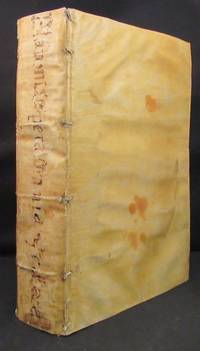
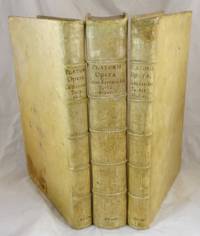
151332134Venice: Aldus Manutius and Andreas Torresanus September 1513. The Editio Princeps the First Edition of the Works of Plato in Greek. Folio 312 x 194mm beautifully bound in its contemporary limp vellum binding with hand calligraphy to the spine panel yapp edges. 15 unnumbered leaves without leaf 16 blank; 502 pages without the final blank; 439 pages. Aldine anchor device Fletcher f4 to title-page and verso of the last leaf. A superb copy in excellent condition. Very rare thus in its original binding some leaves with very sophisticated very sympathetic expert re-margining at the bottom outside corners where loss occurred at some time. The restoration has been brilliantly accomplished and is nearly imperceptible. VERY RARE AND IMPORTANT. THE FIRST ALDINE EDITION OF PLATO. THE EDITIO PRINCEPS AND A UNIQUE AND IMPORTANT COPY. As Marsilio Ficino dedicated his Latin translation of Plato to Lorenzo de’ Medici so Manutius dedicates his Greek edition to the son of Lorenzo Giovanni who became Pope Leone X in march. Aldus places his hopes for the foundation of his Academy in the new pope as he says in the dedicatory epistle of his edition of Greek Orators published in the same year: “may you watch over us and take care of our mission which deserves the help and favours of the highest statesmen indeed may you Supreme Pontiff found this Academy as perpetual good for mankind in the city of Rome.†The Platonic Dialogues are preceded by the “Life†of Plato by Diogenes Laertius and followed by a Greek hymn by Marco Musuro publisher of the edition together with Manutius. <br> In 1513 Manutius printed the Editio Princeps of Plato which he dedicated to Pope Leo X in a preface eloquently and earnestly comparing the miseries of warfare and the woes of Italy with the sublime and tranquil objects of the student's life.The printings of Plato done through the years 1484-1485 were issued in parts and the printing of 1491 was printed in book form please see mention in next paragraph. These editions were published and printed in the Latin language rather than in the Greek see the next paragraph for information on the printing and translation of Plato out of the original Greek manuscripts. <br> In 1462 by order and gift of Cosimo de Medici and with support of the Academy the manuscript translations of Plato's philosophical writings.his Dialogues.were begun. They were concluded under the beneficence of Lorenzo the Magnificent. The translation which was completed in the 1470's contributed in great measure to the rediscovery of critical thinking and of the disciplines of Greek scholarship. Marcello Ficino had begun his translation under the patronage of Cosimo de Medici in 1463. The work was completed five years later and circulated in manuscript for several years before finally being printed in parts beginning in 1484. It wasn't until 1491 that an edition brought together for the first time the fundamental text of Plato with Ficino's PLATONICA THEOLOGIA the most important Renaissance interpretation of the great philosopher. In this groundbreaking work Ficino sets out to prove that a harmony can be found between Christian theology and Platonism. The conversion of these two modes of thought the classic and the medieval was instrumental in the formation of the modern European identity. The importance Ficino placed on this work even extended to the printing and he was not pleased with the first edition which contained 7 pages of corrigenda. In contrast Ficino was very pleased with the typographical correctness of the later 1491 edition and this printing in large measure comes with the most important of the textual corrections and emendations and changes.<br> So it was not until 1513 when Aldus undertook the project that the "Works"or "Opera" of Plato the Omnia Platonis Opera was published in the original Greek language of its author. This printing by Aldus was the true first printing of the original writings of Plato in their original tongue. The printing of the Editio Princeps was one of the most important projects ever undertaken by Aldus and represents along with his printing of Aristotle's works the consummate offering of the greatest philosophers of all time. The importance of Aldo's success in bringing the original language of Plato to the reader is one of the most significant accomplishments of the Aldine Press. The leading publisher and printer of the Venetian High Renaissance Aldus set up a definite scheme of book design produced the first italic type introduced small and handy pocket editions of the classics and applied several innovations in binding technique and design for use on a broad scheme. The use of the Greek fonts used in the printing of the text by Aldus is appreciated as one of the singular greatest accomplishments in all of printing history.<br> It was Manutius' ambition to secure the literature of Greece from further loss by committing its chief masterpieces to type. The preface to his editions were written in Greek. Greeks from Crete collated manuscripts read proofs and gave models of calligraphy for casts of Greek type. Not counting the craftsmen employed in purely manual labour Manutius entertained as many as thirty of these Greek assistants in his family. <br> "The entire western philosophical tradition has been described as a footnote to Plato but his importance was particularly felt in the Renaissance where his newly-rediscovered ideas percolated across intellectual communities and laid the groundwork for both the empiricism of the Enlightenment as well as a robust esoteric tradition. Only the Phaedo Meno and a paraphrase of the Timaeus were available to the Latin West for much of the Middle Ages until the groundbreaking Latin translation of the complete works by Marsilio Ficino. For this first Greek edition the great Cretan scholar Marcus Musurus edited the text working from high quality manuscripts belonging to Cardinal Bessarion. In the dedication Aldus sets out a vision for classical studies and the foundation of a Greek academy on Plato’s model; his letter is “one of the most comprehensive statements of the humanist position to be found outside Erasmus†Lowry. This edition also includes the Hellenistic paraphrase of the Timaeus and Diogenes Laertius’s life of Plato. <br><br>Ahmanson-Murphy 114; Clemons and Fletcher 17; Renouard Alde 62:4; see Lowry The World of Aldus Manutius p.205; Wilson From Byzantium to Italy pp.151-2." Christies 12/2018<br><br>Firmin-Didot p. 342; Doniscotti-Orlandi n LXXVIII Laurenziana n 116; Marciana n 130; Legrand I 39; Adams P 1436; UCLA 97 - 1 97-2 Aldus Manutius and Andreas Torresanus hardcover
1501Sq42825Facsimile Publisher 2015-01-01. hardcover. Very Good. 0x0x0. some minor pencil annoatation. otherwise clean and sturdy -rw Facsimile Publisher hardcover
1578620Geneva: Henr. Stephani 1578. First Edition. vellum. Very good. The STEPHANUS Plato <br />The Book That Established the UNIVERSAL REFERENCE System for Platos Writings <br /><br />PLATO. Platonis opera quae extant omnia. The Complete Works of Plato Title also in Greek Henr. Stephani Geneva 1578. First Greek/Latin Edition. <br />Volume 1: TP 16 unnumbered leaves handwritten replacement preliminaries circa 18th c = Dedication to Queen Elizabeth Studioso Lectori Platone Epigrammata Catalogus Dialogorum half title with first page of text - unnumbered - on the verso 1 469 471 471 542. <br /><br />Volume 2: Half-title blank leaf lettered AA.i. 3 unnumbered leaves printed replacement preliminaries circa 18th c. = Dedication to King James the Sixth of Scotland later James the First of England Two Poems 3-701 672 673 704 992. <br /><br />Volume 3: Half-title 3 unnumbered leaves handwritten replacement preliminaries circa 18th c. = Dedication to the Republic of Bern Poem AAAA.i. = Contents Page 3-374 375 368 377-416 1-139; Folio. <br /><br />Three vols. 10.25 x 15.5 in. text block sheets are 10 x 15 in. Folio. <br /><br />"A great Renaissance author and scholar as well as a member of one of Europe's most illustrious families of printers Henri Estienne II himself edited his grand Plato for which he commissioned a new Latin translation by Jean de Serres. Together with his monumental 1572 Thesaurus graecae linguae the lavish Plato was responsible according to Schreiber for securing both Estienne's scholarly reputation and his financial ruin" Garden Ltd. #40. <br />First Greek/Latin edition printed in parallel text with translation and commentary by Jean de Serres noted French historian and advisor to King Henry IV during the reformation. The famous Stephanus edition which has served as the universal reference system for all other editions of Plato's writing since its publication. In every translation of Plato there are small numbers in the margin which refer to the pagination in this edition affording scholars the opportunity to cross-reference each other's work in any language - they are called the "Stephanus numbers." For example Socrates major speech in the Symposium completes at 212c. <br /><br />Some preliminary pages dedication poems etc. are not original but rather were printed and inserted sometime in the 18th century. Because the preliminary pages included dedications to Queen Elizabeth copies of the Stephanus Plato circulating in countries hostile to the throne at the time of publication 1578 often had these pages removed. Some copies of the Stephanus Plato have appeared at auction lacking preliminaries altogether. In 2008 Sokol Books Ltd. catalogued the missing prelims: their absence is the works most common defect. Others like this copy had the preliminaries replacedsometimes by hand other times by a local printeronce relations with England had improved. This is one of those rare copies with replacements. Thus not only is this an important and rare antiquarian book The Stephanus Plato! but also an important historical artifact given its unique history and provenance. <br /><br />CONDITION: Very Good in uniformly bound contemporary possibly early 17th c. vellum with manuscript lettering to spines. Minor repairs to vellum on head and heel of spine mostly on volume 3. Expert old paper repairs to title page of volume I and half-titles of vols. II & III with bookplates on all three pastedowns: Inter Libros Josephi Mariae Parascandolo Antecessoris Regii A.L.N. of Naples. Woodcut-engraved printers vignette on title woodcut-engraved decorated initials head-pieces & tail-pieces. Large paper 15 x 10. Handwritten and printed preliminaries replaced sometime in the 18th c. A tightly bound historically important copy of one of the most important books in the history of philosophy. Henr. Stephani hardcover
15515172Michel De Vascosan 17 x 22,5 Paris 1551 In-4, reliure de vélin souple cousue de l'époque, traces des lanières d'attaches, dos muet. "Le Timée de Platon traittant de la nature du monde et de l'homme, et de ce qui concerne universellement tant l'âme que le corps des deux, translaté du grec en françois, avec l'exposition des lieux plus obscurs et difficiles par Loys Le Roy" : [1 f.bl.], titre, dédicace à Monseigneur le révérendissime Cardinal de Lorraine, l'argument du Timée de Platon par Loys le Roy, [8 ff.], le Timée de Platon en quatre parties, 9-115 ff., les chapitres contenus es quatre parties [3 ff.]. Suivi par "Trois oraisons de Desmosthène prince des orateurs, dittes Olynthiaques, pleines de matières d'estat, deduittes avecques singulières prudence & éloquence, translatées pareillement de grec en françois, avec une préface contenant la conjonction de l'éloquence et de la philsophie", titre [1 f.], dédicace à la duchesse de Valentinois [2 ff.], préface de Loys Le Roy et argument [5 ff.], suite de l'argument et oraisons 9-25 ff., privilège et colophon [1 f.], émendations des fautes [1f.]. Couverture de vélin et premier feuillet blanc rongés en queue et sur le bas des plats (4 à 5 cm), page de titre du Timée coupée à la moitié (donc sans la marque de Vascosan ni la date de 1551), mouillures sur les 32 premiers et 20 derniers feuillets, dix premières pages avec déchirures à la marge supérieure, ainsi que les 4 derniers feuillets, page de titre des "Trois oraisons de Démosthène" portant la date de 1552 bien présente, colophon portant la mention "Imprimé à Paris par Michel de Vascosan, le XXII jour de janvier M.D.LII., certains passages biffés sans porter atteinte à la lecture, marque de cire rouge au dos de la couverture de vélin, annotation manuscrite sous le colophon "l'an mille cinq cent quatrevingt X". Rare édition originale, publiée par Vascosan, de la première traduction française de l'oeuvre majeure de Platon à l'influence ininterrompue, par l'humaniste parisien Louis Le Roy (1510-1577), qui fut avec Amyot un des grands traducteurs des auteurs grecs au XVIe siècle.(EvC25)
15515172Michel De Vascosan 17 x 22,5 Paris 1551 In-4, reliure de vélin souple cousue de l'époque, traces des lanières d'attaches, dos muet. "Le Timée de Platon traittant de la nature du monde et de l'homme, et de ce qui concerne universellement tant l'âme que le corps des deux, translaté du grec en françois, avec l'exposition des lieux plus obscurs et difficiles par Loys Le Roy" : [1 f.bl.], titre, dédicace à Monseigneur le révérendissime Cardinal de Lorraine, l'argument du Timée de Platon par Loys le Roy, [8 ff.], le Timée de Platon en quatre parties, 9-115 ff., les chapitres contenus es quatre parties [3 ff.]. Suivi par "Trois oraisons de Desmosthène prince des orateurs, dittes Olynthiaques, pleines de matières d'estat, deduittes avecques singulières prudence & éloquence, translatées pareillement de grec en françois, avec une préface contenant la conjonction de l'éloquence et de la philsophie", titre [1 f.], dédicace à la duchesse de Valentinois [2 ff.], préface de Loys Le Roy et argument [5 ff.], suite de l'argument et oraisons 9-25 ff., privilège et colophon [1 f.], émendations des fautes [1f.]. Couverture de vélin et premier feuillet blanc rongés en queue et sur le bas des plats (4 à 5 cm), page de titre du Timée coupée à la moitié (donc sans la marque de Vascosan ni la date de 1551), mouillures sur les 32 premiers et 20 derniers feuillets, dix premières pages avec déchirures à la marge supérieure, ainsi que les 4 derniers feuillets, page de titre des "Trois oraisons de Démosthène" portant la date de 1552 bien présente, colophon portant la mention "Imprimé à Paris par Michel de Vascosan, le XXII jour de janvier M.D.LII., certains passages biffés sans porter atteinte à la lecture, marque de cire rouge au dos de la couverture de vélin, annotation manuscrite sous le colophon "l'an mille cinq cent quatrevingt X". Rare édition originale, publiée par Vascosan, de la première traduction française de l'oeuvre majeure de Platon à l'influence ininterrompue, par l'humaniste parisien Louis Le Roy (1510-1577), qui fut avec Amyot un des grands traducteurs des auteurs grecs au XVIe siècle.(EvC25)
15563-0-226Basel, Oporinus, 1556. 8°(17,5x12cm), 465 S., 23 nn.S., flex. Pergamenteinband d. Zt. mit späterem RS
1557952227Paris: Hieronymus de Marnef. 1557 und 1559. Sedecimo. 111 x 67 mm. (Vordergelenk angeplatzt, leicht berieben, innen nur wenig fleckig, im Ganzen recht frisch) [10 Warenabbildungen] 141, [3 weiße] Blätter. - Lagenkollation: A-S8; 219 (recte 221), [2], [1 weiße] Seiten. A-O8. Halblederband des frühen 19. Jahrhunderts,
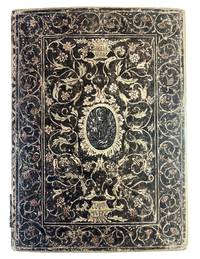
15204422Cologne: Quentel heirs 1520. 4to 194 x 140 mm. Collation: A-B4. 15 pages. Woodcut initial on title the latter in two sizes of large gothic types text in small gothic types leaded epigram on title and text heading in roman. Small stain in top of gutter margins small inkstain on A1v f. B3 corner clipped. Bound in early 18th-century South German pasteboards completely overpainted in imitation of a Renaissance binding: both covers painted in watercolor and gouache on a brown ground with outer panel of scrolling tendrils with red flowers and leaves central panel with arabesque foliate decor two vases at top and bottom and central cartouche containing a winged lion holding a book painted in silver on a black ground; flat spine with portion of a different painted decor endleaves of gold on green Bronzefirnispapier bronze varnish paper probably from Augsburg with interlacing tendrils and birds foxes rabbits dogs an angel’s head and a putto emerging from a bud thick paper flyleaves small tear to backstrip edges slightly rubbed small marginal repair to lower flyleaf. Provenance: contemporary inscription on title:  Plus que moins que me d’amour or quie en amour et or est qui la scait servir; Maurice Burrus 1882-1959 bookplate and acquisition label dated September 1937 identifying Arthur Lauria as the seller. <br /> <br /> First separate edition previously unknown of Cicero’s translation of part of Plato’s Timaeus. Cicero's fragmentary translation of sections 27d-47b was highly influential in late antiquity. In either Cicero’s version or Calcidius’s more extensive translation of sections 17a–53c the Timaeus was often the only text of Plato found in medieval monastic scriptoria and libraries. The first separate edition of Calcidius’s translation was also published in 1520 by Josse Bade. <br /> <br /> This edition was intended as a schoolbook with its moderately leaded lines. The title page includes an epigram by one Ioannis Sartae Leodiensis Jean de Sarthe of Liège. I locate one mention of another copy in a 1902 catalogue of the library of the Gymnasium of Emmerich bound with two other Cicero Quentel imprints from 1518 and 1517 J. Wattendorff Katalog der Lehrerbibliothek Part IV Emmerich 1904 p. 21 shelfmark O 35. That volume was evidently destroyed in 1944 when 90% of the town was bombed. <br /> <br /> The most remarkable feature of this unusual book is the binding carefully painted on inexpensive pasteboards by an unknown early 18th-century amateur to resemble a 16th-century gold-tooled and paneled binding. The artist indulged in a certain amalgamation of styles viz. the central silver medallion containing a representation of the lion of Venice holding the Gospel of Mark. <br /> <br /> The lovely “bronze varnish†or gold varnish endpapers with their swirling tendrils among which are hidden animals and birds are typical of papers produced in Augsburg in the first two decades of the 18th century cf. Haemmerle pp. 72-73. These especially resemble examples produced by Georg Christoph Stoy. I have not found an exact match in the printed and online literature. <br /> <br /> Not in VD16 KVK OCLC ISTC Hoffmann etc. My thanks to Irene Malfatto for her help with the inscription. Quentel heirs unknown