STUART MILL J. PLATONLivre Rare Book

7 013 résultats
187915823Germer Baillière et Cie 1879 200+228 pages in-12. 1879. Percaline titrée au dos en lettres dorées. 200+228 pages.
1975G0226776972I5N00Univ of Chicago Pr 1975. Hardcover. Acceptable. Readable copy. Pages may have considerable notes/highlighting. ~ ThriftBooks: Read More Spend Less.Dust jacket quality is not guaranteed. Univ of Chicago Pr hardcover
1995Q-1555236103Scythe Publications inc 1995-11-01. paperback. New. In shrink wrap. Looks like an interesting title! Scythe Publications inc paperback
Minor shelfwear to DJ. ; Author's Gift inscription on ffep. ; 230 pages; Plato's Crito examines a single moral decision, whether Socrates ought to escape from his death-cell. Stokes's book discusses Socrates' arguments against Crito's offer of escape. It construes Socrates' questions as genuine questions, which clarify and undermine Critos positions. Stokes's approach avoids the "documentary fallacy"; it shows how Plato catered for both the novice and the experienced reader of his published works. This book offers a fresh account of Socrates' whole strategy. It demonstrates both the shakiness of Socrates' persuasion of the un-philosophical Crito to engage in dialectic, and the coherence of his substantive confutation. Plato's reasoning emerges from Stokes's study with more credit than many have given it.; Signed by Author
190823160Halle, Niemeyer 1908. 131 Seiten. Broschiert
190892528Bayreuth, Druck Ellwanger 1908. 22 S. Gr.-8°. Orig.-Geheftet.
1961163410-1Hamburg, Meiner 1961. XXX; 337 S. Original-Leinenband
1965F109055Bonn, 1965 189pp., 21cm., softcover, text in German, Doctoral dissertation (Inaugural-Dissertation zur Erlangung der Doktorwürde der Philosophischen Fakultät der Rheinischen Friedrich-Wilhelms-Universität zu Bonn), stamp at verso of title page, text is clean and bright, good condition, F109055
189pp., 21cm., softcover, text in German, Doctoral dissertation (Inaugural-Dissertation zur Erlangung der Doktorwürde der Philosophischen Fakultät der Rheinischen Friedrich-Wilhelms-Universität zu Bonn), stamp at verso of title page, text is clean and bright, good condition, F109055
2003F108690Leuven, 2003 [6] + 113pp., 30cm., gebroch., onuitgegeven verhandeling aangeboden tot het behalen van de graad van Licentiaat in de Taal- en Letterkunde Latijn en Grieks aan de Katholieke Universiteit Leuven (promotor: prof.dr. C. Steel), enkele sporadische tekstaanduidingen en/of verbeteringen, verder in goede staat, F108690
[6] + 113pp., 30cm., gebroch., onuitgegeven verhandeling aangeboden tot het behalen van de graad van Licentiaat in de Taal- en Letterkunde Latijn en Grieks aan de Katholieke Universiteit Leuven (promotor: prof.dr. C. Steel), enkele sporadische tekstaanduidingen en/of verbeteringen, verder in goede staat, F108690
2006F105225Cambridge, Cambridge University Press 2006 vii + 191pp., 24cm., publisher's hardcover, dustwrapper, very good condition, F105225
vii + 191pp., 24cm., publisher's hardcover, dustwrapper, very good condition, F105225
1965002844Niu Iork New York: By the Author 1965. First Edition. Very good. First edition; 7 3/4 x 5 1/4; pp. 2 3-95; light-brown wraps printed in black; a small bump to tail of spine; minor creasing to corners; illustrated with frontis photographs and facsimile documents; very good to near fine condition. Around 1958 Ukrainian emigres in the US came up with the idea of building a memorial to "Ukraine's Favorite Son" author Taras Shevchenko as a way of making a statement about their community and of the situation in their homeland. The campaign gained momentum and in 1960 Congress passed a bill which allocated land in Washington DC for the Ukrainians to build a statue. Platon Stasiuk a prominent Ukrainian-American businessman and treasurer of the Shevchenko Memorial Committee went to Ukraine in 1961 intent on taking back a container of soil from Shevchenko's grave to be placed under the monument in Washington. Expecting an appreciative committee he was instead met with rejection as his bringing the soil was viewed as a Soviet ploy. Disappointed Stasiuk published a book describing his experience and the Soviet media denounced the dismissal as hostility towards a friendly gesture. Stasiuk returned the soil to Ukraine and wrote a second account the current one in which he included numerous letters of support he had received for his initiative. By the Author paperback
1965002844Niu Iork New York: By the Author 1965. First Edition. Very good. First edition; 7 3/4 x 5 1/4; pp. 2 3-95; light-brown wraps printed in black; a small bump to tail of spine; minor creasing to corners; illustrated with frontis photographs and facsimile documents; very good to near fine condition. Around 1958 Ukrainian emigres in the US came up with the idea of building a memorial to "Ukraine's Favorite Son" author Taras Shevchenko as a way of making a statement about their community and of the situation in their homeland. The campaign gained momentum and in 1960 Congress passed a bill which allocated land in Washington DC for the Ukrainians to build a statue. Platon Stasiuk a prominent Ukrainian-American businessman and treasurer of the Shevchenko Memorial Committee went to Ukraine in 1961 intent on taking back a container of soil from Shevchenko's grave to be placed under the monument in Washington. Expecting an appreciative committee he was instead met with rejection as his bringing the soil was viewed as a Soviet ploy. Disappointed Stasiuk published a book describing his experience and the Soviet media denounced the dismissal as hostility towards a friendly gesture. Stasiuk returned the soil to Ukraine and wrote a second account the current one in which he included numerous letters of support he had received for his initiative. By the Author paperback books
195997251BBKöln, 1959. 8°. 241 S. Broschiert (Besitzervermerk auf Widmungsseite; Ex Libris auf Innendeckel; gut erhalten)
1967133845Amsterdam: Liberac N.V. publishers 1967. 1 Bl., 152 Seiten. Grüner, titelvergoldeter Original-Leinwand-Einband mit rotem Rückenschildchen. (Geringe Gebrauchsspuren). 22x15 cm
1962F105293Göttingen, Vandenhoeck & Ruprecht 1962 130pp., in the series "Hypomnemata. Untersuchungen zur Antike und zu ihrem Nachleben" volume 2, softcover (few small stains), 25cm., text and interior clean and bright, good condition, F105293
130pp., in the series "Hypomnemata. Untersuchungen zur Antike und zu ihrem Nachleben" volume 2, softcover (few small stains), 25cm., text and interior clean and bright, good condition, F105293
Very light foxing to inner covers. Former owner's bookplate on ffep. DJ spine is browned. DJ has edgewear with chipping to extremities and small tears. Light foxing to back panel of DJ. ; 106 pages; Argues that Plato uses fallacy consciously in a number of arguments especially in Euthydemus. Also looks at Theaetetus, Cratylus, and Hippias Minor.
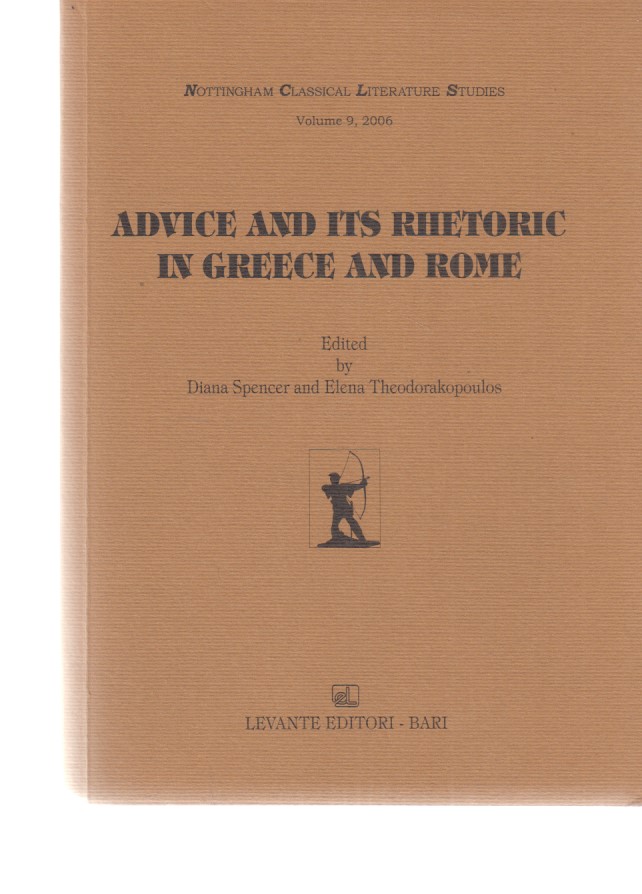
Gutes Exemplar. - Englisch. - Substantially, the essays in this collection formed part of the 2000 meeting of the Midlands Classics Colloquium, held on that occasion in Nottingham. We are sad to say that Thomas Wiedemann's contribution on the consilium principis, though a highlight of the day, could not be recovered to be included in this volume. The essays by Desmond Costa and Gideon Nisbet, as well as our own essay, are additions to the original conference essays - we hope that they help to illuminate different facets of our subject. At its most basic, advice is the help that a friend or comrade gives - a gesture that saves one from acting, and also from feeling, alone. This, surely, is Diomedes' point when asking for someone to come with him on his nocturnal expedition: If another comrade would escort me though, there'd be more comfort in it, confidence too. When two work side by side, one or the other spots the opening first if a kill's at hand. When one looks out for himself, alert but alone, his reach is shorter - his sly moves miss the mark. (Homer Iliad 10.224-226). It is settled that Odysseus will go with him, and so Diomedes achieves both the comfort he asks for and the practical benefits to be had from being part of a pair. He also now has as his partner one of the Iliad's best advisers - and the added bonus of Athena, an even greater Homeric adviser. There are, of course, many more public roles for advice or counsel in the Iliad itself: the process of making plans and taking decisions - of boule in the broadest sense - is central to the poem. And the giving and the receiving of good counsel, both in assemblies and between friends, seem to be as much part of the world of the Iliad as the relentless pursuit of glory in warfare. ... (Vorwort der Herausgeberinnen). - INHALT : Notes on Contributors --- List of illustrations --- Introduction --- DIANA SPENCER and ELENA THEODORAKOPOULOS --- 'Good men who have skill in speaking': performing advice in Rome DIANA SPENCER and ELENA THEODORAKOPOULOS --- On the receiving end: the hidden protagonist of Plato's Laches ANDREW BARKER --- Advice and Advisers in Xenophon's Anabasis TIM ROOD --- Consul and consilium: suppressing the Catilinarian conspiracy CATHERINE STEEL --- Telling it like it is: Seneca, Alexander and the dynamics of epistolary advice DIANA SPENCER --- Advice from on high - Pliny and Trajan ANDY FEAR --- Dio Chrysostom and the development of On Kingship literature HARRY SIDEBOTTOM --- 'That's not funny': advice in skoptic epigram GIDEON NISBET --- Afterword: giving advice in Greek letters DESMOND COSTA --- Bibliography Index. ISBN 9788879494397
20061200713Levante Editori; Bari, 2006. XV; 215 S.; 20,5 cm; fadengeh. Orig.-Pappband.
pp. xxii, 238 + Frontis and sixteen full page illustrations. Tall 8vo. Original full orange cloth binding. OCC 13
19722090502113717055Not Available 1972. Soft Cover. Fine. The book is in fine condition. Not Available paperback
1960F105340s.l., s.n. s.d. [ca. 1960's] [8] + 276pp., Réimpression moderne de l'édition originale de 1919, reliure d'éditeur en toile verte, 23cm., texte et intérieur frais, bon état, F105340