427 résultats
PHIL2792Leipzig Thomas 1898. Gr.-8°. XI 212; 173; 167 S. neuerer stummer HLnbd. Titelblatt gebräunt u. gestempelt. Erste dt. Ausgabe. Leipzig, Thomas 1898. unknown
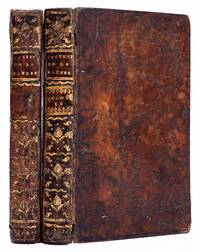
1797elala1352Paris: De LImprimerie De Lemaire An 5 De La République 1797. 1797. 2 Volumes in 1. 8vo. pp. 16 179; 190. with half-title. contemporary sprinkled calf extremities worn head of spine chipped spine label wanting half-title upper outer corner clipped internally very good. Fourth Edition. Purporting to be a translation from the English of John Trenchard and Thomas Gordon. First published in 1768 this vehemently atheistic text was condemned to be burned on August 18 1770. Vercruysse 1797-A1. cfBarbier I 739. cfCioranescu 34033. cfQuérard IV 118. cfTchemerzine VI 233 d. Paris: De LImprimerie De Lemaire, An 5 De La République [1797]. unknown
177520090“Londres†but Amsterdam 1775. Contemporary gilt-ruled calf flat spine and label gilt board edges and turn-ins gilt gold edges blue silk marker. In excellent condition. A scathing dismissal of the miracles cited in the Bible. Purporting to be a partial translation of the Latin manuscript Theophrastus Redivivus the first systematic atheistic philosophy the text argues that pagans have performed miracles as often as Jews and Christians. The anonymous author cites paranormal events in Greek and Roman mythology as analogous to the miracles of Christian tradition and claims that the existence of oracles and pagan religion after the birth of Christ prove the existence of extra-Christian miraculous power.<br /> <br /> Although the author remains a mystery the text was likely translated and disseminated by Paul Holbach a Franco-German philosopher and atheist. For obvious reasons this title bears a false imprint but Holbach’s works were usually printed in Amsterdam.<br /> ESTC T111947; see Yve-Plessis 267 and Caillet 3835. unknown
177654261Amsterdam: Chez Marc-Michel Rey 1776. First edition 3 volumes 8vo pp. 5 vi-xxiv 1 2-286; 5 2-256; 5 2-283; engraved vignette title pages; contemporary full mottled calf gilt-decorated spines. red and black morocco labels; moderate wear especially at the tops of 2 spines and the bottom of another; marbled edges and endpapers; ex-Forbes Library Northampton Mass. with bookplates and perforated stamps in the title pages; minor dampstains on the edges of a few leaves; a good reasonably sound copy. As an early atheist and critic of the Church Baron d'Holbach was an influential figure in the French Enlightenment. Known for his lavish dinner parties he hosted various intellectuals such as Denis Diderot Charles-Georges Le Roy Jean-François Marmontel abbé Guillame-Thomas-François Raynal and Jean-Jacques Rousseau. Holbach's work here heavily influenced by Locke and Hobbes discusses a universal system of ethics and political philosophy based upon the nature of man. Holbach posited that people are concerned with their self-preservation and their own happiness but are ultimately social creatures. Human happiness and self-preservation can be best achieved through altruistic co-operation with others and according to Holbach this co-operation is what motivates the acquiring of virtues. When individuals make this social contract with one another they expect their governing body to function in a utilitarian manner to uphold their basic rights such as a right to property freedom of speech and freedom of religion. When these rights were violated Holbach argues the people have a right to revolution. Volume I discusses a theory of morality volume II the practice of morality and volume III the duties of one's private life. Holbach often published anonymously as his ideas were considered dangerous and contemptible in a time when a humanist theory of morality was seen as anathema in a pre-dominantly Christian western world "Paul-Henry Thiry Holbach" in Stanford Encyclopedia of Philosophy. See PMM 215. Chez Marc-Michel Rey unknown
1776elala1354Amsterdam: March-Michel Rey 1776. 1776. 3 Volumes. 8vo. pp. xii xxiv 152 143-286; 2 p.l. 256; 2 p.l. 283. with half-titles engraved title vignettes. 19th century vellum covers bowed some staining to lower covers & lower margins in Vol. I. First Edition. Holbach was the foremost exponent of atheistic materialism in the Enlightenment. In the Politique Naturelle La Morale Universelle and the Système Sociale Holbach attempted to construct a system of ethical and political values based on mans physical nature and primary needs as the only desirable alternative to the illusory and harmful system predicated on supernatural theology. Happiness is the supreme natural goal of human existence but man is a social animal and Holbachs ethics was based on social utility. "Ethics is the science of human cooperation to promote the well-being of the individual through that of society and it is based on the positive knowledge of mens reciprocal social needs Atheism is the prerequisite of all valid ethical teaching. In place of the condemnation of sin Holbachs exposition of secular and utilitarian ethics is typically accompanied by vibrant appeals to humanitarianism and moving exhortations to civic virtue all in the name of nature and happiness. A.Vartanian Encyc. of Philosophy Vercrysse 1776-A4 our copy without the errata in Vol. III as usual. Barbier III 355. Cioranescu 34064. Quérard IV 119. Rand I 269. cfTchemerzine VI 248. 1st Edition. Amsterdam: March-Michel Rey, 1776. hardcover
1773POLP[HOL54London ie. Amsterdam: Marc Michel Rey: 1773. 1773. 2 Volumes bound in 1. 8vo. pp. vii 1 232; 2 p.l. 280. with half-titles. 19th century half calf back joint cracked. First Edition of one of the principal works of the 'foremost exponent of atheistic materialism in the Enlightenment'. Holbach advanced a system of natural politics based upon the needs common to all men and a system of ethics based on social utility. As the legitimacy of government depends upon the happiness of one or all living under it Holbach affirmed the people's natural right to overthrow an unjust ruler. In keeping with his ethocratic ideal Holbach proposed radical political and economic reforms for France. He favoured the adoption of a limited constitutional monarchy the abolition of hereditary class privileges the implementation of the principle of progressive taxation according to wealth the separation of church and state and the toleration of all religious sects the establishment of a system of secular public education and absolute freedom of thought and the press. Cioranescu 34059. Rand I 269. Tchemerzine VI 245. Vercruysse 1773.A2. 1st Edition. Hardcover. Very Good. London [ie. Amsterdam: Marc Michel Rey]: 1773. Hardcover
1802elala1450Paris: Au Palais Des Thermes De Julien 1802. 1802. 12mo. pp. 380. with half-title. Uncut in original wrs. some scattered foxing. Also including a preface containing correspondence between Voltaire and DAlembert and others a life of Meslier by Voltaire and a decree of the Convention in honour of Meslier. Holbachs popular account of his atheistic materialist philosophy was first published in 1772 and immediately condemned by the Paris Parlement. Vercruysse 1802-A1 noting that the text may actually have been printed as late as 1822. cfCioranescu 34054-56. cfQuérard IV 118. cfTchemerzine VI 244 a. Paris: Au Palais Des Thermes De Julien, 1802. unknown
177313873Paris: Chez Valade 1773 First published in Neuchâtel though the title-page says "Londres" the previous year this is an early perhaps the first book-length commentary on Holbach's Le Systême de la Nature which was published in Amsterdam in 1770 with a bogus London imprint. Printing and the Mind of Man notes: "Holbach's target was the very idea of God. Even Voltaire was moved to reply in defense of religion by this "bible of materialism" P.M.M. 215. Contemporary mottled calf gilt spine with burgundy morocco spine label edges stained red. Two volumes in one twelvemo. With nine cancel leaves bound in at the end. Binding extremities lightly rubbed. A very good clean copy. In the preface the editor states that he has made various textual changes and has suppressed certain passages without Holland's permission so that the book could have a wider distribution. This copy is interesting in that it contains both Holland's 1742-1784 original text and the editor's "improvements." He also made various improvements to Holland's French Holland not being a native French speaker. This first edition of his commentary is rare: OCLC lists eleven copies eight in North America Yale LSU Michigan Boston Public Library Oklahoma Texas and Montreal. It is uncertain whether the first edition has the uncorrected text which we see in the cancels or something even different. Chez Valade, unknown
60039Londres Amsterdam: Marc-Michel Rey 1770. FIRST EDITION FIRST ISSUE OF "THE BIBLE OF MATERIALISM" PMM 215. 2 vols. 8vo. 20 x 12.5 cm. Half-title Table des chapitres 2 title Avis de l'editeur 2 Préface de l'auteur 4pp.370; title Table des chapitres 2pp.412. Contemporary full mottled calf spines decorated in gilt two brown morocco labels vol. 1 missing one label decorative navy blue chequered endpapers pink silk ribbon page markers red speckled edges. Joints slightly cracked but strong and with some minor losses spines rubbed contents clean save for some occasional light toning generally a very good unsophisticated set of this major philosophical work. The rare first edition first issue with the correct pagination the comma after 'Londres' in the imprint' and without the 4-page errata which was added later during the printing process as mistakes were discovered of d'Holbach's main work the main work of materialism and one of the most important works of natural philosophy. Paul Heinrich Dietrich Baron d'Holbach was born at Heidelsheim in Germany and educated in Holland at Leiden University before settling in Paris and becoming a naturalized Frenchman. He first became known as a scientist and contributed some four hundred articles to the Encyclopédie of his lifelong friend and colleague Denis Diderot. Diderot d'Alembert Helvetius Voltaire and others of the philosophes met frequently for dinner and philosophical discussions at the Baron's house which became known as 'the café of Europe' among foreign visitors to these dinners were Wilkes Hume and Sterne. Later Holbach turned from science to more dangerous topics: he wrote and had published abroad a stream of books attacking religion in all its aspects which flooded illegally into France. He could not publish safely under his own name but had had the ingenious idea of using the names of recently dead French authors. Thus in 1770 his most famous book 'The System of Nature' appeared under the name of Jean-Baptiste Mirabaud. When it reached France it provoked one of the greatest scandals of the century being immediately condemned on the 18th of August 1770 and put on the Index the 9th of November. "In the Système Holbach rejected the Cartesian mind-body dualism and attempted to explain all phenomena physical and mental in terms of matter in motion. He derived the moral and intellectual faculties from man's sensibility to impressions made by the external world and saw human actions as entirely determined by pleasure and pain. He continued to direct his attack on religion by attempting to show that it derived entirely from habit and custom. But the Système was not a negative or destructive book: Holbach rejected religion because he saw it as a wholly harmful influence and he tried to supply a more desirable alternative. In fact he outlined a whole ethical and political philosophy which he expanded in his later works especially La Morale Universelle 1776. It was his aim to derive a morality and an ethic from a completely materialistic and atheistic bias.the confident dogmatism and the comprehensiveness of the Systême de la Nature which even provoked Voltaire to reply in defence of religion have ensured its survival as the bible of materialism" PMM 215. PMM 215. Londres [Amsterdam: Marc-Michel Rey], 1770. unknown
elala5529London i.e. Amsterdam: Marc-Michel Rey 1770. First Edition of Holbach’s most famous work the sole example in the Enlightenment of a comprehensive uncompromising defence of atheistic materialism which became the “principal free-thought textbook of the late eighteenth century.†PMM Holbach drew on the ideas of Hobbes La Mettrie Helvétius and Diderot but pressed them to their most radical conclusion. His work was assailed alike by the ecclesiastical and civil authorities as well as by the philosophes; both Voltaire and Frederick the Great wrote responses to it. This copy has the same pagination as the first edition first issue as described by Vercruysse 1770-A6 with a coma rather than a period after ‘Londres’ in the imprint but there are no errata leaves and the title of Volume I exhibits slight differences in setting and typography and has a different title ornament. It is generally referred to as a first issue in the trade. Brunet III 1739. Cioranescu 34051. Printing and the Mind of Man 215. Rand I 269. Quérard IV 119. cfVercruysse 1770-A6. cfTchemerzine VI 243. 2 Volumes. 8vo. pp. 6 p.l. 370; 2 p.l. 412. with half-title in Vol. I. A nice copy in contemporary mottled calf gilt backs few nicks & scrapes to binding faint embrowning to outer leaves. elala5529 London [i.e. Amsterdam: Marc-Michel Rey], 1770 unknown
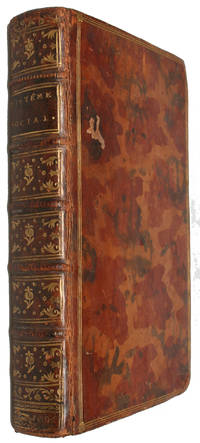
177340375London recte: Amsterdam M.M. Rey 1773. 8vo. Bound in one beautiful contemporary full mottled calf binding with five raised bands to richly gilt spine; triple gilt line-borders to boards and inner gilt dentelles. Edges of boards with single gilt line. All edges gilt. Corners abit bumped and a bit of overall wear. Inner hinges a bit weak. Internally very fine and clean. All in all a very fine copy indeed. 4 210; 176; 167 pp. With all three half-titles all three title-pages and all three indexes as well as the introduction. <br/><br/><em>The rare first edition first issue though Tchermerzine mentions an unknown 2-volume-edition form the same year - this edition has never been verified of one of d'Holbach's most important works his influential "social" and political continuation of his seminal main work "Systeme de la nature" - the bible of materialism. D'Holbach 1723-1789 who was raised by a wealthy uncle whom he inherited together with his title of Baron in 1753 maintained one of the most famous salons in Paris. This salon became the social and intellectual centre for the Encyclopédie which was edited by Diderot and d'Alembert whom he became closely connected with. D'Holbach himself also contributed decisively to the Encyclopédie with at least 400 signed contributions and probably as many unsigned between 1752 and 1765. The "Côterie holbachique" or "the café of Europe" as the salon was known attracted the most brilliant scientists philosophers writers and artists of the time e.g. Diderot d'Alembert Helvetius Voltaire Hume Sterne etc etc. and it became one of the most important gathering-places for the exchange of philosophical scientific and political views under the "ancient régime". Apart from developing several foundational theories of seminal scientific and philosophical value D'Holbach became known as one of the most skilled propagators and popularizers of scientific and philosophical ideas promoting scientific progress and spreading philosophical ideas in a new and highly effective manner. D'Holbach was himself the most audacious philosophe of this circle. During the 1760's he caused numerous anticlerical tracts written in large but not entirely by himself to be clandestinely printed abroad and illegally circulated in France. His philosophical masterpiece the "Système de la nature ou des lois du monde physique et du monde moral" a methodological and intransigent affirmation of materialism and atheism appeared anonymously in 1770" D.S.B. VI:468 as did the social and political follow-up of it the famous "Systême social" in 1773. That is to say Mirabeau whom he had used as the author on the "System of Nature" in 1770 is not mentioned in the "Social System" on the title-page of which is merely stated "By the Author of "Systême de la Nature". As the theories of d'Holbach's two systematic works were at least as anticlerical and unaccepted as those of his smaller tracts and on top of that so well presented and so convincing it would have been dangerous for him to print any of them under his own name and even under the name of the city or printer. Thus "Systême de la Nature" appeared pseudonomously under the name of the secretary of the Académie Francaise J.B. Mirabaud who had died 10 years earlier and under a fictive place of printing namely London instead of Amsterdam. "He could not publish safely under his own name but had the ingenious idea of using the names of recently dead French authors. Thus in 1770 his most famous book "The System of Nature" appeared under the name Jean-Baptiste Mirabaud." PMM 215 and so the next "System" also appeared in the same manner three years later.In his "Systême de la Nature" d'Holbach had presented philosophical materialism in an actual system for the first time and had created a work that dared unite the essence of all the essential material of the English and French Enlightenment and incorporate it into a closed materialistic system; on the basis of a completely materialistic and atheistic foundation he provided the modern world with a moral and ethic philosophy the effects of which were tremendous. It is this materialism and atheism that he continues three years later in his next systematic work "Systême social" through which politics morality and sociology are also incorporated into his system and take the place of the Christianity that he had so fiercely attacked earlier on. In this great work he extends his ethical views to the state and continues the description of human interest from "Systême de la Nature" by developing a notion of the just state by d'Holbach calle "ethocracy" that is to secure general welfare. "Système social 1773; "Social System" placed morality and politics in a utilitarian framework wherein duty became prudent self-interest." Encyclopaedia Brittanica. "Holbach's foundational view is that the most valuable thing a person seeking self-preservation can do is to unite with another person: "Man is of all beings the most necessary to man" Sysème social 76; cf. Spinoza's Ethics IVP35C1 C2 and S. Society when it is just unites for the common purpose of preservation and the securing of welfare and society contracts with government for this purpose." SEP.As the "Systême de la Nature" had been condemned to burning in the year of its publication so the "Systême social" was on the list of books to be confiscated already in 1773 and it was placed on the Index of the Church in August 1775. As the "Systême de la Nature" the "Systême social" is thus also of great scarcity. Another edition of the work appeared later the same year in 12mo. Tchermerzine says that "Il ya une édition que nous ne connaissons pas en 2 vol. in-8. C'est sans doute l'originale." The present edition was reprinted the following year in 1774.Tschermerzine VI:246; Graesse III:317; Barbier IV:622 only listing later editions. </em> hardcover
1773elala1356London Amsterdam: 1773. 1773. 3 Volumes in 1. 8vo. pp. 2 p.l. 210; 176; 167. with half-titles. contemporary sprinkled calf gilt back extremities worn. Published the same year as the first edition. Holbach was the foremost exponent of atheistic materialism in the Enlightenment. In the Politique Naturelle La Morale Universelle and the Système Sociale Holbach attempted to construct a system of ethical and political values based on mans physical nature and primary needs as the only desirable alternative to the illusory and harmful system predicated on supernatural theology. Copies of the present work were seized by the police and it was placed on the Index on August 18 1775. Vercruysse 1773-A5. Barbier IV 621-22. Cioranescu 34061. Quérard IV 119. Rand I 269. cfTchemerzine VI 246 a. 1st Edition. Hardcover. London [Amsterdam?]: 1773. Hardcover
1773POLst[HO77Londres Amsterdam: Marc Michel Rey 1773. 1773. 3 Volumes in 1. 8vo. pp. viii viii 9-218 2; 2 p.l. 174 2; 2 p.l. 166 2. with half-titles. contemporary quarter calf gilt back extremities worn head of spine chipped. First Edition First Issue. Holbach advanced a system of natural politics based upon the needs common to all men. As the legitimacy of government depends upon the happiness of one or all living under it Holbach affirmed the people's natural right to overthrow an unjust ruler. Barbier IV 621-22. Cioranescu II 34061. Querard IV 119. Tchemerzine VI 246. Vercruysse 1773-A4. Rand I 269. 1st Edition. Hardcover. Good. Londres [Amsterdam: Marc Michel Rey], 1773. Hardcover
elala2504Londres Amsterdam: Marc Michel Rey 1773. First Edition First Issue. Holbach advanced a system of natural politics based upon the needs common to all men. As the legitimacy of government depends upon the happiness of one or all living under it Holbach affirmed the people's natural right to overthrow an unjust ruler. Barbier IV 621-22. Cioranescu II 34061. Querard IV 119. Tchemerzine VI 246. Vercruysse 1773-A4. Rand I 269. 3 Volumes in 1. 8vo. pp. viii viii 9-218 2; 2 p.l. 174 2; 2 p.l. 166 2. with half-titles. contemporary quarter calf gilt back extremities worn head of spine chipped Londres [Amsterdam: Marc Michel Rey], 1773 unknown
42229Londres aux dépens de la Compagnie [ Cazin ] 1788 in 8 (20x12,5) 1 volume reliure demi velin, dos lisse, pièce de titre de cuir marron, 206 pages. Pamphlet antireligieux et anticlérical. Bon exemplaire ( Photographies sur demande / We can send pictures of this book on simple request )
1804381361804 4 volumes in-8, demi-veau vert sapin, dos lisses ornés de triples filets dorés, titres et tomaisons dorés, tranches citron (rel. vers 1850). Paris, Xhrouet et Déterville, an XII - 1804.
4 volumes in-8, demi-veau vert sapin, dos lisses ornés de triples filets dorés, titres et tomaisons dorés, tranches citron (rel. vers 1850). Recueil des principaux articles publiés dans la "Gazette Littéraire de l'Europe" ainsi que dans le "Journal des étrangers", par François Arnaud et Jean Baptiste Antoine Suard, fondateurs et rédacteurs historiques de ces périodiques, entre 1764 et 1766, augmenté de plusieurs articles qui ne figuraient pas dans l'édition originale. Ambitionnant d'élaborer un périodique culturel encyclopédique de "référence", les auteurs obtinrent le soutien actif du gouvernement et du ministère des Affaires étrangères et un large rayonnement international. Outre les articles d'Arnaud et de Suard, La "Gazette littéraire" comptait parmi ses rédacteurs Diderot, Voltaire, le baron d'Holbach, Morellet, Saint-Lambert, etc. De nombreux articles concernent la musique et l'opéra, sujet privilégié de François Arnaud, mais aussi beaux-arts, sciences de la vie, littérature et poésie, théâtre, médecine, philosophie, voyages, etc., etc. Chaque volume s'achève par une table. (Hatin, 'Bibliographie de la presse périodique française', p. 48). Quelques auréoles et quelques rousseurs. Bon exemplaire, bien relié.
A9783110145212Hardback. New. hardcover
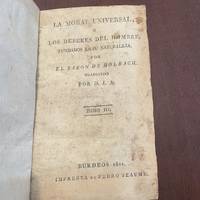
182128870Imprenta de Pedro Beaume 1821. 16 cm. Burdeos. Piel. Buen estado general. 16 cm Imprenta de Pedro Beaume unknown
A9781498171236Hardback. New. hardcover
5187758like new. unknown
B9781169969315Paperback / softback. New. paperback
B9781498171236Hardback. New. hardcover
1838F55920Tournay, Casterman 1838 Complet en 2 tomes: viii,376 + 358pp., reliures cart. (dos en cuir avec titre et décoration doré), 23cm., qqs.cachets et rousseurs, bon état, [réfutation de la théorie de Holbach]
1772F92299Paris, chez Humblot 1772 Complet en 2 tomes: xvi,430 + xii,413,[iii] pp., reliures uniformes cart. du 19e siècle (plats marbrés, dos en cuir avec titre et faux-nerfs dorés), 17cm., cachet, bon état, [réfutation de la théorie de Holbach], F92299