HOBBES (Thomas), HOLBACH (Paul Thiry, baron d') traducteur et FAIGUET DE VILLENEUVE (Joachim)Livre Rare Book
70 résultats
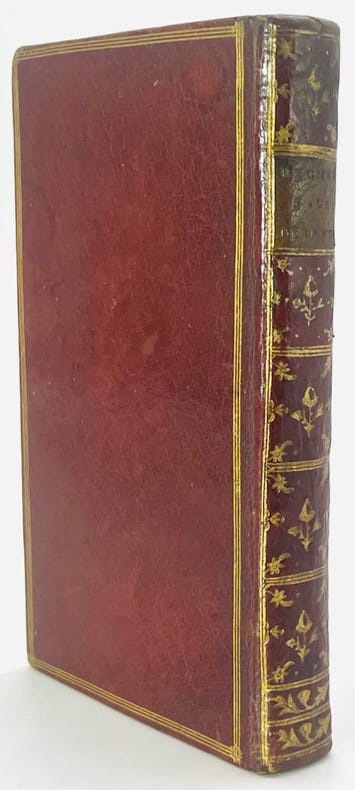
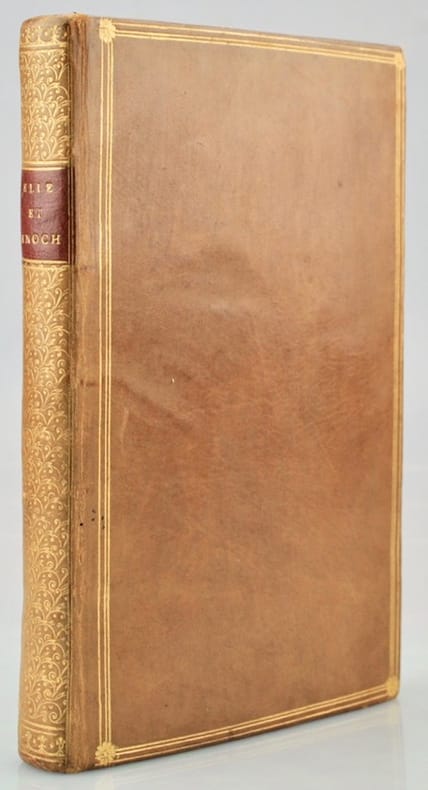
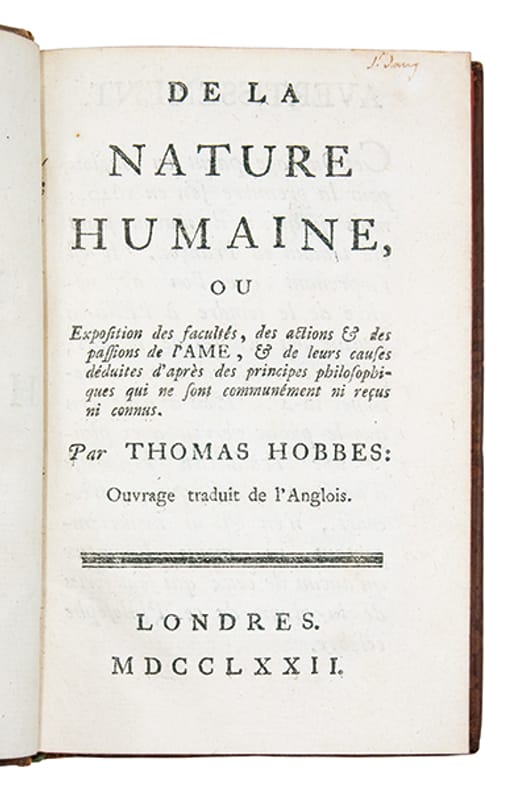
1772385001772 2 ouvrages reliés en un volume in-12 (153 x 96 mm), plein veau marbré de l'époque, dos lisse entièrement orné d'un décor doré à la grotesque, pièce de titre de maroquin bordeaux, tranches rouges.
1752002066Paris: Durand Pissot 1752. Hardcover. Very Good. Title page continued: "Un Mémoire sur la Maniere de faire le Saffre; Le Secret des Vraies Porcelaines de Chine & de Saxe. Ouvrages ou l'on trouvera la maniere de faire le Verre & le Crystal d'y porter des Couleurs d'imiter les Pierres Prétieuses de préparer & colorer les Emaux de faire la Potasse de Peindre sur le Verre de préparer des Vernis de composer des Couvertes pour les Fayances & Poteries d'extraire la Couleur Pourpre de l'Or de contrefaire les Rubis de faire le Saffre de faire & peindre les Porcelaines &c. Traduits de l'allemand par M. D." 4 lv 1 629 3 p. 16 leaves of copperplate engravings including the frontispiece most folded; 26 cm. Contemporary full calf with six spine compartments between raised bands. Orange leather spine label in second compartment with gilt-tooled title; gilt-tooled decoration in other compartments. All page edges red. Woodcut head pieces and in-text illustrations. Contents: Sol sine Veste ou Trente Experiences pour Tirer la Couleur Pourpre de l'Or by J.C. Orschall -- Helioscopium Videndi sine Veste Solem Chymicum -- Sol non sine Veste ou L'Invincibilité de l'Or by Christophe Grummet -- De la Vitrification des Vegetaux -- Chapitre XI du Livre de Mr. Henckel qui a pour titre Flora Saturnizans -- Secret des Vraies Porcelaines de la Chine et de Saxe. Baron von d'Holbach translated several early works on glassmaking including works by Antonio Neri Christopher Merret and Johannes Kunckel. In Very Good Condition: front joint starting to separate from tail; slight loss of leather at head and tail of spine; light cracking on spine; corners rubbed. Pages and plates are clean and bright. Durand, Pissot hardcover
175275603Paris, Durand & Pissot, 1752, in-4, [4]-LV-629-[3] pp, 16 pl, veau havane de l'époque, dos à nerfs et fleuronné, pièce de titre rouge, 16 planches dépliantes gravées sur cuivre, dont le frontispice, et quelques figures sur bois dans le texte. Première édition française de cet compilation sur la verrerie mise en oeuvre par le baron Thiry d'Holbach (1723-1789), grand classique sur le sujet. Elle se compose des traductions, qu'il a lui-même données, ainsi que de mémoires divers, soit : L'important traité d'Antoine Neri (1576 - c. 1614) ; Les notes de Merret sur Neri, les observations du verrier Kunckel, le recueil d'opérations de ce dernier ; Le Sol sine Veste d'Orschall, l'Helioscopium videndi sine veste solem Chymicum ; Le Sol Non Sine Veste [de Grummet] ; Le chapitre XI du Flora Saturnizans de Henckel, sur la vitrification des Végétaux ; Un mémoire sur la manière de faire le saffre (le smalt) et le Secret des vraies porcelaines de la Chine et de la Saxe. La traduction de Neri, reconnu pour son habilité dans la coloration des verres, a été faite sur la version allemande de Kunckel (1679) : il s'agit du premier ouvrage imprimé sur la verrerie, publié pour la première fois en italien en 1612. Sol sine veste d'Orschall et le Sol non sine veste de Grummet contiennent des questions relatives à l'alchimie et à la destruction de l'or. Reliure restaurée avec soin. Petite réparation au frontispice et au titre, une auréole intérieure pâle aux premiers feuillets, tache d'encre claire sur la dédicace. Bon exemplaire néanmoins. Duveen, 427. Cole, 971. Dorbon (3235). Ferguson II, 135. Couverture rigide
1769elala1353London Amsterdam: Marc Michel Rey: 1769. 1769. 8vo. pp. 2 p.l. 228. contemporary mottled calf gilt back head of spine worn bookplate excised from front paste-down. First Edition. Although translated according to the Avertissement from the second edition of an English work entitled Considerations upon war upon cruelty in general and religious cruelty in particular 1761 this exposure of religious cruelty intolerance and injustice is fully or largely the work of the Baron dHolbach. Vercruysse 1769-D1. Barbier I 826. Tchemerzine VI 238 a. cfCioranescu 34034 incorrectly citing date 1768. 1st Edition. Hardcover. London [Amsterdam: Marc Michel Rey]: 1769. Hardcover
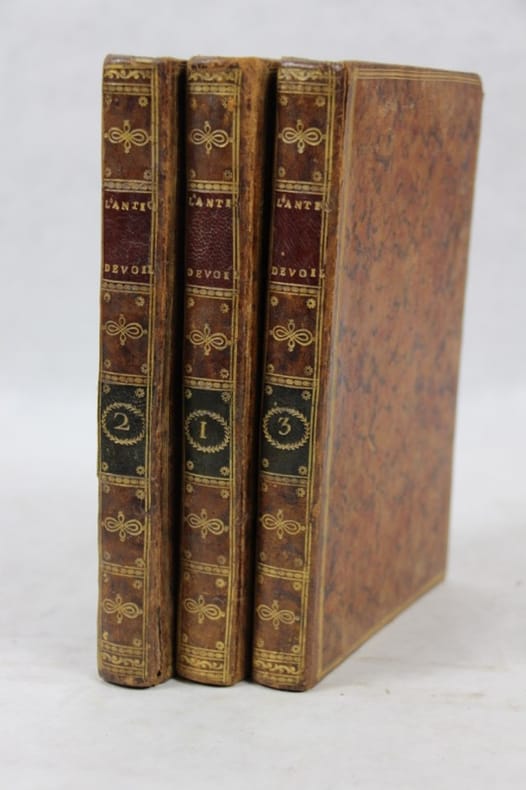
17642207, , 1764. In-12 de XIV-216 pp.AUTREY (Henri-Jean-Baptiste Fabry de Moncault, comte d'). L'Antiquité justifiée, ou Réfutation d'un livre qui a pour titre : l'Antiquité dévoilée par ses usages. A Amsterdam, et se trouve à Paris chez Vallat-La-Chapelle, 1766. In-12 de XII-(2)-200 pp. Ensemble 1 vol. in-12, maroquin rouge, dos lisse orné, pièce de titre en maroquin olive, tranches dorées (reliure de l'époque).
176411984, , 1764. In-12 de XVI-284 pp., veau blond, dos lisse orné, triple filet doré sur les plats, pièce de titre en maroquin rouge, tranches rouges (reliure de l'époque).
1790VT - LA - HAY049891790 - Édition originale. Paris chez G. de Bure. relié plein veau marron raciné de ce temps là. Mors fendus en pied et surtout en tête avec quelques manques de cuir le long de la charnière coins un peu usés ; quelques inscriptions à l'encre sur la page de garde et de titre ; petite trou au centre d'une rousseur en marge de la dernière page sinon intérieur en très bon état. in-16. dos lisse à faux-nerfs orné de motifs dorés et pièce de titre en cuir rouge avec lettres dorées ; coupes agrémentées de filets dorés ; toutes tranches marbrées. unknown
1769372051769 In-12, broché, couverture papier bleu d'origine, (8), 295 p., exemplaire non rogné, non coupé, tel que paru. Londres [i.e. Amsterdam, Marc-Michel Rey], 1769.
1772F92299Paris, chez Humblot 1772 Complet en 2 tomes: xvi,430 + xii,413,[iii] pp., reliures uniformes cart. du 19e siècle (plats marbrés, dos en cuir avec titre et faux-nerfs dorés), 17cm., cachet, bon état, [réfutation de la théorie de Holbach], F92299
1771260111771 2 volumes in-12, pleine basane marbrée de l'époque, dos à nerfs fleuronnés et cloisonnés, pièces de titre et de tomaison de maroquin, tranches rouges, xvi, 430 p. et xij, 407 p., (3) p. de privilège. Paris, Humblot, 1771.
17810042251781 Genève, Pellet, 1781. Dix volumes in-8 (130 X 207 mm) basane fauve marbrée, dos lisse orné à la grotesque de motifs dorés, pièces de titre et de tomaison grenat et vert, coupes ornées d'une guirlande dorée, coiffes filetées, tranches jaspées (reliure de l'époque). Tome I : portrait, XVI pages de faux-titre, titre, avertissement et table, 348 pages, (1) f. d'errata, (2) tableaux dépliants ; Tome II : frontispice, XII pages de faux-titre, titre et table, 378 pages, (1) f. d'errata, (4) tableaux dépliants ; Tome III : frontispice, VII pages de faux-titre, titre et table, 372 pages, (1) f. d'errata ; Tome IV : frontispice, XII pages de faux-titre, titre et table, 308 pages, (1) f. d'errata, (3) tableaux dépliants ; Tome V : frontispice, VII pages de faux-titre, titre et table, 259 pages, (1) f. d'errata, (1) tableau dépliant ; Tome VI : frontispice, XII pages de faux-titre, titre et table, 308 pages, (1) f. d'errata ; Tome VII : frontispice, XVI pages de faux-titre, titre et table, 359 pages, (1) page d'errata, (5) tableaux dépliants ; Tome VIII : frontispice, XII pages de faux-titre, titre et table, 352 pages ; Tome IX : frontispice, VIII pages de faux-titre, titre et table, 262 pages, (1) f. blanc, (1) f. d'errata, (9) tableaux dépliants ; Tome X : frontispice, V pages de faux-titre, titre et table, 348 pages, (1) f. d'errata. Quelques petites restaurations à la reliure.
178915957Paris, Quillau, 1789. 88 livraisons à pagination continue reliées en 1 vol. petit in-4, cartonnage saumon, pièce de titre manuscrite sur le dos (reliure de l'époque).
177254481Amsterdam, Chez Marc Michel Rey 1772 3 volumes in-12, plein veau marbré, dos à nerfs, caissons ornés, XXIV- 358- VII- 352- VII- 363 pp. Dos passés, coiffes et coins usés, qq. mors fendillés. Rares rousseurs.
177554461Amsterdam, Marc-Michel Rey 1775 3 volumes in-12, plein veau porphyre, dos lisse, caissons ornés, pièces de titre et de tomaison de maroquin noir et grenat, triple filet d’encadrement des plats, roulettes en coupes et contreplats, X-310- 330- 330pp. Reliure un peu frottée, quelques coins émoussés, un plat fragilisé en pied, petites attaques de ver, néanmoins décorative. Int. frais.
177041908Londres, , 1770. In-12 de (4)-XXII-201 pp., demi-papier rouge, dos à nerfs, entièrement non rogné (reliure de l'époque).
1797elala1352Paris: De LImprimerie De Lemaire An 5 De La République 1797. 1797. 2 Volumes in 1. 8vo. pp. 16 179; 190. with half-title. contemporary sprinkled calf extremities worn head of spine chipped spine label wanting half-title upper outer corner clipped internally very good. Fourth Edition. Purporting to be a translation from the English of John Trenchard and Thomas Gordon. First published in 1768 this vehemently atheistic text was condemned to be burned on August 18 1770. Vercruysse 1797-A1. cfBarbier I 739. cfCioranescu 34033. cfQuérard IV 118. cfTchemerzine VI 233 d. Paris: De LImprimerie De Lemaire, An 5 De La République [1797]. unknown
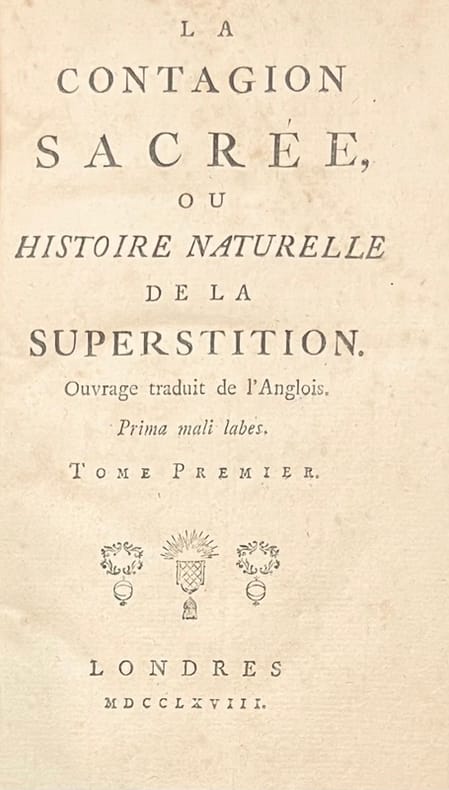
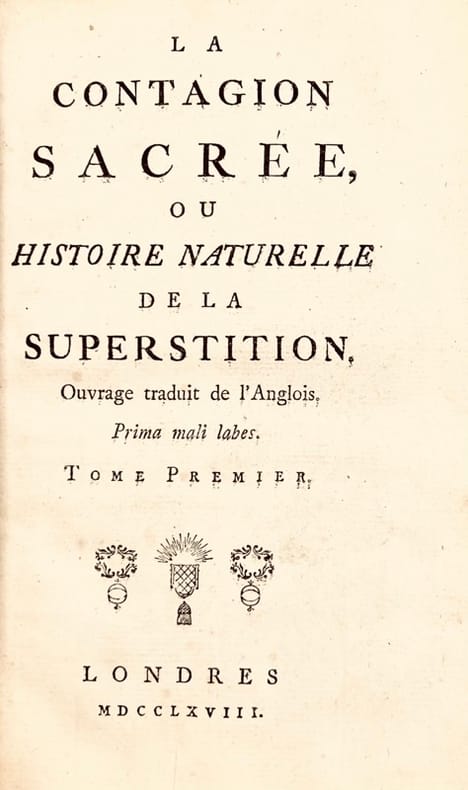
177518405Londres London Amsterdam: S. n. 1775. Fine. S. n. Londres London Amsterdam 1775 10 x 17 cm 2 tomes reliés en un volume New edition. The original dates from 1768. Contemporary full Contemporary full pink paper boards binding. Smooth spine with fillets. Brown calf title-label. Rubbing to boards and headcaps. Although the text was presented as a translation by Jean Trichard the work is indeed by Baron d'Holbach. This history of superstition is a merciless indictment against persecutions and political and religious tyrannies of all kinds which made terror reign through fear and fanaticism as much as through political ambition. S. n. hardcover
1768660Londres, , 1768. 2 tomes en 1 vol. in-12 de (2)-X-169 (1) pp. ; (4)-184 pp., demi-basane havane, dos lisse orné, pièce de titre (relié vers 1800).
176843523Londres, , 1768. 2 tomes en 1 vol. in-12 de X-169 (1) pp. ; (4)-184 pp., maroquin rouge, dos lisse orné, roulette sur les coupes et dentelle intérieure dorée, tranches dorées (reliure de l'époque).
179715936Paris, Lemaire, 1797. 2 parties en 1 vol. in-8 de 16-179, 190 pp., demi-basane à petits coins, dos orné à nerfs, pièce de titre "BIBLIO.PHILOSO" en maroquin vert, tranches jaspées (reliure de l'époque).
177518405S. n. | Londres [Amsterdam?] 1775 | 10 x 17 cm | 2 tomes reliés en un volume
177520090“Londres†but Amsterdam 1775. Contemporary gilt-ruled calf flat spine and label gilt board edges and turn-ins gilt gold edges blue silk marker. In excellent condition. A scathing dismissal of the miracles cited in the Bible. Purporting to be a partial translation of the Latin manuscript Theophrastus Redivivus the first systematic atheistic philosophy the text argues that pagans have performed miracles as often as Jews and Christians. The anonymous author cites paranormal events in Greek and Roman mythology as analogous to the miracles of Christian tradition and claims that the existence of oracles and pagan religion after the birth of Christ prove the existence of extra-Christian miraculous power.<br /> <br /> Although the author remains a mystery the text was likely translated and disseminated by Paul Holbach a Franco-German philosopher and atheist. For obvious reasons this title bears a false imprint but Holbach’s works were usually printed in Amsterdam.<br /> ESTC T111947; see Yve-Plessis 267 and Caillet 3835. unknown
177654261Amsterdam: Chez Marc-Michel Rey 1776. First edition 3 volumes 8vo pp. 5 vi-xxiv 1 2-286; 5 2-256; 5 2-283; engraved vignette title pages; contemporary full mottled calf gilt-decorated spines. red and black morocco labels; moderate wear especially at the tops of 2 spines and the bottom of another; marbled edges and endpapers; ex-Forbes Library Northampton Mass. with bookplates and perforated stamps in the title pages; minor dampstains on the edges of a few leaves; a good reasonably sound copy. As an early atheist and critic of the Church Baron d'Holbach was an influential figure in the French Enlightenment. Known for his lavish dinner parties he hosted various intellectuals such as Denis Diderot Charles-Georges Le Roy Jean-François Marmontel abbé Guillame-Thomas-François Raynal and Jean-Jacques Rousseau. Holbach's work here heavily influenced by Locke and Hobbes discusses a universal system of ethics and political philosophy based upon the nature of man. Holbach posited that people are concerned with their self-preservation and their own happiness but are ultimately social creatures. Human happiness and self-preservation can be best achieved through altruistic co-operation with others and according to Holbach this co-operation is what motivates the acquiring of virtues. When individuals make this social contract with one another they expect their governing body to function in a utilitarian manner to uphold their basic rights such as a right to property freedom of speech and freedom of religion. When these rights were violated Holbach argues the people have a right to revolution. Volume I discusses a theory of morality volume II the practice of morality and volume III the duties of one's private life. Holbach often published anonymously as his ideas were considered dangerous and contemptible in a time when a humanist theory of morality was seen as anathema in a pre-dominantly Christian western world "Paul-Henry Thiry Holbach" in Stanford Encyclopedia of Philosophy. See PMM 215. Chez Marc-Michel Rey unknown
1776elala1354Amsterdam: March-Michel Rey 1776. 1776. 3 Volumes. 8vo. pp. xii xxiv 152 143-286; 2 p.l. 256; 2 p.l. 283. with half-titles engraved title vignettes. 19th century vellum covers bowed some staining to lower covers & lower margins in Vol. I. First Edition. Holbach was the foremost exponent of atheistic materialism in the Enlightenment. In the Politique Naturelle La Morale Universelle and the Système Sociale Holbach attempted to construct a system of ethical and political values based on mans physical nature and primary needs as the only desirable alternative to the illusory and harmful system predicated on supernatural theology. Happiness is the supreme natural goal of human existence but man is a social animal and Holbachs ethics was based on social utility. "Ethics is the science of human cooperation to promote the well-being of the individual through that of society and it is based on the positive knowledge of mens reciprocal social needs Atheism is the prerequisite of all valid ethical teaching. In place of the condemnation of sin Holbachs exposition of secular and utilitarian ethics is typically accompanied by vibrant appeals to humanitarianism and moving exhortations to civic virtue all in the name of nature and happiness. A.Vartanian Encyc. of Philosophy Vercrysse 1776-A4 our copy without the errata in Vol. III as usual. Barbier III 355. Cioranescu 34064. Quérard IV 119. Rand I 269. cfTchemerzine VI 248. 1st Edition. Amsterdam: March-Michel Rey, 1776. hardcover
177654261Amsterdam: Chez Marc-Michel Rey 1776. First edition 3 volumes 8vo pp. 5 vi-xxiv 1 2-286; 5 2-256; 5 2-283; engraved vignette title pages; contemporary full mottled calf gilt-decorated spines. red and black morocco labels; moderate wear especially at the tops of 2 spines and the bottom of another; marbled edges and endpapers; ex-Forbes Library Northampton Mass. with bookplates and perforated stamps in the title pages; minor dampstains on the edges of a few leaves; a good reasonably sound copy. As an early atheist and critic of the Church Baron d'Holbach was an influential figure in the French Enlightenment. Known for his lavish dinner parties he hosted various intellectuals such as Denis Diderot Charles-Georges Le Roy Jean-François Marmontel abbé Guillame-Thomas-François Raynal and Jean-Jacques Rousseau. Holbach's work here heavily influenced by Locke and Hobbes discusses a universal system of ethics and political philosophy based upon the nature of man. Holbach posited that people are concerned with their self-preservation and their own happiness but are ultimately social creatures. Human happiness and self-preservation can be best achieved through altruistic co-operation with others and according to Holbach this co-operation is what motivates the acquiring of virtues. When individuals make this social contract with one another they expect their governing body to function in a utilitarian manner to uphold their basic rights such as a right to property freedom of speech and freedom of religion. When these rights were violated Holbach argues the people have a right to revolution. Volume I discusses a theory of morality volume II the practice of morality and volume III the duties of one's private life. Holbach often published anonymously as his ideas were considered dangerous and contemptible in a time when a humanist theory of morality was seen as anathema in a pre-dominantly Christian western world "Paul-Henry Thiry Holbach" in Stanford Encyclopedia of Philosophy. See PMM 215. <br/><br/> Chez Marc-Michel Rey unknown books