(HELVETIUS, CLAUDE ADRIEN).Biblio.com

487 résultats
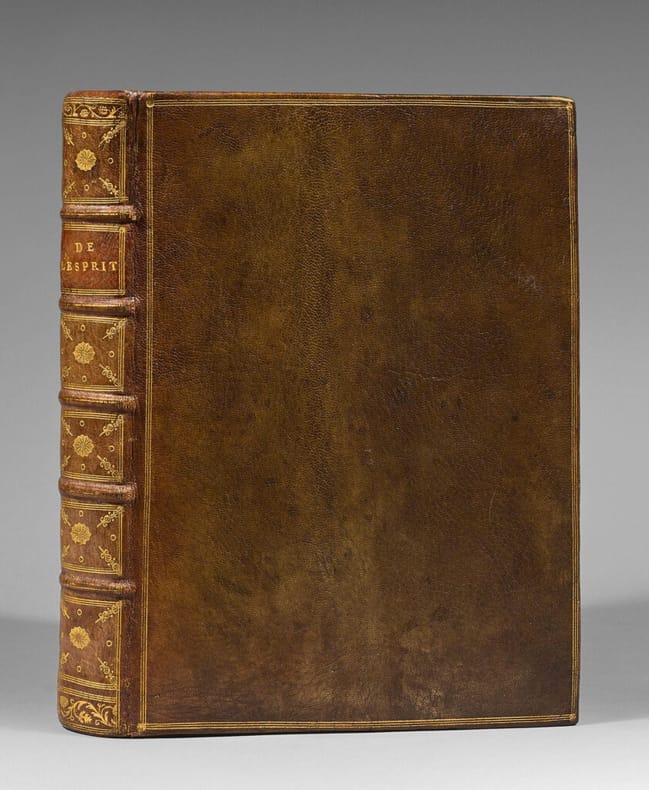
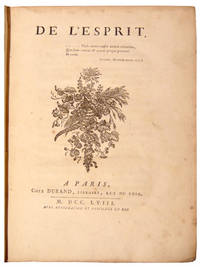
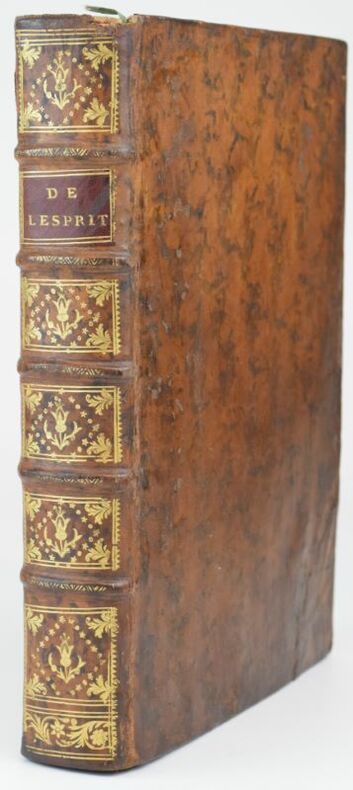
175852026Paris Durand 1758. Large 4to. Large-paper copy bound in a beautiful contemporary full calf binding with five raised bands to richly gilt spine. Triple gilt line-borders to boards all edges of boards gilt and inner gilt dentelles. All edges gilt. A stunning bright clean and fresh copy with minimal wear and no restorations of any kind. Presentation-inscriptions to front free end-paper and to verso of title-page see description in note below. Large woodcut title-vignette and many smaller vignettes throughout. 4 XXII 643 1 pp. 40 ff. i.e. the original uncorrected leaves: pp. 1-16; 35-38; 59-62; 67-70; 75-78; 139-142; 145-154; 169-176; 187-190; 233-34; 227-230; 459-462; 547-550; 603-606 2 extra leaves that were printed incorrectly namely p. 160 - reset & p. 239 - different vignette. <br/><br/><em>Extremely rare first edition first issue with manuscript dedication-inscription from the author of this monumental work of the French Enlightenment. This magnum opus of modern thought is considered the founding work of modern Utilitarianism as it is here that Helvétius articulates the greatest happiness principle "the greatest happiness for the greatest number" for the first time and becomes the first to define social welfare upon this utilitarian maxim directly influencing Bentham and Mill.The materialistic philosophy of Helvétius' "De l'Esprit" also directly influenced Karl Marx who had studied the work while in Paris and called the ideas presented in it "the social basis of communism"."De l'Esprit" arguably constitutes the greatest "succès de scandale" of Western thought and one of the most influential works of Western philosophy.This magnificent copy is stunning in all ways. It contains all the extremely rare condemned and repressed leaves of the first issue bound in the back it is printed on large paper contemporarily bound presumably under instruction by Helvétius himself in a stunning full calf gift binding and with two manuscript ex-dono- presentation- inscriptions by Helvétius himself. One of them on the verso of the title-page is crossed out but is still legible reading "donum auctoris 17 avril 1760 Cl. Helvetius" the second on the front free end-paper reads "ex dono auctoris 1761" - thus indicating that Helvétius who had the copy in his possession to give away when he felt it appropriate had first intended to give it away - perhaps late in the year - in 1760 and then ended up giving it away in 1761. The work lost its privilege almost immediately and even though Hélvetius wrote three retractions it was still condemned and publicly burnt. In spite of this Helvétius still kept a few copies of the very first issue with all the original leaves. According to Smith 15 copies existed and as Jacques Guérin also notes these copies were all intended for his close friends and family we know for instance that Rousseau received one of the copies. These copies of which the present is one are thus of the utmost scarcity. Only one other has been on the market within the last 25 years namely that of Jacques Guérin which however did not have a dedication-inscription from Helvétius.As Tchermerzine describes the extremely rare copies of the first issue which are either without the newly formulated leaves or with the original leaves preserved our copy has them all! are between 10 and 60 times as valuable as the later issues depending on condition - these between 4 and 15 copies are the only ones to contain the 80 revolutionary pages that caused the work to be condemned and burnt and sent Helvétius into exile. Tchermerzine does not however account for copies with a presentation-inscription like the present. The work caused an immense uproar when it appeared. It was considered so heretical atheistic and immoral that it lost its privilege within a fortnight; it was heavily condemned by the Church and the State and was burnt by the Hangman the plan being to destroy all copies of it. Few books in the entire history of printing have been met with such opposition - it was condemned by both the son of Louis XV and the Sorbonne and the priests succeeded in convincing the court that the doctrines were so dangerous that even though Helvetius wrote three retractions the book was still publically burned; and when the Encyclopédie of Diderot and d'Alembert was suppressed for the second time this had much to do with Helvétius' De l'Esprit and the scandal it had caused.This scandalous work however gained so much attention that it was almost immediately translated into all European languages contributing to the immense influence it came to have on all European thought. "The history of Helvetius's De l'esprit 1758 his first major work is eventful complicated and paradoxical. No book during the eighteenth century except perhaps Rousseau's Emile evoked such an outcry from the religious and civil authorities or such universal public interest. Condemned as atheistic materialistic sacrilegious immoral and subversive it enjoyed a remarkable succes de scandale. The work lost its privilege within a fortnight of its publication. It was attacked in Church periodicals and in polemical pamphlets in the literary salons and in popular songs from bishops' pulpits and from the stage of the Théâtre francais. Though Helvetius retracted his book three times he was condemned by the Archbishop of Paris Nov. 1758 the Pope Jan. 1759 the Parlement of Paris Feb. 1759 the Sorbonne Apr. 1759 and by various bishops." Smith p. 332."In "De l'ésprit" 1758 Helvétius follows the Lockean sensationalism of Condillac and pairs it with the claim that human beings are motivated in their actions only by the natural desire to maximize their own pleasure and minimize their pain. "De l'ésprit" though widely read gives rise to strong negative reactions in the time both by political and religious authorities the Sorbonne the Pope and the Parlement of Paris all condemn the book and by prominent fellow philosophes in great part because Helvétius's psychology seems to critics to render moral imperatives and values without basis despite his best attempts to derive them. Helvétius attempts to ground the moral equality of all human beings by portraying all human beings whatever their standing in the social hierarchy whatever their special talents and gifts as equally products of the nature we share plus the variable influences of education and social environment." SEP.D. W. Smith The Publication of Helvetius's De l'esprit in French Studies 1968 p. 105.Tschermerzine III:672. </em> hardcover
175852026Paris, Durand, 1758. Large 4to. Large-paper copy bound in a beautiful contemporary full calf binding with five raised bands to richly gilt spine. Triple gilt line-borders to boards, all edges of boards gilt and inner gilt dentelles. All edges gilt. A stunning, bright, clean, and fresh copy, with minimal wear and no restorations of any kind. Presentation-inscriptions to front free end-paper and to verso of title-page (see description in note below). Large woodcut title-vignette and many smaller vignettes throughout. (4), XXII, 643, (1) pp. + 40 ff. (i.e. the original, uncorrected leaves: pp. 1-16 35-38 59-62 67-70 75-78 139-142 145-154 169-176 187-190 233-34 227-230 459-462 547-550" 603-606 + 2 extra leaves that were printed incorrectly, namely p. 160 - reset & p. 239 - different vignette).
BB25<p>A Paris chez Durand Libraire Rue Du Foin 1758. Avec Approbation et Privilège du Roi. </p><p>Large 4to 253 x 193 mm of 2 ll. xxii pp. 643 pp. 1 p. Full bronze green morocco triple gilt fillet around the covers spine ribbed and decorated inner roll-stamp gilt edges. <i>Contemporary binding in morocco.</i></p><p><b>First edition seized and condemned to be burned immediately upon publication.</b></p><p><b>Copy from the issue C.</b></p><p>"<i>De l'esprit</i> had a huge scandal success. It is considered today as one of the most systematic and absolute forms of French materialism of the 18th century." Jacques Guérin.</p><p>Diderot considered that this book was "<i>a furious</i> <i>sledgehammer blow worn on prejudices".</i></p><p>"This famous work was censored by La Sorbonne as containing <i>all the scattered poisons distilled in the different modern books</i> that is contemporary ones" Tchemerzine.</p><p>The work dedicated to the royal family was rejected by the latter and on August 10 a few days after that of the publication the privilege given on May 12 was revoked. Despite the <i>Letter to the Reverend Father</i>. Berthier or Pleix which constitutes an apology and a retraction followed by a another more explicit retraction the book was blamed by the clergy.</p><p>Helvetius made these retractions out of friendship for his censor <i>Texier</i> who had had a lot of trouble because of him. These copies present <i>Petitions</i> on pages 1-16 35-38 59-62 67-70 75-78 139-142 145-154 159-160 169-176 187-190 227-230 233-234 239-240 459-462 545-550 603-606. </p><p>In the issue A the first word of page 5 is "dans"; "de" in the issue B and "mon" in the common issue C.</p><p>"The social and religious ideas developed in "<i>De l'Esprit</i>" are often borrowed from Hobbes Diderot Voltaire or Montesquieu; some of his theories on self-love the interest and fecundity of passions the identity between moral and social question are not unlike Vauvenargues La Rochefoucauld or Machiavel. However how to explain the huge "scandal success" that greeted the publication of this book We know that the reaction of the Church and the State was not long in coming and that a cascade of condemnations were launched against the author who had uselessly published his book anonymously. The author had to take refuge in England then in Germany where he was the guest of Frederick II. The Archbishop of Paris Mgr Christophe de Beaumont issued on November 22 1758 a special order against the book; La Sorbonne and the Parliament interfered so much that <i>De l'esprit</i> was burnt by the executioner himself. This condemnation was to entail the following year that of the <i>Encyclopedia</i>.</p><p>This "scandal success" undoubtedly holds to the fact that with Helvetius fall the last theological barriers in which the sensualism of Locke and also that of Condillac was still locked up. With Helvetius the French materialism of the 18th century took one of its most systematic and absolute forms and resolutely replaced the idealist myth which states that it is the ideas that govern the world and men the materialist principle which considers that it is by transforming the environment that has formed him that man kind will be transformed. It is understandable that such a principle could only arouse passion and interest at a time where great changes in society appeared to be more probable and desirable." Guy Schoeller.</p><p><b>Beautiful copy bound in contemporary green morocco coming from the famous library of Madame de La Borde with ex-libris. </b><br /></p><p><br /></p><p><u>French</u></p><p>A Paris chez Durand Libraire Rue Du Foin 1758. Avec Approbation et Privilège du Roi. </p><p>Grand in-4 de 2 ff. xxii pp. 643 pp. 1 p. Plein maroquin vert bronze triple filet doré autour des plats dos à nerfs orné filets or sur les coupes roulette intérieure tranches dorées. <i>Reliure en maroquin de l'époque</i>. </p><p>253 x 193 mm.</p><p><b>Edition originale saisie et condamnée à être brûlée dès sa parution.</b></p><p><b>Exemplaire du tirage C.</b></p><p>" <i>De l'esprit</i> eut un énorme succès de scandale. Il est considéré aujourd'hui comme l'une des formes les plus systématiques et les plus absolues du matérialisme français du XVIIIe siècle. " Jacques Guérin.</p><p>Diderot considérait que ce livre était " <i>un furieux coup de massue porté sur les préjugés</i> ".</p><p>" Cet ouvrage célèbre fut censuré par la Sorbonne comme contenant <i>tous les poisons épars distillés dans les différents livres modernes</i> c'est-à-dire contemporains " Tchemerzine.</p><p>L'ouvrage dédié à la famille royale fut repoussé par cette dernière et le 10 août peu de jours après celui de la parution le privilège donné le 12 mai fut révoqué. Malgré la <i>Lettre au</i> <i>révérend père</i>.Berthier ou Pleix qui constitue une apologie et une rétractation suivie d'une autre rétractation plus explicite le livre fut blâmé par le clergé.</p><p>Helvétius en remit alors une troisième à <i>Joly de Fleury</i> avocat général le 22 janvier 1759 ; le 31 parut la lettre du pape le 9 avril la censure de la Faculté de Théologie. Dès le 23 janvier Fleury avait prononcé ses réquisitions tout en ménageant l'auteur lui-même et le Parlement le 6 février 1759 rendit son jugement ; le livre fut brûlé le 10. Helvétius se défit de sa charge de maître d'hôtel de la reine ; le censeur démissionna. </p><p>Helvétius fit ces rétractations par amitié pour son censeur <i>Texier</i> qui avait eu beaucoup d'ennuis à son sujet. Ces exemplaires présentent des <i>Cartons</i> aux pages 1-16 35-38 59-62 67-70 75-78 139-142 145-154 159-160 169-176 187-190 227-230 233-234 239-240 459-462 545-550 603-606. </p><p>Dans le tirage A le premier mot de la page 5 est " dans " ; " de " dans le tirage B et " mon " dans le tirage commun C.</p><p>" Les idées sociales et religieuses développées dans " <i>De l'Esprit</i> " sont souvent empruntées à Hobbes Diderot Voltaire ou Montesquieu ; certaines de ses théories sur l'amour- propre l'intérêt et la fécondité des passions l'identité entre question morale et question sociale ne sont pas sans rappeler Vauvenargues La Rochefoucauld ou Machiavel. Cependant comment expliquer alors l'énorme " succès de scandale " qui salua la parution de cet ouvrage On sait que la réaction de l'Église et de l'État ne se fit point attendre et qu'une cascade de condamnations furent lancées contre l'auteur qui avait bien inutilement publié son livre sous l'anonymat. L'auteur dut se réfugier en Angleterre puis en Allemagne où il fut l'hôte de Frédéric II. L'archevêque de Paris Mgr Christophe de Beaumont lança le 22 novembre 1758 un mandement spécial contre le livre ; la Sorbonne et le Parlement s'en mêlèrent si bien que <i>De l'esprit</i> fut brûlé de la main même du bourreau. Cette condamnation devait d'ailleurs entraîner l'année suivante celle de l'<i>Encyclopédie</i>.</p><p>Ce " succès de scandale " tient sans aucun doute à ce fait qu'avec Helvétius tombent les dernières barrières théologiques dans lesquelles le sensualisme de Locke et aussi celui de Condillac était encore enfermé. Avec Helvétius le matérialisme français du XVIIIe siècle prenait une de ses formes les plus systématiques et les plus absolues et substituait résolument au mythe idéaliste qui veut que ce soient les idées qui gouvernent le monde et les hommes le principe matérialiste qui estime que c'est en transformant le milieu qui l'a formé que l'on transformera l'homme. On comprend qu'un tel principe ne pouvait que susciter les passions et l'intérêt en un moment où de grands changements dans la société apparaissaient comme de plus en plus probables et désirables. " Guy Schoeller.</p><p><i>Karl Marx</i> devait ajouter : " <i>la doctrine matérialiste suivant laquelle les hommes sont des produits des circonstances et de l'éducation que par conséquent des hommes modifiés sont des produits d'autres circonstances et d'une éducation modifiée oublie que ce sont précisément les hommes qui modifient les circonstances et que l'éducateur a besoin lui-même d'être éduqué</i>".</p><p><b>Bel exemplaire relié en maroquin vert de l'époque provenant de la célèbre bibliothèque de Madame de La Borde avec ex-libris. </b></p> hardcover
LCS-17835Bel exemplaire relié en maroquin vert de l’époque provenant de la célèbre bibliothèque de Madame de La Borde avec ex-libris. A Paris, chez Durand, Libraire, Rue Du Foin, 1758. Avec Approbation et Privilège du Roi. Grand in-4 de (2) ff., xxii pp., 643 pp., (1) p. Plein maroquin vert bronze, triple filet doré autour des plats, dos à nerfs orné, filets or sur les coupes, roulette intérieure, tranches dorées. Reliure en maroquin de l’époque. 253 x 193 mm.
1758233527Paris: Chez Durand 1758. First edition second issue. 4 xxii 643 1 pp. 1 vols. 4to 9-3/4 x 7-1/4 inches. Contemporary mottled calf gilt spine with red leather label marbled endpapers and edges. Upper joint starting but solid half-title with small stain at outer edge overall a fresh crisp copy. First edition second issue. 4 xxii 643 1 pp. 1 vols. 4to 9-3/4 x 7-1/4 inches. First edition of the last major work of the French philosopher and encyclopédiste Helvetius De l'esprit On the Mind was condemned by the Church and the Sorbonne for its uncompromising atheism regarded as dangerously revolutionary by the Court of Louis XV and publicly condemned by Parliament. A follower of Locke's empiricism Helvetius's work was an important development in the history of utilitarian thought and both Bentham and Mill were strongly influenced by Helvetius's elaboration of a theory which saw mankind as the product of his environment and his education. <br /> <br /> The first issue of the first edition is very rare: Smith locates only 15 copies. Smith E.1B Chez Durand unknown
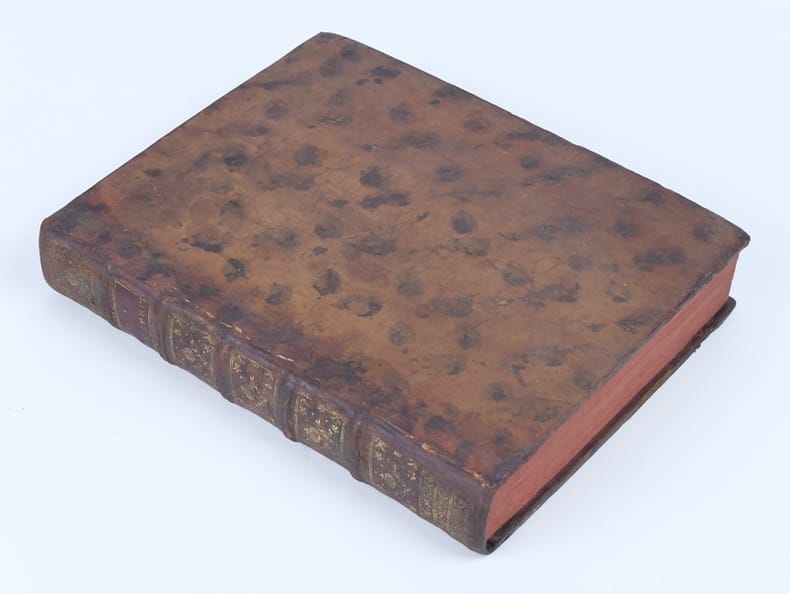
10232,A Paris, Chez Durand 1758, [4], xxii, 643, [1] privilege pp., 1 vol. in 4 relié First edition, plein veau moucheté, dos à cinq nerfs orné de fleurons et petits fers dorés, (dorures légèrement estompées), pièce de titre en maroquin rouge, tranches jaspées (reliure de l'époque), petit trou de vers en queue, quelques rousseurs et pages jaunies, coins usés et petites épidermures sur les tranches. Rare exemplaire de l' édition originale de deuxième tirage E1B (second issue of the first edition), cf. D. W. Smith : Bibliography of the writings of Helvetius, Centre international d'étude du XVIIIe siècle , 2001, pages 121-126. D. W. Smith ne recense que 4 exemplaires dans le monde pour le tirage E1A, et 80 exemplaires pour le tirage E1B, seules ces deux premières émissions peuvent se prévaloir du titre d'édition originale et elles sont très rares. Cet ouvrage sera condamné par la Sorbonne, la congrégation de l'Index (31 janvier 1759) puis le Parlement (6 février 1759) pour finir brûlé par la main du bourreau.
1758024097Paris: Durand 1758. E.O. Un volume in quarto 21x26 cm di 4 XXII- 643 pagine. Seguito da: CENSURE de la Faculté de Theologie de Paris contre le livre qui a pour titre De lEsprit. Paris Garnier; 1758. Pp 79; testo e titolo anche in latino. ARRETS de la Cour de Parlement du 23 Janvier 1759. Paris Simon; 1759. Pp 31. Condamnation et prohibition. de la part du pape Clement XIII. Roma Camera apostolica; 1759. Pp4; testo in latino e francese. Mandement de Monseigneur lArcheveque de Paris. Paris Simon; 1758. Pp 28; seguito dallEstratto delle Nouvelles Ecclesiastiques. -Legatura coeva in piena pelle dorso a nervi ornato e dorato. Usure alla cuffia superiore a due angoli fenditure alla cerniere; tagli rossi risguardie in carta marmorizzata. Grandi margini. Condizioni molto buone per questa Edizione Originale first edition tiraggio C secondo lo studio di D.W. Smith. Tchemerzine: E.O. Dans beaucoup dexemplaires on trouve à la suite les pièces du procés. Malgrado i tentativi di ritrattazione e di ammenda dellautore lopera venne venne condannata dalla Facoltà di teologia di Parigi dal Papa Clemente XIII 31 gennaio 1759 quindi dal Parlamento. come contenente affermazioni empie blasfeme erronee ed eretiche. Durand unknown
17581735Paris, Durand, 1758. 1 vol. in-4, (25,5 x 20 cm) ; [2] ff., XXII pp., 643 pp. et [1] p. Reliure en plein veau d'époque, dos à nerfs orné, pièce de titre de maroquin rouge, tranches rouges. Exemplaire en belle condition (deux coins légèrement frottés à signaler).
1758873<p>Paris: Durand 1758. First Edition. Hardcover. Very good. An Important Document for Understanding 18th Century French Censorship and Printing Practices and the Philosophical-Political Climate in 1758 <br /><br />HELVÉTIUS Claude-Adrien. De lesprit On the Mind Durand Paris 1758. 1 blank leaf half- title TP i-xxii 1-643 644 = Approbation and Privilege du Roi 1 blank leaf. Quarto. The B Tirage of De lesprit see below.Smith E.1b. <br /><br />The history of Helvétiuss De lesprit his first major work is eventful complicated and paradoxical. No book during the eighteenth century except perhaps Rousseaus Émile evoked such an outcry from the religious and civil authorities or such universal public interest. Condemned as atheistic materialistic sacrilegious immoral and subversive it enjoyed a remarkable success de scandale. The work lost its privilege within a fortnight of its publication. <br /><br />The publication history is no less eventful and complicated. There are three distinct first editions of the book: called the A B and C tirages. After carefully orchestrating efforts to mislead and bully the censor into a hasty approval of the text the A tirage the first impressions of the original edition which had begun to leave the presses by the end of June were kept by Helvétius for his personal friends. But before the work could be put on sale to the general public Malesherbes directeur de la librarie ordered that publication of the work be suspended indefinitely. The subversiveness of the book had been discovered and a new censor was introduced into the controversy and changes were made to the text. <br /><br />At this point the cunning of Helvétiuss publisher Durand came into play. He set up a completely new type modeling it upon the original edition. This type it can easily be recognized by its different type-setting and by its several new printing errors was adapted to suit the second censors requirements and was used to produce the second edition the B tirage. Thus when De lesprit was officially published in Paris on July 27th 1758 nobody suspected that it was in fact a completely new edition. However Durand had secretly saved and hidden the original typeset forms. <br /><br />The publication in 1758 of his principal work De lesprit was noisily condemned by the authorities both ecclesiastical and ministerial for its dangerously heretical and subversive opinions. Suppression of the book signaled a grave but fortunately temporary setback for the party of philosophes and Encyclopedists. Despite the recantations that Helvetius was forced to make regarding De lesprit he reaffirmed his ideas even more strongly in De LHomme de ses facultes intellectuelles et se son education published posthumously in 1772. EP Vol. 3 p. 472 Helvètius continued the work of Condillac by reducing all human understanding to sensation or sense- <br />perception. He then took this reductionist psychology and erected a utilitarian theory of morality based upon it making him one of the chief pioneers and promoters of utilitarian moral theory Copelston VI 1 p. 51. Helvètius was a strong defender of the benefits of education and also extremely political attacking all forms of despotism and in particular French despotism. <br /><br />CONDITION: Very good or better in a contemporary full calf binding with boards that are just a bit scuffed. The spine with five raised bands and beautiful gilt lettering and devices. Bookplate to front paste down. Stamp to upper corner of title page. Seemingly rehanged but expertly done. With lovely marbled endpapers. Overall a very beautiful copy of this book. <br /><br /></p> Durand hardcover
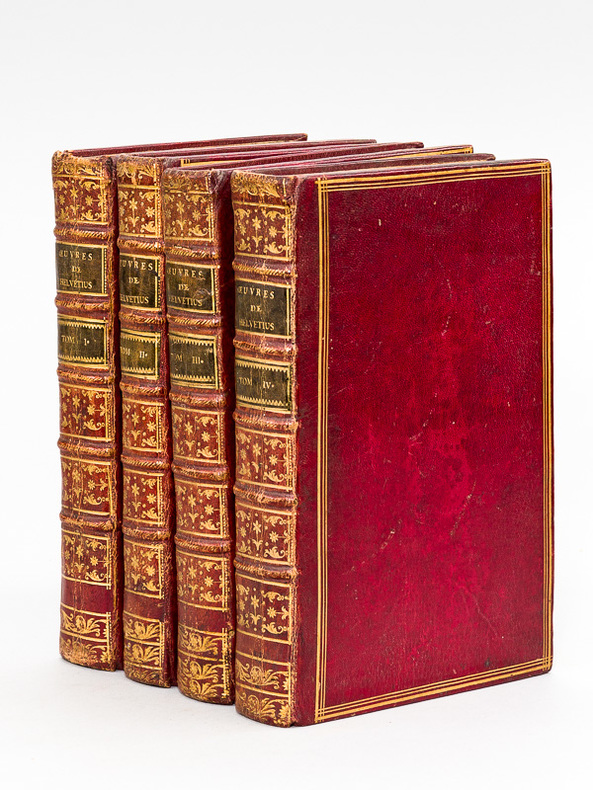
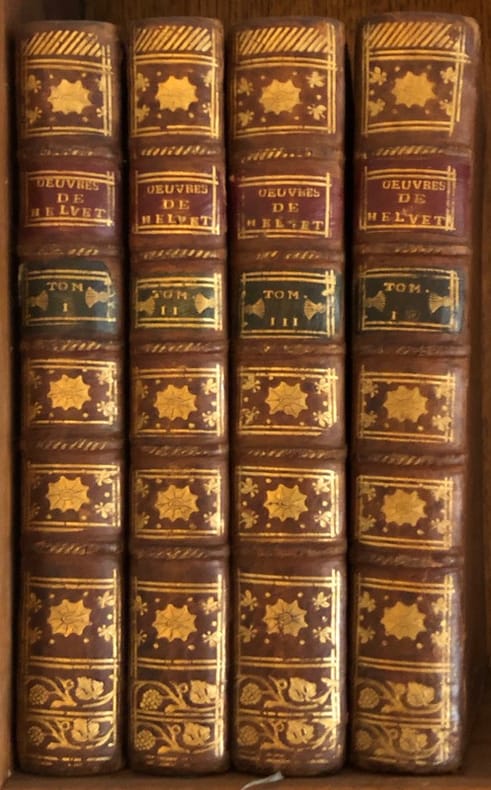
1774584284 vol. in-8 reliure de l'époque plein maroquin rouge, dos à 5 nerfs dorés orné, triple filet doré d'encadrement en plats, filet doré en coupes, toutes tranches dorées, Chez Bassompierre, A Liège, 1774, 2 ff., frontispice, VIII-634 pp. ; 2 ff., 226-201 pp. ; XVI-495 pp. ; 2 ff., 615 pp. Titre complet : Oeuvres complettes (4 Tomes - Complet) Tomes I et II : De l'Esprit [ Suivi de ] Le Bonheur, Poëme en six Chants, avec des Fragments de quelques Epîtres. Ouvrages posthumes de M. Helvetius ; Tomes III et IV : De l'Homme, de ses Facultés intellectuelles et de son éducation [ Oeuvres complètes ]
elala2495Paris: Durand 1758. Second Quarto Edition. Conceived as a rival work to Montesquieu's L'Esprit des Lois this is Helvétius' principal work and the only one to be published in his lifetime. Helvetius' thought represents the extreme form attained by the sensationalist and utilitarian philosophy in eighteenth century France and his treatise had a wide and profound influence on Beccaria the Encyclopedist movement particularly Holbach the British Utilitarians especially Bentham and Mill as well as on Godwin who considered it to be one of the most influential books in his development. "No book during the eighteenth century except perhaps Rousseau's Émile evoked such an outcry from the religious and civil authorities or such universal public interest. Condemned as atheistic materialistic sacrilegious immoral and subversive it enjoyed a remarkable succès de scandale. The work lost its privilege within a fortnight of its publication." Smith Denounced by the Sorbonne as containing within its pages all of the poisons scattered through modern literature it was burned by order of the parlement at the beginning of 1759. Helvetius himself made three separate retractions but his work was widely reprinted translated and read throughout Europe. Smith E2A. Cioranescu III 33643. Goldsmiths' 9432. Kress 5710. Rand I 250. cfTchemerzine VI 188. 4to. pp. 2 p.l. xxii 643 1. complete with half-title. woodcut title vignette. contemporary mottled calf gilt back spinal extremities chipped small piece of calf missing from lower front cover; a nice crisp copy Paris: Durand, 1758 unknown
17581883Paris, Durand, 1758. 1 vol. in-4, (26 x 20,5 cm) ; [2] ff., XXII pp., 643 pp. et [1] p. Reliure en plein veau d'époque, dos à nerfs orné, pièce de titre de maroquin rouge, tranches rouges. Restaurations aux mors, aux coupes et aux coins. Faiblesse en pied du mors supérieur.
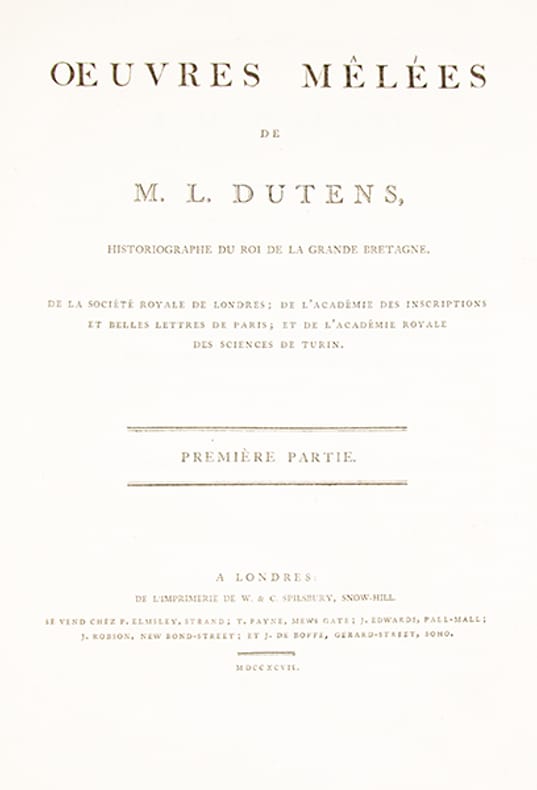
388442 tomes reliés en un volume in-4 (272 x 218 mm), veau havane raciné de lépoque, dos lisse orné de roulettes, palettes, filets dorés et dun fleuron répété au centre, pièce de titre de veau rouge, plats encadrés de filets dorés, dentelle intérieure, tranches jaspées, viii, 260 p. et (8), 189, (12) p. de tables, errata et catalogue, un tableau dépliant. Londres, De l'imprimerie de W. & C. Spilsbury (...), 1797.
177317694London = France: La Société Typographique 1773. Contemporary mottled calf gold-tooled spine. 8vo. 2 volumes bound as 1. Third or second edition of one of the key works of the Radical Enlightenment published in the same year as the first edition. The author had evoked huge outcry with the publication of De L'esprit 1758 a carefully argued essay on the mind in which he roundly rejected metaphysics and the idea of Truth replacing Christian morals by purely utilitarian ethics and stressing the importance of education as the key to moral behaviour. In De l'homme Helvétius expanded and clarified his views provoking even Diderot to write a Réfutation. The present edition was most likely printed in France and as Smith argues it was probably this edition that the Paris Parliament condemned on 10 January 1774.Binding slightly rubbed; top of spine slightly worn. Fine copy.l Smith Bibliography H.3; cf. Cioranescu 33651 other edition; for Helvétius's philosophy: Blom A Wicked Company pp. 126-129. La Société Typographique, unknown
17580055151758 Paris, Durand, 1758. In-quarto (256 X 214 mm) veau fauve marbré, dos cinq nerfs, caissons dorés ornés, pièce de titre maroquin fauve, tranches rouges (Reliure de l'époque) ; (2) ff. de faux-titre et titre, XXII-643 pages, (1) page d'approbation et privilège. Petite épidermure au second plat.
1781elala1449London Bouillon: Société Typographique 1781. 1781. 2 Volumes. 4to. pp. lxxii 407; 2 p.l. iv 708. with half-titles. titles in red & black. engraved frontis. portrait by Aug. de St. Aubin after L.M.Vanloo. woodcut ornaments & initials. contemporary marbled calf gilt backs some wear to extremities short splits in joints. First and Only Quarto Edition of which 500 copies were printed according to Smith. This copy has both titles in red and black dated 1781 the original setting of the table in smaller type pp. 399-409 and the second version of the portrait noted by Smith. Helvetius' thought represents the extreme form attained by the sensationalist and utilitarian philosophy in eighteenth century France and his most famous treatise De LEsprit had a wide and profound influence on Beccaria the Encyclopedist movement particularly Holbach the British Utilitarians especially Bentham and Mill as well as on Godwin who considered it to be one of the most influential books in his development. "No book during the eighteenth century except perhaps Rousseau's Émile evoked such an outcry from the religious and civil authorities or such universal public interest. Condemned as atheistic materialistic sacrilegious immoral and subversive it enjoyed a remarkable succès de scandale. The work lost its privilege within a fortnight of its publication." Smith Denounced by the Sorbonne as containing within its pages all of the poisons scattered through modern literature it was burned by order of the parlement at the beginning of 1759. Helvetius himself made three separate retractions but his work was widely reprinted translated and read throughout Europe. The second volume contains De LHomme De Ses Facultès Intellectuelles Et De Son Éducation Le Bonheur and correspondence with Voltaire Hume &c. Smith O6. Tchemerzine VI 200 b. Hardcover. London [Bouillon: Société Typographique], 1781. Hardcover
17586311Paris, Chez Durand, 1758. In-4 (254 x 195 mm), (4)-XXII-643-(1) pp., sont reliés à la suite : - "Arrest du conseil du Roi" du 10 août 1758 qui révoque le privilège accordé à l'ouvrage, 1 f., - la "Lettre au Révérend Père *** jésuite" d'Helvetius, 4 pp., - "Chanson sur le livre intitulé : De l'Esprit", 1 f. de 192 x 120 mm. Reliure d'époque en basane marbré, dos orné de fleurons dorés, filets sur les coupes, tranches rouges. Manque à la coiffe sup., début de fente au mors sup., les 2 coins inf. sont anciennement restaurés, épidermures sur les plats, un poème de M. Saurin, "aux Manes de M. Helvetius 1772" est retranscris sur le premier feuillet de garde, petite tache brune sur les 5 premiers feuillets, légères traces de mouillure dans le coin sup. plus visible sur les 3 premiers et les 2 derniers feuillets et sur l'Arrest du conseil du Roi.
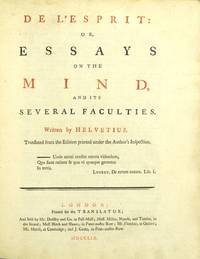
175922826London: printed for the translator and sold by Mr. Dodsley 1759. First edition in English 4to pp. xvi 331; title-p. in red and black; recent full black goatskin gilt ruled border gilt paneled spine red morocco label. About fine. Interesting text and the author's most famous book probing psychology ethics the moralities of social interaction the rewards and virtues of human understanding memory mortality. Kress 5783. printed for the translator and sold by Mr. Dodsley unknown
ORD-5002A Paris Chez Durand. 1758. 1 volume in-4 (20,5x28cm), veau brun, dos à 5 nerfs ornés, pièce de titre maroquin brun, tranches rouges, fleurons aux coins des plats, 2ff., XXII et 643pp. 1p.n.ch. (Approbation et privilège). Reliure de l'époque habilement restaurée, lgt frottée, dos un peu fendillé mais bon exemplaire à grandes marges. Edition originale.
17807053007Londres London 1780-1781. 1/2 calf and marbled boards. 1/2 veau. Spines all damaged with tops and bottoms of leather missing: needs rebacking. Covers otherwise lightly rubbed contents clean tight: nice reading copy as is or reback to collectible condition. 8vo. Frontispiece portrait by L.M. Vanloo. Volume 2 is dated 1780; the others are 1781. Neither the editor nor the publisher are specified. TEXTS IN FRENCH; TEXTES EN FRANCAIS. hardcover
175878291758 Paris: Durand, 1758. In-4: 20.5 x 25.5 cm, 2 ff. n. chiff. de faux-titre et titre, xxii pp. de préface et table, 643 pp. de texte des 4 Dicscours, privilège au vo du dernier f. Édition originale de ce célèbre essai matérialiste qui fit date tant dans lhistoire de la pensée que dans celle de lédition. (Smith, «The publication of Helvetius's De l'Esprit», French studies, XVIII, 1964, pp. 332 et sq.) Paru sans nom dauteur le 27 juillet, les thèses matérialistes défendues par Helvetius sont rapidement dénoncées par les milieux conservateurs; le privilège est révoqué en janvier 1759, et bon nombre dexemplaire sont brûlés après larrêté du parlement du 6 février 1759. Reliure de lépoque en veau brun. Dos à cinq nerfs avec pièce de titre en maroquin rouge et caissons ornés aux petits fers. Tranches rouges. Déchirures marginales aux faux-titre et titre, rares piqûres. Manque à la coiffe de tête. Griffures aux plats, coins émoussés. Beau volume de lecture.
182745081827 Paris, Dalibon, 1827, 14,5x23, huit volumes. Élégante reliure en demi basane bleue. Dos orné à 5 nerfs, titre, auteur et tomaison en lettres dorées. Plats et tranches marbrées. Portrait en frontispice et une page d'écriture en fac-similé, bon exemplaire malgré quelques rousseurs. Envoi de photographies sur demande.
177436999à Londres London Amsterdam: S. n. Marc Michel Rey 1774. Fine. S. n. Marc Michel Rey à Londres London Amsterdam 1774 12.50 x 19.50 cm relié Rare and interesting gathering of these two works. New edition of the Système de la nature after the rare first edition of 1770 and first edition of Helvetius's work at the same date of 1774 as this new edition of Mirabaud; in reality three editions appeared at the same date with different collation without being able to determine if there is a true first edition. Contemporary full marbled sheep binding. Richly decorated smooth spine. Red morocco title label and black morocco volume label. Red edges. Tail headcaps torn away. A brown stain on the upper board of volume I. Restoration using a piece of leather on the upper board of volume II. Fairly good copy. Helvetius's work is an exegesis and examination of the Système de la nature the author seems to have condensed the material in the form of maxims and assertions all resting on a strong materialist creed. We now know that the work may not be by Helvetius although we recognize his philosophy in it. As for Mirabaud's Système de la nature it was received like a bombshell in literary circles and ultimately quite poorly received by the philosophers. It was not d'Holbach's openly materialist theses that were condemned but the demonstration of atheism and anticlericalism. S. n.[ Marc Michel Rey] hardcover
1758CLL-624Paris, Durand, 1758 In-4 de (2)ff., XXII pp., 643 pp., (1) p., veau marbré, triple filet à froid d'encadrement sur les plats, dos à nerfs orné de roulettes et caissons avec motifs floraux, macles et d'étoiles dorés, pièce de titre de maroquin rouge, double filet doré sur les coupes, tranches rouges (reliure de l'époque).
209090Londres [Maastricht], s.n. [Dufour & Roux], 1777 4 vol. in-8, [2] ff. n. ch., iij-484 pp. ; [2] ff. n. ch., xx-513-[2] pp. ; [2] ff. n. ch., xxviij-586 pp. ; [3] ff. n. ch. , pp. v-xiv, 416 pp., avec un portrait-frontispice gravé par H. Godin d'après Van Loo, basane fauve marbrée, dos à nerfs cloisonnés et fleuronnés, pièces de titre et de tomaison cerise et vertes, encadrement de triple filet doré sur les plats, simple filet doré sur les coupes, tranches marbrées (reliure de l'époque). Bon exemplaire.