Condorcet, MBiblio.com
281 résultats
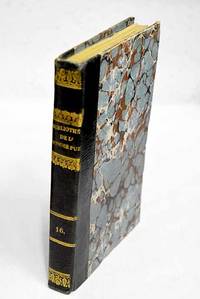
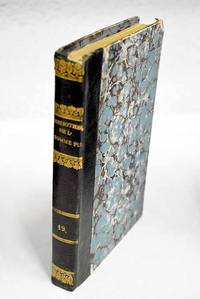
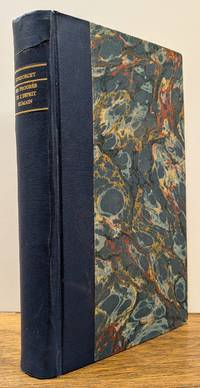
17913304769Paris.: Buisson. 1791. Hardcover. Cubierta deslucida. Good. 19 cm. 268 p. Encuadernación en tapa dura artesanal lomo en piel. Idioma francés . Cubierta deslucida. Buisson. hardcover
17913304767Paris.: Buisson. 1791. Hardcover. Cubierta deslucida. Good. 19 cm. 264 p. Encuadernación en tapa dura artesanal lomo en piel. Idioma francés . Cubierta deslucida. Buisson. hardcover
17913304770Paris.: Buisson. 1791. Hardcover. Cubierta deslucida. Good. 19 cm. 270 p. Encuadernación en tapa dura artesanal lomo en piel. Idioma francés . Cubierta deslucida. Buisson. hardcover
8471124432.Gpaperback. Good. Access codes and supplements are not guaranteed with used items. May be an ex-library book. paperback
0274861364.Gpaperback. Good. Access codes and supplements are not guaranteed with used items. May be an ex-library book. paperback
0274861372.Ghardcover. Good. Access codes and supplements are not guaranteed with used items. May be an ex-library book. hardcover
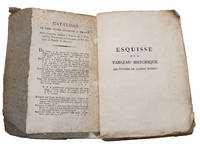
17982060<p>8vo pp. viii 389 1 blank; occasional spotting and marking but never heavy; the odd tear to foot with slight paper loss but never affecting text; final leaf stuck to wrapper but verso blank so with no loss of text; uncut in interim wrappers; wrappers worn but sound spine chipped at head and foot with light dampstain to head and old manuscript paper label.</p><p>First Milan printing uncommon of Condorcet's monumental survey of the history of human endeavour first published posthumously in 1795.</p><p>An 'ouvrage d'un utilité générale et durable' the <em>Esquisse</em> represents a summation of Concordet's thoughts on the notion of human progress and thus can in some ways be seen as a definitive encapsulation of the enlightenment project or at least of one view of it. Condorcet divides his work into ten <em>époques</em> tracing human history from the initial formation of societies through the development of agriculture the invention of writing the intellectual and scientific achievements of classical Greece the progress not uninterrupted of the sciences the invention of printing and the tense relationship between scientific progress and 'the yoke of authority'. Closing with two chapters on the period from Descartes until the French Revolution and on his expectations for future human progress Condorcet demonstrates his optimism: 'Our hopes for the future state of the human species can be reduced to these three important points: the destruction of inequality between nations; the progress of equality within nations; and finally the real perfection of humanity. Are not all nations bound one day to approach the state of civilisation reached by the most enlightened freest least prejudiced of peoples such as the French and the Anglo-Americans' p.328</p><p>Concorcet's work was instantly popular with 1795 printings in Paris and Zürich; it was swiftly translated into English printed in both London and Philadephia and German Tübingen before Zatta in Venice published an Italian translation by Luigi Bossi in 1797. The present edition is the first to be printed in French in Italy.</p><p>Outside Continental Europe OCLC records copies at Connecticut the College of the Holy Cross in Massachusetts and Durham.</p> De l’Imprimerie Italienne et Française à S. Zeno
2322543829.Gpaperback. Good. Access codes and supplements are not guaranteed with used items. May be an ex-library book. paperback
1795161166Paris: chez Agasse l'an III de la République 1795. History as progress First edition of the finest and most durable expression of the ultimate perfectibility of man perhaps the clearest and boldest statement of the enlightenment belief in progress demonstrating "man's progressive emancipation first from the arbitrary domination of his physical environment and then from the historical bondage of his own making" Encyclopedia of Philosophy II 184. Condorcet wrote the work in 1794 while in hiding from Robespierre's agents having voted against the execution of the king. Captured by the state he was found dead the next day presumed to have taken his own life to escape the guillotine. His manuscript was published the next year. "In the Esquisse. Condorcet traces the history of man through epochs the first three covering his progress from savagery to pastoral community and thence to the agricultural state. The next five span the growth of civilizations and knowledge down to Descartes and the ninth describes the revolution of Condorcet's own lifetime from Newton to Rousseau. The prophetic view of the tenth epoch shows Condorcet at his most original. He forecasts the destruction of inequality between nations and classes and the improvement intellectual moral and physical of human nature" PMM. Octavo 193 x 119 mm. Early 19th-century blue quarter roan smooth spine lettered and tooled in gilt blue mottled sides brown speckled edges. Front pastedown with early 20th-century bookseller's label of Emile Nourry of Paris and bookplate of Caroli Michel. Light rubbing to binding corners worn spotting to contents marginal loss to foot of G2 not affecting text a few peripheral nicks very good. Printing and the Mind of Man 246; En français dans le texte 196; Martin & Walter 1 8083; Quérard II p. 269. unknown
2019698447.Gpaperback. Good. Access codes and supplements are not guaranteed with used items. May be an ex-library book. paperback
179542119Paris Agasse l'an III de la République une et indivisible 1795. 8vo. Bound in a very nice newer pastiche-binding in full mottled calf. Five raised bands and gilt title-label to spine. A very nice clean fresh and attractive copy. VIII 389 pp. <br/><br/><em>The rare first edition of Condorcet's main work "the most fully developed exposition of the progress of man" Printing and the Mind of Man p. 149 and a main work of the Enlightenment as well as of historical thought in general. The author was the creator of what came to found the basis for the modern French system. The great French philosopher political thinker and mathematician M.J.A. Condorcet 1743 - 1794 played a seminal role in 18th century France. He was friends with the likes of d'Alembert Voltaire Turgot etc. and he greatly contributed to the social and political debates of politically turbulent France. As one of the few he advocated a liberal economy equality in public education as well as in gender and race etc. He preached constitutionalism and his thoughts that are still influential today embody those of the Enlightenment and rationalism."A belief in the ultimate perfectibility of man lies at the root of all progressive thinking about the human condition. The "philosophes" and Godwin had familiarized the reading public with this notion; it was left to Condorcet to give it its finest and most durable expression. It was the gospel of nineteenth century that mankind is destined for indefinite future progress. Condorcet looking back and then forward saw proof of this in the growing equality between classes and nations the intellectual physical and moral improvement of man; and he prophesied that popular education on correct principles would strengthen and assure this progress." PMM 246.During the French Revolution Condorcet came to play a dominating role advocating a rationalist reconstruction of society and he championed many liberal causes. In 1791 he became secretary of the Legislation Assembly and the institution adopted his scheme for comprehensive state education which later became the basis of the modern French system. In the struggle between the two political parties the Girondists and the Montagnards Condorcet occupied an independent role but when he opposed the death penalty under the trial of King Louis XVI still supporting the actual trial and the radical Montagnards gained more power Condorcet was branded a traitor and in October 1793 a warrant was issued for his arrest. He now went into hiding for several months almost a year and it is during these months that he writes the work that was to become his most important the main work "Esquisse." "Sketch for a Historical Picture of the Progress of the Human Mind" which was published posthumously the year after his death. In 1794 Condorcet was arrested and two days later he was found dead in his cell -it is unknown whether he committed suicide or was murdered because of fear of fierce reactions that would definitely have occurred had the beloved man been officially sentenced to the death penalty."In the Esquisse" published after his death Condorcet traces the history of man through epochs the first three covering his progress from savagery to pastoral community and thence to the agricultural state. The next five span the growth of civilizations and knowledge down to Descartes and the ninth describes the revolution of Condorcet's own lifetime from Newton to Rousseau. The prophetic view of the tenth epoch shows Condorcet at his most original. He forecasts the destruction of inequality between nation and classes and the improvement intellectual moral and physical of human nature. it exercised considerable influence on Comte. But it is as the most fully developed exposition of the progress of man that Condorcet's work is now remembered and it is this which has given it its lasting appeal." PMM 246. </em> hardcover
1795Biblio239THE PERFECTIBILITY OF MAN. 8vo. Early half red morocco. Near fine. FIRST EDITION. A distinguished mathematician and friend of Voltaire d'Alembert and Turgot Condorcet played a major role in promoting the Revolution's democratic principles. In the Esquisse An Historical Outline of the Progress of the Human Mind he traces the history of man through ten epochs moving from savagery through the development of civilization and knowledge up to Descartes in the eighth epoch. The ninth epoch spans the Enlightenment from Descartes to the Revolution. For the tenth epoch Condorcet predicts that equality of opportunity will prevail among all classes and nations and that man will improve intellectually morally and physically. "A belief in the ultimate perfectibility of man lies at the root of all progressive thinking about the human condition. The philosophes and Godwin had familiarized the reading public with this notion but it was left to Condorcet to give it its finest and most durable expression. . . . Unlike Godwin he does not preach absolute equality but equality of opportunity" Printing and the Mind of Man 246. A'gasse, L'An III hardcover
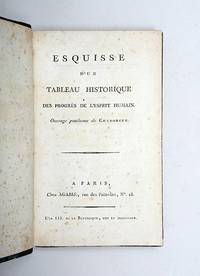
179565358Paris: Chez Agasse 1795. Can Man Become Perfect"<br> <br> CONDORCET Marie Jean Antoine Nicolas Caritat Marquis de. Esquisse d'un tableau historique des progrès de l'esprit humain. Ouvrage posthume de Condorcet. Paris: Chez Agasse L'an III. de la République 1795.<br> <br> First edition of Condorcet's philosophical masterpiece. Octavo 7 7/8 x 4 13/16 inches; 201 x 123 mm. viii 389 1 blank pp.<br> <br> Contemporary quarter calf over dark blue paste-paper boards spine gilt with dotted bands and ornaments gilt red morocco lettering piece. Old owner's signature on half-title. A quarter-inch marginal tear at the bottom of leaf M42 that does not affect the text. Light foxing throughout. A blue ink stain on top edge from signature Z to the end. Overall a clean and attractive copy.<br> <br> "It was the gospel of the nineteenth century that mankind is destined for indefinite future progress. Condorcet 1743-1794 looking back and then forward saw proof of this in the growing equality between classes and nations the intellectual physical and moral improvement of man; and he prophesied that popular education on correct principles would strengthen and assure this progress.In the Esquisse 'An Historical Outline of the Progress of the Human Mind' published after his death Condorcet traces the history of man through epochs the first three covering his progress from savagery to pastoral community and thence to the agricultural state. The next five span the growth of civilizations and knowledge down to Descartes and the ninth describes the revolution of Condorcet's own lifetime from Newton to Rousseau. The prophetic view of the tenth epoch shows Condorcet at his most original. He forecasts the destruction of inequality between nations and classes and the improvement intellectual moral and physical of human nature.it is as the most fully developed exposition of the progress of man that Condorcet's work is now remembered and it is this which has given its lasting appeal" Printing and the Mind of Man.<br> <br> Printing and the Mind of Man 246.<br> <br> HBS 65358.<br> <br> $2000. Chez Agasse unknown
1248A Paris: Chez Agasse An V 1797. Hardcover. Good. Octavo. viii 392pp. 4 A8-Z8 Aa8 Bb4. Half-title present. Third edition published by Sophie Condorcet and Daunou. Later quarter calf over boards by GKB Pynaker Bookbinders at the Hague with their small bookplate. A. Martin & G. Walter Catalogue de l'histoire de la Révolution Française 8083. <br/> <br/> A Paris: Chez Agasse, An V (1797). hardcover
1795168984Paris: Chez Agasse 1795. Second. hardcover. very good. 389pp. 4pp. of advertisments 8vo untrimmed rebound in cloth-backed marbled boards spine neatly repaired. Paris: Chez Agasse L'An III 1795. Second Edition. Very good .<br/> <br/> Printing and the Mind of Man 246; Robinet 382. Considered to be Condorcet's most original and most important work. Considered to be Condorcet's most original and most important work. In it he divided history into ten epochs the first nine dealing with history upto the time in which he himself lived whereas the tenth is his prophetic view of the future. It is the most original part of the book in which Condorcet forecasts among others the future moral intellectual and physical improvement of man. '. PMM<br/> <br/> Chez Agasse unknown
1108077994.Gpaperback. Good. Access codes and supplements are not guaranteed with used items. May be an ex-library book. paperback
178566958Paris: De k'Imprimerie Royale 1785. The First Large-Scale Attempt to Apply Mathematics to Knowledge of Human Phenomena"<br> <br> CONDORCET Marie Jean Antoine Nicolas Caritat Marquis de. Essai sur l'application de l'analyse à la probabilité des décisions rendues à la pluralité des voix. Paris: De l'Imprimerie Royale 1785.<br> <br> First edition. Quarto. 2 cxci 1 blank 304 pp. Decorative woodcut head- and tail-pieces.<br> <br> Contemporary French mottled calf spine decorated in gilt with five raised bands. Marbled endpapers all edges red. First and last few pages browned at edges . gathering K is browned a Q and 2G is toned. Otherwise very good and very scarce.<br> <br> "Condorcet's most significant and fruitful endeavor was in a field entirely new at the time. The subject was one that departed from the natural sciences and mathematics but nevertheless showed the way toward a scientific comprehension of human phenomena taking the empirical approach of natural science as its inspiration and employing mathematics as its tool. Condorcet called this new science 'social mathematics.' It was apparently intended to comprise.a statistical description of society a theory of political economy inspired by the Physiocrats and a combinatorial theory of intellectual processes. The great work on the voting process published in 1785 is related to the latter. Condorcet there sought to construct a scheme for an electoral body the purpose of which would be to determine the truth about a given subject by the process of voting and in which each elector would have the same chance of voicing the truth.No doubt the results obtained in the Essai d'application de l'analyse were modest ones. 'In almost all cases' Condorcet said 'the results are in conformity with what simple reason would have dictated; but it is so easy to obscure reason by sophistry and vain subtleties that I should feel rewarded if I had only founded a single useful truth on a mathematical demonstration' Essai p. ii. One must nevertheless recognize in this work.the first large-scale attempt to apply mathematics to knowledge of human phenomena" D.S.B.<br> <br> Brunet VI col. 472.<br> <br> HBS 66958.<br> <br> $7500. De k'Imprimerie Royale unknown
3050044616.Ghardcover. Good. Access codes and supplements are not guaranteed with used items. May be an ex-library book. hardcover
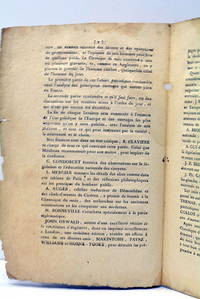
67764A la fin: Paris Imprimerie du Cercle Social 1791. 4 pages. 23x145 Cm. Broché. Rarissime prospectus de parution de ce célèbre périodique paru entre 1791 et 1793. On y trouve la philosophie de la publication la rubrique assurée par chaque auteur les conditions d'abonnement etc. Petits manques. Taches et rousseurs. (A la fin:) Paris, Imprimerie du Cercle Social (1791). unknown
1024118274.Ghardcover. Good. Access codes and supplements are not guaranteed with used items. May be an ex-library book. hardcover
027486133X.Ghardcover. Good. Access codes and supplements are not guaranteed with used items. May be an ex-library book. hardcover
0274861321.Gpaperback. Good. Access codes and supplements are not guaranteed with used items. May be an ex-library book. paperback
1774127684Paris: Chez Couturier père 1774 but 1775. First edition of Condorcet's defence of the free trade of grain. Turgot's liberalisation of the grain trade in 1774 coinciding with bad harvests and rocketing prices led to a fierce pamphlet war between proponents of the mercantilist and free trade schools of thought. Condorcet had written the present tract prior to Turgot's enactment of the policy perhaps to anticipate it but the work was not published until April 1775 in the midst of the troubles and the month before the outbreak of bread riots in Paris. Condorcet would elaborate his ideas further in his 1776 treatise Réflexions sur le commerce des bleds the year in which Turgot was dismissed and liberalisation of the grain trade scaled back. Octavo 181 x 118 mm. Recent marbled boards black calf label. Half-title present. Some offsetting from type a few minor creases discreet repair to tear on p. 8 else a very good copy. INED 1171 bis; Kress 7003. Williams Condorcet and Modernity p. 19. hardcover