Marquis de CondorcetBiblio.com

281 résultats
697502166Akademie-Verlag pp. 276 . Hardback. New. Akademie-Verlag hardcover
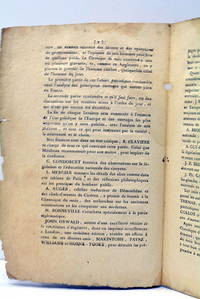
67764A la fin: Paris Imprimerie du Cercle Social 1791. 4 pages. 23x145 Cm. Broché. Rarissime prospectus de parution de ce célèbre périodique paru entre 1791 et 1793. On y trouve la philosophie de la publication la rubrique assurée par chaque auteur les conditions d'abonnement etc. Petits manques. Taches et rousseurs. (A la fin:) Paris, Imprimerie du Cercle Social (1791). unknown
178851530No place: no publisher 1788. The abolition of taxes First edition the first four numbers of Le Moniteur a political journal edited by Brissot de Warville Clavière and Condorcet all published. Issues two and four consider taxation proposing the abolition of all existing taxes and their replacement by equally distributed voluntary subsidies. In this volume the fourth number is the 50-page edition. Garrett notes: "The Bibliothèque nationale has the only complete collection of Le Moniteur. The British Museum has a 38-page edition of the fourth number and Cornell University has versions of the same pamphlet in 48- and 50-page editions. Among the other major collections of French revolutionary pamphlets in this country i.e. USA Le Moniteur is to be found only at Harvard University 48-page edition of the fourth number Princeton University 50-page edition of the fourth number and the New York Public Library an edition of the third number differing slightly from that in the Bibliothèque nationale" Garrett. 4 parts in one vol. octavo 188 x 119 mm pp. 14 2 bl.; 20; 32; 50. Ownership stamp of Thomas Valletau de Chabresy to title verso of the fourth part. Modern dark red quarter morocco spine lettered in gilt patterned paper boards old red edges to first 3 parts. Boards rubbed at lower outer edges some dampstaining to part 4 very good copies. Hatin 92; INED 815. Clarke W. Garrett "The Moniteur of 1788" in French Historical Studies vol. 5 no. 3 Spring 1968 pp. 263-73. hardcover
2322121592.Gpaperback. Good. Access codes and supplements are not guaranteed with used items. May be an ex-library book. paperback
699307326Voltaire Foundation pp. vii 238 . Other. New. Voltaire Foundation unknown
101540832X.Ghardcover. Good. Access codes and supplements are not guaranteed with used items. May be an ex-library book. hardcover
1015538479.Gpaperback. Good. Access codes and supplements are not guaranteed with used items. May be an ex-library book. paperback
1015533884.Ghardcover. Good. Access codes and supplements are not guaranteed with used items. May be an ex-library book. hardcover
45441330like new. unknown
B9781015533882Hardback. New. hardcover
0364839996.Ghardcover. Good. Access codes and supplements are not guaranteed with used items. May be an ex-library book. hardcover
1024118274.Ghardcover. Good. Access codes and supplements are not guaranteed with used items. May be an ex-library book. hardcover
027486133X.Ghardcover. Good. Access codes and supplements are not guaranteed with used items. May be an ex-library book. hardcover
0274861321.Gpaperback. Good. Access codes and supplements are not guaranteed with used items. May be an ex-library book. paperback
1023840987.Ghardcover. Good. Access codes and supplements are not guaranteed with used items. May be an ex-library book. hardcover
1148506624.Gpaperback. Good. Access codes and supplements are not guaranteed with used items. May be an ex-library book. paperback
1146233337.Gpaperback. Good. Access codes and supplements are not guaranteed with used items. May be an ex-library book. paperback
1774127684Paris: Chez Couturier père 1774 but 1775. First edition of Condorcet's defence of the free trade of grain. Turgot's liberalisation of the grain trade in 1774 coinciding with bad harvests and rocketing prices led to a fierce pamphlet war between proponents of the mercantilist and free trade schools of thought. Condorcet had written the present tract prior to Turgot's enactment of the policy perhaps to anticipate it but the work was not published until April 1775 in the midst of the troubles and the month before the outbreak of bread riots in Paris. Condorcet would elaborate his ideas further in his 1776 treatise Réflexions sur le commerce des bleds the year in which Turgot was dismissed and liberalisation of the grain trade scaled back. Octavo 181 x 118 mm. Recent marbled boards black calf label. Half-title present. Some offsetting from type a few minor creases discreet repair to tear on p. 8 else a very good copy. INED 1171 bis; Kress 7003. Williams Condorcet and Modernity p. 19. hardcover
1120278015.Gpaperback. Good. Access codes and supplements are not guaranteed with used items. May be an ex-library book. paperback
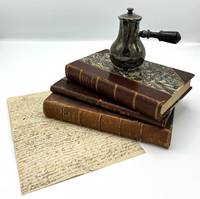
17801756c.1780-1800. French silver coffee pot with turned ebony side-handle 12.5cm in height with engraved inscription to the front: "Cafetière de la Marquise de Condorcet / donnée à Claude Fauriel / léguée à Madame Mary de Mohl / 120 Rue du Bac Paris" "Coffee pot belonging to the Marquise de Condorcet / given to Claude Fauriel / bequeathed to Madame Mary de Mohl / 120 rue du Bac Paris". Stamped maker's mark and hallmarks to the base and lid. The coffee pot's ebony handle has an old somewhat crude glue repair where it joins the silver pot there are possible old repairs to the silver base of the handle and to the base of the spout as well as a few minor dents to the body otherwise it is in good condition and presents well. </p><p>With: A closely-written 2pp. manuscript letter in French from Mary Clarke to Claude Furiel dated August 1829 with a later typed English translation. The letter with a 1cm tear to the foot some splitting along the folds and scattered foxing.</p><p>And three books comprising: </p><p>1 Mohl Ottmar de: Correspondance de Fauriel et Mary Clarke. Paris: Plon-Nourrit et Cie. 1911. Author's own copy with his armorial bookplate to the front pastedown. First edition. Octavo. Contemporary binding by Victor Wächter of Cairo Egypt of half brown sheep over marbled boards ruled in gilt the spine ruled and with titles in gilt. Marbled endpapers. Original blue paper upper wrapper with printed titles bound-in. Illustrated with a photogravure frontispiece of Clarke with tissue guard and two further portraits of Fauriel and Julius Mohl. pp. 6 iii 1 403. A very good copy the binding firm with a little rubbing to the joints. The contents with some minor spots of worming to the front hinge and occasional light foxing are otherwise in good order. The book is accompanied by a group of contemporary press cuttings reviewing the work.</p><p>2 Galley J. B.: Claude Fauriel Membre de l'Institut 1772-1843. Saint-Étienne: Loire Républicaine. 1909. Ottmar von Mohl's copy with his armorial bookplate to the front pastedown. First edition. Octavo. Contemporary binding by Victor Wächter of Cairo Egypt of half brown sheep over green cloth boards the spine with five raised bands ruled and titled in gilt. Marbled endpapers. pp. xxiv 512. A good copy the binding firm with heavy rubbing to the joints and fading and a few scuffs to the spine. The contents with the occasional spot minor mark or spot of foxing are otherwise in good order.</p><p>3 ROD. Ed.: Le Roman de Claude Fauriel et de Mary Clarke. Lettres d'Amour de 1822 a 1844. Three instalments excerpted from an unidentified journal "La Revue". 1909. Ottmar von Mohl's copy with his armorial bookplate to the front pastedown. Octavo. Contemporary binding by Victor Wächter of Cairo Egypt of half brown sheep over marbled boards ruled in gilt the spine with titles in gilt. Marbled endpapers. pp. 551-587; 832-862; 131-161. A very good copy the binding firm with rubbing to the joints and few scuffs to the spine. The contents with toning light scattered foxing and the occasional finger-mark are otherwise in good order. An evocative artefact in the form of a silver coffee pot connecting two of most significant female-intellectual salon hostesses of the late eighteenth and early nineteenth centuries. Originally owned by the philosopher author and influential public figure Sophie Madame de Condorcet 1764-1822 the coffee pot was subsequently bequeathed to her lover the historian philologist and critic Claude Charles Fauriel 1772-1844 who then gifted it to his intimate friend the feminist intellectual Mary Clarke 1793-1883.</p><p>Following her marriage to the French Enlightenment philosopher political economist politician and mathematician the Marquis de Condorcet 1743-1794 in 1786 Sophie de Grouchy now Madame de Condorcet began hosting what would become one of the most significant salons of the revolutionary period. Commencing in 1789 the salon ran until 1793 when it was halted by the reign of terror and the proscription and death of the Marquis resuming again uninterrupted from 1799 to 1822. More egalitarian than her fellow-Girondist hostess Madame Roland Condorcet did not discriminate on the basis of class or social origins and always welcomed other women into her salon along with a host of notable visitors including Thomas Jefferson Adam Smith and Germaine de Staël. The salon also played a particularly notable role in the promotion of women's rights with Condorcet allowing the Cercle Social - an association with the goal of equal political and legal rights for women - to meet in her home; Olympe de Gouges author of the "Declaration of the Rights of Woman and of the Female Citizen" 1791 being prominent amongst its members. Scholars have also argued that Sophie de Condorcet's own concern with female emancipation was responsible for her husband's arguments for greater rights for women most famously expressed in his essay "Sur l'admission des femmes au droit de cité" 1790. Beyond her role as a salon hostess Condorcet also penned the philosophical work "Lettres sur la Sympathie" which she appended to her 1798 translation of Adam Smith's "Theory of Moral Sentiments".</p><p>Claude Charles Fauriel a dedicated republican was a regular attendee at Condorcet's salon having been introduced to such intellectual circles by Madame de Staël particularly the group centred around Antoine Destutt de Tracy and the "idéologues". He began a relationship with Condorcet in 1801 living openly with her until her death in 1822. Fauriel met Mary Clarke that same year with the pair quickly developing a romantic attachment although this ultimately developed instead into an intimate friendship.</p><p>Born into a family of progressive intellectual women Mary Clarke moved from Westminster to Paris with her mother and grandmother at the age of eight. By her twenties initially via her friend the French socialite Juliette Récamier she had become a well-known figure at the heart of Parisian intellectual and literary life and was acquainted with writers including Stendhal Victor Hugo Prosper Merimee Chateaubriand and Alessandro Manzoni. In 1838 she established her salon in rooms that she rented above the home of Chateaubriand in a third floor apartment at 120 Rue du Bac in the Saint-Germain district. Here for more than forty years her home became an intellectual centre in Paris where she hosted all manner of writers thinkers aristocrats diplomats and politicians additionally offering a home-from-home for Anglophone foreigners such as William Thackeray the Brownings and the Trollopes. It was here that Clarke also cultivated a number of friendships with other distinguished female authors thinkers and activists including George Eliot Lady Augusta Stanley Elizabeth Gaskell and most intensely Florence Nightingale with whom she shared a close lifelong friendship. In her mid-fifties she married the German orientalist Julius von Mohl 1800-1876 whose nephew Ottmar von Mohl 1846-1922 a German diplomat and government adviser in Meiji period Japan ultimately published Clarke and Fauriel's correspondence and via whom the present collection descended. Between 1897 and 1917 von Mohl served as a German delegate to the Egyptian National Debt Commission in Cairo hence the Egyptian binder's labels in the three books.</p><p>In the present typically full letter by Clarke - which she notes with pleasing detail was written whilst her beloved cat sits upon her lap - she makes reference to her travels between Paris Brussels and England as well as politics religion her current reading and the pair's own intellectual and literary endeavours as well as mentioning the activities of various friends and associates including the physicist and mathematician André-Marie Ampère 1775-1836 statesman and later Prime Minister of France François Guizot 1787-1874 and historian Augustin Thierry 1795-1856. Writing in a forthright style she is unafraid to commence the letter with a rebuke to Fauriel for apparently requiring encouragement from another friend to reply promptly to her letters: "Madam Arconati is very kind and has more capacity for affection in her little finger than the entire male race has in their whole bodies".</p><p>The present coffee pot was left by Sophie de Condorcet to Fauriel in her will as part of a larger generous inheritance which is reproduced in one of the accompanying books noted in a more intimate line: "I bequeath and give to Mr. Claude Fauriel named above my small silver coffee pot the few pieces of furniture and books that will be found at the time of my death mixed with his in Paris and Meulan". Galley p.275. It was likely engraved with its present inscription later in Clarke's own lifetime following her marriage bearing her final address of 120 Rue du Bac.</p><p>Coffee of course formed part of the life-blood of convivial salon culture as it similarly did in the English coffeehouse; the present coffee pot which passed through the hands of two prominent public female intellectuals who served as leading salon hostesses of the period thus carries a strong symbolism which as the proud inscription attests was likely not lost on Mary Clarke. Considering the varied and illustrious nature of those who passed through Condorcet's and Clarke's salons it is tempting to imagine who may have poured their coffee from this distinguished little pot.</p><p>Provenance: Sophie Marquise de Condorcet; bequeathed to Claude Charles Fauriel 1822; bequeathed to Mary Elizabeth Clarke 1844; the collection of Clarke's nephew and the editor of her correspondence Ottmar von Mohl 1846-1922. hardcover
20112-2705680837Editions Hermann 2011. Paperback. New. 223 pages. French language. 7.95x5.43x0.87 inches. Editions Hermann paperback
2705680837.Gpaperback. Good. Access codes and supplements are not guaranteed with used items. May be an ex-library book. paperback
0365693812New. Brand new and still unused unknown
1160746036.Gpaperback. Good. Access codes and supplements are not guaranteed with used items. May be an ex-library book. paperback
1168116023.Gpaperback. Good. Access codes and supplements are not guaranteed with used items. May be an ex-library book. paperback