951 résultats
13002Le mouvement social, n°60, juillet-sept. 1967. In-8, broché.
1974135041974 P., Editions Anthropos, 1974, 1 vol. in-8° (235 x 153 mm) broché sous couverture blanche imprimée en noir et illustrée en gris, de 174 pp.Pâles rousseurs en couverture, bel exemplaire par ailleurs.
6205Paris, Editions anthropos, 1974. In-8, broché, couverture blanche glacée, 174 pp.
197447549Anthropos, 1974, gr. in-8°, 174 pp, une illustration et un fac-similé hors texte, broché, bon état
Paris, Editions anthropos, 1974. In-8, broché, couverture blanche glacée, 174 pp. Bel exemplaire.
12934Editions anthropos, Paris, 1972 Fort in-8 broché, couverture illustrée d'un dessin de Matta, 521 pp. Edition originale fort rare. Etablissement, notes et introduction de Simone Debout-Oleszkiewicz.Nom du propriétaire en haut à gauche de la page de titre, sinon à l'état de neuf.
1976101001Presses Universitaires de France - P.U.F. , Revue d'Histoire des Sciences Malicorne sur Sarthe, 72, Pays de la Loire, France 1976 Book condition, Etat : Bon broché, sous couverture imprimée éditeur bleu ciel grand In-8 1 vol. - 96 pages
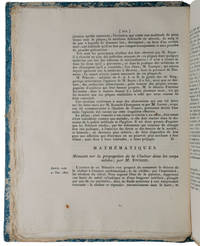
18085302Paris: Bernard 1808. First edition. <p>First printing extremely rare of the discovery of Fourier series and their application to the mathematical theory of heat appearing here 14 years before Fourier's famous Théorie analytique de la chaleur. "This work marks an epoch in the history of both pure and applied mathematics. It is the source of all modern methods in mathematical physics . The gem of Fourier's great book is 'Fourier series'" Cajori A History of Mathematics.</p>. EVANS 37 - THE TRUE FIRST PUBLICATION OF FOURIER SERIES. <p>First printing extremely rare of the discovery of Fourier series and their application to the mathematical theory of heat appearing here 14 years before Fourier's famous Théorie analytique de la chaleur. "This work marks an epoch in the history of both pure and applied mathematics. It is the source of all modern methods in mathematical physics . The gem of Fourier's great book is 'Fourier series'" Cajori A History of Mathematics p. 270. "The methods that Fourier used to deal with heat problems were those of a true pioneer because he had to work with concepts that were not yet properly formulated. He worked with discontinuous functions when others dealt with continuous ones used integral as an area when integral as an anti-derivative was popular and talked about the convergence of a series of functions before there was a definition of convergence . such methods were to prove fruitful in other disciplines such as electromagnetism acoustics and hydrodynamics. It was the success of Fourier's work in applications that made necessary a redefinition of the concept of function the introduction of a definition of convergence a reexamination of the concept of integral and the ideas of uniform continuity and uniform convergence. It also provided motivation for the discovery of the theory of sets was in the background of ideas leading to measure theory and contained the germ of the theory of distributions" González-Velasco p. 428. In December 1807 Fourier submitted a large manuscript entitled Sur la propagation de la chaleur to the Institut de France in Paris "but although Laplace Lacroix and Monge were in favour of publishing it Lagrange blocked publication apparently because its treatment of trigonometric series differed markedly from the way he Lagrange had stipulated in the 1750s. Another chance came in 1810 when the Academy of Sciences announced a prize competition on heat diffusion. Fourier submitted a revised memoir which won in 1811 but was criticised for a lack of rigour and generality. Fourier thought the criticism unfair but revised it again and the resulting book came out in 1822 after Lagrange's death and when Fourier's standing was rising in the Academy" Gray p. 14. The present article is an extract of the 1807 memoir the only part of it to be published until 1972. The prize memoir of 1811 appeared in two parts in the Mémoires de l'Académie Royale des Sciences de l'Institut de France tomes 4 & 5 published in 1824 & 1826. "Previous historical interpretation of Fourier's work has often depended on the Théorie analytique for the sequence of his researches. The 1807 memoir however is one of the great papers in the history of science which led to fundamental advances in the study of heat flow mathematical analysis and an almost unlimited number of applications in science and engineering" Gillmor p. 501. "The 1807 paper is Fourier's masterpiece: the problems and the consequences of their solutions in it dominated his scientific effort while the circumstances of the preparation and publication of its successors encompassed most of his career" Grattan-Guinness 1972 p. ix. ABPC/RBH lists the sale of only one copy the March 1808 issue extracted from the yearly volume in a modern binding. OCLC locates no copy in the US.</p> <br /> <p>Born in Auxerre France Fourier 1768-1830 was in 1795 appointed an assistant lecturer at the École Polytechnique working under Lagrange and Monge. In 1798 Monge a prominent supporter of Napoleon selected Fourier to go on the French expedition to Egypt. After the British defeated them there Fourier returned to France in 1801 hoping to resume his work at the École Polytechnique but Napoleon had been impressed by his organisational talents and sent him instead to be the prefect of the Department of Isère. Despite these administrative duties Fourier managed to pursue scientific research in his spare time and on 21 December 1807 he sent a paper to the mathematical and physical section of the Institut de France in Paris presenting some of his discoveries. The paper was a large one: 234 pages of text with many complicated equations several diagrams of strange mathematical functions and in the last part a few tables of experimental results.</p> <br /> <p>"The secrétaire perpétuel of the mathematical and physical section Delambre sent it to the Institut's foremost mathematical minds-Lagrange Laplace Monge and Lacroix-for examination. The topic was novel and ambitious for it purported to take the mathematical analysis of physical phenomena outside the terms of reference of Newton's law of universal gravitation; the theoretical investigation of the propagation of heat. Little had been achieved on this problem although it was known that Biot and Poisson two of Paris's rising young scientists were interested in it. Now Fourier a man in his fortieth year who had published only one paper in his life-a study of the Principle of Virtual Work ten years previously-was submitting his own ideas on the subject" Grattan-Guinness 1969 p. 250.</p> <br /> <p>"Fourier began by exploring the known properties and parameters for the study of heat diffusion. There were three main ones of the latter: conduction internally within a solid body and externally through its surface or boundary into the environment; and specific heat. Assuming them to be constant he used them to define quantity of heat at a point or section of the body. He took the flow of heat to be uniform and temperature change linear with respect to distance. He drew upon Newton's law of cooling that the flow of heat through a domain was proportional to the temperature difference across it . To mathematize the phenomenon Fourier used the standard differential and integral calculus in the version developed by Euler" Landmark Writings p. 356.</p> <br /> <p>Fourier's 1807 paper followed the chronology of his discoveries. He began with an analysis of heat diffusion between disjoint bodies. He then attempted to model heat diffusion on a line or a circle by replacing them with a finite number of bodies arranged along a line or circle and then letting the number of bodies tend to infinity. For various reasons this approach was unsuccessful so he started afresh on continuous bodies. Fourier was led to the 'heat diffusion equation': in the simplest case of heat flow through a body in one dimension the temperature T at a distance x along a line at time t satisfies the differential equation</p> <br /> <p>d2T/dx2 = KdT/dt</p> <br /> <p>where K is a constant which depends on the physical parameters of the body. For heat flow in bodies of more than one dimension there was a corresponding partial differential equation. The 1807 paper concluded with a section on Fourier's experimental findings.</p> <br /> <p>To solve the heat diffusion equation Fourier used 'separation of variables': he assumed a solution of the form Txt = UxVt which led to ordinary differential equations for U and V; the solutions for U were trigonometric functions. Since the heat diffusion equation is linear superposition of such solutions will also be a solution. Fourier thus arrived at solutions of the form</p> <br /> <p>Txt = Σ ar cos rx br sin rx exp-r2Kt</p> <br /> <p>where the infinite sum is over r = 0 1 2 3 . and the coefficients ar br are determined by the 'boundary conditions' e.g. the given values of T at certain values of x and t.</p> <br /> <p>"There had been a long 18th-century debate about trigonometric series in connection with solutions to the wave equation and the shape of a vibrating string. On the one hand it seemed reasonable that a string could have any continuous initial shape - that was Euler's view - on the other hand the equation could only be solved by functions to which the calculus applied . Fourier proposed to reopen the debate by boldly asserting that any solution to the heat equation which he was the first to derive could be written as an infinite sum of sines and cosines for the simple reason that any function could be written that way. This is a dramatic claim and it was still more so in his day because the consensus was that however broadly a function might be defined all the functions that arise in practice are finite sums of familiar ones: polynomials sines cosines exponentials and logarithms nth roots and the like. They could also be infinite power series and indeed infinite trigonometric series but nonetheless they had the usual sorts of properties such as smoothly varying graphs. No-one said so in so many words but it is clear that the expectation was there and Fourier in particular simply assumed that every function is continuous as is clear from his account of the coefficients of a Fourier series . One of the dramas introduced by Fourier's series was that they readily flout all these expectations . at various stages in the 19th century they provided fresh and disturbing examples of just what functions could do. Contrary to what Fourier himself believed if Cauchy's work began the exploration of what rigorous mathematics can do Fourier series can indicate just what theory is up against" Gray pp. 13-14.</p> <br /> <p>To give some indication of Fourier's originality and technical expertise one problem he considered led to the equation</p> <br /> <p>1 = a1 cos x a3 cos 3x a5 cos 5x .</p> <br /> <p>from which the coefficients a1 a3 a5 . had to be determined. Fourier solved these equations by repeated differentiation followed by putting y = 0. This led to an infinite set of linear equations for a1 a3 a5 . He took the first n of these equations truncated them by omitting all but the first n coefficients solved the resulting finite set of equations and finally let n tend to infinity. Using John Wallis's expression for π as an infinite product this gave</p> <br /> <p>a1 = 4/π a3 = - 1/3. 4/π a5 = 1/5. 4/π .</p> <br /> <p>and hence</p> <br /> <p>π/4 = cos x - 1/3 cos 3x 1/5 cos 5x - .</p> <br /> <p>This formula illustrates an important point which Fourier was the first to understand: the representation of a function by its Fourier series is valid only in a restricted range. For example the preceding series is valid only when x lies between -π/2 and π/2: in fact if x is between π/2 and 3π/2 the sum of the series is -π/4! One of Lagrange's criticisms was that Fourier series being periodic functions are not sufficiently general to represent a 'general' function. Fourier realized that "periodicity is no handicap to generality when the range of values required of the variable equals that period; what happens outside that range is irrelevant to the physical problem and therefore to the mathematics used to describe it. All this is common wisdom today but it is the wisdom that Fourier created; Euler and Lagrange wrote under and indeed did much to create an algebraic approach to the theory of functions and one of its most profound features was that if the algebraic expression fx took real values over a particular range of values of x then it must be used or at least thought of over the whole of that range. Therefore a 'general' function would have a 'general' range as well as a 'general' shape and so the restricted range of trigonometric series would in itself exclude their candidature for generality . It is this profound mistake over the kind of generality demanded of a solution of the wave equation which was as responsible as any other cause for the subsidence into failure of the 18th-century discussion of the vibrating string problem . The vibrating string analysis was Fourier's great predecessor in the field of linear partial differential equations and Fourier enriched it by solving the generality problem and introducing into the theory of functions the specification of a range of values to a function independent of its shape or equation" Grattan-Guinness 1969 pp. 241-242. </p> <br /> <p>Remarkable as the 1807 memoir was for its originality in the introduction and application of Fourier series it actually went beyond standard Fourier series in its discussion of heat flow in bodies with curved boundaries. The study of heat flow in a sphere led to non-periodic series such as</p> <br /> <p>a1 sin n1x a2 sin n2x a3 sin n3x .</p> <br /> <p>where n1 n2 n3 . instead of being integers or integer multiples of a fixed quantity are roots of the equation</p> <br /> <p>nX / tan nX = constant</p> <br /> <p>where X is a constant. When Fourier considered heat flow in a cylinder trigonometric series did not work: they had to be replaced by what are now known as 'Bessel functions' and Fourier developed many of their basic properties more than a decade before Friedrich Wilhelm Bessel introduced them in his astronomical work.</p> <br /> <p>"Not surprisingly the examiners of Fourier's 1807 memoir found several points of concern. The equations to represent the propagation of heat in the first place were far from well-established and so the versions given here needed careful scrutiny. Then there were the methods used to solve them. The equations themselves were all 2nd-order linear partial differential equations and the basic routine of separating the variables if unusual was not new; but after that there were the most surprising developments . the main bone of contention was Lagrange's doubt over the use of all those trigonometric series in forming general solutions to the partial differential equations. Further explanations were called for and during 1808 and 1809 a detailed discussion of the convergence and mode of representation of the series</p> <br /> <p>½x = sin x - ½ sin 2x ⅓ sin 3x - .</p> <br /> <p>was sent in and also a general paper on convergence and other difficulties. Finally after some coercion the examiners proposed a prize problem on 2 January 1810: 'Give the mathematical theory of heat and compare the result of this theory with exact experiments.' The entries had to be in by 1 October 1811. Fourier revised the old paper reordering some of its material and suppressing many of its diagrams but preserving all the main results and adding some new sections; and he managed to get the paper to Paris just in time. Haüy and Malus replaced Monge on the examiners' panel but the most important judges were still Laplace and Lagrange. Laplace seems to have been quite pleased-he had already made one encouraging reference to the original paper in 1809-but Lagrange was still hostile . So Fourier had won the prize-but with criticism which he always resented" Grattan-Guinness 1969 pp. 231-232.</p> <br /> <p>From a modern point of view some of Lagrange's criticisms were justified particularly those relating to the question of convergence of Fourier series and of whether 'any' function could be expanded in a Fourier series. These questions would only be answered decades later especially by Lejeune Dirichlet. "Fourier was not a naive formalist: he could handle problems of convergence quite competently as in his discussion of the series for the saw-tooth function. The leading technical ideas of several basic proofs such as that of Dirichlet on the convergence of the Fourier series can be found in his work. Moreover he saw long before anyone else that term-by-term integration of a given trigonometric series to evaluate the coefficients is no guarantee of its correctness; the completeness of a series is not to be assumed. The great shock caused by his trigonometric expansions was due to his demonstration of a paradoxical property of equality over a finite interval between algebraic expressions of totally different form. Corresponding to any function in a very wide class there could be constructed a trigonometric series whose values on an assigned interval are the same as those of the function. As he showed by example the given function could even be a mixture of different algebraic expressions each defined on disjoint subintervals of the basic one. Both trigonometric expansions and arbitrary functions had been used by others including Poisson; but the former were restricted to problems involving periodic phenomena and the latter when they appeared in the solutions of partial differential equations were assumed by their nature to be incapable of an algebraic expression" DSB.</p> <br /> <p>With no prospect of publication of his 1811 prize memoir Fourier began a third version of the work this time in the form of a book which he would publish separately. This was near completion by 1814 when the biggest upset of his life occurred-the fall of Napoleon. Following this he went to Paris to try to follow the intellectual life he had always wanted and to get his prize paper and book printed. The printing of the book was almost complete by 1816 when an abstract was published in the Annales de Chimie et de Physique Series 2 Vol. 3. With the restoration of the monarchy the old Académie des Sciences was reinstituted and Fourier gained election to it at the second attempt in 1817. The Théorie analytique was finally published in 1822 and the prize paper in 1824-26 following which Fourier was elected secrétaire perpétuel of the Académie to succeed Delambre and in 1827 to the Académie Française. He died in 1830 as the result of complications from an illness contracted in Egypt.</p> <br /> <p>"But what had happened to the original paper of 1807 During Fourier's own lifetime it seems to have been kept in the archives of the Académie des Sciences; but sometime after his death it vanished and remained missing until 1890. Then Darboux prepared an incomplete edition of Fourier's works and announced its discovery in the library of the École Nationale des Ponts et Chaussees in Paris. He gave the impression of subtle detection on his part but in fact he might well have noticed its clear listing in the Catalogue of Manuscripts of the library which had recently been published. So exactly sixty years after its author's death it had been found again" Grattan-Guinness 1969 pp. 231-233. It was finally published by Grattan-Guinness in 1972.</p> <br /> <p>The Bulletin des Sciences par la Société Philomathique first appeared in July 1791 with tome I covering the period up to 1798 tome II 1799-1800 and tome III 1801-4. Publication was then interrupted until October 1807 when it resumed under the title Nouveau Bulletin des Sciences par la Société Philomathique with three volumes covering the period up to 1813. A third series then began under the title Bulletin des Sciences publication of which continued until 1826. </p> <br /> <p>Dibner 154; En Français dans le Texte 232; Evans 37; Roberts & Trent Bibliotheca Mechanica p. 118; Sparrow 68; Landmark Writings in Western Mathematics Grattan-Guinness ed. 26; Norman 824 all for the 1822 Théorie analytique. Gillmor Review of Grattan-Guinness 1972 Technology and Culture 14 1973 pp. 501-503. González-Velasco 'Connections in mathematical analysis: the case of Fourier series' American Mathematical Monthly 99 1992 427-41. Grattan-Guinness 'Joseph Fourier and the revolution in mathematical physics' Journal of the Institute of Mathematics and its Applications 5 1969 pp. 230-253. Grattan-Guinness Joseph Fourier 1768-1830. A survey of his life and work based on a critical edition of his monograph on the propagation of heat presented to the Institut de France in 1807 1972. Gray The real and the complex: A history of analysis in the 19th century 2015. For the history of the Société Philomathique and its Bulletin see: Bertholet 'Sur les publications de la Société philomathique et ses origins' Journal des savants 1888 pp. 477-493.</p> <br/> <br/> Large 4to 280 x 212 mm comprising the Nouveau Bulletin of Oct-Dec 1807 nos. 1-3 Oct-Dec 1808 nos. 4-15 Jan-Dec and 1809 nos. 16-24 Jan-Sep. Original interim boards a little rubbed. A very fine copy in original state. Bernard unknown
Ensemble de 4 ouvrages reliés en un volume in-16, demi-chagrin rouge de l'époque, dos lisse orné de triples filets dorés en place des nerfs, titre doré, tranches mouchetées. 1– Edition originale. Par l'industriel, fondateur des "chauffages Godin", député d'extrême gauche, fouriériste et promoteur d'une organisation coopérative au sein de son entreprise, "le familistère de Guise", directement inspirée des idéaux phalanstériens. "Des logements propres et confortables, des écoles à la pointe de la modernité pédagogique, des loisirs variés, des magasins de proximité, un système de protection sociale. C'est déjà à partir de 1859, au Familistère de Guise dans l'Aisne, que Jean-Baptiste André Godin bâtit un Palais social, juste aux cotes de son usine. Rare expérimentation d'inspiration fouriériste qui a su résister au temps" (Michel Lallement). (Del Bo, p. 73 et 74) 2- Edition originale posthume de cette synthèse du programme social de Charles Fourier, composée à partir de fragments tirés en particulier d'articles du "Nouveau Monde", mise en ordre et présentés par le phalanstérien Charles Pellarin et préfacée par Victor Poupin. (Del Bo, p. 9. Einaudi, 1950). 3– Edition originale. 4– Edition originale. Magistrat et homme politique français originaire du Puy-de-Dôme), l'auteur lutta toute sa vie en faveur des idéaux démocratiques et sociaux. Les 4 ouvrages sont édités à la "Librairie de la Bibliothèque démocratique" de Victor Poupin avec ses commentaires. Dos frotté, quelques petits défauts de papier en marge. Bon exemplaire. Intérieur très frais.
243263 ouvrages reliés en un volume in-12, demi-basane bleue de l'époque, dos lisse orné de filets et fers dorés.
376403 ouvrages reliés en un volume in-12, demi-percaline chagrinée vert bronze de l'époque, dos lisse orné de filets dorés, titre doré, tranches mouchetées.
3 ouvrages reliés en un volume in-12, demi-percaline chagrinée vert bronze de l'époque, dos lisse orné de filets dorés, titre doré, tranches mouchetées. 1- Edition originale. Ouvrier teinturier, militant et propagandiste phalanstérien, l'auteur revendique comme fouriériste l'idée de l'organisation du travail et affirme qu'en dehors de cette doctrine, il n'y a pas d'organisation de travail qui soit réalisable. "Ce livre est de nature à aider puissamment à la propagation des doctrines économiques de l'Ecole sociétaire, notamment parmi les industriels" (Catalogue raisonné de la Librairie Sociétaire). (Del Bo, p. 21. Maitron, I, 302). 2- Seconde édition considérablement augmentée de ce célèbre manifeste de l'Ecole Sociétaire dans lequel Victor Considérant expose le programme du Parti auquel il imprime sa propre vision. Cf. analyse in : Dommanget, 'V. considérant', p. 22 et s. 3- "Troisième édition". Condisciple de Victor Considérant à l'École Polytechnique, gagné à la cause phalanstérienne par celui-ci, H. Renaud devint l'un des disciples les plus orthodoxes de l'École. Il donne dans cet ouvrage un "résumé fidèle de la doctrine de Fourier", des conceptions philosophiques qui ont conduit son maître à élaborer son système et tire les ultimes conséquences politiques et sociales de l'application de la "loi de l'harmonie universelle". (Del Bo, p. 41. Maitron, III, p. 296). Rousseurs au dernier titre. Papier des plats frotté. Bon exemplaire, relié, de ce recueil de trois essais "canoniques" dans l'histoire du fouriérisme.
3 ouvrages reliés en un volume in-12, demi-basane bleue de l'époque, dos lisse orné de filets et fers dorés. Recueil de trois ouvrages d'hygiène populaire parmi les plus célèbres de la période, les trois en édition originale. Médecin et député au début de la monarchie de juillet, A.-F. Baudet-Dulary fut le responsable et le principal soutien financier de la commune sociétaire de Condé-sur-Vesgre. Il est l'auteur de nombreux articles et ouvrages fouriéristes.
18831Paris, Penaud-Jolly, s.d., - 1 vol. in-4, pl., i demi-chagrin aubergine, dos à nerfs, double filet sur les plats, tête dorée (rel. de l'époque). Qqs rousseurs éparses aux serpentes. Bon exemplaire.Contenant 136 portraits sur pied des grands personnages de l'histoire de France depuis la Révolution, accompagnés d'une notice biographique.
181641346(Paris, Crochard, 1816, 1817,1817,1820, 1824, 1824, 1825). Without wrappers as issued in: ""Annales de Chimie et de Physique, Par MM. Gay-Lussac et Arago."". Vol. 3, pp. 350-375. - Vol. 4, pp. 128-145. - Vol. 6, pp. 259-303. - Vol. 13, pp. 418-38. - Vol. 27, pp. 136-167. - Vol. 27, pp. 236-281. - Vol. 28, pp. 337-365.
181641346Paris Crochard 1816 181718171820 1824 1824 1825. Without wrappers as issued in: "Annales de Chimie et de Physique Par MM. Gay-Lussac et Arago.". Vol. 3 pp. 350-375. - Vol. 4 pp. 128-145. - Vol. 6 pp. 259-303. - Vol. 13 pp. 418-38. - Vol. 27 pp. 136-167. - Vol. 27 pp. 236-281. - Vol. 28 pp. 337-365. <br/><br/><em>All first edition and first appearances of papers forecasting the more elaborated theories which he published in his famous work "La Therorie analytique de la chaleur. 1822". His analytical mathematical method that any continous function can be represented as a sum of sine and cosine curves is here applied to physical problems f.i. his treatment of the warming and cooling of the earth and terrestrial temperatures f.i. the papers offred here no.1 2 4 5 a. 6. The theory of terrestrial temperatures played a central role in Fourier's mathematical physics.An. 1. Description of the 4to volume which was afterwards published in 1822 without the chapters on radiant heat the solar heat as it effects the earth the comparison of analysis with the experiment and the history of rise and progress of the theory of heat. As such the paper contains importent applications and results not described in "Theorie analytique.1822."An. 2. This is a mathematiccal sketch on the sine law of emission of heat from a surface. The authors paradox on the hypothesis of equal intensity of emission in all directions is here proved.An. 3. An elegant physical treatise on the discoveries of Newton Pictet Wells Wollaston Leslie and Prevost.An. 4. A Sketch of a memoir mathematical and descriptive on the waste of the earth's initial heat.An. 5. A descriptive memoir read before the Academy 20. a. 29. Sept 1824 and later published in "Memoires de l'Academy." Tome VII 1827.An. 6. An elementary analytical account of surface-emissions and absorption based on the principle of equilibrium of temperature. This paper comes with Poisson's "Observations relatives à un Mémoire sur l'Equilibre d'une masse fluide inséré dans la Transactions philosophique de cette année." Pp. 225-236.An. 7. An elementary analysis of emissionn absorption and reflexion by walls of enclosure uniformly heated. At p. 364 Fopurier promises a "Theorie physique de la chaleur" to contain the applications of the "Theorie analytique" omitted in teis work published 1822. </em> unknown
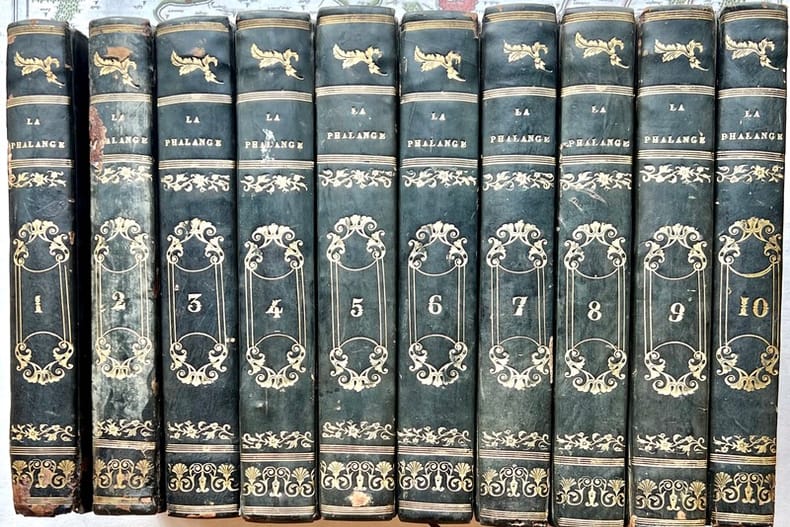
18452872Paris, aux bureaux de la Phalange, 1845-1849. 10 vol. in-8, demi-veau vert, dos lisse orné de fers romantiques (reliure de l'époque).
197051524Lexington/Totont, Xerox College, 1970. IX, 446 (26 cm) Leinen / gebundene Ausgabe
200261844Cambridge : Cambridge University Press, 2002. With applications in physics and engineering VIII, 132 S. (23 cm) Broschierte Ausgabe
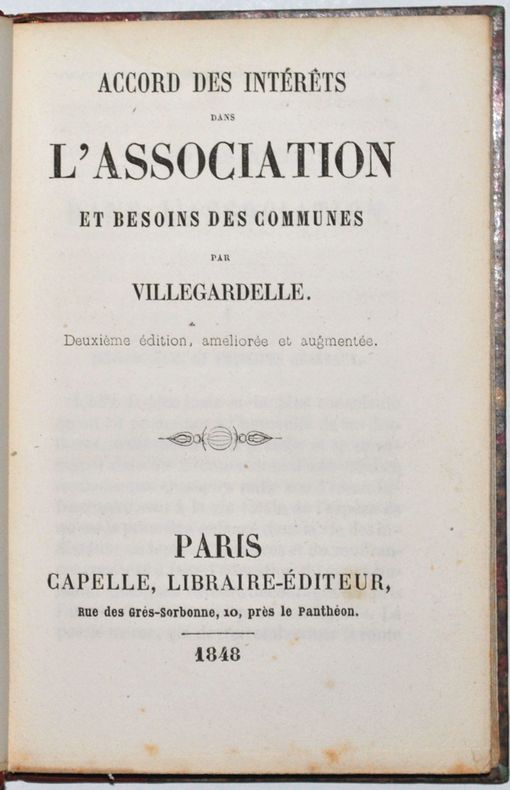
18487455Paris, Capelle, 1848. In-16 de 128-(1) pp., demi-maroquin rouge, dos orné à nerfs (reliure de l'époque).
2004LFA-126739216Un ouvrage de 121 pages, format 210 x 295 mm, illustré, broché couverture couleurs, publié en 2004, Impr. des Ecureuils, bon état
43790Revue trimestrielle. Paris, rédacteur en chef : Henri Deluy. Comité de rédaction : Elisabeth Roudinesco, Bernard Vargaftig, Paul Louis Rossi, Charles Dobzynski, Pierre Lartigue, Mitsou Ronat, Jacques Roubaud, Alain Lance, etc. Un volume 13x21cm broché de 190 pages. Bon état.
AMA-408Hilversum, A. Gerits, 1983. In 8°, toile de l’éditeur. XV, 36 pp., illustrations in texte.
14729Hilversum, 1983. With portrait and plates. 16, 35 pp. 8vo. Cloth. (Supplements to existing handbooks, 1)