"BACON, FRANCIS.Livre Rare Book

170 résultats
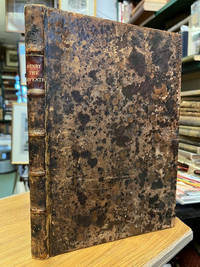
163846277London, Edward Griffin [John Haviland, Bernard Norton, and John Bill], Richard Whitaker [& John Norton], 1638. Folio. (Binding: 32x22 cm, leaves: 31,1x20,8 cm.). Contemporary full speckled calf binding with six raised bands and gilt red leather title-label to spine. Boards with blindstamped ornamental border. Scuff marks to boards and hinges worn, so bands showing. Large woodcut head- and tail-pieces, initials, printer's devices, and typographical ornaments (that have been of great significance to the Baconians in their attempts to establish Bacon as the author of the works attributed to Shakespeare). Roman and Italic lettering, and some Greek. Several neat inscriptions to front free end-papers and verso of frontispiece, in Latin, Greek, English, and German, dated 1704, 1740, and 1926, the last being a presentation-inscription for the renowned German Bacon-scholar and noted Baconian George J. Pfeiffer. Neat early 18th century inscription to top of title-page. Old description of the copy (1946) neatly pasted on to inside of front board. Vague minor damp-staining to lower margin throughout, far from affecting text, and mostly barely visible. A vague minor dampstain to margins of a few leaves at the beginning, also far from affecting text. All in all a lovely, clean and crisp copy on large paper. Full page engraved frontispiece-portrait + (14), 386 (pp. 177-78 omitted in pagination)"" (16), 475, (1) pp. Fully complete, with separate half-titles for the different works.
162348295London, Joannis Haviland, 1623 [later altered in manuscript to 1624]. Small folio. Bound in a lovely early 19th century full vellum binding with gilt borders to boards and gilt ornamentations and gilt title-label to spine.Lower front hinge cracked, but bindning still tight. A bit of edge wear, but overall very nice. Woodcut title-vignettes (burning heart) and woodcut initials in beginning. Text within single woodcut borders. (18), 493, (1 - errata) pp. Complete with both title-pages (no final blank). Old owner's name to title page (along with the dates 1624 and 1648), unlegible scribbles to second title-page, and ""collated e perfect"" in old hand to last leaf. A very nice and clean copy with good margins.
166024612Amsterdam: Joannis Ravensteinii 1660. Second Printing. With an engraved titlepage featuring two sailing ships viewed from behind two columns 'Multi pertranfibunt de augebiteur scientia' and woodcut initials throughout. 12mo contemporary full vellum the spine lettered in manuscript edges yapped. xxiv 404pp. A very well preserved copy a bit age mellowed but proper and sturdy the vellum darkened and with some unobtrusive old staining. The second Amsterdam printing of Bacon’s important scientific works. There was no publication in England until 1676. Joannis Ravensteinii hardcover
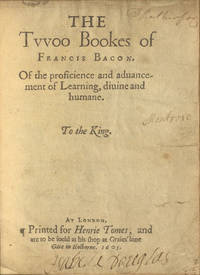
1605008068London Graies Inne Gate in Holborne: Henrie Tomes 1605. 1st Edition . Hardcover. Very Good. 12mo - over 6¾ - 7¾" tall. A Very Good example of Bacon's First published works. Better known under title: Advancement of learning. In attractive full calf c1818 decorative gilt tooling edges rubbed. Spine raised bands gilt tooling & titles. Internally 2 45 ff 70 70-71 1 70 21 89-97 8 106-118 ff 2 blanks signatures A-M2 Aa-3H1 small burn hole Pp3-Qq2 slightly affecting text occasional light spotting & soiling the fep & the last 2 blanks have been substituted with blanks watermarked 1817 although ESTC states that most copies were issued without these this was probably when the book was rebound in its attractive calf a.e.g. ink names to tp Isabella Douglas; Montrose; & P Rutherford. The variant copy with C4r line 5 reading maniable rather than amiable. Erratic pagination but complete. 181131 mm. ESTC 1164; Gibson 81; Pforzheimer 36 Thomas Purfoot the elder printed book 1 and 2K-2R of book 2; Thomas Creede printed 2A-2I 3E-3H; another unidentified printer or compositor set the rest. Cf. STC <br/> <br/> Henrie Tomes hardcover
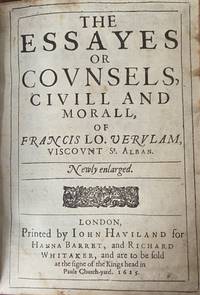
162524374London: Printed by John Haviland for Hanna Barret and Richard Whitaker 1625. Hardcover. First issue of the first complete edition of the Essays and the last edition to appear during Bacon's lifetime. It "contains fifty-eight essays and is the text most commonly reprinted today. For this reason the present edition ranks in importance with the first of 1597" Pforzheimer. Small quarto somewhat closely trimmed at upper margin; text block measures 18 x 13 cm. In an unsigned 19th century full red leather binding with purple satin ribbon bookmark bound in gilt floral borders spine gilt in six compartments all edges gilt gilt inner dentelles and marbled endpapers unfortunately marred by some uneven darkening to boards and top edge see accompanying images. Lacking original front blank but with added engraved portrait of Bacon by Alexander Bannerman created c. 1784 as frontispiece. Collation matches Pforzheimer 30 in all other respects. Ownership signature dated 1839 on front blank;small area of damage to leaf A3 no loss of text; dampstain visible--primarily on the first and last ca. 15 leaves--at gutter near the base of the spine; otherwise clean. Written in a concise aphoristic style the Essays take both a pragmatic and a philosophical approach to questions of civic and private life morality and the human condition and "can be read as his final comments on the contemporary world of politics" ONB. Printed by John Haviland for Hanna Barret and Richard Whitaker hardcover
167663144London:: Printed by W. G. for R. Scot T. Baffet J. Wright R. Chiswell and J. Edwyn 1676. old full calf; both covers are detached and the spine label is absent. Both covers detached; old engraved armorial bookplate; calf rubbed and worn. Folio. Engraved frontispiece. . Printed by W. G. for R. Scot, T. Baffet, J. Wright, R. Chiswell, and J. Edwyn, unknown
162228847London: printed by W. Stansby for Matthew Lownes and William Barret 1622. Mixed edition small folio pp. 4 248; engraved portrait frontispiece by John Payne with moderate dampstain pervading about a third of it title within an elaborate architectural woodcut border text within ruled borders throughout early ownership signature on the front free endpaper of "Jer. Milles de Duloe" almost certainly the antiquary Jeremiah Milles 1714-1784 of Duloe Cornwall -- see DNB for a 3-column account and with numerous underlinings and occasional notes in the margins in his hand; dampstain at the bottom quarter of C1-D2 all else very good in contemporary full speckled paneled calf speckled edges; edges a little rubbed the whole very nicely rebacked and preserving the original red morocco label. See Gibson 116a and 116b for distinctions in the many errata: "There is . no certain means of determining their priority. printed by W. Stansby, for Matthew Lownes, and William Barret unknown
164752110London: Printed for Mathew Walbancke at Grayes-Inne-Gate 1647. First edition 8vo xvi 323 13 pp. Engraved second title showing a map of Britain light damp staining to the first 5 leaves. Booklabel of Kimbolton Castle Library to the paste down. Contemporary speckled calf spine dull joints recently repaired with a new maroon label. "Bacon's greatest service to anti-Stuart causes. probably written using notes collected by John Selden. Published. to justify the Long Parliament's war against Charles I with a continuation appearing in 1651 the work has been referred to as 'the English Francogallia'. it argued with unrelenting force an anti-royalist ideology of enormous persuasive power. This was the radical ancient constitution which. was first fully articulated during the civil wars by polemicists such as William Prynne and Bacon himself. Early a mainstay of the Long Parliament's cause the ideology consisted of the following propositions: first while government in general was from God the particular form came from the people. Writing a summation of his work in 1651 Bacon re-emphasized the continuity of an elective and contractual monarchy and a parliament which oversaw its proper functioning. With a salute to both past and present he wrote at the very end of his tract: 'as I found this nation a commonwealth so I leave it and so it may be forever'" ODNB. Wing B348B. The true first edition as opposed to the 1872 reprint with "Grayes-Inn-Gate" in the imprint second state with the publisher's name spelt "Walbancke. London: Printed for Mathew Walbancke at Grayes-Inne-Gate unknown
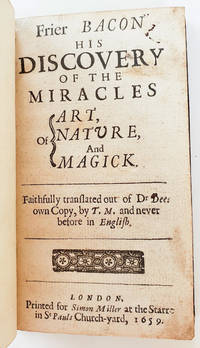
1659021560London: Simon Miller 1659. First Edition. Hardcover. Minor foxing pencil notes on endpapers; small chip to head of spine. Near Fine and very scarce. Small duodecimo 3-1/8" x 5-1/2" bound in early calf with gilt-ruled covers and gilt decoration and lettering on the spine; xii 51 7 - ads pages. First separate printing and First English Edition of Roger Bacon's letter to William of Paris that first appeared in Dee's BACON'S EPISTOLAE published in Hamburg in 1618. Bacon begins this long essay denying the existence of magic but concludes showing how to create a "Philosophers Egg." He writes about optics gunpowder Bacon is believed to have introduced gunpowder--a Chinese invention--to the West and petroleum in warfare. Bacon makes some bold futurist statements such as admirable Artificial Instruments of locomotion It's possible to make a Chariot move with an inestimable swiftnesse and this motion to be without the help of any living creature of flight It's possible to make Engines for flying a man sitting in the midst whereof by turning onely about an Instrument which moves artificiall Wings made to beat the Aire and diving A man may make an Engine whereby without any corporal danger he may walk in the bottome of the Sea or other water. Bookplate of Lord Northwick on front pastedown. <br/><br/> Simon Miller hardcover
16243619<p>Compendium on Alchemy Medicine and Science A-2S8 2S8 blank present. 34 598 24 pages. Title-page in red and black. Worming to inner margin of first gathering with some minor affects; browning some old underlining partially in red and marginal notes some minor stains. Overall a good copy in the original full yapped vellum. This volume contains:1 Basilius Valentinus:Triumphwagen des Antimonii.2 Roger Bacon: Von der Medicin und Artzney/ oder Tinctur des Antimonii oder Spieglases Beydes in den Menschlichen Crpern zu erhaltung desselben Gesundheit und abwendung aller auch unheilbaren Kranckheiten und Seuchen Und unvollkommenen Metallen ihren Aussatz heilen sie zu clarificiren und in das beste Gold zuverse.3 Ein kurtz rundes und wolgegründtes Tractätlein Von den Particular und Universal-Tincturen.4 Vom Stein der Weisen Theoria. Und Practica Des Edlen . Georgii Phaedronis Rodocheri.5 Uhralter Ritterkrieg Das ist Ein alchymistisch kürtzliches Gäsprech. Unsers Steins/ des Golds und des Mercuii .6 Opus Saturni M. Johannis Isaaci Hollandi.7 Consideratio Oder Philosophische Betrachtung Von der Materia Lapidis Philosophici.8 Von der Occulta Chemicorum Philosophia Ein kurtzer Tractat.Basilius Valentinus also known under the Anglicized version of his name Basil Valentine was a fifteenth-century alchemist & the Canon of the Benedictine Priory of Saint Peter in Erfurt Germany. Krown & Spellman HA 45215; 18 mo 4 x 6.4 in; xxxviv 59824 pages; All shipments through USPS insured Priority Mail. .</p> Friedrich Lanckisch for Bartholmaeus Voigt hardcover
16183463<p>London: Bonham Norton and John Bill 1618. Rare first edition first issue of the defense of James Is execution of Sir Walter Raleigh written by Francis Bacon and with according to Bacon very material additions by the king himself. The work describes the circumstances surrounding Raleighs final voyage to America in 1618 with the purpose of locating a fabled gold mine and includes the text of Raleighs commission. In the event his expedition ended up seizing the island of St. Thomas and killing its Spanish governor an ostensible act of war against Englands ally. Back in England Raleigh who had already been sentenced to death in 1603 on another conviction was tried by a commission headed by Bacon and executed in October 1618. The English public was appalled: To sacrifice to a concealed enemy of England the life of the only man in the nation who had a high reputation for valor and military experience was regarded as meanness and indiscretion and the intimate connections which the king was now entering into with Spain being universally distasteful rendered this proof of his complaisance still more invidious and unpopular David Hume History of England. The present volume is the governments hasty attempt to justify the execution. Bacon as a member of the council that had sentenced Raleigh appears to have been the main author. In a letter to a friend he mentioned the work and the kings input: We have put the Declaration touching Raleigh to press with his Majestys additions which were very material and fit to proceed from his Majesty cf. Pforzheimer 819. The work is known in at least two issues a first issue of 63 pages and a second of 68. STC and Pforzheimer originally took the present to be the second issue but the STC has since revised its opinion based on the research by Starkey published in his Library article of 1948. STC 2nd ed. 20652.5; Gibson Francis Bacon 369c; Starkey The printing of a declaration of the demeanor and carriage of Sir Walter Raleigh 1618 The Library 5th series 3 1948 124-34. 4to. 16.6 x 11.4 cm 4 63 1 pp. including initial blank signed A in a woodcut tailpiece. Bound in later paneled calf title stamped on spine lower portion of spine damaged slightly worn at extremities. INTERNAL CONDITION Generally very good.</p> Bonham Norton and John Bill
162973791London: Stephens and Christopher Meredith 1629. 4to. 2nd edition. 4 248 10 index pp. Full mottled calf with a double gilt ruling on either side of five raised bands and red title-label lettered in gilt; marbled edges. 4 pages of prelims missing incl. portrait & engraved title. Edges & joints rubbed with a clean interior apart from some minor offsetting and foxing to first few leaves small light stain and a very small burn to edges of index leaves. Engraved bookplate with the armorial crest of Arma Iohannis Stenhani Robinson Baronetti affixed to front paste-down. STC 1191 . Good. Full Calf. 2nd Edition. 1629. Stephens and Christopher Meredith 1629 unknown
162246505London: Printed by W. Stansby for Matthew Lownes and William Barret 1622. Very Good. London: Printed by W. Stansby for Matthew Lownes and William Barret 1622. Mixed Edition per Gibson published the same year as the first. Small folio; bound in early 20th century full dark brown calf with new endpapers; five raised bands and red leather label to spine; 4 248pp. frontis portrait; lacking A1 blank else collated and complete. Edgewear to boards; corners bumped; brief split and chipping to joints and crown; binding sound; early writing to preliminaries; contemporary ownership inscription to title page; occasional marginalia including manuscript "corrections" to some errata; brief chipping to first 10 leaves with no loss of meaning; tide marks. This copy with all seven errata or "Faults Escaped" from page 248 uncorrected. Many of Gibson's additional errors corrected of which he notes "There is. no certain means of determining their priority." A Very Good and sound copy often found lacking the frontis portrait. <br /> <br /> Considered Bacon's most substantial work of history his biography of Henry the Seventh was composed following his public and professional disgrace in 1621 culminating in twenty-three charges of corruption and spending a few days in the Tower. This history was written in part to pacify James I by providing him with a "flattering portrait of his ancestor" though it also successfully conveyed an accurate depiction of "the man and the real business of his reign. Every history which has been written since has derived all its light from this" DNB Vol. 1 p. 823. <br /> <br /> Gibson 116A and 116B. Printed by W. Stansby for Matthew Lownes, and William Barret unknown
16232Londres John Haviland pour Matthew Lownes 1623 1 3 ff., 454 pp. Velin. Les feuillets blancs Aa4 et Cc6 sont absents.
166248562Amsterdam, Ex officina Elzeviriana, 1662. 12mo. Cont. full vellum with handwritten title on spine. Engraved titlepage. 404,(5) pp. A small nick to the vellum-flab of rearcover.Internally clean and fine.
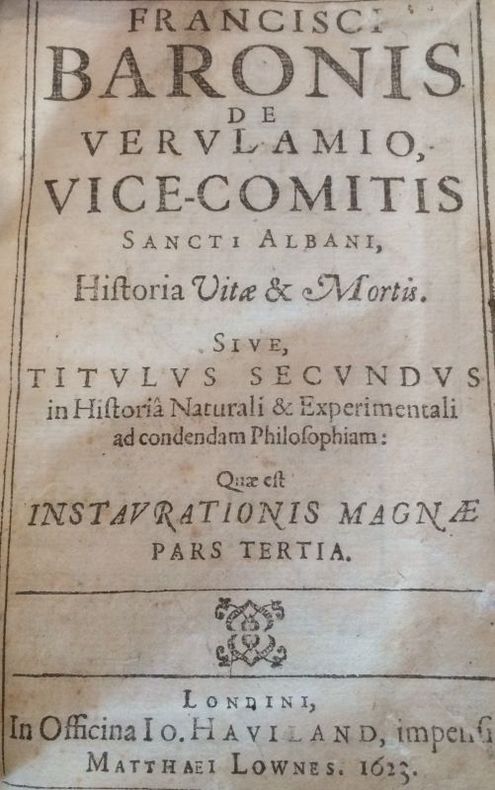
162388621Londres, John Haviland pour Matthew Lownes, 1623, in-8, [4]-454 pp. (les feuillets blancs Aa4 et Cc6 sont absents), Vélin ancien, titre manuscrit en tête du dos et sur la tranche supérieure, Édition originale de ce livre majeur de Francis Bacon (1561-1626). Publié comme la troisième partie de l'Instauratio Magna, l'ouvrage offre une étude sur la longévité ou la brièveté de la vie chez l'homme et aborde la question de la prolongation de la vie. L'auteur s'interroge sur la possibilité de vivre plusieurs centaines d'années, comme les hommes avant le déluge, et propose quelques témoignages contemporains relatifs à de rares grandes longévités, voire exceptionnelles, en citant notamment le cas de la comtesse de Desmond, qui aurait vécu 140 ans (Operation super exclusionem aeries II, 14, p. 269). La philosophie de Francis Bacon (1561-1626) fut l'une des plus influentes au XVIIe siècle, avec celle de Descartes. Il a encouragé le développement de la méthode inductive d'investigation scientifique, en s'opposant à la méthode scolastique qui avait cours depuis le Moyen Âge. Il rejetait la logique déductive d'Aristote et pensait que la science devait s'intéresser au monde physique. Précocement, il pensait que la chaleur est un mouvement, identifiait la force magnétique et la gravitation, affirmait que la lumière voyageait à une vitesse finie et reconnaissait l'idée de la conservation de la masse (Heirs of Hippocrates n° 398). Bacon a également pensé la question de l'euthanasie et a livré sur le sujet des réflexions d'une telle importance qu'il a été crédité, à tort, d'avoir forgé le terme d'euthanasia. Charnière intérieure ouverte. Garrison & Morton n° 10491. Gibson, n° 147 Dominique Weber, "La prolongation de la vie humaine selon Francis Bacon. Ou : quel Tithon voulons-nous être ?", Astérion, 8 | 2011 [en ligne] Couverture rigide
169412516Lipsiæ, Johannis Justi Erythropili, 1694. Folio. Cont. full vellum. Small stamp on title. Htitle neathly repaired withoutl loss of letters, title in red a. black with engraved titlevign. (16),792 (=1584 colums),48 pp. Front-and endpapers renewed. A few pages very slightly browned.
169451314Lipsiæ, Johannis Justi Erythropili, 1694. Folio. Cont. halfcalf over 5 raised bands. Rebacked preserving most of orig. gilt and rubbed spine. Corners restored. Title-page in red a. black with engraved titlevign. (16),(792) (=1584 colums),48 pp. A bit of browning to htitle, title-page and last few leaves. Internally clean.
168545897Amsterdam, Officina Wetsteniana, 1685. 12mo. Contemp. full calf. Spine gilt. Some wear to spine, especially at upper and lower compartment. Engraved and printed title.(10),399 pp. + Engraved title. 328,(4) pp. From the library of Paul V. Rubow.
164430037ABLeyden, Hackius, 1644. 8°. 439 (recte 419) S, (3) S. (Index). Mit 1 gest. Titel. Pergamentband der Zeit.
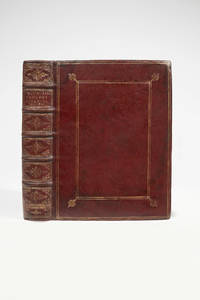
163273<p><b>The rare first French edition of <i>De Dignitate et augmentis scientarum</i> " <i>Francis Bacon's first important published text</i>" J. P. Cavaillé.</b></p><p>Gibson 137.</p><p>The book was published in English in 1605 in only two books. The Magna Instituatio was published in 1620. At the end of his life 1623 Bacon gave a new edition in nine books and in Latin.<br /><br />A translation was given by André Maugars in Paris in 1624 under the title Le Progrez et avancement aux sciences divines & humaines. This one different is a new book much more complete.<br /></p><p>Bacon's work of great significance in the development of modern Western thought called "intrinsically important" by Pforzheimer.</p><p>Bacon's masterpiece that will deeply influence the thinking of Descartes Locke Leibniz Huygens and Voltaire. </p><p>In this work Bacon reveals his new scientific method.<br /><br />Francis Bacon 1551-1626 " was the prophet of the truths that Newton later came to reveal to men" Horace Walpole.<br /></p><p>" This work is the most complete of Bacon's writings: it is also one of those in which the author's qualities shine most brightly and where the truly encyclopedic qualities of his vast intelligence are developed at their ease. Bacon in this treatise begins by defending letters and the arts against the contempt of their detractors and celebrates in magnificent terms their greatness and usefulness. He then examines what has been done up to his century for their progress and what remains to be done… it ends with a treatise on the sources of law which is a masterpiece of its kind and places Bacon next to Montesquieu… One of the most beautiful monuments raised to the glory of the human spirit" Francis Riaux.<br /></p><p>"It is not to possible to think that Descartes did not know of this revolution in English philosophy and it is impossible to deny the reality of the influence of Bacon's writings on Descartes" <i>Notice sur Descartes Œuvres de Descartes</i>1864.</p><p>" <i>His proposal was: "A total reconstruction of sciences arts and all human knowledge… to extend the power and dominion of the human race… over the universe</i>".<i> His notions for a planned development of science and social organization based on scientifically ascertained facts are still relevant to what has become one of the crucial problems of the twentieth century </i>"PMM.</p><p>" <i>In terms of conscious power and statesmanlike eloquence he expressed ideas far in advance of his time</i> " W. C. Dampier.</p><p><b>A beautiful copy preserved in its contemporary red morocco.</b></p><p>Provenance : J<i>acques Lacour Gayet.</i></p> Jacques Dugast hardcover
1638WRCLIT65585London: Exculum typis Edwardi Griffini . 1638. 14176179-386164751pp. with occasional misnumbering as per Gibson. Large quarto. Contemporary gilt armorial calf rebacked and recornered to style at some point in the 20th century with the original label chipped laid down. Lacks the portrait frontis marginal repairs and discolorations to title leaf and terminal leaf not affecting text and with a long closed tear in lower margin of title repaired intermittent faint old marginal tide-marks occasional marginal smudging and soiling early ink name and shelf designation on endsheet the latter repeated on title; otherwise a good sound and reasonably tall 32.5 cm copy. First collected edition of Bacon's Latin works and the first issue prior to the inclusion of unsold sheets from the 1620 NOVUM ORGANUM and the alteration of the title- page to include it. The edition was overseen by William Rawley Bacon's secretary and chaplain. Although the register is continuous the major constituent works were equipped with full title leaves some of them bearing the imprint of John Haviland. GIBSON 196. STC 1109. ESTC S106899. Exculum typis Edwardi Griffini ... unknown books
1612304166London: William Jaggard for John Jaggard 1612. Second Jaggard edition second issue with G78 canceled with addition of signatures H-O. Woodcut headpiece and printer's ornaments on title and "Of the Colours" section title woodcut initials. 220 pp. Collation: A-F8 G8 -G78 H-O8. Small 8vo. Nineteenth century full blue morocco covers gilt with dentelle border smooth spine lettered in gilt a.e.g. Light wear to extremities small waterstains to covers. Second Jaggard edition second issue with G78 canceled with addition of signatures H-O. Woodcut headpiece and printer's ornaments on title and "Of the Colours" section title woodcut initials. 220 pp. Collation: A-F8 G8 -G78 H-O8. Small 8vo. Huth-Pirie Copy of the 1612 Jaggard Printing of Bacon's Essayes. The second Jaggard edition of the Essayes of statesman and philosopher Francis Bacon 1561-1626. Jaggard used his 1606 edition of the Essayes which contained the original 10 essays of the first edition as a model for this 1612 printing. When a new edition by Beale expanded from 10 to 38 essays appeared in 1612 Jaggard canceled the final two leaves G78 and expanded the work to include the full compliment of essays.<br/>Jaggard made no entry of this or his 1606 and 1613 editions of the Essayes in the Stationers' Register and so it has been customary to regard his editions as piracies. Jackson gently disputes this notion in the note to Pforzheimer 29 suggesting that a later transfer of rights to Jaggard's widow in 1624 as well as the silence of Hopper and Beale who did register their rights with the Stationers' Company argues for Jaggard having some right to the Essayes. "In some manner therefore Jaggard must have himself secured 'rights' which the Stationers' Company regarded as transferable even though not previously entered in the Register" Pforzheimer. In any case a rare edition: we trace only this copy at auction.<br/>The Essayes which went into numerous editions in the author's lifetime and eventually expanded from the 10 essays printed in the first edition to 58 in the 1625 edition treat moral and political topics in "a terse aphoristic style . which Bacon conceived as a genre setting down discrete observations on life and aspiring to some kind of objective validity" ODNB. "In an age of complicated and superficial verbiage Bacon turns the licence of imaginative and allusive expression into an instrument of accurate and chastened thought" Cambridge History of English and American Literature. The Essayes were originally circulated in manuscript among Bacon's friends - the threat of a pirated edition by Richard Seeger lead to Bacon entrusting the work to Humfrey Hooper for publication in 1597.<br/>A fine copy with exceptional provenance. ESTC S100353; Gibson 7; cf. Pforzheimer 28 & 29. Provenance: Henry Huth black morocco booklabel Sotheby's Wilkinson & Hodge 15 November 1911 lot 389; Robert S Pirie his bookplate purchased Seven Gables 1962 [William Jaggard] for John Jaggard unknown books
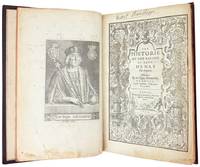
1622304161London: W. Stansky for Matthew Lownes and William Barret 1622. Second edition first published in 1622. Engraved frontispiece portrait of Henry VII by John Payne title within architectural woodcut border McKerrow & Ferguson 224 woodcut initials and headpieces text within ruled border with blank marginal columns for side-notes one printed side-note on X1b. iv 248 pp. Folio. Seventeenth-century calf covers tooled in blind to a panel design center panel of roll-tool and triple fillet border spine in six compartments with raised bands red morocco spine label printer's waste on pastedowns plain free endpapers. Ties and clasps perished joints cracked covers scuffed light foxing. Second edition first published in 1622. Engraved frontispiece portrait of Henry VII by John Payne title within architectural woodcut border McKerrow & Ferguson 224 woodcut initials and headpieces text within ruled border with blank marginal columns for side-notes one printed side-note on X1b. iv 248 pp. Folio. Large paper copy on thick paper of the second edition of Bacon's history of Henry VII. Bacon had promised the work to James I while on trial and he quickly completed the work following his impeachment for taking bribes. "It should be seen in the context of humanist historiography rather than as a precursor of its modern methods. Bacon was keenly interested in the conventional topics of virtue and fortune but was unconventional in placing a much stronger emphasis on fortune than virtue. The central lesson of The History of Henry VII was that a ruler must remain open to accident and ready to seize the opportunities it offered" ODNB. ESTC S122252; Gibson 116b. Provenance: Robert Eglesfield bookplate on verso of title-page; Joseph Dickinson signature on slip dated 1823 on front pastedown; C. Geldart signature on upper front free endpaper and numbered "26"; Robert S Pirie bookplate acquired from Seven Gables 1963 W. Stansky for Matthew Lownes, and William Barret unknown books
162043494London: apud Joannem Billium 1620. <p>Bacon Francis 1561-1620. Instauratio magna. Novum organum sive indicia vera de interpretatione naturae. Small folio. 12 including blank leaf conjugate with engraved title 172 181-360 36 2pp. Beautiful engraved title-page by Simon de Passe 1595-1647; early inscriptions partially erased from top margin and center of engraving. London: John Bill 1620. 292 x 192 mm. Vellum ca. 1620 leather spine labels a bit soiled. Remnants of blue paper on front and back pastedowns first leaves a bit soiled but a fine copy. Leather booklabel of Frederick Spiegelberg.</p> <p> First Edition second issue. Only a handful of copies of the first issue exist. The philosophical exposition of the experimental method in science which greatly influenced the creation and development of the first scientific academies—the "Invisible College" the Royal Society and the Académie Royale des Sciences with inestimable effect on the development of scientific thought.</p> <p> At a time when scholars still relied on classical authority and metaphysical speculation to learn about the world they lived in Bacon conceived a new means of acquiring true knowledge of the world via observation experiment and inductive reasoning the type of logical thinking that ascends from specific facts to the establishment of general laws and principles. Bacon saw this novum organum or "new instrument" as the means of bringing about a "great revolution" instauratio magna in thought. Once taught the new experimental method everyone would be capable of engaging in scientific investigation unlocking the secrets of nature and applying the results ideally for the betterment of humankind. Bacon's vision of science inspired the subsequent foundation of the first scientific academies and also opened up the question of science's relationship with government and society.</p> <p> Bacon originally envisioned the Instauratio magna in six parts of which only two were completed: De augmentis scientiarum 1623 and Novum organum which along with the introduction to the third part Parasceve ad historiam naturalem et experimentalem and two sets of Aphorisms makes up the present work. The second issue has the errata leaf and colophon reading "Londini/Apud Joannem Billium/Typographum Regium/M.DX.XX." STC 1163. Horblit 8b. Dibner 80. Printing and the Mind of Man 119. Gibson Bacon 1950 103b. Eiseley "Francis Bacon" Makers of Modern Thought 1972. Norman 98. </p> . apud Joannem Billium unknown books