46 résultats
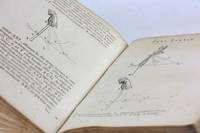
1677324650Amsterdam: Elzevir 1677. Third. hardcover. very good. La Forge & Von Gutschoven. Illustrated throughout the text with many anatomical woodcuts. Title printed in red & black with printer's device. 76 239 pages. Small 4to 8 x 6 inches contemporary leather rather worn & torn with front cover re-attached but interior is rather clean with just a few errant stains and some occasional worming in the gutter margins. Amsterdam: Elzevir 1677. Third edition First and only Elzevir edition and the first edition of the better Latin text. Overall a very good- copy with some occasional stains and with the binding defects noted but a remarkably clean copy of this important book.<br/> <br/> The great philosopher's early work in which he developed his concept of mind-body dualism and animal automatism. "A physiological appendix to his Discourse on method "it" was the first attempt to cover the whole field of "animal physiology." GM 574. This work "also quickly became a rich fund of ideas upon which he drew throughout the rest of his intellectual life." DSB 4 p. 63. Withheld from the public while Descartes was alive for fear of censure by the Catholic church the text was first printed in 1662 from a flawed manuscript. A French translation appeared in 1664 followed by the present corrected Latin edition published by Elzevir with diagrams after la Forge and von Gutschoven and an extensive introduction by Clerselier. -- Willems 1531; Wellcome II p. 453; Laehr I 394-96. Garrison p. 356.<br/> <br/> Elzevir unknown
16777609BB1677. Amsterdam Daniel Elsevier 1677. Kl.-4°. 38 Bl. Titel in Rot und Schwarz mit dem Minerva-Druckerzeichen 239 S. Mit 53 Holzschnitten teilw. wiederholt. Späterer Pappband. Angebunden: Ders.: Passiones animae per Renatum Descartes: Gallicè ab ipso conscriptae nunc autem in exterorum gratiam Latina civitate donatae ab H. D. M. I. V. L. 12 Bl. 92 S. 2 Bl. Ebda. 1677. Ad I: Willems 1531. Krivatsy 3123. Waller 2377. Lateinische Ausgabe von Descartes 15961650 «Traité de l'homme». Der Text 1649 erstmals erschienen behandelt den menschlichen Körper und seine Funktionen. Er ist hier mit den ausführlichen Anmerkungen von Louis de La Forge 16321666 versehen. Dieser war ein Freund von Descartes und «einer der fähigsten Interpreten des Cartesianismus». Ad II: «Les passions de l'âme» in einer lateinischen Version. Diese Abhandlung über die Gefühle deren Funktion und Eigenschaften ist Teil einer Sammlung von drei Werken vgl. Willems 1530. Beide Titel nicht in VB 17. Exlibris auf dem inneren Vorderdeckel sowie Etikette mit Nummer; durchgehend leicht gebräunt. Einbandbezug an Kanten und Rücken berieben. unknown
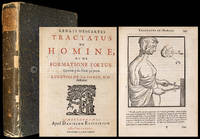
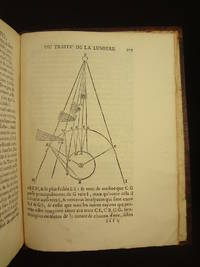
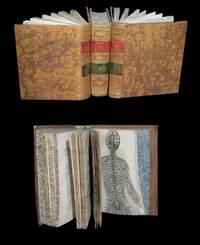
1677628Paris: Angot 1677. Hardcover. Fair. Misc. Well-illustrated 1677 second French edition reviewed and corrected from the first René Descartes L'Homme The Man et la Formation du Foetus Formation of the Fetus; and added to this edition Le Monde ou Traité de la Lumiere The World or Treatise on the Light. This copy with the provenance of a noted scientist. A lot to unpack here; might I suggest that you review the Wikipedia articles on the Descartes works ""Treatise on Man"" and ""The World"". In extreme short and therefore a poor description there are three works of Descartes here which blended science and philosophy. The treatise on The Man and The Fetus he didn't feel confident to publish after Galileo's condemnation so they are here published only for the second time corrected from the first edition and they are not finished as Descartes didn't every prepare them for publication. They delve into Descartes theories on the body it's mechanisms and how the psychosomatic affects it. About 50 corresponding illustrations hard to count as some pages may be two plates. The third work again a poor brief description The World was added to this second edition. ""Descartes espoused mechanical philosophy a form of natural philosophy popular in the 17th century. He thought everything physical in the universe to be made of tiny corpuscles of matter. Corpuscularianism is closely related to atomism. The World presents a corpuscularian cosmology in which swirling vortices explain among other phenomena the creation of the Solar System and the circular motion of planets around the Sun. The World rests on the heliocentric view first explicated in Western Europe by Copernicus. Descartes delayed the book's release upon news of the Roman Inquisition's conviction of Galileo for ""suspicion of heresy"" and sentencing to house arrest. Descartes discussed his work on the book and his decision not to release it in letters with another philosopher Marin Mersenne."" About the Provenance - Bookplate of the scientist Herbert Mclean Evans who is credited with discovering Vitamin E. Bibliographic Details - OCLC numbers 1323309050 71707841 457690626; held at the BNF Bibliotheek Universiteit van Amseterdam Koninklijke Bibliotheek New York Public Library and Universidad de Navarra Physical Attributes - Measures approx. 25.5 x 19 x 4 cm. Signed in 4. Leather binding. Spine with five raised bands; five compartments richly decorated in gilt with central floret medallion and corner leafing florets one compartment with ""LHOMME DE DESCART"" in gilt. Rebacked; older repair. Edges sprinkled. Illustrated. I count 49 plates in ""The Man"" and 32 plates in ""The World"". All pages checked by gatherings all present. Pages - xxxii prefatory leaves 511 8 pages table 1 page royal privilege Collation - a4e4i4 o4 u4 aa4 ee4 ii4 A-Z4 Aa-Zz4 Aaa-Ttt4 Condition - See pictures. Binding has been rebacked but it was long ago; still with wear to corners edges rubs to boards etc. Some cracking along joints. Some loss to gilt of spine. A few tiny wormholes entering the leather. Chip at very base of spine that will likely fall off and expose bottom endband. Still nice that they retained the earlier binding and the book is holding together well. Lots of bibliographic notes on endpapers and ex libris ticket and Rome bookseller; a few holes at gutter of free front endpaper. Toning and some fox spots throughout. Occasional moisture mark thumb page edge chip dog-eared ear candle ember mark etc. Title page deckled at bottom edge; wide margins it seems. Top corner of first five leaves repaired old no text affected. Several tiny wormholes in bottom margin. N2 with several dark stains not mold; ink maybe. Worm track at bottom margin sometimes tissue repaired. Several annotations rear endpaper. Despite notes a solid and honest book cared for once repaired long ago with wide margins. Angot
16642341508London: Excudebat J.F. James Flesher pro Jona Hart 1664. First Thus. Hard Cover. Near Fine/No Jacket. Rebound with new end sheets: brown leather spine marbled paper over boards red morocco spine label gilt titles and rules. Binding tight pages clean and unmarked. 1664 Hard Cover. viii 230 pp. Last text page misnumbered 216. Descartes's fundamental and originating work of the modern era in Western philosophy bound together with a work by one of the Utrecht Cartesians Lambert van Velthuysen. This is the first British printing of the Meditations though it does not include Descartes's 'Objections and Replies' as many editions do. Velthuysen was connected by marriage to Descartes's friend Henry Regnier and corresponded with scientists and philosophers such as von Leeuenhoek Spinoza and Leibniz. The work included here shows the influence of Thomas Hobbes - unsurprising given that Velthuysen is credited with translating Leviathan into Dutch. John Locke may have met Velthuysen while in Utrecht in 1684/85 and had eight titles by Velthuysen in his personal library including the Rheims edition of the present title. Bound into this volume are two plates not called for in either work which may be taken from the Hart printing of Principia Philosophia which was published the same year. Wolf 736 Wing D1133a. Excudebat J.F. [James Flesher] pro Jona Hart hardcover
1650503095Ludovicum Elzevirium 1650. Hardcover. VERY GOOD. 4to 6.5 x 8' contemporary vellum with hand written spine label. Principia Philosophae second Latin Edition 1650. Illustrated throughout with woodcut diagrams illustrating Descartes' theory of vortices. 40 302 pp Collation complete: 1 - 4; A1-Oo2 M5 for M3 pagination jumps from 227 but catchword and signatures continuous name excised lower title page and repaired early owner's inscription 'ex libris Thome Fontana D. Ph' straddling printer's device. Passiones Animae 1650. 24 98 5 pp. Collation complete: 1-4; A1-N4. Willems 1106 1 and 3 bound without the Specimina Philosophiae. Tips a bit worn foxing rear hinge loosening recent owner's inscription in pen to FFEP and title notation to FPEP. Ludovicum Elzevirium hardcover
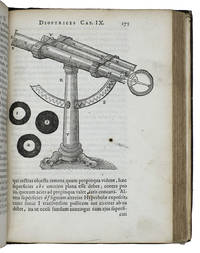
166465770Amsterdam:: Apud Danielem Elzevirium 1664. old calf; gilt spine. Shallow chipping to spine at extremities; short non-structural splits to joints; worn at corners. Tiny old repair at corner of title page; contents clean and fine. . 4to. Engraved portrait and numerous engraved text illustrations. Ultimo editio cum optima collata diligenter recognita & mendis expurgata. Apud Danielem Elzevirium, unknown
1647305091647. A Paris chez la Veuve de Jean Camusat et Pierre Le Petit 1647 - Amstelodami Amsterdam apud Danielem Elzevirium Daniel Elzevier / Elsevier 1664 - Amstelodami apud Danielem Elzevirium 1664 - Amstelodami apud Ludovicum & Danielem Elzevirios 1664 - Lugduni Batavorum Leyde / Leyden apud Franciscum Moyardum & Petrum Leffen 1662 - A Paris chez Michel Bobin et Nicolas Le Gras 1677. 3 vol. au format pt in-4 208 x 165 mm de 1 f. bl. 7 ff. n.fol. 606 pp. 1 f. n.fol. et 1 f. bl. ; 1 f. bl. 20 dont frontispice gravÂŽ ff. n.fol. et 222 pp. ; 1 f. bl. 8 ff. n.fol. et 248 pp. ; 12 ff. n.fol. 92 pp. et 2 ff. n.fol. ; 18 ff. n.fol. 121 pp. et 1 f. bl. ; 32 ff. n.fol. 511 pp. 4 ff. n.fol. et 1 f. bl. Reliures uniformes dÂŽbut XIXÂme de pleine basane racinÂŽe blonde plats jansÂŽnistes dos lisses ornÂŽs de jeu de filets gras et maigres dorÂŽs larges fleurons dorÂŽs entrelacs de petits filets dorÂŽ formant croisillons piÂces de titre de maroquin carmin piÂces de tomaison de maroquin vert-bronze titre dorÂŽ tomaison dorÂŽe palette dorÂŽe en queue filet dorÂŽ sur les coupes tranches mouchetÂŽes. PrÂŽcieux ensemble renfermant six oeuvres de Descartes en ÂŽditions XVIIÂme. Les MÂŽditations mÂŽtaphysiques sont ici proposÂŽes dans leur premiÂre ÂŽdition franÂaise ; en partie originale. ''PremiÂre traduction franÂaise des MÂŽditations faite par le Duc de Luynes. C'est Descartes qui a lui-mÂme corrigÂŽ et revu la traduction en franÂais de ses MÂŽditations en prÂŽcisant certains passages insuffisamment claires dans leur forme latine''. in Guibert. Edition originale pour De homine figuris ; dont la marque d'imprimeur en page de titre figure un ange avec une lyre sous des lauriers. ''Cette ÂŽdition originale latine a ÂŽtÂŽ faite sur une copie du manuscrit original franÂais. Elle renferme 58 figures sur bois et cuivre dont 10 hors-texte''. in Guibert. On trouve ˆ la suite la traduction franÂaise de L'Homme ; dont c'est lˆ la seconde ÂŽdition ; en partie originale. ''L'ouvrage contient de nombreuses figures anatomiques et gÂŽomÂŽtriques sur bois''. in Guibert. Quant aux Principia philosophiae Specimina philosophiae et Passiones animae ''on trouve ces oeuvres dans le recueil factice des Oeuvres philosophiques de Descartes 1670-72''. in Guibert. Guibert Bibliographie des Oeuvres de Descartes publiÂŽes au XVIIÂme siÂcle p. 45 ; p. 126 ; p. 107 ; p. 163 ; p. 196 ; p. 203. LÂŽgÂres altÂŽrations superficielles affectant les reliures. Titre de s MÂŽditations rognÂŽ court en marge infÂŽrieure. rares rousseurs dans les corps d'ouvrages. Petite cerne angulaire affectant une dizaine de feuillets. Restauration anciene au revers d'une des planches. Du reste ensemble en belle condition. b42961 unknown
1664BOOKS109286IAmsterdam: Elizeum Weyerstraeten. Very good copy. 1664. 4th ed. leather. 8vo Includes the following separately paginated books: 1 Philosophiae sev Dissertatio de Methodo Recte regendae rationis & veritatis in scientiis investigandae: Dioptrice et Meteora Ex Gallico translata & ab Auctore perlecta variisque in locis emendata. Nunc denno hac Editione diligenter recognita & mendis expurgata 196 pp. 2 Dissertatio de Methodo recte utendi ratione Et veritatem in scientiis investigandi 216 pp. 3 Passiones Animae Gallice ab ipso conscriptae nunc autem in exterorum gratium Latina civitate donatae ab H.D.M. I.V.L. 18 pp. & 4 Passiones Sive Affectus Animae in three parts with indices 83 pp. indices. . Elizeum Weyerstraeten hardcover
165063878Amsterdam: Apud Ludovicum Elzevirium 1650. Two vols. in one. 4to. xl 216 227-302 collation complete w/ M5 for M3 error so pagination jumps but catchword and signatures contiguous; xvi 316 pp. With many woodcut engravings throughout some full page. Contemporary flexible vellum ownership markings on endpapers & titles former ownership excised w/ expert paper repairs occasional pencil ms markings in 2nd vol. still a VG clean copy. Second collected edition of Descartes groundbreaking works in philosophy and the history of science which were also sold separately or under a general title following the original 1644 Elzevir edition. The Principia Philosophiae was the first comprehensive study of the nature of the universe as well as an epochal work in the history of science where Descartes first developed his vortex theory arguing that the Earth was immobile and at rest while the entire vortex circled the sun. This served as Descartes’ attempt to reconcile Copernican heliocentric astronomy with traditional theology and also included the first scientific discussion of magnetism as well as investigations into heat light gravity and electricity. This second Latin edition of Specimina philosophiae was first published anonymously in 1637 in Leiden and then revised later by Descartes. This work includes his contributions on mathematics as well as significant studies of optics light colour and meteors. In De Methodo his summary of cardiovascular physiology significantly influenced the study of medicine in the 17th-Century while his De Dioptrice summarized his basis for the detailed study of sensation image formation and visual perception. See: Willems 1008; Cushing D124; Garrison & Morton 574 1662 ed.; Norman 623. Apud Ludovicum Elzevirium, hardcover
16856380Amsterdam: Blaeu 1685. Editio ultima. Good. Quarto 22 cm; Three works in one volume each with separate title page and pagination. 6; 36 222 2 blank; 16 248; 24 92 4 pages including engraved portrait frontispiece. Title pages with Blaeu's armillary device. Woodcut illustrations in text many of them full-page. Shoulder notes. Occasional reader's notes in margins contemporary hand and occasional underlining. In contemporary polished vellum over boards stamped in blind with arabesque cartouche on both boards. Hinges cords and linings exposed pastedowns never pasted down. <br /><br />Based on the Elzevir edition of 1678 "the last edition" The "Meditiations" which should complete the contents of Opera Philosophica was published in a separate volume. Blaeu hardcover
1650C99FYZV03MLMAmsterdam 1650. 4to. Louis Elzevier Sprinkled calf old boards rebound on 4 recessed cords with a blind-tooled spine a spine label and new endpapers ca. 1800. With 3 title pages each with Elzeviers woodcut Athena and tree device Rahir M19 ads 1 and 2 with numerous woodcut illustrations in the text ad 1 with a woodcut tailpiece Rahir fleuron 102 and all three with a few woodcut decorated initials 2 series. 3 works in 1 volume. 40 302 = 292; 16 316; 24 98 6 pp. Third edition of the Principia in the original Latin bound with the associated third Latin editions of the two supplementary works the three published in matching format and layout in the year of the authors death by Louis Elzevier who published all of the earlier Latin editions in 1644 and 1650. Together these three books form the collected principal works of René Descartes 1596-1650 arguably the most influential philosopher of early modern Europe. Louis Elzevier first published Descartess Principia philosopiae in 1644. It contains the philosopher's thoughts on the structure of the universe including his highly influential vortex theory illustrated with woodcuts after drawings by Franciscus van Schooten. Although Descartes wrote the Principia in Latin he had earlier written two books in French that he now revised and corrected for publication in Latin by Louis Elzevier matching the format and layout of the Principia so that they could be issued together. They originally appeared in French as Discourse de la methode pour bien conduire sa raison 1637 and Les passions de lame 1649. Elzevier published the Latin edition of the Discourse . with the present title Specimina . together with the first edition of the Principia in 1644. In 1650 he published new editions of both as well as the first Latin edition of the French Passion . under the present title Passiones animae. Later in 1650 he published new editions of all three works the present set but their layout and typography matches the earlier 1650 4to editions so closely that the classic bibliographies including Willems Rahir and Berghman do not distinguish them. Descartes lived in Leiden from 1630 when he registered at the university to a few months before his death a time when the Dutch Republic was world famous or in less tolerant circles infamous for its lack of censorship and the high quality of its printing. His controversial works benefitted from both.With the armorial bookplate of Alexander Thomson of Banchory Scotland active 1866. In good condition. Spine damaged and restored.l Ad 1: Berghman 372; Hoogendoorn Desc 03.03; Van Otegem pp. 265-266 = 1650b; STCN 303442972 fingerprint matching the 1st of the 2 reported; Rahir 1120; Willems 1106. Ad 2: Hoogendoorn Desc 01L.03; Van Otegem pp. 41-43 = 1650b; STCN 303445521. Ad 3: Hoogendoorn Van Otegem pp. 372-374 = 1650b; STCN 303448318. hardcover
168339632Amsterdam: Ex Typographia Blaviana 1683. Third edition corrected of the first title; First edition of the second title. Numerous diagrams in text. 16 420; 8 pp. 1 vols. 4to. Later full vellum. Foot of title torn away with loss of bottom line of imprint else a clean sound copy. Third edition corrected of the first title; First edition of the second title. Numerous diagrams in text. 16 420; 8 pp. 1 vols. 4to. Third edition of Descartes' mathematical treatise bound with Gillet's work on pendulum oscillation. Ex Typographia Blaviana unknown
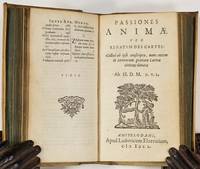
165019746Amsterdam: Apud Ludovicum Elzevirium 1650. FIRST LATIN EDITION. First Latin edition printed in French the year before. This the last book authored by Descartes and written for Queen Christina of Sweden discusses psychology ethics and the relationship between mind and body. “Descartes believed the soul to be a definite entity giving rise to thoughts feelings and acts of volition. He was one of the first to regard the brain as an an organ integrating the functions of mind and body†G&M.<br /> <br /> Descartes made an essential distinction between the soul as the divinely-endowed seat of consciousness will and rational thought and the body as a machine or automaton subject to the laws of physics and only indirectly controlled by the soul through the nerves. Using this dualistic model he was able to make the important distinction between voluntary and involuntary actions. <br /> <br /> “Cartesian physiology and philosophy had a powerful influence on the thinking of such men as Robert Hooke Giovanni Borelli Jan Swammerdam and Thomas Willis. Descartes’ theories helped to explain in understandable mechanistic terms the more puzzling problems of human physiology during a time when scientific research was expanding rapidly†Heirs. <br /> <br /> DSB IV pp. 55 - 65; Garrison & Morton 4965 Fr. ed.; Heirs of Hippocrates 467; Norman 625 Fr. ed.; Wellcome II p. 453. Apud Ludovicum Elzevirium unknown
1648601631650-1648. Amstelodami : Elzevirus 1650 12° 56 242 14 pp.; vorgebunden: Lugd. Batavorum : Hackius 1648 12° 16 232 16 pp. Kupfertitel; gebunden im Pergamenteinband mit hs. Rückentitel; feines Expl. First Latin Edition of Descartes' Important Work on the Workings of the Body and Soul Including Significant Contributions on Ethics and Psychology. The first Latin editions were published by Elzivier in 1650 in both 12mo and quarto formats - most likely simultaneously although the 12mo version is typically given priority. This Latin translation of the original French edition of Les passions de l'ame 1649 was done by Samuel and Henri des Marets. The Latin edition of Descartes' last work Les passions de l'ame 1649 was written in Egmond-Binnen his last Dutch residence for Queen Christina of Sweden and first published in the original French the previous year. It discusses psychology ethics and the relationship between mind and body; Descartes believed that the soul was a definite entity giving rise to senses thoughts feelings affections and acts of volition and he was one of the first to regard the brain as an organ which integrated the function of mind and body. "Cartesian physiology and philosophy had a powerful influence on the thinking of such men as Robert Hooke Giovanni Borelli Jan Swammerdam and Thomas Willis. Descartes' theories helped to explain in understandable mechanistic terms the more puzzling problems of human physiology during a time when scientific research was expanding rapidly. " Heirs of Hippocrates no. 291 "Finally he brought physiological psychology within the compass of his system in 'Les passions de l'aime' in 1649. This system aimed to be as complete as Aristotle's which it was designed to replace. It was not by chance that it dealt in the same order with many of the same phenomena such as the rainbow as well as with others more recently investigated such as magnetism." DSB Guibert Nr.7 BACON Francis : Historia Naturalis & Experimentis de Ventis &c. Third but second Leiden Edition is according to Gibson the second of two known variants. Contains a.o. the following chapters: Historia Naturalis & Experimentalis de Ventis; Historia Naturalis et Experimentalis de Forma Calidi; De Motus Sive Virtutis Activae variis Speciebus; Historia vitae et mortis. Bacon's natural history of winds and a treatise on the aging process and death forming the first 2 books of the third part of his Instauratio magna his projected systematization of scientific knowledge. "Important as collecting all the facts and theories then known on the subject and especially as the first to point out the deflexion of winds caused by the earth's rotation" Sotheran for 1st English ed. Gibson 110b Willems 1277. unknown
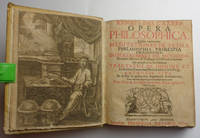
1656918Amsterdam: Elzevier 1656. vellum. Very good. DESCARTES René Opera philosophica Amsterdam: L. & D. Elzevier 1656. 3 parts in 1 volume: 2 blank leaves TP 1 leaf Typographus with portrait on verso TP Principia 3 leaves = dedication 14 leaves = introduction & index 1 - 222 TP Specimina philosophiae 7 leaves = index 1 - 248 TP Passiones animae 11 leaves Praefatiuncula 1 - 92 2 leaves index 3 blank leaves Quarto. Third Latin Edition. <br /> <br />This Edition Tertia includes numerous woodcut figures with an engraved portrait of Descartes by Franciscus van Schooten. <br /> <br />OPERA PHILOSOPHICA EDITIO TERTIA contains three major works: <br /> <br />Principia Philosophiæ. Principles of Philosophy 1650 focuses on metaphysics and natural philosophy. <br /> <br />Specimina Philosophiæ: seu Dissertatio de Methodo Rectè regendæ rationis & veritatis in scientiis investigandæ: Dioptrice et Meteora. The Proofs of Philosophy: The Discourse on the Method of Properly conducting the reason & seeking for truth in the sciences: Dioptics and Meteors 1650 outlines the process of Cartesian doubt as a method for proper philosophical and scientific investigation. <br /> <br />Passiones Animæ. The Passions of the Soul 1650 addresses the interaction between the mind and the body. <br /> <br />CONDITION: Very good or better in original full vellum. Spine with soiling and remnants of labels library. Covers lightly soiled with yapped edges. Pages crisp and clean and free of markings. <br /> <br/><br/> Elzevier hardcover
1685elala230Amsterdam: Blaeu 1685. 1685. 5 Parts in 1. 4to. pp. 22 p.l.the last blank 222 blank leaf; 8 leaves 248; 12 leaves 92 4; 8 leaves the last blank 191; 164 88. engraved frontis. portrait. numerous woodcuts in the text. woodcut device on titles. woodcut ornaments & initials. contemporary vellum. Seventh Edition. Descartes philosophical works comprising: Principia Philosophiae; Specimena Philosophiae: Seu Dissertatio De Methodo Dioptrice Et Meteora ; Passiones Animae ; Meditationes De Prima Philosophia ; and Appendice Continens Obiectiones Quintas & Septimas In Renati Descartes Meditationes De Prima Philosophia by Gisbert Voet which contains Descartes Epistola Ad celeberrimum Virum D. Gisbertum Voetium "It is no exaggeration to say that Descartes was the first of modern philosophers and one of the first modern scientists; in both branches of learning his influence has been vast The revolution he caused can be most easily found in his reassertion of the principle lost in the Middle Ages that knowledge if it is to have any value must be intelligence and not erudition. His application of modern arithmetic to ancient geometry created the analytical geometry which is the basis of the post-Euclidean development of that science. His statement of the elementary laws of matter and movement in the physical universe the theory of vortices and many other speculations threw light on every branch of science from optics to biology ". Printing and the Mind of Man Guibert p. 232. cfPrinting and the Mind of Man 129. Amsterdam: Blaeu, 1685. hardcover
1692009238<p>Francofurti ad Moenum: Fridrici Knochii 1692-97. . quibus continentur Meditationes de prima philosophia Principia philosophiae Dissertationes de methodo dioptrice meteora & Tractatus de passionibus animae His accessit nova hac editione Tractatus de homine et formatione foetus cum notis Ludovici de la Forge authoris Vita et in fine de quibusdam argumentis annotationes una cum indice operis hujus universali adjiciuntur . Francofurti ad Moenum Fridirici Knochii. - - Un volume in 8vo grande 175x20 cm titolo generale in nero e rosso antiporta incisa con ritratto di Cartesio seduto al tavolo con mappamondi scheletro e meteorologia agitata uno strappetto. Contiene ognuno con proprio frontespizio: - Renati Des-Cartes Principia philosophiae. Editio novissima auctior & emendatior 32- 168 pagine Frontespizio con data 1692. – Renati Des Cartes Specimina philosophiae: seu Disseratio de methodo rectè regendae rationis & veritatis in scientiis investigandae: Dioptrice et Meteora. Ex Gallico translata & ab auctore perlecta variiisque in locis emendata 16- 200 pagine. - Passiones animae per Renatum Des Cartes: Gallice ab ipso conscriptae nunc autem in externorum gratiam Latina ciuitate donatae. 24- 74- 6 pagine. -Manca rispetto a quanto annunciato nel frontespizio il Tractatus de Homine et de formatione foetus.-- Segue invece un frontespizio di OPERA PHILOSOPHICA OMNIA in tres tomos distributa data 1697 poi 26 pp con Nota dell'editore la Vita di Cartesio Vitae Renati Des.Cartes brevis descriptio e l'Index generalis. Poi senza numerazione le BREVES ANNOTATIONES AD CONTROVERSA QUAEDAM PHILOSOPHIAE RENATI DES CARTES 72 pp- Seguono 5 tavole di figure applicate ft. Che si riferiscono al trattato Dioptrice et Meteora le figure 1 e 7 sono ripetute sia nel testo sia nelle tavole in fine. Bruniture diffuse e insistenti in quasi tutte le parti del libro per le caratteristiche purtroppo della carta olandese. Legatura coeva in piena pergamena con titolo manoscritto al dorso qualche abrasione al piatto posteriore. - Volume ricomposto e "censurato" con l'omissione del Tractatus de Homine e la sua sostituzione con le Breves Adnotationes in polemica con Cartesio. Ma resta anche per questo una notevole testimonianza dell'influenza delle idee cartesiane della loro diffusione e delle reazioni che suscitarono alla fine del 600. Di queste raccolte di opere di Cartesio ne furono pubblicate numerose e con composizioni diverse tra il 1644 e il 1897 da parte di Elsevier di Blaeu e di Knoch.</p> Fridrici Knochii
1654920Amstelodami Amsterdam: Ludovicum Elzevirium 1654. vellum. Very good. Second Elzevir Edition of Descartes Meditations Published Just Four Years <br />After His Death <br /> <br />DESCARTES René. Meditationes de Prima Philosophia Meditations on First Philosophy Ludovicum Elzevirium Amstelodami Amsterdam 1654. 2 blank leaves TP i - v = Epistola vi-viii = Praefatio ad Lectorem ix-x = Contenta 1-191 TP Appendix Continens Objectiones Quintas & Septimasin Renati Des-Cartes Meditationes de Prima Philosophia 3 - 164. TP Epistola Renati Des Cartes ad celeberrimum virum D. Gisbertum Voetium 3 - 88. Quarto. Second Elzevir Edition. <br />$ 3500 <br /> <br />The first edition of Descartes Meditations was published in Paris in 1641 presenting the most detailed explanation of his metaphysical system. The six meditations follow Descartes as he categorically doubts everything he knows and then tries to discover a method whereby he can establish what if anything can be known with certainty. This book along with the earlier presentation Discours 1637 of roughly the same ideas was the foundational moment in Modern Philosophy and a seismic event in the history of Western ideas. This Second Elzevir Fifth Latin edition also includes the 164-page further Response to Gassendis objection along with a later refutation of a Seventh Set of Objections that had been sent to Descartes by the Jesuit Pierre Bourdin primarily attacking his method of doubt as well as a letter addressed to the Jesuit Father Dinet revisiting and rebutting the accusations that had formerly been made against Descartes by his virulent Dutch enemy Voetius. The book concludes with the 88 page Letter to the Very Famous Man Mr. Gisbert Voetius where Descartes defends his philosophy. <br /> <br />CONDITION: Very good or better in original full vellum. Spine with soiling and remnants of labels library. Covers lightly soiled with yapped edges. Pages crisp and clean and free of markings. <br /> <br/><br/> Ludovicum Elzevirium hardcover
1678B4450Danielem Elsevirium 1678. Very good condition in full contemporary vellum text clean and crisp. . Edition: Fifth Edition the last corrected and revised by E Binding: Contemporary vellum title inked on spine. Notes: An important book in astronomy-cosmology physics optics philosophy of scientific methods and principles of philosophy and psychology.<br>René Descartes is one of the most famous thinkers in history. Celebrated for his advancements in geometry and algebra he also is renowned for laying the foundations of modern philosophical thought. Meditations on First Philosophy the text in question here is particularly canonized in the Western philosophical tradition and remains a fundamental text for all students of philosophy. Text in Latin. <br> Size: 4to 155x198 Illustration: Illustrated with woodcut printer’s device on first two title pages. Volume: 3 parts in 1 volume References: Willems 1545 Berghman 366 Guibert Descartes p.61 12 Pages: P. Title Blank Epistola 1-5 Preface 1-3 Contents 1-2 1-191 Blank Appendix 1-164 Epistola 1-88. Category: Book Philosophy; Book Science & Technology; Danielem Elsevirium hardcover
165777<p><b>First edition Tchemerzine containing " <i>119 French and Latin letters mostly addressed to the queen of Sweden the Palatine princess Mersenne Chanut Le Roy Morin. They are sometimes associated with woodcuts. </i>" Guibert</b></p><p>Guibert pp.77-79 ; Tchemerzine II 785; Brunet II 611.</p><p>The publication of the letters of Descartes 1657-1667 had cooled the Jansenists' zeal towards him d'Arnauld's and de Nicole's in particular and certainly Pascal's also who accused him of wanting to forgo God in his metaphysics.</p><p><i>"Despite the attacks targeting him his reputation as an innovative philosopher had surpassed the small scholarly world and reached the world of the patron princes. The princess Elisabeth the Palatine princess exiled in The Hague who was an educated woman and interested in philosophy reached out to him and they maintained a steady correspondence which makes up the bulk of the Letters. The marquis of Newcastle and the queen Christine of Sweden did the same</i>." Dictionnaire des auteurs</p><p>For the most part these letters were written between 1637 and 1647.</p><p>From 1642 to 1649 the period of his life ranging from the <i>Méditations métaphysiques</i> to his death in Stockholm Descartes maintained a steady correspondence with the princess Elisabeth daughter of Frederick V Palatine elector and king of Bohemia. This cultivated woman who had studied mathematics had read the <i>Méditations métaphysiques</i> with much interest and great admiration. Descartes kept her up to date on his own writings recommended books and discussed physics philosophy and mathematics with her.</p><p>"<i>Clerselier had chosen the letters of this volume well : those interested in questions on morals physics and even medicine were satisfied ; the names of the queen Christine and the princess Elisabeth both still alive and also of this English gentleman M. More and this lord whose name he kept a secret attracted attention and gave the philosopher who had written to these illustrious individuals great prestige. The success of the book was inevitable and two years later when Clerselier published a second volume he acknowledged in the preface that the first one was already "completely sold"." </i><i>Œuvres de Descartes</i> Adam et Tannery</p><p>This correspondence is fascinating because Descartes explains himself and develops certain points exposed in his work ; it is also one of the only documents that we have that allow us to peer into the thinker's intimate thoughts.</p><p><b>A beautiful copy very pure preserved in its attractive contemporary vellum.</b></p><p>Handwritten ex-libris from 1685 on title page.</p> Charles Angot hardcover
1698228921698. A Rouen chez Jean Baptiste Besongne 1698. In/12 17 x 10 cm reliure plein veau moucheté du temps dos à nerfs à caissons dorés 20 f. p. titre et faux-titre préface et table de la première et seconde partie 599 pages avec 6 f. & 7 f. intercalés tables des troisième et quatrième partie un tableau hors-texte nombreuses illustrations in-texte. Défauts mineurs en coiffes et coins inférieurs ouvrage frais. unknown
169824064<p><strong>1698 Rene Descartes Principles of Philosophy Physics Metaphysics Laws of Motion</strong></p><p><em>"It is not enough to have a good mind; the main thing is to use it well." </em></p><p>– ReneÌ Descartes</p><p>ReneÌ Descartes was a 17th-century French philosopher whose theories and discoveries spawned an influx of commentary and responsive writings from western philosophers. In 1644 Descartes wrote "<em>Principles of Philosophy</em>" a work that discussed the principles of nature and the laws of physics. A number of the theories in this work were borrowed by Isaac Newton in his 'Principia' particularly the laws of motion. 'Principles' was one of the first comprehensive accounts of the universe.</p><p>This fine 1698 printing of "<em>Les Principes</em>" is very rare and known for being <strong><u>a highly valuable printing</u></strong>.</p><p>Item number: #24064</p><p>Price: $1500</p><p>DESCARTES ReneÌ</p><p><strong><em>Les principes de la philosophie</em></strong></p><p>Rouen: Chez Jean-Baptiste Besongne 1698.</p><p><u>Details</u>: </p><p><!-- if !supportLists-->· <!--endif-->Collation: Complete with all pages; in XX parts</p><p><!-- if !supportLists-->o <!--endif-->Parts I-II – 40 144</p><p><!-- if !supportLists-->o <!--endif-->Part III – 12 143-352</p><p><!-- if !supportLists-->o <!--endif-->Part IV – 14 353-599 1 </p><p><!-- if !supportLists-->o <!--endif-->Numerous in-text illustrations throughout</p><p><!-- if !supportLists-->· <!--endif-->Language: French</p><p><!-- if !supportLists-->· <!--endif-->Binding: Leather; tight and secure</p><p><!-- if !supportLists-->· <!--endif-->Size: ~6.75in X 4in 17cm x 10cm</p><p><!-- if !supportLists-->· <!--endif-->Very rare and desirable </p><p>Our Guarantee:</p><p>Very Fast. Very Safe. Free Shipping Worldwide.</p><p>Customer satisfaction is our priority! Notify us with 7 days of receiving and we will offer a full refund without reservation!</p><p>24064</p><p>Photos available upon request. </p> Jean-Baptiste Besongne hardcover
1651RMP799<p>París Henry Le Gras et Edme Pepingvé 1651</p><p>4º. 31 h. 486 p. 1 h. 20 láminas grabadas desplegables. Encuadernación en plena piel de época con nervaduras y compartimentos cuajados de dorados. Tapas ligeramente gastadas; pequeña muesca en el borde inferior de la tapa posterior. Página de título grabada y página tipográfica; guardas delanteras algo manchadas; guarda anterior con anotaciones manuscritas antiguas; nombre antiguo parcialmente borrado en esquina inferior derecha de página de título; pequeña mancha tenue en el margen superior de las primeras hojas; algunas hojas con ligeras manchas; por lo demás ejemplar limpio y bien conservado. Las láminas presentan una mancha en la esquina superior izquierda fuera de la imagen.</p><p>Obra en 4 partes: <em>Des principes de la connaissance humaine – Des principes des choses matérielles – Du monde visible – De la terre</em>.</p><p><strong>Segunda edición francesa</strong> traducida de la primera edición latina de <em>Principia philosophiae</em> 1644 por el abate Picot. En esta obra Descartes presenta su sistema general de epistemología y física —incluyendo la teoría de los torbellinos la imposibilidad del vacío etc.— con un copernicanismo atenuado por la idea de que todo movimiento es relativo.</p><p>En la carta que Descartes antepone a esta traducción francesa de los <em>Principios</em> afirma que dos condiciones y solo dos determinan si los primeros principios propuestos pueden aceptarse como verdaderos: "primero que sean tan claros y evidentes que la mente del hombre no pueda dudar de su verdad cuando se aplica atentamente a considerarlos; y segundo que todo lo demás pueda deducirse de ellos." Pero añade: "En realidad sólo Dios posee la sabiduría perfecta es decir un conocimiento completo de la verdad de todas las cosas."</p><p>Brunet II:611.</p> Henry Le Gras et Edme Pepingvé hardcover
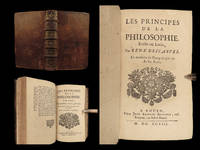
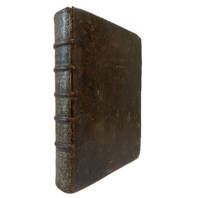
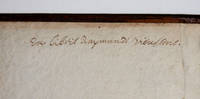
16684897Paris: Bobin & Le Gras 1668. Hardcover. Very Good. 4to - over 9¾ - 12" tall. 55 477 pp 2. With 22 full-page woodcuts 1 folding and 70 woodcut illustrations in text. Ink ownership inscription of Raymond Vieussens to front pastedown & shelf mark on front free endpaper. Bound in contemporary French calf spine in six compartments with gilt florets and title; some wear to boards but generally an excellent copy clean and fresh. Scarce edition of Descartes' magnum opus bearing the manuscript ex-libris of Raymond Vieussens 1635-1715 Royal Physician to Louis XIV and an important anatomist in his own right. Drawing directly on the dualistic theories of Descartes Vieussens became fascinated by the actions of the heart and of the brain in particular. "In his speculations on physiology Vieussens drew inspiration from both the mechanistic philosophy of Descartes and the iatrochemical ideas of F. de la Boë Sylvius. He believed that he had demonstrated the existence of the nervous fluid." DSB "Without Descartes the seventeenth-century mechanization of physiological conceptions would have been inconceivable" notes the DSB ".No other great philosopher except perhaps Aristotle can have spent so much time in expermintal observation. According to Baillet over several years he studied anatomy dissected and vivisected embryos of birds and cattle and went on to study chemistry. His correspondence from the Netherlands described dissections of dogs cats rabbits cod and mackerel; eyes livers and hearts obtained from an abattoir.". Descartes' magnum opus his Principia Philosophiae presented to the world the purest expression of his mechanist vision of the universe seized upon eagerly by later anatomists such as Thomas Willis Nicolas Steno and as is evident from the present copy Raymond Vieussens. Intended to replace the Aristotelian texts used in universities with a curriculum based on physical and immutable laws of nature Descartes' Principles especially in its French editions comes replete with numerous plates of his famous swirling vortices as well as discussions of the Copernican system. Curiously as C. F. Fowler has noted a direct reference to the Principia is lacking from the Index Librorum Prohibitorum of 1664 which otherwise banned most of Descartes' works - although a blanket clause is also given "and the philosophical works of same author". Evidently the decree of the Catholic Church disuaded neither French publishers from printing the work nor the Royal Physician from purchasing it! In particular Veussens seems to have been inspired by the Cartesian concept of cerebral localization; but while Descartes considered the pineal body to be the seat of animal spirits and the soul Veussens regarded the corpora striata as the seat of the imagination. "Inspired by both Descartes's mechanistic and the iatrochemical philosophies Vieussens studied the white matter of the brain by tracing the path of its fibers" Schlager & Lauer eventually providing us with an early description of the brain's centrum semiovale sometimes referred to as Vieussens' centrum. Following his well-received Neurographica Universalis 1685 the Royal Physician issued his Traité nouveau des Liqeurs de Corps Humain 1705 in which he describes the three Cartesian elements in detail and their functions within the body. Guilbert "Les Principes" 13; cf also Schlager & Lauer eds Science and Its Times 3 Gale 2001 p. 154; Fowler Descartes on the human soul: philosophy and the demands of Christian doctrine Kluwer 1999 pp 8-10. For the impact of Descartes' philosophy see PMM 129. Bobin & Le Gras hardcover
16811901220009Paris: Theodore Girard 1681. 4th. Hardcover. Good. Quarto. Quatrieme edition Bound in contemporary calf. 6 gilt stamped spine compartments raised bands. Spine hinges cracked. Minor chipping to head / tail of spine. Collated complete. Includes 21 plates and an additional engraved title. Very light scattered foxing. 477 p. BM French 412. Paris: Theodore Girard hardcover