176 résultats
19959013157Storrs Connecticut: Martino 1995. Hardcover. Fine Condition. Original thirty three catalogues bound in two volumes. Facsimile edition. Bound in publisher's original blue cloth with the spines stamped in gilt. <br/><br/> Martino hardcover books
13014hardcover. 24pp. IN: Deutsch Arch. Klin. Med. 1886 vol.39 pp.209-32. 8vo 1/2 cloth. Leipzig 1886. First Edition. Whole vol. offered entire.<br/><br/> In his classical description of leptospirosis icterohaemorrhagica Weil differentiated the disease from other types of acute jaundice. It is better known as "Weil's disease". GM 5332.<br/><br/> unknown books
1948DL6919Buenos Aires: Editorial Cosmopolita 1948. First Edition. Hardcover. Very Good. Original grey cloth lettering stamped in black on upper board and spine; 8vo 5.5 x 8 inches; pp. 244 with maps. This copy uniquely and lengthily inscribed and signed by the author on the recto and verso of the FFEP. Boards lightly rubbed; tiny chips in the cloth at bottom corners and spine tips. <br/><br/> Editorial Cosmopolita hardcover books
18381262764Stuttgart: Verlag der Classiker 1838-1841. small 4to. 926pp. 942pp. 958pp. 952pp.; VG; 3/4 bound in brown leather marbled boards paneled spine with two green text blocks with gilt lettering gilt decorations; scratches and peeling to boards edges corners; bumping to head and tail of spine; frontispiece present in all volumes in volume 1 frontis is on the verso rather thaan the recto; foxing persistent but light throughout all volumes; heavy text in German. 1262764. Shelved Rockville Bookstore. Verlag der Classiker unknown books
19238289San Francisco: The Book Club of California 1923 One of 400 copies printed by the Grabhorn Press. A Memoir of the author by Flora J. Arnstein Albert I. Elkus and Stewart W. Young. Words spoken at the funeral of the author by Stewart W. Young. Quarto. 11½x7¾ inches. 18 3-119 7 pp. Photographic frontis portrait within gold rules by Dorothea Lange from a painting by Olga M. Ackerman. Title design by H. von Schmidt. Black cloth-backed brown cloth gilt-lettered red paper labels on cover and spine. Spine label faded photographic portrait with heavy silvering as usual else a fine copy. Oscar Weil 1839-1921 was a well-known musicologist who spent much of his life in San Francisco. Includes his contributions to "The Argonaut" commentaries for programs at the Greek Theater of the University of California plus a bibliography of his compositions. One of the Fifty Books of the Year. We have seen any number of copies of this title; the frontis photo is always "silvered". The Book Club of California hardcover books
1923044863San Francisco: Book Club of California 1923. xvii 119 7p. with tipped-in front. photograph of Oscar Weil by Dorothea Lange. Printed in red and black t.e.g. deckle edges half black cloth with stiff boards paper label on the front cover and on the spine. "Four hundred copies.printed by the Grabhorn Press San Francisco California in December 1923. Title page design by H. Von Schmidt. Photograph by Dorothea Lange from a painting of Oscar Weil by Olga M. Ackerman. Copy No. 350 Book Club of California unknown books
19669377Westerham: Limited Editions Club 1966. Hardcover. Fine. Translation and introduction by Geza Verms. Illustrated by Shraga Weil. Designed by Henri Friedlander and printed at the Westerham Press. One of 1500 numbered copies signed by Weil. Bound in quarter tangerine leather with natural linen over boards in a matching tangerine paper slipcase fine condition. <br/><br/> Limited Editions Club hardcover books
1995130330New York NY: Kelly-Winterton Press 1995. stiff paper wrappers top edge cut other edges uncut. Kelly-Winterton Press. 12mo. stiff paper wrappers top edge cut other edges uncut. 12 pages. Limited to 66 copies. Presentation by the author on colophon. A collection of poetry. Kelly-Winterton Press unknown books
2001130244New York NY: Kelly-Winterton Press 2001. stiff paper wrappers top edge cut other edges uncut. Officina Bodoni. 4to. stiff paper wrappers top edge cut other edges uncut. 8 pages. Limited to 26 lettered copies. Presentation by the author on colophon. Printed by Martino Mardersteig at Officina Bodoni Verona Italy commemorating the friendship between the author and Mardersteig. Kelly-Winterton Press unknown books
196962910New Rochelle: Elizabeth Press 1969 - 1977. First editions. Seven 4 x 3 inch chapbooks by Weil each fine in wrappers and integral dust jackets some with pasted on cover labels. Printed in editions ranging from 100 to 500 copies printed either at Stamperia Valdonega in Verona or Genichido in Kyoto. For the collection: New Rochelle: Elizabeth Press unknown books
1923039331San Francisco: Book Club of California 1923. xv 119 7p. tipped-in Dorothea Lange front. photo half-cloth with original brown paper boards paper label on the spine and front cover deckle edges quarto format. Printed in red and black with some blue decorative initials. "Four hundred copies of "OscarWeil: Letters and Papers" printed by the Grabhorn Press San Francisco California in December 1923. Title page design by H. Von Schmidt. Photography by Dorothea Lange from a painting of Oscar Weil by Olga M. Ackerman. Cope No. 350. Book Club of California unknown books
1973131930Iowa City IA: Stone Wall Press The 1973. cloth paper spine label top edge cut other edges uncut. Stone Wall Press. 8vo. cloth paper spine label top edge cut other edges uncut. viii 41 5 pages. Limited to 150 copies. Translated from the French by Mary McCarthy. Preface by George P. Elliott. Biographical sketch of the author follows text. Stone Wall Press, The unknown books
35695Berlin: Springer-Verlag 1975. Hardcover. 9.5" x 6.5". 2 volumes. Viii 958; xii 878 pp. Text in German. Frontis portrait to each volume. Publisher's blue cloth with gilt titles to spine and upper cover. Minor shelfwear to extremeties of both volumes; ownership signature to each flyleaf interiors otherwise clean. . VeryGood. Hardcover . Springer-Verlag 1975 hardcover books
195273681New York: G.P. Putnam's Sons 1952. First Edition. Hardcover. Very good/Very good. First American Edition translated from the French by Arthur Wills. Weil 1909-43 was a French mystic social philosopher and activist in the French Resistance during World War II whose posthumously published works had particular influence on French and English thought. This the author's major work reflects her consciousness of the lordship of Christ asserting that everything in the world is brought down as if by gravity and raised only by grace. Octavo. Original black cloth binding with gray titles. The dust jacket is a bit edgeworn with some unobtrusive tape reinforcement; otherwise very good. G.P. Putnam's Sons hardcover books
189952390NY: Published for Camera Notes by the Publications Committee 1899. Hand-pulled photogravure image size 6 9/16 x 3 9/16 in. 16.6 x 9 cm. printed on copper plate paper and inset on a woven art paper which measures 14 7/8 x 10 7/8 in. There is a small band of faint toning along the blank bottom edge and a tiny chip at the blank bottom right corner. Near fine. A richly-toned photogravure Plate 14 from the portfolio AMERICAN PICTORIAL PHOTOGRAPHY SERIES ONE which was published for "Camera Notes" by the Publication Committee of the Camera Club New York 1899. Limited to only 150 copies. This image was also reproduced in Alfred Stieglitz's CAMERA NOTES in January 1900 Vol. 3 No. 3.<br/><br/>"Mathilde Weil studied drawing and painting at the Philadelphia Academy of Fine Arts the Decorative Art League and the Museum of Industrial Arts. She acquired her first camera in the winter of 1896 - 1897 and according to her own account established a portrait studio within two months. Among the photographic exhibitions in which she participated were the Philadelphia salons of 1898 - 1900 the London salons of 1898 - 1901 and the American Institute exhibitions of 1898 - 1899. Three of Weil's photographs were seen in the inagugural exhibition of the Photo-Secession in 1902 at the National Arts Club. She was also represented in two subsequent Photo-Secession organized shows at the Corcoran Gallery of Art and the Carnegie Institute in 1904."- Petersen Christian A. ALFRED STIEGLITZ'S CAMERA NOTES. The Minneapolis Institute of Arts in association with W.W. Norton & Company 1996. p. 177. <br/><br/> Published for Camera Notes by the Publications Committee unknown books
46548Unpag. 8 pp. booklet with title introductory text and descriptions accompanying 11 woodcuts printed from original old woodblocks in the Berlin Kupferstichkabinett the Germanische Museum in Nuremberg and the Maihingen Collection mounted on 9 leaves with passepartouts. Folio. Boards portfolio front cover damaged. Munich Munchner Drucke 1925. One of only 110 copies. hardcover books
1889008376Stuttgart Germany: Rieger'sche Verlagsbuchhandlung 1889. Four volumes in original red linen front covers and spines wonderfully illustrated decorative end papers. Near Fine end papers uniformly browned light scattered toning. viii 408 412 421 1 362 2 adverts. With 200 illustrations. A gorgeous set. Will require additional shipping charges for priority and international mail- Please inquire before ordering. . First Edition Thus. Decorative Cloth. Near Fine/No Jacket As Issued. 8vo - over 7¾" - 9¾" tall. Rieger'sche Verlagsbuchhandlung Hardcover books
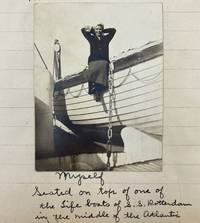
19141820Various places in Germany mostly Darmstadt as well as England Holland the Atlantic Ocean New York and Allentown 1914. Good plus. 144pp. with ten original photographs and printed document mounted at rear. Quarto commercial journal. Black cloth boards edges dyed red. Spine perished boards attached with amateur tape repairs. Text block solid. Minor offsetting from photographs; a bit of soiling to first leaf; light even tanning. Accomplished for the most part in highly legible hand; approximately 17500 words in total. A remarkable manuscript travel journal that documents the European trip of a 22-year-old Pennsylvania woman its interruption by the outbreak of World War I her subsequent stranding in Germany and her trials in securing passage back to the United States. Anna F. Weil b. about 1892 the daughter of an Allentown grocer John Weil departed New York on June 29 1914 aboard the S.S. Rotterdam a 3400 passenger luxury cruise liner operated by the Holland America Line. She arrived in Rotterdam Germany on July 9th and proceeded to connect with family and sightsee in Germany and the Netherlands with plans to proceed to Switzerland and Germany which were cut short by the declaration of war between Germany and England:<br/><br/>"Wed. July 29. To-day war was declared I have many postal cards written to send to American but was told not to send them as they would not reach their destination so all communication with outside countries is cut off. The harbor is closed and no ships can leave or enter German ports. The English cut the German cable a few days ago before war was declared so now we can't even send a telegram from Germany." p.68<br/><br/>At first the war is present in daily life but still seems some distance from it:<br/><br/>"On Sunday Aug. 23. I saw the first wounded French soldiers saw a wagon full but there were well treated by the Germans and the people expressed pity for them as they were a sad looking party. We were at Frankenstein's Castle a ruin on the mountain which can be seen way in the distance from Darmstadt. It was a very nice ramble through the woods and part of the castle is used as a restaurant where we had some thing to eat and drink before resuming our ramble in and about the castle. When at the top of the town it was nice to look over the tops of the trees over the fields and see the villages and the city away off in the distance." <br/><br/>The reality of the situation however quickly becomes more evident and more pressing:<br/><br/>"Aug. 28. Friday. Received a letter from Angeline dated July the 23d. also one from Frank dated August the 4th. Saw hundreds and hundreds of horses which are taken and sent to battle with the men. Saw many companies leaving it was a beautiful sight to see them march as one man. As they passed through the streets the women came and greeted them and gave them flowers. Horses wagons men every thing was covered with the acorn leaves the German emblem of victory and as the women gave the flowers they were placed among the acorn leaves and so they left their homes families and country with flowers and song and their flags waving high above them. It was a beautiful and inspiring sight to see them go but to think of their return made one's heart grow sad. One company that I saw Company 115 had but 30 men left after the battle the rest were dead or wounded."<br/><br/>Throughout the account her German heritage shapes a favorable view of the Germans in the war:<br/><br/>"In Belgium the Germans were very much ill treated they had to flee the country in 1 hours notice and leave every thing back Elizabeth Buehler and her brother as well as other Germans who were living in Belgium in the city of Antwerp had to flee for their lives and all their belongings were taken from them they arrived in Darmstadt with nothing but what they had on their bodies. When the war first broke out the Russians who were in Germany threw bombs and tried various ways of doing mischief. So all were given a chance to leave and got to their own country. Those who refused and did any mischief were taken into custody and placed under guard until the war is over. Those who did any wrong were sentenced to death were shot. This was at least more human that the way some of the Belgians and Russians treated and mutilated the Germans when they had done no wrong and deserved no punishment. War is war and there are rules which we cannot change and are considered honest in warfare but I don't think it right to torture or mutilate a wounded soldier whether friend or foe."<br/><br/>She remained with family at an estate on Dieburger Strasse in Darmstadt Germany until she was able to secure an emergency passport from the American Consul in Frankfurt on September 15th. The return passage was fraught as Holland America misplaced her reservation the ship was delayed and she was forced to find temporary lodgings in Rotterdam when she arrived on October 1st:<br/><br/>"When we got there the proprietor said all was taken this made the porter cross and he said he would find some kind of place for us but we were not going to take any kind of a make shift so we turned and hurried back to the station the porter took hold of my arm and tried to detain us but I broke loose and Mrs. Kramer and I ran as fast as could when we reached the station we were just in time to catch the other four who were driving away in carriages. The eldest one saw us running and stopped the team and waited for us. We got in and such a time till we found lodgings. Every thing was taken which was due to so many Americans and fleeing Belgians. We succeeded in finding a place at 2.30 am where all six of us stayed. Then there was trouble with the driver and one of the Americans went out and called a police-man and settled the trouble and we retired at 3am."<br/><br/>She eventually landed back in The States after a return trip that saw rough seas and an intense scrutiny of passengers upon landing in New York:<br/><br/>"At Staten Island the doctor came to our ship with a yacht flying the yellow flag. Here we stopped for some time the mail ship came and all mail bags were given over to this ship. Then another yacht crowded with American custom officers arrived on the scene and boarded our ship. Then we all had a hurried lunch as there was no time for supper. All had to go on deck until the dining room was in readiness for the officers. It was dark by this time and the ship under way again. When all was ready we had to stand in line with our yellow tickets. Only a few at a time were allowed to enter the dining-room. When once inside we had to look about for the table bearing the number of our ticket. Here we were interviewed by the officer at that table. Some people had a great deal of trouble and were sent from one table to another. Others were refused admission into the United Sates and some had to go to Ellis Island."<br/><br/>The rear pages of the journal are illustrated by 10 mounted original photographs of her initial journey family some sightseeing and her return passage; also tipped in are her emergency passport and a typed letter from the American consul. Overall the journal is a detailed and eventful original woman's travel manuscript as well as a rich primary record of an American civilian caught in Europe during the outbreak of the Great War. A partial transcription with additional excerpts is available upon request. unknown books
194316547London 1943. <p>Weil Ernst 1891-1965. Complete set nos. 1-33 of Weil's rare book catalogues. Approx. 1320pp. total. Plates. London: E. Weil 1943-1965. 218 x 138 mm. Bound in 3 volumes recent cloth red leather spine labels; original printed wrappers present. Fine. Herbert M. Evans' Copies with his purchase notes on the front wrappers of several catalogues and his signature or initials on one or two front wrappers. Typed letter signed from Weil to Evans dated 19 May 1953 bound into Catalogue 20.</p> <p> First Editions of these important catalogues issued by one of the foremost 20th-century dealers of rare books in medicine and science. These copies are from the library of Herbert M. Evans 1882-1971 co-discoverer of Vitamin E and one of the pioneering collectors of rare medical and scientific books. Many of the catalogues in this set bear Evans's pencil or ink notes on their front covers and Catalogue 20 1953 has a typed letter signed from Weil to Evans bound in discussing a possible purchase of four items.</p> <p> Ernst Weil a native of Germany was influenced by his cousin the bookseller Heinrich Eisemann to collect and eventually to sell early printed books. In 1924 he founded with Hans Taeuber the firm of Taeuber & Weil in Munich; in 1933 he moved his family to London where he entered into partnership with E. P. Goldschmidt. In 1943 he began selling books under his own name issuing 33 catalogues before his death in 1965. Although modestly produced his catalogues contain much research and original observation particularly on hitherto ignored medical and scientific books. See E. Weil "A doctor and his books: Harvey Cushing and his library. The formation of the Harvey Cushing Collection" Journal of the History of Medicine 1 1946: 234-246. </p> . unknown books
19979654New York: Vincent FitzGerald & Co 1997. One of 50 copies all on Fabriano Artistico paper each signed by the artist on the colophon. Page size: 4-7/8 inches x 4-7/8 inches; 31 individual leaves cards including "Joker" and 2 "Wild Cards" titlepage and colophon. Bound: housed in red cloth clamshell box by BookLab with title printed in silver gilt on front cover new. The calligraphy is by Jerry Kelly who has printed it letterpress at Kelly / Winterton Press. There are 59 etchings of body parts - some hand watercolored - by Susan Weil from her drawings that were blind-drawn on copper a technique that Weil has used for more than 50 years. The double-sided cards can be shuffled and dealt in any pattern which contributes to the humorous possibilities in the title pun. Further the cards can be re-arranged by simply turning them over creating a new figure. The simple line etchings become incredibly complicated upon closer inspection. Playful and sly touching and always imaginative Ms. Weil gives us her unique view of the human condition touching on varieties of emotions and stages of life with an artist's eye. Vincent FitzGerald & Co unknown books
20019656New York: Vincent FitzGerald & Co 2001. Portfolio of five etchings by Susan Weil signed by Weil on the colophon in pencil and initialed by her with the print number in pencil on each print. Printed on Japanese Gampi paper chine colle on Hahnemuhle Copper paper by Peter Pettengill at Wingate Studio. The etchings are taken from re-strikes of the Rembrandt Self-Portrait etchings purchased by Susan Weil while studying art in Paris at the Academie Julien in the 1940's. For this suite she has cut up the etchings and collaged them to achieve the images herein. The images were made from photogravue plates made by Jon Goodman. Ms. Weil has been experimenting with the use of images made from blueprint paper since 1951 when she and her then husband Robert Rauschenberg were working at Black Mountain College. Her use of collage has dated from this time as well. She has obviously has made these mediums her own. Vincent FitzGerald & Co unknown books
19979655New York: Vincent FitzGerald & Co 1997. One of 20 copies all on Antique JB Green and Japanese Gampi paper signed and numbered by the artist in pencil on each of the 5 etchings. The names of the subject of each portrait is etched in the plate itself. The authors are: Gertrude Stein James Joyce Franz Kafka and Virginia Woolf. The artist is of course Matisse. Each etching measures 12-1/4 inches x 17 inches fine. The etchings were printed by Lothar Osterburg and Vincent FitzGerald. Susan Weil's aesthetic predecessors are portrayed in these blind-drawn etchings created around the same time as BLIND MAN'S BLUFF. She has captured the key element in the features of each. Vincent FitzGerald & Co unknown books
20069813New York: Vincent FitzGerald & Company 2006. One of 10 copies only on J.B. Green paper each signed and numbered in pencil on the colophon by the artist Susan Weil. Page size: irregular but about 7 inches x 9 inches; 7 individual collages each hand water colored cut out and assembled by the artist Susan Weil and the publisher Vincent FitzGerald. On the reverse of each individual work of art is a "secret" hand written by the artist. Because they are secrets the reader / viewer can see words but there is no way to read the secret. Bound: loose in translucent plexi-glass box with sliding cover printed colophon in black with title in red visible through side of box new. The images created by Weil are so full of life - one is instantly drawn into the full world of this talented artist who has always included others in her life - children partners pets - all lovingly viewed through her aesthetic. The colors are vivid blues bright yellows gold and silver and the reader / viewer engages with them - knowing they will be unknowable and all the more intriguing. Vincent FitzGerald & Company unknown books
20029651New York: Vincent FitzGerald & Co. 2002. One of 20 copies all on special paper handmade by Paul Wong at Dieu Donne Papermill each signed and numbered on the colophon by Susan Weil. The artist has titled signed numbered and dated each print as well at the bottom in pencil. Page size: 16 x 16 inches; 6 images plus colophon. Housed in orange silk custom-made clamshell box with inset of blueprint image by the artist of broken glasses printed in white on blue fabric box made by Priscilla Spitler at Hands on Bookbinding new. The colophon was printed by Daniel Keleher at Wild Carrot Letterpress. Vincent FitzGerald & Company did the collage work. The prints are described by the publisher as follows: 1 blueprint image on cover; 2 "Umbrella" photograph which puts the umbrella structure directly on the paper; 3 "Secrets" A collaged blueprint. These private words are layered then cut in strips and woven. The back of the strips are water colored red reflecting slightly. 4 "Grace's Lace" The lace squares are treated with chemicals for a brown print and developed with ultraviolet light. This is mounted on handmade paper which has been water colored pale gray. 5 "Catenary" This is a blueprint collage. The two blueprint hands hold a copper string. The handmade paper is water colored pale green. 6 "Woven Wineglasses" This is a photograph collage. Several direct wineglass images are simply woven into a box form making this study of water and shadows into an abstraction. 7 "Haphazard" This is a formal blue print configuration of glass rectangles. The haphazard quality comes from the unpredictability of the beautiful breaks in the glass. <br/>Susan Weil returns to a medium she used in the late 1940's and early 1950's with her then husband Robert Rauschenberg at Black Mountain College where they had studied with Josef Albers. Carla Schulz-Hoffman notes in her article on Susan Weil in the exhibition catalogue MIND'S EYE 1989 the origins of this art form. In subsequent visits to Black Mountain they began experimenting with blueprint paper. Rauschenberg writes "Sue and I experimented with light-sensitive papers partly because of their low cost.". Schulz-Hoffman writes "In 1951 their son Christopher was born and in that same year 'Life' magazine published a three page article including reproductions of their spectacular 'Blueprints'. Similar to Man Ray's rayographs the blueprints used blueprint-paper and a sunray lamp to capture life-sized silhouettes." She notes "For this reason it is not always possible to credit one particular individual with the discovery of innovations which would prove decisive in precipitating the fall of Abstract Expressionism and in shaping the course which the entire New York School would eventually take. Although many of the results of Weil's productive collaborations with Rauschenberg and Jasper Johns cannot be attributed exclusively to one or another of these artists nevertheless a typically one-sided art historical scholarship tends to ignore Weil or consign her a marginal role.". As well as blueprint images Weil began to use collage in an especially creative way. Her complete mastery of these techniques can be seen in these images. Vincent FitzGerald & Co. unknown books
1966129889N.P.: n.p. 1966. Limited Editions Club. framed painting 34 by 28 inches. A framed painting depicting a guard at the fortress and monastic community at Qumran. Shraga Weil 1918-2009 was an Israeli artist. Born in Prague in 1918 he studied at the National School of Arts there. He served in the Hungarian resistance to the Nazis during World War II. After the war he joined the exodus to Israel. He received training in monumental and graphic techniques at the Academy of Arts in Paris in 1953. He worked as a designer and illustrator of books during the 1950s during which time he was illustrator of The Dead Sea Scrolls New York: Limited Editions Club 1966. This work was included as an illustration in that book. In the 1960s and 1970s he created several architectural designs including the copper doors for the main entrance of the Knesset building and the residence of the President of Israel in Jerusalem. source: Knesset website and Shraga Weil website. Qumran was the location of an ancient Jewish fortress and Essene monastic community where the Dead Sea Scrolls were found beginning in 1947. n.p. unknown books