87 résultats
1969146891Unknown: I.P.C. Pictures 1969. Draft script for the 1971 film here under the working title "The Catcher in the Raw." <br/><br/>At a California hot springs resort a shady therapist helps eight carefully selected applicants find themselves and "experience their bodies" a process which mostly involves consuming large amounts of LSD meditative screaming and slow-motion basketball games. Louis Garfinkle's sole directorial credit and an excellent example of the intersection of early 1970s wellness culture and sexploitation. <br/><br/>Set in California.<br/><br/>Brown titled wrappers. Title page present dated 1969 with credits for director Louis Garfinkle. 136 leaves with last page of text numbered 133. Xerographic duplication rectos only. Pages Very Good plus wrapper Very Good plus bound with three gold brads. I.P.C. Pictures unknown books
19231344Heine Heinrich. 1799-1856. <b>Der Rabbi von Bacherach</b> mit Originallithographien von Max Liebermann. Berlin: Im Prophlaen Verlag 1923. #279 of 400 with signed frontispiece and limitation page by Liebermann and 17 full or partial page lithographs in black. The first 100 were printed on Japan Vellum. <br /><br />Folio. Publisher's half-morocco with title in gold with yellow board sides bearing a lithograph on the upper cover. Printed on laid paper. Original open slipcase with paper label joints split. 58p. Fine copy with a touch of wear to spine ends. <b>The Rabbi of Bacharach</b> set in the middle ages is Heine's unfinished novel that describes the ordeal of Rabbi Abraham and his wife in the small town of Bacharach Germany . <br /><br />Gentiles come to the Passover Seder in order to secretly plant a body of a Christian child. They will accuse the Rabbi of ritual murder. Then when he is taken away they will rob his home. The rabbi and his "schönne" beautiful Sarah manage to leave their home during an interval in the seder and run to the river docks. They are then transported for a fee down the Mainz to Frankfurt where they enter into the Jewish quarter without incident. In that quarter life is fully described with all its variety and color. <br /><br /> This unfinished story remains popular because it pictures life in the medieval Jewish community with detailed description of worship customs and pecking orders as well as dress manners and a variety of activities within the Jewish quarter. Liebermann's realistic sketchbook style depicts scenes with a charcoal drawing like simplicity. The stark flat depiction creates an atmosphere of dark foreboding. <br /><br />The 19th century poet Emma Lazarus wrote a biographical sketch of Heine that includes commentary on The Rabbi of Bacharach: "During the period of his earnest labors for Judaism Heine had buried himself with fervid zeal in the lore of his race and had conceived the idea of a prose-legend the Rabbi of Bacharach illustrating the persecutions of his people during the middle ages. Heine one of the most subjective of poets treats this theme in a purely objective manner. He does not allow himself a word of comment much less of condemnation concerning the outrages he depicts. He paints the scene as an artist not as the passionate fellow-sufferer and avenger that he is. But what subtle eloquence lurks in that restrained cry of horror and indignation which never breaks forth and yet which we feel through every line gathering itself up like thunder on the horizon for a terrific outbreak at the end!" <br /><br />Refer: Lazarus Emma 1849-1887 From the Biographical Sketch of the life of Heinrich Heine reprinted in The Rabbi of Bacharach by Heinrich Heine. Mondial 2008. Prophalen Verlag hardcover books
1902237000New York: Printed for Subscribers only by Croscup and Sterling Company 1902. Düsseldorf edition number 15 of 250 copies printed on Holland Paper signed by the publishers. With plates in TWO STATES. Printed by Ballantyne Hanson & Co. Edinburgh. 20 vols. 8vo. Bound in original three quarter blue morocco with gilt stamping and red morocco floral onlays on the spines t.e.g. Bookplate of Richard Waln Meirs. Two volumes with hinges neatly repaired. Very nice and unusual set. Düsseldorf edition number 15 of 250 copies printed on Holland Paper signed by the publishers. With plates in TWO STATES. Printed by Ballantyne Hanson & Co. Edinburgh. 20 vols. 8vo. This was one of the last works by Charles Leland. He died in 1903. Printed for Subscribers only by Croscup and Sterling Company unknown books
1902281949New York: Croscup 1902. hardcover. near fine. Translated by Charles Godfrey Leland frontispiece portraits in 2 states illustrated lettered tissue guards. 20 volumes rubricated titles 8vo 3/4 green morocco raised spines gilt design on spines top edges gilt. New York: Croscup & Sterling Co. n.d. ca. 1900. The Dusseldorf edition number 83 of 250 sets this copy unnumbered printed on Holland Paper. A near fine set.<br/><br/> Croscup unknown books
19210053731921. Hardcover. Very Good. Exquisite and delightful manuscript account of a happy and prosperous marriage made as a commemoration on its Silver Anniversary which occurred in 1921. Folio. 38 by 27.5 cm. 10 leaves on card stock with original watercolored artwork on each page. Blue felt bevelled binding with stalks of tall grass painted in silver on the cover. The grass design repeats on the title page with the addition of cherubs and a highly ornamental painted placard bearing the title -- this placard is suspended from a stalk and held by one of the cherubs. The account begins with a young man Vienna leaving his love behind as he travels to Lyon. We are told how he misses his beloved and so follows their wedding in 1896. A stock market crash then leaves the desperate groom concerned about their future. The young family return to Vienna where he becomes a workaholic as his wife tends to the home filling it with bric-a-brac that speaks to their material well being. Finally there comes the anniversary celebration and the happiness from seeing their children grown and settled. This brief account doesn't do justice to the verse or paintings. The account is really just a few snapshots of their lives using words and pictures which work together to bring a dream-like glow to the reminiscences. Each page is framed by a decorative band of primarily blue set off by a floral festoon within it. Most pages have two illustrations with the verse written by a calligraphic hand. The illustrations are filled with a vigor and energy -- they almost seem to float above or hover over the page. We would guess that the anniversary couple's surname was Labin based on a door sign in the office scene and the company the husband worked for was named Abadie which may have been based in Paris. Beyond that we can not speak more specifically about the parties. Condition: the felt is rubbed and slightly sunned on front. The silver design is somewhat faded. Soiling along the bevelled edge. The contents are clean and bright. <br /><br /> hardcover books
1910006225Berlin: Paul Cassirer 1910. Limited First Edition Thus. Vellum. Near Fine. No. 46 of 60 on Imperial Japan Japan vellum and a total limited edition of 310 copies. Large 4to. 31.5 by 24 cm. 83 2 pp. With 35 lithographic plates six of which are hand-colored and nine of which are signed by Pascin. Also signed by him on the limitation page. The cover also has a partly colored illustration by Pascin done on the vellum. This book was Pascin's first book project. The satirical Heine novel first published in 1833 actually was the inspiration for Wagner's "Der Fliegende Hollander" or "The Flying Dutchman". Pascin was born in Bulgaria was active in Paris for much of his career although becoming an American citizen and working in the U.S. as well. The illustrations in this book have a deliberately naive quality almost as if done by a child. Condition: short tear of vellum along lower front joint 2 to 3 cm in length. Typical yet slight bowing of the vellum and a touch of lifting of the vellum from the boards. Minor darkening of the vellum leaves within along the edges. <br/><br/> Paul Cassirer hardcover books
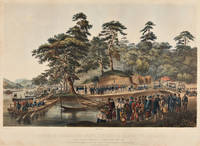
185625141New York: GP Putnam & Company 1856. Folio. 20 1/4 x 14 1/4 inches. 12 ff. letterpress text. 10 lithographic prints one tinted portrait of Perry on india paper mounted from a daguerreotype by P. Haas nine hand finished views by Heine two of these chromolithographed seven printed in two colours on india paper mounted all printed by Sarony & Co. Expertly bound to style in half purple morocco over period purple cloth covered boards.<br/> <br/>An important work recording Commodore Perry's expedition to Japan.<br/> <br/>William Heine was the official artist on Commodore Matthew C. Perry's expedition to Japan in 1853-54. On returning to the United States he produced several series of prints commemorating the trip. A group of six elephant-folio prints appeared in 1855 and the following year the present volume was issued in a smaller format with different images and with explanatory text. Both projects employed the New York lithographic firm of Sarony among the best lithographers in the United States at that time. "As artistic productions the pictures speak for themselves . none superior to them have been executed in the United States and they have no cause to shun comparison with some of the best productions of Europe" Introduction. Copies were produced tinted though with some plates with several colors on regular paper as in the present copy and a deluxe hand-coloured issue on card. The plates are numbered and titled as follows 1. portrait of Perry; 2. Macao from Penha Hill; 3. Whampoa Pagoda; 4. Old China Street Canton; 5. Kung-kwa at On-na Lew-Chew; 6. Mia or road side chapel at Yokuhama; 7. Temple of Ben-teng in the harbor of Simoda; 8. Street and bridge at Simoda; 9. Temple of the Ha-tshu Man-ya-tshu-ro at Simoda; 10. Grave yard at Simoda Dio Zenge. Bennett describes the plates as "many times finer than those in the regular account of the Perry expedition." His remarks on the work's great rarity are confirmed by its absence from both of Cordier's Japanese bibliographies.<br/> <br/>Bennett p.53; McGrath American Color Plate Books 123. GP Putnam & Company unknown books
185620647New York: GP Putnam & Company 1856. Folio. 20 1/4 x 14 1/2 inches. 12 ff. letterpress text. 10 lithographic prints one tinted portrait of Perry from a daguerreotype by P. Haas nine hand finished views by Heine two of these chromolithographed seven printed in two colours on india paper mounted all printed by Sarony & Co. 20th-century maroon half morocco over paper-covered boards titled in gilt on spine original wrappers bound in<br/> <br/>An important work recording Commodore Perry's expedition to Japan.<br/> <br/>William Heine was the official artist on Commodore Matthew C. Perry's expedition to Japan in 1853-54. On returning to the United States he produced several series of prints commemorating the trip. A group of six elephant-folio prints appeared in 1855 and the following year the present volume was issued in a smaller format with different images and with explanatory text. Both projects employed the New York lithographic firm of Sarony among the best lithographers in the United States at that time. "As artistic productions the pictures speak for themselves . none superior to them have been executed in the United States and they have no cause to shun comparison with some of the best productions of Europe" Introduction. Copies were produced tinted on regular paper as in the present copy and hand-coloured. The plates are numbered and titled as follows 1. portrait of Perry; 2. Macao from Penha Hill; 3. Whampoa Pagoda; 4. Old China Street Canton; 5. Kung-kwa at On-na Lew-Chew; 6. Mia or road side chapel at Yokuhama; 7. Temple of Ben-teng in the harbor of Simoda; 8. Street and bridge at Simoda; 9. Temple of the Ha-tshu Man-ya-tshu-ro at Simoda; 10. Grave yard at Simoda Dio Zenge. Bennett describes the plates as "many times finer than those in the regular account of the Perry expedition." His remarks on the work's great rarity are confirmed by its absence from both of Cordier's Japanese bibliographies.<br/> <br/>Bennett p.53; McGrath American Color Plate Books 123. GP Putnam & Company unknown books
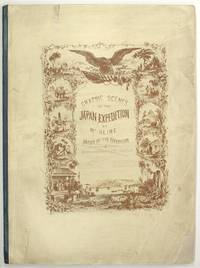
185646791New York: G. P. Putnam & Co 1856. Large folio approx. 20½ x 15" consisting of a title page and introduction leaf and 10 leaves of descriptive text to accompany each of the 10 plates of which one is a lithograph portrait of Commodore Perry from a daguerreotype by P. Haas 2 chromolithographs 7 lithographs printed in 2 colors on India paper and mounted as issued original pictorial wrappers with the title enclosed by 8 vignette scenes and an American eagle at the top the wrappers backed in blue cloth; the whole in the publisher's quarter green morocco lettered in gilt on upper cover; some soiling of the front wrapper and title page a little spotted but over all very good or better. Heine 1827-1885 was the official artist on Perry's expedition to Japan in 1853-54. The sketches he produced of the places he visited and the people he encountered there together with the daguerreotypes taken by his colleague Eliphalet Brown Jr. formed the basis of the official iconograhy of the American expedition to Japan which remains an important record of the country as it was before the foreigners arrived in force. Upon his return to New York in 1855 he published several books: a collection of prints entitled Graphic Scenes of the Japan Expedition; and the 400 sketches which were included in Perry's official report as well as his memoirs Reiss um die Welt nach Japan Leipzig 1856. Bennett p. 53: "The plates are very beautiful Japanese scenes and places of special interest many times finer than the plates in the three-volume regular account of the Perry Expedition." McGrath American Color Plate Books 123. <br/><br/> G. P. Putnam & Co hardcover books
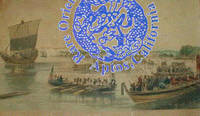
99009904New York 1856 Putnam. Tall folio single hand colored litho of "PASSING THE RUBICON" 82.5 x 56.5 cm. slight browning marginal tears mounted on a stiff cardboard VERY R A R E ! This work preceded the famous three volume set published in 1856: THE JAPAN EXPEDITION. GRAPHIC SCENES OF THE JAPAN EXPEDITION was a spectacular work and contained 10 hand tinted large and nine smaller colored lithographs to document the arrival of Perry & his Squadron. Most were drawn by Heine the young German who was the expedition artist. The complete work includes: 1. PORTRAIT OF M.C. PERRY. 2. MACAO FROM PENHA HILL. 3. PAGODA OF WHAMPOA. 4. OLD CHINA STREET IN CANTON. 5. KUNG-TWA AT ON-NA LEW CHEW. 6. MIA OR ROADSIDE CHAPEL AT YOKU-HAMA. 7. TEMPLE AT BEN-TENGIN THE HARBOR OF SIMODA. 8. STREET & BRIDGE AT SIMODA. 9. TEMPLE OF THE HA-TSHU-MAN-YA TSCHU-RO AT SIMODA. 10. GRAVEYARD AT THE SIMODA DIO ZENGE. Of these exceedingly RARE lithographs one prints is now offered: PASSING THE RUBICON documents the event of July 11 1853 wherein Lt. Silas Bent from the Mississippi's first cutter confronted Japanese guard boats and a coastal Junk. This is illustrated in S. Morrison: "OLD BRUIN" COMMODORE MATTHEW CALBRAITH PERRY on p.327. This scene shows the American sounding party at work on Monday morning July 11th ".when a flotilla of thirty to forty guard boats filled with soldiers who presented quite a bristling front with their spears and matchlocks while their lacquered caps and shields flashed brightly in the sun confronted the flag launch under charge of Lt. Bent & the senior Japanese officer made minatory gestures with his iron fan and yelled orders which nobody in the American launch understood. The Lieutenant anxious to avoid a crash altered his collision course but dispatched another boat to the Mississippi to ask Capt. Lee to move closer. On the steamer's approach the guard boats retired. And Perry named the nearest point of land 'Point Rubicon' because no foreign ship had passed it for three centuries." See Morrison p.328. The lithograph PASSING THE RUBICON is 83 x 56.5 cm. overall print size is 83 x 49.5 cm. with top and side edges trimmed bottom edge slightly trimmed; overall browned with some surface scuffs tears laid down on an old cardboard complete illustration present with minor faults. The complete title reads: PASSING THE RUBICON. Lieut's. Bent in the Mississippi's First Cutter Forcing His Way Through a fleet of Japanese Boats While Surveying the Bay of Yedo July 11th. 1853. To Commodore M.C. Perry Officers and men of the Japan Expedition this print is respectfully dedicated by their Obt. Servths sic. BIBLIOGRAPHY: R. Pineau: THE JAPAN EXPEDITION 1852-1854 THE PERSONAL JOURNAL OF COMMODORE MATTHEW C. PERRY after p.156 & before p.167 color illustrations. THE PAUL C. BLUM COLLECTION CATALOGUE OF BOOKS Yokohama Archives of History vol.4 no.4395. H. Cordier: BIBLIOTHECA JAPONICA p.513-518. By and large any of these prints from this work is exceptionally rare and seldom if ever found on the market for sale. . unknown books
185634436New York: G.P. Putnam & Company 1856. Folio. 20 x 14 inches. 12 ff. letterpress text. 10 lithographic prints one tinted portrait of Perry on india paper mounted from a daguerreotype by P. Haas nine hand-coloured views by Heine two of these chromolithographed seven printed in two colours on india paper mounted all printed by Sarony & Co. all mounted on thick card with smooth glossy backings. Text in the original yellow pictorial wrappers expertly rebacked to style with purple cloth the plates loose as issued with the text within a half purple morocco and period purple cloth portfolio yellow pastedowns and flaps cloth ties. All within a black morocco backed box.<br/> <br/>An important work recording Commodore Perry's expedition to Japan: the very rare deluxe hand coloured issue on card.<br/> <br/>William Heine was the official artist on Commodore Matthew C. Perry's expedition to Japan in 1853-54. On returning to the United States he produced several series of prints commemorating the trip. A group of six elephant-folio prints appeared in 1855 and the following year the present volume was issued in a smaller format with different images and with explanatory text. Both projects employed the New York lithographic firm of Sarony among the best lithographers in the United States at that time. "As artistic productions the pictures speak for themselves . none superior to them have been executed in the United States and they have no cause to shun comparison with some of the best productions of Europe" Introduction. Copies were produced tinted though with some plates with several colors on regular paper and a very rare deluxe hand-coloured issue on card like the present example. The plates are numbered and titled as follows 1. portrait of Perry; 2. Macao from Penha Hill; 3. Whampoa Pagoda; 4. Old China Street Canton; 5. Kung-kwa at On-na Lew-Chew; 6. Mia or road side chapel at Yokuhama; 7. Temple of Ben-teng in the harbor of Simoda; 8. Street and bridge at Simoda; 9. Temple of the Ha-tshu Man-ya-tshu-ro at Simoda; 10. Grave yard at Simoda Dio Zenge. Bennett describes the plates as "many times finer than those in the regular account of the Perry expedition." His remarks on the work's great rarity are confirmed by its absence from both of Cordier's Japanese bibliographies. Two distinct issues of Heine's work were published: a regular issue with hand coloured plates on thick card; and the deluxe issue like the present with more elaborate hand coloring and on thick cards with glossy paper backings. The deluxe issue is considerably more rare than the regular issue.<br/> <br/>Bennett p.53; McGrath American Color Plate Books 123. G.P. Putnam & Company unknown books
1856WRCAM54032New York: Eliphalet M. Brown Jr. 1856. Six lithographs with integral descriptions and titles to the six plates all within an elaborate decorative border including vignettte scenes and portraits of places and people encountered on the expedition six lithographic plates printed in colors and finished by hand by J. Sarony & Co. 4 Boell & Lewis 1 and Boell & Michelin 1 all after Heine. Title leaf not present as usual. Elephant folio. Individually matted and framed. One print with repaired closed tears slightly affecting image. Occasional faint marginal foxing and dust soiling. Very good. Magnificent and very rare example of Heine's elephant folio-sized lithographic record of six lithographs illustrating the opening of Japan under Commodore Matthew Perry. In scale scope and quality of execution this is arguably the finest lithographic work ever produced in the United States and is among the rarest of all American color plate books. <br> <br> William Heine was the official artist on Commodore Matthew C. Perry's expedition to Japan in 1853-54. On returning to the United States he produced several series of prints commemorating the trip the first the greatest and the rarest of which is the present group consisting of a titlepage and six plates. These were overseen by the expedition's daguerreotypist Eliphalet Brown who was also an excellent artist and lithographer - he designed and drew the spectacular titlepage. The total number of sets of printed is not known but it is recorded that Brown gave 100 sets to Commodore Perry for distribution to members of the expedition. The number of sets sold to the public has not been established but was undoubtedly small. One of the reasons for the rarity of the complete set is that the plates were printed over two years by three publishers. Individual prints are occasionally encountered particularly the four printed in 1855 by Sarony of New York but the two other plates are much scarcer and were accomplished by different lithographers Boell & Lewis and Boell & Michelin. <br> <br> A secondary reason for the rarity of this set is the initial cost. It was significantly more expensive than Heine's GRAPHIC SCENES OF THE JAPAN EXPEDITION a much smaller folio published in the same year as the final plate: the popularity of this smaller set ensured that only very few of the magnificent larger sets were ever sold. The set consists of the following prints: <br> <br> 1 "Passing the Rubicon. Lieut. S. Bent in the 'Mississippi's' First Cutter Forcing his way through a Fleet of Japanese Boats while Surveying the Bay of Yedo Japan July 11th 1853." Printed by Sarony & Co dated 1855. <br> <br> 2 "First Landing of Americans in Japan. Under Commodore M.C. Perry at Gore-Hama July 14th 1853." Printed by Sarony & Co dated 1855. This print is the most dramatic of the series showing the first landing of Perry on Japanese soil. Through a flotilla of American landing barges with the ships' complement of Marines drawn up on the beach Perry proceeds to meet a Japanese delegation while Japanese troops ring in the Americans. In the foreground are two Japanese official launches and two Japanese officials stand in the right foreground. Perry's steamboats can be seen lying under steam in the left corner. <br> <br> 3 "Landing of Commodore Perry Officers & Men of the Squadron to Meet the Imperial Commissioners at Yoku-Hama Japan March 8th 1854." Printed by Sarony & Co dated 1855. <br> <br> 4 "Landing of Commodore Perry Officers & Men of the Squadron to Meet the Imperial Commissioners at Simoda Japan June 8 1854." Printed by Sarony & Co dated 1855. <br> <br> 5"Return of Commodore Perry Officers & Men of the Squadron from an Official Visit to the Prince Regent at Shui Capitol of Lew Chew June 6th 1853." Printed by Boell & Lewis dated 1855. <br> <br> 6 "Exercise of Troops in Temple Grounds Simoda Japan in Presence of the Imperial Commissioners June 8th 1854." Printed by Boell & Michelin dated 1856. <br> <br> This set of the Heine prints belonged to Major Robert Smith John Rodgers son of Commodore John Rodgers of War of 1812 fame and hung in his fine mansion on a hilltop outside of Havre de Grace Maryland. PETERS AMERICA ON STONE pp.98 352-53. Samuel Eliot Morison "OLD BRUIN": COMMODORE MATTHEW CALBRAITH PERRY 1794-1858 Boston 1967 p.463. Eliphalet M. Brown Jr. unknown books