Proust, MarcelBiblio.com
1 651 résultats
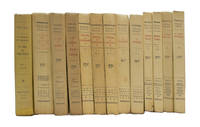
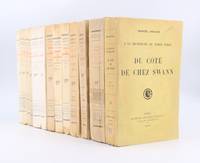
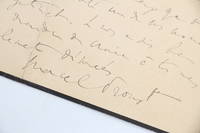
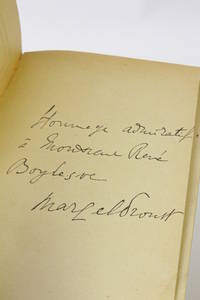
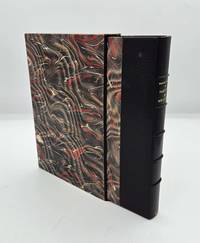
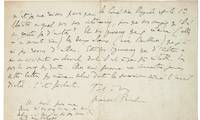
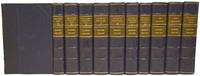
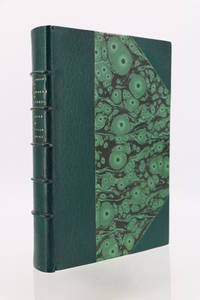
640316Paris: Grasset & Nrf. 1st Edition. Paperback. Very Good. octavo. A superb set of Proust's masterpiece with the rare first issue of Du côté de chez Swann being signed and dedicated to blank preliminary page before the half-title and accompanied by a fragment of the original manuscript of Du côté de chez Swann. A mixed set the three signatures being dedicated to different recipients housed in stunning matching black solander boxes with Du côté de chez Swann also housed in a slipcase within the solander.Du côté de chez Swann – first edition first issue with the printing error in the Grasset imprint 1913 Signed by Proust to a blank preliminary page and dedicated to the novelist Lucien Descaves who was a member of the Prix Goncourt and who actually voted against Proust in 1919 the year he was awarded the prize for 'À l’ombre des jeunes filles en fleurs'.A l’ombre des juenes filles en fleurs – first edition though with the false edition statement to the cover so not the first issue 1918. Le côté de Guermantes I – third edition first edition on standard paper 1920 Signed and dedicated to the poet critic and writer Andre Salmon.Le côté de Guermantes II / Sodome et gomorrhe I – sixth edition Signed and dedicated also to Andre Salmon.Sodome et gomorrhe II i - first edition 1922 #276.Sodome et gomorrhe II ii - first edition 1922 #533.Sodome et gomorrhe II iii - first edition 1922 #553.La Prisonnière I – first edition 1925 #334.La Prisonnière II – first edition 1925 #334.Albertine disparue I – first edition 1925 #767.Albertine disparue II – first edition 1925 #767.Le Temps retrouvé I – first edition 1927 #293.Le Temps retrouvé II – first edition 1927 #293.Manuscript fragment from Du côté de chez Swann being an excerpt from concerning Françoise and the walks near Méséglise. This fragment presents a different version of the printed text Marcel Proust In Search of Lost Time Bouquins vol. I pp. 141-142. It is a working manuscript and more likely given its size a rough draft.This set was put together by the art dealer Karsten Schubert and is a truly outstanding collection. Grasset & Nrf paperback
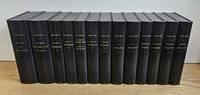
191468610Paris: Bernard Grasset 1914. A La Recherche du Temps Perdu. Paris: Bernard Grasset 1914 i.e. 1913; Éditions de la Nouvelle Revue Française 1918-1927.<br> <br> A complete set of first editions. First issue of Du Cots de Chez Swann with the date 1913 on the front wrapper and 1914 on the title-page printer's imprint dated "le huit novembre mil neuf cent treize" on the verso of p. 523 and with 8 pp. of ads at the end. With the printer's misprint on the title-page and no table of contents. 4 523 1 printer's imprint 8 ads pp. Swann's Way. Together thirteen octavo volumes. Original glassine on all volumes. All volumes numbered on except for A l'Ombre des Jeunes Filles en Fleurs as there was no numbered print for this volume.<br> <br> "A l'ombre des Jeunes Filles en Fleurs" is first edition on regular paper after 64 large paper copies; all other volumes are in numbered first edition bearing the indication "Edition originale" on the cover.<br> <br> The set comprises: Du Cote de Chez Swann; A l'Ombre des Jeunes Filles en Fleurs; Le Cote de Guermantes I one of 800 numbered copies for the Amis de L' Edition Originale #760; Le Cote de Guermantes II and Sodome et Gomorrhe I one of 800 numbered copies for the Amis de L'Edition Originale #168; Sodome et Gomorrhe II three volumes one of 30 numbered copies for the Exemplaires D'Auteur Hors Commerce Marques For the author not for sale all three numbered 855; La Prisonniere two volumes one of 875 numbered copies for the Amis de L'Edition Originale both volumes nymbered 293; Albertine Disparue two volumes one of 1200 numbered copies for the Amis de L'Edition Originale Both volumes numbered 346; and Le Temps Retrouve two volumes one of 1200 numbered copies for the Amis de L'Edition Originale both volumes numbered 845.<br> <br> Original buff wrappers printed in red and black. Du Cote de Chez Swann in yellow wrappers printed in black. Volume I of Sodome et Gomorrhe II with previous owner's ink notes on front blank ink bleeding a bit onto the half-title. Overall fine copies of all volumes. Each volume individually housed in chemises with red morocco spines over gray paper boards and black paper slipcases with red morocco edges.<br> <br> "Du cote de chez Swann is the first volume of Proust's monumental opus A la recherche du temps perdu the most important French novel of the twentieth century and a masterpiece of European literature. This first volume described the narrator's childhood and contains the celebrated madeleine episode. Publication of subsequent volumes was interrupted by the war. This novel famously turned by Gide for the N.R.F was published at the author's expense by Grasset. By 1918 the N.R.F had realised its huge blunder and published A l'ombre des jeunes filles en fleurs which won the Prix Goncourt and established Proust as a major literature figure" From Stendhal to Rene Char: Le Cabinet de livres de Renaud Gillet Sotheby's 27 October 1999 lot 64.<br> <br> "Translated by Scott Moncreiff as Swann's Way etc. Proust's great novel A la recherche du temps perdu is something that happens once in a hundred years like Les Fleurs du Mal or War and Peace. He combined tragic poetical insight with the gift of creating comic characters in the round like Shakespeare. He is consistently both intelligent and poetic. Bergsonian philosophy of time gives depth Ruskinian aesthetics texture. Embittered by his homosexual bias and disabling asthma he shows some deterioration in the unrevised volumes though not enough to upset this magisterially executed conception of a master-mind in which art erects its monument to dead loves using for material only thought and the passage of time. 'It appeals to our sense of wonder and gains our hommage by its veiled greatness. I don't think there ever has been in the whole of literature such an example of the power of analysis' Conrad" Connolly The Modern Movement.<br> <br> BN Proust 402 445 484 489 531 533 and 536. Connolly The Modern Movement 23.<br> <br> HBS 68610.<br> <br> $35000. Bernard Grasset unknown
191389908Paris: Grasset first volumeGallimard other volumes 1913. Fine. Grasset first volume Gallimard other volumes Paris 1913-1927 12 x 19 cm 13 volumes brochés First edition for each volume. Fine copy of Du côté de chez Swann in first edition second printing with all identifying points front cover dated 1913 table of contents present no publisher's catalogue at end; copy in first edition bearing the mention ""quatrième édition"" for À l'ombre des jeunes filles en fleurs with the correct colophon dated November 30 1918; although bearing the same colophon dated November 30 1918 the 128 reimposed copies were not actually printed until a year later together with the large paper copies of the Swann reissue; for the following 11 volumes numbered copies on pur fil wove paper the only large paper copies apart from the reimposed ones. The complete first edition of À la recherche du temps perdu comprises the first two volumes on ordinary paper with the particularities mentioned above followed by deluxe copies for the subsequent volumes. These deluxe copies on pur fil are in the same format as the first two volumes. Restorations with losses filled on the spine and boards of the first and second volumes spine of third volume browned small tears or slight losses of no consequence at foot of certain spines rear board of fifth volume partially sunned some foxing on fore-edge of sixth volume manuscript ex-libris inscriptions in upper right corners of front cover and title page of first volume. This complete set of La Recherche comprises the following titles: Du côté de chez Swann À l'ombre des jeunes filles en fleurs Le Côté de Guermantes 2 volumes Sodome et Gomorrhe 3 volumes La Prisonnière 2 volumes Albertine disparue 2 volumes and Le Temps retrouvé 2 volumes. Fine complete set all volumes in first edition as published. Grasset (first volume)Gallimard (other volumes) hardcover
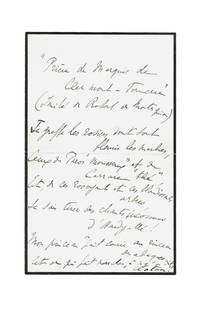
1908Proust26<p><strong>PROUST Marcel 1871-1922</strong></p><p>Autograph pastiche-poem signed " Marcel Proust " to the marquis Philibert de Clermont-Tonnerre<br />N.p.n.d c. summer 1908 2 p. in-8° watermarked mourning paper<br />Watermark : " Original / Turkey Mill / Kent "<br />Central fold mark</p><p><strong>A rare and admirable poem-pastiche by Proust in the manner of Robert de Montesquiou whose style he somewhat mocks</strong></p><p><em>" "Prière du Marquis de Clermont-Tonnerre"</em>¹<br /><em>Imité de Robert de Montesquiou </em></p><p><em>Je greffe les rosiers dont sont fleuris les marbres</em><br /><em>Ceux du Paros "mousseux" et du Carrare "thé" </em><br /><em>Et de ces rosoyants et ces blondissants arbres</em><br /><em>Je sais tirer des chants inconnus d'Hardy-Thé !</em>²</p><p><em>Mon pinceau fait courir au rinceau des abaques</em><br /><em>Cet or qui fait marcher à ce qu'on dit Cloton !</em>³<br /><em>Trianon</em>â´<em> Vézelay ne sont que des baraques </em><br /><em>Quand l'esprit les compare au Palais Lauriston !</em>âµ</p><p><em>Seigneur si vous daignez m'admettre dans les Salles</em><br /><em>Où le Juste rompra le Pain Essentiel </em><br /><em>Que de marbre aussi pur étincellent vos stalles ! </em><br /><em>De Glisolles et d'Ancy</em>â¶<em> que soit digne le Ciel ! </em></p><p><em>pour copie conforme</em>â·<br /><em>Marcel Proust "</em></p><p>Through this pastiche Proust takes up the floral motif abundantly used by Robert de Montesquiou 1855-1921 in his works and poems. When the latter published his first collection <em>Les Chauves-souris</em> in 1893 Proust 22 years old at the time wrote to him on 29 April 1893 that "Never have the vain flowers of gardens smelled so good" <em>Corr</em>. t. I p. 206. The two men met for the first time a few days earlier at Madeleine Lemaire's house on April 13 1893. Dandy with a pure profile a fascinating look… Proust fell under the admiration of Montesquiou the future model of Charlus. This was followed by an abundant often flattering correspondence. If the young Proust never ceased to praise Montesquiou's taste for the erudite display of names cultural references and the rare word we observe through the present poem-pastiche a touch of mockery with regard to the style of the dandy-poet. The two would however maintain a friendship that would last until Montesquiou's last days in 1921.<br />At the time when Proust was thinking of resuming his pastiche of Saint-Simon "Fête chez Montesquiou" <em>Textes retrouvés</em> ed. P. Kolb Gallimard p. 191-195 he wrote to Montesquiou on February 16 1909 without forgetting the usual precautions: "Basically the pastiche that would amuse me the most to make when I can write a little without prejudice to more serious studies is a pastiche of you! But in the first place it would perhaps annoy you and I don't want anything of me to ever make you angry …!" <em>Corr.</em> t. IX p. 34.<br />The epistle addressed to the Marquis Philibert de Clermont-Tonnerre 1871-1940 was published by his wife Elisabeth de Clermont-Tonnerre née de Gramont in 1955 in the <em>Bulletin Marcel Proust</em>. The latter who first met the writer in 1903 had previously published a study of Robert de Montesquiou and Marcel Proust Flammarion 1925.</p><p>1 The title recalls Robert de Montesquiou's <em>Prières de tous</em> 1902 illustrated by Madeleine Lemaire.<br />2 Lucien Hardy-Thé composer and singer socialite<br />3 Clotilde Legrand 1857-1944 born de Fournès nicknamed "Cloton".<br />4 In 1908 Montesquiou acquired the Palais Rose du Vésinet a reduced copy of the Grand Trianon in Versailles.<br />5 The Clermont-Tonnerres lived in their hotel at 74 rue de Lauriston in Paris.<br />6 Duke Aimé Gaspard Marie de Clermont-Tonnerre 1779-1865 owned a castle built in the eighteenth century at Glisolles in the Eure and another built in the sixteenth century at Ancy-le-Franc in the Yonne.<br />7 Proust indicates "pour copie conforme" a practice he used for his pastiches and common at the time.</p><p><u>Provenance:</u><br />Philibert de Clermont-Tonnerre destinataire<br />Elisabeth de Clermont-Tonnerre née de Gramont par descendance</p><p><u>Bibliography:</u><br /><em>BSAMPAC</em> n°5 1955 p. 5 publié par Elisabeth de Clermont-Tonnerre<br /><em>Correspondance</em> t. VIII Kolb Plon p. 207 n°111<br /><em>Essais</em> éd. Antoine Compagnon 2022 Pléiade p. 630</p><p><u>Source:</u><br /><em>Marcel Proust I</em> – Biographie Jean-Yves Tadié Folio pp. 283-295<br /><em>Essais</em> éd. Antoine Compagnon 2022 Pléiade p. 1605-1606</p>
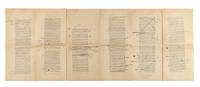
26139S.l. circa février 1903. 12 p. in-8 montées sur papier et formant un placard de 49 x 130 cm sous étui à rabats de Julie Nadot. . Rares épreuves corrigées de passages de La Bible d'Amiens pour la parution dans la revue littéraire La Renaissance latine du 15 février 1903. Nombreuses corrections autographes donnant plusieurs variantes inédites qui témoignent du soin méticuleux porté par Proust à cette traduction dont le succès l'encouragera à se prêter une seconde fois à l'exercice avec Le Sésame et les Lys deux ans plus tard. . Marcel Proust commence à s'intéresser aux ouvrages de Ruskin à l'automne 1899 dès son retour d'Évian-les-Bains en se plongeant dans la lecture intensive de celui qu'il appelle « ce grand homme » après avoir découvert le chapitre intitulé « La Lampe de la mémoire » des Sept Lampes de l'architecture. Une révélation. Quelques mois plus tard il apprend la mort la mort du critique d'art dans Le Figaro du 21 janvier 1900 et écrit immédiatement à Marie Nordlinger une ami anglaise de Manchester et cousine de Reynaldo Hahn lui exprimant outre sa tristesse son désir de pérennité des ouvrages de l'écrivain : il prépare alors plusieurs hommages à Ruskin sous formes d'articles nécrologiques et de notes qui deviendront avec des modifications amplifiées les péritextes de sa future traduction de La Bible d'Amiens. Les premiers - et seuls - extraits paraissent en février et mars 1903 un an avant la parution en volume. Le texte de ces épreuves évoquent des épisodes de l'hagiographie des saints Martin Geneviève et Jérôme et parurent dans la revue littéraire La Renaissance latine numéro du 15 février 1903 du Prince de Brancovan malgré les réticences de ce dernier qui le moquait encore le mois précédent pour sa traduction qu'il jugeait « légère ». Proust lui fera alors cette belle réponse : « Je crois que cette traduction non pas à cause de mon talent qui est nul mais de ma conscience qui a été infinie - sera une traduction comme il y en a très peu une véritable reconstitution . À force d'approfondir le sens de chaque mot la portée de chaque expression le lien de toutes les idées je suis arrivé à une connaissance si précise de ce texte que chaque fois que j'ai consulté un Anglais - ou un Français sachant à fond l'anglais - sur une difficulté quelconque - il était généralement une heure avant de voir surgir la difficulté et me félicitait de savoir l'anglais mieux qu'un Anglais. En quoi il se trompait. Je ne sais pas un mot d'anglais parlé et je ne lis pas bien l'anglais. Mais depuis quatre ans que je travaille sur la Bible d'Amiens je la sais entièrement par coeur et elle a pris pour moi ce degré d'assimilation complète de transparence absolue où se voient seulement les nébuleuses qui tiennent non à l'insuffisance de notre regard mais à l'irréductible obscurité de la pensée contemplée ». Mais la tâche fut ardue en effet puisque Proust connaît à peine l'anglais : sa mère fait le « mot à mot » qu'il remanie avec les conseils de Marie Nordlinger et de Robert d'Humières traducteur de Kipling. Au terme de ces longues années d'un travail acharné et d'un commentaire personnel sur l'art et la création Proust achève enfin sa préface la traduction et les notes dont certaines se développent sur plusieurs pages. L'ouvrage qui sera achevé un an plus tard en février 1904 portera une dédicace à Adrien Proust qui vient de mourir au lieu de celle destinée à Reynaldo Hahn : « à la mémoire de mon père frappé en travaillant le 24 novembre 1903 mort le 26 novembre cette traduction est dédiée ». Il s'en excusera dans la dédicace personnelle lorsqu'il offrira un exemplaire à Hahn « tant son petit Papa désirait le voir paraître que maintenant j'ai mieux aimé vous le retirer pour le lui offrir ». Proust néanmoins lui dédicacera la second texte de Ruskin qu'il traduira trois ans plus tard Les Sésames et les Lys. S.l., [circa février 1903]. 12 p. in-8, montées sur papier et formant un placard de 49 x 130 cm, sous étui à rabats de Julie unknown
189683<p>A BEAUTIFUL PRESENTATION COPY WARMLY INSCRIBED BY THE AUTHOR TO THE GREAT BIBLIOPHILE HORACE DE LANDAU.<i><u><br /></u></i> </p><p><b>PROUST</b><b> Marcel.</b> <i>Les Plaisirs et les jours</i><i>. </i><i>Illustrations de Madeleine Lemaire. Preface d'Anatole France. Quatre pieces pour piano de Reynaldo Hahn</i>.</p><p>Paris Calmann Levy 1896.</p><p>FIRST EDITION. 4to pp. 2 X 271 pp. 2; with 14 plates out of the text and several illustrations in the text. Landau's bookplate. <b>Beautiful dedication on the initial blank by </b><b>Proust to Baron Landau:</b> "A Monsieur Horace de Landau comme un hommage de ma respecteuse admirative et reconnaisante amitié Marcel Proust". Contemporary binding in half purple morocco publisher's printed wrappers preserved. Pasteboard slipcase. Fine copy.<br /><br /></p><p><i>Horace de Landau was an important 19th century banker and a great collector and bibliophile. Part of his famous library was donated to the city of Florence the other was auctioned by Hoepli in 1945.</i></p><p><i>The work is a collection of poems and prose on the world of the Parisian salons and cultural gatherings that Proust used to frequent. This is almost a representation in embryo of his immensely celebrated "Recherche".</i><br /></p> Calmann Levy
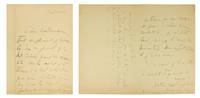
190484876s. l. 1904. Fine. Because I also want success I am extremely material in my wishes for those I love and I wish them every pleasure from the highest to the crudest. s. l. mardi 25 octobre 1904 12.60 x 20.40 cm 12 pages sur 3 bifeuillets Autograph letter signed by Marcel Proust addressed to René Peter. Twelve pages written in black ink on three bifolia framed in black. Tears at the ends along the folds of the bifolia not affecting the text. Published in Kolb IV n°168. A very long letter from Proust full of innuendo to the playwright René Peter. Praising Peter's success Proust confesses to his own vanity as a writer and his literary ambitions. He subtly lets his jealousy for Peter's mistress shine through and declares his absolute devotion to Reynaldo Hahn. This is one of the first letters he sends to his childhood friend after recently reconnecting with him. Proust eternally plagued by ailments remains a recluse and apologizes for missing the rehearsal of Peter's new play Le Chiffon. Peter's three-act comedy with music by Reynaldo Hahn premiered at the Athénée the following month and was a huge success with around sixty performances before the end of the year. The young Proust relies on the glowing opinion of Hahn who had attended the rehearsals and the missive becomes a love letter for the composer and his impeccable judgement: ""Reynaldo told me that your play was delightful and ravishing which is not quite the same thing that he laughed and cried in it as he never laughs or cries in the theater and that the language was exquisite. Of that I was certain. But knowing nothing about you I couldn't know if you had dramatic genius. I am certain of it now because even if I do not know a judge as severe as ridiculously severe as Reynaldo I also do not know one who has more taste giving his enthusiasm very great value in my eyes. In a characteristic tangle of confession and denial Proust barely hides his ambitions and his quest for recognition. He hopes and prays for the same laurels he places on Peter's head: your poor and charming mother who like all those who love and who have lived life bruising all our tenderness has suffered so much is witnessing this great happiness these first rays of glory on your charming forehead which Vauvenargues says softer as the rising sun. I only speak of them in quotations having never known them myself! He will even end up instilling his own literary vocation into the fictional life of the narrator of In Search of Lost Time although the narrator's journey as a man of letters is more marked by disappointments than rays of glory so long awaited by Proust himself. However it culminates in Time Regained with an epiphany: the narrator now knows what to write and above all how to write it. The letter marks the beginnings of the Proust-Peter-Hahn trio whose complicity was such that they formed a special vocabulary of which only they had the secret. The river of words in this letter perfectly illustrates the undeniable link between desire and intellectual admiration: Because I also want success I am extremely material in my wishes for those I love and I wish them every pleasure from the highest to the crudest. Despite these displays of generosity the writer cannot however mask a certain jealousy towards Robert Danceny the fictional co-author of Le Chiffon who was none other than Peter's mistress Mme Dansaërt. Proust elegantly but explicitly refers to her: It makes me happy to think that the charming woman who I am assured is hiding under the male name of your collaborator shares half of your work. I am not talking about your success because whether she worked with you or not she would always have shared your success with her heart having I believe a deep friendship for you. Typical of a Proust transposing his desires through fiction the writer will form various dramatic and morbid scenarios between Peter and this young woman in the following years: I unknown
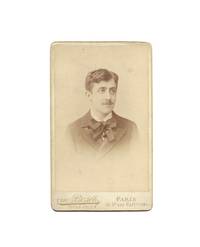
1891Proust11<p><strong>PROUST BOYER Paul 1861-1952</strong></p><p>Original photograph by Paul Boyer successor to Otto Van Bosch<br />Period albumin print c. 1891. Carte-de-visite format 90 x 58 mm laminated on thick cardboard with the photographer's name. Golden edges.<br />Some tiny spots annotations on verso<br />Mante-Proust collection stamp on verso<br />Very good original condition</p><p><strong>Famous portrait of young Marcel Proust by Paul Boyer the only known period print</strong></p><p>Like his portrait by Jacques-Émile Blanche painted at the same time we find here the same thin mustache and delicate face of the writer.<br />Portraitist Paul Boyer took over Otto Van Bosch's Paris studio in 1888. Located on Boulevard des Capucines and in Trouville he worked until 1909.</p><p><strong><u>This precious print was kept by the Proust family until 2016</u></strong></p><p><u>Bibliography:</u><br /><em>Proust. Documents iconographiques</em> – G. Cattaui Pierre Cailler 1956 n°35<br /><em>Passion Proust</em> – L'album d'une vie J. Picon Paris Textuel 1999 p. 46<br /><em>Marcel Proust</em> l'Arche et la Colombe M. Naturel Michel Lafon p. 59</p><p><u>Exhibition:</u><br />Marcel Proust BnF1965 n° 103 This print or the other pose taken during the same photo-session</p><p><u>Provenance:</u><br />-Famille Proust<br />-Then Suzy Mante-Proust Robert Proust's unique daughter by descent<br />-Then Patricia Mante-Proust Suzy Mante-Proust's unique grand-daughter by descent<br />-Then Private collection</p> hardcover
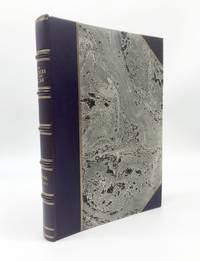
30855Paris Mercure de France 12 mai 1906. 1 vol. 135 x 190 mm de 224 p. 1 et 1 f. Demi-maroquin taupe à coins filets dorés sur les plats dos à nerfs ornés de caissons d'encadrement tête dorée date en pied couvertures et dos conservés reliure signée de Jean Duval. Édition originale de la traduction française par Marcel Proust. Longue préface inédite de Proust : « Sur la lecture ». Un des 12 premiers exemplaires sur hollande n° 9. Marcel Proust commence à s’intéresser aux ouvrages de Ruskin à l’automne 1899 lorsqu’il se plonge dans la lecture de celui qu’il appelle « ce grand homme » après avoir découvert le chapitre intitulé « La lampe de la mémoire » des Sept Lampes de l’architecture. Une révélation. Apprenant quelques mois plus tard la mort du critique d’art il écrit à Marie Nordlinger une amie anglaise cousine de Reynaldo Hahn pour lui exprimer outre sa tristesse son désir de pérennité des ouvrages de l’écrivain : il prépare alors plusieurs hommages à Ruskin sous forme d’articles nécrologiques et de notes qui deviendront avec des modifications amplifiées les péritextes de sa future traduction de la Bible d’Amiens. Une tâche ardue puisque Proust connaît à peine l’anglais : c’est madame Proust mère qui fait le ‘mot à mot’ collaborant ainsi d’une manière capitale à la traduction de La Bible d’Amiens. Malade elle fut remplacée par Marie Nordlinger dans ce rôle de défricheuse lorsque Proust aborda Sésame et les lys aidée par Robert d’Humières le traducteur de Kipling au Mercure de France. Après la mort de sa mère Proust reprit les épreuves et écrivit à Marie Nordlinger : « J’ai clos à jamais l’ère des traductions que Maman favorisait ». Il désirait de son propre aveu se consacrer à son œuvre personnelle et décide dans cette idée de faire précéder sa traduction d’une préface ô combien importante un texte délicieux intitulé « Sur la lecture » : « Il n’y a peut-être pas de jours de notre enfance que nous ayons si pleinement vécus que ceux que nous avons cru laisser sans les vivre ceux que nous avons passés avec un livre préféré. Je n’ai essayé dans cette préface que de réfléchir à mon tour sur le même sujet qu’avait traité Ruskin : l’utilité de la lecture. Ruskin a donné à sa conférence le titre symbolique de Sésame la parole magique qui ouvre la porte de la caverne des voleurs étant l’allégorie de la lecture qui nous ouvre la porte de ces trésors où est enfermée la plus précieuse sagesse des hommes : les livres ». Remaniées ces 52 pages prendront ensuite place dans Pastiches et mélanges sous le titre « Journée de lecture ». Précieux exemplaire sur hollande celui de Jeanne Jacquemin. Peintre autodidacte elle enflamme la critique à sa première exposition en 1892 et étonne par son physique androgyne et sensuel : la jeune femme rousse « aux yeux préraphaéliques » incarne parfaitement le symbolisme. Membre de la société de la Rose-Croix elle est admirée par Huysmans Verlaine Odilon Redon et noue avec Stéphane Mallarmé une relation d’amitié et d’admiration réciproque. La « peintresse aux yeux verts » ainsi qu’il la surnomme est souvent citée dans le Journal d’Edmond de Goncourt ; elle donnera plusieurs lithographies pour L’Estampe moderne et illustrera La Mandragore un « Conte de Noël » de Jean Lorrain publié en 1894. Dépressive elle est soignée par le docteur Samuel Pozzi le père français de la gynécologie qui connaissait à merveille le Tout-Paris. Amant de Sarah Bernard surnommé « Docteur Dieu » c’est un ami de la famille Proust ; du père le Pr. Adrien Proust épidémiologiste de renom comme de ses fils Robert qui fut son élève à l’hôpital Broca et Marcel à qui il procura en 1914 la dispense lui évitant d’être envoyé au front. Il encouragea le développement de la radiothérapie essentiellement à l’hôpital Tenon où le service d’oncologie-radiothérapie porte désormais son nom. Il soigna Jeanne Jacquemin des années durant. L’exemplaire passa ensuite entre les mains du libraire Ronald Davis – c’est probablement lui qui fit établir la reliure comme il fit exécuter à la fin des années 1920 tout un ensemble des œuvres de Proust Christie’s Londres 2007 lot n° 133 dont un Swann et ce volume sur hollande. Sur ce même papier on ne connaît par ailleurs que les exemplaires suivants : Léon Blum conservé à la BnF ; n° 2 reliure de Maylander collections Simonson-Hayoit-Leroy ; n° 8 collection R. et B. Loliée. Aucun des 12 ne figurait à l’exposition Proust et son temps de 1971. De la bibliothèque de Jeanne Jacquemin ex-libris. Paris, Mercure de France, (12 mai) 1906. 1 vol. (135 x 190 mm) de 224 p., [1] et 1 f. Demi-maroquin taupe à coins, filets doré unknown
190886094s. l. 1908. Fine. Proust and the future of pastiche: ""it seems to me that it could perhaps become a more discreet more fragile and more elegant form of literary criticism"" s. l. s. d. 1908 ou 1919 11.60 x 17.80 cm 4 pages sur un feuillet remplié Autograph letter signed by Marcel Proust to his friend Maurice de Fleury a psychiatrist and famed man of letters close to Émile Zola who wrote a collection of short stories as well as various medical works on neurasthenia insomnia epilepsy Chiara Carraro Philip Kolb. Four pages written in black on a bifolium with ""Island Mill"" watermark and framed in black. Usual traces of folds. Published in Kolb VIII no. 32 p. 74-75. Superb letter extolling the merits of literary pastiche by one of the greatest writers of the genre: Marcel Proust. The writing of this letter may coincide with the publication of Proust's series of pastiches on the Lemoine Affair a scam set up by a French engineer of that name who claimed to be able to make genuine diamonds. The articles were printed on the front page of the literary supplement of 'Le Figaro' between 1908 and 1909 or date from its publication in volume under the title 'Pastiches et mélanges' in 1919. The autograph letter is presented in a midnight blue half morocco chemise with marbled paper boards beige suede lined pastedowns and a slipcase edged with the same morocco. Proust warmly thanks his correspondent Maurice de Fleury whom he describes as a ""scholar and writer"" for his favorable reception of his ""little pastiches"": ""Your double merit should make you doubly severe: and you excuse pastiche that inferior genre!"" Votre double mérite devrait vous rendre doublement sévère : et vous excusez le pastiche ce genre inférieur ! acknowledging with irony the still precarious place of this unusual genre although popular during Proust's lifetime. Pastiche was perceived more as a stylistic musing or even a student exercise than a true creation worthy of literary praise. Yet here the writer considers it here a refreshing addition to the strict hierarchy of genres that still prevailed: ""Handled however by your hands more beautiful than mine it seems to me that it could perhaps become a more discreet more fragile and more elegant form of literary criticism. Very proud minds could devote themselves to it and very fine minds like yours very attached to greatness seriousness duty as wise could take pleasure in it and follow these games."" Manié pourtant par vos mains plus belles que les miennes il me semble qu'il pourrait peut-être devenir comme une forme indirecte plus discrète plus frêle et plus élégante de critique littéraire. Des esprits très fiers pourraient s'y adonner et des esprits très fins. comme le vôtre très attraché par la grandeur le sérieux le devoir aussi sage pourrait s'y plaire suivre ces jeux. With these words Proust asserts the interest of 'critical pastiche' which was already well established and acted as an empirical analysis of an author's style. Since his years as a student in Condorcet the writer had regularly indulged in this activity with according to him varying degrees of success: ""I have also sometimes made pastiches of medical literature! these writings are now lost If I could have found them again or started them again but all that is too far away I would have published them if I had known that you read this for fun. I don't need to tell you that considered inimitable you are not among the authors I pastiched. But . others are less perfect and combined some very interesting qualities with small flaws that could be imitated and caricatured."" J'ai été aussi quelques fois à faire des pastiches de littérature médicale ! Si j'avais pu les retrouver ou les recommencer mais tout cela est trop loin je les aurais publiés si j'avais su que vous lisiez cela pour vous amuser. Je n'ai pas besoin de vous dire que jugé inimitable vous n'y figurez pas. Mais . d'autres sont moins parf hardcover
191952983Paris: Nrf 1919. Fine. ""An homage of admiration"" by Proust Nrf Paris 1919 13 x 19 cm broché sous chemise-étui First edition on ordinary paper despite a false statement of third edition. Handsome copy signed and inscribed by Marcel Proust to René Boylesve. Housed in a half kaki morocco over marbled paper boards chemise and slipcase with flaps spine very slighlty faded with gilt inscriptions of provenance at foot lined with light green paper. One very pale angular dampstain. Provenance : Heilbronn's library with his ex-libris. René Boylesve discovered the work of Marcel Proust in 1913 upon the publication of the first volume of the Recherche. Initially disconcerted by Proust's writing he soon became an enthusiastic admirer: ""Our own writing is ruined by his. We have labored in vain. Proust obliterates the literature of the past fifty years"" quoted by Émile Gérard-Gailly ""Note liminaire"" in René Boylesve Marcel Proust Quelques échanges et témoignages 1931 p. 24. As for Proust his admiration for Boylesve mentioned in this copy's inscription is not feigned; a few months before his death Proust praised Boylesve's novels celebrating not only ""an art seemingly so simple yet saying everything"" but also ""a supreme refinement of technique"" Marcel Proust Correspondance vols. XX and XXI 1991 pp. 332 and 778. The two men were not close but corresponded from 1917 onward. In sending Boylesve a copy of his Pastiches et mélanges Proust must have delighted him: aside from his activies as a writer Boylesve was a seasoned bibliophile. Thus regarding another of his works Proust showed this delicate consideration: ""I had some hesitation concerning your copy. Usually those printed for me without publisher's mark are somewhat finer than the 'regular copies.' This time the superiority is not apparent to me; and as I am incapable of distinguishing 'pur fil' from the rest I do not know which of the two sorts of copies is preferable. . You would be infinitely kind to tell me what you would like. It is because I know you to be a bibliophile that I write to you about a book of mine a matter of little importance ."" Marcel Proust op. cit. vol. XXII pp. 156-157. Nrf hardcover
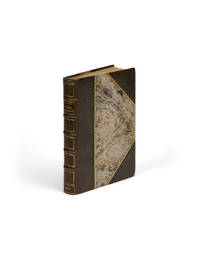
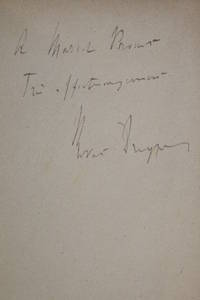
1919640315Paris: Editions de la Nouvelle Revue Française 1919. Very Good. octavo. First edition on standard paper despite a false statement of third edition. Signed by Proust to a blank preliminary page and dedicated to the novelist Lucien Descaves who was a member of the Prix Goncourt and who actually voted against Proust in 1919 the year he was awarded the prize for 'À l’ombre des jeunes filles en fleurs'. There is no evidence that the two novelists ever met but Proust did send Descaves signed copies of all of his books from 'Du côté de chez Swann' onwards. This copy has been beautifully rebound in three quarter calf over marbled boards with gilt top edge by Goy & Vilaine with the original covers bound in and with matching slip-case. An absolutely stunning copy of Proust's playful accounts of the Lemoine case. Editions de la Nouvelle Revue Française hardcover
1908020055Versailles @6 October 1908. Letter. Creases from folding light edge toning. Near Fine. AUTOGRAPH LETTER SIGNED "Marcel Proust." Four pages of a bifolium 5" x 8" undated circa October 6 1908. Written on mourning stationary and addressed to Max Daireaux a man 13 years his junior whom he had met earlier that year in Cabourg France the inspiration for the resort town of Balbec in Proust's novel REMEMBRANCE OF THINGS PAST À LA RECHERCHE DU TEMPS PERDU. Though undated the letter has been identified as being written shortly before writing his magnum opus. An English translation: "I had written you a tender letter and one which with a pride to which I am not accustomed I believed to be witty! And for six days now we have been searching for it around the bed under the bed which I cannot rise from I have been suffering more in the time since I came to Versailles than I have in years - what a life! and cannot find it. So I resign myself to considering these affectionate secrets these farcical stories burned and I write to you to tell you that I am here. Some evening when you have nothing to do call and ask if I can receive you for dinner in my room dinner is the only possible way. Surely they will tell you that I am too ill. But in fact it may happen that I get better although it seems to depend on the air the weather etc. The first days I fought back I was even in Paris once in a strange way that I will recount to you and since then it has been impossible to even speak. And my poor Lauris is severely wounded in Paris - I returned for him and I cannot go see him. But this could get better; call around 6:30 PM such that if I am up to it you would be there around 7:30 because after 8 it becomes impossible to get anything to eat. Dear friend you did not get my letter so you will never know the poem that I sent you which began with these lines: <br /> <br />My heart previously gentle chooses from this night on <br />To hate you forever lady Spinelly <br />And I so would love to see an omnibus <br />On the body of the so-called Dolfus. <br /> <br />And you will not know the conversations with Reynaldo who told me 'The fact that the Comedie Royale is the first theater that you took interest in is no reason for you to believe that no others exist.' And you will not know that I am back in love they don't know anything with the two sisters born Berthier that I furthermore have not seen again. And you will not know that d'Alton had a riding accident from which he has more or less recovered. But certainly you know that. Dear friend no one will ever know that letter not even the person to whom a beloved memory dictated it. It's infuriating.Send a message to tell me if you received this from me because I'm not sure of the house number on Vernet Street." <br/><br/>Documented in Kolb's archive of Proust letters Vol. VIII number 127. unknown
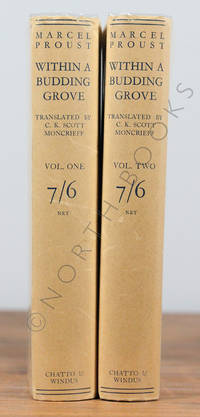
74831London: Chatto and Windus and Alfred A. Knopf 1922-31. Modern literature in translation COMPLETE FIRST EDITIONS IN ENGLISH first impressions. Complete in 11 volumes 19 x 14 x 42cm. Handsomely bound in half dark blue calf with twin brown morocco title labels lettered in gilt five raised bands gilt rules matching blue cloth-covered sides sewn endbands and top edges gilt. Contents clean but for some light expected foxing exteriors unmarked. A scarce set in an attractive recent leather binding. The author's most prominent and influential literary work now difficult to find in the first English translation. London: Chatto and Windus and Alfred A. Knopf, 1922-31 unknown
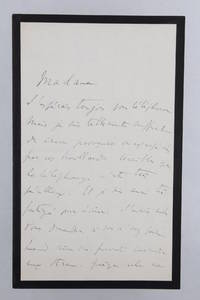
190783638s. l. 1907. Fine. ""New Year's Day is just an occasion for me -- as if occasions were needed! -- to reminisce and weep"" s. l. s. d. ca 1907 12.60 x 20.40 cm 3 pages sur un double feuillet Autograph letter signed to Madame Catusse 126x204cm 3 pages on a double leaf. Autograph letter signed by Marcel Proust probably addressed to Madame Catusse. The recipient and date have been determined by Proust scholar Jean-Yves Tadié. Three pages in black ink on a double leaf edged in black. A fold inherent to the mailing. A sombre and admirable letter steeped in Proustian melancholy. The future author of In Search of Lost Time feels more than ever the loss of his mother during the New Year period. The famously generous Proust also asks his faithful confidante Madame Catusse to buy a gift for the Straus couple whose wife inspired the character of the Comtesse de Guermantes. The end of 1907 apparent date of this letter alluding to the approaching New Year marks the second holiday season spent without Madame Proust who had died two years earlier: ""New Year's Day is only an occasion for me - as if occasions were needed! -- to reminisce and weep"". Proust had also expressed this sentiment in a letter to Anna de Noailles the year before ""New Year's Day had a terrible evocative power over me. It suddenly gave me back the memories of Maman that I had lost the memory of her voice"" February 1906. This fateful moment acted on Proust like a pernicious madeleine at once a sensory reminiscence and an acute awareness of his loss. He would soon begin writing In Search of Lost Time to conjure up this mother figure whose absence would remain unbearable. For the time being Proust is busy writing a series of Pastiches for Le Figaro ""which were in reality only a penultimate detour before writing La Recherche"" George D. Painter. One of these Pastiches dealt with the swindle perpetrated on the president of De Beers in which Proust had invested. Imagining himself already ruined he mentions these unfortunate circumstances in capital letters: ""HAVE I REPORTED MY FINANCIAL DESASTERS TO YOU OVER THE TELEPHONE ."" Overwhelmed by ailments he is also plagued by one of his many asthma attacks ""provoked or exasperated by these terrible fogs"" forcing him into reclusion and even silence: ""telephoning is very dangerous for me. And I'm also very tired when it comes to writing"". The recipient Mme Catusse was a friend of Proust's mother and became an invaluable support to the writer. Proust's prolific correspondence with the woman Ghislain de Diesbach had dubbed the writer's Notre-Dame-des-Corvées represents an inexhaustible resource of insights into his secret life and fears. Proust had called her in a panic during an aphasia attack suffered by his mother shortly before her death. As he became increasingly isolated after moving into 102 boulevard Haussmann the previous year Proust sought her help in many matters including the purchase of numerous gifts: ""I would have liked to ask you if you had by any chance seen anything suitable for the Straus although I always dislike coinciding with New Year's Day"". This sentiment would inspire a passage in The Captive castigating those same ""New Year's Day presents"" given to Madame Verdurin: ""those singular and superfluous objects which still appear to have been just taken from the box in which they were offered and remain for ever what they were at first"" The Captive C.K. Scott Moncrieff's Translation Edited and Annotated by William C. Carter Yale University Press 2023 p. 308. Known for his frenzied displays of prodigality Proust overcomes his aversion to these occasional gifts. The smallest favor to the writer gave rise to extravagant expenses. Lawyer Emile Straus had probably helped the writer sort out his inheritance affairs: ""I FEEL THAT THE NUMEROUS SERVICES PROVIDED TO ME BY MR. STRAUS CANNOT REMAIN WITHOUT THANKS since I believe he would not accept a fee. If you happened to have seen something very unknown
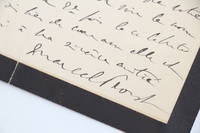
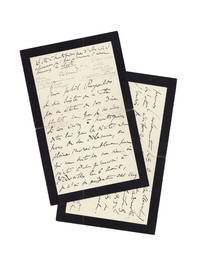
1907Proust15<p><strong>PROUST Marcel 1971-1922</strong></p><p>Autograph letter signed " Marcel " to Reynaldo Hahn<br />N.p.n.d " Monday " 7th January 1907 8 p. in-8° in black in on mourning paper two bi-folios watermark " L. T. & C° "<br />Small annotation in pencil in the upper margin of the first page period fold marks<br />Slight discharges of ink on the first bi-folio testifying to a folding by Proust when the ink was not yet dry.</p><p><strong>A precious letter to Reynaldo Hahn his "Bunchnibuls" about his relationship with Robert de Montesquiou and the latter's late lover Gabriel de Yturri the one who inspired Proust for the character of Jupien in <em>The Search</em></strong></p><p><em>" Mon petit Reynaldo</em><br /><em>Je suis triste de n'être pas en état de vous dire plutôt ce que je vous écris. <strong>Si vous écrivez à Montesquiou dites-lui que la vérité est hors de son dilemme en pleine invraisemblance pour qui ne sait pas ma vie</strong>. La vérité c'est qu'arrivé à Versailles le 6 Août je n'ai pas pendant ces cinq mois été une seule fois capable de sortir. <strong>Je n'ai pas été une seule fois au Château pas une seule fois à Trianon</strong> mais du reste vous savez bien tout cela pas une seule fois au cimetière des Gonards. Si je n'avais eu qu'un seul jour de bon je serais allé plutôt qu'au Château et à Trianon aux Gonards <strong>surtout M. de Montesquiou n'étant pas à Versailles ne pouvant pas y aller j'aurais eu un sentiment très doux en me disant que je le remplaçais</strong></em> <strong><em>que je venais de sa part auprès du pauvre Yturri comme lui si souvent vint de la part de M. de Montesquiou auprès de moi</em></strong><em>. Et puis je savais par vous par d'autres que c'était une tombe unique d'émotion et de beauté2. Et comme je ne pense plus guères qu'aux tombeaux j'aurais bien voulu voir ce que Montesquiou avait fait là et comment son goût avait réussi à donner plus de noblesse encore à sa douleur. <strong>Quand il sera revenu à Paris ou à Versailles je me soignerai pour tâcher de le voir un soir mais outre que c'est impossible pour tout le monde avec lui la difficulté avec lui</strong>3 <strong>grandit encore car c'est la personne du monde avec qui je me gêne le plus dans le mauvais sens du mot</strong>. Et même s'il se prête pour une fois à mes heures la possibilité d'une crise intempestive m'empêchera d'oser lui donner un rendez-vous que j'aimerais mieux mourir que rompre tandis que d'autres comprendraient. <strong>Vous pouvez lui dire que j'ai eu une grande joie à recevoir les Hortensias bleus que je n'avais jamais tant aimés</strong>4. Les pièces du début m'ont paru plus exquises qu'autrefois. Quant à l'Ancilla dont je vous ai appliqué ce fragment dernièrement5 c'est une chose admirable un magnifique pendant de La servante au grand cœur6. Il me semble mais je n'en suis pas sûr que la pièce à Yturri a été retouchée et peut'être pas améliorée. Elle reste peut'être ce qu'il a jamais écrit de mieux mais je ne me rappelle pas que la couronne fût verte la première fois et je ne sais pas si c'est mieux ainsi7. <strong>Inutile de lui dire cela d'abord parce qu'il s'en ficherait complètement</strong> ensuite parce que c'est un doute très vague et que je ne suis pas du tout sûr d'avoir raison.</em><br /><em>Avez-vous été interrogé par les Lettres au sujet de Shakespeare Tolstoï8. Je suis trop souffrant pour répondre je ne peux pas vous dire ce que rien qu'une lettre comme celle-ci m'épuise. Plusieurs personnes notamment Me G. de Caillavet m'ont écrit que votre Noël était adorable9. <strong>J'aurais bien voulu l'entendre Bunchnibuls et suis triste de n'avoir pas pu</strong>. Dites à M. de Montesquiou que je n'ai même pas pu aller à l'enterrement de mon pauvre oncle10.</em><br /><em>Tendrement à vous</em><br /><em>Marcel.</em><br /><em>Vous pouvez dire à M. de Montesquiou que je n'ai pas été une seule fois assez bien pour voir Miss Deacon qui habitait le même hôtel11.</em><br /><em>Dites à Montesquiou que d'ailleurs cela n'intéressera pas que je commence à aimer beaucoup les objets12. "</em></p><p>1- Letter dated "Monday"; must date either from Monday 31 December 1906 or from Monday 7 January 1907: allusion to the news that Proust had of a performance of the recipient's Christmas see infra note n°9</p><p>2- In a letter to Montesquiou dated November 18 1905 Proust apologized for not having been able to attend the inauguration of the monument in honor of Gabriel de Yturri: " I would have liked my strength to allow me to unite with the little group… ". Robert de Montesquiou died on 11 December 1921 and was buried in the same vault as his companion.</p><p>3- By slip Proust repeats "with him"</p><p>4- <em>Les Hortensias bleus</em>. Definitive edition with portrait of the author after a painting by Laszlo. Paris 1906. It is the first volume of the poet's definitive work published in December 1906 by Georges Richard 7 rue Cadet. The first edition of the work had appeared in 1896.</p><p>5- In a letter to the same recipient dated December 13 1906 Proust quoted some verses from Montesquiou that he had slightly modified.</p><p>6- Baudelaire<em> Les Fleurs du Mal</em> <em>Tableaux parisiens</em> vol. 1 ed. Claude Pichois Pléiade p. 100:<br /><em>La servante au grand cœur dont vous étiez jalouse </em><br /><em>Et qui dort son sommeil sous une humble pelouse</em><br /><em>Nous devrions pourtant lui porter quelques fleurs.</em> …</p><p>7- An allusion to the sonnet In Memoriam which Montesquiou placed after the preface to the collection in question a piece entitled In Memory of Gabriel de Yturri. It begins:<br /><em>Mes sentiments pour Vous sont fiers d'être éternels; </em><br /><em>Ils ont assez duré pour avoir fait leur preuve </em><br /><em>Sérieux dans la joie et sereins sous l'épreuve</em><br /><em>Et sans jamais mentir aux pactes fraternels.</em><br /><em>Chacun de nous eut droit à sa verte couronne: </em><br /><em>La mienne je l'espère et l'attends sans émoi; </em><br /><em>La vôtre si d'avance ici je vous la donne </em><br /><em>Recevez-la sans trouble en la tenant de moi.</em></p><p>8- The magazine <em>Les Lettres</em> had asked some French writers and artists for their opinion on this judgment of Tolstoy reported by Georges Bourdon in his book <em>Listening to Tolstoy</em> 1904</p><p>9- Allusion to the performance given at the home of Mrs. Madeleine Lemaire on New Year's Eve. It is apparently the <em>Pastorale de Noël</em> a mystery in one act by Arnous Grevan adapted by Leonel de La Tourasse and Taurines with piano accompaniment by Reynaldo Hahn.</p><p>10- This is Georges Denis Weil brother of Jeanne Weil-Proust. The funeral took place on August 27 1906. It was Robert Proust Marcel's brother who went there to lead the mourning.</p><p>11- Gladys-Mary Deacon daughter of Edward Parker Deacon and Florence Baldwin</p><p>12- A play on words it seems alluding to both trinkets and Montesquiou's poem entitled <em>Objets</em>. Cf. <em>Les Hortensias bleus</em> LXXVI of the 1896 edition; LXXII of the definitive edition of 1906.</p><p>We know Hahn's letter to Montesquiou now in the Montesquiou collection at the BnF sent the next day or the day after in which he forwards Proust's request:<br />"Dear Sir I have communicated your letter to Marcel. I am sending you his reply this letter. I haven't seen him for several days. It is alas all too true that not once did he go out at Versailles … "</p><p>It was at Madeleine Lemaire's house on April 13 1893 that Marcel Proust met Robert de Montesquiou. The latter portrayed as the Baron de Charlus in <em>The Search</em> a character of irascible character and sharp verve made a completely different impression on Proust during this first meeting. A dandy with a pure profile a fascinating look… Proust fell under the admiration of Montesquiou and a current of sympathy was established between them. . This admiration was followed by a friendship that lasted until the last days of the dandy-poet in 1921.<br />Montesquiou is known to have had only one affair: that with his much-loved and mourned secretary Gabriel de Yturri. He died of diabetes on July 6 1905.</p><p>This is a remarkable testimony of intersecting relationships each of the people mentioned here inspiring Proust for major figures in <em>The Search</em>.</p><p><u>Provenance:</u><br /><em>Autographes littéraires et historiques Lettres de Marcel Proust</em> Marie Nordlinger Drouot 15th – 17th December 1958 lot 188.<br />After Reynaldo Hahn his cousin Marie Nordlinger who had helped Marcel Proust in his translation of Ruskin inherited it.</p><p><u>Bibliographie :</u><br /><em>Correspondance</em> t. VII Kolb Plon n°5<br /><em>Lettres à Reynaldo Hahn</em> éd. Philip Kolb Gallimard LXXVIII</p><p><u>Source :</u><br /><em>Marcel Proust I</em> – Biographie Jean-Yves Tadié Folio pp. 283-295</p>
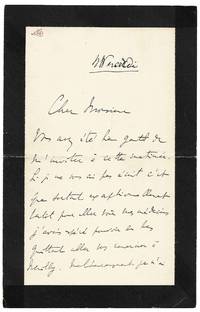
1904Proust29<p><strong>PROUST Marcel 1871-1922</strong></p><p>Autograph letter signed " Marcel Proust " to Robert de Montesquiou<br />N.p September 7 1904 4 pp. in-8° mourning paper<br />Montesquiou's stamp on top left corner<br />Tears on folds annotation in pencil on fourth page</p><p><strong>Proust makes a scathing assessment of Italy and the preservation of its heritage in an astonishing letter to his mentor</strong></p><p><em>" Cher Monsieur<br />Vous avez été bien gentil de m'inviter à cette matinée. Si je ne vous ai pas écrit c'est que sortant exceptionnellement tantôt pour aller voir mes médecins j'avais espéré pouvoir en les quittant aller vous remercier à Neuilly. Malheureusement je n'ai été libre qu'à 7 heures. <strong>J'aurai ces jours-ci par Reynaldo de beaux récits qui préciseront mes regrets</strong></em> d'après le compte rendu du <em>Figaro</em> du lendemain Hahn a ravi l'auditoire avec ses compositions. <strong><em>Et dire que c'est peut-être la seule fois que vous m'inviterez !</em></strong><em> Mes rendez-vous avec ces médecins étaient pris et comme j'étais souffrant cela m'a fait de sortir beaucoup plus de mal qu'ils ne me feront jamais de bien. On m'a parlé avec la vague déformation que prennent les bruits quand ils arrivent jusqu'à ma chambre de malade des conférences que vous feriez en Italie. Malgré ce que vous m'avez dit en faveur de l'évangélisation plus efficace d'une terre inesthétique comme l'Amérique je pense que les " Conférences d'Italie " seront plus glorieuses encore<strong>. La véritable terre inesthétique n'est pas celle que l'art n'ensemença pas mais celle qui couverte de chefs-d'œuvre ne sait ni les aimer ni même les conserver et laisse les Tintoret s'effacer peu à peu sous la pluie quand elle ne les repeint pas entièrement qui détruit pièce à pièce ses plus beaux palais pour en vendre les morceaux très cher par cupidité ou pour rien par ignorance de leur valeur. La vraie terre inesthétique n'est pas la terre vierge en qui l'art habite du moins par le désir qu'elle en a mais la terre morte où l'art n'habite plus par la satiété le dégoût et l'incompréhension qu'elle en a</strong>. Et je suis sûr que votre <u>Épitre aux Romains</u> ne sera pas moins belle que votre <u>Message à l'Église de Philadelphie</u> </em>allusion au voyage de Montesquiou aux États-Unis l'année précédente<em>.<br />Votre respectueux<br />Marcel Proust "</em></p><p>The missed meeting by Proust seems to be the morning that Montesquiou gave at the Pavillon des Muses in honor of the Italian writer Mathilde Serao on Wednesday December 7 1904. This morning was announced in <em>Le Figaro</em> of Tuesday December 6 1904 the report was given the day after in the same newspaper.<br />It is not surprising that Proust here insistently expresses strong feelings about Italy and its most famous Venetian painter he whose translation of Ruskin's <em>The Bible of Amiens</em> had just been published at the beginning of 1904 in the <em>Mercure de France</em>. Touched by the work of the English author which he discovered in 1898 thanks to his friend Robert de Billy Proust undertook several "Ruskinian" pilgrimages at the same time as he was working on the translation helped by his mother Jeanne Weil. He went to the north of France to Amiens and especially to Venice. He visited the lakeside city twice in 1900 once in April and again in November. The country its history its works… Proust's fascination with Italy is not only due to the chapter he devotes to it in <em>Le Temps retrouvé</em>. It first emanates significantly through Ruskin's work.<br />Had the writer been aware of Tintoretto's monumental <em>Paradise</em> clumsily "detached" from the Doge's Palace in 1903 when he writes an unflattering critique of the way Italy preserved the paintings of its masters Or was it an observation of his own experience during his two trips to Venice and its surroundings In any case the craze among American collectors for European paintings those of "the virgin land in which art lives" had been in full swing for many years already.</p><p><u>Provenance:<br /></u>Robert de Montesquiou<br />Robert Proust who bought all of his brother's letters after Montesquiou's death<br />Suzy-Mante Proust's estate</p><p><u>Bibliography:</u><br /><em>Correspondance générale</em> t. I éd. Robert Proust et Paul Brach Plon p. 179-180 n°CLXXIV incorrect transcription on one word<br /><em>Correspondance</em> t. IV éd. Philip Kolb Plon n°202</p>
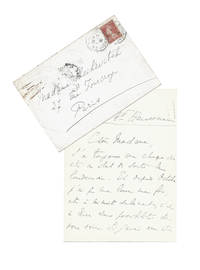
1915Proust14<p><strong>PROUST Marcel 1871-1922</strong></p><p>Autograph letter signed " Marcel Proust " to Marie Scheikévitch<br />Paris 102 boulevard Haussmann 1st February 1915 post mark 4 p. in-8° in black in on laid paper<br />With autograph envelope<br />Paper clip marks on upper margin and envelope see scans</p><p><strong>With compunction Proust prefers to suffer in bed rather than lead an "easy life" and thinks of the soldiers mobilized at the front</strong></p><p><em>" Chère Madame</em><br /><em>J'ai toujours cru chaque soir être en état de sortir le lendemain. Et depuis octobre j'ai pu me lever une fois et à minuit seulement</em>1<em> c'est à dire sans possibilité de vous voir. Si j'avais cru être aussi incapable de bouger je vous aurais écrit plus tôt. Mais je ne voulais pas vous répondre qu'il m'était impossible de fixer d'avance un jour mes crises étant si imprévues parce que j'espérais que cela allais devenir possible. <strong>L'expérience du passé ne m'a pas découragé d'espérer un avenir qui ne lui ressemble pas</strong>. Et même maintenant au moment où je vous écris cette lettre j'espère encore qu'une chance me permettra de vous la porter.</em><br /><strong><em>En attendant je ne cesse de penser à vous</em></strong><em>. Je mets tout mon espoir dans votre fils</em>2<em> et je pense que seule au monde sa faiblesse aura la force de vous aider à porter votre croix. Tout ce que vous me dites du frère que vous avez perdu et que je ne savais pas rend mon chagrin plus vif encore en me faisant mieux imaginer votre désespoir</em>3<em>. Mais la décision de votre plus jeune frère me navre</em>4<em>. Je l'admire. Mais j'aurais préféré que sa douleur se consacrât à la vôtre au lieu de l'accroître d'une telle angoisse.</em><br /><em>En attendant qu'on se décide à me faire passer un conseil de contre-réforme qui ne saurait je crois tarder <strong>je bénis la maladie de me faire souffrir car si cette souffrance ne sert à personne du moins elle m'évite celle plus grande que me donnerait le bien-être la vie facile pendant que souffrent et meurent tous ceux que ma pensée ne quitte pas</strong>. </em><br /><em>Quand vous aurez le temps de dicter pour moi une une ligne où vous me diriez "mon frère va bien et est moins exposé mon fils va bien j'ai du courage" vous rendrez bien heureux votre respectueux admirateur. </em><br /><em>Marcel Proust "</em></p><p>1 – Proust went to Madame Edwards's house that evening at midnight as he states in a letter to Lucien Daudet sent the night before.</p><p>2 – André Carolus-Duran 1902-1972 son of Marie Scheikévitch</p><p>3 – This is one of Mrs. Scheikovich's brothers Victor Scheikovich 1885-1914 a lawyer at the Court of Paris who fell a few days after being proposed as captain on 15 September 1914 at Tracy-le-Val</p><p>4 – Here is the youngest brother of Mrs. Sheikevich Valentin Sheikevich. He had left as medical officer of a battalion of cyclists attached along the way to General Lanrezac's staff and had just been sent to the front line at his request as surgeon-major of the 2nd Infantry Battalion Mangin division. He was to be cited at Neuville-Saint-Vaast.</p><p><u>Proust and the War:</u></p><p>This letter was a direct follow-up to the one sent to Marie Scheikovich three weeks earlier on 9 January. Proust was shocked to learn of the death of Victor Scheikévich the younger brother of his correspondent who had been killed at the front in the early hours of the war. He is sorry to know that her younger brother Valentin Sheikevich has also been mobilized.<u><br /></u>When the war came the writer was in the middle of writing the sequel to <em>Swann's way </em>which had been published in November 1913. He was not called to the front because of illness and followed the progress of the conflict from his Parisian apartment at 102 boulevard Haussmann. The conflict as we know had a direct impact on the course of his novel. He turned the church of Combray into a German observatory which was destroyed by the French and the English.</p><p><em>"Proust was following closely the entire duration of the conflict in the first place to study the behavior of the society that he frequented during the war. He reads seven newspapers a day … war is a constant concern"</em> Nathalie Mauriac Dyer</p><p><u>An intimate of Proust who did much effort in using her network for the publication of the first volume of <em>The Search</em> :</u></p><p>Marie Scheikevitch 1882-1964 was the daughter of a wealthy Russian magistrate and art collector who settled in France in 1896. George D. Painter described her as "one of the smartest and most prominent ladies of the new generation." Patron of artists and writers she frequented salons and then founded her own. She was friends with Jean Cocteau Anna de Noailles Reynaldo Hahn the Arman de Caillavet family among others.<br />A feeling of singular quality united Marcel Proust to Marie Scheikévitch. Although they met briefly in 1905 in Mme Lemaire's salon it was in 1912 that they really get to know eachother. There followed a correspondence that lasted until 1922 the year of the writer's death. Seeing each other "almost every day" as she would later say friends writing all the less as they see each other more we know only 28 letters from Proust addressed to her.<br />She opened to him the doors of her salon frequented by all that Paris had of illustrious personalities in literature and arts so that he paid tribute to her in <em>Sodome et Gomorrhe</em> under the veil of Madame Timoléon d'Amoncourt "a charming little woman of a spirit like her beauty so ravishing that only one of the two would have succeeded in pleasing ".<br />A fervent admirer of the writer she spent a great deal at the time of the publication of the first volume of <em>The Search</em> trying everything to put Proust in touch with the Parisian personalities she considered most capable of helping him. It was she who recommended him to her lover Adrien Hébrard the influential director of the newspaper <em>Le Temps</em> to obtain the famous interview of November 12 1913 by Élie-Joseph Bois on the eve of <em>Swann</em>'s publication: This was the first significant article published in the major press and devoted to <em>The Search</em>. To thank her Proust sent her a major inscription recently acquired by the BnF when Swann was published.</p><p><u>Provenance:</u><br />Catalogue Andrieux vente du 12 mars 1928 n°175</p><p><u>Bibliography:</u><br /><em>Lettres à Madame Scheikévitch</em> 1928 p. 51 – 52<br /><em>Correspondance</em> Kolb t. XIV n°15</p><p><u>Source:</u><br /><em>Marcel Proust II</em> – Biographie Jean-Yves Tadié Folio pp. 391-392</p>
191889560Paris: Nrf 1918. Fine. Nrf Paris 1918 12.8 x 19.5 cm Relié First edition on ordinary paper without edition statement bearing the correct colophon dated 30 November 1918. The 128 deluxe paper copies would only be issued six months later during the summer of 1919. Light spotting to the margins of the endleaves small l and a faint dampstain to the title page and following leaves a bluish stain to the margins of pp. 339-340 inherent to the quality of the paper. Bound in contemporary half forest-green morocco over corners spine with five raised bands ruled in black gilt date at foot cats-eye patterned paper boards comb-marbled endpapers and pastedowns original wrappers and spine preserved top edge gilt binding signed by Huser. A handsome copy in a well-executed binding. Nrf hardcover
19071240261907. Paris: after October 7 1907. <br /> <br /> 3 pp. sm. 8vo 4 1/2 x 7 ins. Written in ink slightly faded on paper watermarked "AU PRINTEMPS PARIS NOUVEAU PAPIER FRANCAIS".<br /> <br /> § A fine personal letter written by Proust to Marie-Marguerite Catusse née Bertin his mother's dearest friend and his own close friend and confidante especially after his mother's death.<br /> <br /> In the letter he describes reading about a recent duel in which a witness was named as M. Catusse and which he briefly and wrongly supposed to be her son Charles Catusse. Later in the letter he makes a wonderfully coy reference to Lucien Daudet: "J'ai recu directement des lettres très nobles d'un sentiment très élevé d'une extreme intelligence de Lucien Daudet. Je vous assure qu'il n'est pas du tout comme vous croyez."<br /> <br /> A certain piquancy is added to the letter when it is remembered that ten years earlier in 1897 Proust had himself fought a duel with writer Jean Lorrain after Lorrain publicly questioned the nature of Proust's relationship with Lucien Daudet.<br /> <br /> "Monomotopa" and the verse quoted are from a fable of La Fontaine.<br /> <br /> The letter was recorded by Philip Kolb in his Correspondance de Marcel Proust Vol. VII 1907 p. 291 Plon 1981: n. 163 à Mme Catusse.<br /> <br /> ---<br /> <br /> The letter reads in full:<br /> <br /> Chère Madame<br /> <br /> Tout simplement j'avais lu dans un journal qu'un M. Catusse que j'ai supposé être Charles avait été témoin d'un duel entre deux jeunes gens. Sachant que dans ce cas les mères s'alarment facilement et craignent que de témoin on ne risque de passer à celui de combattant je m'étais levé comme l'ami de Monomotapa dans La Fontaine et j'avais couru.<br /> <br /> "J'ai craint qu'il ne fût vrai je suis vite accouru.<br /> Ce maudit songe en est la cause. » <br /> <br /> Votre respectueux ami Marcel.<br /> <br /> Je n'ai jamais reçu la carte dont vous me parlez et la regrette bien.<br /> <br /> J'ai reçu directement des lettres très nobles d'un sentiment très élevé d'une extrême intelligence de Lucien Daudet.<br /> <br /> Je vous assure qu'il n'est pas du tout comme vous croyez.<br /> <br /> <br /> -----. unknown
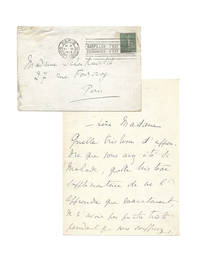
1918Proust21<p><strong>PROUST Marcel 1871-1922</strong></p><p>Autograph letter signed " Marcel Proust " to Marie Scheikévitch<br />Paris 21st November 1918 4 p. in-8°<br />With autograph envelope stamped and obliterated<br />Clipper mark previously mounted see scans</p><p><strong>Having just been informed that Marie Scheikévitch had survived the Spanish flu Proust hastens to write to the lady who had once helped him with the publication of <em>Swann's way</em></strong></p><p><em>" Chère Madame</em><br /><em>Quelle tristesse d'apprendre que vous avez été si malade quelle tristesse supplémentaire de ne l'apprendre que maintenant de n'avoir pu être triste pendant que vous souffriez puisque je ne savais rien. <strong>Comment ne l'ai-je pas su Probablement parce que j'ai vu si rarement la Princesse Soutzo et au milieu de tant de monde et c'est elle qui vient de me l'apprendre.</strong></em><br /><em>C'est d'une manière rétrospective maintenant que vous êtes guérie qu'il me faut par l'imagination remonter en sens inverse de votre calvaire dormir ou plutôt ne pas dormir vos nuits de fièvre. <strong>La condition humaine est si perfidement méchante</strong> que comme si ce n'était pas assez pénible pour moi d'avoir à m'attrister sur vous avec mon amitié d'aujourd'hui le passé de votre souffrance me rend pour un moment mon amitié plus vive qu'il y a un an. C'est avec celle-là que je compatis à tous les malaises que vous avez eus ce qui me force à donner une force maximum de compassion alors que celle que dicterait le feuillet actuel du calendrier de mon amitié serait déjà assez triste ! Enfin vous êtes guérie Dieu merci. Et quelles jolies choses vous avez dû penser durant les heures délicieuses et neuves de convalescence.</em><br /><em>Votre respectueux ami</em><br /><em>Marcel Proust "</em></p><p><u>An intimate of Proust who did much effort in using her network for the publication of the first volume of <em>The Search</em> :</u><br />Marie Scheikevitch 1882-1964 was the daughter of a wealthy Russian magistrate and art collector who settled in France in 1896. George D. Painter described her as "one of the smartest and most prominent ladies of the new generation." Patron of artists and writers she frequented salons and then founded her own. She was friends with Jean Cocteau Anna de Noailles Reynaldo Hahn the Arman de Caillavet family among others.<br />A feeling of singular quality united Marcel Proust to Marie Scheikévitch. Although they met briefly in 1905 in Mme Lemaire's salon it was in 1912 that they really get to know eachother. There followed a correspondence that lasted until 1922 the year of the writer's death. Seeing each other "almost every day" as she would later say friends writing all the less as they see each other more we know only 28 letters from Proust addressed to her.<br />She opened to him the doors of her salon frequented by all that Paris had of illustrious personalities in literature and arts so that he paid tribute to her in <em>Sodome et Gomorrhe</em> under the veil of Madame Timoléon d'Amoncourt "a charming little woman of a spirit like her beauty so ravishing that only one of the two would have succeeded in pleasing ".<br />A fervent admirer of the writer she spent a great deal at the time of the publication of the first volume of <em>The Search</em> trying everything to put Proust in touch with the Parisian personalities she considered most capable of helping him. It was she who recommended him to her lover Adrien Hébrard the influential director of the newspaper <em>Le Temps</em> to obtain the famous interview of November 12 1913 by Élie-Joseph Bois on the eve of <em>Swann</em>'s publication: This was the first significant article published in the major press and devoted to <em>The Search</em>. To thank her Proust sent her a major inscription recently acquired by the BnF when Swann was published.</p><p>Born Hélène Chrissoveloni Princess Soutzo 1879-1975 was introduced to Marcel Proust on March 4 1917 at the Larue restaurant through Paul Morand whom the latter would marry ten years later in 1927. The meeting between Proust and the princess remained memorable the writer having suggested that she bring together the Poulet quartet at the Ritz to perform César Franck <em>Journal d'un attaché d'ambassade 1916-1917</em> 1963 Gallimard 1996 p. 171-172; Journal inutile t. II p. 131.</p><p><strong><u>We include:</u></strong><br />An autograph carte-de-visite from Hélène Soutzo Chrissoveloni madame Paul Morand<br /><u>An invitation for tea time</u><br />N.p.n.d 1 p. in-24°<br />With autograph annotation: " Tea Monday 8th June between 5 and 8 " see scan<br />The Morands lived at 3 avenue Charles Floquet in the 7th arrondissement of Paris from 1927 to 1976.</p><p><u>Provenance:</u><br />Catalogue Andrieux 12 mars 1928; n°190<br />Then private collection</p><p><u>Bibliography:</u><br /><em>Lettres à Madame Scheikévitch</em> 1928 p. 107-108<br /><em>Correspondance générale</em> t. V p. 259-260 n°XXIV<br /><em>Correspondance</em> Kolb t. XVII n°203<br /><em>Marcel Proust II</em> – Biographie Jean-Yves Tadié Folio pp. 391-392</p>
192429520London: Chatto & Windus 1924. Hardcover. First Edition First Impression. 5 x 7.25in. 396pp.; 356pp. Publisher's cloth boards with gilt titling. Blue top-stain. Both volumes are in VERY GOOD condition in Near Fine dust jackets protected in removable archival covers. The books themselves show the slightest shelf rubbing of the extremities spines lightly tanned endpapers evenly and naturally toned former owner name neatly on each endpaper otherwise they remain Fine having been exceptionally well maintained. The rare dust jackets show the spines very lightly rubbed and very lightly tanned a small spot of discoloration on the spine of Vol. 1 topmost of the spines nominally shelf rubbed otherwise remain exceptionally bright colorful and distinct. As fine an example as one could hope to find. As pictured. Chatto & Windus hardcover
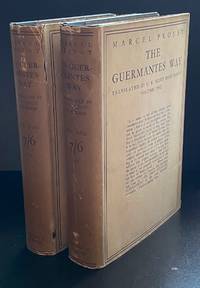
1925122334455673<p>A 2 Vols. set : The First UK printings published by Chatto and Windus London in 1925. Translated by C.K. Scott Moncrieff. From the personal collection of literary agent David Higham with his neat penned name to the front blank end-papers of both volumes. Both BOOKS are in Very Good condition with the publisher's original cloth and top-stain still present. Gilt titling to the spines. Many pages remain unopened. Slight toning to the text-block and page edges. Some very mild spotting to the text-block. The WRAPPERS are in Very Good condition. Some toning especially to the spines folds and to the edges in both wrappers. Vol.1 wrapper has a small marginal tear to the rear lower edge and rear lower flap fold. Mild edge-wear to the spine ends. Vol.2 wrapper has a 5cm closed tear along the upper front spine fold and a much larger closed tear across the front panel. The extremities are lightly worn with a tiny area of loss to the lower front spine fold. Despite the description both copies present very well in the removable Brodart archival covers. The third title in the 'Remembrance of things past' series. Extremely scarce with the wrappers with only one such set having appeared at auction in the last 40 years. Collectible. More images available on request. Ashton Rare Books welcomes direct contact.</p> Chatto and Windus, London hardcover
190755277Paris: les Cahiers de la Quinzaine 1907. Fine. les Cahiers de la Quinzaine Paris 1907 13 x 19 cm broché First edition on current paper. Small gaps in the head and foot of the back some bites and clear spots on the boards. Exceptional autograph dedication signed by Robert Dreyfus to his friend: ""Marcel Proust. Very affectionately. Childhood friends and students of Lycée Condorcet Marcel Proust and Robert Dreyfus founded the magazine Le Banquet in 1892 with some of their classmates including Daniel Halévy. Will appear eight numbers that contain the first steps in literature of one and the other. In 1907 Dreyfus when he wrote this letter to Proust imbued with deep sympathy is a noted author for his essays: The Life and the prophecies of Count Gobineau published two years earlier earned him a prize from the French Academy . Proust meanwhile is then working on the writing of his great work In Search of Lost Time but still has a modest reputation as a writer. The friendship between the two men crosses the decades as evidenced by their correspondence started in 1888 and continued until 1920. Well inspired Dreyfus will preserve preciously the letters of Proust who after the death of this one will allow him to write a precious book for the Proustians Souvenirs on Marcel Proust accompanied by unpublished letters 1926: ""Is it a consolation to think: if he had been better . he would not have written these letters where the flares of his mind still sparkle. "" Copy of Marcel Proust's library donated by his childhood friend Robert Dreyfus. les Cahiers de la Quinzaine hardcover
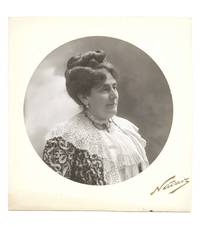
1904Pro4<p><b>PROUST Jeanne WEIL 1849-1905</b></p><p>5th December 1904 original period film print. Round photography 159 cm diameter mounted on thick paper frame in the photographer's name.Tiny spot on lower margin of the mounting small stainStamp on verso from collection Suzy Mante-Proust collection</p><p><b>One of Jeanne Weil Proust's last portraits less than a year before her death</b></p><p>This portrait was taken on December 5th 1904. At this time aged 56 years old Proust's mother has been a widow for a year. The translation of his son's <i>The Bible of Amiens</i> was published that same year. She died of nephritis a year later on September 26 1905. Nadar did process her portrait and removed the shadows and various flaws on her face.</p><p>Michel Schneider notes that the narrator's mother in the <i>Search</i> is obviously inspired by the mother of the author himself. Jeanne Proust was born Jeanne Weil in 1849 from a Jewish family of the enlightened bourgeoisie. Much has been said about the intellectual complicity that united her with elder son. Marcel Proust who during his mother's lifetime wrote only <i>beautiful</i>things in the spirit of the time <i>Pleasures and Days</i> will not become the novelist of the <i>Search</i> until after the death his mother an event that has somehow freed his creation. In the novel the grief he felt at his death is shifted to that of the grandmother and that of Albertine. In the <i>Search</i> Mom doesn't die she is also mentioned more than 500 times.</p><p>Provenance:<br />-Proust Family<br />-Suzy Mante-Proust only daughter of Robert Proust by descent<br />-Patricia Mante-Proust granddaughter of Suzy Mante-Proust by descent</p><p><u>References:</u><br />Nadar repr. p. 32 in full. <br />Cattaui n° 59 repr. <br />Mauriac repr. p. 10.</p>