3 449 résultats
1954CLL-198Paris, N.R.F., 1954 In-8, broché, non coupé.
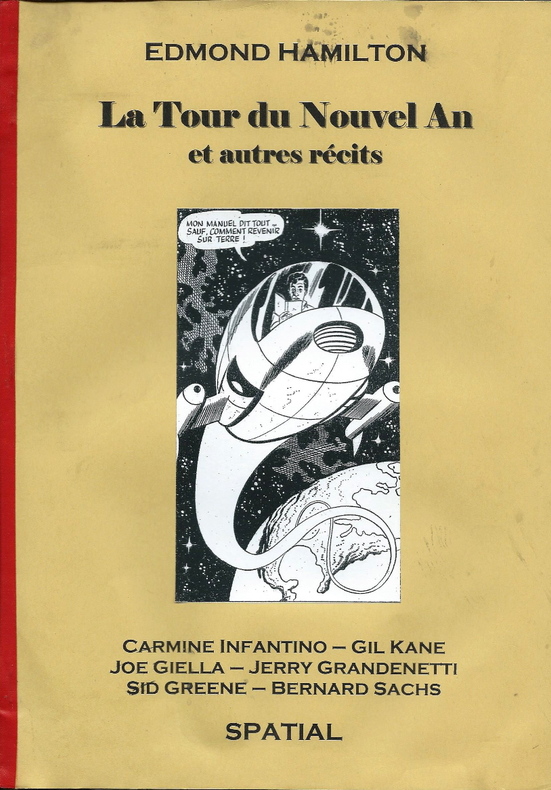
23138Francis Valéry / Collection " Spatial " n° 4 de 2005. In-8 broché avec dos thermocollé rouge, de 54 pages au format 21 x 30 cm sous couverture illustrée. Recueil de bandes dessinées avec scénarios de Edmond Hamilton et dessins de Carmine Infantino, Gil Kane, Joe Giella, Jerry Grandenetti, Sid Greene et Bernard Sachs. Postface et bibliographie par Francis Valéry. Tirage artisanal à 26 exemplaires, numérotés en lettres ( exemplaire S ). Seuls 17 exemplaires furent mis en vente. Petites brunissures en haut du 1er plat. Intérieur frais. Edition originale, peu courante. Il existe des retirages plus récents à 99 exemplaires sous une autre couverture.
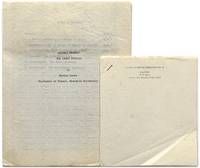
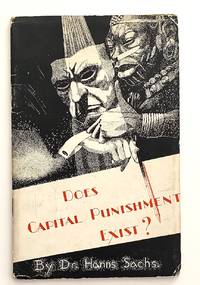
1974618138Waltham Massachusetts 1974. Unbound. Fine. Carbon typescript. Small quarto onionskin sheets. 2 ii 89pp. with four or five supplemental pages numbered e.g. "85a". Most pages renumbered in manuscript and a handful of manuscript edits to the text. Fine with a tiny bit of wear. In what we presume to be the original mailing envelope addressed to Roger Raymond of Brandeis University along with a proof in the form of two corner-stapled groups of 16mo sheets printed rectos only. The proof also contains manuscript edits and is very good or better with a bit of light soil and the first 13 leaves with corner creases. <br /> <br /> The book was published in 1974 by Edward Arnold London as No. 28 in their Studies in French Literature series editor W. G. Moore. Murray Sachs was at the time a professor of French at Brandeis University. Sachs edited or coedited two collections of French literature and wrote a book on Alphonse Daudet Harvard University Press 1965. He also was a recipient of the Palmes Académiques the French government’s highest educational honor. unknown
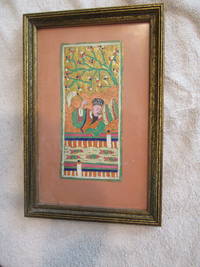
1920039019China Circa 1920 1920. Original Oil Painting . Framed. Very Good. 8" X 3 5/8" Painting Heavily Gilt On Paper Mounted In Antique Gilt Frame Under Glass. From The Collection Of Pasquale Napolitano Probably From The Collection Of Herman Sachs. <br/> <br/> unknown
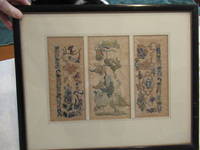
1800039011Circa 1800 1800. 1st Edition . No Binding. Very Good. Original Silk Embroideries Circa 1800 Embellished With Gold Leaf-Wrapped Yarn Mounted On Old Paper Framed Under Glass. From The Collection Of Los Angeles Architectural Decorator Herman Sachs Bullock's Wilshire Los Angeles City Hall Etc. <br/> <br/> unknown
7079Gent (Belgique). 1976. Snoeck-Ducaju & Zoon, éditeur. Grand in-8° broché. Revue à parution annuelle.
7080Gent (Belgique). 1979. Snoeck-Ducaju & Zoon, éditeur. Grand in-8° broché. Revue à parution annuelle.
190029700Partitions sur l'Italie Eschig Max 1900 approx.
1173111352.Gpaperback. Good. Access codes and supplements are not guaranteed with used items. May be an ex-library book. paperback
1246019574.Gpaperback. Good. Access codes and supplements are not guaranteed with used items. May be an ex-library book. paperback
189029143AB1890. Wiesbaden / Leipzig / Berlin / Marburg Thieme / Elwert / u.a. 1890 - 1914. Octavo. Original Softcover. Very good condition with only minor signs of external wear / The earliest offprint by Behring and Nissen with a faded dampstain to lower margins / Otherwise with some minor fraying to some of the offprints only. Rare important collection and very interesting association between Emil von Behring the first Nobel Laureate of Medicine and Dr.Hans Sachs jewish serologist and pioneer in efficient diagnosis of syphilis and one of the sad examples of the purge of scientists by Hitler's regime in 1930s germany. / The collection also comes with several important works of Reference including: 1. A copy of Derek S. Linton's stunning work: "Emil von Behring - Infectious Disease Immunology Serum Therapy" - Philadelphia 2005 / 2. also part of the collection is Arthur M. Silverstein's work on "A History of Immunology" - San Diego 1992 see images of this collection ! Hans Sachs 1877-1945 Paul Ehrlich's colleague was born in 1877 in Kattowice Upper Silesia. After studying in Freiburg Breslau and Berlin and receiving his doctorate in Leipzig in 1900 he joined the staff of the Institute for Experimental Therapy in Frankfurt in 1905. In 1914 he was appointed extraordinary honorary professor at the newly founded University of Frankfurt and became deputy director of the institute in 1915. Sachs later became professor of immunology and serum research and director of the Cancer Institute in Heidelberg. He published numerous papers with Paul Ehrlich on immunological subjects and also edited the Zeitschrift für Immunitätsforschung Journal of Immunology Research. Like so many of his brilliant Jewish colleagues Hans Sachs "Germany's first serologist" fell victim to the Nazis. He died in 1945. Source: Paul Ehrlich Institute Hans Sachs 6. Juni 1877 in Kattowitz; 25. März 1945 in Dublin war ein deutscher Mediziner und Serologe. Hans Sachs war der Sohn des Kaufmanns Elias Sachs in Kattowitz und dessen Ehefrau Flora Hausdorff. Er ging auf die Gymnasien von Kattowitz und Breslau wo er 1895 am Johannesgymnasium die Reifeprüfung bestand. Sachs studierte ab 1895 an den Universitäten Freiburg Breslau und Berlin seine Doktorwürde bekam er nach seiner Dissertation Ueber das Verhalten der Laevulose im Stoffwechsel 1900 an der Universität Leipzig. Ab 1905 forschte und arbeitete er an der Universität Frankfurt am Main. 1907 wurde er dort Professor seit 1914 auch Honorar-Professor an der Universität Frankfurt/Main. 1920 ging er nach Heidelberg als Professor des Institutes für Immunität- und Serumforschung und Direktor der Wissenschaftlichen Abteilung des Instituts für Experimentelle Krebsforschung. Im Jahr 1932 wurde er zum Mitglied der Wissenschaftsakademie Leopoldina gewählt. 1935 wurde er als Jude aus dem Institut und der Universität entlassen. Hans Sachs musste 1938 aus Deutschland fliehen emigrierte nach Oxford und später nach Dublin wo er 1945 starb. Er heiratete im Jahr 1905 Adelheid Sophie Charlotte Grelling 18841978 eine Tochter des Richard Grelling 18531929 und der Margarethe Anna Simon 18621934. Das Paar hatte einen Sohn und eine Tochter. Der Mathematiker Kurt Grelling 18861942 war sein Schwager. Wikipedia Paul Heinrich Römer 19. Mai 1876 in Kirchhain; 30. März 1916 in Nowogrodek war ein deutscher Hygieniker. Paul Römer war Sohn von Hermann Römer praktischer Arzt in Kirchhain und Neffe von Ludwig Gundlach. Paul Römer begann an der Philipps-Universität Marburg Medizin zu studieren. Am 27. Oktober 1894 wurde er im väterlichen Corps Teutonia Marburg recipiert. Zweimal bewährte er sich als Senior. Als Inaktiver wechselte er an die Christian-Albrechts-Universität zu Kiel und die Julius-Maximilians-Universität Würzburg 1899 bestand er das Staatsexamen und wurde er zum Dr. med. promoviert. Er habilitierte sich 1903 in Marburg und wurde 1904 zum Privatdozenten ernannt. Seit 1907 außerordentlicher Professor verbrachte er ein Jahr in Argentinien um die Tuberkulosemittel von Emil von Behring zu erproben. 1908 wurde er von Behring zum Abteilungsvorsteher im Marburger Hygieneinstitut ernannt. Das Preußische Ministerium der geistlichen Unterrichts- und Medizinalangelegenheiten berief ihn 1913 als Nachfolger Friedrich Loefflers auf den Lehrstuhl der Königlichen Universität zu Greifswald. Als Sanitätsoffizier zog er 1914 in den Ersten Weltkrieg. Am 1. Oktober 1915 wechselte er als Nachfolger von Carl Fraenkel auf den Lehrstuhl der Friedrichs-Universität Halle. Noch keine 40 Jahre alt starb er als Korpshygieniker an der Ostfront an Fleckfieber. Er hinterließ seine Frau Luise geb. Bene aus Niederweimar und die gemeinsame Tochter. Römer war der einzige Schüler Behrings an dessen Forschung zur Tuberkulose er sich maßgeblich beteiligte. Außerdem befasste er sich mit Paul Ehrlichs Seitenkettentheorie und der Poliomyelitis. Durch seine richtungweisenden Experimentalstudien über die Kinderlähmung hat Römer als eigentlicher Erfinder der später von Salk und Sabin verwirklichten Polio-Schutzimpfung zu gelten. Rudolf Siegert Source: Wikipedia paperback
5349Paris, Réunion des musées nationaux, 1986. Fort in-4, broché, nombreuses illustrations.
1909C2132München, Verlag von J. F. Lehmann, 1909 ; 154 x 227 mm, 22 pp., couverture et cahiers agrafés. Tiré à part, en langue allemande. Münchener medizinischen Wochenschrift. N° 49 und 50, 1909 (Sonderadruck aus der). Bon état.
2012232867New York: Oxford University Press 2012. First edition first printing. Hardcover in dust jacket. Gentle bumps top corners else fine in fine dust jacket in mylar cover. Oxford University Press hardcover
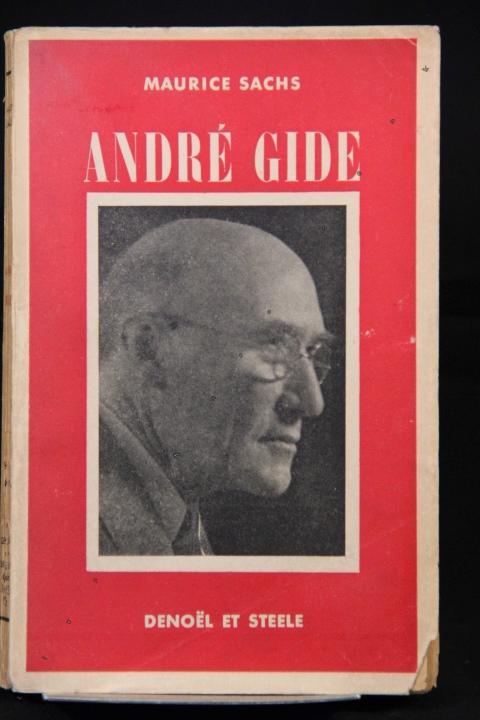
45047P., Denoël et Steele, 1936, petit in 12 broché, 123 pages.
19364694Paris, Denoël et Steele, 1936. In-12 de 124-[4] pages, couverture illustrée d’un portrait photographique de Gide. Légers plis au dos, petit manque en coin inférieur du premier plat, velle condition générale cependant.
201202019Paris, Editions corréa , 1950 ; in-12, 196 pp., br. Éditionssegond originale premier plat taché.
200817189Paris, Edition Corrêa, 1948 ; in-12, 196 pp., broché.
1955H1570Paris, Éditions Gallimard, 1955 ; in-12, 358 pp., broché. Exemplaire du Service de Presse. Maurice Sachs, né Maurice Ettinghausen le 16 septembre 1906 à Paris et tué le 14 avril 1945 en Allemagne, est un écrivain français. Ami de Max Jacob et homosexuel, juif, mais aussi collaborateur. Maurice Sachs n'est pas à un paradoxe ou une combine près. Il est pourtant un écrivain incontournable pour ceux qui s'intéressent à cette période troublée. Très bon état.
201304682Paris, Correa, 1946 ; in-12, 443 pp., cartonnage de l'éditeur. Bon état.
200813530Paris, NRF Gallimard, 1954 ; in-8, 348 pp., broché.
200509414Paris, Editions corrêa, 1950 ; in-12, 443 pp., broché.
19302583Riant Territet: Pool 1930. First edition. 19 5 pp. Stapled glossy printed wrappers. Surface wear edges and corners rubbed.<br /> <br /> The second to last volume published under the Pool imprint a translation from the German article published in Die psychoanalytische Bewegung. Januar-Februar 1930. Jahre II. Heft I. The translator is unnamed. Printed by Darantiere in Dijon. Dr. Sachs was an associate of Freud’s and a friend and psychoanalyst to Bryher. OCLC locates ten copies. Pool unknown
9786BOTTEGHE OSCURE. " Revue internationale de littérature contemporaine ". Roma (Via delle Botteghe Oscure, 32). Arnoldo Mondadori, editore - puis De Luca, editore. (Distributeur pour la France : Jean Hugues, libraire ; puis - à partir du n° 13 - La Hune ; puis - à partir du n° 19 - les éditions du Mercure de France ; puis - à partir du n° 23 - les éditions du Seuil). Fondatrice : Princesse Marguerite Caetani. Directeur : Giorgio Bassani. Grand in-8° broché. Environ 500 pages par livraison. Tous les textes sont inédits et publiés dans leur langue d'origine. 25 numéros ont paru en 25 livraisons semestrielles de 1948 à 1960 (et un numéro de " Tables " en 1964). Sommaires très copieux et d'une stupéfiante richesse. // " Vous avez sûrement eu connaissance de la revue " Botteghe Oscure " publiée à Rome par la princesse Caetani. Je crois pouvoir dire qu'il n'y a sans doute pas de plus belle revue de ce type " (Paul Celan à Nelly Sachs, in " Correspondance Nelly Sachs - Paul Celan ", Belin, 1999, p. 6).
10239LA LIGNE DE CUR. N° 4. (1ère série). (Mars 1926). Georges Hugnet, Maurice Fombeure, Julien Lanoë, Constantin Balmont, Claude Cahun, Maurice Sachs, etc. 1/25 sur papier dAlgrée, seul tirage de luxe. Très bel exemplaire.