5 503 résultats
1842R320058366PERROTIN. 1842. In-12. Relié cuir dos-coins. Etat d'usage, Couv. convenable, Dos satisfaisant, Rousseurs. 372 + 444 pages - plats et contre-plats jaspés - Tampon sur la page de titre -1 etiquette collée en coiffe en pied - Auteur, titre, tomaison et ornement dorés au dos.. . . . Classification Dewey : 840.08-XIX ème siècle
1842R320058364PERROTIN. 1842. In-12. Relié cuir dos-coins. Etat d'usage, Couv. convenable, Dos satisfaisant, Intérieur frais. 392 pages - plats et contre-plats jaspés - Tampon sur la page de titre -1 etiquette collée en coiffe en pied - Auteur, titre, tomaison et ornement dorés au dos.. . . . Classification Dewey : 840.08-XIX ème siècle
1934R240161817Hachette. 1934. In-4. Cartonnage d'éditeurs. Etat d'usage, Couv. convenable, Dos satisfaisant, Papier jauni. 195 pages - quelques illustrations en noir et blanc hors texte et en page de titre. Petite annotation au crayon de papier en page de faux titre. Illust. en couleurs contrecollée sur le 1er plat.. . . . Classification Dewey : 840-Littératures des langues romanes. Littérature française
1947R240165357Jacques Vautrain. 1947. In-8. Broché. Bon état, Couv. convenable, Dos satisfaisant, Intérieur frais. 316 pages - quelques illustrations en couleurs hors texte.. . . . Classification Dewey : 840.091-XX ème siècle
1843R320058372PERROTIN. 1843. In-12. Relié cuir dos-coins. Etat d'usage, Couv. convenable, Dos satisfaisant, Quelques rousseurs. 273 pages - plats et contre-plats jaspés - Tampon sur la page de titre -1 etiquette collée en coiffe en pied - Auteur, titre, tomaison et ornement dorés au dos.. . . . Classification Dewey : 840.08-XIX ème siècle
1843R320058368PERROTIN. 1843. In-12. Relié cuir dos-coins. Etat d'usage, Couv. convenable, Dos satisfaisant, Rousseurs. 400 pages - plats et contre-plats jaspés - Tampon sur la page de titre -1 etiquette collée en coiffe en pied - Auteur, titre, tomaison et ornement dorés au dos.. . . . Classification Dewey : 840.08-XIX ème siècle
2006RO80246558Pocket. 2006. In-12. Broché. Etat d'usage, Couv. convenable, Dos satisfaisant, Intérieur frais. 321 pages. Traces d'étiquette sur le second plat.. . . . Classification Dewey : 840.08-XIX ème siècle
1939ROD0119362LIBRAIRIE GEDALGE. 1939. In-8. Broché. Etat d'usage, Tâchée, Dos abîmé, Quelques rousseurs. 254 pages augmentées de quelques illustrations en noir et blanc dans le texte. Couverture contre-pliée. Annotations sur les pages de titre et la dernière page. Coiffes et coins très frottés.. . . . Classification Dewey : 840.091-XX ème siècle
1936R300271466Gedalge. 1936. In-4. Relié. Etat d'usage, Couv. convenable, Dos fané, Papier jauni. XI + 308 pages - quelques illustrations en noir et blanc dans et hors texte. Plats jaspés et toilés. Le papier jaspé sur le 2e plat se décolle.. . . . Classification Dewey : 840.091-XX ème siècle
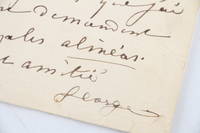
1838866321838. Fine. Sand publishes her response to Lerminier s. d. 23 février 1838 11 x 20.40 cm 1 page sur feuillet Autograph letter signed by George Sand addressed to François Buloz. One page in black ink on a single sheet. Fold marks sheet reinforced with paper on verso. Published in her correspondence ed. Georges Lubin vol. IV pp. 331-332. Exasperated by the attitude of the Revue des deux mondes of her friend Buloz George Sand decides to defend the progressive thinker Félicité Lammenais targeted by a scathing critique published in the review. She takes up her pen here and orders Buloz to publish her response article without changing a single line. Mon cher Buloz voici la lettre à M. Lerminier n'y changez rien. Relisez-en vous même et vous seul l'épreuve. Corrigez les fautes de typographie. Veuillez à la ponctuation et aux guillemets. Il va sans dire que les blancs de mon manuscrits sont le résultat de coupures et de transcriptions que j'ai faites et ne demandent que de simples alinéas. Bonjour et amitié George ""My dear Buloz here is the letter to M. Lerminier change nothing. Proofread it yourself and yourself alone. Correct the typographical errors. Mind the punctuation and quotation marks. It goes without saying that the blanks in my manuscript are the result of cuts and transcriptions I have made and require only simple paragraphs. Good day and friendship George"" This letter perfectly illustrates the stormy yet fruitful collaboration that united François Buloz and George Sand. The latter gave Sand for many years a platform and a means to live by her pen. She published in the Review a great number of masterpieces including Lettres d'un voyageur 1834-1836 Mauprat 1837 Spiridion 1839 Gabriel 1839 Mademoiselle La Quintinie 1863 Césanne Dietrich 1870. Through his mediation she also actively participated in the political debates of her time. In 1838 Buloz was the great orchestrator of an ideological duel when Sand ""decided to take on the critic Lerminier who had just made a very critical analysis of the Livre du peuple in the review. Buloz out of desire for publicity allowed his two collaborators to publicly exchange blows in the review. Through Lerminier and his superior tone the review then revealed its rather misogynistic vision of literature and philosophy: 'the time has come for you to give your philosophical opinions more consistency and scope because you are entering a new phase of life and talent. Inspiration and fantasy have raised you to a height where they would not suffice to maintain you. Draw now madam new strength from reflection and science'"" Marie-Eve Thérenty George Sand François Buloz et la Revue des Deux Mondes. Sand reacted immediately and sent her response article accompanied by this peremptory missive ordering Buloz to publish her text as it stood. Lamennais was very touched by her gesture: ""I shall always count among the happy circumstances of my life where I don't count many to have been defended by you. In publishing my last book I knew well that it would shock almost everyone legitimists juste-milieu Catholics even republicans those at least who want neither God nor liberty and their number is great and they have a terrible faith in themselves. I have hoped only in the people who do not make systems and who under the influence of primitive and imperishable human instincts judge by the heart and judge alone infallibly. Without them I don't know what would become of liberty on earth. M. Lerminier and many others imagine that I speak at random according to whatever idea of the moment occurs to me. They are mistaken"" Yves Chastagnaret George Sand Lerminier et le Livre du Peuple de Félicité Lamennais. Flying to the rescue of a defender of the people Sand writes this scathing missive at a key moment in her tumultuous relationship with Buloz. unknown
183886632s. d. [23 février 1838] | 11 x 20.40 cm | 1 page sur feuillet
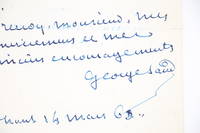
186376837Nohant Nohant-Vic 1863. Fine. Nohant Nohant-Vic 14 mars 1863 13.40 x 20.60 cm 3 pages sur un double feuillet Autograph letter signed by George Sand addressed to René Biémont. Three pages written in blue ink on a double sheet bearing at the head of the first page the blind stamp of Sand's initials. Envelope included. Folds inherent to mailing. This letter was published in the complete correspondence of George Sand established by Georges Lubin. Fine letter of congratulations addressed to René Biémont after sending his work Le Petit Fils d'Obermann: ""Your little book is very original and you show qualities of talent that will develop if you look ahead."" As an attentive reader much solicited by her young peers Sand develops her literary criticism: ""Obermann and his grandson the monk belong to the past. They are true and the timid Jean is well drawn. There is grandeur and truth in this exceptional type. But Constant d'Heurs is too passive to events. He should react against this powerless man and cure him or pity him more ."" Sententiously she thus concludes her letter: ""Do not complain of thankless work and accept it as a good thing three-quarters of life sacrificed to some duty makes the last quarter very strong and very alive. It is very good to be attached to poetry and thwarted in the possession of a beautiful dream. As soon as one can savor it without respite it fades or becomes troubled. I speak to you from experience. One is never happier and more inspired than when one believes one does not have time to be so."" Very fine testimony to the leading role that George Sand played on the literary scene of the Second Empire. unknown
1843R320058373PERROTIN. 1843. In-12. Relié cuir dos-coins. Etat d'usage, Couv. convenable, Dos satisfaisant, Quelques rousseurs. 356 pages augmetnées d'une illustratins en noir et blanc hors texte (Blason) - plats et contre-plats jaspés - 1 annotation en marge du texte de la page 162 - Tampon sur la page de titre -1 etiquette collée en coiffe en pied - Auteur, titre, tomaison et ornement dorés au dos.. . . . Classification Dewey : 840.08-XIX ème siècle
1992RO30320504Christian Pirot. 1992. In-8. Broché. Bon état, Couv. convenable, Dos satisfaisant, Intérieur frais. 189 pages. Nombreuses illustrations en noir et blanc, hors texte.. . . . Classification Dewey : 840-Littératures des langues romanes. Littérature française
1996RO30319051Stalkine. 1996. In-8. Relié. Bon état, Couv. convenable, Dos satisfaisant, Intérieur frais. 322 pages. Signet conservé.. . . . Classification Dewey : 840-Littératures des langues romanes. Littérature française
1843R320058369PERROTIN. 1843. In-12. Relié cuir dos-coins. Etat d'usage, Couv. convenable, Dos satisfaisant, Quelques rousseurs. 419 pages - plats et contre-plats jaspés - Tampon sur la page de titre -1 etiquette collée en coiffe en pied - Auteur, titre, tomaison et ornement dorés au dos.. . . . Classification Dewey : 840.08-XIX ème siècle
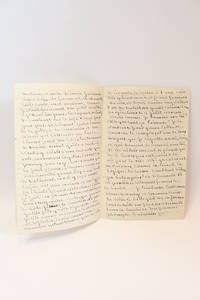
186771232Nohant Nohant-Vic 1867. Fine. Nohant Nohant-Vic 21 décembre 1867 13.40 x 20.70 cm deux feuillets sous chemise et étui Autograph letter from George Sand to Gustave Flaubert dated December 21 1867 8 pages on two lined leaves. Published in Sand's Correspondance XX pp. 642-645. From one of the finest literary correspondences of the century this letter written on Christmas Eve 1867 is a sublime testament to the frank friendship between George Sand the old troubadour and Gustave Flaubert christened cul de plomb leaden ass after declining his invitation to Nohant to complete L'Éducation sentimentale. Despite their seventeen year-age gap opposing temperaments and divergent outlooks on life the reader is gripped by the tenderness and astonishing verve of George Sand's long confession to Flaubert. At the height of her literary fame and enjoying her theater in Nohant Sand talks at length about politics their separation their conception of the writer's work and life itself. In this stream-of-consciousness letter Sand naturally and freely sets down on paper eight pages of conversations with Flaubert who made only too rare and brief appearances in Nohant: But how I chat with you! Do you find all this amusing I'd like a letter to replace one of our suppers which I too miss and which would be so good here with you if you weren't a cul de plomb leaden ass who won't let yourself be dragged along to life for life's sake whereas Flaubert's motto then busy writing L'Éducation sentimentale was rather art for art's sake. In the end of 1867 Sand grieved the death of an almost brother François Rollinat which Sand appeased with letters to Flaubert and lively evenings at Nohant: This is how I've been living for the last 15 days since I stopped working . Ah'! . Ah! when you're on vacation work logic and reason seem like strange swings. Sand was quick to criticize him for working tirelessly in his robe the enemy of freedom while she was running up and down mountains and valleys from Cannes to Normandy even to Flaubert's own home which she had visited in September. On this occasion Sand had happily reread Salammbô where she picked up a few lines for her latest novel Mademoiselle Merquem. Their literary and virile friendship similar to Rollinat's defied the old guard of literati who declared the existence of a sincere affair between man and woman utterly impossible. Sand who has been described in turn as a lesbian a nymphomaniac and made famous for her resounding and varied love affairs began a long and intense correspondence with Flaubert for whom she was a mother and an old friend. She called herself in their letters old troubadour or old horse and no longer even considered herself a woman but a quasi-man recalling her youthful cross-dressing and formidable contempt for gender norms. To Flaubert had compared the female writers as Amazons denying their femininity: To better shoot with the bow they crushed their nipples Sand replied in this letter: I don't share your idea that you have to do away with the breast to shoot with the bow. I have a completely opposite belief for my own use which I think is good for many others probably for the majority. A warrior yes but a peaceful warrior Sand willingly adopted the customs of a world of misogynistic intellectuals while remaining true to herself: I believe that the artist should live in one's nature as much as possible. To the man who loves struggle war; to the man who loves women love; to the old man who like me loves nature travel and flowers rocks great landscapes children too family everything that moves everything that fights moral anemia she then adds. A fine evocation of her green period this passage marks the time of Sand's country novels when mellowed by the years she gave herself over entirely to contemplation to write François le Champi La Mare au diable and La Petite Fadette. But her love of nature didn't stop unknown
186771232Nohant 21 décembre 1867 | 13.40 x 20.70 cm | deux feuillets sous chemise et étui
19701510141175xbvkKrakow, PWM Edition, 1969/1970. 267 (2) pages, 1 tipped-in Errata-sheet; many illustrations of Chopin['s]-Publications on glossy-paper plates. - Publisher's blue-grey cloth with illustrated dustjacket; large-8vo.(ca. 23 x 17,5 x 2 cm).
197654984Plan de la Tour Var: Éditions d'Aujourdhui 1976. 30 vols. 8vo 20x125 cm. Imitation leather spines gilt gilt ornemental border on frontcovers "relié à l'ancienne selon la meilleure tradition artisanale et conforme à l'edition de Michel Lévy par Jacques Fazan". Printed in 800 numbered copies. This is copy no. 255. Texts conformable of the editions of Lévy Perrotin a.o. - 1 Conformable of Perrotin 1842-43: Indiana Valentine Jacques André Leone Leoni Spiridon Le Compagnon du Tour de France 2 vols. - 2 -- of Dupuis et Tenré 1833: Lélia 2 vols. - 3 -- of Hetzel: Jeanne 1852 Lucrezia Floriani 1855 - 4 -- of La Librairie Nouvelle: Les Maîtres sonneurs 1858. - And in chronological order of Lévy and Calmann-Lévy 1856-1879: Teverino Le Péché de M. Antoine 2 vols La Ville noire Jean de la Roche Le Château des Désertes Tamaris Simon Le Meunier d'Angibault Cadio Nanon Impressions et Souvenirs Nouvelles Lettres d'un Voyageur Contes d'une Grand'mere 2 vols Questions politiques et sociales Souvenirs de 1848. - "Un choix qui permet d'embrasser toute la vie llittéraire de George Sand". - Nice set in perfect condition with bookplates pasted - text in French Éditions d'Aujourdhui hardcover
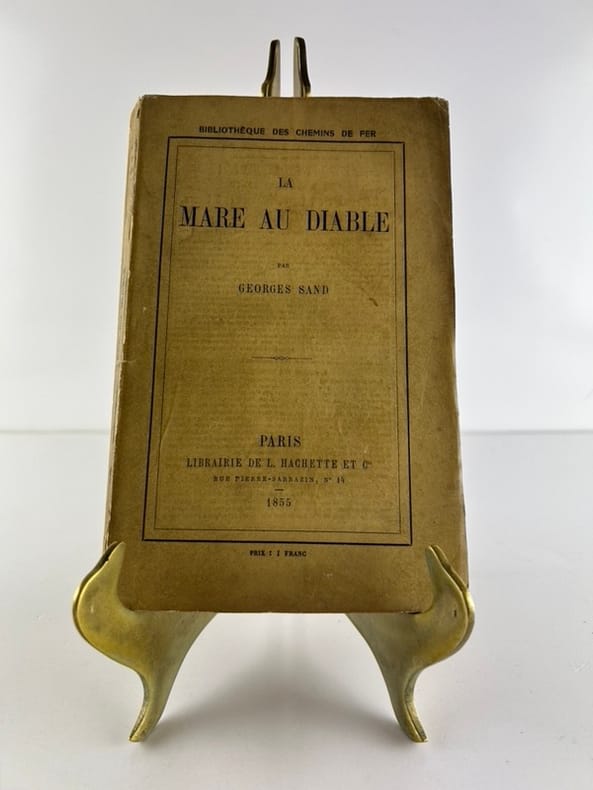
185585652Paris Librairie de L. Hachette / Typographie Lahure 1855 in-12 broché 168p. Verso des couvertures et gardes présentant la collection. A noter que George est orthographié avec un 's'. Peu courant dans cet état.
192122304Unterhausen i. Württemberg. Eintragungen von 1912 bis 1921). 37 nummerierte u. 12 nicht nummerierte Seiten. Halbleinwand-Einband der Zeit. (Die letzten 2 Blätter beschädigt) 18x12 cm
18381584Paris : Cordier et Ledoyen (Impr. d’Everat et Comp.), 1838 In-8, 200 x 124 : x, 422 pp. Demi-veau rouge à petits coins, filet dorés, dos lisse orné d’un décor romantique en long (Louis Bodin. Relieur doreur).
1271544334.Gpaperback. Good. Access codes and supplements are not guaranteed with used items. May be an ex-library book. paperback
185755056Paris: Michel Lévy & Calmann Lévy 1857-1923. 13 vols. 18mo 18x115 cm. Uniformly bound about 1950. Lightbrown halfcalf some parts of the leather darkened; spines with ribbons; gilt titles on spines; marbled paper on covers. Little by little paper more and more age-toned and browned due to the paper but a nice spotless set of the most important novels 15 with additions and 1 play bound in 13 volumes. Michel Lévy & Calmann Lévy hardcover