Livre Rare Book

487 résultats
176728111 plaquette in-12 ( 28pp ). Plaquette très rare parue à Londres en 1767 : contrefaçon de l'édition londonienne de 1766 ? Pas à la BNF ni au CCF. Broché Très bon Londres s.n. 1767 1 plaquette in-12
178212718Genf o. V., 1782. 403 S. Kl. 8° Klein-Oktav Kart.
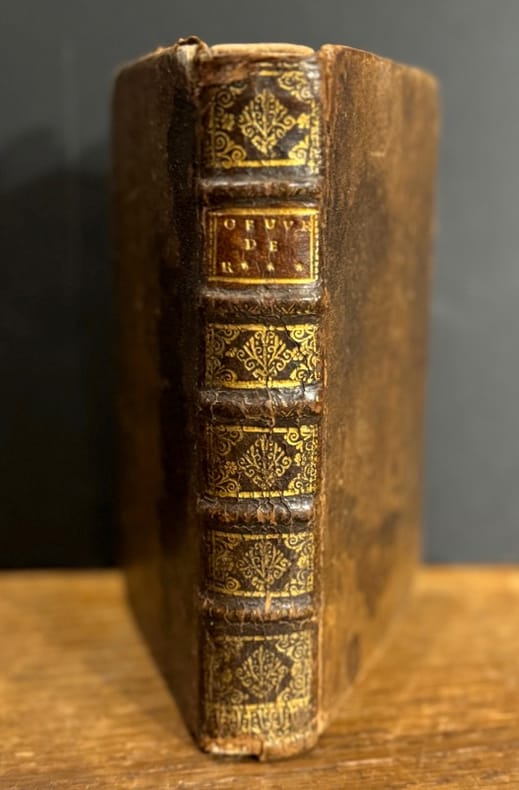
176961288Munster, Perrenon, 1769. 8vo. Bound in a very nice contemporary half calf binding with four raised bands and richlty gilt spine. Center and corners of boards with gilt flower ornamentation. Small paper-label to upper part of spine. Traces from label (ex-libris?) having been removed from verso of front board. A nice and clean copy. 143 pp.
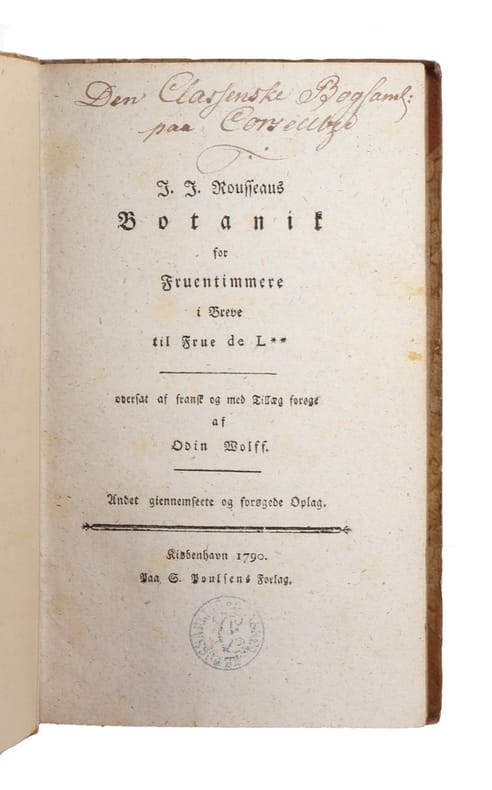
179062475Kiøbenhavn, 1790, Poulsens Forlag, 1790. 8vo. In contemporary half calf with four raise bands. ""Den Classenske bogsaml paa Corselitze"" (i.e. ""Classen's bookcollection in Corselitze Manor House"") in contemporary hand to title-page and small stamp to lower part of title-page. Internally nice and clean. XXIV, 112 pp.
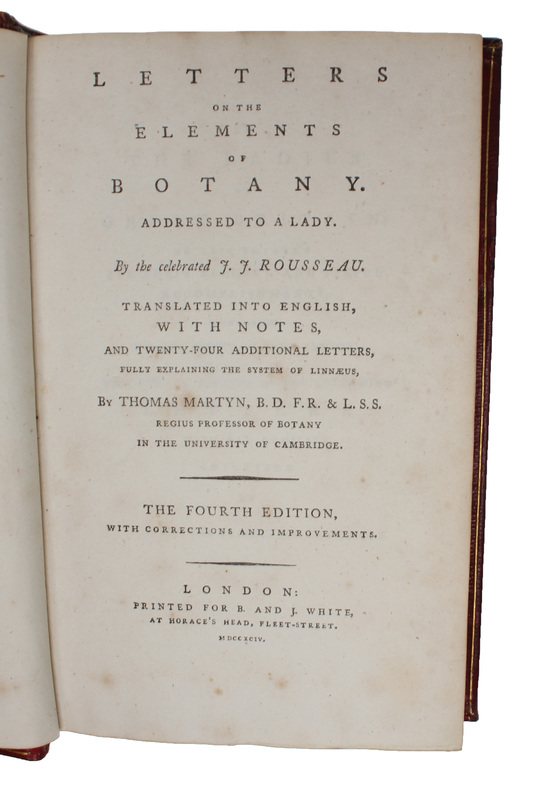
179428518London, B. and J. White, 1794. Bound in 2 very fine cont. full red longgrained morocco. Gilt inside and outside borders. All edges gilt, gilt back. Backs lightly faded. XXIV,503,(28) pp. and 1 folded table + VI,72 pp. and 38 fine engraved and hand-coloured plates (Drawn and engraved by F.P. Nodder). Both volumes in excellent condition, clean and fresh, printed on good paper and plates with tissueguards. Inscription in ink in both volumes reads: ""Emma Curtis the gift of MS. Taylor(?) 1795.""
177055218Paris, Marc-Michel Rey, 1770. Bound in 2 contemp. full mottled calf. profusely gilt spines. Title-and tomelabels with gilt lettering. Light wear to top of spines. Joints at lower compartment on volume 2 with small cracks. Stamp on halftitles (Halftitle: ""Julie, ou la...""). The 4 title-pages in red and black. (4),LVI,245"(4),IV,184(4),IV,143(4),VI,204 pp., 8 engraved plates.
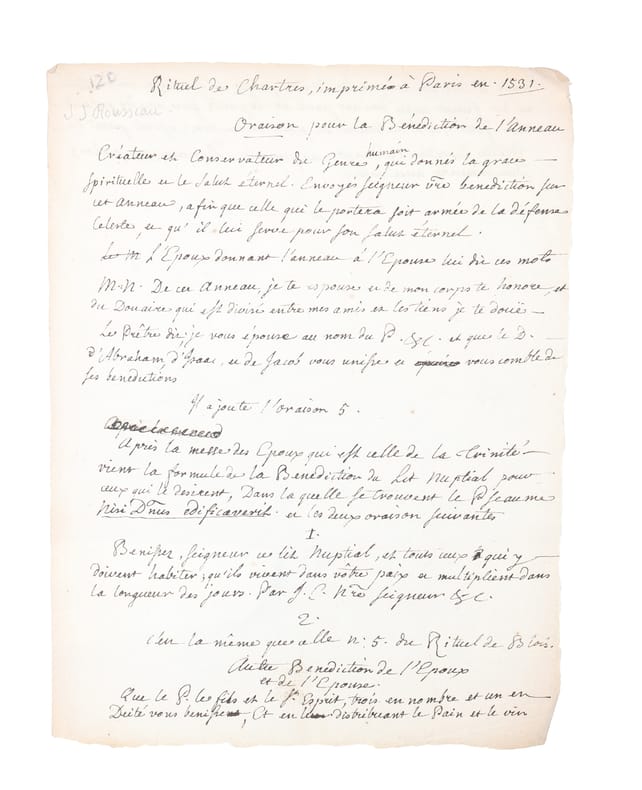
174660377(Unsigned, and no date, but penned between 1746 and 1751). 1 leaf 4to (25,5 x 19 cm), off-white paper in fine condition. Penned on both recto (21 lines) and verso (6 lines) in columns taking up half the pages.
174660957(Unsigned, and no date, but penned between 1746 and 1751). 1 leaf 4to (25,5 x 19 cm), off-white paper in fine condition. Fully penned on both recto (24 lines) and verso (5 lines).
1781CLL-482Londres, 1781 4 volumes in-8 de (2) ff., XI, (1), 386 pp. - (2) ff., 370 pp. - (2) ff., 434 pp. - (2) ff., 388, 4 pp., reliure à la Bradel de papier rouge, chaînage à froid en encadrement sur les plats, dos lisses ornés de filets dorés, titre et tomaison dorés, tranches mouchetées rouge (reliure de l'époque).
17642541# AUTEUR: Rousseau Jean-Jacques # ILLUSTRATEUR: Cochin (frontispice) # ÉDITEUR: Neuchatel - Duchesne - Paris # ANNÉE ÉDITION: 1764 # ENVOI, BEAUX PAPIERS: Vergé # COUVERTURE: plein veau marbré - dos lisse à fleurons dorés - tranches rouges - pdt rouge # DÉTAILS: 4 volumes in 12° reliés: T1- IV + 454pp. frontispice de Cochin et 2 planches gravées par Gravelot. T2- 1ff + 478pp. 3 planches hors-texte. T3- 1ff + 504pp. 3 planches ht. T4- 2ff + 436pp. + 4 ff.(approbation, catalogue) 3 planches ht. Nouvelle édition. La deuxième préface est donnée ici en entier ( 64pp.) # PHOTOS visibles sur www.latourinfernal.com
176961288Munster Perrenon 1769. 8vo. Bound in a very nice contemporary half calf binding with four raised bands and richlty gilt spine. Center and corners of boards with gilt flower ornamentation. Small paper-label to upper part of spine. Traces from label ex-libris having been removed from verso of front board. A nice and clean copy. 143 pp. <br/><br/><em>The exceedingly rare second edition of Brument’s attempt at a sequel to Rousseau's "La Nouvelle Héloïse" with the story revolving around Henriette the daughter of Julie de Wolmar a central character in Rousseau's novel. The first edition was published in Geneve in 1768 – both editions are of the utmost scarcity and are rarely found in the trade. “Henriette de Wolmar†is part of a broader trend in the 18th century where Rousseau's “La Nouvelle Héloïse†inspired numerous derivative works including sequels parodies and adaptations – all early examples of fan-fiction. The success of Rousseau's novel sparked a wave of creative responses as readers and writers sought to expand reinterpret or critique the original story. In Rousseau's original work “La Nouvelle Héloïse†Julie is portrayed as a virtuous woman who navigates the complexities of love duty and social expectations. Brument's sequel however shifts the narrative focus to Julie's role as a mother particularly highlighting her possessiveness and jealousy towards her daughter. This jealousy serves as the central conflict of the story illustrating the psychological and emotional turmoil that can be within family relationships. Provenance: Valdemar's Castle. </em> hardcover
176692101766 Paris, 1766; in-12, plein veau marbré époque, dos lisse orné, titre doré sur étiquette de maroquin brun, tranches rouges; (4),328,(4)pp. Petite tache rousse angulaire à quelques feuillets.
1799100133672Pierre didot 1799 in16. 1799. Broché.
1785GF264301785 Paris - Mérigot le jeune - 1785 - 1 volume in12 - Reliure d'époque pleine basane mouchetée - Double filet doré sur les plats - tranches rouges - pièces de titre en maroquin rouge - dos lisse - Coupes un peu frottées - Bon exemplaire -
176310180A La Haye [Paris], s.é. [Panckoucke], 1763. Un vol. in-12 (168 x 98 mm) de 1 f. bl., 1 frontispice gravé n.fol., 1 f. n.fol., 321 pp. et 1 f. bl. Reliure de l'époque de plein veau marbré blond, filet à froid encadrant les plats, dos lisse orné de doubles filets dorés, roulettes dorées, fleurons dorés, semis de pointillés dorés, fleurons dorés, pièces de titre de maroquin havane, titre doré, palette dorée en queue, dentelle dorée sur les coupes, toutes tranches marbrées.
179269071792 Paris, Garnéry, L'An premier de la République Française, [1792-1793]. In-18, cartonnage XIXe, pièce de titre en maroquin rouge. Titre avec vignette, (1) f. d'Avertissement, 168 pp., (3) pp. de table. Frontispice. Un bandeau gravé sur bois. Collationné complet. Papier jauni, quelques rousseurs. Travail de ver aux 4 derniers feuillets, dont dernier feuillet de table rongé avec manques et atteinte de certains numéros de pages.
176416516Paris, La Veuve Duchesne; Gueffier, 1764-1766. 3 ouvrages en un volume in-8 de 120-62-80 pages, plein maroquin citron, dos lisse orné de fleurs de lys et petits fers dorés, dentelle géométrique avec des motifs floraux en encadrement des plats, filet doré aux coupes, roulette dorée aux chasses, gardes de tabis rose, tranches dorées.
1719A2577Soleure, Chez Ursus Heuberger, 1719 ; in-12, XXIV-331 pp. + table, reliure plein veau d'epoque, dos orné à nerfs. Oeuvres attribuées à Jean-Baptiste Rousseau, poète et écrivain français, entre la fin du XVIIème et le début du XVIIIème siècle, fils d'un cordonnier, il fit ses études chez les jésuites. Il faisait preuve d'habileté en tant que versificateur. Ses pièces de théâtre n'ont connues aucun succès. Suite à des affaires de billets comportant des vers satiriques perdus dans des cafés, ou envoyés anonymement par la poste, mais tous concernant les ennemis de Rousseau, il dû s'exiler à Bruxelles. Ses poésies était très connues au 18ème, elles sont tombées dans l'oubli à partir du 19ème siècle. Bon état.
1744_202100416Paris, Chez De Saint, et Briasson, 1744 ; in-12 (89 x 147 mm), 4-332 pp., reliure plein veau, coloris naturel nuageux, dos orné de caissons et de fleurons à 5 nerfs, chants à frise dorée, pièce de titre rouge sang, tranches jaspées ocre rouge (coiffes usées, frottements, coins usés). Jean-Baptiste Rousseau, à qui ces oeuvres sont attribuées, poète et écrivain français de la fin du 17ème et le début du 18ème siècle, fils d'un cordonnier, fit ses études chez les jésuites. Habile en versificateur, ses pièces de théâtre ne connurent aucun succès mais ses poésies étaient très connues au 18ème siècle. Elles tombèrent cependant dans l'oubli à partir du 19ème siècle. Pour l’anecdote, Rousseau dut s’exiler à Bruxelles suite à des affaires de billets contenant des vers satires qui concernaient ses ennemis et qu’il perdait dans des cafés ou envoyait anonymement.
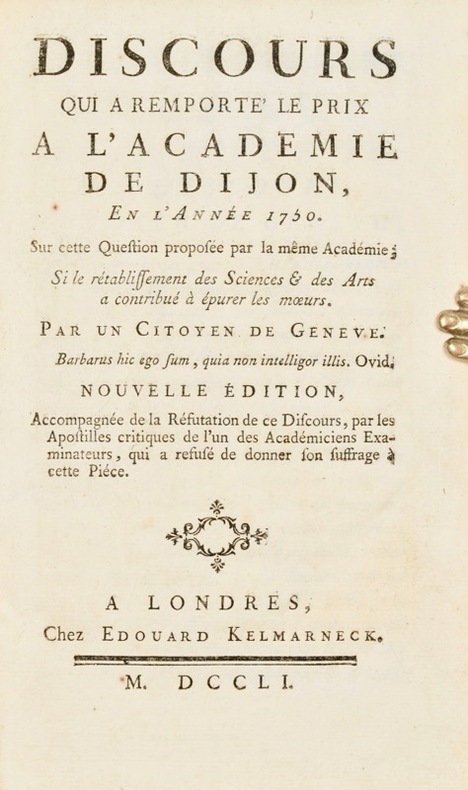
175141338A Londres, chez Edouard Kelmarneck, 1751. In-8 à deux colonnes de XII-132 pp., frontispice et vignette de départ, veau brun granité, dos orné à nerfs, pièce de titre en maroquin rouge, tranches rouges (reliure de l'époque).
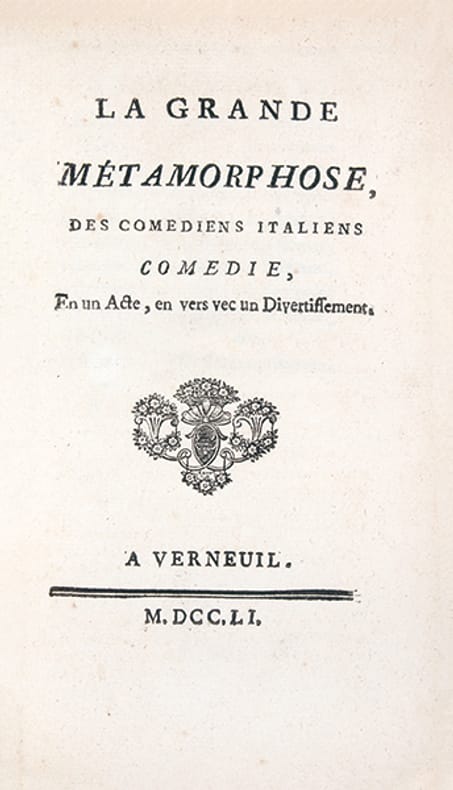
1751383991751 In-8, broché, couverture de papier bleu moderne, (4), 77 p. Verneuil, s. n., 1751.
1712681Chez Urfus Heuberger 1712 A Soleure, Chez Ursus Heuberger, 1712., In-12, XXVIII, 318 pp., (1) (table) Pleine basane, dos à 5 nerfs orné de fleurons, coiffes fragiles. Trous de vers en début et fin de volume (sans manque).
17589087La Haye, [sans nom], 1758. In-8 de [2]-VIII- de 3 à 189-[1] pages, demi vélin blanc à la Bradel, dos lisse, pièce de titre bordeaux, tranches rouges, reliure moderne.
1712117871712 basane, dos à nerf (reliure rapée). (quelques ff. intervertis dans la préface sans manque). in-16, XXVIII-318pp., (3ff. table), A Soleure chez Ursus Heuberger, 1712,
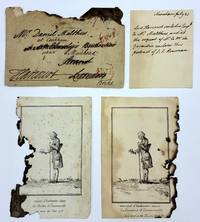
17791748Original manuscript / ink drawing. c.1779-1788. Pen and ink portrait of Jean Jacques Rousseau in the garden at Ermenonville titled beneath "venant d'herboriser dans les Jardins d'Ermenonville au mois de Juin 1778" along with a printed version of the image signed Mayer Georg Friedrich Meyer engraved by J. M. Moreau in 1779. Each 15 x 10cm. Accompanied by an ink manuscript letter 10.5 x 8cm headed "Nuneham July 21" presenting the images: "Lord Harcourt sends his compts. to Mr. Malthus and at the request of Mr. le Mqs. de Girardin encloses this portrait of J: J: Rousseau". Contained within the original postal cover addressed to Mr. Daniel Malthus redirected from his London address to Cookham signed at the foot by Harcourt under the parliamentary privilege franking system with additional "free" handstamps to the front panel and further postal markings to the reverse the specific types of postal markings on the cover indicate a date range of 1779-1788. The ink portrait engraved portrait and postal cover all have historical burn marks and associated loss as well as toning and light foxing; the letter remains in good order. A fascinating and intimate gift linking several late eighteenth-century intellectuals all connected to the French philosopher Jean Jacques Rousseau in the form of two portraits of the philosopher one ink one engraved sent from Rousseau's last pupil René de Girardin Marquis of Vauvray 1735-1808 via the radically-inclined politician and gardener George Harcourt 2nd Earl Harcourt 1736-1809 to the father of the famous economist Thomas Malthus Daniel Malthus 1730-1800 himself a friend of Rousseau.</p><p>The present portrait depicts Rousseau in the final weeks of his life 'botanizing' in the garden at Ermenonville the first French landscape garden created by his pupil René de Girardin who here sends the portrait. Ermenonville was itself inspired by Rousseau's ideas created by Girardin as an illustration of his philosophical and social beliefs regarding the place of man in nature. Within the garden Girardin began construction of a house for Rousseau modelled after the "Élysée" of Julie in Rousseau's novel <em>La Nouvelle Héloïse</em>. Rousseau himself visited the garden in May 1778 staying in a small thatched cottage where he remained until his death in July that year. Girardin subsequently made a tomb for Rousseau at Ermenonville which became a destination of pilgrimage for his admirers until his body was re-interred at the Pantheon in Paris in October 1794. Following Rousseau's death Girardin and two other of his friends of prepared a complete edition of his works using the manuscripts of some of his most important writings including <em>Les Confessions </em>and <em>Les Rêveries du promeneur solitaire</em> which he had left behind at Ermenonville. This new edition was published in Geneva between 1780 and 1782 and contributed greatly to the spread of Rousseau's ideas throughout France and beyond in the years leading up to the French Revolution.</p><p>The original drawing of Rousseau at Ermenonville was executed by the German artist Georg Friedrich Meyer 1733-1779 who also resided with Girardin at Eremenonville during his final years and where he became well acquainted with Rousseau. Other similar versions of this drawing by Meyer exist one being in the collection of the Fine Art Museum of San Francisco and it is unclear as to whether the present pen and ink drawing is an original work by Meyer or a contemporary copy of the engraving - either way its origin from the hands of Girardin himself provide it with sufficient interest. </p><p>The present two portraits subsequently made their way to the politician George Harcourt 2nd Earl Harcourt previously Viscount Nuneham a supporter of John Wilkes friend of Catherine Macaulay opponent of the war against the American colonies and pioneering garden designer. Here he apparently acted as an intermediary in this distinguished friendship circle sending the pictures on to Daniel Malthus - enlightened gentlemen friend of David Hume and Rousseau and father to Thomas Malthus.</p><p>Daniel Malthus had first become acquainted with Rousseau when he visited him at Môtiers in May 1764. He later invited Rousseau and his wife Thérèse to stay at his estate "The Rookery" near Dorking Surrey during the couple's visit to England in 1766 with Malthus hoping to find them a place to settle nearby. They visited the Malthus home for a day with Hume about three weeks after Thomas's birth but ultimately settled in Derbyshire for the remainder of their visit. Daniel and several family members subsequently went north to visit Rousseau joining him on botanical expeditions - a shared passion. Rousseau and Malthus maintained a lifelong correspondence and botanical exchange with the pair enthusiastically swapping English and French literature botanical specimens and philosophical musings. Later in life Rousseau would divide his personal herbarium among his friends sending parts of it to Daniel who also ultimately purchased his botanical library.</p><p>Daniel Malthus was - like Girardin - a dedicated Rousseauist using like many enlightened families of the period Rousseau's <em>Émile</em> as a guide to the education of his children; as he described in a letter to Rousseau of 1768 his children botanized in their local area went on nature walks carried out farm work and conducted their own little experiments. Indeed in his last known letter to Rousseau he declared "if I am ever known it will be as the friend of Rousseau". He would however ultimately be best known by his progeny Thomas who would go on to famously argue against the writings of the thinkers who proclaimed humanity's perfectibility preferred by his father including Rousseau William Godwin and the Marquis de Condorcet. Regardless of this Daniel keenly supported his adult son's endeavours with Thomas's earlier unorthodox education itself also having played a key role in shaping his knowledge of natural law and mathematics. MacDonald J. Marc "Malthus and the Philanthropists 1764–1859: The Cultural Circulation of Political Economy Botany and Natural Knowledge" Social Sciences 2017 61 4. [Original manuscript / ink drawing]. unknown