Jean-Jacques RousseauBiblio.com
9 625 résultats
0282573119.Gpaperback. Good. Access codes and supplements are not guaranteed with used items. May be an ex-library book. paperback
0331905507.Ghardcover. Good. Access codes and supplements are not guaranteed with used items. May be an ex-library book. hardcover
2026220908Athêna 2026. Etat Correct coins frottés. in8. 2026. Relié. 270275 pages. Athêna unknown
96361Amsterdam Jean Néaulme 1762. . Erschienen im Jahr der Erstausgabe La Haye Jean Néaulme.Wilpert Weltlit. II S. 261. - Provenienz: Aus der Bibliothek des Germanisten u. Buchforschers Gustav Milchsack 1850-1919 des Leiters der Herzog August Bibliothek in Wolfenbüttel 1904-1919 mit dessen Nachlass-Exlibris 1920. - Jean-Jacques Rousseau 1712-1778 aus Genf stammender Schriftsteller Philosoph u. Pädagoge Naturforscher u. Komponist als Vertreter einer politischen Philosophie der Aufklärung wurde er zu einem wichtigen Wegbereiter der Französischen Revolution die er selbst nicht erlebte. - Einbände berieben Kapitale mit kl. Fehlstückchen Ecken bestoßen; Papier vornehmlich im Vorsatzbereich braun- u. stockfleckig. Amsterdam, Jean Néaulme, 1762. unknown
0483475769.Gpaperback. Good. Access codes and supplements are not guaranteed with used items. May be an ex-library book. paperback
1772402288Amsterdam : Chez Jean Neaulme 1772. 1st edition in this form. Hardcover. Poor copies in the original full tree calf leather with gilt borders. All edges marbled. Spines worn. Spine bands and panel edges rubbed and bumped as with age. Text remains clear and without blemish. Physical description; 2 v. Subjects; Education ; Early works to 1800. Rousseau Jean-Jacques. Émile ou de l'Éducation. Philosophy. Amsterdam : Chez Jean Neaulme hardcover
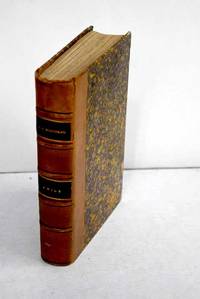
18783544599Paris.: Librairie Garnier Frères. 1878. Hardcover. Good. 19 cm. 565 p. Encuadernación en tapa dura artesanal hol nervios y guardas en papel artistico. Idioma frances. Rousseau Jean-Jacques 1712-1778. Par J. -J. Rousseau. De l'éducation. Ãndice alfabético: p. 599-638. Forma parte de la Colección Bioy Casares-Ocampo. FilosofÃa de la educación. FilosofÃa francesa. Siglo XVIII . Librairie Garnier Frères. hardcover
2008Q-2035844568LAROUSSE 2008-11-19. Paperback. New. New. In shrink wrap. Looks like an interesting title! LAROUSSE paperback
2012658822.Gpaperback. Good. Access codes and supplements are not guaranteed with used items. May be an ex-library book. paperback
2012658849.Gpaperback. Good. Access codes and supplements are not guaranteed with used items. May be an ex-library book. paperback
2012541739.Gpaperback. Good. Access codes and supplements are not guaranteed with used items. May be an ex-library book. paperback
2329339348.Gpaperback. Good. Access codes and supplements are not guaranteed with used items. May be an ex-library book. paperback
0274416697.Ghardcover. Good. Access codes and supplements are not guaranteed with used items. May be an ex-library book. hardcover
0274416735.Ghardcover. Good. Access codes and supplements are not guaranteed with used items. May be an ex-library book. hardcover
0274416719.Ghardcover. Good. Access codes and supplements are not guaranteed with used items. May be an ex-library book. hardcover
1271327422.Gpaperback. Good. Access codes and supplements are not guaranteed with used items. May be an ex-library book. paperback
1271346583.Gpaperback. Good. Access codes and supplements are not guaranteed with used items. May be an ex-library book. paperback
2329201036.Gpaperback. Good. Access codes and supplements are not guaranteed with used items. May be an ex-library book. paperback
1179215834.Gpaperback. Good. Access codes and supplements are not guaranteed with used items. May be an ex-library book. paperback
1179251970.Gpaperback. Good. Access codes and supplements are not guaranteed with used items. May be an ex-library book. paperback
1357892764.Ghardcover. Good. Access codes and supplements are not guaranteed with used items. May be an ex-library book. hardcover
1829952505Deux-Ponts Zweibrücken: G. Ritter 1829. hardcover. Gut. 1 Blatt 364 Seiten; 1 Bl. 300 S.; 1 Bl. 316 S. Pappbände der Zeit mit Rückentiteln. Oktav 205 cm Einbände stärker berieben und bestoßen innen braunfleckig sonst sauber im Ganzen passabel erhalten. "Jean-Jacques Rousseau geb. 28. Juni 1712 in Genf; gest. 2. Juli 1778 in Ermenonville bei Paris war ein französischsprachiger Genfer Schriftsteller Philosoph Pädagoge Naturforscher und Komponist der Aufklärung. Rousseau hatte großen Einfluss auf die Pädagogik und die politische Theorie des späten 18. sowie des 19. und 20. Jahrhunderts in ganz Europa. Er war ein wichtiger Wegbereiter der Französischen Revolution. Sein Werk ist unlösbarer Bestandteil der französischen und europäischen Literatur- und Geistesgeschichte." "Émile oder Über die Erziehung ist das pädagogische Hauptwerk Jean-Jacques Rousseaus aus dem Jahr 1762." Wikipedia. Ein Verlag Georg Ritter ist in der ersten Hälfte des 19. Jahrhunderts in Zweibrücken Rheinland-Pfalz nachzuweisen. Wegen Urlaub kann Ihre Bestellung / Anfrage erst nach dem 21.06.2026 bearbeitet werden. - Because of holidays your order / question can be handled only after 06/21/2026. G. Ritter hardcover
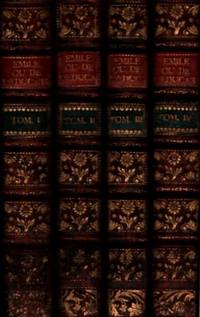
176254730A la Haye Chez Jean Néaulme Recte: Paris Duchesne 1762. 8vo. Bound in four beautiful uniform contemporary full mottled calf bindings with gilt title-and tome-lables to richly gilt spines. Gilt line-border to edges of bords. Lovely patterned edges. Spines and some corners lightly and expertly restored barely noteable. Occasional very light brownspotting or dusting but overall very nice and clean. Printed on good heavy paper with wide margins. An excellent copy. 2 VIII 2 466 6 pp. 4 407 1 pp. 4 384 pp.; 4 455 1 pp. 5 engraved plates used as frontispieces and facing p. 141 of vol. 1 respectively. The first plate "Thétis" in the variant state without title as described in MacEachern. Fully complete exactly as described in MacEachern. With all the misprints: Vol. 1: 88 as S8 443 as 433 465 as 46; vol. 2: 356 as 256 357 as 257; vol. 3: 383 as 363; vol. 4: 336 with first 3 broken according to McEachern this is just the case in some copies. With the usual cancelled leaves: Vol 1: Av B4; vol. 2: H3 N6 called I6. The final leaf ends with "FIN" and has no grapes MacEachern: "The grapes appear in three different forms.". <br/><br/><em>The very scarce actual first edition being the rarer more sought-after nicer 8vo-edition as opposed to the much more common 12mo edition which was printed about simultaneously but which seems to have appeared later the 8vo format also being the one preferred by Rousseau himself and the format in which he wanted his great work to appear.This magnificent work constitutes the climax of Rousseau's genius as well as the most important work on education since Plato. In Émile Rousseau poses an entirely new approach to education and the upbringing of children. His thoughts were exceedingly controversial the work was burnt by the executioner immediately after its first appearance and Rousseau had to flee the country due to a warrant for his arrest. The printing history of "Émile" is extremely complicated and has been a matter of intense dispute for many decades. Until Maceachern's bibliography from 1989 the edition that has now been established as the "Second Paris octavo" MacEachern 4A was generally considered the first printing of the work but there is no longer any dispute about the fact that the present edition is in fact the actual first 1A. The first edition appeared in both 8vo1A and 12mo1B and it seems to be generally accepted that the 8vo-edition was distributed first but that parts of the 12mo-edition may have been in printing a bit earlier. Rousseau himself seems to have preferred the 8vo-edition and wished for his great work to appear as this form first "The question of the format gave rise to some dissension for while Rousseau felt that the work was more suited to the octavo format Duchesne preferred to print a duodecimo and only a limited number of the more expensive octavo. Rousseau finally agreed to Duchesne's plan with reluctance declaring that in his opinion Duchesne was committing an error of judgment and that the octavo would certainly be the more sought after of the two formats." - MacEachern pp. 18-19. Rousseau himself was more involved in the coming-to-be of "Émile" than perhaps any other author has been in any other book. Throughout the entire process there were a large number of misunderstandings between himself and Duchene which more than once endangered the printing and publishing of this seminal work and which has contributed greatly to the extremely complicated bibliographical data of it. In fact up until very late in the process Rousseau did not believe that the work was actually going to be finished and it took several instances of mediation between the two to keep the work on tracks. Finally however the work was a reality and with it one of the greatest works of Western culture had been born.Rousseau's "Émile" constitutes the most significant modern treatise on the education of man surpassed only by Plato's "Republic". The comparison with Plato is all the more apt seeing that both works grow out of and are meant to remedy lacunae in the political philosophy of their authors.The conclusion to Rousseau's work on the social contract also written during Rousseau's stay in Montmorency had pointed to a predicament of political thought: that only if man were himself naturally inclined to freedom could he make use of political freedom. "Émile" is the analysis of the conditions under which a child can develop into a free human being. As such it presents the conclusion to Rousseau's earlier works on inequality political freedom and servitude.The paradox of Émile is that while the development of human nature must be natural if the child is to develop into a free human being steering that development in the right - that is free - direction requires constant intervention which moreover must be hidden from the child. Rousseau details this intervention in his analysis of the five stages in the education of the child covering the period from birth to the age of 25.Being one of the most influential thinkers of the 18th century Rousseau is considered one of the indirect causes of the French Revolution. In Rousseau one certainly finds one of the most influential spokesmen for 18th century thought and it is primarily the thoughts of him and Voltaire that are put into action with the Revolution."The first and last of these i.e. Héloise and Émile with their sentimental expression of deism gave much offence and Rousseau like Voltaire was forced to flee to Prussia. Restless and locally unpopular he fled again to England where he had a great welcome. Hume who had offered him asylum looked after him patiently." PMM 207 Printing and the Mind of Man.The totalitarian tendency of Rousseau's philosophy of education has been noted by a number of philosophers in recent times most famously Karl Popper.McEachern: 1A </em> unknown
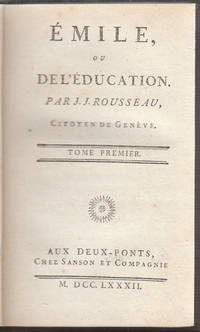
5333-01Deux-Ponts Sanson 1782. 4 in 2 vols. VI 251; 232; 290; 251 S. HLn. d. Zt. m. goldgeprägt. Rückentit. Rü. gebleicht berieb. - Oeuvres completes Deux-Ponts, Sanson 1782. unknown
1762PUSilROU64Amsterdam: Jean Néaulme 1762. 1762. 4 Volumes. 12mo. pp. 2 p.l. 442; 2 p.l. 383; 2 p.l. 328; 2 p.l. 463. with half-titles. 5 engraved plates after Eisen. woodcut ornaments. contemporary half calf extremities bit rubbed some light foxing. The Second Lyon Edition with false Amsterdam address of Néaulme. A classic in educational theory Émile is also as Rousseau himself points out a philosophical treatise on the goodness of human nature. The work seeks to follow the natural unfolding of a young man raised in rural isolation unsubjected to the corrupting influences of society. Rousseau's radical ideas especially his proposal to substitute sentimental deism for the dogma of revealed religion aroused the wrath of ecclesiastical and civil authorities; the book was condemned and Rousseau threatened with arrest fled the country. McEachern II 5. cfGagnebin 5. cfRand I 448. cfTchemerzine X p. 45. Amsterdam: Jean Néaulme, 1762. unknown