593 résultats
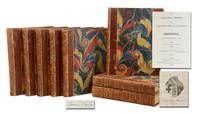
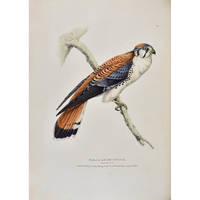
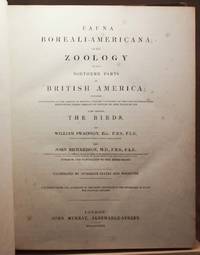
18316251London: John Murray 1831. First edition presentation copy from John Murray to Edward Jesse. Very Good/Sir John Richardson accompanied Sir John Franklin on both of his overland expeditions to the North 1819-1822 and 1825-1827. As naturalist to the expedition Richardson collected specimens of the flora and fauna of the Arctic. Swainson was responsible for preparing the lithographic plates classification and synonymy for Richardson's monumental Fauna Boreali-Americana which described the zoology ornithology ichthyology and entomology of the fauna of northern Canada. Swainson was entirely responsible for this volume on the birds. The illustrations mark the beginning of the use of lithography in bird book illustration. Quarto 285 mm; lxvi 2 523 1 pages. 50 hand-colored lithograph plates finished in gum arabic by Swainson. In contemporary half leather over marbled boards worn. Mild to moderate foxing present on some plates primarily in the first quarter of the text block; later plates quite clean. Provenance: presentation inscription on half-title by John Murray "The Publisher" to natural history author Edward Jesse; armorial bookplate of Irish ichthyologist and breeder of Irish Setters Harry Blake-Knox JP. References: Fine Bird Books p.135; Nissen IVB 773; Sabin 71027; Zimmer p.520 John Murray hardcover books
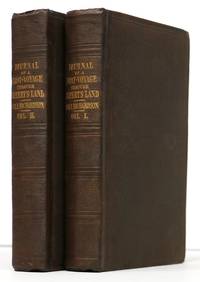
1851144847London: Longman Brown Green and Longmans 1851. viii413; vii426 pp. Octavo. Two volumes. Original blindstamped brown cloth. Gilt title on spine. Joints have had a slight bit of professional restoration. This is the first issue binding. Coated yellow endpapers. 10 coloured lithograph plates including frontispiece in each volume Untrimmed. Top edges a bit dusty. Wood engraved illustrations in text and folding map partly coloured in outline opposite p.1 volume 1. The map is in very good condition and not rebacked. Occasional light foxing on the plates mainly on the margins. The text is generally very clean with a small amount of mainly marginal light foxing or browning. Overall a very attractive set with the fragile folding map in very nice condition. Both volumes with a near contemporary signature of Richard Norman on the top of the title. Arctic Bib. 14489. An account of the Franklin Search expedition led by Sir John Richardson and Dr. John Rae down the MacKenzie then eastward along the coast to the Coppermine River returning overland to Fort Confidence in 1848 and Rae's journey down the Coppermine in the summer of 1849. Includes chapters on the Eskimos Kutchin Cree and Chipewyan Indians. 1851 Longman, Brown, Green, and Longmans hardcover
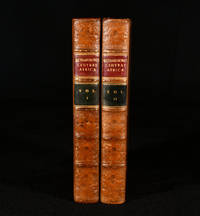
1853678L17London: Chapman and Hall 1853. First edition. Leather. Very Good Indeed. 8" by 5". None. A smartly bound first edition set of James Richardson's narrative of his mission to central Africa. An association copy owned by the author's nephew. With an inscription to the title page 'A Goodsir nephew of author from Gertie'. It is believed this book was presented to one of the sons of Susanna Richardson and her husband Joseph Goodsir probably Alexander David Goodsir. This is one of two works written by Richardson of his travels the second being 'Travels in Morocco'. Half-title to volume I present. Additional half-title from volume II misbound before the preface to volume I. Pages v-vi has been misbound after vii-viii to volume I. Volume I has been rebacked with the original spine relaid. Illustrated with a folding map to each volume. This work regards the wildlife climate people customs and politics of Central Africa during Richardson's travels. His mission under the orders and at the expense of Her Majesty's Government was to propagate Christianity and suppress the slave trade. This was Richardson's second time in Ghat whereby he was accompanied by Heinrich Barth and Adolf Overweg. Though he succumbed to fever before reaching Lake Tchad. They were the first Europeans to cross the stony elevated plain of the Hammada. This work is formed of Richardson's notes and diaries posthumously. A very smart first edition copy of this uncommon work. In uniform full calf bindings. Rebacked with the spine laid down and boards preserved. Renewed spine labels. Externally very smart with light rubbing to the extremities and to the head and tail of spine. Handling marks to boards. Internally firmly bound. Pages are bright. Scattered spots to the first and last few pages. Otherwise pages are clean. Very Good Indeed Chapman and Hall hardcover
1844A35042London: E.W. Janson printed by Edward Newman 1844-1848. viii 139 60 lithographic plates. . HB. 4to nineteenth century half morocco rubbed and a little worn to extremities raised bands gt aeg marbled endpapers. Some scattered foxing heavier to a couple of plates. With the bookplate and gilt crest to front cover of the General Assembly Library New Zealand. No stamps. Also with decorative bookplate of a later owner. Zoology of the voyage of the H.M.S. Erebus and Terror Vol. II Part 2 Ichthyology. The complete report concerning the fish specimens collected during Ross' voyage to the Antarctic 1839-1842 including species from Australia New Zealand Cape Horn the Falklands and elsewhere.The expedition of HMS Erebus and Terror to the Antarctic was under the command of Captain James Clark Ross 1800-1862. Francis Crozier was second-in-command Captain of HMS Terror. It was the first of the major Antarctic expeditions with the mission of conducting 'magnetic research and geographical discovery'. The natural history collections collected en route proved of lasting importance many being collected by the assistant surgeon and botanist Joseph Dalton Hooker 1817-1911. Page 15 records an amusing story; �When the ships were in the high latitude of 77�10�S. and long. 178�� a fish was thrown up by the spray in a gale of wind against the bows of the Terror and frozen there. It was carefully removed for the purpose of preservation and a rough sketch was made of it by the surgeon John Robertson Esq. but before it could be put into spirits a cat carried it away from his cabin and ate it. The sketch is not sufficiently detailed so � we have introduced a copy of the design merely to preserve a memorial of what appears to be a novel form.� It would be another 60 years before another specimen of this new species would be caught again.Fine lithographic plates of fish by W. Mitchell printed by Hullmandel & Walton. Also bound at the rear are the first 24 pages and 6 plates of the report on Insects 'Insects of New Zealand' by Adam White 1846 which includes species of stick insects and dragonflies new to European science collected from New Zealand and the Auckland Islands. A further part on insects pp. 25-52 plates 7-10 was published much later in 1874 but is not present here.The present volume comprises an important part of the scientific reports resulting from the expedition. The complete Zoological reports were published in 24 parts in 2 volumes over a thirty-year period and complete sets are extremely rare.BMNH Library Catalogue Vol. IV p. 1698; Nissen ZBI 3386; Rosove 270-8. E.W. Janson, printed by Edward Newman hardcover
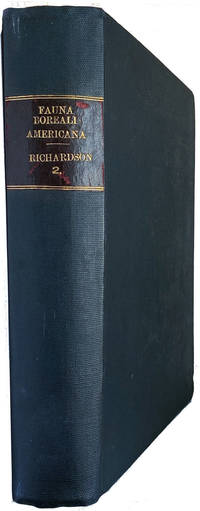
183140977London: John Murray 1831. 4to. 27.5cm tall copy ix errata slip-xlxvi5231p. errata page with With 46 of 50 hand-coloured lithographed plates & 41 wood-engraved text illustrations rebound in later blue cloth black leather label the plates are clean and the colour is excellent. fine. ~ ~ Of the 4 volumes of Fauna Borealis Americana each covering a different subject Volume 3 THE BIRDS over the years was always considered the rarest of the single volumes. Complete sets in fine bindings are the rarest and most difficult to find in acceptable condition. <br /> <br /> Richardson was surgeon and naturalist with Franklin on his two overland expeditions to discover a Northwest Passage in 1819-22 and 1825-27 and these fine works are the chief scientific data collected. The Illustrations were drawn from specimens volume three being the artistic work of William Swainson the plates being hand-coloured. Richardson wrote most of the text and gives accounts of previous natural history investigations in the Arctic. Most of the species here recorded were then new to science. "To the publication of them the four volumes. the government made a grant of 1000 pounds. This may therefore boast of being the first zoological work published with the support of the British government". -Anker. Anker 493. Nissen 773. Zimmer II520. Casey A. Wood p537. Sabin 71026-7-8. T.P.L. 1454. Sitwell. Fine Bird Books 1700-1900. p135. John Murray unknown
1848WRCAM54899Baltimore: John W. Woods Printer 1848. 96pp. plus three wood-engraved plates including frontispiece one in-text illustration and a facsimile manuscript. Modern morocco in an antique style spine gilt raised bands edges tooled in gilt. Contemporary institutional gift inscription on front free endpaper. Occasional light foxing. A very good copy. Second edition after the very rare first edition of the previous year of this important Wagner-Camp and Mexican-American War title. This second edition remains quite rare and is seldom met with in commerce. Richardson enlisted as a mounted volunteer due to patriotism engendered on the 4th of July in Carrollton Missouri. He took part in Doniphan's expedition over the Santa Fe Trail in the fall of 1846 heading south to El Paso by the first of the New Year then on to Chihuahua and eventually to Matamoros where the command shipped by boat to New Orleans. By July 10 Richardson was back home in Anne Arundel County Maryland and the first edition of his fascinating journal was published before the end of 1847 in the nearest city Baltimore. <br> <br> An important and well-written account of overland travel along the Santa Fe Trail during the Mexican-American War. GARRETT p.153. GRAFF FIFTY TEXAS RARITIES 33 1st ed. WAGNER-CAMP 137:2. CLARK II:164. HOWES R262 "aa." TUTOROW 2630. GRAFF 3496 1st ed. RITTENHOUSE 480 note. SABIN 71093. John W. Woods, Printer hardcover books
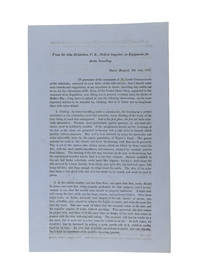
1853144972London: Admiralty 1853. Notes: Folio 34cm one sheet folded 3 printed pages on pale blue stock paper a fine copy very rare. With regard to the Admiralty letters McGahern says "We found no standard references auction records or listings. They are not listed in WorldCat or Amicus. These letters are mentioned in George W. Corner's biography of Kane "Doctor Kane and the Arctic Seas" 1972 p116. 'From England he Kane received letters of advice and encouragement from the experienced Arctic travellers Sir William Parry Sir John Richardson Sir James Ross and Colonel later Sir Edward Sabine.' only reference located. </p><p>WorldCat shows one copy at the University of Illinois at Urbana Champaign as part of a collection of 3 items Richardson Parry and Sir John Ross sic: this should be James Clark Ross. Described as "Three letterpress copies of letters addressed to Sir Francis Beaufort hydrographer of the British Admiralty… The letters were presumably printed for distribution by the Admiralty each on blue paper bifoliate leaves." OCLC #1114338177.</p><p>In early 1853 Kane was preparing for the Second Grinnell Expedition and apparently he or the US Navy Dept. solicited advice on suitable equipment and technique from the British Admiralty. In response the Admiralty sent letters to several of the better known Arctic explorers of the time their replies being forwarded to Kane in printed form. These letters are filled with detailed suggestions regarding clothing with particular attention to feet fuel sledges tents travelling etc. McGahern Plimer Catalogue #375. 1853 Admiralty hardcover
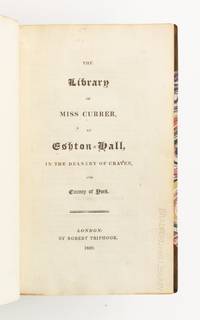
1820ST16983London: Robert Triphook 1820. ONE OF 40 COPIES PRINTED. 235 x 142 mm. 9 1/4 x 5 3/4". iii-xi 1 308 pp. lacking the first of the two title pages at front. <br/> In a very nice replica binding of honey-brown sheepskin over marbled boards raised bands ruled in gilt gilt titling. Front free endpaper INSCRIBED IN INK BY CURRER: With Miss Currer's Compliments"; small ownership perforation of the Bradford Free Library on title page and p. 99; two small ink stamps on p. 59 and 99. Front free endpaper with thinned area where indication of earlier ownership likely appeared. The boards just very lightly scuffed though probably to provide a feeling of authenticity otherwise only trivial imperfections. Apart from the signs of library ownership a very fine copy the text showing virtually no signs of use.<br/> <br/> This is a presentation copy of the first library catalogue of Frances Mary Richardson Currer an Englishwoman described by De Ricci as "England’s earliest female bibliophile" and hailed by Dibdin as "the head of all female collectors in Europe." An only child Currer 1785-1861 inherited considerable assets from both her father's and her mother's families: her relative Dorothy Richardson wrote in 1815 "She is in possession of both the Richardson and Currer estates and inherits all the taste of the former family having collected a very large and valuable library . . . in addition to what were collected by her great grandfather and great-uncle." Dibdin noted that her library at Eshton Hall in North Yorkshire was surpassed only by three collections those of Earl Spencer and the dukes of Devonshire and Buckingham. According to DNB "the library had substantial holdings in natural science topography antiquities and history together with a collection of the classics. There were rarities some early printed books a collection of Bibles and a fine gathering of illustrated books. . . . Dibdin first estimated the number of volumes at 15000 and later 18000. In 1852 Sir J. B. Burke put the number at 20000." With just 40 copies printed this first printing there was a 1933 second edition is very rarely seen on the market. Robert Triphook unknown
1854WRCAM54205London 1854. xi11711 erratapp. plus thirty-three mounted lithographic plates seventeen double- page. Half title bound after the titlepage. Quarto. 20th-century half polished calf and marbled boards spine gilt leather label. Minor scuffing to boards. Modern bookplate on front pastedown light occasional foxing. Very good. The first edition of this zoological publication from the voyage of the Herald with descriptions of fossil bones from Eschscholtz Bay. The first part of this work appeared in 1852; in 1854 it was completed and issued with a new titlepage. The lithographs depict all manner of mammalian fossils including full skeletons of the bighorn and musk-bull and detailed illustrations of their parts with skulls spinal bones and more. Also includes three excellent plates featuring lizards and six of various fish. Rare; not in Hill or ARCTIC BIBLIOGRAPHY. <br> <br> "Sir John Richardson was a distinguished British naturalist and arctic explorer. In 1819 he was appointed surgeon and naturalist to Franklin's first arctic expedition and subsequently to the second. The scientific results of these expeditions he described in contributions to Franklin's NARRATIVES. He also wrote the natural history accounts of several other arctic voyages. The present work is one of these." - Lada-Mocarski. FORBES 2049. LADA-MOCARSKI 139. SABIN 71033. hardcover books
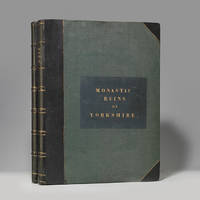
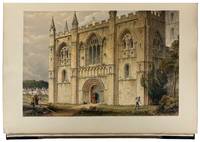
18431177231843. First Edition. RICHARDSON William. The Monastic Ruins of Yorkshire. York: Robert Sunter 1843. Two Volumes. Elephant folio 18 by 24 inches early cloth rebacked and recornered in later dark green morocco all edges gilt. $6500.First edition of this monumental production with two hand-colored title pages a hand-colored dedication leaf 34 hand-colored full-page plates 24 hand-colored half-page plates 22 uncolored full-page plates some tinted and a map.The dissolution of the monasteries by Henry VIII in the 16th century left Yorkshire with a rich collection of monastic ruins captured here in a series of plates by artist William Richardson in a work that rivals the great Holy Land by David Roberts. Locations included here are Whitby Abbey Kirkstall Abbey St. Mary's York Rievaulx and Kirkham Abbeys Fountains Roche Abbey Byland and Newborough Guisborough Mount Grace Selby Abbey Bolton Priory Bridlington Priory Old Malton Priory Joraulx Abbey Sallay Abbey Sawley Abbey Monk Bretton Priory Coverham Abbey Eggleston Abbey Easby Abbey Grey Friars Richmond Howden Kirkham Priory Marrick Nun-Monkton Ellerton and Rosedale Priory. The plates were printed by the lithographic firm of William Day frequently referred to as ""Day and Hague"" because of the fine work of Belgian draughtsman and watercolorist Louis Haghe the foremost lithographer of his time. ""The firm of Day and Haghe raised lithography to perhaps the highest point it ever attained"" Abbey 340. Perhaps not surprisingly this is the same firm that printed Roberts' Holy Land. Issued in two versions one entirely uncolored and the other with many of the plates hand-colored. This copy without the uncolored plate labeled number 49 by Abbey not present or listed in the uncolored copies and often not present but in the plate list in colored copies; in this copy Abbey's plate number 74 ""Howden Tombs"" has been bound in its place. Abbey Life 381. Scattered foxing to some text and plates. An impressive production. hardcover
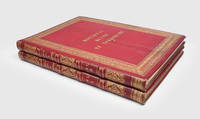
1843185001York: Robert Sunter 1843. Richardson's really fine plates will always make this a desirable book First and only edition; a very handsome copy bound in York of one of the most resplendent English colour plate topographical books. Richardson's beautifully composed picturesque scenes superbly lithographed by George Hawkins were printed by the firm of Day & Haghe - responsible for the celebrated David Roberts folios - which "raised lithography to perhaps the highest point it ever attained" Abbey. Boyne remarks that "Richardson's really fine plates will always make this a desirable book" and notes that it was issued originally in nine parts available at nine guineas plain or eighteen guineas coloured; this copy has a mixture of both which is often the case. All the major abbeys of Yorkshire are portrayed among them Whitby Kirkstall Rievaulx Byland and Fountains as well as a number of priories and smaller religious houses. Richardson's finely rendered placid scenes populated attractively by local people and admiring visitors illustrate the exceptional richness of Yorkshire's survivals from Henry VIII's dissolution of the monasteries. In fact Yorkshire did not "go quietly" during that period of state-sanctioned vandalism: "The dissolution violently destroyed centuries-old communities and wiped out ancient landmarks But in the midst of the dissolution a sudden storm of opposition took the government by surprise; for a time it looked likely to threaten not only Cromwell's policy but even perhaps Henry's throne. This was the northern rising also known as the Pilgrimage of Grace which convulsed Lincolnshire Yorkshire and finally all the north in the last three months of 1536" Elton p. 145. Monastic Ruins pairs two men with deep roots in the county. York-born William Richardson 1814-1899 the son of a cabinet maker specialized in architectural and landscape subjects and exhibited at the Royal Academy between 1842 and 1869. Edward Churton 1800-1874 theologian and Spanish scholar held the living of Crayke in the North Riding of Yorkshire for forty years and from 1841 was prebendary of York Minster. "Churton saw himself as the custodian of a continuous Catholic tradition within the Church of England inherited from the Caroline divines" ODNB - making him a sympathetic choice as author. 2 vols folio 605 x 415 mm. With 2 lithograph title pages that for vol. I hand-coloured hand-coloured lithograph dedication leaf 82 lithograph plates by George Hawkins after William Richardson 32 full-page 27 half-page on text leaves 25 of these 59 are hand-coloured and mounted and 23 plain lithograph plans printed by Day & Haghe coloured decorative initials and map showing locations; text and plates mounted on white linen stubs. Contemporary red morocco by H. Potter of York gilt-stamped on the front turn-ins bevelled boards spines with four low broad gilt-decorated raised bands gilt-lettered and numbered direct in second and fourth compartments others panelled with gilt paired fillets enclosing scrolling foliate cornerpieces dots and circlets and a central lozenge composed of multiple tools gilt-lettered covers framed by alternating concentric panels of gilt triple fillets and scrolling foliate rolls gilt turn-ins Bouquet pattern marbled endpapers gilt edges. Bindings a little rubbed at extremities a few shallow indentations to covers pale stains to front cover of vol. II some foxing light tidemark at top corner of a handful of leaves at end of vol. I offsetting from turn-ins to endleaves a few mount sheets browned. A very good copy. Abbey 381; William Boyne The Yorkshire Library: A Bibliographical Account 1869 XXXIII. G. R. Elton England Under the Tudors 1991. hardcover
1843B4090York: Robert Sunter c.1843. Edges gilt all plates are clean and crisp and beautifully hand colored A very handsome and fine set in original dark green half morocco. Frontispiece with a small library stamp on the lower right corner of the margin not affecting the plate. . Binding: Original green half morocco with matching marbled boards. 6 raised bands in 7 compartments tooled gilt rules tooled gilt lettering and elaborate design on the spine marbled free and pasted end papers Notes: An architectural and landscape engraver George Hawkins 1809-1852 turned his attention to lithography in which he was very successful. He was frequently employed by architects in colouring their designs for various edifices many of which were exhitibted in the architectural room of the Royal Academy. One of his most important undertakings was a series of lithographs of the “Monastic Ruins of Yorkshire†from sketches made by W. Richardson. For the above projects he worked closely with prominent printers Day and Hague which were also the printers for the celebrated works of David Roberts of Holyland and Egypt.<br>Abbey 248 DNB.<br> Size: Large Folio: 450mm x 606m Illustration: Illustrated with 55 hand colored full page plates 25 half page plates and one map 2 frontispieces. Volume: Two Volumes References: Abbey 248 381 DNB. Pages: P. Vol1: Blank Frontis Title Contents 1 Intro v-ix 11-56 blank; Vol 2: Blank Frontis Blank 57-88 blank. Category: Book Plate Books Colour; Book Europe United Kingdom; Robert Sunter hardcover
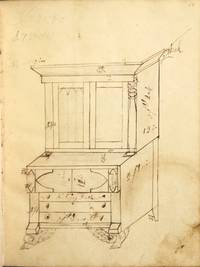
183561406Holley NY 1835. Small 4to notebook approx. 8 x 6 1/4 in. bound in original half calf over marbled boards containing approximately 80 leaves with manuscript entries and designs composed and drawn in ink and pencil; some blank pages scattered throughout. Approximately 50 designs including fully realized furniture styles with measurements some sketches or details of design elements table legs column styles acanthus leaf patterns etc. some more abbreviated images of design features. Dates on some of the drawings indicate the notebook was used between 1830 and 1833. One manuscript entry includes a grid-style list of prices for joints in various woods; another describes the construction of a portable desk giving the cost of various additions to the basic design such as a hollow for pens a square drawer and a book rest. Another 10 pp. offer approximately 18 recipes for stains and varnishes. Three loose scraps containing designs laid in. Moderate wear dampstaining to endpapers otherwise very good. The letterpress broadside advertises Richardson's business and reads in part: "Holley / Cabinet / Ware House. / C. Richardson / would inform the people of Holley and vicinity / that he still continues the cabinet making business 3 doors south of Perry's Tavern." Brockport: A. Edwards Printer 1835. The broadside measures 14 x 11 in. printed in various sizes and styles of type with a central composite image of period furniture including a dresser chairs settee and wash stand the text within a thick ornamental border. Old fold lines some foxing else a nice example. This broadside appears to be unrecorded. A very faint contemporary pencil notation on the front endpaper of the notebook reads "Chase Richardson 1832." This is most likely the same Richardson who had the broadside printed given that some of the illustrations on the broadside appear to be taken from drawings in the accompanying manuscript. Records from Hillside Cemetery Clarendon Orleans County NY just 3 miles from Holley NY mention a Chase Richardson 1810-1839. Both items are housed in recent cloth clamshell boxes with gilt stamped leather labels. At the beginning of the 19th century the furniture industry in America saw a sudden shift of its epicenter from Philadelphia to New York. Dubbed the "London of America" it was thought at the time that New York would in fact be the leader in business in the United States. To facilitate the cabinetmaking industry a new directory for cabinetmakers in New York was published in 1805 and various guides were issued helping craftsmen to price their furniture. Styles were elegant and influenced highly by the European furniture which was also being imported into New York. Phyfe Allison and Ash produced some of the finest examples of furniture from that period. However although the high styles of the time may have been determined by these well known cabinetmakers others imitated and added their own interpretations.<br/>John L. Scherer in his exhibition catalog "New York Furniture: The Federal Period 1788-1825" Albany: 1988 states: "Eventually cabinetmakers in upstate towns and villages who picked up New York City styles rendered their own versions. Using local woods this furniture evokes a spirit of the time with a dash of country charm. As trends in New York State furniture moved upstate they also spread across the country. New York remained in the forefront of furniture design and production until the end of the century." This fine group of material illustrates an 1830's provincial craftsman working in the newly fashionable Empire-style designs. Among the more fully executed designs in this notebook are a washstand stool dressing tables and secretaries each with detailed measurements. Some are titled such as "French Bureau" "Grecian Card Table" and "Portable Secretary." Others may have been sketched during a trip to York Ontario now Toronto including "York Bureau No. 1 and 2." Richardson was aware of the developments in furniture design in other parts of the state. One of the notes beside a drawing of a "Dress Beauro sic Plain" mentions what the same item sold for at Meads & Alvords. John Meads & William Alvord operated a successful cabinet-maker's shop in Albany NY until Alvord's death in 1847 according to a "Bi-centennial History of Albany" published by W.W. Munsell in 1886. The notebook also includes details of carving designs such as foliage scrolls turning profiles and volutes. In the back of the volume are several recipes for varnishes and stains some intended to imitate more expensive materials such as mahogany curly maple and marble. For example to imitate birds eye maple one had only to mix "cuprite two shades darker than white lead & chrome yellow & V. Red plus Raw Terra de Sena" using a quill and fingers as tools. Many of these recipes are credited to other cabinet-makers residing in Ontario and northern New England. A recipe for white varnish came from John Bradshaw of Waterson sp a stain for Rose Wood Chairs from Silas Alden of Boston a German Polish recipe from Clark H. Ober of New Ipswich etc. While information and documentation for furniture makers in the larger cities is often obtainable information on smaller local artisans is much more scarce. <br/>Both items were inherited by Gertrude Cole Simmons 1895-1985 of an old Holley-area family. Her grandmother was Ellen Maria Richardson Cowles 1838-1873 who may have been the daughter or niece of the cabinet maker C. Richardson. <br/><br/> hardcover books
183548691Holley NY 1835. Small 4to notebook approx. 8" x 6¼" bound in original half calf over marbled boards containing approximately 80 leaves with manuscript entries and designs composed and drawn in ink and pencil; some blank pages scattered throughout. Approximately 50 designs including fully realized furniture styles with measurements some sketches or details of design elements table legs column styles acanthus leaf patterns etc. some more abbreviated images of design features. Dates on some of the drawings indicate the notebook was used between 1830 and 1833. One manuscript entry includes a grid-style list of prices for joints in various woods; another describes the construction of a portable desk giving the cost of various additions to the basic design such as a hollow for pens a square drawer and a book rest. Another 10 pp. offer approximately 18 recipes for stains and varnishes. Three loose scraps containing designs laid in. Moderate wear dampstaining to endpapers otherwise very good. The letterpress broadside advertises Richardson's business and reads in part: "Holley / Cabinet / Ware House. / C. Richardson / would inform the people of Holley and vicinity / that he still continues the cabinet making business 3 doors south of Perry's Tavern." Brockport: A. Edwards Printer 1835. The broadside measures 14" x 11" printed in various sizes and styles of type with a central composite image of period furniture including a dresser chairs settee and wash stand the text within a thick ornamental border. Old fold lines some foxing else a nice example. This broadside appears to be unrecorded. A very faint contemporary pencil notation on the front endpaper of the notebook reads "Chase Richardson 1832." This is most likely the same Richardson who had the broadside printed given that some of the illustrations on the broadside appear to be taken from drawings in the accompanying manuscript. Records from Hillside Cemetery Clarendon Orleans County NY just 3 miles from Holley NY mention a Chase Richardson 1810-1839. Both items are housed in recent cloth clamshell boxes with gilt stamped leather labels. At the beginning of the 19th century the furniture industry in America saw a sudden shift of its epicenter from Philadelphia to New York. Dubbed the "London of America" it was thought at the time that New York would in fact be the leader in business in the United States. To facilitate the cabinetmaking industry a new directory for cabinetmakers in New York was published in 1805 and various guides were issued helping craftsmen to price their furniture. Styles were elegant and influenced highly by the European furniture which was also being imported into New York. Phyfe Allison and Ash produced some of the finest examples of furniture from that period. However although the high styles of the time may have been determined by these well known cabinetmakers others imitated and added their own interpretations. John L. Scherer in his exhibition catalog "New York Furniture: The Federal Period 1788-1825" Albany: 1988 states: "Eventually cabinetmakers in upstate towns and villages who picked up New York City styles rendered their own versions. Using local woods this furniture evokes a spirit of the time with a dash of country charm. As trends in New York State furniture moved upstate they also spread across the country. New York remained in the forefront of furniture design and production until the end of the century." This fine group of material illustrates an 1830's provincial craftsman working in the newly fashionable Empire-style designs. Among the more fully executed designs in this notebook are a washstand stool dressing tables and secretaries each with detailed measurements. Some are titled such as "French Bureau" "Grecian Card Table" and "Portable Secretary." Others may have been sketched during a trip to York Ontario now Toronto including "York Bureau No. 1 and 2." Richardson was aware of the developments in furniture design in other parts of the state. One of the notes beside a drawing of a "Dress Beauro sic Plain" mentions what the same item sold for at Meads & Alvords. John Meads & William Alvord operated a successful cabinet-maker's shop in Albany NY until Alvord's death in 1847 according to a "Bi-centennial History of Albany" published by W.W. Munsell in 1886. The notebook also includes details of carving designs such as foliage scrolls turning profiles and volutes. In the back of the volume are several recipes for varnishes and stains some intended to imitate more expensive materials such as mahogany curly maple and marble. For example to imitate birds eye maple one had only to mix "cuprite two shades darker than white lead & chrome yellow & V. Red plus Raw Terra de Sena" using a quill and fingers as tools. Many of these recipes are credited to other cabinet-makers residing in Ontario and northern New England. A recipe for white varnish came from John Bradshaw of Waterson sp a stain for Rose Wood Chairs from Silas Alden of Boston a German Polish recipe from Clark H. Ober of New Ipswich etc. While information and documentation for furniture makers in the larger cities is often obtainable information on smaller local artisans is much more scarce. Both items were inherited by Gertrude Cole Simmons 1895-1985 of an old Holley-area family. Her grandmother was Ellen Maria Richardson Cowles 1838-1873 who may have been the daughter or niece of the cabinet maker C. Richardson. See also: Finkelman Encyclopedia of the New American Nation: The Emergence of the United States 1754-1829. Detroit 2006; Scherer New York Furniture: The Federal Period 1788-1825. Albany 1988; and Scherer New York Furniture at the New York State Museum Alexandria VA 1984. <br/><br/> hardcover books
184342171York: Robert Sunter 1843. 2 volumes. Folio. 23 5/8 x 16 7/8 inches. Lithographed Dedication Contents leaf explanatory text accompanying each section of plates. Illustrated with 84 plates of which 34 are full-page hand-coloured plates 27 are hand-coloured and affixed to text pages and 23 are with tinted details or uncoloured and 1 coloured map showing localities of abbeys etc. Half brown morocco and cloths spine with raised bands forming six compartments marbled endpapers all edges gilt<br/> <br/> A rare beautifully illustrated work with magnificent hand coloured lithographs celebrating Yorkshire’s storied architectural heritage.<br/> <br/> A monumental visual and historical survey The Monastic Ruins of Yorkshire is among the most ambitious 19th-century publications devoted to Britain's early architectural heritage. Comprising 84 lithographic plates 61 hand coloured after on-site drawings by architect William Richardson and lithographed with remarkable sensitivity by George Hawkins the work offers sweeping detailed views of the region's most storied monastic sites: Fountains Abbey Rievaulx Whitby Bolton Kirkstall and many others. The accompanying texts by the Revd. Edward Churton M.A. supply rich historical commentary detailing each abbey's foundation its monastic order phases of architectural development notable benefactors and the devastation wrought by the Dissolution of the Monasteries under Henry VIII. Yorkshire's landscape rugged expansive and historically wealthy in natural resources was ideally suited for the growth of monastic communities. From the 12th century onward the region became a stronghold for the Cistercians Benedictines Augustinians and Premonstratensians whose abbeys often flourished under aristocratic and royal patronage. Yorkshire's remoteness from court life its vast agricultural estates and its political significance as a northern frontier made it a vital religious and economic center in medieval England. These monasteries were not only spiritual havens but also hubs of learning manuscript production and agrarian innovation. The prominence of Yorkshire in England's monastic landscape also made it disproportionately affected by the Dissolution 1536-1541 which stripped religious houses of their lands and wealth and left their architectural shells to decay. By the 19th century these ruins overgrown sublime and emblematic of a vanished order became focal points of Romantic imagination and national identity. The present work reflects this cultural turn merging antiquarian interest with a Victorian appreciation for the picturesque. This copy is notable for its original hand colouring. While some examples were issued with colour tinting or were embellished with modern hand colouring this copy preserves the original hand-colouring.<br/> <br/> Abbey Scenery 381. Robert Sunter unknown
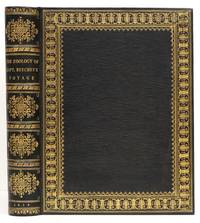
1839144944London: Henry G. Bohn 1839. xii180 pp. Quarto 28 X 22.5 cm. Bound in an attractive modern full dark blue straight grain morocco. Gilt decoration on spine and gilt decoration on boards. All edges speckled red. Marble endpapers to match. Modern bookplate on the front pastedown. Half title. 50 hand-colored engraved plates by Sowerby on the title page but there are actually only 44 plates 3 engraved geological plans with hand-colored details and 1 folding hand-colored engraved plate of geological sections. One extra uncoloured plate not called for after Plate 44. Overall a very attractive and fresh copy with very bright colouring. A very rare item. An IMPORTANT WORK NOTED for ITS STRIKING COLORED PLATES of BIRDS REPTILES MAMMALS and MARINE LIFE. The collections and notes were done during the four-year voyage of the Blossom a voyage to assist the expeditions of W.E. Parry and John Franklin. The notes are by John Richardson mammalia Nicholas A. Vigors birds George T. Lay and Edward T. Bennett fishes Richard Owen crustacea William Buckland geology and John Edward Gray reptiles and shells. As Beechey explains in the introduction the appearance of this work was long frustrated and it was only after a full eight years that it saw publication. In no uncertain terms he states "that it the delay has been occasioned entirely by Mr. Gray's failing to furnish his part in spite of every intercession from myself and others." As also noted by Beechey although the nature of the Blossom's mission prevented long stays in any one locality the crew did collect an astounding number of rare and exotic species from a good variety of locations. Hill 96; Sabin 71032. Lada Mocarski 105. 1839 Henry G. Bohn hardcover
1812140947913London: Printed for the Translator by Robert Wilks 1812. First Edition in English. Very Good. First edition in English of the works of Aristotle one of 50 sets printed and boldly signed by the translator Thomas Taylor in ink at the end of the first volume. All volumes bear the armorial bookplates of noted bibliophile and Bronte family benefactor Frances Mary Richardson Currer 1785-1861. <p>Incomplete set with eight of ten volumes present of the complete translation. Uniformly bound by "J. Mackenzie Binder to the King" in contemporary half morocco over French Curl marbled boards with spines lettered and tooled in gilt; all edges gilt 4to. Very Good with wear extremities rubbed sporadic foxing hinges slightly tender. <p>Volumes include: 1. The Organon 1807. 2. The Treatises on the Soul 1808. 3.The History of Animals 1809. 4.The Treatises on the Parts and Progressive Motion on Animals etc. 1810. 5. The Rhetoric 1811. 6. The Great Edemian Ethics 1811. 7. A Dissertation on the Philosophy of Aristotle 1812.8. The Metaphysics first edition of 1801. <p>The first collected English translations of Aristotle's works from Orphic fragments by Neoplatonist scholar Thomas Tyler 1758-1835. Provenance of famed bibliophile and collector Frances Mary Richardson Currer whose well-curated and respected library expanded to nearly 20000 volumes. Bibliographer Thomas Frognall Dibdin remarked that she was "the head of all female book collectors in Europe." Known for her philanthropic endeavors she donated a sum of 50 pounds to Patrick Bronte father of Charlotte Bronte when he was widowed in 1821. Currer also contributed an unknown amount to the Clergy Daughter's School that the Bronte sisters attended. Scholars postulate that Charlotte chose the non de plume of "Currer Bell" for her first published 1847 novel Jane Eyre in honor of Currer's philanthropy. A desirable set even without Currer's bookplate that seldom comes up for sale. Printed for the Translator by Robert Wilks unknown
1829B568<p>London: John Murray Richard Bentley and Josiah Fisher 1829- 1837 4 vols 4to 275 x 200mm Contemporary red half morocco gilt with 110 engraved plates of which 72 are hand-coloured a very nice large uncut copy.</p><p>Scarce Complete Copy of the First Edition of this Rare Work on the Natural History of the Arctic.</p><p>Sir John Richardson 1787–1865 surgeon naturalist and Arctic explorer went on Sir John Franklin's first two Arctic expeditions as ship's doctor and naturalist and made observations and collected a large number of plant and animal specimens from the Canadian Arctic. </p><p>On his return to England after the second expedition he began to write this four-volume work of natural history first published between 1829 and 1837. A volume is dedicated to each of the classes of mammal bird fish and insect which are found in the Canadian Arctic. This work is an interesting example of pre-Darwinian natural history full of detailed descriptions of the appearance anatomy and behaviour of the different species. Volume 2 was first published in 1831 and focuses on the species of birds found in the Canadian Arctic. It was co-authored with naturalist and illustrator William Swainson 1789–1855 and contains many illustrations.</p>Please go to www.marshallrarebooks.com for many more books on this subject.<br /> John Murray