RICHARDSON, WilliamBiblio.com

112 résultats
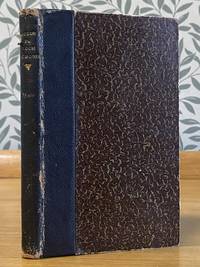
1784D9LCK6ZOP9W8Amsterdam: J. Yntema 1784. Contemporary blind-stamped vellum. 8vo. 2 parts in 1 volume. Amusing work in Dutch on the Russian Empire in the form of a series of 49 letters written by William Richardson 1743-1814 Scottish classicist and literary scholar. Richardson discusses a wide array of subjects: the politics the character of Empress Catherine the Great climate religion customs law the progress of the first Russo-Turkish War the library of the Academy of Peter the Great and other events and ceremonies during the years 1769-1772. Hinges loosening. Good copy of a lively work on the daily life in Russia in the last quarter of the 18th-century.l Cat. Russica R1126; V. Gestel - Van het Schip Maps in books of Russia and Poland 224; Poggendorff II 576; not in Muller Bibl. Neerlando-Russe; Tiele Bibl. J. Yntema, hardcover
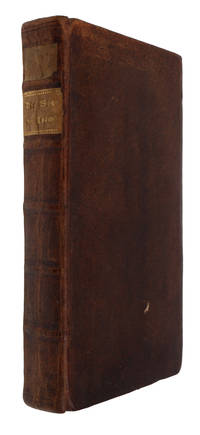
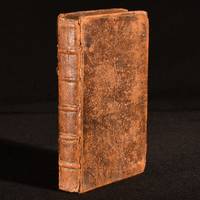
1784RICec[RI37London: Printed For W.Strahan And T.Cadell 1784. 1784. 8vo. pp. xvi 478 1 leaferrata. with half-title. contemporary sprinkled calf extremities & spine very worn covers & first 2 leaves detached occasional light foxing. First Edition. The author was tutor to Lord Cathcart's two sons and accompanied them to St. Petersburg in 1768 following Lord Cathcart's appointment as ambassador-extraordinary to the Russian empress. During the course of his four years there he also acted as secretary to Lord Cathcart. His letters touch on the causes and progress of the Turkish War the state of agriculture in Russia the slavery of the Russian peasants life at court the situation of the Jews in Russia &c. Crowther 2053. Nerhood 96. F. Hardcover. London: Printed For W.Strahan, And T.Cadell, 1784. Hardcover
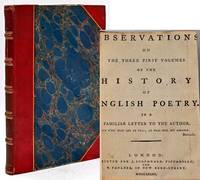
1782298728London: J. Stockdale; R. Faulder 1782. First Edition. Half Leather. Very Good binding. 8vo.; in an attractive later binding of red half-goat over marbled boards with raised bands with morocco label lettered vertically; with marbled endpapers; 2 49 1 pages.~~A note on this rather interesting binding: we assume that the binder was charged with binding a group of different books to a uniform size -- the title page is trimmed and mounted and all the other leaves are folded neatly to fit the bottom edge and then the leading edge over it. Rather astonishing actually.~~This is Ritson’s first book in which he attacks Thomas Warton’s History of English Poetry in such vitriolic tones -- Warton is a pretender a cheater and a liar -- as to cause quite a contretemps in late 18th century English literary circles. One assumes this actually pleased Ritson as he went on the next year to attack Samuel Johnson and George Steevens. Eventually Ritson went complete mad barricading himself in his rooms at Gray’s Inn and setting fire to a pile of manuscripts. Very Good binding. J. Stockdale; R. Faulder unknown
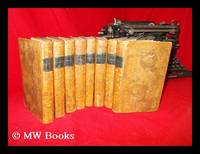
1792240340London: B. Law and Son T. Cadell and more 1792. First Edition. Hardcover. Bound in near contemporary full tree calf with gilt-blocked leather lable to the spine. Some wear to the spine and panel edges as with age. Remains well-preserved overall; bright clean and sharp-cornered. Physical description; 8 volumes. Summary; Pressured by her unscrupulous family to marry a wealthy man she detests the young Clarissa Harlowe is tricked into fleeing with the witty and debonair Robert Lovelace. He however proves himself to be an untrustworthy rake whose vague promises of marriage are accompanied by unwelcome advances. Pressured by her unscrupulous family to marry a wealthy man she detests the young Clarissa Harlowe is tricked into fleeing with the witty and debonair Robert Lovelace and places herself under his protection. Lovelace however proves himself to be an untrustworthy rake whose vague promises of marriage are accompanied by unwelcome and increasingly brutal sexual advances. And yet Clarissa finds his charm alluring her scrupulous sense of virtue tinged with unconfessed desire. Told through a complex series of interweaving letters ""Clarissa"" is a richly ambiguous study of a fatally attracted couple and a work of astonishing power and immediacy. A huge success when it first appeared in 1747 and translated into French and German it remains one of the greatest of all European novels. Subjects; England — Social life and customs — Fiction. General & literary fiction ; Novels other prose & writers ; Literary studies: 16th to 18th centuries. Fiction / Classics. England - Fiction. Kidnapping - Fiction. Young women - Crimes against - Fiction. Genres; Bibliography. Epistolary fiction. Novel. London: B. Law and Son, T. Cadell, and more hardcover
1751h038.clarGB: S Richardson 1751. Old full leather with twin title labels. Old bookplate of "R S MILLER J C" with mootoes and heraldic devices. on front pastedown of each book. Fairly clean tight texts but Some spotting mostly to early and late leaves and text edges. A few covers only just holding by strings. in need of attention. Set is in good double plus condition with noticeable signs of wear and/or age. SPECIAL POSTAGE RATES APPLY 2026 GB £9. Packed weight 4500g. NOT AVAILABLE OVERSEAS . 4th Edition. Hardback. G/No DW. S Richardson Hardcover
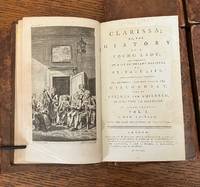
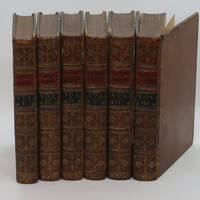
179211296<p>B. Law and Son T. Cadell G. G. and J. Robinson R. Baldwin J. Johnson . London. 1792. EIGHT VOLUMES. Complete. 8vo. 7 x 4.4 inches. Engraved frontis in each volume the one in volume 2 being supplied in facsimile the others all original. Folding engraved music plate in Volume 2. Neat previous owner name to the top of the blank front free endpapers and a couple of volumes with a previous owners page number notes alongside them otherwise a lovely bright fresh and clean set throughout. Bound without the half titles in contemporary full tree calf bindings. Spines decorated and ruled in gilt. Red and green labels double ruled and lettered in gilt. Spines rubbed and chipped to extremities. Several hinges rubbed or cracked but all still holding firm. Aside from the one facsimile frontis plate this is a better set than usually found internally in worn but still atractive early leather bindings.</p> B. Law and Son, T. Cadell, G. G. and J. Robinson, R. Baldwin, J. Johnson .......... London. 1792 hardcover
1768395<p>1768. leather. Good. Photo Gallery Clarissa or the History of a Young Lady Vol. 4 -By Samuel Richardson 6th Edition Publisher-Printing Location: London Printed for J. and F. Rivington Date and Numbering: 1768 Size and Page Count: 4.25"" X 7"" Tall approx. 380 pages</p><p>Condition: Good binding good some age yellowing to pages cover has shelf wear first page torn markings on endpages last few pages <strong>missing</strong></p><p>----An excellent opportunity for the collector researcher or historian----</p><p>Contains:</p><p>Clarissa or the History of a Young Lady is an epistolary novel by Samuel Richardson published in 1748. It tells the tragic story of a heroine whose quest for virtue is continually thwarted by her family and is the longest real novel in the English language. -Wikipedia</p> hardcover
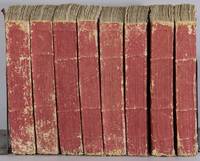
178566986London: printed for J. F. and C. Rivington. T. Davies B. Law T. Cadell G. Robinson J. Johnson W. Goldsmith W. Lowndes. J. Knox W. Fox C. and T. Wilkie P. Maqueen and E. Newberry 1785. 8 volumes 12mo original pink pastepaper wrappers; engraved frontispieces in each volume folding plate of engraved music in volume II; overall wear wrappers rubbed especially on volume VIII and worn but the binding is sound. Volumes II and V partially unopened the remainder unopened save volume I. Leaf of ads at the back of volume III and a 9-page catalogue at the back of volume VIII. First published in 1748 this remains one of the greatest English novels. printed for J. F. and C. Rivington. T. Davies, B. Law, T. Cadell, G. Robinson, J. Johnson, W. Goldsmith, W. Lowndes. J. Knox, W. unknown
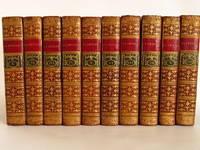
178567202à Genève Geneva: Chez Paul Barde 1785. Fine. Chez Paul Barde à Genève Geneva 1785 13.30 x 20.80 cm 10 tomes en 10 volumes reliés First octavo edition in Letourneur's new translation illustrated with 21 fine figures by Chodowiecki and a frontispiece portrait by Pujos on strong paper. The figures printed before letters. The English original was published in 1748. Contemporary full porphyry sheep bindings. Smooth spines very richly decorated with ornamental compartments Greek fillets at head and tail fillets between compartments. Red morocco title label volume label with urn and garland in black morocco. Leather of upper joint of volume I narrowly split at head; slight lack at tail. Small leather lack at head of volume II revealing the board; lacks to joint at tail; lack to lower joint at head. Volume III: lower joint split at tail. Volume IV: lower joint split at tail. Volume V: upper joint narrowly split. Volume VI: Lower and upper joints with lacks at tail and narrow splits along the lower joint. Volume VII: Top of headcap rubbed and slightly worn. Volume IX: Upper joint split at head and top of headcap rubbed. Volume X: Lower joint open at head same at tail upper joint split at head. Some corners slightly bumped. No half-titles were bound in this copy. Fresh copy overall full-margined some engravings are shorter in right margin. Despite the mentioned defects superb set in rich decorative binding. Clarissa Harlowe is the second major novel published by the author after the immense success of Pamela; it is again a sentimental novel whose virtuous heroine finds herself forced by her family to marry a noble ugly and obese man against her will. She will flee with one Lovelace the very type of elegant villainous and deceitful libertine who desires to constrain her body and soul leading her into social and moral decline but this will be without counting on Clarissa's virtuous qualities. If the novel from a modern viewpoint suffers from sentimentalism and length it nonetheless remains true that the construction of the plot the dramatic twists and the psychology would durably mark European literature. Diderot would proclaim it in his Eloge de Richardson and numerous authors would claim it as influence or undergo its influence: Rousseau Jane Austen Choderlos de Laclos. Chez Paul Barde hardcover
1764FB367 (1 to 6) /4C<p>Leather binding with black and red title plates.</p><p>Volumes I. to VII. but <strong>volume III. is missing.</strong></p><p><strong>A noteworthy collection.</strong> <strong><em>Clarissa; or The History of a Young Lady: Comprehending the Most Important Concerns of Private Life. And Particularly Shewing the Distresses that May Attend the Misconduct Both of Parents and Children In Relation to Marriage</em></strong> is an epistolary novel by English writer Samuel Richardson published in 1748. It tells the tragic story of a young woman Clarissa Harlowe whose quest for virtue is continually thwarted by her family. The Harlowes are a recently wealthy family whose preoccupation with increasing their standing in society leads to obsessive control of their daughter Clarissa. It is considered one of the longest novels in the English language based on estimated word count. It is generally regarded as Richardson's masterpiece. In 2015 the BBC ranked <em>Clarissa</em> 14th on its list of the 100 greatest British novels. In 2013 <em>The Guardian</em> included <em>Clarissa</em> among the 100 best novels written in English.</p><p><strong>PLOT SUMMARY </strong> Robert Lovelace a wealthy "libertine" and heir to a substantial estate begins to court Arabella Clarissa's older sister. However she rejects him because she felt slighted by his more ardent interest in her parents approval than in her. Lovelace quickly moves on from Arabella to Clarissa much to the displeasure of Arabella and their brother James. Clarissa insists that she dislikes Lovelace but Arabella grows jealous of Lovelace's interest in the younger girl. James also dislikes Lovelace greatly because of a duel which had occurred between the two of them. These feelings combine with resentment that their grandfather had left Clarissa a piece of land and lead the siblings to be aggressive to Clarissa. The entire Harlowe family is in favour of her marrying Roger Solmes however Clarissa finds Solmes to be unpleasant company and does not wish to marry him either. This makes her family suspicious of her supposed dislike of Lovelace and they begin to disbelieve her. The Harlowes begin restricting Clarissa's contact with the outside world by forbidding her to see Lovelace. Eventually they forbid her to either leave her room or send letters to her friend Anna Howe until Clarissa apologises and agrees to marry Solmes. Trapped and desperate to regain her freedom Clarissa continues to communicate with Anna secretly and begins a correspondence with Lovelace while trying to convince her parents not to force her to marry Solmes. Neither Clarissa nor her parents will concede. They see her protests as stubborn disobedience and communication between parents and daughter breaks down. Lovelace convinces Clarissa to elope with him to avoid the conflict with her parents. Joseph Leman a servant of the Harlowes shouts and makes noise so it may seem like the family has awoken and discovered that Clarissa and Lovelace are about to run away. Frightened of the possible aftermath Clarissa leaves with Lovelace but becomes his prisoner for many months. Her family now will not listen to or forgive Clarissa because of this perceived betrayal despite her continued attempts to reconcile with them. She is kept at many lodgings including unknowingly a brothel where the women are disguised as high-class ladies by Lovelace so as to deceive Clarissa. Despite all of this she continues to refuse Lovelace longing to live by herself in peace. Lovelace is too cynical to believe that virtuous women exist and he is desperately trying to seduce Clarissa despite declaring that he loves her. Although he puts her under increasing pressure to submit Clarissa does not waver. Under the pretence of saving her from a fire Lovelace at last gains entry to Clarissa's bedroom but she thwarts his attempted assault with vigorous resistance. She promises under threat of rape to forgive and marry him. However she considers this promise made under duress as void; soon after she makes her first successful escape from Lovelace concealing herself in lodgings in Hampstead. Enraged by Clarissa's flight Lovelace vows to seek revenge. He hunts her down to the lodgings where she is hiding and rents all the rooms around her effectively trapping her. He hires people to impersonate respectable family members of his in order to gain her trust. During this time he intercepts a letter to Clarissa from Anna Howe warning her of true extent of his deception and roguery. He commits forgery to put an end to the communication between them. Eventually he persuades Clarissa to accompany his imposter-relatives out in a carriage and thus carries her back to the disguised brothel. There with the assistance of the prostitutes and brothel madam he first drugs and then rapes her. After the rape Clarissa suffers a loss of sanity for several days presumably brought on by her extreme distress as well as the dose of opiates administered to her. This temporary insanity is represented in her "mad letters" by the use of scattered typography. When Clarissa recovers her senses Lovelace soon realises that he has failed to "subdue" or corrupt her; instead she is utterly repulsed by him repeatedly refusing his offers of marriage despite her precarious situation as a fallen woman. She accuses him of deceiving and unlawfully detaining her and insists that he set her free. He continues to claim that the impersonators really were his family members and that his crime was simply one of desperate passion. He tries to convince her to marry him alternating between threats and professions of love. She steadfastly resists and attempts several more escapes. Lovelace is forced to concede that Clarissa's virtue remains untarnished but he begins to convince himself that the "trial" was not properly conducted. Since Clarissa was drugged at the time she could consent nor refuse. He decides to orchestrate a second rape but without drugs. Pretending to be angered by the discovery that she has bribed a servant to help her escape Lovelace begins to menace Clarissa intending to escalate the confrontation to physical violence but she majestically condemns his premeditated villainy and threatens to kill herself with a penknife should he proceed. Utterly confounded by her righteous indignation and terrified by her willingness to die for her virtue Lovelace retreats. More intent than ever to make Clarissa his wife Lovelace is called away to attend his dying uncle from whom he is expecting to inherit an Earldom. He orders the prostitutes to keep Clarissa confined but well-treated until he returns. Clarissa escapes however. The brothel madam is able to have her jailed for a few days for unpaid bills and Clarissa finds sanctuary with a shopkeeper and his wife when she is released. Corresponding with Lovelace's real family she discovers for herself the true extent of his deception. She lives in constant fear of again being found by him who continues to send her marriage offers through his disreputable friend John Belford as well as through his own family members. Clarissa is determined not to accept. She becomes dangerously ill from the stress rarely eating convinced that she will die soon. Her illness and probable anorexia progress. She and Belford become correspondents she appointing him executor of her will as she puts all of her affairs in order to the alarm of the people around her. Belford is amazed at the way Clarissa handles her death and laments what Lovelace has done. In one of the many letters sent to Lovelace he writes "if the divine Clarissa asks me to slit thy throat Lovelace I shall do it in an instance." Eventually surrounded by strangers and her cousin Col. Morden Clarissa dies in the full consciousness of her virtue and trusting in a better life after death. Belford manages Clarissa's will and ensures that all her articles and money go into the hands of the individuals she desires should receive them. Lovelace departs for Europe and continues to correspond with Belford. Lovelace learns that Col. Morden has suggested he might seek Lovelace and demand satisfaction on behalf of his cousin. He responds that he is not able to accept threats against himself and arranges an encounter with Col. Morden. They meet in Munich and arrange a duel. Morden is slightly injured in the duel but Lovelace dies of his injuries the following day. Before dying he says "let this expiate!" Clarissa's relatives finally realise they have been wrong but it comes too late. They discover Clarissa has already died. The story ends with an account of the fate of the other characters.</p><p><strong>Samuel Richardson</strong> baptised 19 August 1689 – 4 July 1761 was an English writer and printer best known for three epistolary novels: <em>Pamela; or Virtue Rewarded</em> 1740 <em>Clarissa: Or the History of a Young Lady</em> 1748 and <em>The History of Sir Charles Grandison</em> 1753. He printed almost 500 works in his life including journals and magazines working periodically with the London bookseller Andrew Millar. Richardson had been apprenticed to a printer whose daughter he eventually married. He lost her along with five sons but remarried and had four daughters who reached adulthood but no male heirs to continue the print shop. As it ran down he wrote his first novel at the age of 51 and immediately joined the admired writers of his day. Leading figures he knew included Samuel Johnson and Sarah Fielding the physicians Behmenist and George Cheyne and the theologian and writer William Law whose books he printed. At Law's request Richardson printed some poems by John Byrom. In literature he rivalled Henry Fielding; the two responded to each other's literary styles.</p> J Rivington.
1791370724London: James Ridgway 1791. Hardcover. Near Fine. Four works in one volume: 1. Criticisms on the Rolliad. Part the First Ninth edition 1791; 2. Criticisms on the Rolliad. Part the Second Fourth edition 1790; 3. Probationary Odes for the Laureatship: with a Preliminary Discourse by Sir John Hawkins Knt. Ninth edition 1791; 4. Political Miscellanies by the authors of the Rolliad and Probationary Odes First edition 1790. Octavo. Engraved frontispiece plate and title vignette. Contemporary full tree calf with morocco spine label: "Rolliad Compleat." Rubbing to the spine and joints else near fine. A scarce complete set of this pioneering collection of satires on the administration of William Pitt the Younger written in the form of mock reviews of a mock epic. Originally published in the Morning Herald in 1784-85 it became an instant sensation. Its anonymous authors also contributed ancillary satires which were published together with it. When collected in book-form they ran through twenty-two editions. Armorial bookplate of Henry Merrick Hoare and bookseller's ticket on the front pastedown. A handsome copy. ESTC T133733 T133732 N11967 and T173343. James Ridgway hardcover
1787619L3London: James Ridgway 1787-1788. Leather. Good. 8.5" by 5.5". None. Two collections of satirical poetry bound as one being an early edition of the satirical poem directed at William Pitt's the younger's administration. The eighth edition of this satirical poem directed at the administration of William Pitt the Younger. A collaborative effort this work takes the form of a piece of literary criticism of the epic poem 'The Rolliad'. With an engraved frontispiece and engraved title page. This work was originally published in a serial form for the early daily newspaper the 'Morning Herald' from 1784-1785. This work is a very early if not first edition in book form. The main victim of this satire is John Rolle MP for Devon but further individuals mentioned include William Pitt Henry Dundas and Charles Jenkinson. This poem was written by Joseph Richardson George Ellis Richard Tickell French Laurence and Richard FitzPatrick. The second work to this volume is Sir John Hawkins' Probationary Odes. The seventh edition of this work. With publisher's adverts for Ridgway to the start of the work. Being an anthology of satires and parodies by Richard Tickell and others purporting to be the competitive essays of Thomas Warton's rivals for the laureatship. ESTC Richard Tickell was an English playwright and satirist. With the bookplate of one Alexander Adair to the front pastedown. This is likely to be the Adairs of Flixton Hall. Alexander Adair was the great grandson of Sir robert Adair of Ballymena and Custos Rotulorum of County Antrim. In a full calf binding. Externally generally smart. Patches of light rubbing to the extremities and to the spine. Front joint and hinge are tender with cords showing. Rear hinge and joint are tender with cords showing. Lacking portions of spine label. Prior owner's bookplate to the front pastedown Alexander Adair. Internally firmly bound. Pages are generally bright with just the odd spots. Good James Ridgway hardcover
176561565Altenburg Richter 1765. 8vo. In contemporary full calf with five raised bands and gilt lettering to spine. All edges coloured in red. Light wear to extremities boards with a few scratches. Small paper-label pasted on to top of spine. Internally nice and clean. 8 248 186 6 pp. <br/><br/><em>Abridged German translation of Richardson's The Paths of Virtue Pamela and Clarissa Harlowe. </em> hardcover
1789E16986London: J. Murray 1789. Second edition. Wraps. Very Good. 12mo in original plain paper wraps. 96 pp. Fore edge uncut. Half title reads: "Essay On Falstaff &c./ Priced sewed Two Shillings". The second edition the first being the previous year. Wraps with moderate even soiling and a old round small sticker top corner and though still tight lacking the spine strip ; interior generally fine and clean. As early as 1820 this was considered a collectible book as referenced in A Catalogue of Rare Curious and Valuable Old Books on sale by Alfred Russell Smith it would have cost you 3 shillings 6 in those days. Hubbard's Shakespeariana notes that there is no apparent difference between this edition and the 1788. J. Murray unknown
17991356Glasgow: Printed for John Murdoch 1799. 2nd Edition . Hardcover. Good. Small 12mo. 162 pages. Quarter bound in dark morocco with patterned paper-covered boards. Text block with all edges gilt. Patterned endpapers. 7 folding engraved plates and 7 folding maps; plate 6 Lanark Cotton Mills is missing. Boards rather heavily worn along edges; lightly rubbed elsewhere. Pages toned but generally clean; a few foxing spots on some maps. Hinges just starting to crack but otherwise binding remains firm. <br/> <br/> Printed for John Murdoch hardcover
175244635Stockholm Lars Salvius 1752-53 Folio. 33x22 cm Stor helt ubeskåret eksemplar i orig. blødt blankt papbind. rester af titelskrift på ryg. Kobberstukket frontispiece = planche I. 121008101-260. Med ialt 30 kobberstukne plancher Nummererede II-XXIX komplet og med det lille stik indsat ved p. 6 de fleste store dobbeltsidede. 2 kort hvor det sidste er kobberstukket gengivelse af 2 Ptolemaeus-kort fra 1513-udgaven planche XXIX. 33 x 43 cm. Indvendig aldeles frisk eksemplar uden pletter trykt på skrivepapir. <br/><br/><em>Blandt planchernme kan nævnes Kungsbacka Varberg Falkenberg Halmstad Laholm Vinbergs Holms og Getinge Kirker Skottorp etc.Warmholtz 610: ""Lycka var at Döden ryckte pennan ur handen på Författaren eljest hade Kronan blifvit belastad med ännu mera Maculatur" ! </em> unknown
177711940à Amsterdam: S. n. 1777. Fine. S. n. à Amsterdam 1777 16.50 x 9.50 cm relié New edition. Translated by Abbé Prévost with his introduction. Full marbled glazed calf binding spine with raised bands decorated. One tear to joint at headcap. ""Richardson était l'inventeur de la tragédie bourgeoise . Il a inventé ce roman où l'art consiste à négliger tous les préceptes de l'art où l'accumulation de détails étrangers à l'action où la répétition des mêmes scènes et des mêmes sentiments produisent plus d'effet que la précision le goût la justesse et l'ordre n'en ont jamais produit"" Richardson was the inventor of bourgeois tragedy . He invented this novel where art consists in neglecting all the precepts of art where the accumulation of details foreign to the action where the repetition of the same scenes and the same sentiments produce more effect than precision taste accuracy and order have ever produced. AUGUSTIN FILON Histoire de la littérature anglaise : depuis ses origines jusqu'à nos jours Paris Hachette 1883. Abbé Prévost did not content himself with translating Richardson's novel he arranged and reworked it; not liking the ending he probably rewrote it and it is this version that circulated throughout Europe and made Richardson's reputation while the original comprised 28 volumes that Prévost reduced to 8 systematically cutting the verbosity and characteristic prolixity of Richardson. NB: This work is available at the bookshop on request within 48 hours. S. n. hardcover
1752965P22London: T. Longman and C. Hitch 1752. Leather. Good. 6.5" by 4". None. A very scarce guide to letter writing by the master of the epistolary novel Samuel Richardson. A very scarce work.The fifth edition.A guide to letter writing by Samuel Richardson in which he presents examples for letters to be written in various circumstances. Containing a total of one hundred and seventy three letters with situations including "from an uncle to a nephew on his keeping bad company bad hours &c. in his apprenticeship" "an elder to a younger brother who is in love with a young lady of great gaiety" "from a brother to his sister in the country upbraiding her for being negligent in writing" "to a friend on his recovery from a dangerous illness" "from a gentleman to his mistress resenting her supposed coquetry" and more. The letters Richardson offers here are often comical and offer a unique insight into society during the Georgian era in England. Richardson is best known for his three epistolary novels: 'Pamela' 'Clarissa' and 'The History of Sir Charles Grandison'. Bound without endpapers. In a contemporary calf binding. Externally a little rubbed. Bumping to the extremities resulting in a small amount of loss of leather. A small amount of loss to the head and tail of the spine. Lacking the spine label. Joints are starting. Hinges are strained. Lacking the endpapers. Internally generally firmly bound. Pages are lightly age-toned and generally clean with scattered spots. Small chip to the tail of the title page. Torn printers label to the verso of the title page. Good T. Longman and C. Hitch hardcover
17517061C1751. Bände 1-3 von insgesamt 6 Bänden. Dresden. Walther. 1751 ca. 16 x 102 cm. III 544 S.; 510 S.; 440 S. Mit mehreren Stichen. Französische Sprache. Papp-Einbände der Zeit mit montierten Rückentiteln Bände 2 und 3 und bräunlich marmorierten Deckeln. Einband von Band 1 mit Schadstellen am Rücken Bindung etwas gelockert. Einbände von Band 2 und 3 mit Abrieb an hinteren Buchdeckeln insbesondere bei Band 3. Innen sind die drei Bände gut erhalten vereinzelt stockfleckig. Insgesamt noch guter Zustand für ein so altes Werk. Band 1-3 der insgesamt 6 Bände erschienen 1751-1752 im Verlag von George Conrad Walther in Dresden. Richardsons Roman wird literaturgeschichtlich als englische Prosa der Empfindsamkeit eingeordnet. Die Dresdner Ausgabe ist in französischer Sprache erschienen. Vom Englischen ins Französische übersetzt wurde sie von Antoine-François Prévost dem später durch sein Werk "Manon Lescaut" berühmt gewordenen französischen Schriftsteller. Angesichts nur kleiner Auflage für gehobene Kreise 270 Jahren seit Erscheinen und den Zerstörungen im 2. Weltkrieg heute sehr seltene Ausgabe von denen hier die ersten 3 Bände von 6 vorliegen. unknown
176613080Paris: Chez Les Libraires Associes. Good. 1766. Hardcover. Tomes Neuvieme & Dixieme 2 volumes in one . Nouvelle edition. Full leather spine with five raised bands spine label and gilt decorations. Marbled endpapers. Spine ends chipped. French Text. France ; 16mo 6" - 7" tall; 443 pages . Chez Les Libraires Associes hardcover