848 résultats
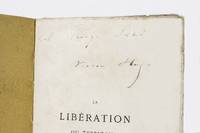
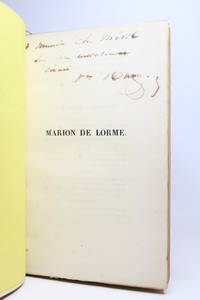
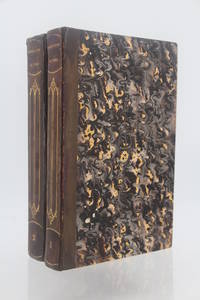
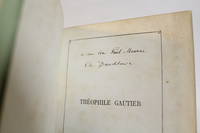
185968622Paris: Poulet Malassis & De Broise 1859. Fine. Baudelaire and Hugo: The Storm-Swept Meeting of the Albatross and the Man of the Ocean Poulet Malassis & De Broise Paris 1859 11.50 x 18 cm relié First edition of which only 500 copies were issued. With an etched frontispiece portrait of Théophile Gautier by Émile Thérond. With a substantial prefatory letter by Victor Hugo. Full red morocco binding gilt date at the foot of spine marbled endpapers Baudelairian ex-libris from Renée Cortots collection on the first endpaper wrappers preserved top edge gilt. Pale foxing affecting the first and last leaves beautiful copy perfectly set. Rare handwritten inscription signed by Charles Baudelaire: À mon ami Paul Meurice. Ch. Baudelaire. To my friend Paul Meurice. Ch. Baudelaire. In addition we have mounted on a guard an autograph ex-dono slip by Victor Hugo addressed to Paul Meurice. This slip which was doubtless never used had nevertheless been prepared along with several others by Victor Hugo in order to present his friend with a copy of his works published in Paris during his exile. If History did not allow Hugo to send this volume to Meurice this presentation note hitherto unused could not in our view be more fittingly associated. Provenance: Paul Meurice then Alfred and Renée Cortot. This exceptional inscription from Charles Baudelaire to Paul Meurice the true surrogate brother of Victor Hugo bears witness to a singular literary encounter between two of the most important French poets Hugo and Baudelaire. Paul Meurice was indeed the indispensable intermediary between the condemned poet and his illustrious exiled counterpart for asking Victor Hugo to associate their names with this elegy to Théophile Gautier was one of Charles Baudelaires great audacities and would scarcely have had any chance of succeeding without the invaluable assistance of Paul Meurice. Ghost-writer to Dumas author of Fanfan la Tulipe and the theatrical adaptations of Victor Hugo George Sand Alexandre Dumas and Théophile Gautier Paul Meurice was a gifted writer who chose to remain in the shadow of the great artists of his time. His unique relationship with Victor Hugo nevertheless granted him a decisive role in literary history. More than a friend Paul together with Auguste Vacquerie stood in place of Victor Hugos deceased brothers: I have lost my two brothers; he and you you and he you replace them; only I was the younger; I have become the elder that is the only difference. It was to this brother of the heart whose wedding he witnessed alongside Ingres and Dumas that the exiled poet entrusted his literary and financial affairs and it was he whom Hugo named together with Auguste Vacquerie as his executor. After the poets death Meurice founded the Maison Victor Hugo which remains today one of the most celebrated writers house-museums. In 1859 Pauls home had become the Parisian antechamber to Victor Hugos Anglo-Norman retreat and Baudelaire therefore turned quite naturally to this official ambassador. Baudelaire knew Meurice well ever since an earlier intercession on his behalf with Hugo had earned him an exceptional copy of Les Fleurs du mal as a testament of friendship. The two men also shared a close friend Théophile Gautier with whom Meurice had worked from 1842 on an adaptation of Falstaff. Meurice thus stood as the ideal intermediary through whom to secure the goodwill of the otherwise inaccessible Hugo. Baudelaire had however already met Victor Hugo briefly. At the age of nineteen he sought an audience with the greatest modern poet to whom he had been devoted since childhood: I love you as one loves a hero a book as one loves purely and disinterestedly every beautiful thing. Even then he imagined himself as a worthy successor as he half-confesses: At nineteen would you have hesitated to write as much to . Chateaubriand for instance For the young apprentice poet Victor Hugo belonged to the past and Baudelair Poulet Malassis & De Broise unknown
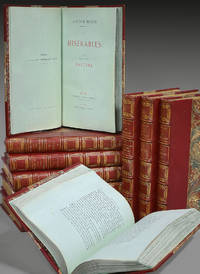
1862LCS-17702<p><strong>Precious first French edition of <em>Les Miserables</em> </strong></p><p><strong>the greatest success of 19th century publishing history.</strong></p><p><strong>"<em>Major work universally esteemed</em>" Carteret.</strong></p><p><strong>One of the very few copies printed on sea-green paper.</strong></p><p>10 large 8vo volumes 238 x 150 mm of: I/ 4 ll. 357 pp. misnumbered 355 1 bl.l. 2 illustrations out of pagination; II/ 2 ll. 382 pp. 1 bl.l. 2 illustrations out of pagination; III/ 2 ll. 358 pp. 1 bl.l. 2 illustrations out of pagination; IV/ 2 ll. 318 pp. 1 bl.l. 2 illustrations out of pagination; V/ 2 ll. 320 pp. 1 illustration out of pagination; VI/ 2 ll. 297 pp. 1 bl.l. 2 illustrations out of pagination; VII/ 2 ll. 432 pp. 2 illustrations out of pagination; VIII/ 2 ll. 399 pp. 3 illustrations out of pagination; IX/ 2 l. 400 pp. 2 illustrations out of pagination; X/ 2 ll. 311 pp. 2 illustrations out of pagination 2 ll. of album. Suite of 20 copper-engravings by Outhwaite after Castelli and De Neuville published by Lacroix and Verboecken in 1869. Illustrated wrappers of the suite bound at the end of part 10.</p><p>Red quarter-morocco gilt fillets on the corners and joints spines ribbed and decorated with gilt fillets and Greek gilt patterns top edge gilt many untrimmed edges. <em>Contemporary binding</em> signed by <em>Champs</em>.</p><p>First French edition of this great novel by Hugo large social indictment published during the author's exile in Guernsey.</p><p>Copy from the first issue without any mention of edition.</p><p>Clouzot <em>Guide du bibliophile</em> 150 ; Talvart IX p.40 ; Carteret I 421.</p><p>"Major work universally esteemed. <em>One of the greatest best-sellers it is one of the books the most sold; it is sold and will be sold for a long time</em>" Carteret.</p><p>One of the very few copies printed on sea-green paper of Victor Hugo's fictional masterpiece.</p><p>Bibliographers mention that "<em>a few copies" </em>have been printed on Dutch paper and on sea-green paper "<em>which are extremely rare</em>". Carteret mentions three copies on Dutch paper but none on sea-green paper. As for Vicaire he only mentions one sea-green paper copy the one of Jules Janin.</p><p>Copies from the deluxe issue on coloured paper were distributed only later. After the liquidation of the editor Lacroix among the 25 that existed less than ten survived and no wrappers were made.</p><p>Started in 1845 in a feeling of indignation and pity this generous epic tale of the people fruit of a long elaboration would only be achieved in 1861 during Guernsey's exile.</p><p><em>Les Misérables</em> comes at countercurrent of the aesthetical choices of the time: tendency to "<em>impassiveness</em>" and "<em>school of Art for the Art</em>".</p><p>Hugo clearly settles the mission of his book in the Foreword: "<em>So long as there shall exist by virtue of law and custom a social damnation artificially creating hells in the midst of civilization so long as such wretchedness exists on earth papers like this must be written</em>".</p><p>"Les Misérables" immediately stood out despite the first reluctance of the critics and the popular success was huge.</p><p>Many bibliographers such as Talvart see in <em>Pagnerre</em>'s edition the true first edition. It is now established that the Belgium edition preceded the French edition of a few days.</p><p>This novel was the greatest success of 19th century edition.</p><p>An exceptional copy of great freshness with very wide margins as mostly untrimmed very elegantly contemporary bound by Champs.</p><p>The copy is enriched with the suite of 20 copper-engravings by <em>Outhwaite</em> after <em>Castelli</em> and <em>De Neuville</em> published by <em>Lacroix</em> and <em>Verboecken</em> in 1869 with the illustrated wrappers of the album.</p><p>FRANCAIS</p><p><strong>Précieuse édition originale française des <em>Misérables</em></strong></p><p><strong>le plus grand succès d'édition du XIXe siècle.</strong></p><p><strong>" <em>Ouvrage capital et universellement estimé</em> " Carteret.</strong></p><p><strong>L'un des rarissimes exemplaires sur papier vert d'eau.</strong></p><p>10 volumes grand in-8 de : I/ 4 ff. 357 pp. mal numérotées 355 1 f.bl. 2 illustrations hors texte ; II/ 2 ff. 382 pp. 1 f.bl. 2 illustrations hors texte ; III/ 2 ff. 358 pp. 1 f.bl. 2 illustrations hors texte ; IV/ 2 ff. 318 pp. 1 f.bl. 2 illustrations hors texte ; V/ 2 ff. 320 pp. 1 illustration hors texte ; VI/ 2 ff. 297 pp. 1 f.bl. 2 illustrations hors texte ; VII/ 2 ff. 432 pp. 2 illustrations hors texte ; VIII/ 2 ff. 399 pp. 3 illustrations hors texte ; IX/ 2 ff. 400 pp. 2 illustrations hors texte ; X/ 2 ff. 311 pp. 2 illustrations hors texte 2 ff. d'album. Suite des 20 gravures sur acier par Outhwaite d'après Castelli et De Neuville publiée par Lacroix et Verboecken en 1869. Couvertures illustrées de la suite reliées en fin du tome X.</p><p>Demi-maroquin rouge à coins filets dorés aux coins et aux mors dos à nerfs ornés de filets dorés caissons ornés d'une grecque têtes dorées nombreux témoins. <em>Reliure de l'époque</em> signée de <em>Champs</em>.</p><p>238 x 150 mm.</p><p>Edition originale française de ce grand roman de Hugo vaste réquisitoire social publié lors de l'exil de l'auteur à Guernesey.</p><p>Exemplaire de première émission sans mention d'édition.</p><p>Clouzot <em>Guide du bibliophile</em> 150 ; Talvart IX p.40 ; Carteret I 421.</p><p>" Ouvrage capital et universellement estimé. <em>Un des plus colossaux succès de librairie c'est un des livres qui s'est le plus vendu ; il se vend et se vendra encore longtemps</em> ". Carteret.</p><p>L'un des rarissimes exemplaires sur papier vert d'eau du chef-d'uvre romanesque de Victor Hugo.</p><p>Les bibliographes indiquent qu'il a été tiré " <em>quelques exemplaires</em> " sur papier de Hollande et sur papier vert d'eau " <em>qui sont fort rares</em> ". Carteret cite trois exemplaires sur Hollande mais aucun sur papier vert d'eau. Vicaire quant à lui ne cite qu'un exemplaire sur papier vert d'eau celui de Jules Janin.</p><p>Les exemplaires du tirage sur papier de couleur ne furent distribués que plus tard. Suite à la liquidation de l'éditeur Lacroix de 25 qu'ils étaient moins d'une dizaine ont survécu et il n'a pas été fait de couverture.</p><p>Entreprise en 1845 dans un sentiment d'indignation et de pitié cette épopée généreuse du peuple fruit d'une longue élaboration ne serait achevée qu'en 1861 durant l'exil de Guernesey.</p><p><em>Les Misérables</em> s'inscrivaient à contre-courant des choix esthétiques du temps : tendance à " <em>l'impassibilité</em> " et " <em>école de l'Art pour l'Art</em> ".</p><p>Hugo fixe d'ailleurs clairement la mission de son livre dans la Préface : " <em>Tant qu'il existera par le fait des lois et des murs une damnation sociale créant artificiellement en pleine civilisation des enfers. tant qu'il y aura sur la terre ignorance et misère des livres de la nature de celui-ci pourront ne pas être inutiles </em>".</p><p>" Les Misérables " s'imposèrent aussitôt malgré les premières réticences de la critique et le succès populaire fut immense.</p><p>Nombreux furent les bibliographes comme Talvart à voir en l'édition <em>Pagnerre</em> la véritable originale. Il est à présent établi que l'édition belge précéda de quelques jours l'édition française.</p><p>Ce roman fut le plus grand succès d'édition du XIXe siècle.</p><p>Exceptionnel exemplaire dans une condition de fraicheur irréprochable à toutes marges avec de nombreux témoins très élégamment relié à l'époque par Champs.</p><p>L'exemplaire est enrichi de la suite des 20 gravures sur acier par <em>Outhwaite</em> d'après <em>Castelli</em> et <em>De Neuville</em> publiée par <em>Lacroix</em> et <em>Verboecken</em> en 1869 avec les couvertures illustrées de l'album.</p> Pagnerre.
1831140946084Paris: Charles Gosselin 1831. First Edition. Near Fine. First edition first printing first issue. 8 404; 4 536 pp. Bound in modern gilt armorial stamped morocco green leather bindings with marbled endpapers; wood-engraved title vignettes by Tony Johannot. Near Fine with light toning and minor patches of foxing throughout else fine. <p>Victor Hugo's Gothic French masterpiece printed by Gosselin in a run of 1100 copies on March 16 1831; this first printing was distributed into four separate issues of 275 copies each the subsequent three issues being designated as "second edition" "third edition" and "fourth edition" respectively on the title-pages. "This first edition is the rarest of all the works of Victor Hugo; it has had a resounding impact worldwide and is one of the most difficult titles of the Romantic period to obtain" Carteret. Charles Gosselin unknown
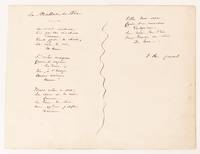
183089005No Location: s. n. 1830. Fine. I would give all of 'Cromwell' for that sigh for that lied more dream than song Fernand Gregh s. n. No Location s. d. circa 1830 25 x 19.7 cm Une feuille Autograph manuscript signed of Victor Hugos Ballade du fou sung by the jester Elespuru in his play Cromwell IV 1. Two pages on a folded leaf backed with green glazed paper. Exceptional autograph manuscript of Victor Hugos most celebrated poetic song performed by the jester Elespuru in his resounding drama Cromwell. Both grotesque and exalted this piece embodies the freedom of Romantic drama championed by Hugo in the plays famous preface: as noted by the Bibliothèque nationale de France this song is the only passage in the play as equally famous as its preface. The fine elegant script places this manuscript in the early years of Hugo's career either immediately or only a few years after the poems composition. This was in fact the very first excerpt of Cromwell ever to appear in print a year before the plays publication. Hugo chose to place the poem as the epigraph to his tenth ballad A un passant published in Odes et ballades 1826. Notably this epigraph does not appear in the manuscript of Odes et Ballades preserved at the BnF. Alongside our manuscript therefore only one other autograph example of the Chanson dElespuru survives in public institutions: within the full manuscript of Cromwell also at the BnF. This spellbinding song inspired countless poems and elicited much praise from his fellow writers: for Barbey dAurevilly Hugo is above all the balladeer of the delightful Chanson du Fou those trembling drops of dew dusky red enough to drown an entire human head in an infinity of reverie! Les oeuvres et les hommes. Steeped in Hugos verses Alfred de Musset perfectly replicated the song's structure in La Nuit one of his earliest poems. As Hovasse remarks A lot of poets would have damned themselves to write it"" quoting the poem in full in his Hugo biography. Alfred de Vigny called himself a fool for the song like the fool jester himself letter to Hugo 19 November 1826 and applauded Cromwell that immortal book"" which casts all modern tragedies into wrinkled old age. This seemingly effortless refrain is above all a dazzling demonstration of Hugos genius equally at home in every literary form. By combining pentasyllabic lines with two-syllable verses Hugo revives the lai a poetic composition used in the Middle Ages and the Renaissance. Its short lilting rhythm from distant centuries is nonetheless resolutely modern: a Verlaine poem before Verlaine who adopted this metrical play in Colombine from Fêtes galantes and Chanson dautomne Poèmes saturniens. The jester Elespuru who gives voice to this poem is moreover the very first character created by Hugo at only nine years old. Before viewing himself a novelist playwright or poet Hugo wrote Elespourou Elespuru in his copy of Tacitus now preserved in his house on the Place des Vosges during a very unhappy year at the colegio des nobles in Madrid. The name belonged to his schoolmate Don Francisco Elespuro a shocking great fellow with crispy hair sprawling hands ill-shapen uncombed unwashed incurably lazy using his inkstand no more than his washbowl surly and ridiculous whose name was Elespuru."" he would later recall to his wife in Victor Hugo by a Witness of His Life. He took his revenge in his own fashion depicting him as one of the least appealing figures in one of his dramas yet granting him immortality. Elespuru the grotesque jester par excellence sings the sublime in this poem one of those adorable little pieces where the giant Hugo showed that he could be as delicate as he was powerful and as mysterious as he was radiant Gregh. Hugo used the stage as the theatre of his vendettas: Elespuru then Gubetta the executioner in his Lucrèce Borgia inspired by the violent Count Frasco de Belverana who injured Hugos brot s. n. unknown
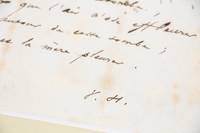
1840878291840. Fine. ""Spare still the mother vainly weepingO'er baby lost not long a-sleeping."" s.d. 21 janvier 1840 21.20 x 26.70 cm un feuillet sous cadre Autograph poem by Victor Hugo signed V. H. four stanzas written black ink on a leaf. Blind stamp of the city of Bath in the lower left-hand corner. Some folds small traces of foxing along the folds a few pale stains to the lower right margin not affecting the text. A few very small dark spots in the lower right margin one affecting a single letter of the word retombe. Original manuscript and earlier version of Victor Hugo's poem published as Écrit sur le tombeau d'un petit enfant au bord de la mer Baby's seaside grave in Les Rayons et les Ombres XXXVIII Paris Delloye 1840. Hugo wrote this magnificent eulogy in memory of his great friend Auguste Vacquerie's young nephew who died at the age of four years and ten months. The poet had promised a poetic epitaph and personally addressed this manuscript to Vacquerie: Take these verses if you still want them for the tomb of this dear little one Letter to Vacquerie January 21 1840. As Joseph Petrus Christiaan de Boer pointed out There is no sorrow Hugo understood and expressed more delicately than the immense grief that fills the hearts of parents upon the death of a child Victor Hugo et l'enfant 1933 p. 48-49. This poem is the first of a sublime macabre series composed on the occasion of the numerous tragedies suffered by the families of both Victor Hugo and his friend Auguste Vacquerie. The most famous will be Demain dès l'aube. written after the untimely death of Hugo's beloved daughter Léopoldine who drowned alongside Auguste Vacquerie's brother Charles on September 4 1843 shortly after their marriage. Hugo wrote these verses for Charles-Emile Lefèvre the young child of Vacquerie's sister who had succumbed to sudden illness on November 6 1839. On January 21 1840 Hugo sent this manuscript to Vacquerie which includes a variation from the final version published by Delloye on May 16 of the same year: « Vieux lierre frais gazon herbe roseaux corolles ; Église où l'esprit voit le Dieu qu'il rêve ailleurs ; mouches qui murmurez d'ineffables paroles A l'oreille du pâtre assoupi dans les fleurs ; Vents flots hymne orageux chur sans fin voix sans nombre ; Bois qui faites songer le passant sérieux ; fruits qui tombez de l'arbre impénétrable et sombre ; Étoiles qui tombez du ciel mystérieux ; oiseaux aux cris joyeux vague aux rumeurs ' plaintes' in the published version profondes ; froid lézard des vieux murs dans les pierres tapi ; plaines qui répandez vos souffles sur les ondes ; Mer où la perle éclot terre où germe l'épi ; Nature d'où tout sort nature où tout retombe feuilles nids doux rameaux que l'air n'ose effleurer Ne faites pas de bruit autour de cette tombe ; Laissez l'enfant dormir et la mère pleurer. » ' Brown ivy old green herbage new; Soft seaweed stealing up the shingle; An ancient chapel where a crew Ere sailing in the prayer commingle. A far-off forest's darkling frown Which makes the prudent start and tremble Whilst rotten nuts are rattling down And clouds in demon hordes assemble. Land birds which twit the mews that scream Round walls where lolls the languid lizard; Brine-bubbling brooks where fishes stream Past caves fit for an ocean wizard. Alow aloft no lullall life But far aside its whirls are keeping As wishfully to let its strife Spare still the mother vainly weeping O'er baby lost not long a-sleeping.' tr. Nelson Rich Tyerman Hugo sent the manuscript with a touching letter: Here at last my poet is what I have kept you waiting for so stupidly long. . Take these verses if you still want them for the tomb of this dear little one . For my part I do not feel that I have repaid my debt to this angel with so little. I have begun something longer for him that I will one day lay at the feet of his poor mo unknown
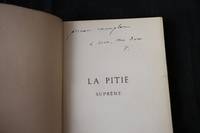
187945162Paris: Calmann Lévy 1879. Fine. ""for you my lady"" - Juliette Drouet's personal copy Calmann Lévy Paris 1879 15 x 24 cm relié HUGO Victor La Pitié suprême The Supreme Compassion Calmann Lévy Paris 1879 150 x 240 mm 5 15/16 x 9 7/16 half shagreen First edition. Elegant half dark blue shagreen over marbled paper boards by René Aussourd spine in four compartments with gilt dots and double gilt compartments containing horizontal arabesques and gilt stars date and ex. de J. Drouet in gilt at foot marbled endpapers and pastedowns covers and spine preserved marginal repairs to covers top edge gilt ex-libris of Pierre Duché on one endpaper. An exceptional presentation copy inscribed by Victor Hugo to Juliette Drouet the love of his life: The first copy for you my lady. V. Premier exemplaire à vous ma dame. V. Written in 1857 this long philosophical poem on the Revolution was originally meant to conclude the ""Légende des Siècles"". Victor Hugo eventually published it in 1879 when he took a stand on behalf of the Communards. Pleading for the abolition of the death penalty La Pitié suprême highlights one of the first and most heartfelt of Hugo's political struggles which he carried on till the very end of his eighties: if my name stands for anything in these deadly times in which we live it stands for Amnesty ""Letter to the citizens of Lyon"" 1873. Comparing Hugo and Machiavelli J. C. Fizaine underlines the intellectual rigor of the poet who put himself at the service of a humanism elevated into a universal principle: Machiavelli writes for those who wanted to become princes. Hugo writes first and foremost for the people who have known tyranny. It is ""La Pitié suprême"" that defines what will remain immutably sacrosanct human life without hate resentment and the memory of past suffering being justifications for the transgression of its sanctity; and the danger of such transgression is the impossibility of establishing any kind of political system and falling back into a pre-civilized state. Victor Hugo penseur de la laïcité Le clerc le prêtre et le citoyen He waged this final struggle alonside Juliette Drouet. Published in February 1879 not long after they had settled in the avenue d'Eylau La Pitié suprême seems to be a political echo of the newfound legitimacy of the two old lovers after fifty years of clandestine relations. Hugo's last fight for amnesty and pardon reverberated in his emotional life like with the poem he wrote on the death of Juliette in 1883: On my grave they'll write as a great victory The cherished deep embattled memory of a love that was not sanctioned but grew virtuous. A fine copy in a handsome binding and with an extraordinary provenance the most desirable one could wish for. Calmann Lévy hardcover
188060981Paris: Calmann Lévy 1880. Fine. Juliette Drouet's copy Calmann Lévy Paris 1880 15.50 x 24 cm relié First edition. Black half morocco binding spine with four raised bands adorned with gilt dotted fillets and double gilt compartments decorated at the corners gilt date and the inscription ""Ex. de J. Drouet"" at the tail marbled paper boards and endpapers preserved covers and spine top edge gilt binding signed by René Aussourd. Some minor foxing mainly at the beginning and end of the volume. Precious signed and inscribed copy by Victor Hugo to Juliette Drouet the great love of his life: To you my lady. Humble homage. V.' This copy comes from the library of Pierre Duché who acquired Juliette Drouet's entire library and commissioned René Aussourd to bind the volumes uniformly marking each with an identifying inscription at the foot of the spine. Bookplates pasted on a pastedown and a flyleaf. In late 1878 after more than forty years together Victor Hugo and Juliette Drouet finally moved in together at Avenue d'Eylau in the small town house where the poet would spend his final years. ""From that moment on Juliette's life became little more than an unbroken sorrow a servitude of every hour. She herself suffered from stomach cancer knowing she was condemnedto die of hunger!"" Louis Guimbaud Victor Hugo et Juliette Drouet Paris 1927. Despite her illness and severe physical weakness she remained devotedly at Hugo's side as his caregiver. It was during this time that Bastien Lepage painted a strikingly realistic portrait of her: ""From her goddess-like face once serene and noble the relentless illness had made a frail human visage drawn and hollowed furrowed with wrinkleseach one telling a story of pain."" ibid. Religions et religions was published two years before Juliette's death; is was one of the last books Hugo dedicated to the unwavering love of his life. In a final tribute to her lifelong devotion he later offered her a photograph inscribed: ""Fifty yearsthat is the most beautiful marriage."" Copy from the most intimate source. Calmann Lévy hardcover
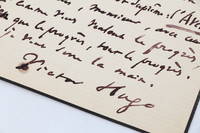
1871833181871. Fine. « So that justice finally be done for women » Mardi 7 novembre 1871 13.30 x 20.80 cm 2 pages sur un feuillet double Autograph letter signed by Victor Hugo to Léon Richer two pages in black ink on a double sheet framed in black. Crosswise folds inherent to envelope inserting. A central tear at the junction of the two sheets. Published in uvres complètes de Victor Hugo Ollendorff 1905. Manuscript housed in a blue half morocco chemise and slipcase marbled paper boards marbled paper slipcase signed Boichot. A magnificent and important letter to Léon Richer one of the first male feminist activists considered by Hubertine Auclert as the ""father of feminism"" and later regarded by Simone de Beauvoir as its ""true founder"". This deeply humanist text is a compendium of Victor Hugo's campaign for the abolition of capital punishment and the female attainment of social equality and civil rights. « Mardi 7 novembre 1871 Monsieur on m'a demandé d'urgence mon intervention pour les condamnés à mort. L'accomplissement de ce devoir a retardé ma réponse à votre excellente lettre. Vous avez raison de compter sur moi pour affirmer l'avenir de la femme. Dès 1849 dans l'Assemblée nationale je faisais éclater de rire la majorité réactionnaire en déclarant que le droit de l'homme avait pour corollaires le droit de la femme et le droit de l'enfant. En 1853 à Jersey dans l'exil j'ai fait la même déclaration sur la tombe d'une proscrite Louise Julien mais cette fois on n'a pas ri on a pleuré. Cet effort pour qu'enfin justice soit rendue à la femme je l'ai renouvelé dans les Misérables je l'ai renouvelé dans le Congrès de Lausanne et je viens de le renouveler encore dans ma lettre au Rappel que vous voulez bien me citer. J'ajoute que tout mon théâtre tend à la dignification de la femme. Mon plaidoyer pour la femme est vous le voyez ancien et persévérant et n'a pas eu de solution de continuité. L'équilibre entre le droit de l'homme et le droit de la femme est une des conditions de la stabilité sociale. Cet équilibre se fera. Vous avez donc bien fait de vous mettre sous la protection de ce mot suprême : l'Avenir. Je suis Monsieur avec ceux qui comme vous veulent le progrès rien que le progrès tout le progrès. Je vous serre la main. Victor Hugo » ""Tuesday november 7 1871 Sir I have been urgently asked to intervene on behalf of those sentenced to death. The fulfillment of this duty has delayed my reply to your excellent letter. You are right to count on me to defend the future of women. As early as 1849 in the National Assembly I made the reactionary majority burst into laughter by declaring the rights of man as natural counterparts to the rights of woman and the rights of children. In 1853 in my Jersey exile I made the same declaration on the grave of an outlaw Louise Julien but this time people didn't laugh they wept. I renewed this effort to finally do justice to women in Les Misérables I renewed it in the Congrès de Lausanne and I've just renewed it again in my letter to Le Rappel which you are kind enough to publish. I would add that every single one of my theatrical works aims to dignify women. As you can see my plea for women is long-standing and persevering and no other has ventured to continue with this endeavor. Balance between men's rights and women's rights is one of the conditions of social stability. This balance will be achieved. I commend you for placing yourself under the protection of this supreme word: the Future. I am Sir with those who like you want progress nothing but progress the whole of progress. I shake your hand. Victor H Although this letter focuses primarily on advocating for women's rights it begins with the death penalty: I have been urgently asked to intervene on behalf of those sentenced to death. The fulfillment of this duty has delayed my reply to your excellent letter. Shortly after the Paris Commune the October 1871 pages of Hugo's diary la hardcover
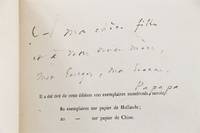
187583705Paris: Michel Lévy frères 1875. Fine. First edition copy of Hugo's political manifesto offered to his grandchildren Jeanne and Georges signed Papapa' Michel Lévy frères Paris 1875 19.50 x 25 cm relié Actes et paroles - Avant l'exil 1841-1851 Words and Deeds - Before the Exile 1841-1851 Michel Lévy frères Paris 1875 195x25cm bound. First edition one of 20 numbered copies on chine most limited deluxe edition of this important collection of speeches public declarations and political texts intended for French parliament Chamber of Peers Constituent Assembly and Legislative Assembly all written - as stated in the title - prior to his exile. These important texts address freedom of the press theater and education as well as the abolition of the death penalty. Half red shagreen binding smooth spine decorated in gilt lengthwise marbled paper boards caillouté pastedowns and endpapers original covers preserved top edge gilt over untrimmed edges. Exceptional and loving signed inscription by Victor Hugo to his daughter-in-law Alice Lehaene - widow of Charles Hugo - and his beloved grandchildren: ""To my dear daughter and your sweet mother my Georges my Jeanne signed: Papapa"" A ma chère fille et à votre douce mère mon Georges ma Jeanne Papapa. ""We called him Papapa. Legend has it - he surrounded us with legends! - that one morning at Hauteville House while he was working in that glass cage perched at the top of the house little Georges came in and said: - Hello Papapa! . To hear the son of his son Charles who had just died pronounce this unknown word the grandfather was overjoyed for he knew the secret language of children: Georges' stammer made him twice a father much more than a grandfather. . My name is Papapa now' he said softly. And until he died my sister and I called him by this dearest name which he always cherished"" Georges-Victor Hugo My Grandfather Mon grand-père Paris: Calmann-Lévy In 1871 after the tragic and unexpected death of his son Charles Victor Hugo became guardian of his two grandchildren Georges and Jeanne. From then on he played a large part in their upbringing and spent some of the happiest moments of his life with them reflected in the countless endearing notes about the two children in Choses vues Things Seen. Upon the death of his last son François-Victor he moved in with Georges and Jeanne's mother Alice at 21 rue de Clichy; on the floor below he lodged Juliette Drouet. This gave him plenty of time to spend with his ""little ones"" for whom he organized children's dinners and made plenty of toys. The children are the subject of his immensely popular poetry collection L'Art d'être grand-père 1877 The Art of Being a Grandfather. ""Its popularity was immediate and its success resounding so dazzling was his way of celebrating childhood by telling the story of Georges Jeanne and himself. By putting children's words into verse so naturally and freshly Georges et Jeanne's ""Papapa"" has succeeded like no other in exalting ""grandparental"" feelings. At home these feelings are not limited to allowing children to leave their toys lying around on manuscripts: when Alice remarried journalist and politician Édouard Lockroy' Simon contributor to Le Rappel Hugo opposed him sharing guardianship"" Sandrine Fillipetti Victor Hugo This inaugural volume of Actes et paroles Deeds and Words containing Victor Hugo's first major political texts is a poignant testimony to his humanist commitments. The ""little"" owners of this precious copy received their grandfather's intellectual and militant legacy: from his ""Discours de réception"" at the Académie française 1841 to his famous stance against Napoleon III ""Révision de la Constitution"" ""No! after Napoleon the Great I don't want Napoleon 'le Petit'!"" which led to his exile. At the heart of this compilation is a highly significant text ""For Charles Hugo. The death penalty"" delivered by Hugo before the Seine Assize Court in 1851 in de Michel Lévy frères hardcover
185153579Paris: La librairie nouvelle 1851. Fine. Precious inscribed copy signed by Victor Hugo to Juliette Drouet: «à mon pauvre doux ange aimé. V.» La librairie nouvelle Paris 1851 16.50 x 25 cm broché Partly first edition gathering the most famous speeches by Victor Hugo including some of his most memorable addresses delivered at the tribune of the Legislative Assemblymost notably the speech on constitutional revision and the powerful plea he gave at the trial of his son on 11 June 1851 before the Cour d'assises of the Seine in defense of the inviolability of human life. Spurious mention of eighth edition. Complete with the rare portrait of the author by Masson printed on China paper as frontispiece. Scattered occasional foxing. Precious inscribed copy signed by Victor Hugo to Juliette Drouet: «à mon pauvre doux ange aimé. V.» A treasured copy belonging to Victor Hugos muse and mistress. This moving and remorseful dedication is Hugos response to the tragedy Juliette endured that same year having just discovered he had been unfaithful for seven years with Léonie Biard. In June 1851 Biard sent Juliette the letters Victor had written to her. In July Hugo swore eternal fidelity to Juliette and in August inscribed this plea for a more compassionate justice to her. In the autumn Juliette demanded that Hugo meet Madame Biard to formally end the affaira meeting she choreographed in every detail and to which Hugo complied. Provenance: libraries of Pierre Duché 1972 no. 75 and Philippe Zoummeroff 2001 no. 71. La librairie nouvelle unknown
187369841Paris: Michel Lévy frères 1873. Fine. Michel Lévy frères Paris 1873 15.50 x 24 cm broché sous chemise et étui First edition mention of second edition. Our copy is presented in a case and shirt with a green canvas back and marbled paper boards. We enclose the cover of the catalog of the sale of the library of George and Maurice Sand in 1890 on which was pasted the descriptive sheet of our copy with its hammer price in pencil. Exceptional autograph shipment signed by Victor Hugo to Georges Sand. ""But what did they think of each other these two outstanding personalities of literary life in the 19th century Because they never met these two yet they were perfectly contemporary: Victor Hugo 1802-1885 George Sand 1804-1876. Certainly there were the ups and downs of life: George Sand did not really publish until 1832 at a time when Victor Hugo was already aware of his glory; and then there was the exile of Victor Hugo from 1851 to 1870 but that does not explain everything! At the beginning they are not really part of the same coterie: Victor Hugo Pair of France support of Louis-Philippe on one side George Sand socialist on the other. They do not really appreciate each other even if George Sand has a certain annoyed admiration for Victor Hugo called grandiloquent: ""the most talkative of sublime poets"" while Hugo him finds bluntly that ""Sand does not know how to write""! Then with the coup d'etat of Napoleon III Victor Hugo evolves politically; he quickly overflows George Sand on his left goes into exile while George Sand accommodates internal exile. Their relationship heats up only very very weakly: ""George Sand has talent that's all"". In exile Victor Hugo publishes ""Les Châtiments"" a very critical work which is obviously prohibited in France. George Sand would like Victor Hugo to be less intransigent in his writings so as to be published. The publication of ""Contemplations"" in 1856 much less controversial is welcomed by George Sand and marks a new phase in their relations. In fact their first letter contact does not concern literary life. Nini the little girl of George Sand dies in 1855 Victor Hugo still very marked by the death of his daughter Léopoldine sympathizes; the loss of a loved one brings them together. Here they are friends George Sand becomes a ""genius"" she will often be invited to Guernsey . without further action their relationship will never be familiar. Victor Hugo supports him during the publication of the Beaux Messieurs de Bois Doré 1858 but George Sand gets angry when he refuses the amnesty of 1859 while on her side she seeks to soften the situation of the proscribed. When Les Misérables was published 1862 Victor Hugo sought the support of George Sand but this support was lacking. Victor Hugo is saddened George Sand will say that he prefers the poetry of Victor Hugo to his prose work. On the return from exile with the Commune here is a new misunderstanding; Victor Hugo argues George Sand is horrified: legalist and shocked by the violence she condemns in extremely harsh terms this Paris Commune. Nevertheless from there these two support and defend themselves as soon as one or the other is attacked. In 1876 it was Victor Hugo who delivered the famous funeral praise of George Sand: ""I mourn a dead woman I salute an immortal ."" The relationships of George Sand and Victor Hugo have therefore evolved a great deal during their lives. It is undoubtedly a reflection of their personal development but perhaps their entourage political ideas or the opinion that the other had of his own work also interfered with literary criticism; even our great personalities are under influence! ""Victor Hugo and George Sand what if they had met"" »This is a fictional play by Danièle Gasiglia. But maybe as Danièle Bahiaoui suggests: Both of them in the same room it's one too many! »» Blog ""We in Boischaut Sud"" conference by Danielle Bahiaoui Arnaud Laster and Danielle Gasaglia Provenance: Maurice Sand Venet Ferrou Michel Lévy frères hardcover
183556714Paris: Eugène Renduel 1835. Fine. Eugène Renduel Paris 1835 14 x 21.50 cm relié First edition.Bound in red half Russia with corners spine with four raised bands gilt-ruled and decorated with double gilt panels date in gilt at foot within a compartment marbled endpapers and pastedowns rare wrappers and spine preserved top edge gilt uncut binding signed by Bernasconi.The catalogue leaf of Victor Hugos works is present. A few folding creases to some leaves. Mounted opposite the definitive version printed on p. 223 is a precious autograph poem by Victor Hugo entitled La pauvre fleur disait au papillon céleste on two folded leaves mounted on a stub. This is a first version consisting of four quatrains. These verses were reworked by Hugo with some variants in the definitive version augmented with four additional quatrains. The poem was composed by Hugo for his mistress Juliette Drouet whom he had met two years earlier. It symbolizes the nature of their relationshipthe poet bound by his marital and literary life the young woman condemned to wait for himand played a central role in their shared imagination: Juliette Drouet frequently quoted the line Et moi je reste seule à voir tourner mon ombre / À mes pieds ! in her love letters to Victor Hugo. The double motif of the flower and the butterfly alongside their entwined initials also appears in the painted decoration of the Chinese salon from Hauteville Fairy Juliette Drouets residence in Guernsey a décor conceived by Hugo himself and now preserved at the Maison Victor Hugo in Paris. A fine uncut copy in a charming signed binding enriched with a very rare autograph poem by Victor Hugo written for Juliette Drouet. Eugène Renduel hardcover
188047658Paris: Michel Lévy 1880. Fine. Michel Lévy Paris 1880 15.50 x 23.50 cm relié First edition. Contemporary half red shagreen over marbled paper boards a few discreet repairs spine in six compartments date to foot marbled paper-lined endpapers and pastedowns covers preserved top edge red. A very handsome autograph inscription signed by Victor Hugo to Alphonse Daudet. Mrs. Daudet's collection stamp to first endpaper. Victor Hugo represented for Alphonse Daudet as for the other writers of his generation the incontestable master of the Pantheon of the arts. His benevolent attention runs through Daudet's work often listed side by side with Rousseau Byron Sand and Delacroix. If during Daudet's childhood and youth Hugo an exile of enormous stature in Guernsey remained a distant ideal ""almost above humanity"" his return to France allowed him finally to meet the master. Around 1875 just after his first works appeared Alphonse and Julia Daudet were thus invited to Hugo's house; Hugo was living with Juliette Drouet at the time. From then on they become frequent visitors to the house right up to the poet's death. Hugo helped with the young Léon Daudet's education his grandson Georges' best friend and later for a short while Jeanne's husband. In her Souvenirs d'un cercle littéraire Memories of a Literary Circle Julia Daudet talks of their friendship of ten years with ""the idol of lyric France"": ""I can see Victor Hugo at the end of his great table: the aged master a little cut off a little deaf presiding with god-like silence the little absences of a genius on the verge of immortality. His hair all white his face colorful and his eyes like an old lion's that would occasionally flash with ferocious bursts of force. He is listening to my husband and Catulle Mendès between whom there is a very animated discussion on the subject of the youth and celebrity of famous men and their charm for women.During the debate we moved through to the salon with Hugo musing beside the fire famous omni-present and a demi-god but perhaps still missing his youth a little as Mme Drouet sleeps softly."" The friendship between this great Romantic writer and one of the masters of the nascent naturalist school is testimony to Hugo's sharpness who even during his glory days preserved a special and benevolent attention for modern literature no matter how far removed it was from his own lyricism. This inscription from Hugo to Daudet on a work considered - along with Le Pape The Pope and La Pitié suprême The Supreme Compassion - a ""philosophical testament"" by Henri Guillemin resonates strongly the passing of the writer's political and moral responsibilities to a devoted disciple. Provenance: Alphonse Daudet his sale at Sicklès 1990 IV n°1200 then Philippe Zoummeroff's sale 2 Avril 2001. An extract from Memories of a Literary Circle by Julia Daudet : ""How could I forget that first visit to his in the rue de Clichy in a modest apartment so out of proportion to his glory to the image of his glory that we had which would have filled entire palaces. He got up out of his chair beside the fire opposite Madame Drouet his old friend.I was shocked by how small he was but soon after he had greeted me and begun talking to me I felt him very big indeed very intimidating. And this timidity that I felt then I would always feel towards him the result of my great admiration and respect something akin to that for an absent god that my parents had inculcated within me for inspired poets. I could never overcome that wobble in my voice whenever I would reply to his kind words and I was shocked to hear women over the course of almost ten years when admitted to his presence regale him with their personal matters and their everyday chatter. That evening when he had introduced me all in a flutter to Madame Drouet she said to me with her most charming grace: 'This is the old people's bit you know and you're far too young for us. But Mon Michel Lévy hardcover
1831LCS-17869<p><strong>The first edition of"<em>Notre-Dame de Paris</em>" The Hunchback of Notre-Dame one of only 1100 copies printed.</strong></p><p>Two 8vo volumes 205 x 126 mm of: I/ 4 ll. for the half-title title and foreword 404 pp. ; II/ 2 ll. 536 pp. for part 2. Both titles are decorated with <em>Tony Johannot's</em> woodcuts engraved by <em>Porret</em>. Bound in blue half calf flat spines. <em>Reliure de l'époque.</em></p><p>First edition of the famous and first great novel by Victor Hugo.</p><p>Carteret I pp. 400-402; Escoffier 870; Vicaire <em>Manuel de l'amateur de livres du XIXe siècle</em> IV 256-257.</p><p>This copy belongs to the second state with the author's name on the title and the fictitious mention "<em>Seconde edition</em>" below the title.</p><p>"<em>Since Gosselin's copy appeared at auction Leroy auction March 26-27th 1931 N°328 it became indisputable that the mention of a second or third edition doesn't take anything from the first edition nature of a book.</em></p><p><em>Gosselin-Leroy's copy bore indeed on a fourth edition of Notre-Dame de Paris 1831 the following autograph note:</em></p><p><em>'</em>First edition published in 1100 copies that have been following the habits of the bookselling at the time divided into four editions. Signed. Charles Gosselin editor' ".</p><p>Escoffier <em>Le Mouvement romantique</em> 870.</p><p>Michaud comes to the same conclusion in the Bulletin du bibliophile 1931: "copies<em> falsely pointed out as second or third edition authentically belong to the first edition"</em>.</p><p>"This first edition in good condition is the rarest of all the author's works; it had a worldwide impact and it's one of the most difficult to get from the Romantic period" Carteret.</p><p>A precious copy preserved in its elegant contemporary blue half calf binding.</p><p>FRANCAIS</p><p><strong>L'édition originale de " Notre-Dame de Paris " tirée à 1100 exemplaires.</strong></p><p><strong>Précieux exemplaire conservé dans son élégante reliure de l'époque en demi-veau bleu.</strong></p><p>Edition originale du celebre et premier grand roman de Victor Hugo.<br />Carteret I pp. 400-402 ; Escoffier 870 ; Vicaire <em>Manuel de l'amateur de livres du XIXe siècle</em> IV 256-257.</p><p>Exemplaire de la seconde tranche avec le nom de l'auteur figurant sur le titre et la mention fictive " <em>Seconde édition</em> " au-dessous du titre.</p><p>" <em>Depuis que l'exemplaire de Gosselin est passé en vente publique Vente Leroy 26-27 mars 1931 n° 328 il n'y a plus de discussion possible sur le fait que la mention d'une deuxième ou troisième édition n'enlève rien au caractère d'édition originale d'un livre.</em> <em>L'exemplaire Gosselin-Leroy portait en effet sur une quatrième édition de Notre-Dame de Paris 1831 la note autographe suivante :</em></p><p><em>"</em>Edition originale tiree a 1100 exemplaires qui ont ete suivant l'usage de la librairie a cette epoque divises en quatre editions. Signé. Charles Gosselin éditeur<em>".</em> "<br />Escoffier <em>Le Mouvement romantique</em> 870.</p><p>Michaux conclut de même dans le <em>Bulletin du bibliophile</em> 1931 : " <em>les exemplaires ainsi faussement désignés de seconde voire de 3e édition appartiennent authentiquement à l'édition originale</em> ".</p><p>" Cette edition originale en bel etat est la plus rare de toutes les uvres de l'auteur ; elle a eu un retentissement mondial et c'est une des plus difficiles a se procurer de la periode romantique " Carteret.</p><p>Précieux exemplaire conservé dans son élégante reliure de l'époque en demi-veau bleu.</p> Charles Gosselin.
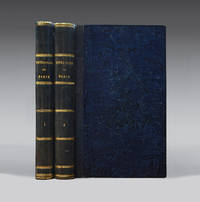
1831307333Paris: Charles Gosselin 1831. First edition third issue. Title vignettes by Tony Johannot. viii 404; iv 536 pp. 2 vols. 8vo. Bound to style in the early 20th-century in red half morocco and embossed paper over boards smooth spines stamped in gilt and blind to cathedral design t.e.g. the rest uncut by René Aussourd signed in gilt at foot of spine and on front free endpaper. Slight rubbing to extremities expert paper repair to lower outside corner of vol. I half-title and repairs to a few other paper faults throughout. In a custom gilt-ruled full brown morocco slipcase and chemise by R. Patron. Johannot Tony. First edition third issue. Title vignettes by Tony Johannot. viii 404; iv 536 pp. 2 vols. 8vo. First edition third issue of Hugo's first great success as a novelist The Hunchback of Notre-Dame in a fine retrospective binding by René Aussourd. Though styled the "Troisème Édition" on the title-page this is in fact the third issue of the first edition. The entire edition consisted of four separate issues of 275 copies each with each issue designated as a separate edition on the title-page. <br /> <br /> Notre-Dame de Paris is more commonly known in English as The Hunchback of Notre-Dame the title under which the first English translation by Frederic Shoberl appeared in 1833. Set in 15th-century Paris the novel introduces a memorable cast of Romantic characters; some such as the hunchback Quasimodo and the gypsy girl Esmérald have so permeated our culture that they've reached the status of archetypes. Hugo hoped that his novel would reverse the sad neglect of Gothic architecture in his country much of which had fallen into ruin or been brutally altered. Indeed Hugo created a depiction of Notre-Dame "so erudite and familiar that it caused a revolution in architectural taste. The success of this darkly moving novel was immediate establishing Hugo as the premier historical novelist of his time" Oxford Companion to Literature in French.<br /> <br /> In a fine retrospective French romantic binding by René Aussourd recalling the work of Simier or Thouvenin. Aussourd studied under his uncle Charles Meunier and was first gilder at Chambolle-Duru before starting his own business in 1912 Devauchelle III p. 243. Carteret I p. 402 Charles Gosselin unknown
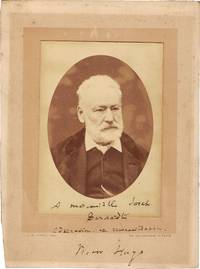
1872804Paris: J.M. Lopez 1872. Bust portrait of Victor Hugo 3 7/8†X 5 3/8†mounted on its original card 6 1/4†X 8 3/8â€. Inscribed in black ink trailing from the photograph down to the card “A mademoiselle Sarah Bernhardt admiration et reconnaissance. Victor Hugo†To Miss Sarah Bernhardt admiration and gratitude. Victor Hugo. The card is backed with contemporary framing craft paper and mounted to it is an image of Bernhardt’s study showing this very photograph a fillet on the former frame hanging on the wall centered over her desk. Slight edge darkening and slighter spotting to the photograph but very good the inscription sharp and unfaded the card to which it is mounted has some mat burn and a few spots of foxing its edges cleanly cut but the lower left corner was cut on a slight angle. A monumental association between at the time the most famous author and the most famous actress and there are no 19th century comparables like this one that are nearly as great as this one. <br /> <br /> Here is a précis of Bernhardt’s story. She was born in 1844 and attended her first play at 15 with her mother and 2 of her mother’s friends Charles de Morny and Alexandre Dumas. She was so emotionally taken by it that she cried throughout. Dumas calmed her afterwards spoke with her at length and told her mother that Sarah’s intellect and emotional wiring destined her to be an actress and a star. Morny who was half–brother to Napoleon III fixed her acceptance into the Paris Conservatory Dumas coached her and she made her professional debut at 18. A dozen other roles followed but she left Paris for Belgium had a sultry romance with The Prince of Linge then returned to Paris to have their child. In 1866 she signed with Théâtre de L’Odéon and in 1868 became the star Dumas had predicted playing the lead role in the revival of his play Kean. She served as a nurse during the Franco–Prussian war converting the Odéon into a hospital and when the French 2nd empire was replaced by the 3rd republic Victor Hugo returned to France from a 19–year political exile and met Bernhardt. Once the siege of Paris was over and the theaters reopened Hugo’s play Ruy Blas was staged in Jan. 1872 to celebrate his homecoming. Bernhardt played the lead role as the Queen of Spain and her fame already prodigious rose to the pinnacle with a triumphant performance. The bond between author and actress combined mutual respect and appreciation a victorious professional relationship unparalleled satisfaction for an adoring public and a well–known ongoing tryst recounted with intimate details and frankness in the book My Erotic Life. Already the most renowned actress in France Bernhardt toured England Belgium and Denmark with her own troupe in 1879 and 1880 then sailed to America toured 51 cities and returned to France with $194000 in gold coin. Now the most famous actress in the Western world the first superstar she performed across the rest of Europe except for Germany then returned to Paris and shined there again. Other world tours followed and she came home from one of them with 3 1/2 million francs. In 1893 she bought the Théâtre de la Renaissance where she performed and directed sold it 1899 and leased a larger concert hall where she staged whatever struck her mood often playing male roles and every time she wanted more money she would do another tour. She injured her leg in a stunt leap on stage had to have it amputated in 1915 weathered W. W. I. continued to perform made a few films and died in 1923 still the most acclaimed actress in the world. We have already said that she was the first superstar and so she was of course the earliest born person awarded a star on the Hollywood Walk of Fame. <br /> <br /> “There are five kinds of actresses: bad actresses fair actresses good actresses great actresses––and then there is Sarah Bernhardt.†–Mark Twain. J.M. Lopez unknown
187883249Paris: Léon Vanier 1878. Fine. Léon Vanier Paris s. d. 1878-1899 & 1886-1892 19.50 x 28.50 cm 5 volumes reliés First edition of Les Hommes d'aujourd'hui 33 issues lacking out of 469. Five volumes bound in light blue half-cloth smooth spines blue morocco title labels decorated with double filets marbled paper boards 4 volumes. The color title pages have been preserved and bound in. Marginal tears without damage to the text no. 163; no. 165; no. 184 p. 2. Marginal restorations without damage to text on 8 leaves between nos. 214 and 223. Two leaves of no. 224 backed. Marginal tear with some paper missing no. 345 p.1. Format of quires in the first volume varies; some are trimmed more than others. First edition of Les Femmes du jour very rare complete collection in 11 issues published between 1886 and 1892 the last very rare Réjane issue appeared in 1892 six years after the other 10. Bound in half red cloth smooth spine midnight-blue morocco title labels framed in gilt gilt title lengthwise marbled paper boards. An impressive gallery of prominent 19th century women and men caricatured and described by the foremost avant-garde artists and writers of the time. Created by writer Félicien Champsaur and illustrator André Gill in 1878 this exceptional literary and satirical review was later directed by Léon Vanier the publisher of the Parnassiens poets from 1885 to 1899. Each issue is a portrait of a contemporary figure in the world of arts and letters politics science or technology. The full set includes 469 monographs written by some of the most provocative voices of the time: Jules Laforgue Gustave Kahn Joris-Karl Huysmans Jean Moréas Félix Fénéon. The only contributor Vanier ever paid for those written portraits was Paul Verlaine famously always short of money. Each issue includes on the front page a large and fine color lithographed caricature by artists such as Manuel Luque André Gill and Félix Régamey but also world-renowned painters: Toulouse-Lautrec Steinlen Pissarro Seurat Signac to name a few. The actress Sarah Bernhardt was so famous she appeared both in the men-issue Hommes d'aujourd'hui as well as one of the very rare women-issues Femmes du jour! The literary issues cover every school and movement of the second half of the 19th century including Buveurs d'eau Vilains bonshommes Hydropathes Parnassiens Naturalists Decadents Symbolists and Incohérents. There is also a number of avant-garde painters belonging to the Pont Aven school Schuffenecker Pissarro Emile Bernard Maximilien Luce the circle of the Montmartre Affichistes Chéret Willette Caran d'Ache Georges Auriol Job Steinlen as well as Post-Impressionnists Cézanne Toulouse-Lautrec Anquetin Pointillists Signac Seurat and Symbolists Redon. Musicians are also featured with fine portraits of Gounot Massenet Verdi Camille Saint-Saëns Rubinstein and Reyer. An exceptional and rare set bearing witness to the free spirit of 19th century French intellectuals and artists. Léon Vanier hardcover
183173562Paris: Eugène Renduel 1831. Fine. Eugène Renduel Paris 1831 14 x 22.50 cm relié First edition rare copy with no statement of print. Full blue morocco binding spine with raised bands in the Jansenist style endpapers and pastedowns of combed marbled paper gilt dentelle framing the pastedowns double gilt fillets and gilt tooling to headcaps and board edges top edge gilt with untrimmed margins preserved original front wrapper bound in binding signed by Marius Michel. Monogrammed bookplate mounted on the verso of the first endpaper. This copy is enriched with four hors-texte plates by Louis Boulanger and Alfred Johannot. Signed autograph inscription by Victor Hugo on the half-title: « À Monsieur Charles Mévil son bien cordialement dévoué Victor Hugo. » Valuable and intriguing presentation inscription to the administrator and principal shareholder of the highly influential Revue de Paris publisher of Balzac whom the young Hugo was likely hoping to win over. It was only in 1834 two years after the success of Notre-Dame de Paris that Hugo would publish a text in the Revue Claude Gueux alongside his prolific rivals Le Père Goriot. Presentation copies of this title by Victor Hugo are exceedingly rare. In his Chronologie des livres imprimés de Victor Hugo published in 2013 Éric Bertin records only nine such inscriptions in this edition: to Sainte-Beuve Taylor Paul Lacroix Charles Mévil this copy Charles Nodier Loève-Veimars Armand Bertin H. Romand and the faithful Paul Meurice. The work also notes that this copy appeared in the Latour sale 1885 and more significantly the Noilly sale 1886. Magnificent copy bound by Marius Michel enriched with engravings and a signed autograph inscription by the author. Eugène Renduel hardcover
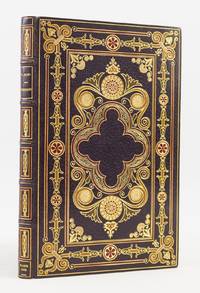
1830ST19754Paris: Mame et Delaunay-Valleé 1830. FIRST EDITION. 225 x 143 mm. 8 3/4 x 5 3/4". 2 p.l. vii 1 154 pp. 7 leaves ads. <br/> DAZZLING AUBERGINE CRUSHED MOROCCO ELABORATELY INLAID AND GILT BY GRUEL stamp-signed at foot of spine and on front turn-in covers inlaid to an Art Nouveau design of curving lines and botanical elements in red citron tobacco ivory and teal morocco raised bands spine compartments with tan morocco and gilt centerpiece BEAUTIFUL MOSAIC DOUBLURES with a complex Moorish lattice design in turquoise red and dark brown morocco and much gilt dark brown jacquard silk endleaves all edges gilt on the rough. In the matching suede-lined morocco-backed chemise and morocco-trimmed slipcase. Original paper wrappers bound in. Bibliotheque de M. René Descamps-Scrive II 423 this copy; Carteret II 399. A FLAWLESS COPY.<br/> <br/> This is the superb Descamps-Scrive copy of Hugo's revolutionary play in a binding by one of the great French masters—a bibliopegic achievement that reflects the play with its memorably exuberant and flamboyant style as seen particularly in the intricacy of its highly decorative doublures. When "Hernani" debuted on 25 February 1830 it caused a fierce argument among the audience--between the young Romantics led by Hugo's friend Théophile Gautier and the fans of classical theatrical styles--that became known as the Battle of Hernani. According to the Library of Congress "The clashes lasted several days and marked the triumph of romantic drama which dominated the stages of French theaters for years to come." Gautier would later reminisce: "February 25 1830! This date remains written in the depths of our past in flamboyant characters: the very first performance of Hernani! That evening decided our lives! It was there that we received the impetus which still drives us on after so many years and which will see us through to the end of our career." The binding here is as uninhibited by tradition and as over-the-top dramatic as the play with arresting design motifs inspired by Art Nouveau and Orientalism and with richly colored leathers that both contrast with and complement each other. In her "Bookbinders and their Craft" Prideaux says that the Gruel firm founded in 1811 "has always had the highest reputation . . . for initiative in artistic matters as well as for irreproachable execution in the detail of its many-sided achievements." Our binding stands as testament to the truth of this statement. The Gruel bindery was managed by several family members over the years most famously by Léon Gruel 1841-1923 and the list of binders who trained at the Gruel atelier is the most distinguished in Europe. Our binding was very probably done by Léon in the late 19th century for the famed French bibliophile René Descamps-Scrive 1853-1924 whose collection was as prestigious as Henri Beraldi's. Descamps-Scrive owned the volume in any case as it was auctioned after his death as part of his library at the Parisian gallery Georges Petit in May 1925 where it was lot no. 423 with full-page illustration. Like Beraldi Descamps-Scrive collected beautiful bindings that typified major styles and periods and was known for his insistence on acquiring only volumes in perfect condition. We have sold many fine bindings with elaborately decorated doublures but nothing quite like the ones seen here: they resemble a kind of fiery thicket although formed with rigorous control by a masterly binder. Mame et Delaunay-Valleé unknown
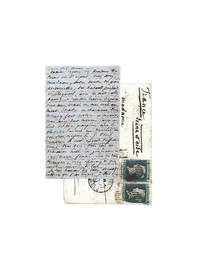
1855Hugo17<p><strong>HUGO Victor 1802-1855</strong></p><p>Autograph letter to Alphonsine Masson<br />Marine Terrace Jersey 5th August 1855 4 pp. small in-12°<br />With autograph envelope<br />Postmark: ANGL –5 Augt departure / CHEVREUSE 99th Août arrival<br />Fine condition throughout</p><p><strong>A long unpublished letter with mystical overtones addressed to his psychic friend Alphonsine Masson through which Victor Hugo addresses a message to his former love Léonie Biard – The exiled poet expresses in the manner of a prose poem and like a waking dream the power of loving memory for the woman he was forced to leave behind during the coup d'Etat of December 2 1851</strong></p><p><u>We transcribe here only a few fragments</u></p><p><em>" Comme toutes les femmes de cœur et d'esprit vous avez Madame outre toutes vos grâces personnelles des hasards profonds et éloquents. <strong>Avec ce mot : <u>elle partie c'est ma lumière disparue</u></strong><u></u> <strong>vous avez remué en moi tout un monde sombre et charmant vous m'avez fait revivre et mourir vous avez fait monter jusqu'au bord de ma paupière tout le flot des larmes non versées et qui sont toujours là. Je vous remercie de cette exquise souffrance que je vous dois</strong>.</em> …<em>. Rien ne vous manque ; vous charmez de près et vous consolez de loin.</em><br /><em>Je suis heureux des deux douces lettres que j'ai reçues. <strong>Je sais bien ce qui manque à l'une mais <u>elle</u> le sait aussi. Et – qui connaît l'avenir </strong></em><br /><em>Vous me faites un adorable tableau ; je vous vois toutes deux dans cette belle nature qui vous aime parce qu'elle voit vos âmes ; vous êtes là dans les fleurs sous les astres harmonies vous-mêmes ; vous causez ; je retiens mon souffle et il me semble que je vous entends.</em><br /><strong><em>Et tous les soirs je regarde là-haut je fais des signes d'intelligence aux yeux célestes de la nuit et il me semble que je la vois.</em></strong><br /><em>Je suis avec elle dans l'inexprimable. Elle qui pourtant devrait tout comprendre elle ne comprend pas cela. Elle me dit : écrivez-moi donc.</em> … <em>Je regarde les étoiles en songeant à elle et je lui dis : traduisez-moi.</em><br /><em>Soyez heureuse. Soyez heureuses. La beauté lui revient. Est-ce qu'elle était partie Est-ce qu'elle partira Qu'<u>elle</u> ouvre la sombre poitrine de l'absent ; il y a là un miroir. Qu'elle s'y regarde.</em><br /><em>Je dis l'absent. Et vous vous n'êtes pas absentes où vous êtes où elle est la présence est. <strong>Je regarde avec dédain et pitié ce Paris qui me fait l'effet d'un grand vide depuis qu'elle n'y est plus.</strong></em><br /><em>Je veux m'arrêter car il y a des portes d'écluses qu'il ne faut pas rouvrir. À quoi servirait le flot qui en sortirait </em><br /><em>Pardonnez-moi toutes deux ce mélange de rêves et de souvenirs.</em> …. <strong><em>Qu'elle en prenne ce qu'elle voudra. Qu'elle y lise ce qu'elle voudra</em></strong><em>. Je suis sûr des commentaires de votre noble et charmant cœur. –</em> …<br /><strong><em>Un jour elle me comprendra. En attendant elle fait ce qu'elle peut pour croire à un abîme ; elle dit toujours <u>fini</u> à moi qui ne sait pas d'autre mot qu'<u>infini</u>. Qu'elle me voie donc où je suis ; dans la mort et dans le ciel ; dans la mort par l'absence dans le ciel par sa pensée</em></strong><em>. "</em></p><p><u>Léonie Biard's loving memory from exile</u><br />A great love of Victor Hugo Léonie Biard 1820-1879 was the only woman for whom the writer hesitated to leave Juliette Drouet. Born into a family of minor nobility Léonie Thévenot received a good education before marrying the painter François Biard. In the spring of 1843 she met Victor Hugo perhaps in Fortunée Hamelin's salon. They became lovers in December of the same year. Léonie inspired him to write many poems of which we can find traces in <em>Les Contemplations</em>. In July 1845 the two lovers were caught in the act of adultery. Léonie Biard was arrested and thrown into the prison of Saint-Lazare where she remained from 5 July to 10 September. She was then transferred to the convent of Sentenced by the Seine court she lost custody of her children. Victor Hugo benefiting from his inviolability as Peer of France will always feel indebted to her. He sent her money regularly and continued to send her his books. Their affair was abruptly interrupted during the coup d'état of 2 December 1851 forcing the poet into exile. Juliette Drouet unaware of the affair learned of this seven-year affair from Léonie herself who on June 28 1851 sent her back the poet's letters. They were published by Jean Gaudon and are kept at the Maison de Victor Hugo after having belonged successively to Juliette Drouet Louis Koch Paul Meurice Alexandrine de Rothschild sale I n°67 and then to Colonel Sickles II 1989 n°361.</p><p><u>Alphonsine Masson the spiritual link</u><br />The direct recipient of this letter Alphonsine Masson played an essential role as an intermediary between the poet and Léonie Biard. The two friends knew each other from before the exile. It is therefore through her that Victor Hugo can reach Léonie through words. An exalted personality Alphonsine wanted to go beyond a wise conjugal existence through literary essays and an eventful spiritual quest. Marked by an education received from a militant agnostic father and a pious mother she first devoted herself to spiritualism establishing contacts with spirits from beyond the grave. In 1857 she was a member of an association that had rediscovered Franz Mesmer's scorned and abandoned science. Around 1860 she suddenly lost her ability as a medium: "Whatever I did then to get it back together I couldn't do it." She then proclaimed herself a Christian convert and published an autobiography <em>Ma conversion</em> Paris 1864 in which she recounted her spiritual journey. At the same time as this conversion remembering that she had been asked to write for many years by friends eminent in letters she became emboldened and responded to her late vocation. She wrote three novels: <em>Louise</em> <em>Les Trois amies</em> <em>La Perle noire</em> which appeared only in serials in <em>L'Estafette</em> <em>Le Siècle</em> and other Parisian newspapers.</p><p>Why did Victor Hugo pass on his messages to Léonie Biard through Alphonsine Masson Was it a question of not reviving the scandal that had marked the discovery of adultery No doubt the poet wanted to escape any police control over this correspondence which if revealed could have compromised the exile in the eyes of public opinion. He might also be afraid of hurting Juliet by reviving an old wound.</p><p><u>Provenance:</u><br />Alphonsine Masson's etate until 2002<br />Then private collection</p>
18313576Paris: Charles Gosselin Libraire 1831. NOTRE-DAME DE PARIS- Victor Hugo- Illustrated Title Vignettes by Tony Johannot- Charles Gosselin Libraire- Paris 1831- 1st Edition-1st Impression-4th Issue- The publishers own statement on May 10th 1831 in the Journal des Débats that the first impression of 1100 copies were divided into 4 groups of 275 designating Premiere to Quatrieme edition- He did this to lure people into believing that the novel was popular due to the many editions already out there- This one is falsely designated as Quatrieme Edition as stated on the title page- errors as per the first issue- Vol II pagination errors 339 instead of 439 and 391 instead of 491.- original publishers 1/2 leather and marbled boards rubbed at extremities but sound and clean- 5 smooth gilt compartments on spine with some legibility of titles and volume- Vol I: 4ff un-numbered 1-404 Vol II: 2ff un-numbered 1-536.-no tears no writing-small amount of foxing especially towards endpapers- A nice set in the original bindings- Bookplate of long time collector René Escande de Messières in both volumes- SEE PHOTOS- Hugo's first full length novel and also the rarest of all his 1st editions- nice woodcut title vignettes by Tony Johannot.- Fiction-adventure-romance-French-France-classic 3576 . 1st Edition-1st Impression-4th Issue. 1/2 Leather & Marble Boards. G-VG/No Jacket as Issued. Illus. by Tony Johannot. 8vo - over 5¾" - 6¾" Tall. Charles Gosselin, Libraire Hardcover
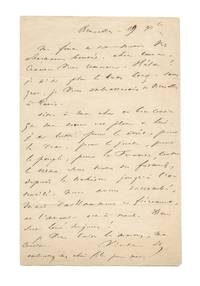
1851Hugo2<p><b>HUGO Victor 1802-1885</b></p><p>Autograph letter signed "<i>Victor H</i>" to Joséphine TrébuchetBrussels 19th December 1851 1 page in-8 on double sheetFold marks</p><p><b>Vibrant and precious letter from Victor Hugo written in the early hours of his exile from Brussels just 17 days after Napoleon III's coup d'état</b></p><p><b><br /></b></p><p><i>"Brussels – 19 XbreMy wife tells me all your lovely gratitude dear cousin how to thank you. <b>Alas! I no longer have a long arm</b> otherwise I would kiss you from Brussels to Paris.Tell my dear and good cousin that my heart is full of him. <b>I have fought for the right for the truth for the righteous for the people for France against crime in all its forms from treason to atrocity. We have succumbed but valiantly and proudly and the future is ours</b>. Praise God always!I kiss your hands my cousin.Victor H.Kiss my dear daughter for me."</i></p><p><i><br /></i></p><p><i><br /></i></p><p>On December 2nd 1851 the day of Napoleon III's coup d'état Victor Hugo was put a price on his own head for his opposition to the emperor and for trying in vain to organize the resistance by raising the Parisian masses. 25000 francs reward are promised to whoever captures him. On 11 December Hugo with a false passport leaves Paris for Brussels on the 8pm train under the name Jacques-Firmin Lanvin. He is alone.</p><p>On the same day as our letter December 19 Hugo wrote to Paul Meurice: "<i>If we could colonize a small corner of free earth! Exile would no longer be exile. I'm making this dream."</i></p><p>This small corner of free land was first the Channel Island of Jersey then the island of Guernsey where it settled as early as 1855. His exile lasted for nearly 20 years.</p><p>At the capitulation of Napoleon III following the stinging failure of the French army in Sedan on September 1st 1870 Victor Hugo returned to France on the 5th of the same month and uttered these unforgettable words that would forever last:<i>"Citizen I said: The day the Republic returns I will return. </i><i>Here I am.</i> … <i>Defend Paris keep Paris. </i><i>Saving Paris is more than saving France saving the world. Paris is the very center of humanity. Paris is the sacred city. Whoever attacks Paris attacks the whole human race.</i> … <i>Let us all gather around the Republic in the face of invasion and be brothers. We'll win. It is through brotherhood that freedom is saved."</i></p>
187946925Paris: Michel Lévy 1879. Fine. Michel Lévy Paris 1879 15.50 x 23.50 cm relié Original edition. Binding half old red grief with some discreet restorations back with five nerves when tail paper plates to the tank and contreplats combed guards lined paper preserved covers red head contemporary binding. Precious autograph signed by Victor Hugo Alphonse Daudet. Buffer library of Madame Daudet on the first guard. Victor Hugo is for Alphonse Daudet like other writers of his generation the undisputed master of arts Hall of Fame. His father figure sprinkles the works of Daudet commonly called alongside those of Rousseau Byron Sand and Delacroix. If during childhood and youth Daudet Hugo exiled giant on his island of Guernsey remains an unattainable ideal ""almost beyond humanity"" Back in France allows him to meet him someday. Around 1875 shortly after the publication of his first works Alphonse Daudet and Julia are well received in Hugo who now lives with Juliette Drouet. They therefore become intimate of the house until the poet's death. Victor Hugo is involved in the education of the young Léon Daudet best friend grand-son of Hugo George and later husband of Jeanne ephemeral. In his Memories of a literary circle Julia Daudet evokes friendship of ten years with the ""idol of all France poetic"" ""I see the great Victor Hugo end of his table; the old master a bit isolated a little deaf sits with God silences absences of a genius on the brink of immortality. The white hair colored head and this eye old lion that develops side with power ferocity; he listens to my husband and Catullus Mendes between which is very lively discussion about youth and celebrity known men and their attractiveness to women. . During the debate we went to the salon Victor Hugo dream by the fire and famous universal and demigod regret perhaps his youth while Mrs Drouet sleeping quietly. » The friendship between the last great romantic writer and one of the masters of the early naturalist school reflects the sharpness of Victor Hugo who at the height of his fame and retains a special kind attention for the remote yet modern literature Hugo's lyricism. This dedication Hugo Daudet on a skilled with The Pope and Religions and Religion of ""philosophical testament"" by Henri Guillemin symbolically resonates as a legacy by a devout follower of the political and moral responsibility of the writer. Provenance: Alphonse Daudet sales Sickles 1990 IV No. 1200 and Philippe Zoummeroff sale 2 April 2001. Gift extract of a literary circle by Julia Daudet: ""How can we forget that first visit home rue de Clichy in the modest apartment so disproportionate to his glory the idea we had of the glory that had filled palaces: He gets up the seat he occupied the fire in front of Madame Drouet his old friend . I am amazed at its size but soon when it will meet me and talk to me I would find it very big very intimidating. And this I felt so shy I always try them in front of Victor Hugo the result of this great admiration respect it as an absent god my parents instilled in me the genius of a poet. I will overcome never that trembling voice every time I answer his kind words and I say astonish for nearly years to hear women admitted to him maintain their inner and their usual trivia. That night when he had made me quite confused Mrs Drouet she said with a charming good grace - Here is the corner of the old and you are too young for us. But Victor Hugo will introduce you to his daughter Mrs. Lockroy; alone has standing to that. And I was driving on the other side of the room moderately large though but that was as divided in two by a table topped with a bronze elephant very majestic Japanese or Chinese I think. It was enough to make two very distinct small groups that communicate easily but without merging. At the time of his return Victor Hugo was dazzling wit many memories and told with an inexhaustible verve when the policy is not too Michel Lévy unknown
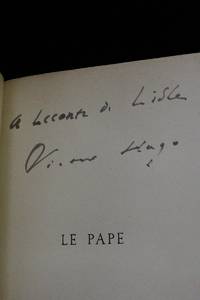
187848336Paris: Calmann-Lévy 1878. Fine. Calmann-Lévy Paris 1878 15 x 23.50 cm relié First edition one of 15 copies on Whathman paper Contemporary Bradel binding by Paul Vié in red cloth gilt fleuron to spine midnight blue morocco titlepiece double fillet and date at foot of spine Handsome autograph inscription from Victor Hugo to Leconte de Lisle poet and head of the Parnassianist movement who would go on to take over Hugo's chair at the Académie Française. Calmann-Lévy hardcover
183188279Paris: Charles Gosselin 1831. Fine. Charles Gosselin Paris 1831 13.60 x 21 cm 2 volumes reliés First edition limited to 1100 copies divided into four fictitious editions within the same year in order to create the illusion of commercial success. These were subsequently reissued with a new title-page bearing an edition statement and the authors name together with a volume designation on the half-titles cf. Clouzot. Our copy carries the designation third edition. Contemporary bookplate traces on the upper pastedowns. Expert restorations to headcaps and joints with a tiny loss at the foot of the lower joint of vol. I. A clean copy entirely free of foxing. Contemporary half chocolate calf bindings smooth spines decorated with gilt fillets and romantic fleurons with gilt Gothic motifs marbled paper boards pebbled paper endpapers and pastedowns marbled edges strictly contemporary bindings. The title-pages are illustrated with two wood-engraved vignettes after Tony Johannot by Poiret showing Esmeralda offering water to Quasimodo vol. I and LAmende honorable vol. II. A fine copy in handsome period bindings and entirely without foxing a state of preservation very seldom encountered. This first edition in fine condition is the rarest of all the authors works; it enjoyed worldwide renown and is among the most difficult to obtain from the Romantic period Carteret. Charles Gosselin hardcover