31 338 résultats
190612796AB1906. Vienna Schroll 1906. 245 : 18 cm. IX 250 pages 2 leaves With 13 partly coloured plates and 692 illustrations in the text. Original cloth with coloured illustrations. First edition of this richly illustrated book on Japanese seals rare. hardcover
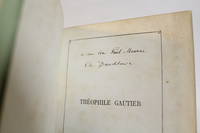
185968622Paris: Poulet Malassis & De Broise 1859. Fine. Baudelaire and Hugo: The Storm-Swept Meeting of the Albatross and the Man of the Ocean Poulet Malassis & De Broise Paris 1859 11.50 x 18 cm relié First edition of which only 500 copies were issued. With an etched frontispiece portrait of Théophile Gautier by Émile Thérond. With a substantial prefatory letter by Victor Hugo. Full red morocco binding gilt date at the foot of spine marbled endpapers Baudelairian ex-libris from Renée Cortots collection on the first endpaper wrappers preserved top edge gilt. Pale foxing affecting the first and last leaves beautiful copy perfectly set. Rare handwritten inscription signed by Charles Baudelaire: À mon ami Paul Meurice. Ch. Baudelaire. To my friend Paul Meurice. Ch. Baudelaire. In addition we have mounted on a guard an autograph ex-dono slip by Victor Hugo addressed to Paul Meurice. This slip which was doubtless never used had nevertheless been prepared along with several others by Victor Hugo in order to present his friend with a copy of his works published in Paris during his exile. If History did not allow Hugo to send this volume to Meurice this presentation note hitherto unused could not in our view be more fittingly associated. Provenance: Paul Meurice then Alfred and Renée Cortot. This exceptional inscription from Charles Baudelaire to Paul Meurice the true surrogate brother of Victor Hugo bears witness to a singular literary encounter between two of the most important French poets Hugo and Baudelaire. Paul Meurice was indeed the indispensable intermediary between the condemned poet and his illustrious exiled counterpart for asking Victor Hugo to associate their names with this elegy to Théophile Gautier was one of Charles Baudelaires great audacities and would scarcely have had any chance of succeeding without the invaluable assistance of Paul Meurice. Ghost-writer to Dumas author of Fanfan la Tulipe and the theatrical adaptations of Victor Hugo George Sand Alexandre Dumas and Théophile Gautier Paul Meurice was a gifted writer who chose to remain in the shadow of the great artists of his time. His unique relationship with Victor Hugo nevertheless granted him a decisive role in literary history. More than a friend Paul together with Auguste Vacquerie stood in place of Victor Hugos deceased brothers: I have lost my two brothers; he and you you and he you replace them; only I was the younger; I have become the elder that is the only difference. It was to this brother of the heart whose wedding he witnessed alongside Ingres and Dumas that the exiled poet entrusted his literary and financial affairs and it was he whom Hugo named together with Auguste Vacquerie as his executor. After the poets death Meurice founded the Maison Victor Hugo which remains today one of the most celebrated writers house-museums. In 1859 Pauls home had become the Parisian antechamber to Victor Hugos Anglo-Norman retreat and Baudelaire therefore turned quite naturally to this official ambassador. Baudelaire knew Meurice well ever since an earlier intercession on his behalf with Hugo had earned him an exceptional copy of Les Fleurs du mal as a testament of friendship. The two men also shared a close friend Théophile Gautier with whom Meurice had worked from 1842 on an adaptation of Falstaff. Meurice thus stood as the ideal intermediary through whom to secure the goodwill of the otherwise inaccessible Hugo. Baudelaire had however already met Victor Hugo briefly. At the age of nineteen he sought an audience with the greatest modern poet to whom he had been devoted since childhood: I love you as one loves a hero a book as one loves purely and disinterestedly every beautiful thing. Even then he imagined himself as a worthy successor as he half-confesses: At nineteen would you have hesitated to write as much to . Chateaubriand for instance For the young apprentice poet Victor Hugo belonged to the past and Baudelair Poulet Malassis & De Broise unknown
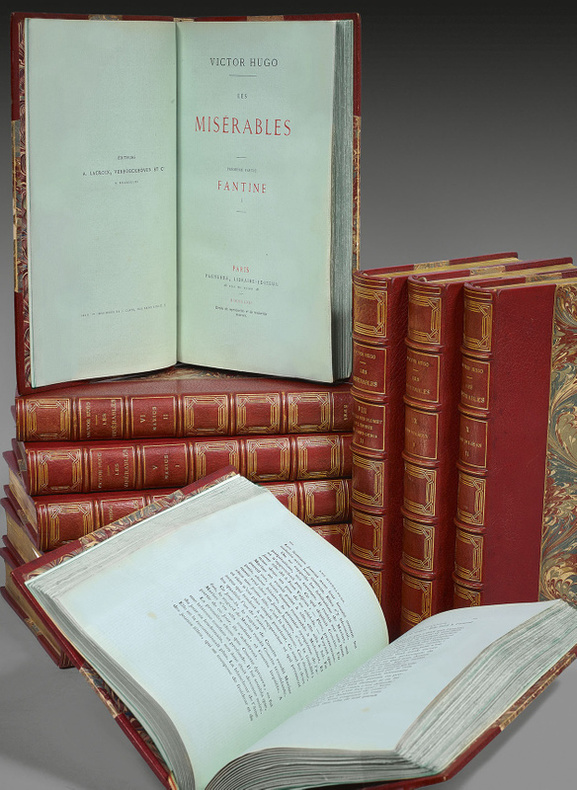
LCS-17702L’un des rarissimes exemplaires sur papier vert d’eau. Paris, Pagnerre, 1862. 10 volumes grand in-8 de : I/ (4) ff., 357 pp. (mal numérotées 355), (1) f.bl., 2 illustrations hors texte ; II/ (2) ff., 382 pp., (1) f.bl., 2 illustrations hors texte ; III/ (2) ff., 358 pp., (1) f.bl., 2 illustrations hors texte ; IV/ (2) ff., 318 pp., (1) f.bl., 2 illustrations hors texte ; V/ (2) ff., 320 pp., 1 illustration hors texte ; VI/ (2) ff., 297 pp., (1) f.bl., 2 illustrations hors texte ; VII/ (2) ff., 432 pp., 2 illustrations hors texte ; VIII/ (2) ff., 399 pp., 3 illustrations hors texte ; IX/ (2) ff., 400 pp., 2 illustrations hors texte ; X/ (2) ff., 311 pp., 2 illustrations hors texte, (2) ff. d’album. Suite des 20 gravures sur acier par Outhwaite d’après Castelli et De Neuville, publiée par Lacroix et Verboecken en 1869. Couvertures illustrées de la suite reliées en fin du tome X. Demi-maroquin rouge à coins, filets dorés aux coins et aux mors, dos à nerfs ornés de filets dorés, caissons ornés d’une grecque, têtes dorées, nombreux témoins. Reliure de l’époque signée de Champs. 238 x 150 mm.
1862LCS-17702<p><strong>Precious first French edition of <em>Les Miserables</em> </strong></p><p><strong>the greatest success of 19th century publishing history.</strong></p><p><strong>"<em>Major work universally esteemed</em>" Carteret.</strong></p><p><strong>One of the very few copies printed on sea-green paper.</strong></p><p>10 large 8vo volumes 238 x 150 mm of: I/ 4 ll. 357 pp. misnumbered 355 1 bl.l. 2 illustrations out of pagination; II/ 2 ll. 382 pp. 1 bl.l. 2 illustrations out of pagination; III/ 2 ll. 358 pp. 1 bl.l. 2 illustrations out of pagination; IV/ 2 ll. 318 pp. 1 bl.l. 2 illustrations out of pagination; V/ 2 ll. 320 pp. 1 illustration out of pagination; VI/ 2 ll. 297 pp. 1 bl.l. 2 illustrations out of pagination; VII/ 2 ll. 432 pp. 2 illustrations out of pagination; VIII/ 2 ll. 399 pp. 3 illustrations out of pagination; IX/ 2 l. 400 pp. 2 illustrations out of pagination; X/ 2 ll. 311 pp. 2 illustrations out of pagination 2 ll. of album. Suite of 20 copper-engravings by Outhwaite after Castelli and De Neuville published by Lacroix and Verboecken in 1869. Illustrated wrappers of the suite bound at the end of part 10.</p><p>Red quarter-morocco gilt fillets on the corners and joints spines ribbed and decorated with gilt fillets and Greek gilt patterns top edge gilt many untrimmed edges. <em>Contemporary binding</em> signed by <em>Champs</em>.</p><p>First French edition of this great novel by Hugo large social indictment published during the author's exile in Guernsey.</p><p>Copy from the first issue without any mention of edition.</p><p>Clouzot <em>Guide du bibliophile</em> 150 ; Talvart IX p.40 ; Carteret I 421.</p><p>"Major work universally esteemed. <em>One of the greatest best-sellers it is one of the books the most sold; it is sold and will be sold for a long time</em>" Carteret.</p><p>One of the very few copies printed on sea-green paper of Victor Hugo's fictional masterpiece.</p><p>Bibliographers mention that "<em>a few copies" </em>have been printed on Dutch paper and on sea-green paper "<em>which are extremely rare</em>". Carteret mentions three copies on Dutch paper but none on sea-green paper. As for Vicaire he only mentions one sea-green paper copy the one of Jules Janin.</p><p>Copies from the deluxe issue on coloured paper were distributed only later. After the liquidation of the editor Lacroix among the 25 that existed less than ten survived and no wrappers were made.</p><p>Started in 1845 in a feeling of indignation and pity this generous epic tale of the people fruit of a long elaboration would only be achieved in 1861 during Guernsey's exile.</p><p><em>Les Misérables</em> comes at countercurrent of the aesthetical choices of the time: tendency to "<em>impassiveness</em>" and "<em>school of Art for the Art</em>".</p><p>Hugo clearly settles the mission of his book in the Foreword: "<em>So long as there shall exist by virtue of law and custom a social damnation artificially creating hells in the midst of civilization so long as such wretchedness exists on earth papers like this must be written</em>".</p><p>"Les Misérables" immediately stood out despite the first reluctance of the critics and the popular success was huge.</p><p>Many bibliographers such as Talvart see in <em>Pagnerre</em>'s edition the true first edition. It is now established that the Belgium edition preceded the French edition of a few days.</p><p>This novel was the greatest success of 19th century edition.</p><p>An exceptional copy of great freshness with very wide margins as mostly untrimmed very elegantly contemporary bound by Champs.</p><p>The copy is enriched with the suite of 20 copper-engravings by <em>Outhwaite</em> after <em>Castelli</em> and <em>De Neuville</em> published by <em>Lacroix</em> and <em>Verboecken</em> in 1869 with the illustrated wrappers of the album.</p><p>FRANCAIS</p><p><strong>Précieuse édition originale française des <em>Misérables</em></strong></p><p><strong>le plus grand succès d'édition du XIXe siècle.</strong></p><p><strong>" <em>Ouvrage capital et universellement estimé</em> " Carteret.</strong></p><p><strong>L'un des rarissimes exemplaires sur papier vert d'eau.</strong></p><p>10 volumes grand in-8 de : I/ 4 ff. 357 pp. mal numérotées 355 1 f.bl. 2 illustrations hors texte ; II/ 2 ff. 382 pp. 1 f.bl. 2 illustrations hors texte ; III/ 2 ff. 358 pp. 1 f.bl. 2 illustrations hors texte ; IV/ 2 ff. 318 pp. 1 f.bl. 2 illustrations hors texte ; V/ 2 ff. 320 pp. 1 illustration hors texte ; VI/ 2 ff. 297 pp. 1 f.bl. 2 illustrations hors texte ; VII/ 2 ff. 432 pp. 2 illustrations hors texte ; VIII/ 2 ff. 399 pp. 3 illustrations hors texte ; IX/ 2 ff. 400 pp. 2 illustrations hors texte ; X/ 2 ff. 311 pp. 2 illustrations hors texte 2 ff. d'album. Suite des 20 gravures sur acier par Outhwaite d'après Castelli et De Neuville publiée par Lacroix et Verboecken en 1869. Couvertures illustrées de la suite reliées en fin du tome X.</p><p>Demi-maroquin rouge à coins filets dorés aux coins et aux mors dos à nerfs ornés de filets dorés caissons ornés d'une grecque têtes dorées nombreux témoins. <em>Reliure de l'époque</em> signée de <em>Champs</em>.</p><p>238 x 150 mm.</p><p>Edition originale française de ce grand roman de Hugo vaste réquisitoire social publié lors de l'exil de l'auteur à Guernesey.</p><p>Exemplaire de première émission sans mention d'édition.</p><p>Clouzot <em>Guide du bibliophile</em> 150 ; Talvart IX p.40 ; Carteret I 421.</p><p>" Ouvrage capital et universellement estimé. <em>Un des plus colossaux succès de librairie c'est un des livres qui s'est le plus vendu ; il se vend et se vendra encore longtemps</em> ". Carteret.</p><p>L'un des rarissimes exemplaires sur papier vert d'eau du chef-d'uvre romanesque de Victor Hugo.</p><p>Les bibliographes indiquent qu'il a été tiré " <em>quelques exemplaires</em> " sur papier de Hollande et sur papier vert d'eau " <em>qui sont fort rares</em> ". Carteret cite trois exemplaires sur Hollande mais aucun sur papier vert d'eau. Vicaire quant à lui ne cite qu'un exemplaire sur papier vert d'eau celui de Jules Janin.</p><p>Les exemplaires du tirage sur papier de couleur ne furent distribués que plus tard. Suite à la liquidation de l'éditeur Lacroix de 25 qu'ils étaient moins d'une dizaine ont survécu et il n'a pas été fait de couverture.</p><p>Entreprise en 1845 dans un sentiment d'indignation et de pitié cette épopée généreuse du peuple fruit d'une longue élaboration ne serait achevée qu'en 1861 durant l'exil de Guernesey.</p><p><em>Les Misérables</em> s'inscrivaient à contre-courant des choix esthétiques du temps : tendance à " <em>l'impassibilité</em> " et " <em>école de l'Art pour l'Art</em> ".</p><p>Hugo fixe d'ailleurs clairement la mission de son livre dans la Préface : " <em>Tant qu'il existera par le fait des lois et des murs une damnation sociale créant artificiellement en pleine civilisation des enfers. tant qu'il y aura sur la terre ignorance et misère des livres de la nature de celui-ci pourront ne pas être inutiles </em>".</p><p>" Les Misérables " s'imposèrent aussitôt malgré les premières réticences de la critique et le succès populaire fut immense.</p><p>Nombreux furent les bibliographes comme Talvart à voir en l'édition <em>Pagnerre</em> la véritable originale. Il est à présent établi que l'édition belge précéda de quelques jours l'édition française.</p><p>Ce roman fut le plus grand succès d'édition du XIXe siècle.</p><p>Exceptionnel exemplaire dans une condition de fraicheur irréprochable à toutes marges avec de nombreux témoins très élégamment relié à l'époque par Champs.</p><p>L'exemplaire est enrichi de la suite des 20 gravures sur acier par <em>Outhwaite</em> d'après <em>Castelli</em> et <em>De Neuville</em> publiée par <em>Lacroix</em> et <em>Verboecken</em> en 1869 avec les couvertures illustrées de l'album.</p> Pagnerre.
185968622Poulet Malassis & De Broise | Paris 1859 | 11.50 x 18 cm | relié
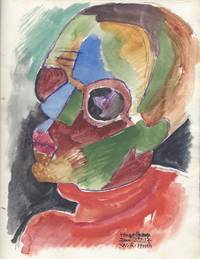
1965918Germany - Israel 1965. Original half-cloth binding with marbled paper panels and ornamented printed endpapers. Pages are handmade Zanders paper. Binding slightly rubbed corners bumped some pages loose. Rear endpaper restored at the joint. Inside clean. Overall in very good condition. The guestbook contains 17 full-page artworks paintings and drawings in ink crayon and pencil many signed and dated 1920–1921 in Berlin some with short dedications. Additionally there are 12 pages of handwritten greetings dated 1955&n. The guestbook contains 17 full-page artworks paintings and drawings in ink crayon and pencil many signed and dated 1920–1921 in Berlin some with short dedications. Additionally there are 12 pages of handwritten greetings dated 1955&n. Original half-cloth binding with marbled paper panels and ornamented printed endpapers. Pages are handmade Zanders paper. . 38 leaves including 17 with full-page artworks graphics and paintings and 12 pages of handwritten greetings. Page size: 22 × 28 cm. <p><br /> Illustrated guestbook of Hugo Graetz art dealer and managing director of the Novembergruppe a collective of German Expressionist artists.<br /> <p><p><br /> This guestbook belonged to Hugo Graetz an art dealer and the managing director of the Novembergruppe a prominent collective of German Expressionist artists. The volume includes:<br /> <p><br /> Two drawings by Friedrich Feigl 1884–1965 Czech Expressionist painter.<br /> <p><p><br /> An ink drawing by Jakob Steinhardt 1887–1968 a German-born Israeli painter member of the Berlin Secession founder of the Pathetiker Group and later associated with the Bezalel school group.<br /> <p><p><br /> Three images by Willy Robert Huth 1890–1977 a founding member of the “Jung-Erfurt†artist group and two collaborative works with Martel Schwichtenberg 1896–1945 who also contributed an individual pencil drawing. Schwichtenberg was a member of the Deutschen Werkbund and the Novembergruppe.<br /> <p><p><br /> A portrait of Hugo Graetz playing the cello by Wilhelm Schmid 1892–1971 a founding member of the Novembergruppe.<br /> <p><p><br /> A gouache by Otto Beyer 1885–1962 member of the Berlin Secession.<br /> <p><p><br /> A signed crayon drawing and an unsigned painting by Franz Winninger 1893–1960.<br /> <p><p><br /> Four works by unidentified artists.<br /> <p><p><br /> The greetings written during the Graetz family’s later years in Israel provide a personal and historical complement to the artworks.<br /> <p><p><br /> The Novembergruppe was founded in 1918 by Max Pechstein and César Klein to promote Expressionist art and its connection to social and cultural transformation. Hugo Graetz became its managing director in 1919 a position he held until Hitler’s rise to power in 1933. After emigrating to Palestine with his wife Trude Graetz left the art business settling in Safed and working as a meteorologist and weatherman on Mount Canaan where he lived for the rest of his life.<br /> <p>. unknown
1831140946084Paris: Charles Gosselin 1831. First Edition. Near Fine. First edition first printing first issue. 8 404; 4 536 pp. Bound in modern gilt armorial stamped morocco green leather bindings with marbled endpapers; wood-engraved title vignettes by Tony Johannot. Near Fine with light toning and minor patches of foxing throughout else fine. <p>Victor Hugo's Gothic French masterpiece printed by Gosselin in a run of 1100 copies on March 16 1831; this first printing was distributed into four separate issues of 275 copies each the subsequent three issues being designated as "second edition" "third edition" and "fourth edition" respectively on the title-pages. "This first edition is the rarest of all the works of Victor Hugo; it has had a resounding impact worldwide and is one of the most difficult titles of the Romantic period to obtain" Carteret. Charles Gosselin unknown
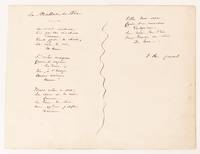
183089005No Location: s. n. 1830. Fine. I would give all of 'Cromwell' for that sigh for that lied more dream than song Fernand Gregh s. n. No Location s. d. circa 1830 25 x 19.7 cm Une feuille Autograph manuscript signed of Victor Hugos Ballade du fou sung by the jester Elespuru in his play Cromwell IV 1. Two pages on a folded leaf backed with green glazed paper. Exceptional autograph manuscript of Victor Hugos most celebrated poetic song performed by the jester Elespuru in his resounding drama Cromwell. Both grotesque and exalted this piece embodies the freedom of Romantic drama championed by Hugo in the plays famous preface: as noted by the Bibliothèque nationale de France this song is the only passage in the play as equally famous as its preface. The fine elegant script places this manuscript in the early years of Hugo's career either immediately or only a few years after the poems composition. This was in fact the very first excerpt of Cromwell ever to appear in print a year before the plays publication. Hugo chose to place the poem as the epigraph to his tenth ballad A un passant published in Odes et ballades 1826. Notably this epigraph does not appear in the manuscript of Odes et Ballades preserved at the BnF. Alongside our manuscript therefore only one other autograph example of the Chanson dElespuru survives in public institutions: within the full manuscript of Cromwell also at the BnF. This spellbinding song inspired countless poems and elicited much praise from his fellow writers: for Barbey dAurevilly Hugo is above all the balladeer of the delightful Chanson du Fou those trembling drops of dew dusky red enough to drown an entire human head in an infinity of reverie! Les oeuvres et les hommes. Steeped in Hugos verses Alfred de Musset perfectly replicated the song's structure in La Nuit one of his earliest poems. As Hovasse remarks A lot of poets would have damned themselves to write it"" quoting the poem in full in his Hugo biography. Alfred de Vigny called himself a fool for the song like the fool jester himself letter to Hugo 19 November 1826 and applauded Cromwell that immortal book"" which casts all modern tragedies into wrinkled old age. This seemingly effortless refrain is above all a dazzling demonstration of Hugos genius equally at home in every literary form. By combining pentasyllabic lines with two-syllable verses Hugo revives the lai a poetic composition used in the Middle Ages and the Renaissance. Its short lilting rhythm from distant centuries is nonetheless resolutely modern: a Verlaine poem before Verlaine who adopted this metrical play in Colombine from Fêtes galantes and Chanson dautomne Poèmes saturniens. The jester Elespuru who gives voice to this poem is moreover the very first character created by Hugo at only nine years old. Before viewing himself a novelist playwright or poet Hugo wrote Elespourou Elespuru in his copy of Tacitus now preserved in his house on the Place des Vosges during a very unhappy year at the colegio des nobles in Madrid. The name belonged to his schoolmate Don Francisco Elespuro a shocking great fellow with crispy hair sprawling hands ill-shapen uncombed unwashed incurably lazy using his inkstand no more than his washbowl surly and ridiculous whose name was Elespuru."" he would later recall to his wife in Victor Hugo by a Witness of His Life. He took his revenge in his own fashion depicting him as one of the least appealing figures in one of his dramas yet granting him immortality. Elespuru the grotesque jester par excellence sings the sublime in this poem one of those adorable little pieces where the giant Hugo showed that he could be as delicate as he was powerful and as mysterious as he was radiant Gregh. Hugo used the stage as the theatre of his vendettas: Elespuru then Gubetta the executioner in his Lucrèce Borgia inspired by the violent Count Frasco de Belverana who injured Hugos brot s. n. unknown
5946Six albumen prints from wet collodion negatives each 430 x 430 mm. each mounted on stiff card stock panels each panel measuring 620 x 430 mm. joined together with the orig. linen with the lithographed title at foot of the two middle panels. Preserved in the orig. green cloth-backed board portfolio ties gone. Essen: F. Krupp ca. 1872-73. A magnificent and rare photographic panorama of the Krupp Steel Works in Essen consisting of six albumen prints each mounted on paper board panels measuring altogether 430 x 2480 mm. The industrial steel manufacturer Friedrich Krupp AG was the largest company in Europe at the beginning of the 20th century. One of the most powerful business dynasties in Europe for 400 years Krupp flourished as the premier weapons manufacturer of Germany. From the Thirty Years' War until the end of the Second World War they produced everything from guns and cannons battleships U-boats tanks and hundreds of other products. "In 1861 one of the most remarkable figures in German industrial history Alfred Krupp commissioned his far relative Hugo van Werden 1836-1911 to learn photography in a studio in Hannover then well-known for its qualities in depicting industrial products. After a short apprenticeship van Werden set up the Krupp photographic and lithographic institute which from then on had to deliver all visual materials used for documentation press releases and public relations for Krupp's steel company. As early as 1862 on the occasion of the London World Fair Krupp was able to show and deliver large quantities of photographs of all his products and the company gained fame for the use of the new medium in advertising.On top of the Krupp stand at the World Fair in London in 1862 there was a large photograph showing the Essen company site. Made of 12 images it correlated to a recent fashion among manufacturers: showing a bird-like view of their establishment."-Rolf Sachsse in Encyclopedia of 19th-Century Photography p. 584. In the century prior to the advent of photography panoramic painting reached a pinnacle of development in which whole buildings were constructed to house 360 degree panoramas and even incorporated lighting effects and moving elements. Indeed the career of one of the inventors of photography Daguerre began in the production of popular panoramas and dioramas. Shortly after the invention of photography the desire to show overviews of cities and landscapes prompted photographers to create panoramas. The development of panoramic cameras was a logical extension of the 19th-century enthusiasm for panorama. Because of the high cost of materials and the technical difficulty of properly exposing the plates Daguerreotype panoramas especially those pieced together from several plates are rare. After the advent of wet-plate collodion process photographers would take anywhere from two to a dozen of the ensuing albumen prints and piece them together to form a panoramic image. This photographic process was technically easier and far less expensive. The history of photography and the modern manufacturing of steel have been interwoven since both came into being in the mid-19th century. Photography of steel mills began about the same time that modern steel making became possible through invention of the Bessemer converter furnace in 1855. Photographers have actively engaged this topic ever since. Photographing the steel industry has always presented technical as well as aesthetic challenges but no challenge was more daunting than that of access. Mere fascination with industrial architecture the dramatic processes of transforming raw iron ore to finished steel or the many tasks performed by steel workers did not entitle a photographer to take pictures of mills. The pioneering German industrialist Alfred Krupp hired Hugo van Werden as the company's first full- time photographer. As an employee van Werden had unlimited access to take photographs of the factory. The stunning nature of van Werden's early photographs interpreted Krupp's business vision. Van Werden's task was to document Krupp's rapidly expanding company; he began to make periodic panoramas of the Kruppsche Gußstahlfabrik in Essen in 1861. These panoramas started modestly and ended up being monumental. Krupp's intensive advertising work for his company as well as the company's presence in commercial and world exhibitions was important in the success and economic expansion of the company. Krupp used the new medium photography for the self-presentation and documentation of his emerging company. In addition to a historical department which was founded in 1861 Krupp set up an atelier for photographers. Not only the individual products but also the company as a whole were documented by means of the photographic image. Our 180 degree panoramic view of the cast steel factory was taken by van Werden at the request of Krupp from a tower of the cannon workshop. Krupp himself gave the order to photograph the factory on a Sunday because "the work days carry too much smoke steam and restlessness." The elevated viewpoint provides an overview of the extent of the factory which transitions into the landscape on the horizon. The panoramic view over the roofs of the factory buildings along the chimneys to the landscape gives the impression of a self-contained world. From the tower one looks westward over the works to the surroundings of Essen. The arranged scenery - the factory buildings still partly under construction the workers and steam locomotives the railway bicycles and other steel goods transported throughout the plant - give the impression of remarkable economic activity. In fine and fresh condition. From the library of Otto von Bismarck no doubt presented to him by the firm. ❧ Tenfelde Pictures of Krupp: Photography and History in the Industrial Age 2005. hardcover books
LCS-18229Précieux exemplaire A. Claudin, Jules Claretie et P. Villeboeuf cité et décrit par Carteret. Paris, au Bureau du Conservateur littéraire, 1819-20. 3 volumes in-8 de : I/ (1) f., 404 pp., 2 portraits hors-texte dont un à double page ont été ajoutés au début du volume ; II/ (2) ff., 404 pp. mal ch. 504 ; III/ 416 pp. Relié en demi-maroquin vert à grain long à coins, dos lisses ornés d’un motif romantique doré en long, filets dorés sur les plats. V. Champs. 197 x 125 mm.
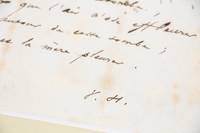
1840878291840. Fine. ""Spare still the mother vainly weepingO'er baby lost not long a-sleeping."" s.d. 21 janvier 1840 21.20 x 26.70 cm un feuillet sous cadre Autograph poem by Victor Hugo signed V. H. four stanzas written black ink on a leaf. Blind stamp of the city of Bath in the lower left-hand corner. Some folds small traces of foxing along the folds a few pale stains to the lower right margin not affecting the text. A few very small dark spots in the lower right margin one affecting a single letter of the word retombe. Original manuscript and earlier version of Victor Hugo's poem published as Écrit sur le tombeau d'un petit enfant au bord de la mer Baby's seaside grave in Les Rayons et les Ombres XXXVIII Paris Delloye 1840. Hugo wrote this magnificent eulogy in memory of his great friend Auguste Vacquerie's young nephew who died at the age of four years and ten months. The poet had promised a poetic epitaph and personally addressed this manuscript to Vacquerie: Take these verses if you still want them for the tomb of this dear little one Letter to Vacquerie January 21 1840. As Joseph Petrus Christiaan de Boer pointed out There is no sorrow Hugo understood and expressed more delicately than the immense grief that fills the hearts of parents upon the death of a child Victor Hugo et l'enfant 1933 p. 48-49. This poem is the first of a sublime macabre series composed on the occasion of the numerous tragedies suffered by the families of both Victor Hugo and his friend Auguste Vacquerie. The most famous will be Demain dès l'aube. written after the untimely death of Hugo's beloved daughter Léopoldine who drowned alongside Auguste Vacquerie's brother Charles on September 4 1843 shortly after their marriage. Hugo wrote these verses for Charles-Emile Lefèvre the young child of Vacquerie's sister who had succumbed to sudden illness on November 6 1839. On January 21 1840 Hugo sent this manuscript to Vacquerie which includes a variation from the final version published by Delloye on May 16 of the same year: « Vieux lierre frais gazon herbe roseaux corolles ; Église où l'esprit voit le Dieu qu'il rêve ailleurs ; mouches qui murmurez d'ineffables paroles A l'oreille du pâtre assoupi dans les fleurs ; Vents flots hymne orageux chur sans fin voix sans nombre ; Bois qui faites songer le passant sérieux ; fruits qui tombez de l'arbre impénétrable et sombre ; Étoiles qui tombez du ciel mystérieux ; oiseaux aux cris joyeux vague aux rumeurs ' plaintes' in the published version profondes ; froid lézard des vieux murs dans les pierres tapi ; plaines qui répandez vos souffles sur les ondes ; Mer où la perle éclot terre où germe l'épi ; Nature d'où tout sort nature où tout retombe feuilles nids doux rameaux que l'air n'ose effleurer Ne faites pas de bruit autour de cette tombe ; Laissez l'enfant dormir et la mère pleurer. » ' Brown ivy old green herbage new; Soft seaweed stealing up the shingle; An ancient chapel where a crew Ere sailing in the prayer commingle. A far-off forest's darkling frown Which makes the prudent start and tremble Whilst rotten nuts are rattling down And clouds in demon hordes assemble. Land birds which twit the mews that scream Round walls where lolls the languid lizard; Brine-bubbling brooks where fishes stream Past caves fit for an ocean wizard. Alow aloft no lullall life But far aside its whirls are keeping As wishfully to let its strife Spare still the mother vainly weeping O'er baby lost not long a-sleeping.' tr. Nelson Rich Tyerman Hugo sent the manuscript with a touching letter: Here at last my poet is what I have kept you waiting for so stupidly long. . Take these verses if you still want them for the tomb of this dear little one . For my part I do not feel that I have repaid my debt to this angel with so little. I have begun something longer for him that I will one day lay at the feet of his poor mo unknown
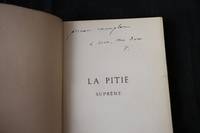
187945162Paris: Calmann Lévy 1879. Fine. ""for you my lady"" - Juliette Drouet's personal copy Calmann Lévy Paris 1879 15 x 24 cm relié HUGO Victor La Pitié suprême The Supreme Compassion Calmann Lévy Paris 1879 150 x 240 mm 5 15/16 x 9 7/16 half shagreen First edition. Elegant half dark blue shagreen over marbled paper boards by René Aussourd spine in four compartments with gilt dots and double gilt compartments containing horizontal arabesques and gilt stars date and ex. de J. Drouet in gilt at foot marbled endpapers and pastedowns covers and spine preserved marginal repairs to covers top edge gilt ex-libris of Pierre Duché on one endpaper. An exceptional presentation copy inscribed by Victor Hugo to Juliette Drouet the love of his life: The first copy for you my lady. V. Premier exemplaire à vous ma dame. V. Written in 1857 this long philosophical poem on the Revolution was originally meant to conclude the ""Légende des Siècles"". Victor Hugo eventually published it in 1879 when he took a stand on behalf of the Communards. Pleading for the abolition of the death penalty La Pitié suprême highlights one of the first and most heartfelt of Hugo's political struggles which he carried on till the very end of his eighties: if my name stands for anything in these deadly times in which we live it stands for Amnesty ""Letter to the citizens of Lyon"" 1873. Comparing Hugo and Machiavelli J. C. Fizaine underlines the intellectual rigor of the poet who put himself at the service of a humanism elevated into a universal principle: Machiavelli writes for those who wanted to become princes. Hugo writes first and foremost for the people who have known tyranny. It is ""La Pitié suprême"" that defines what will remain immutably sacrosanct human life without hate resentment and the memory of past suffering being justifications for the transgression of its sanctity; and the danger of such transgression is the impossibility of establishing any kind of political system and falling back into a pre-civilized state. Victor Hugo penseur de la laïcité Le clerc le prêtre et le citoyen He waged this final struggle alonside Juliette Drouet. Published in February 1879 not long after they had settled in the avenue d'Eylau La Pitié suprême seems to be a political echo of the newfound legitimacy of the two old lovers after fifty years of clandestine relations. Hugo's last fight for amnesty and pardon reverberated in his emotional life like with the poem he wrote on the death of Juliette in 1883: On my grave they'll write as a great victory The cherished deep embattled memory of a love that was not sanctioned but grew virtuous. A fine copy in a handsome binding and with an extraordinary provenance the most desirable one could wish for. Calmann Lévy hardcover
188060981Paris: Calmann Lévy 1880. Fine. Juliette Drouet's copy Calmann Lévy Paris 1880 15.50 x 24 cm relié First edition. Black half morocco binding spine with four raised bands adorned with gilt dotted fillets and double gilt compartments decorated at the corners gilt date and the inscription ""Ex. de J. Drouet"" at the tail marbled paper boards and endpapers preserved covers and spine top edge gilt binding signed by René Aussourd. Some minor foxing mainly at the beginning and end of the volume. Precious signed and inscribed copy by Victor Hugo to Juliette Drouet the great love of his life: To you my lady. Humble homage. V.' This copy comes from the library of Pierre Duché who acquired Juliette Drouet's entire library and commissioned René Aussourd to bind the volumes uniformly marking each with an identifying inscription at the foot of the spine. Bookplates pasted on a pastedown and a flyleaf. In late 1878 after more than forty years together Victor Hugo and Juliette Drouet finally moved in together at Avenue d'Eylau in the small town house where the poet would spend his final years. ""From that moment on Juliette's life became little more than an unbroken sorrow a servitude of every hour. She herself suffered from stomach cancer knowing she was condemnedto die of hunger!"" Louis Guimbaud Victor Hugo et Juliette Drouet Paris 1927. Despite her illness and severe physical weakness she remained devotedly at Hugo's side as his caregiver. It was during this time that Bastien Lepage painted a strikingly realistic portrait of her: ""From her goddess-like face once serene and noble the relentless illness had made a frail human visage drawn and hollowed furrowed with wrinkleseach one telling a story of pain."" ibid. Religions et religions was published two years before Juliette's death; is was one of the last books Hugo dedicated to the unwavering love of his life. In a final tribute to her lifelong devotion he later offered her a photograph inscribed: ""Fifty yearsthat is the most beautiful marriage."" Copy from the most intimate source. Calmann Lévy hardcover
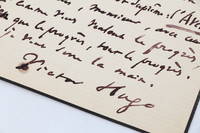
1871833181871. Fine. « So that justice finally be done for women » Mardi 7 novembre 1871 13.30 x 20.80 cm 2 pages sur un feuillet double Autograph letter signed by Victor Hugo to Léon Richer two pages in black ink on a double sheet framed in black. Crosswise folds inherent to envelope inserting. A central tear at the junction of the two sheets. Published in uvres complètes de Victor Hugo Ollendorff 1905. Manuscript housed in a blue half morocco chemise and slipcase marbled paper boards marbled paper slipcase signed Boichot. A magnificent and important letter to Léon Richer one of the first male feminist activists considered by Hubertine Auclert as the ""father of feminism"" and later regarded by Simone de Beauvoir as its ""true founder"". This deeply humanist text is a compendium of Victor Hugo's campaign for the abolition of capital punishment and the female attainment of social equality and civil rights. « Mardi 7 novembre 1871 Monsieur on m'a demandé d'urgence mon intervention pour les condamnés à mort. L'accomplissement de ce devoir a retardé ma réponse à votre excellente lettre. Vous avez raison de compter sur moi pour affirmer l'avenir de la femme. Dès 1849 dans l'Assemblée nationale je faisais éclater de rire la majorité réactionnaire en déclarant que le droit de l'homme avait pour corollaires le droit de la femme et le droit de l'enfant. En 1853 à Jersey dans l'exil j'ai fait la même déclaration sur la tombe d'une proscrite Louise Julien mais cette fois on n'a pas ri on a pleuré. Cet effort pour qu'enfin justice soit rendue à la femme je l'ai renouvelé dans les Misérables je l'ai renouvelé dans le Congrès de Lausanne et je viens de le renouveler encore dans ma lettre au Rappel que vous voulez bien me citer. J'ajoute que tout mon théâtre tend à la dignification de la femme. Mon plaidoyer pour la femme est vous le voyez ancien et persévérant et n'a pas eu de solution de continuité. L'équilibre entre le droit de l'homme et le droit de la femme est une des conditions de la stabilité sociale. Cet équilibre se fera. Vous avez donc bien fait de vous mettre sous la protection de ce mot suprême : l'Avenir. Je suis Monsieur avec ceux qui comme vous veulent le progrès rien que le progrès tout le progrès. Je vous serre la main. Victor Hugo » ""Tuesday november 7 1871 Sir I have been urgently asked to intervene on behalf of those sentenced to death. The fulfillment of this duty has delayed my reply to your excellent letter. You are right to count on me to defend the future of women. As early as 1849 in the National Assembly I made the reactionary majority burst into laughter by declaring the rights of man as natural counterparts to the rights of woman and the rights of children. In 1853 in my Jersey exile I made the same declaration on the grave of an outlaw Louise Julien but this time people didn't laugh they wept. I renewed this effort to finally do justice to women in Les Misérables I renewed it in the Congrès de Lausanne and I've just renewed it again in my letter to Le Rappel which you are kind enough to publish. I would add that every single one of my theatrical works aims to dignify women. As you can see my plea for women is long-standing and persevering and no other has ventured to continue with this endeavor. Balance between men's rights and women's rights is one of the conditions of social stability. This balance will be achieved. I commend you for placing yourself under the protection of this supreme word: the Future. I am Sir with those who like you want progress nothing but progress the whole of progress. I shake your hand. Victor H Although this letter focuses primarily on advocating for women's rights it begins with the death penalty: I have been urgently asked to intervene on behalf of those sentenced to death. The fulfillment of this duty has delayed my reply to your excellent letter. Shortly after the Paris Commune the October 1871 pages of Hugo's diary la hardcover
184087829s.d. (21 janvier 1840) | 21.20 x 26.70 cm | un feuillet sous cadre
187945162Calmann Lévy | Paris 1879 | 15 x 24 cm | relié
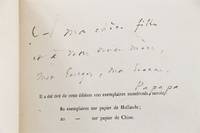
187583705Paris: Michel Lévy frères 1875. Fine. First edition copy of Hugo's political manifesto offered to his grandchildren Jeanne and Georges signed Papapa' Michel Lévy frères Paris 1875 19.50 x 25 cm relié Actes et paroles - Avant l'exil 1841-1851 Words and Deeds - Before the Exile 1841-1851 Michel Lévy frères Paris 1875 195x25cm bound. First edition one of 20 numbered copies on chine most limited deluxe edition of this important collection of speeches public declarations and political texts intended for French parliament Chamber of Peers Constituent Assembly and Legislative Assembly all written - as stated in the title - prior to his exile. These important texts address freedom of the press theater and education as well as the abolition of the death penalty. Half red shagreen binding smooth spine decorated in gilt lengthwise marbled paper boards caillouté pastedowns and endpapers original covers preserved top edge gilt over untrimmed edges. Exceptional and loving signed inscription by Victor Hugo to his daughter-in-law Alice Lehaene - widow of Charles Hugo - and his beloved grandchildren: ""To my dear daughter and your sweet mother my Georges my Jeanne signed: Papapa"" A ma chère fille et à votre douce mère mon Georges ma Jeanne Papapa. ""We called him Papapa. Legend has it - he surrounded us with legends! - that one morning at Hauteville House while he was working in that glass cage perched at the top of the house little Georges came in and said: - Hello Papapa! . To hear the son of his son Charles who had just died pronounce this unknown word the grandfather was overjoyed for he knew the secret language of children: Georges' stammer made him twice a father much more than a grandfather. . My name is Papapa now' he said softly. And until he died my sister and I called him by this dearest name which he always cherished"" Georges-Victor Hugo My Grandfather Mon grand-père Paris: Calmann-Lévy In 1871 after the tragic and unexpected death of his son Charles Victor Hugo became guardian of his two grandchildren Georges and Jeanne. From then on he played a large part in their upbringing and spent some of the happiest moments of his life with them reflected in the countless endearing notes about the two children in Choses vues Things Seen. Upon the death of his last son François-Victor he moved in with Georges and Jeanne's mother Alice at 21 rue de Clichy; on the floor below he lodged Juliette Drouet. This gave him plenty of time to spend with his ""little ones"" for whom he organized children's dinners and made plenty of toys. The children are the subject of his immensely popular poetry collection L'Art d'être grand-père 1877 The Art of Being a Grandfather. ""Its popularity was immediate and its success resounding so dazzling was his way of celebrating childhood by telling the story of Georges Jeanne and himself. By putting children's words into verse so naturally and freshly Georges et Jeanne's ""Papapa"" has succeeded like no other in exalting ""grandparental"" feelings. At home these feelings are not limited to allowing children to leave their toys lying around on manuscripts: when Alice remarried journalist and politician Édouard Lockroy' Simon contributor to Le Rappel Hugo opposed him sharing guardianship"" Sandrine Fillipetti Victor Hugo This inaugural volume of Actes et paroles Deeds and Words containing Victor Hugo's first major political texts is a poignant testimony to his humanist commitments. The ""little"" owners of this precious copy received their grandfather's intellectual and militant legacy: from his ""Discours de réception"" at the Académie française 1841 to his famous stance against Napoleon III ""Révision de la Constitution"" ""No! after Napoleon the Great I don't want Napoleon 'le Petit'!"" which led to his exile. At the heart of this compilation is a highly significant text ""For Charles Hugo. The death penalty"" delivered by Hugo before the Seine Assize Court in 1851 in de Michel Lévy frères hardcover
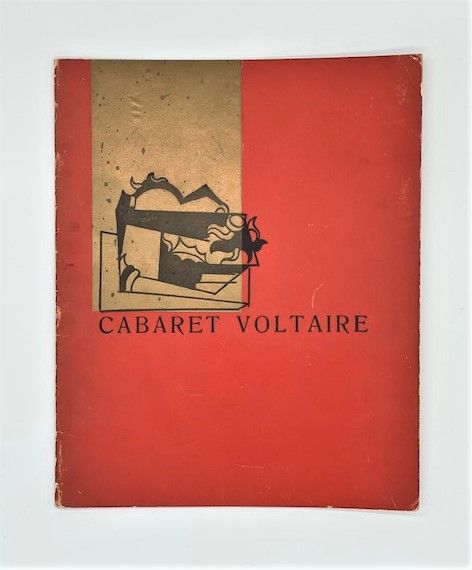
191665214Zürich, (Buchdruckerei Jul. Heuberger für) Meierei, Spiegelgasse 1, (1916). 4°. Mit einem mitpag. Orig.-Holzschnitt von M. Slodki u. 12 (7 ganzs.) Textabbildungen. 31 (1) S., Roter OKart.-Bd. m. Goldfolien-Collage von Hans Arp am Vorderdeckel.
188060981Calmann Lévy | Paris 1880 | 15.50 x 24 cm | relié
200830940Madrid: Novela Ilustrada. 2008. 26 x 18 cm. Media piel buen estado de conservacion interior. Piel tocada y rozada tapas deslucidas. CONSULTE LAS CONDICIONES DE LA LIBRERÃA. Sello anterior propietario. Primeras dos paginas de cortesia con la parte inferior arrancada del lomo. Conserva todas las portadas. 1780 Novela Ilustrada. unknown
185153579Paris: La librairie nouvelle 1851. Fine. Precious inscribed copy signed by Victor Hugo to Juliette Drouet: «à mon pauvre doux ange aimé. V.» La librairie nouvelle Paris 1851 16.50 x 25 cm broché Partly first edition gathering the most famous speeches by Victor Hugo including some of his most memorable addresses delivered at the tribune of the Legislative Assemblymost notably the speech on constitutional revision and the powerful plea he gave at the trial of his son on 11 June 1851 before the Cour d'assises of the Seine in defense of the inviolability of human life. Spurious mention of eighth edition. Complete with the rare portrait of the author by Masson printed on China paper as frontispiece. Scattered occasional foxing. Precious inscribed copy signed by Victor Hugo to Juliette Drouet: «à mon pauvre doux ange aimé. V.» A treasured copy belonging to Victor Hugos muse and mistress. This moving and remorseful dedication is Hugos response to the tragedy Juliette endured that same year having just discovered he had been unfaithful for seven years with Léonie Biard. In June 1851 Biard sent Juliette the letters Victor had written to her. In July Hugo swore eternal fidelity to Juliette and in August inscribed this plea for a more compassionate justice to her. In the autumn Juliette demanded that Hugo meet Madame Biard to formally end the affaira meeting she choreographed in every detail and to which Hugo complied. Provenance: libraries of Pierre Duché 1972 no. 75 and Philippe Zoummeroff 2001 no. 71. La librairie nouvelle unknown
187583705Michel Lévy frères | Paris 1875 | 19.50 x 25 cm | relié
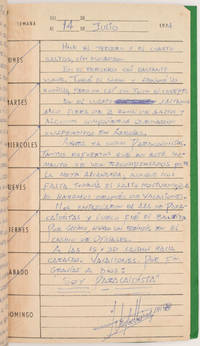
19741811Venezuela 1974. In custom made paper cover. Saddle-stitched. Paper-taped spine. In fine condition. In custom made paper cover. Saddle-stitched. Paper-taped spine. 21 leaves. 22 pages of handwritten text in blue ink signed on the last page. <p><br /> Unique signed manuscript diary of the former Venezuelan president Hugo Chavez written during his parachute course at the Venezuelan Academy of Military Sciences in Caracas between June 24 and July 14 1974.<br /> <p><p><br /> With detailed daily entries about his political ideas military training and his private life as a young cadet the “diary reveals the evolution of his political aspirations and his incipient vision of himself as someone predestined a man with a historical missionâ€. Marcano Tyszka 2007. p. 39<br /> <p><p><br /> 1974 was the 19-year-old Chavez’s last year at the military academy and according to Richard Gott author of the first book about Chávez in English also the year “Chávez was first politicizedâ€. As a cadet “with a growing admiration for Simón BolÃvar†Chávez was chosen for a special trip to Peru in the same year to celebrate the 150th anniversary of Peruvian independence from Spain which “provided his first direct exposure to a social experiment launched by a progressive although dictatorial military man Juan Velasco Alvaradoâ€. By the time Chávez graduated from the academy “he had begun to think about the need for the military to have a role in running the countryâ€. <br /> <p><p><br /> In his present 1974 diary Chávez takes notes about his ideas and quotes both BolÃvar “who abandons all to be useful to his country loses nothing but gains all he consecrates†as well as Che Guevara "The present is a time for struggle; the future is ours.†He also gives an account of his paratrooper training from his arrival to the military base to his first jump which he describes as “one of the greatest experiences in my life. Perhaps the most exciting in my twentiesâ€. In his last entry on July 14 1974 which he also signed Chávez says “Thanks to God I am a paratrooper!†His military education and being a paratrooper played an important role in Chávez’s career. He led the MBR-200 coup attempt in February 1992 as commanding officer of a parachute regiment which he took over in Maracay in 1991 and the red beret of his parachute regiment remained his signature throughout his life. Besides his political ideas and the training process Chávez confesses about personal issues of his private life feelings and relationships and also writes about less intimate affairs such as movies he watched like Spinout with Elvis Presley or The Exorcist.
<br /> <p><p><br /> This original manuscript covers a full chapter of Chávez’s diary from the period between March and September 1974 which was published as a four-chapter-book in 2018 under the title Diario del cadete Hugo Chávez Diary of the Cadet Hugo Chávez based on the typescript of the handwritten diary.<br /> <p><p><br /> Literature: Bart J.: Hugo! The Hugo Chavez Story from Mud Hut to Perpetual Revolution. Hanover: Steerforth Press 2007.; Chávez Hugo FrÃas: Diario del cadete Hugo Chávez. Fundación Comandante Eterno Hugo Chávez 2018.; Gott R.: In the Shadow of the Liberator: Hugo Chávez and the Transformation of Venezuela. London New York: Verso 2000.; Levin J.: Hugo Chavez. New York: Infobase Publishing 2007. p. 56.; Marcano C.; Tyszka A. B.: Hugo Chavez: The Definitive Biography of Venezuela's Controversial President. New York: Random House 2007.<br /> <p>. unknown
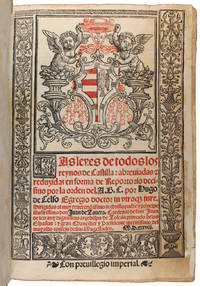
15387227Valladolid: Nicolás Tyerri 1538. First Edition Primera edición. Hardcover Tapa dura. 420x210mm. 16½x8¼". Valladolid Nicolás Tyerri 1538. En folio 320 x 210mm. Tipografía gótica. 8 364 folios. Portada en rojo y negro dentro de orla tipográfica y gran escudo arzobispal de Juan de Tavera grabado en xilografía a media página. Texto dentro de rectángulo tipográfico. Encuadernación de la época en pergamino. Primera edición de este libro estimado y de singular rareza posiblemente la recopilación de leyes de Castilla más importantes realizadas durante el reinado de Carlos I. Desde luego es la obra más importante de este controvertido jurista y por la que Hugo de Celso ha pasado a la posteridad; es una obra continuadora de la tradición jurídica iniciada desde la época romana a cuyo lado cabe situar también el <em>Repertorio de todas las leyes de Castilla</em> 1529 de Jaime Soler y el <em>Repertorio de la Nueva Recopilación de las leyes del reyno</em> 1571 de Diego de Atienza. Sin embargo ninguno de ellos tuvo el éxito y la aceptación como el <em>Repertorio</em> de Celso lo que se tradujo en cuatro ediciones posteriores. Fue el repertorio más completo y minucioso que cualquiera de los anteriores cuyo fin era facilitar el conocimiento estudio y consulta de la legislación castellana vigente única que podía ser alegada en juicio en Castilla al menos en teoría. Además Celso incorpora voces de derecho privado y respecto a las voces comunes transcribe parte de los textos legales en que se basa. "Condenado por herejía y bigamia Hugo de Celso escribió <em>Las leyes de todos los reynos de Castilla</em> con el fin de financiar su fuga de las cárceles de la Inquisición de Toledo. Hay constancia de que el 15 de octubre de 1537 firmó un contrato con Claudio Tupin librero de Lyon que exportaba desde Salamanca por el que se comprometía a escribir algunas obras jurídicas entre ellas el Repertorio decisivo que se publicó a finales de 1538 con dedicatoria al cardenal Tavera arzobispo de Toledo e Inquisidor General al año siguiente en un intento de conseguir más beneficios penitenciarios. Sin embargo cuando el libro salió a la luz Hugo de Celso ya había puesto en práctica otra decisión más drástica sobre su futuro: había urdido financiar su fuga con el dinero que Claudio Tupin le había entregado por escribir su Repertorio. El 13 de noviembre de 1538 la Inquisición pregonó la fuga del doctor Celso y el 22 de ese mes se le otorgó un plazo de treinta días para que regresara voluntariamente so pena de declararle contumaz. Un año más tarde el 11 de marzo de 1539 fue descubierta su presencia en Toulouse". J. Alvarado Planas Anotaciones manuscritas contemporáneas en los márgenes. Portada y primera hoja restaurada al verso en el margen exterior sin afectar; AA<sup>5</sup> con antigua restauración en el margen inferior sin afectar; primeras hojas de preliminares con suciedad en el margen primeros diez folios del texto con pequeña mancha en el margen exterior. Rasgadura restaurada en b<sup>4</sup> yy c<sup>1</sup> b<sup>3</sup> con pérdida de la esquina superior afectando a la numeración del folio v<sup>1-8</sup> con mancha en el margen exterior B<sup>3</sup> y B<sup>8</sup> con antigua restauración en el margen sin afectar; pequeñas restauraciones antiguas en D<sup>1</sup> D<sup>7</sup> y H<sup>5</sup>. K<sup>2</sup> rasgada con pérdida de algunas palabras de las dos últimas líneas. Y<sup>6</sup> con restauración en la esquina superior del margen. Algunas páginas ocasionales ligeramente amarronadas. Aun estos pequeños defectos generalmente pequeñas restauraciones antiguas en los márgenes es un ejemplar atractivo y genuino. Nicolás Tyerri hardcover
185153579La librairie nouvelle | Paris 1851 | 16.50 x 25 cm | broché