Louise BRESLAU - (Victor HUGO)Biblio.com
2 697 résultats
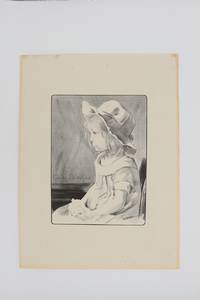
189874591Paris: Imprimerie Champenoispour CH. MassonH. Piazza 1898. Fine. Imprimerie Champenois pour CH. Masson H. Piazza Paris Octobre 1898 24 x 33 cm une feuille Rare original lithograph executed by Louise Breslau for L'Estampe Moderne series number 18 published in October 1898. One of 50 deluxe proofs printed on China paper with wide margins artist's signature in the plate publisher's dry stamp representing a child's profile in lower margin mounted on a sheet of laid paper with the numbered stamp of the deluxe issue on verso pale marginal foxing. Lithograph inspired by three stanzas of a poem by Victor Hugo. Magnificent French monthly publication edited between May 1897 and April 1899 L'Estampe moderne consists of original chromolithographs which unlike other reviews such as Les Maîtres de l'Affiche and as stipulated on the tissue guards were created specifically by each artist for the review. Thus 100 prints appeared in total covering the major artistic movements of the late 19th century: Symbolism Art Nouveau Pre-Raphaelites Orientalists and Belle Époque. Each delivery of four prints was issued in 2000 copies sold for 3.50F and 100 on Japan paper offered at 10F. Henri Piazza also planned a confidential deluxe issue: 50 copies on Japan paper with wide margins and 50 in black on China paper at the considerable price of 30F. This print in a beautiful format is superbly printed on one of the most prestigious papers: China paper. ""Despite all its qualities China paper too inconsistent owes its reputation not to its own beauty but rather to its particular affinities with printing ink. Its texture smooth and soft at the same time is more apt than any other to receive a beautiful printing. This property makes China paper sought after for printing engravings."" Anatole France. French collectors' interest in artistic posters grew in the early 1890s. Octave Uzanne to qualify this fever invented the term ""affichomanie."" The poster originally popular and pasted in the streets of the capital then became an art object and its ephemeral medium became precious and destined for preservation. Piazza decided to remove the poster from its advertising purpose and elevate it to the rank of a complete work of art on the same level as the illustrated deluxe book. He thus composed a prestigious collection of entirely original works by the most prominent European artists of the moment: Georges de Feure Eugène Grasset Henri Detouche Emile Berchmans Louis Rhead Gaston de Latenay Lucien Lévy-Dhurmer Gustave-Max Stevens Charles Doudelet Hans Christiansen Henri Fantin-Latour Steinlen Ibels Engels Willette Henri Meunier Evenepoël Bellery-Desfontaines Charles Léandre etc. Fine copy. Imprimerie Champenoispour CH. MassonH. Piazza unknown
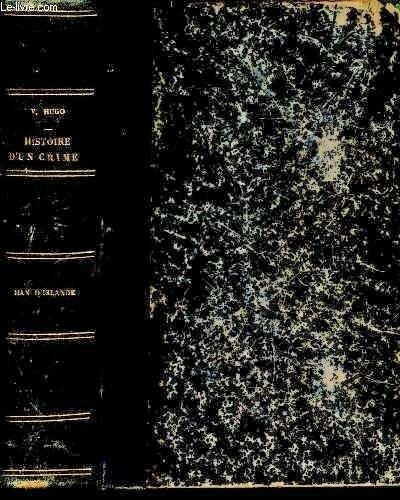
1879R200120228Eugène Hugues. 1879. In-4. Relié. Etat d'usage, Coins frottés, Dos fané, Quelques rousseurs. 468 + 387 pages. Nombreuses gravures en noir et blanc, dans et hors texte, dont un portrait de Vicotr Hugo. Couverture partiellement désolidarisée du reste de l'ouvrage. Contreplats jaspés + filets, titres et auteur dorés au dos. 5 photos disponibles.. . . . Classification Dewey : 840.08-XIX ème siècle
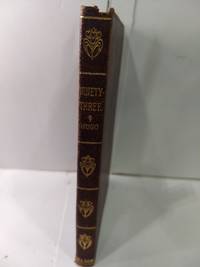
1877R240004979J. HETZEL & CIE / MAISON QUANTIN. 1877. In-12. Relié demi-cuir. Bon état, Coins frottés, Dos satisfaisant, Quelques rousseurs. 243 pages. Dos cuir rouge à 5 nerfs, avec auteur, titre, tomaison, fleurons doré. Plat marbrée. Epidermures sur les nerfs et sur les mors.. . . . Classification Dewey : 840.05-XVIII ème siècle
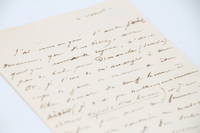
183087775Paris 1830. Fine. Paris s. d. ca 1830 12 x 18.50 cm 1 page Autograph letter signed by Victor Hugo to his friend H. de Cambier 20 lines written in black ink on a bifolium autograph address on the verso of the final leaf. Splendid and likely unpublished letter from Victor Hugo inviting his correspondent to the famed Romantic 'Cénacle' gatherings at the Bibliothèque de l'Arsenal a veritable literary institution in the 1830's. ""This Saturday the 6th I noticed the other evening Sir that you expressed with some regret not having a ball to attend on Sunday tomorrow. Now I have managed to arrange my guard duty so as to be free tomorrow from nine o'clock to midnight alas I could not obtain more than six hours and I am taking advantage of it to take my wife to a small masquerade party at Nodier's. If you would like to come with us we would be delighted and Nodier too. To do so you would need to be at my home at nine o'clock the hour I myself will return. Answer me this morning and believe in all my friendship. Vr Hugo."" ""In the drawing room of the Arsenal library where he had been head librarian since 1824 Charles Nodier hosted every Sunday evening the entire Romantic literary and artistic elite during the final years of the Restoration and the early years of the July Monarchy. In addition to Hugo one of the most regular attendees and later Musset Dumas and Balzac the salon gathered ""representatives of all the book professions from conception to illustration publication and criticism . in a friendly and convivial atmosphere"" Marta Sukiennicka. Hugo invites his correspondent to a masked ball held on one of those celebrated Sundays. Far from being a mere social occasion the 'Cénacle of the Arsenal' salon was one of the most vibrant centers of the Romantic movement. Having succeeded in excusing himself from his National Guard duties he was a sub-lieutenant in 1830 Hugo had likely arranged for a replacement to take his watch that evening; even the most illustrious of writers were not exempt from such military service. A few years later Balzac dodged his National Guard shifts and was imprisoned twice in 1836 and 1839. unknown
183087775Paris s. d. [ca 1830] | 12 x 18.50 cm | 1 page
1838R320068986RENDUEL EUGENE. 1838. In-12. Relié demi-cuir. Etat d'usage, Coins frottés, Dos satisfaisant, Intérieur frais. 252 + VII + 196 pages augmentées de quelques gravures en noir et blanc hors texte sous serpente - Plats , contre-plats et tranches japsés - Auteur, titres, filets et roulettes dorés au dos. Signet conservé.. . . . Classification Dewey : 792-Théâtre
1845RO80085118CHARPENTIER. 1845. In-12. Relié demi-cuir. Bon état, Couv. défraîchie, Dos satisfaisant, Rousseurs. 296 + 307 pages. Titres dorés sur le demi-chagrin aubergine. Quelques épidermures sur le dos.. . . . Classification Dewey : 840.08-XIX ème siècle
1875R320055722HOUSSIAUX ANDRE (VEUVE). 1875. In-8. Broché. A relier, Couv. défraîchie, Dos plié, Quelques rousseurs. XVII + 400 pages augmentées de nombreuses illustrations en noir et blanc hors texte - Ouvrage pariellement desolidarisé.. . . . Classification Dewey : 809-Histoire, littérature
185670986Hauteville House Hauteville House 1856. Fine. Hauteville House Hauteville House 11 et 13 mai 1856 14 x 21.50 cm une feuille Autograph letter signed by Victor Hugo dated 13 May 1856 following an unpublished letter from Madame Victor Hugo to Madame David d'Angers dated 11 May. 4 pages on a folded sheet with watermark ""Barbet Smith Street Guernesey"". Published in Correspondance de Victor Hugo Paris year 1856 p. 246 In this letter imbued with the apparitions and specters that haunt the recently published Contemplations Victor Hugo addresses the widow of his great friend the sculptor David d'Angers fervent republican and artist particularly admired by the Romantics. In the midst of a mystical crisis Hugo speaks to the shadow of the sculptor to whom he dedicated sublime poems in Les feuilles d'automne as well as Les rayons et les ombres and requests from his widow his favorite portrait a marble bust once sculpted by David d'Angers. After the expulsion of the exiles from the island of Jersey Victor Hugo purchased Hauteville House thanks to the success of Contemplations and sadly learned of the death of a dear friend. He writes to the sculptor's widow on the same sheet as his wife Adèle also connected with the family of David d'Angers creator of a medallion in her likeness: ""You are the widow of our great David d'Angers and you are his worthy widow as you were his worthy wife"". The renowned sculptor had already formed bonds at Nodier's first romantic salon at the Arsenal and visited Hugo almost daily in the late 1820s in the Bonapartist and good-natured atmosphere of rue Notre-Dame des Champs in the company of the Devéria brothers Sainte-Beuve Balzac Nanteuil and Delacroix. In 1828 the writer had happily posed in David d'Angers' studio on rue de Fleurus for a medallion then a bust which had been followed by two sublime poems celebrating the sculptor's talent in Les Feuilles d'Automne and Les rayons et les ombres. Of all his numerous portraits he cherished above all others his marble bust signed David d'Angers and does not hesitate to request it from his widow: ""Before long perhaps madame my family will ask you to return this bust which is my figure which is little but which is a masterpiece by David which is everything. It is him even more than me and that is why we want to have it among us"". From these posing sessions with the sculptor arose fruitful aesthetic and political conversations where their common aversion to the death penalty was affirmed. They witnessed the chaining of galley slaves who were joining Toulon from Paris described by Hugo in two chapters of Dernier jour d'un condamné. A victim of exile like Hugo David d'Angers had returned to Paris before joining the world of the dead: ""My exile is like neighbor to his tomb and I see distinctly his great soul outside this world as I see his great life in the stern history of our time"". The ""great life"" of David d'Angers was devoted to shaping the effigies of illustrious men through a subtle balance of resemblance and idealization. The sculptor finally takes his place in Victor Hugo's personal pantheon he who had adorned the pediment of the true Pantheon of great men where the writer rests today: ""David is today a figure of memory a renown of marble an inhabitant of the pedestal after having been its craftsman. Today death has consecrated the man and the sculptor is statue. The shadow he casts upon you madame gives your life the form of glory"". It was indeed in the shadow of great men that Hugo lived his exile in Jersey far from the tumult of the capital and in the silence punctuated by sea spray striking the windowpanes. Hugo had plunged into the occult and spoke to the departed: ""David is one of the shadows to whom I speak most often shadow myself"" he declares recalling the final poem of Contemplations ""Ce que dit la bouche d'ombre"" dictated to the poet through the spiritualist process of ""turning tables"". Then at the height of their popularity the tables were practice unknown
185670986Hauteville House 11 et 13 mai 1856 | 14 x 21.50 cm | une feuille
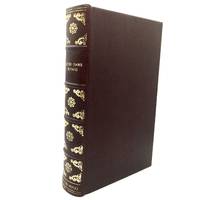
1836HNCHBCK1836<p>"Notre-Dame de Paris" by Victor Hugo Eugene Renduel 1836. 8th edition; very early illustrated edition. Modern rebind in burgundy leather with gilt spine titling and tooling. New gilt on page edges and new marbled cream endpapers & FFE. Half title engraved title and typographical title pages all present 631 pps 11 full page illustrations. Significant foxing small tear in tissue preceding engraved title. Otherwise condition is Very Good- due to rebind.</p><p>Rebound by Arno Werner Bookbinders of Maine per the binder's ticket in the back. From the binder:</p><p>Hand Bound Books and Restorations are handcrafted by a Master Bookbinder Arno Werner Bookbinders from the highest quality skins available and heavy weight full cotton rag paper Linen threads and cords marble paper or silk end papers hand sewn silk head bands gold tooled or blind tooled. All restoration work is done with appropriate materials to match the original state of the period and binding style to the best of our ability. All the books are created with 100% acid free presentation grade materials "Red Label" binders board linen thread linen cords linen ribbons silk threads and ribbons.</p> Eugene Renduel hardcover
189974842Paris: Imprimerie Champenoispour CH. MassonH. Piazza 1899. Fine. Imprimerie Champenois pour CH. Masson H. Piazza Paris Avril 1899 23.50 x 30 cm une feuille et une serpente Rare original lithograph executed by Adolphe Willette for L'Estampe Moderne after the drawing exhibited at the Luxembourg Museum series number 24 published in April 1899. One of 50 deluxe proofs printed on Japan paper with wide margins laid paper mounted on Japan paper artist's signature in the plate publisher's dry stamp representing a child's profile in the lower margin numbered stamp of the deluxe printing on verso; engraving preceded by a tissue guard captioned with the artist's name title and text. Lithograph inspired by a poem extracted from the collection Chatîments by Victor Hugo reproduced on the print's tissue guard. Magnificent French monthly publication edited between May 1897 and April 1899 L'Estampe moderne consists of original chromolithographs which unlike other magazines such as Les Maîtres de l'Affiche and as stipulated on the tissue guards were created specially by each artist for the magazine. A total of 100 prints were thus published covering the major artistic movements of the late 19th century: Symbolism Art Nouveau Pre-Raphaelites Orientalists and Belle Époque. Each issue of four prints was printed in 2000 copies sold for 3.50F and 100 on Japan paper offered at 10F. Henri Piazza also planned a confidential deluxe printing: 50 copies on Japan paper with wide margins and 50 in black on China paper at the considerable price of 30F. This beautifully formatted print is superbly printed on the most prestigious of papers: Japan paper. Thick silky satiny and pearlescent it contributes to making each page a work in its own right. Its ink absorption quality and its affinity with colours also make it the ideal support for these very beautiful lithographs. French collectors' interest in artistic posters intensified in the early 1890s. Octave Uzanne to describe this fever invented the term ""affichomanie"". The poster originally popular and pasted on the streets of the capital then became an art object and its ephemeral medium became precious and destined for preservation. Piazza decided to remove the poster from its advertising purpose and elevate it to the rank of a work of art in its own right on the same level as the illustrated luxury book. He thus composed a prestigious collection of entirely original works by the most prominent European artists of the moment: Georges de Feure Eugène Grasset Henri Detouche Emile Berchmans Louis Rhead Gaston de Latenay Lucien Lévy-Dhurmer Gustave-Max Stevens Charles Doudelet Hans Christiansen Henri Fantin-Latour Steinlen Ibels Engels Willette Henri Meunier Evenepoël Bellery-Desfontaines Charles Léandre etc. Handsome copy. Imprimerie Champenoispour CH. MassonH. Piazza unknown
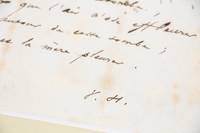
1840878291840. Fine. ""Spare still the mother vainly weepingO'er baby lost not long a-sleeping."" s.d. 21 janvier 1840 21.20 x 26.70 cm un feuillet sous cadre Autograph poem by Victor Hugo signed V. H. four stanzas written black ink on a leaf. Blind stamp of the city of Bath in the lower left-hand corner. Some folds small traces of foxing along the folds a few pale stains to the lower right margin not affecting the text. A few very small dark spots in the lower right margin one affecting a single letter of the word retombe. Original manuscript and earlier version of Victor Hugo's poem published as Écrit sur le tombeau d'un petit enfant au bord de la mer Baby's seaside grave in Les Rayons et les Ombres XXXVIII Paris Delloye 1840. Hugo wrote this magnificent eulogy in memory of his great friend Auguste Vacquerie's young nephew who died at the age of four years and ten months. The poet had promised a poetic epitaph and personally addressed this manuscript to Vacquerie: Take these verses if you still want them for the tomb of this dear little one Letter to Vacquerie January 21 1840. As Joseph Petrus Christiaan de Boer pointed out There is no sorrow Hugo understood and expressed more delicately than the immense grief that fills the hearts of parents upon the death of a child Victor Hugo et l'enfant 1933 p. 48-49. This poem is the first of a sublime macabre series composed on the occasion of the numerous tragedies suffered by the families of both Victor Hugo and his friend Auguste Vacquerie. The most famous will be Demain dès l'aube. written after the untimely death of Hugo's beloved daughter Léopoldine who drowned alongside Auguste Vacquerie's brother Charles on September 4 1843 shortly after their marriage. Hugo wrote these verses for Charles-Emile Lefèvre the young child of Vacquerie's sister who had succumbed to sudden illness on November 6 1839. On January 21 1840 Hugo sent this manuscript to Vacquerie which includes a variation from the final version published by Delloye on May 16 of the same year: « Vieux lierre frais gazon herbe roseaux corolles ; Église où l'esprit voit le Dieu qu'il rêve ailleurs ; mouches qui murmurez d'ineffables paroles A l'oreille du pâtre assoupi dans les fleurs ; Vents flots hymne orageux chur sans fin voix sans nombre ; Bois qui faites songer le passant sérieux ; fruits qui tombez de l'arbre impénétrable et sombre ; Étoiles qui tombez du ciel mystérieux ; oiseaux aux cris joyeux vague aux rumeurs ' plaintes' in the published version profondes ; froid lézard des vieux murs dans les pierres tapi ; plaines qui répandez vos souffles sur les ondes ; Mer où la perle éclot terre où germe l'épi ; Nature d'où tout sort nature où tout retombe feuilles nids doux rameaux que l'air n'ose effleurer Ne faites pas de bruit autour de cette tombe ; Laissez l'enfant dormir et la mère pleurer. » ' Brown ivy old green herbage new; Soft seaweed stealing up the shingle; An ancient chapel where a crew Ere sailing in the prayer commingle. A far-off forest's darkling frown Which makes the prudent start and tremble Whilst rotten nuts are rattling down And clouds in demon hordes assemble. Land birds which twit the mews that scream Round walls where lolls the languid lizard; Brine-bubbling brooks where fishes stream Past caves fit for an ocean wizard. Alow aloft no lullall life But far aside its whirls are keeping As wishfully to let its strife Spare still the mother vainly weeping O'er baby lost not long a-sleeping.' tr. Nelson Rich Tyerman Hugo sent the manuscript with a touching letter: Here at last my poet is what I have kept you waiting for so stupidly long. . Take these verses if you still want them for the tomb of this dear little one . For my part I do not feel that I have repaid my debt to this angel with so little. I have begun something longer for him that I will one day lay at the feet of his poor mo unknown
184087829s.d. (21 janvier 1840) | 21.20 x 26.70 cm | un feuillet sous cadre
18652695# AUTEUR: Hugo Victor # ÉDITEUR: Lacroix A. - Verboeckhoven et Cie - librairie internationale - Paris # ANNÉE ÉDITION: 1865 # COUVERTURE: 1/2 chagrin vert - dos à nerfs - liserés et titre doré # DÉTAILS: In 8° relié 440pp. Edition originale éditée à Bruxelles. texte rédigé en exil à Guernesey. Les 16 premiers feuillets sont paginés en chiffres romains. # PHOTOS visibles sur www.latourinfernal.com
18672694# AUTEUR: Hugo Victor # ÉDITEUR: Lacroix - Verboeckhoven et Cie - librairie internationale - Paris # ANNÉE ÉDITION: 1867 # COUVERTURE: 1/2 chagrin vert - dos à nerfs - liserés et titre doré # DÉTAILS: In 8° relié 124pp.+1ff. Edition originale. Rédigé en exil à Guernesey en introduction au livre ”Paris-Guide” à l'occasion de l'exposition universelle de 1867. # PHOTOS visibles sur www.latourinfernal.com
18282501100022xbvkStuttgart und Tübingen, in der J. G. Cotta'schen Buchhandlung, 1828. XVI, (2) 624 Seiten; 3 mehrfach gefaltete Kupferstichtafeln mit insgesamt 66 filigranen Darstellungen. - Fester olivgrüner Pappeinband der Zeit mit schwarz-gedrucktem Titel auf grünem Papierrückenschild, Rundum-Grünschnitt; 8vo.(ca. 20 x 12 x 3 cm).
1900P1515Used; Good. 31-G-19 Thomas Nelson and Sons no date given but circa 1900 Hardcover. leatherbound. Page edges have some yellow spotting but text is clean and unmarked. No dust jacket as issued. Covers have wear at top of spine and along the back cover edge. Book Condition; Good . 1900. HARDCOVER. hardcover
1841R150175056CHARPENTIER.. 1841. In-12. Relié demi-cuir. Etat d'usage, Coins frottés, Dos frotté, Quelques rousseurs. 428 pages. Note au stylo sur la page de garde et la page de titre.. . . . Classification Dewey : 792-Théâtre
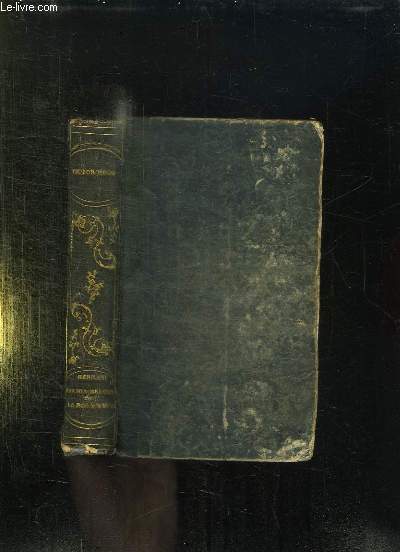
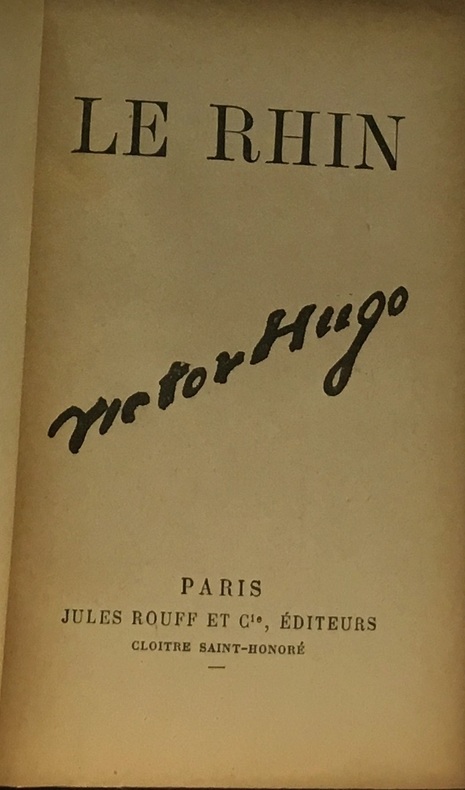
1890291980Jules rouff et cie 1890. Etat Correct circa 1890 bords frottés couvertures et tranches ternies intérieur jauni rousseurs dans les plats intérieurs. in12. 1890. Relié. 12 romans en 22 volumes: Toute la Lyre 3 vol. Le Rhin 3 vol. Victor Hugo raconté 3 vol. Pendant l'exil 2 vol. les jumeaux Le pape Amy Robsart Avant l'exil 2 vol. Depuis l'exil Alpes et Pyrénées Bug-jargal Les burgraves Jules rouff et cie unknown
1890291980Jules rouff et cie 1890 in12. 1890. Relié. 12 romans en 22 volumes: Toute la Lyre 3 vol. + Le Rhin 3 vol.+ Victor Hugo raconté 3 vol.+ Pendant l'exil 2 vol.+ les jumeaux + Le pape + Amy Robsart + Avant l'exil 2 vol.+ Depuis l'exil + Alpes et Pyrénées + Bug-jargal + Les burgraves
188683491886 Paris, Calmann Lévy 1886; plaquette grand in-8° broché couverture jaune imprimée en noir ; (4),12pp. Edition originale, 1 des 25 exemplaire sur Japon , n°17.
1879882521879 Paris, Baur, 1879, in 12 broché, 76 pages ; couverture défraichie.
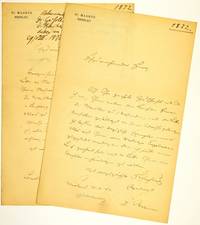
1872483091872. Breslau 28. und 31.VIII.1872. 2 Seiten gr.-8°. Mit gedrucktem Briefkopf. Minimal fleckig. Hugo Magnus 1842-1907 Ophthalmologe arbeitete insbesondere über die Farbwahrnehmung und verfasste ein Lehrbuch über Verletzungen des Auges. - An den Ophthalmologen Johann Adolf Winter in Leipzig Redakteur von "Schmidt's Jahrbüchern der in- und ausländischen Medicin". 28.VIII.1872. ". ich beabsichtige Ihrem Referenten für Ophthalmologie Herrn Dr. Geisler ein Exemplar eines von mir jetzt in Leipzig erscheinenden ophthalmoscopischen Atlas zu übersenden da mir nun aber die Adresse des genannten Herrn nicht bekannt ist erlaube ich mir die Bitte an Sie zu richten mir dieselbe gefälligst mittheilen zu wollen ." Am Kopf ein Vermerk von Winters Hand: "Uebersendung d. betr. Zuschrift an Dr. Geissler zu Meerane i.S. sowie d. Buches selbst an mich vorgeschlagen / beides an G. zu senden versprochen. / 29.VIII.1872 /Wr." - Der über ein ophthalmologisches Thema promovierte Mediziner und Statistiker Arthur Geissler 1832-1902 praktizierte als Arzt in der sächsischen Industriestadt Meerane tätig. 31.VIII.1872. ". Das bezügliche Exemplar meines Atlas wird Ihnen vom Verleger Engelmann zugestellt werden ." unknown
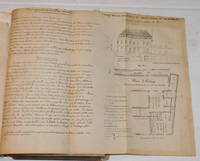
182897115Paris: impr. Dezanche and impr. Pihan Delaforest and Delangle Freres 1828-1835. 1828-1835. Fair. - Octavo 8-1/4 inches high by 5-1/4 inches wide. Four pamphlets bound into early brown calf with an elaborate floral device embossed in blind at the center of both the front and rear covers within an elaborate outer gilt ruled frame with formal decorations. All edges are marbled. The rubbed & worn covers are detached and the spine has perished and thus lacking. The pagination is as follows: i-xii 1-96 pp.; 5 6-45 1 pp.; 5 folding plates; 5 6-66 pp.; 4 pp. 1-82. There is foxing throughout.<p>The ownership name of James Stewart and the faded date of "1881" is penned on the front blank. In what appears to be his hand the statement "From Pierre Soule" is penned along the top of the verso of the front endpaper. Additionally the attractive sienna-toned ex-libris bookplate of "R.G.S." is mounted on the front pastedown. <p>Stated to be from the library of Pierre Soule with his name signature at the head of the first pamphlet. Soule 1801-1870 was the French-born New Orleans attorney and Louisiana Senator.<p>The lawyer involved in these 4 cases Gustave Louis Chaix d'Est-Ange 1800 - 1876 was the son of the attorney general at the court of criminal justice of Reims. As a lawyer his oratorical talent was noted at the Paris bar where he practiced. He was entrusted with a number of important cases and from 1842-1844 was president of the Paris Bar Association.<p>1 Plaidoyer et réplique de Me Chaix-d'Est-Ange dans le procès d'Émile de La Roncière précédés d'une Note de M. le lieutenant-général Clément de la Roncière d'Esquisse préliminaire de M. Eugène Roch et d'une lettre de M. Émile de La Roncière adressée à "l'Observateur des tribunaux". Paris: De L'Imprimerie De Dezauche 1835. The sensational trial of Emile de La Ronciere 1803 - 1874 was most recently memorialized by John Fowles in his novel "The French Lieutenant's Woman". In chapter 28 of the novel he discusses the trial of the young cavalry officer who was accused of raping Marie the sixteen-year-old daughter of his commanding General Baron de Morell. The trial itself revolved around a series of anonymous letters threatening the Morell family and signed "E. de La R.". La Ronciere was found guilty and sentenced to ten years in prison. The verdict was controversial and has been debated for many years. In the pamphlet at hand is included the text of a letter to the l'Observateur des Tribunaux written by La Ronciere's father Clement de La Ronciere on August 25 1835 and one written by the imprisoned La Ronciere himself on September 10 1835. These are followed by a preliminary outline by Eugene Roch. The text from the trial is based on reporting in l'Observateur des Tribunaux journal des documens judiciaires. It begins with the plea of La Ronciere's attorney Chaix d'Est-Ange. Although misbound later in this collection of pamphlets facsimiles of items used as evidence in the trial are included. These include 4 folding facsimiles on which are printed 8 samples of handwriting of La Ronciere and of Marie de Morell. Also included on a fifth folding plate is a remarkable plan of the home of the Morells with a view of the floor where Marie's room was located.<p>2 Plaidoyer de Me Chaix-d'Est-Ange pour M. le ministre du Commerce et des Travaux publics intervenant contre M. Victor Hugo. Paris: Imprimerie De Pihan Delaforest 1832. Victor Hugo's play "Le Roi s'amuse" was the basis for the libretto of Verdi's opera Rigoletto. The opening of the play on November 22 1832 was highly anticipated. The opening night box office receipts were an enormous success but the play was not. Both the audience and the critic's responses were negative. However the most devastating response came from the Minister of the Interior. He saw the play as an attack on the royal family and ordered it suspended i.e. banned. In the Charter of 1830 censorship was stipulated to "never be re-established". This conflict led to a trial on December 19 1832. Odilon Barrot represented Hugo and Chaix d'Est-Ange represented the Ministry of Commerce. He took the unpopular stand that the State had the authority to examine dramatic works before production. His plea is published here. Hugo lost this free-speech debate and the play was banned for 50 years.<p>3 Plaidoyer de M. Chaix d'Est-Ange pour le sieur Auguste Labauve et les sieur et dame Formage plaignans et parties civiles contre Frédéric Benoît accusé. Paris: Imprimerie De Pihan Delaforest Morinval 1832. A VIVID ACCOUNT OF MATRICIDE! Frederic Benoit 1810 - 1832 known as "Le Parricide" was executed by the guillotine at the Place St. Jaques in the 14th arrondisement of Paris on August 30 1832. The story of Benoit's killing of his mother in November 1829 and that of his male lover seventeen-year-old Joseph Formage on July 22 1831 is well documented and need not be repeated here. In this civil plea of June 14 1832 on behalf of the butcher Auguste Labauve and also on behalf of Joseph Formage's parents Chaix d'Est-Ange outdoes himself in painting with vibrant colors the slaughter by Benoit of his own mother. Labauve was the second victim of this crime. In January of 1830 an anonymous letter was found threatening Benoit's father a justice of the peace as well as Labauve with the same fate as that of Madame Benoit. The letter was said to be in the hand of Labauve. He was brought to trial for murder and was acquitted by a divided jury. However he was sentenced to a 5 year prison term for having written the threatening letter.<p>4 Procès fait à la lettre adressée au duc d'Orléans par Cauchois-Lemaire. Paris: Delangle Freres Libraires 1828. In December 1827 the editor of the Constitutionnel Louis Francois Auguste Cauchois-Lemaire 1789 - 1861 published a notorious 69 page pamphlet "Sur la crise actuelle lettre a S.A.R. le duc d'Orleans". The pamphlet addressed to Louis-Philippe the Duke of Orleans was a powerful attack on the ultra-royalist government of Joseph de Villele and a denunciation of the so-called "massacre" that took place on the rue Saint-Denis on July 27 1827. Cauchois-Lemaire concludes his essay paraphrasing the French "Thus liberty awaits the day which should let it emerge from its prison. And we who are tired of the long wait together we call for a favorable star to hasten it." The result was that Cauchois-Lemaire was accused of trying to persuade the duc d'Orleans the "favorable star" to lead the opposition to the government and have it overthrown. He and the two publishers Ponthieu and Schubart were brought to trial on January 12 1828. Cauchois-Lemaire was sentenced to 15 months in La Force prison in addition to a fine. In defense of Cauchois-Lemaire Chaix d'Est-Ange given that the facts of the matter were difficult to vindicate delivered a brilliant thesis on constitutional law. The press at the time praised his eloquence. Cauchois-Lemaire himself was so impressed that he wrote Delangle Freres from prison on January 28 1828 requesting that they publish a transcript of the trial. That letter together with the proceedings of the trial are published here. Paris: impr. Dezanche, and impr. Pihan Delaforest, and Delangle Freres, 1828-1835. unknown