Shakespeare WilliamBiblio.com
4 résultats
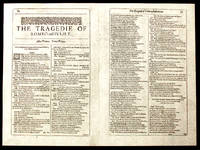
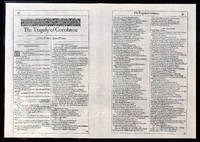
163229673London: by Thomas Cotes for Robert Allot 1632. From the Second Folio of Shakespeare. A sheet rescued from a single folio still bearing a copy of its original title page naming Robert Allot who was owner of the rights to sixteen plays. Bi-Folium a complete bifolium 4 pp. 29 30 31 32. A large and very well preserved copy of this very rare and unusual survival original sewing holes and any other tiny imperfections expertly perfected according to the exacting standards established by the American Institute of Conservation. A RARE OFFERING FROM THE SECOND FOLIO. Made at Thomas Cotes' print shop located at the Signe of the Blacke Beare in Pads Church-yard. this is an example that few have ever seen but for the original 17th century purchasers and binders of Cotes' loose sheets and in later centuries folio conservators or binders working on the rare individual sheet that only remained in sheet form until being rebound back into its folio for use as numbered pages. It also originates from one of the first two folio editions of 1623 and 1632 of which only 1500 or so total combined copies were printed. With the hindsight of 400 years sheets were something that no one thought to preserve in 1632 These folio sheets were printed specifically for binding into complete copies of the Second Folio. Ironically extra sheets would probably have been considered "printer's waste" and discarded or perhaps given away as "mementos". [by Thomas Cotes for Robert Allot] unknown
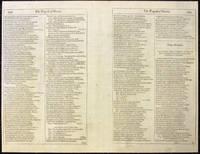
163229674London: by Thomas Cotes for Robert Allot 1632. From the Second Folio of Shakespeare. A sheet rescued from a single folio still bearing a copy of its original title page naming Robert Allot who was owner of the rights to sixteen plays. Bi-Folium a complete bifolium with two folio leaves still attached and unseparated. 4 pp. 75 76 81 82. A large and very well preserved copy of this very rare and unusual survival original sewing holes and any other tiny imperfections expertly perfected according to the exacting standards established by the American Institute of Conservation. A RARE OFFERING FROM THE SECOND FOLIO. Made at Thomas Cotes' print shop located at the Signe of the Blacke Beare in Pads Church-yard. this is an example that few have ever seen but for the original 17th century purchasers and binders of Cotes' loose sheets and in later centuries folio conservators or binders working on the rare individual sheet that only remained in sheet form until being rebound back into its folio for use as numbered pages. It also originates from one of the first two folio editions of 1623 and 1632 of which only 1500 or so total combined copies were printed. With the hindsight of 400 years sheets were something that no one thought to preserve in 1632 These folio sheets were printed specifically for binding into complete copies of the Second Folio. Ironically extra sheets would probably have been considered "printer's waste" and discarded or perhaps given away as "mementos". [by Thomas Cotes for Robert Allot] unknown
163229671London: by Thomas Cotes for Robert Allot 1632. From the Second Folio of Shakespeare. A sheet rescued from a single folio still bearing a copy of its original title page naming Robert Allot who was owner of the rights to sixteen plays. The text on this bifolium includes one of the great lines of Shakespeare one which we all love to quote see the provided close-up image to find it. Bi-Folium a complete bifolium with two folio leaves still attached and unseparated. 4 pp. 273 274 275 276. A large and very well preserved copy of this very rare and unusual survival original sewing holes and any other tiny imperfections expertly perfected according to the exacting standards established by the American Institute of Conservation. A RARE OFFERING FROM THE SECOND FOLIO. A RARE OFFERING FROM THE SECOND FOLIO. Made at Thomas Cotes' print shop located at the Signe of the Blacke Beare in Pads Church-yard. this is an example that few have ever seen but for the original 17th century purchasers and binders of Cotes' loose sheets and in later centuries folio conservators or binders working on the rare individual sheet that only remained in sheet form until being rebound back into its folio for use as numbered pages. It also originates from one of the first two folio editions of 1623 and 1632 of which only 1500 or so total combined copies were printed. With the hindsight of 400 years sheets were something that no one thought to preserve in 1632 These folio sheets were printed specifically for binding into complete copies of the Second Folio. Ironically extra sheets would probably have been considered "printer's waste" and discarded or perhaps given away as "mementos". [by Thomas Cotes for Robert Allot] unknown
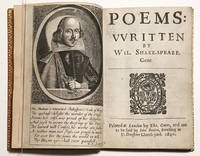
1640BBO36<p><b>SHAKESPEARE</b> William:</p><p><i><b>POEMS</b></i>: Written by Wil. Shake-speare. Gent. </p><p>London: Printed by Tho. Cotes and are to be sold by John Benson dwelling in St. Dunstans Church-yard 1640.</p><p>8vo engraved Portrait Frontispiece by William Marshall after Droeshout with verses below. Two letterpress title pages both with woodcut printer's device the second undated title-page extended and remargined at bottom tiny abrasion at top of frontispiece catchword 3 carelessly printed and punched through final leaf M4 extended; russet morocco by Bedford covers gilt paneled marbled endpapers spine and edges gilt.</p><p><br /></p><p><b>FIRST COLLECTED EDITION</b>. This edition by Benson brings together all but eight of the sonnets: A Lover s Complaint The Passionate Pilgrim mostly not by Shakespeare The Phoenix and the Turtle attributed to Shakespeare and elegies and other poems honoring Shakespeare by Jonson Milton Digges Herrick Strode Carew and others. Benson famously reorganized the sonnets probably out of concern that an old-fashioned sonnet sequence would not appeal to the generation of the Cavalier Poets. Many are run together to form poems of twenty-eight lines or more and all are given titles. Benson also made some effort to disguise the homoerotic content found in some sonnets perhaps most strikingly in his changes to Sonnet 101 O truant Muse what shall be thy amends which he runs together with Sonnet 100 under the title An invocation of his Muse while he also switches the gender of the pronouns to make the poet s lover female. </p><p>References: STC 22344; ESTC S106377; Bartlett 27; Grolier/Langland to Wither 84; Hayward 30; Pfozheimer 880 </p><p>Provenance: Alfred Henry Huth Morocco label Christie s New York 18 November 1977 lot 115 undesignated consignor Sotheby's London 26 April 1982 lot 439 Property of a Gentleman Robert S. Pirie purchased at the foregoing sale through Bernard Quaritch Sotheby's New York 3 December 2015 lot 729 Collection of Robert S Pirie .</p> Printed by Tho. Cotes, and are to be sold by John Benson, dwelling in St. Dunstans Church-yard hardcover books