VOLTAIREBiblio.com
345 résultats
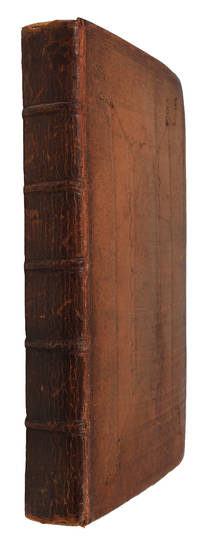
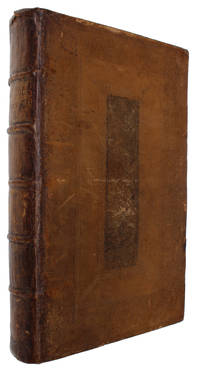
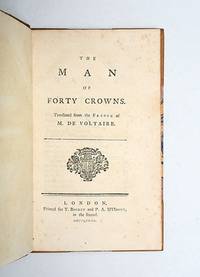
1768156969London: Printed for Robert UriePrinted for T. Backet and P. A. d'Hondt 1768. One of three editions in English of Voltaire's only publication on a distinctly economic subject "an immortal satire on physiocracy" Higgs published the same year as the original French language edition published in Geneva the others published in Glasgow and in Dublin. Directed against the physiocracts and against Le Mercier de la Rivière's Ordre naturel et essentiel des sociétés in particular L'Homme aux quarante écus is "the history of the owner of a small estate yielding a net income of forty crowns a year who has been frightened by the appearance of several edicts promulgated 'by a few gentlemen who having some leisure have undertaken to govern the kingdom from their firesides'" Palgrave. Octavo 209 x 126 mm. Twentieth century half calf and marbled boards spine ruled gilt red morocco label sprinkled edges. Occasional light spotting; a very good copy. Goldsmiths' 10405; Higgs 4515; Kress 6597. For the original edition see Bengesco 1478. hardcover
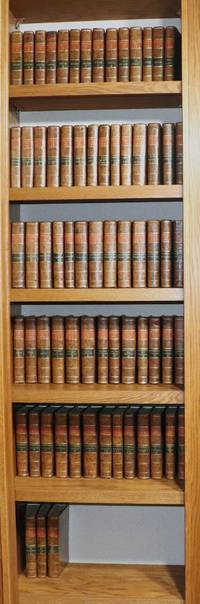
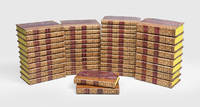
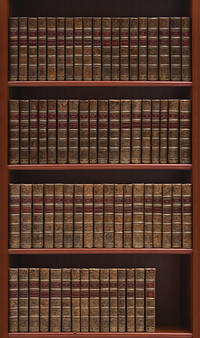
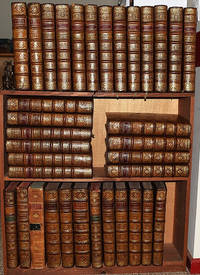
1789000012023Paris: La Société Littéraire-Typographique 1789. First edition. Hardcover. Very Good. 70 vol. 8vo. Please inquire if you require any pagination information. Contemporary full calf spines in six and a half compartments each with a red and a green morocco label lettered in gilt; several edges decoratively stained yellow. With 104 of the 122 recorded plates Cohen-DeRicci calls for 122 plates volume one is missing the tableau the folding plate and the dedication plate. Due to the vagaries of hand-press-era binding and to the large size of the set it is difficult to determine which of the other 16 plates are the ones missing. The plates present depict Voltaire scenes from his plays and several fascinating figures from European History including of course Enlightenment-era figures. All other half-titles present see condition statement. Bengesco 2142. Brunet 681. Cohen-DeRicci 1042-1047. This edition is the set most lauded for its completeness and beautiful typography. Baskerville's type was purchased to produce this sizeable set of Voltaire's writings. The later editions of Voltaire's works are said to be based on this edition. Voltaire's career was nothing short of prolific as demonstrated by these 70 volumes. With a biting wit and a clever pen the philosophe lampooned Leibniz wrote countless plays and historical dramas and corresponded with his fellow Enlightenment-era intellectuals. He walked the line of philosopher and literary figure and made great contributions to science in his translation of Newton's writings into French. He was a champion not only of the natural sciences but of liberty and of personal pleasure. Voltaire dreamed that European society would and could move forward away from tyrannical monarchies towards a more sophisticated and benevolent system of governance. He stands out as one of the most popular and influential figures of the Enlightenment era. Volume 37 lacks its free front endpaper a few leaves in the volumes have an occasional dampspot volume 43 lacks leaf CC8 and its half-title. La Société Littéraire-Typographique hardcover
1738000010155Amsterdam: Etienne Ledet & Compagnie 1738. First edition. Hardcover. Very Good. 8vo. 5 4-399 3 pp. Full contemporary calf with the spine in six compartments spine lettered and decorated in gilt; all edges decoratively stained red. A blue silk-ribbon bookmark bound in. Title page printed in red and black with the publisher's device engraved on it. Illustrated with two frontispieces six plates a folding table a full-page chart in-text engravings and diagrams and engraved head and tailpieces quite elaborate ones. Babson 59-60. Bengesco 1570. Gray 33. PMM 97. SEP Barbara Becker "Émilie du Châtelet". The first state as the Desbordes imprint is generally recognized as the later state. With the pagination error on p. 271. Voltaire is credited with having spread Newton's revolutionary contributions to science across the European continent. He dedicated this work to his romantic and scientific partner the Marquise du Chatelet herself an accomplished scientist. The Marquise completed the first translation of Newton's Principia into French. Voltaire acknowledged her significant contributions to the production of this work an exposition of Newtonian Physics. This book was widely read and quite influential in spreading and popularizing Newton's groundbreaking ideas. Newton's work would replace Descartes' physical system and remained the standard in physics for two hundred years until the discovery of the Theory of Relativity and Quantum Mechanics in the early twentieth century. A brilliant piece of print history and a cornerstone work in the history of science. A Very Good example with the front joint expertly strengthened the bottom corners and spine tips show very minor loss; the rear decorative endpaper has a tiny chip to its corner page 231 is bound in upside down. Etienne Ledet & Compagnie hardcover
17331270881733. First Edition. VOLTAIRE Arouet François-Marie DE. Letters Concerning the English Nation. London: Printed for C. Davis and A. Lyon 1733. Octavo contemporary full brown speckled calf rebacked and recornered raised bands red morocco spine label. Housed in a custom clamshell box. $4800.First edition of Voltaire's commentary on English institutions published one year before the French first edition the first published work to relate the tale of Newton's falling apple.Voltaire ""an approximate anagram of the name Arouet"" fled to England in 1726 following arguments in Paris with powerful political figures ""where he remained till early 1729 learning English reading Shakespeare Milton and the Restoration dramatists making the acquaintance of Walpole Congreve Gay Berkeley and associating with Bolingbroke Pope and Swift"" Harvey & Heseltine 753. ""Much struck by the admirable English phlegm and toleration of free thought and eccentricity he wrote the Letters the most sympathetic of critiques"" PMM 204. ""He became an ardent apostle of the science tolerance and common sense of England. These resulting Letters form his most important early philosophical work. The book has been called the first bomb hurled against the Ancien Régime. In its high praise of English institutions it leaves no doubt that Voltaire is attacking by ironic contrast French despotism and the corruption of the French Church. The book created such a scandal that it was soon condemned and copies burned by the hangman in June 1734. A warrant was issued against Voltaire but he succeeded in escaping.""""This English translation was done by John Lockman from a manuscript prepared by Voltaire himself Four letters deal directly with Newton and his theories and include for the first time the famous anecdote of the falling apple which gave birth to the law of gravitation"" Babson 242. ""In later life Voltaire neither discards nor regrets the opinions articulated in the Letters. The values and ideas that animate these pages the vision of man and not just the Englishman will remain fundamental to Voltaire"" Leigh Introduction Philosophical Letters xvii. Of specific American interest is Letter IV concerning William Penn and the founding of Pennsylvania as a haven for Quakers. When published in French in 1734 the work first appeared as Lettres écrits de Londres sur les Anglois; later in the same year it was retitled Lettres philosophiques the title by which it is generally known. Engraved vignette to title page engraved ornamental tailpieces. Leaf of publisher's advertisement between Contents and first text leaf. Translated into English by John Lockman. Mahaffey 129. Sabin 100751. ESTC T137614. Trace of erasure to early owner signature above title page. Penciled owner inscription. Small early inked initial.Lower corner of front free endpaper blank repaired. Text fresh and clean slight soiling rubbing to boards. Extremely good in nicely refurbished contemporary calf covers. hardcover
17511127E001Berlin: C.F. Henning 1751. 1st Edition . Hardback. Printed pages: 12mo. 14 488 1 Errata 2 466 2 Errata. Very Good. 3.75 x 6 inches 9.5 x 15 cm. Complete in two volumes. Full calf leather bindings red leather title labels and gilt decoration to spines. Good solid bindings. Volume one has light rippling to the pages and foxing up to page 3 hole to front free endpaper and three small holes to leading blank Volume II is very clean throughout. Engraved bookplate to front endpapers Charles Grave Hudson - 1st Baronet Hudson of Wanlip Hall Leicestershire. The first edition of one of Voltaire's most important works a landmark in the development of historiography published under the alternative pseudonym M. de Francheville. A very nice example. Overall condition is Very Good. Size: 3.75 x 6 inches 9.5 x 15 cm. C.F. Henning hardcover
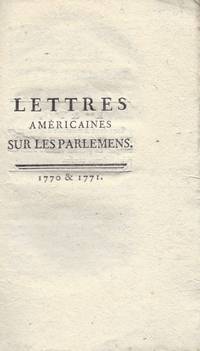
1771729S.l.: S.n. 1771. First edition. Published unbound. Stitched. First page blank but title in ink. First and last pages slightly chipped and stained. Overall in fine condition. First edition. Published unbound. Stitched. 44 4 p. A fictional correspondence between R and T “deux Américaines originaires du Port-au-Prince dans l'Isle de S. Domingue. Le premier réside a Paris depuis quelques années†two Americans from Port-au-Prince on the island of Saint-Domingue. The first lives in Paris for some years. The letters are dated between December 1770 and April 1771. The text is attributed to Voltaire and it is in favour of Maupeou’s jurisdictional reform.<br /> <p><p><br /> René Nicolas Charles Augustin de Maupeou 1714–1792 as the chief minister of the French King made a revolutionary attempt to install the enlightened despotism in France through the suppression of the power of the parliament by destroying its system and the favour of the royal authority. He also made efforts to uniform the judicial system throughout the country. <br /> <p><p><br /> Voltaire praised this revolution applauding the suppression of the old hereditary magistrature and justified the reform in several essays among them this one. <br /> <p><p><br /> Scarce and interesting publication we could trace only two copies in institutional holdings in the US.<br /> <p><p><br /> Not in Sabin.<br /> <p>. [S.n.] unknown
173361360London 1733. 8vo. Bound in a lovely contemporary English Cambridge-style full calf binding with a plain spine with five raised bands. Spine a bit cracked vertically and with minor loss to capitals. Corners a bit bumped and adges of boards a bit worn. Binding overall nice and tight. Small damp stain at the lower blank corner of the first few leaves otherwise a very good clean copy on thick crisp paper. 16 -including preface contents advertisements 253 1 18 -Index pp. <br/><br/><em>The important actual first edition of this highly celebrated key work of the Enlightenment in which the anecdote of how Newton discovered gravity the story about Newton and the falling apple appeared for the first time together with the description of the difference between the physical world view of the English and the French the "plenum" and the "vacuum". This seminal work in which Voltaire famously depicts British philosophy science society and culture in comparison to French can be viewed as the Enlightenment equivalent to Tocqueville's "Democracy in America". This series of essays which is based on Voltaire's experiences when living in England was actually written by Voltaire mostly in English which he mastered to perfection. It has often been presumed that the first edition of the work was that published in French in 1734 but actually the present English edition constitutes the actual first appearance of the work as well as the version that is closest to Voltaire's intention as the French language version is the re-written one and the English version the original. Curiously almost all modern English versions are translations into English of the French edition instead of the original English version making this edition of the utmost importance.After the original English edition of 1733 two French editions soon followed the first in 1734. Unlike the British the French resented the book and already in 1734 the French Parliament issued an order for the author's arrest and condemned the work causing the impact of it in France to be delayed. The book was burned for being "dangerous to religion and civil order". At the same time the work became a bestseller in Britain and as much as 14 editions of the work were published in the eighteenth century. "Inspired by Voltaire's two-year stay in England 1726-8 this is one of the key works of the Enlightenment. Exactly contemporary with Gulliver's Travels and The Beggar's Opera Voltaire's controversial pronouncements on politics philosophy religion and literature have placed the Letters among the great Augustan satires. Voltaire wrote most of the book in English in which he was fluent and witty and it fast became a bestseller in Britain. He re-wrote it in French as the Lettres philosophiques and current editions in English translate his French." Nicholas Cronk Introduction to the Oxford's Classics edition from 1999.The great French philosopher Voltaire was greatly impressed by the philosophical and scientific achievements of the English especially those of Newton Locke and Bacon. As a disseminator of scientific knowledge Voltaire came to play a great rôle in the popularization of Newtonian science and its discoveries the present work being a prime example. Although the work was condemned by the French authorities it still came to play a great rôle in the spreading of Newtonian ideas in France. The present work generally came to play a dominant rôle in Enlightenment accounts of the history of science and philosophy. The work focuses on British science and thought and uses the accounts of these to emphasize what is lacking in French society and French thought. The work is generally very critical towards the French "ancient régime" and when Voltaire here discusses the emergence of empiricism it is viewed as an English tradition that stands in opposition to the French rationalist tradition with Descartes as the prime example. This view is taken over by the following Enlightenment historians of science and philosophy e.g. d'Alembert see for instance his "Preliminary Discourse" of 1751. Some of the most influential passages of the work are probably those on Bacon who Voltaire sees as the founder of modern experimental science Newton and Descartes. Letters XIV on Descartes and Newton XV on attraction and XVI on Newton's Optics from 1704 are among the most influential essays of the work. In XVI Voltaire reflects upon Newton's "Optics" and the way that he rejected Descartes' theory and set out his own account of the properties of light. In XV he presents the first account of Newton and the falling apple: "As he was walking one Day in his Garden and saw some Fruits fall from a Tree he fell into profound Meditation on that Gravity the Cause of which had so long been sought but in vain by all the Philosophers whilst the Vulgar think there is nothing mysterious in it. He said to himself that from what height soever in our Hemisphere those Bodies might descend their Fall wou'd certainly be in the Progression discover'd by Galileo; and the Spaces they run thro' would be as the Square of the Times. Why may not this Power which causes heavy Bodies to descend and is the fame without any sensible Diminution at the remotest Distance from the Center of the Earth or on the Summits of the highest Mountains; Why said Sir Isaac may not this Power extend as high as the Moon." pp. 127-28.But perhaps the most famous passage in the volume is the opening of Letter XIV: "A Frenchman who arrives in London will find Philosophy like every Thing else very much chang'd there. He had left the World a "plenum" and he now finds it a "vacuum". At Paris the Universe is seen compos'd of Vortices of subtile Matter; but nothing like it is seen in London. In France 'tis the Pressure of the Moon that causes the Tides; but in England 'tis the Sea that gravitates towards the Moon; so that when you think that the Moon should make it Flood with us those Gentlemen fancy it should be Ebb which very unluckily cannot be prov'd." pp. 109-10. </em> hardcover
1767140947325London: Printed for J. Almon 1767. First Edition. Near Fine. First English-language edition of Cesare Bonesana di Beccaria's treatise on criminal justice reform with an added commentary by Voltaire. xii 179 lxxix pp. Bound in full contemporary mottled calf laced in boards. Morocco title label gilt tooling to spine and board edges all edges speckled red. Near Fine with light wear to covers boards slightly splayed joints worn but sound. Light toning and scattered foxing throughout more pronounced in first and last few pages. Discoloration from binder's glue to endpapers author's name penciled to front pastedown math equation penciled to back pastedown. A beautiful copy of the influential Enlightenment classic from the collection of scholar and bibliophile Arnold Meadowcroft Muirhead with his bookplate on the front pastedown. Rare. Printed for J. Almon unknown
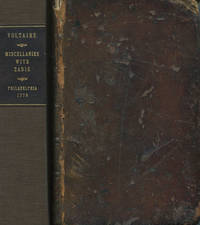
177844246Philadelphia: Printed by Robert Bell 1778. 1778. First U. S. edition. Translated from the French with notes historical and critical by T. Smollett M. D. and T. Francklin A. M. Story contained in MISCELLANIES by Voltaire. The first book on the Haycraft-Queen Cornerstone list and excessively rare—the only copy we have ever seen and it does not seem that any copies have sold at auction for more than twenty five years. Considered to be the "Great Grandfather of the Detective Story." Foxing and staining throughout. A good copy only of this seminal work bound in a full-leather contemporary binding. Housed in a cloth clamshell case with leather label on the spine and titles stamped in gold gilt. Printed by Robert Bell, 1778. hardcover
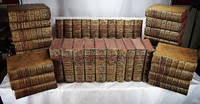
1761186427London: Printed for J. Newbery R. Baldwin W. Johnston; Printed for S. Crowder T. Longman J. Wilkie; Printed for G. Kearsley; Printed for J. and H. L. Hunt 1761-1824. His oeuvre in English for the first time First collected edition of Voltaire's works in English. This first collection did not include two works but this handsome set makes up the omission. It includes uniformly bound copies of the first English translation of The Age of Louis XV and the second English edition of Voltaire's Philosophical Dictionary. In the early 1750s editions and translations of Voltaire's works multiplied rapidly. Following his earlier surge of fame in the late 1730s driven largely by his plays and his Life of Charles XII publishers eventually produced a full English edition of his writings. This thirty six volume collection was issued between 1762 and 1765 under the direction of Tobias Smollett. Lowndes however notes that Smollett lent his name to the project but took little active part in its translation. A final volume appeared in 1770 although in this set it is represented by a later edition dated 1781. 44 vols duodecimo 170 x 109 mm. Engraved frontispieces with tissue guards to 32 vols. 2 folding plates to vol. 26 folding map to vol. 29. Late 19th-century mottled half calf twin red morocco labels compartments elaborately tooled in gilt marbled sides edges yellow. Bookplates of Sir Walter Runciman 1847-1937 occasional minor contemporary inscriptions. Bindings bright sporadic foxing pale damp-staining to a couple of volumes a few chips and short closed tears to fore edges. A very good set. Lowndes 2791. unknown
173360085London C. Davis and A. Lyon 1733. 8vo. Lovely contemporary full Cambridge-style binding with five raised bands to spine and blindstamped ornamental borders to boards. . Double gilt line-borders to boards. All edges of boards with gilt borders. Gilt title to spine. Hinges neatly and professionally re-inforced. Internally very nice clean and fresh. A lovely crisp and large copy with good margins printed on heavy fine paper. 16 -including preface contents advertisements 253 1 18 -Index pp. <br/><br/><em>The important actual first edition of this highly celebrated key work of the Enlightenment in which the anecdote of how Newton discovered gravity the story about Newton and the falling apple appeared for the first time together with the description of the difference between the physical world view of the English and the French the "plenum" and the "vacuum". This seminal work in which Voltaire famously depicts British philosophy science society and culture in comparison to French can be viewed as the Enlightenment equivalent to Tocqueville's "Democracy in America". This series of essays which is based on Voltaire's experiences when living in England was actually written by Voltaire mostly in English which he mastered to perfection. It has often been presumed that the first edition of the work was that published in French in 1734 but actually the present English edition constitutes the actual first appearance of the work as well as the version that is closest to Voltaire's intention as the French language version is the re-written one and the English version the original. Curiously almost all modern English versions are translations into English of the French edition instead of the original English version making this edition of the utmost importance.After the original English edition of 1733 two French editions soon followed the first in 1734. Unlike the British the French resented the book and already in 1734 the French Parliament issued an order for the author's arrest and condemned the work causing the impact of it in France to be delayed. The book was burned for being "dangerous to religion and civil order". At the same time the work became a bestseller in Britain and as much as 14 editions of the work were published in the eighteenth century. "Inspired by Voltaire's two-year stay in England 1726-8 this is one of the key works of the Enlightenment. Exactly contemporary with Gulliver's Travels and The Beggar's Opera Voltaire's controversial pronouncements on politics philosophy religion and literature have placed the Letters among the great Augustan satires. Voltaire wrote most of the book in English in which he was fluent and witty and it fast became a bestseller in Britain. He re-wrote it in French as the Lettres philosophiques and current editions in English translate his French." Nicholas Cronk Introduction to the Oxford's Classics edition from 1999.The great French philosopher Voltaire was greatly impressed by the philosophical and scientific achievements of the English especially those of Newton Locke and Bacon. As a disseminator of scientific knowledge Voltaire came to play a great rôle in the popularization of Newtonian science and its discoveries the present work being a prime example. Although the work was condemned by the French authorities it still came to play a great rôle in the spreading of Newtonian ideas in France. The present work generally came to play a dominant rôle in Enlightenment accounts of the history of science and philosophy. The work focuses on British science and thought and uses the accounts of these to emphasize what is lacking in French society and French thought. The work is generally very critical towards the French "ancient régime" and when Voltaire here discusses the emergence of empiricism it is viewed as an English tradition that stands in opposition to the French rationalist tradition with Descartes as the prime example. This view is taken over by the following Enlightenment historians of science and philosophy e.g. d'Alembert see for instance his "Preliminary Discourse" of 1751. Some of the most influential passages of the work are probably those on Bacon who Voltaire sees as the founder of modern experimental science Newton and Descartes. Letters XIV on Descartes and Newton XV on attraction and XVI on Newton's Optics from 1704 are among the most influential essays of the work. In XVI Voltaire reflects upon Newton's "Optics" and the way that he rejected Descartes' theory and set out his own account of the properties of light. In XV he presents the first account of Newton and the falling apple: "As he was walking one Day in his Garden and saw some Fruits fall from a Tree he fell into profound Meditation on that Gravity the Cause of which had so long been sought but in vain by all the Philosophers whilst the Vulgar think there is nothing mysterious in it. He said to himself that from what height soever in our Hemisphere those Bodies might descend their Fall wou'd certainly be in the Progression discover'd by Galileo; and the Spaces they run thro' would be as the Square of the Times. Why may not this Power which causes heavy Bodies to descend and is the fame without any sensible Diminution at the remotest Distance from the Center of the Earth or on the Summits of the highest Mountains; Why said Sir Isaac may not this Power extend as high as the Moon." pp. 127-28.But perhaps the most famous passage in the volume is the opening of Letter XIV: "A Frenchman who arrives in London will find Philosophy like every Thing else very much chang'd there. He had left the World a "plenum" and he now finds it a "vacuum". At Paris the Universe is seen compos'd of Vortices of subtile Matter; but nothing like it is seen in London. In France 'tis the Pressure of the Moon that causes the Tides; but in England 'tis the Sea that gravitates towards the Moon; so that when you think that the Moon should make it Flood with us those Gentlemen fancy it should be Ebb which very unluckily cannot be prov'd." pp. 109-10. </em> hardcover
17772308270001Geneva: Pellet 1777-79; Neuchatel: La Societe Typographique 1777. troisieme. Hardcover. Very Good. The Organization of Enlightenment Thought: The Revolution in Ideas 41 of 45 volumes. Quartos 25 x 19.5 cm. Bound in handsome catspaw calf. All edges red. Good bindings and covers. Clean unmarked pages. Includes Vol. 1-36 of the Encyclopedie important note: lacks 3 text volumes 23 30 31; Vol. 37-38: Recueil de planches pour la nouvelle edition du dictionnaire raisonne des sciences des arts et des metiers; lacks the final plate volume v.39 Vol. 40-45 Table Analytique Et Raisonnee Des Matieres. <br> Diderot's famous Encyclopedie was initially a modest translation of Chambers's Cyclopaedia. It grew as a project into a massive project which attempted to collect human knowledge from a rationalistic perspective instead of by nature or theology. In organizing knowledge from a position where human reason was paramount the supremacy of the Church was imperiled. As a result the Encyclopedie was widely controversial and placed on the Index Librorum Prohibitorum by the Catholic Church. In discussing fundamental philosophical issues such as on political authority and natural rights articles in the Encyclopedie shifted the basis of governmental authority from the divine right of Kings to radical concepts popular consent was the basis of legitimacy and the ideals of a social contract. The work was banned by the King of France. It spread the foundational ideas of the French Revolution and enlightenment thinkers. "No encyclopaedia perhaps has been of such political importance or has occupied so conspicuous a place in the civil and literary history of its century. It sought not only to give information but to guide opinion." "It was a war machine; as it progressed its attacks on both the church and still more on despotic government as well as Christianity itself became bolder and more undistinguished and it was met with persecution and opposition unparalleled in the the history of encyclopedias." - Encyclopedia Britannica 11th ed p. 1483. Geneva: Pellet, 1777-79; Neuchatel: La Societe Typographique hardcover
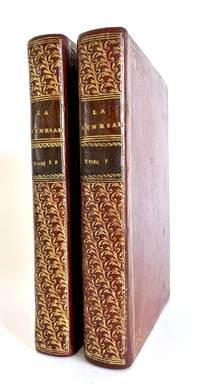
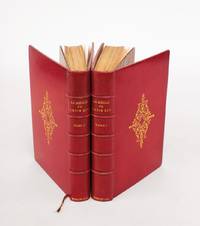
177081957à Paris: Chez La veuve DuchesneSaillantDesaint 1770. Fine. Chez La veuve Duchesne Saillant Desaint à Paris 1770 11.80 x 18.50 cm 2 volumes reliés New illustrated edition with first printing by Eisen of a frontispiece an engraved title with the author's portrait in medallion 10 figures and 10 headpieces all engraved by De Longueil. Volume II contains variants and notes: L'essai sur la poésie épique poème sur le désastre de Lisbonne; Poème sur la loi naturelle etc. This edition was partly revised by Voltaire. The publishers' notice announces this edition as the only complete one since there are more than 50 new verses scattered throughout the work. Contemporary full red morocco binding. Smooth spine decorated in grotesque style. Brown morocco title label olive morocco volume label. Triple fillet frame on covers with corner fleurons. Interior fillet. All edges gilt. Traces of rubbing. Some light foxing in margins and verso of certain engravings. Superb copy rare in this condition. Very fine illustration by Eisen. Complete and critical edition with notes from different editions for each canto Marmontel's preface the author's letter of thanks to Eisen. Chez La veuve DuchesneSaillantDesaint unknown
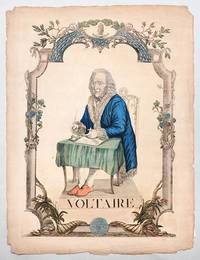
1790138601Paris: Basset c. 1790s. Voltaire as revolutionary icon A full-length portrait of the philosopher towards the end of his life in a fetching electric blue coat. The print is by the Parisian firm of Basset which was a leading source of popular prints during the Revolution. Voltaire was claimed as a foundational influence by many revolutionary leaders and in 1791 they arranged for his remains to be transferred to the Panthéon in Paris. Hand-coloured copperplate engraving. Image size: 70 x 52 cm. Framed size: 85 x 66.5 cm. Presented in a handmade gilt frame with conservation acrylic glazing. Light toning and chipping to extremities not touching impression several small tape repairs to extremities on verso not visible on recto: in very good condition. unknown
175165145à Berlin: Chez C. F. Henning 1751. Fine. Chez C. F. Henning à Berlin 1751 8.50 x 14.50 cm 2 volumes reliés First edition displaying all the distinctive features of its publication: it presents no capital letters except at the beginning of paragraphs and it is the very first work to have been printed with Voltaire's spelling. Our copy is complete with its errata leaf which is often missing. Later bindings 19th century in full red morocco Jansenist spines with five raised bands dates and places gilt at foot boards struck at center with large gilt typographical fleurons double gilt fillets on leading edges and headcaps pastedowns lined with blue morocco presenting a wide gilt decorative border monogrammed bookplates mounted on the pastedowns of each volume following endpapers of combed paper all edges gilt bindings signed Chambolle-Duru. Superb copy perfectly established in a binding signed by a master of French bookbinding. Chez C. F. Henning hardcover
17992091202133206278A Paris De L'imprimerie de Crapelet 1799. Soft Cover. Fine. Number of books: 2 books in total A Paris, De L'imprimerie de Crapelet paperback
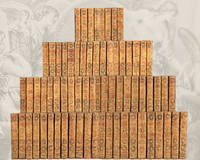
178488246s. l. Kehl: Imprimerie de la Société Littéraire-Typographique 1784. Fine. « Divine Voltaire ora pro nobis ! » Exceptional copy on large paper and contemporary binding Imprimerie de la Société Littéraire-Typographique s. l. Kehl 1784-1789 14 x 21.7 cm 70 vol. reliés The Kehl edition the most renowned edition of Voltaire's works illustrated and published on deluxe paper. It was printed on five different types of paper and only the deluxe editions such as ours on laid paper feature engravings. These are naturally the most sought-after and rarest copies. Binding in full painted sheep decorated with a honeycomb motif smooth spine tooled with gilt fleurons fillets and compartments light beige calf lettering and volume pieces gilt chain-roll border on covers marbled endpapers gilt roll on edges all edges marbled contemporary binding. Two volumes nos. 50 and 70 with slight variations in gilt tools on the spines and with orange morocco lettering pieces edges and covers treated somewhat differently. General condition of the 70 volumes: bindings with light rubbing to corners gilt a little dulled occasional foxing a few wormholes and old restorations not affecting the text. 28 volumes vols. 4 5 8 10 11 13 16 17 19 20 24 27 28 33 34 35 36 37 43 48 61 62 63 65 66 67 68 70 with cracked joints at the ends and 20 volumes vols. 8 11 12 14 16 18 33 34 37 42 46 49 53 56 57 60 65 66 68 70 with damaged caps. Two editions were published at the same time. Our copy belongs to the prestigious in-8 edition on large paper published in 70 volumes the other edition being in-12 format in 92 volumes. It is richly illustrated with 125 etched plates: - There are 17 portraits including 3 of Voltaire: a frontispiece portrait by N. de Largillière engraved by P. Alex. Tardieu; one drawn from Houdon's bust by Moreau le Jeune and engraved by P. Alex. Tardieu; and one allegorical portrait by Louis Croutelle after Moreau le Jeune belonging to the second series of illustrations of Voltaire's works executed by Moreau for the publisher Renouard. The 14 other portraits include an allegorical frontispiece of Frédéric-Guillaume Prince of Prussia depicted in profile in a medallion by Dambrun after Moreau le Jeune; a portrait of Henry IV by Pourbus engraved by Tardieu; one of Charles VII engraved after the original in the King's Cabinet by Mavieri; another of Agnès Sorel drawn by Moreau the Younger after the original in the King's Cabinet and engraved by Mavieri; one of Joan of Arc engraved by Beisson; followed by the Count of Dunois engraved after the original in the King's Cabinet by J. B. Fosseyeux; one of Louis XIV drawn by Moreau Le Jeune after C. Le Brun engraved by J. B. Fosseyeux; one of Charles XII engraved by P. Alex. Tardieu after the original in the King's Cabinet; one of Pierre I engraved by P. G. Langlois after a painting by L. Caravaque; one of Madame du Châtelet after Marie Anne Loir and engraved by P. G. Langlois; one of the Count of Argental after J. Defraine and engraved by J. B. Fosseyeux; one of Frédéric II of Prussia painted from life by Van Loo and engraved by P. G. Langlois; one of Catherine II of Russia engraved by J. B. Fosseyeux; and one of d'Alembert after De La Tour engraved by N. F. Maviez. - 93 engravings by Moreau le Jeune including 44 figures for le Théâtre engraved by Lingée Simonet de Launay Trière Halbou Duclos Romanet Dambrun de Longueil Delignon Le Mire Le Veau 10 for la Henriade engraved by Masquelier Delignon Dambrun Patas Gutemberg Helman Simonet Duclos Romanet 21 for la Pucelle engraved by Simonet Dambrun Halbou Baquoy Trière Delignon de Longueil Croutelle and Duclos 4 for the Contes in verse engraved by Langlois Duclos Delignon and Le Veau and 14 for the Romans engraved by Trière Duclos de Longueil Dambrun Baquoy Delignon Simonet Langlois and Halbou. - 14 scientific plates in volume 31 illustrating the experiments of Newton Descartes and Leibniz. - 1 battle Imprimerie de la Société Littéraire-Typographique unknown
1784191724Kehl: De L'imprimerie de la Société Littéraire-Typographique 1784-89. Canonizing Voltaire an enterprise on the eve of Revolution The first complete collection known as the "Kehl" edition for the small German town in which it was printed to avoid French censorship. After his death the Société Littéraire Typographique was founded there dedicated to the monumental effort of disseminating Voltaire's work through a definitive and typographically magnificent edition. The group of Enlightenment intellectuals ready to champion the author were led by Pierre-Augustin Caron de Beaumarchais who financed the operation and the Marquis de Condorcet who acted as chief editor. For the first time Voltaire's correspondence was published and commentary and a biography by Cordorcet was added. For the type Beaumarchais bought John Baskerville's apparatus from his widow. This coupled with the unprecedented price he paid for the rights the paper mills he purchased and the cost of setting up in Kehl bankrupted Beaumarchais. Nevertheless he concluded "Europe will be satisfied". Octavo 70 vols 213 x 134 mm. Portrait frontispiece engraved plates. Contemporary mottled calf signed by François Gaudreau at foot of spines red morocco labels double gilt fillet to compartments and boards marbled endpapers varicolour bookmarkers. Superficial splits and worming to joints still very firm occasional wear contents largely clean. A very good set. hardcover
1759752Genève Geneva: Cramer 1759. First Edition. 3 vols. in one 12mo 164 x 100mm pp. 2 291 1; 133 1 35 1. First printing of the great 18th century philosophical narrative with all the points correct. Including the 3 usual cancels the right title page ornament repeated pages 193 and 266 the misprints of “que ce ce fut†page 103 line 4 and “précisément†page 125 line 4 the correction removing a paragraph break page 31 the rewritten lines about the Lisbon earthquake page 41 etc. Contemporary full calf red calf label rebacked with the original spine saved and laid down recornered marbled endpapers gilt rubbed inner paper hinges strengthened old ink signatures on the endpaper and front blank tiny signature on the title page one tissue strengthened tear at the bottom of A2 touching the last 3 lines of text without any loss otherwise internally quite nice clean and very good. Bound without N7 a blank and N8 a notice to the binder as is usual agreeing in all respects to what you would have received if you had purchased a copy in sheets on publication day then bought the sequels and then handed them over to the most local Swiss bindery. Ref: PMM 204. There were 18 editions of Candide in 1759. It took 221 years for a clear and convincing bibliography to first sort them out and then got accepted and once accepted our real 1st edition was confirmed as rare. In the last 15 years however that bibliographical data has been more widely circulated and several 1st editions that weren’t on the original 22–copy census have come into market. It is still scarce more so in a contemporary binding.<br /> <br /> Candide bides as the epitomic philosophical fable of the French Enlightenment and the genotype of irony without exaggeration and though it’s laced with more salt than the postwar streets of Carthage it repeatedly tolls a reminder that light hearts live long. Most importantly Candide remains remarkably relevant when examined through contemporary frameworks functioning as an incisive proto-postcolonial text that anticipates modern discourse on global inequality systems of oppression and the limitations of Enlightenment rationality. The novel's scathing portrayal of slavery conquest and religious persecution resonates with intersectional analyses that recognize how power structures interlock across racial gender and economic dimensions. The savage irony throughout the text dismantles not just philosophical optimism but also European exceptionalism exposing the hypocrisy of colonial enterprises and religious institutions alike. The narrative's episodic structure—with its global movements between Europe South America and the Ottoman Empire—invites discussions of transnationalism and diasporic experience while Candide's concluding retreat to cultivate his garden has been reinterpreted by ecocritical scholars as both an acknowledgment of environmental interdependence and a potentially problematic withdrawal from systems-level political engagement.<br /> <br /> “Do you believe†said Candide “that men have always massacred each other as they do to-day that they have always been liars cheats traitors ingrates brigands idiots thieves scoundrels gluttons drunkards misers envious ambitious bloody–minded calumniators debauchees fanatics hypocrites and fools†“Do you believe†said Martin “that hawks have always eaten pigeons when they have found them†<br /> –Voltaire Candide. Cramer unknown
17512605210193Chez Briasson David Le Breton Durand A Paris; Amsterdam 1751 - 1777 1751. First Edition. Hardcover. Very Good. 0x0x0. The Organization of Enlightenment Thought: The Revolution in Ideas. A first edition of this foundational encyclopedia of 18th century knowledge. A massive thirty-five volume set. Large folios volumes 39.5 x 25 cm. Bound in 18th-century French calf. Spines gilt with raised bands. One volume non-uniformly bound in light calf. <br> The set includes: Encyclopedie Paris: 1751-57 & Neuchatel 1765. 17 volumes; Recueil de planches. Paris: 1762-72. 11 volumes 1 2 part I 2 Part II 3 5 6 7 8 9 10 11; Supplement a l'Encyclopedie. Paris & Amsterdam: 1776-77. 5 volumes including the Suite de recueil de planches; Table Analytique. Paris: 1780. <br> Profusely illustrated with engraved plates. <br> Diderot's famous Encyclopedie was initially a modest translation of Chambers's Cyclopaedia. It grew as a project into a massive project which attempted to collect human knowledge from a rationalistic perspective instead of by nature or theology. In organizing knowledge from a position where human reason was paramount the supremacy of the Church was imperiled. As a result the Encyclopedie was widely controversial and placed on the Index Librorum Prohibitorum by the Catholic Church. In discussing fundamental philosophical issues such as on political authority and natural rights articles in the Encyclopedie shifted the basis of governmental authority from the divine right of Kings to radical concepts popular consent was the basis of legitimacy and the ideals of a social contract. The work was banned by the King of France. It spread the foundational ideas of the French Revolution and enlightenment thinkers. "No encyclopaedia perhaps has been of such political importance or has occupied so conspicuous a place in the civil and literary history of its century. It sought not only to give information but to guide opinion." "It was a war machine; as it progressed its attacks on both the church and still more on despotic government as well as Christianity itself became bolder and more undistinguished and it was met with persecution and opposition unparalleled in the the history of encyclopedias." - Encyclopedia Britannica 11th ed p. 1483. "A monument in the history of European thought; the acme of the age of reason; a prime motive force in undermining the ancien regime and in heralding the French Revolution" Printing in the Mind of Man 200. Refs: Grolier/Horblit 25b; Norman 637; PMM 200. <br> Includes: 17 v. : ill. ; 41 cm. supplement 4 volumes plates 11 volumes plates supplement 1 volume. Table Analytique 1 volume. This is an oversized or heavy book which requires additional postage for international delivery outside the US. Chez Briasson, David, Le Breton, Durand, A Paris; Amsterdam (1751 - 1777) hardcover