Volney, C FBiblio.com
65 résultats
180454891London: J. Johnson. Good. 1804. First Edition. Hardcover. First English edition. Contemporary full leather morocco label. Old library bookplate from Rensselaer-Ville Federal Library. PO name of Dr. Platt Wickes dated 1839. Wickes was a medical doctor who apparently at his death was one of the oldest practicing physicians in NY. Two foldout maps and two foldout plates; one of the foldout plates is half in facsimile. The foldout maps have some tears. In protective slipcase. ; 8vo 8" - 9" tall; xxiv 4503 pages . J. Johnson hardcover
1804C000016195London: J. Johnson 1804. First printing. Hardcover. Very Good. First edition in English 1804. 8vo rebound in late 19th century half leather and marbled boards brown leather black spine label flat spine 503 1 pp. including errata two folding maps and two plates. Leather a little rubbed and discolored modern bookplate on pastedown possibly lacking first blank or half title as it begins with the title page contents nice and bright as are the folding plates and maps. J. Johnson hardcover
180411501804. VOLNEY Constantine F. A View of the Soil and Climate of the United States of America: With Supplementary Remarks Upon Florida; on the French Colonies on the Mississippi and Ohio and in Canada; and on the Aboringinal Tribes of America. Translated With Occasional Remarks By C.B. Brown. With Maps and Plates. Phila.: J. Conrad & Co. 1804. 1st ed. in English. 8vo. Illus. with two folding maps and two folding charts. Very good in later antique style calf-backed marbled boards. Howes V-141. Sabin 100693. Field 1610. "The author spent three years in the United States ardently engaged in collecting facts for his work which principally related to the state and manners of the Indians and the climate. unknown
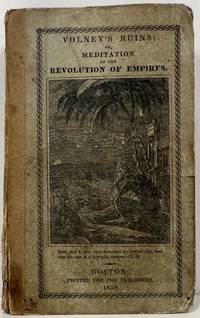
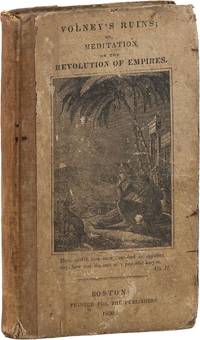
183567296Printed in the USA: Charles Gaylord 1835. 1835 edition. Cloth and paper over boards. As described. Hardcover cloth tan over paper illustrated over boards. 12mo. 216 pp. Illustrated with a b/w engraved frontispiece. No edition marks. Remnants of a paper label on the spine. Faded partially legible inscription on the front flyleaf. Ownership signature P. S. Van Wagner Hamilton 1844 R. R. on the front flyleaf and title page. Small enclosed tear on the back flyleaf. Text block is age browned around the edges and mildly foxed throughout. Binding is strong and square. Spine and boards are soiled rubbed and worn. Edges of the boards are frayed in sections. Small enclosed tear on the fore edge of the front board. Crack in the bottom of the front hinge. Bumped corners. Despite its appearance this copy's bindings are still strong and its pages legible. Charles Gaylord unknown
183588767Boston: Charles Gaylord 1835. Early US Edition. Twelvemo. 17cm. Publisher's original linen spine lacking paper title label over decorated publisher's paper covered boards. 216pp. Strong and solid scuffed to the corners with the paper worn allowing the board to show through rubbed and a little battered in places with some light cosmetic fraying to the spine ends and a general unform wear that is oddly not unappealinig; internally foxed in a pale similarly uniform fashion with some truly eccentric oak gall ink inscriptions to the preliminary blanks stating that the book was part of the library of the Transylvania Whig Society of Kentucky and presented by a visiting Englishman the inscriptions seem to serve as a kind of lending record denoting that the book was especially approved of by Kathleen O'Pinkerly who seems to have borrowed it twice; the page block is worn and a little stained but solid and eminently handleable and the rear flyleaf blank is covered with small neat pencil annotations with a corner of the blank torn away. Cosmetically unappealing perhaps but aesthetically rather charming and undeniably a survivor. A very good copy by dint of completeness eccentricity and stubbornness.<br /> <br /> An early US reprint the US first was issued in New York in 1828 by Dixon and Sickles and it is likely there is a Gaylord edition from 1833 with all US imprints being pretty thin on the ground especially with illustrated publisher's boards. This is in addition an uncredited Jefferson-Barlow translation translated with the approval and co-operation of the author by none other than Thomas Jefferson who managed the first 20 chapters or so before distracting himself with political fripperies whereupon it was subsequently completed by Joel Barlow. Of the various translations the Jefferson-Barlow is considered superior by dint of Volney's close relationship with Jefferson their common views and sympathies and frankly the fact that it renders the whole piece rather more poetically than might be found elsewhere. <br /> <br /> Controversial and madly popular it's far more a work of radical philosophy than anything else; like Jefferson Volney was a committed Deist and a firm believer in the separation of church and state for reasons clearly expressed by him through Jefferson in this work. Even more radically for the time he was a propogator of the "Christ Myth" which suggested that there was little or no evidence for the actual existence of Christ as a historical personage and that He was far more likely to be an inspiring assemblage. As might be expected such views were polarizing engendering either inspired revolutionary support or cries of heresy and treason depending upon the reader. The upshot of this and a number of other controversies was that Volney in common with the Founding Fathers not being a man known for keeping his mouth shut was ejected from the United States on more or less invented charges of espionage and his philosophical musings on the ashes of Empires and the sad destiny of mankind somewhat discredited. This had little effect upon the historical importance of Volney's "Ruins" however and it was for example widely embraced by the Romantics and their followers with Shelley having a virtual addiction to its evocative embracing of decay and his wife Mary for reasons of her own making it the text from which Frankentein's monster learned what he could about the nature of mankind and developed a rather stereotypically male interest in the Roman Empire. An unusual edition of an influential and incendiary work. Charles Gaylord unknown
185316954Philadelphia: F. W. Thomas 1853. Dritte Stereotyp Ausgabe. Hardcover. fair. Sm. 8vo. 220pp. Blind-stamped brown cloth with gold decorated spine. Small plate with "27" handwritten near head of spine. Chipping to head and tail of spine. Wear to edges. Staining and rubbing to boards. Sporadic foxing throughout. Bookplate of school-district on inside of front board and name of the same handwritten on title-page. Ex libris.Text in Gothic script. Binding in fair interior in good condition. Rare. F. W. Thomas hardcover
1852604181852. Notiz. Geb. Nat. Heilk. 4 441445. - Anatomie und Physiologie 1.Bd. No. 4546. - Frorieps Tagsberichte. - Weimar Januar 1852 8° pp.321-336 2 Rückenbroschuren. Erstdruck! "1852 zeigen der deutsche Physiologe Julius Ludwig Budge 1811-1888 und der englische Neurophysiologe Augustus Volney Waller 1816-1870 dass die für die Pupille bestimmten Fasern des Sympathikus ihren Ursprung im Rückenmark haben. Wenn man die vorderen Wurzeln der Nervenpaare durchschneidet die aus dem Centrum ciliospinale hervortreten - also aus der Wurzel der zwei oder drei ersten dorsalen Spinalnervenpaare - so sieht man an der Pupille sogleich die für die durchtrennung des Halssympathikusstrangs charakteristische Verengung." Albert Mudry : Johann Friedrich Horner 1831-1886 und das okulopupilläre Syndrom. Schweiz Med Forum 2014;1434: pp.605-607 "In 1851 Waller abandoned his practice to devote himself entirely to research and moved to Bonn Germany. During his 5 years in Bonn Waller turned to his second major focus in neurophysiology the autonomic nervous system. In collaboration with Julius Ludwig Budge Waller studied the pupillary action and nerve supply to the iris. Their important observations were reported in 1851 and 1852 in the Comptes Rendus published by the French Academy of Sciences. With carefully executed experiments Budge and Waller showed the influence of the cervical portion of the sympathetic nerve in dilatation of the pupil. Using the Wallerian method to trace the dilator fibers they followed the fibers in the sectioned sympathetic trunk to the first and second thoracic segments of the cord. If this region was stimulated in an intact animal there was pupillary dilatation; if the cervical sympathetic nerve was sectioned pupillary dilatation was abolished. Budge and Waller named the area controlling the dilatation of the pupils the ''ciliospinal center.'' Their work on the ciliospinal center won Budge and Waller the 1852 Monthyon Prize awarded by the French Academy of Sciences. They went on to demonstrate the action of the cervical sympathetic nerves on vasoconstriction." Venita Jay: Augustus Volney Waller. Arch Pathol Lab Med 126/9 2002: pp: 1018-1019. unknown
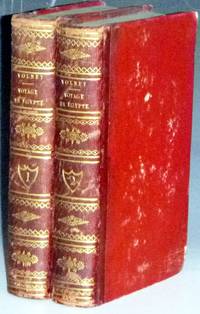
1807029967Paris: Chez Courcier 1807. Octavo. Fourth edition. In two volumes: Vol. I x 487 pages 1 p. advertisement and Vol. II 492 pages half-titles present in both volumes printed on laid paper with each map and image on very thick paper to enhance the preservation. The French academic philosophers of the late 18th century found that with advances in mathematics geodesy and field mapping previous works were limited for serious work. Comte de Volney 1757-1820 was a French orientalist whose study was impressive though he himself was not considered at the time a geographer. However modern geographers realize his work was closer to modern methods than his contemporaries see Anne Godlewska on Modern French Discipline of Geography p. 192-193. Originally published in 1787 this set produces not only the images of The Spinx the Pyramids of Giza Balbek and the Ruins of Palmyre but also the maps of Syria Egypt and of North Africa and the folding plan of the Temple of Balbet. Bound 1/4 red leather over red paper covered boards spine lettered and decorated in gilt all edges marbled with matching endpapers boards rubbed light wear to corners. A very good set. Chez Courcier unknown
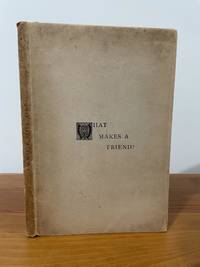
18942938New York: Volwalt Publishing Company 1894. second edition. softcover in wraps. Book VG-: age toning to wraps spine sunned mild scuffs/chips at corners and spine ends. 8vo unpaginated. second edition June 1894. What Makes a Friend Definitions and Opinions from Various Sources Collected and Compiled by Volney Streamer. collection of quotations from across classic and modern literature on friendship. scarce copy. #03003. Volwalt Publishing Company unknown
18940789452New York: Volwalt Publishing Company. 1894. 8vo - over 7¾" - 9¾". Second edition / 1st Printing Collectible. Paperback. Very Good. EXCEPTIONALLY RARE. Second Edition / First Printing. Very Good copy in the scarce foldover jacket slight spotting to covers. 15 x 23cm. soft cover. Approx. 100pp. Volwalt Publishing Company paperback
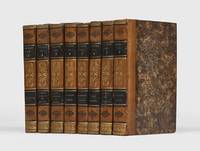
1821160633Paris: Bossange Frères 1821. With autograph material by the author First complete collected works. Bound into this set are five letters by Volney including one dated only a week before his death addressed to his friend Colonel Pierre Jacotin the head geographer responsible for all mapping operations during Bonaparte's Egyptian campaign. The letters underscore Volney's keen engagement with the contemporary discourse surrounding the geography of the Arabian Peninsula Egypt and the Levant. Jacotin met Volney in Corsica in the 1790s while working as a cadastral mapper. His conversations with Volney - who had travelled extensively to Egypt and Syria - eventually inspired him to pursue a career in Egypt where he was later assigned as military cartographer to the Napoleonic expedition. Jacotin's account of the cartographic survey work conducted in the area later formed the basis of the monumental Description de l'Égypte. Bound in at the beginning of the first volume are three letters sent by Volney to Jacotin from Paris respectively dated 20 March 11 April and 17 April 1820 Volney died on 25 April. A fourth letter at the end of vol. IV is dated 24 October. In the first letter Volney apologises for not having been able to receive Jacotin who had come to visit him the day before due to a bad fever. In the others Volney asks Jacotin for help and advice with preparing the plates specifically the maps for an English edition of his Ruines which "a bookseller" had asked him permission to publish; he also points out misspellings appearing in earlier states of the plates for example correcting toponyms in the Arabian Peninsula. No details are given concerning the edition in question. The first translation of the Ruins appeared in 1792 and was followed by numerous others. Further manuscript pages in Volney's hand are tipped into the first volume with a note gifting them to Jacotin. These contain an extract from an anonymous article published on 1 July 1819 in The Monthly Magazine London with the title "Account of Newly-Discovered Antiquities in Arabia Petraea Derived from the Personal Inspection of a Recent British Traveler". The traveller was William John Bankes 1786-1855 and the article is concerned with the projected publication of his voyage. Bankes travelled from Jerusalem to Wadi Musa passing through Kerak Castle Mount Hor and Petra; he describes the ancient Roman ruins that he saw during the trip and recounts sojourning with the Bedouin transcribing a Bedouin love song. Volney translates part of the article into French and adds his own comments and questions. A philosopher and orientalist Volney 1757-1820 wrote extensively on history religion politics and linguistics. His major works include Voyage en Syrie et en Egypte published in 1787 which had a profound impact on the Western view of the region and inspired Napoleon to undertake his invasion of Egypt in 1798 and Les Ruines 1791 a philosophical treatise on the history of social political and religious institutions and the rise and fall of empires. According to the distinguished American historian Ussama Makdisi holder of the Arab-American Educational Foundation Chair of Arab Studies at Rice University Volney's Voyage en Égypte et en Syrie "was simply the first of the great works of modern travel writing and description. Volney was a man of the Enlightenment. His work was suffused with its vocabulary and his humanism motivated him to travel to Asia to better understand the nature of 'despotism' under which his native France laboured" Makdisi p. 17. 8 vols octavo 204 x 123 mm. With 40 engraved plates many folding including portrait of author tables and maps. Contemporary quarter calf smooth spines divided by gilt fillets gilt and black ornaments in compartments black calf labels marbled boards endpapers and sides black silk bookmarkers. Embossed library stamp lettered "Ct Perret Havre" on front free endpaper of vol. I perhaps Auguste Perret 1874-1954 French architect active in Le Havre. Extremities rubbed couple of small chips short superficial splits at foot of front joints of vols. V and VIII remaining firm patches of stripping to leather of vols II and III occasional light foxing to contents faint damp stain to lower margin of final leaves and folding plates of first 5 vols otherwise generally bright and clean. A very good set. Ussama Makdisi The Culture of Sectarianism: Community History and Violence in Nineteenth-Century Ottoman Lebanon 2000. hardcover