6 183 résultats
195312011Paris Denoël 1953 In-12 229 pp, (.) Souvenirs recueillis par Pierre Andrieu, préface de P.-A.Touchard. Exemplaire non coupé, légers frottis d'usage au dos pour le brochage.
1981176001981 Paris, Julliard, 1981 , In huit, 362 pp, avec jaquette,
JULLIARD. 1981. In-8 Carré. Cartonnage d'éditeurs, Jaquette. Bon état. Couv. convenable. Dos satisfaisant. Intérieur frais. 362 pages. Jaquette illustrée en couleurs. Note au stylo sur la page de garde.
JULLIARD. 1981. In-8 Carré. Cartonnage d'éditeurs, Jaquette. Bon état. Couv. convenable. Dos satisfaisant. Intérieur frais. 362 pages. Jaquette illustrée en couleurs. Tampon et note au stylo sur la page de titre. Etiquette de classement sur le dos de l'ouvrage.
in-8°, 362 pages, broche, couv. Bel exemplaire [CA33-6] [P-19]
195140061951 Lyon, Lugdunum, 1942, in 12, broché, 252 pages ; couverture légèrement effrangée.
IMPRIME EN UNION SOVIETIQUE. 1959. In-8 Carré. Relié toilé. Bon état. Couv. défraîchie. Dos satisfaisant. Intérieur frais. 759 pages augmentées de nombreuses planches photos en noir et blanc - Signet conservé - Plats legerement salis. Tranches de tête bleues.
19831180611983 Editions MB Composition - 1983 - In-8, broché - 117 pages - Quelques illustrations et reproductions photographiques en N&B in et hors texte
STOCK.. 2009. In-8 Carré. Broché. Bon état. Couv. fraîche. Dos satisfaisant. Intérieur frais. 169 pages.
New English Paperback. Pbo. Roy. 8vo. (24 x 17 cm). In French. [2], 317, [1] p., 8 color plts. Constantinople - Istanbul en 1852. Texte presente et annote par Jacques Hure.
New English Paperback. Pbo. 4to. (29 x 24 cm). In English. 331 p., b/w and color ills. Constantinople and the orientalists. Since the publication of our earlier study; 'Orientalism and Turkey', we have been exploring the ramifications of Orientalism in the Ottoman capital of Istanbul itself, or as it was generally known in the nineteenth and early twentieth century: Constantinople. The present study, documented by both visual and written records, including memories, reveals not only the ways in which Istanbul was perceived and portrayed by European artists in the nineteenth century, but it also tries to represent the contemporary city as it truly lived and breathed. In the present work, the reader will discover the identity of Western artists whose works pictorially limned the Ottoman capital, their favorite subjects ¿the harem, the bath, the coffeehouse, and the slave market- and the nature of their interpretation of these subjects.
Very Good English Paperback. Pbo. 4to. (29 x 24 cm). In English. 331 p., b/w and color ills. Constantinople and the orientalists. Since the publication of our earlier study; 'Orientalism and Turkey', we have been exploring the ramifications of Orientalism in the Ottoman capital of Istanbul itself, or as it was generally known in the nineteenth and early twentieth century: Constantinople. The present study, documented by both visual and written records, including memories, reveals not only the ways in which Istanbul was perceived and portrayed by European artists in the nineteenth century, but it also tries to represent the contemporary city as it truly lived and breathed. In the present work, the reader will discover the identity of Western artists whose works pictorially limned the Ottoman capital, their favorite subjects ¿the harem, the bath, the coffeehouse, and the slave market- and the nature of their interpretation of these subjects.
New New English Original bdg. Dust wrapper. 4to. (29 x 24 cm). In English. 331 p., b/w and color ills. Constantinople and the orientalists. Since the publication of our earlier study; 'Orientalism and Turkey', we have been exploring the ramifications of Orientalism in the Ottoman capital of Istanbul itself, or as it was generally known in the nineteenth and early twentieth century: Constantinople. The present study, documented by both visual and written records, including memories, reveals not only the ways in which Istanbul was perceived and portrayed by European artists in the nineteenth century, but it also tries to represent the contemporary city as it truly lived and breathed. In the present work, the reader will discover the identity of Western artists whose works pictorially limned the Ottoman capital, their favorite subjects ¿the harem, the bath, the coffeehouse, and the slave market- and the nature of their interpretation of these subjects.
Fine English Paperback. 4to. (30 x 21 cm). In English. 49, [1] p., 16 numerous b/w plates, 1 folded map. Constantinople during the era of Mohammed the Conqueror, 1453-1481 (Maps, explanations, indices).
New New English Original bdg. Dust wrapper. Roy. 8vo. (24 x 17 cm). In English. 608 p. The book is organized chronologically, by political history, and then by theme; a great deal of space is devoted to archaeological history, art history, and architecture. Also discusses the physical nature of the city: how the art, the growth of the streets, and the politics all affected the city's appearance today. The history, mythology, art, and décor of significant mosques in the city are included. Contains about 600 pages of analysis, with a great number of photographs and illustrations. Constantinople was "the most important treatise . . . that has yet appeared in English," wrote a reviewer in the Springfield Republican. "One of the books of the year." The New York Times said that Grosvenor was "uniquely suited to the task." This special edition of the book comprises two volumes, separately published in 1900 and 1895.
New English Paperback. Roy. 8vo. (24 x 17 cm). In English. 856 p., ills., 1 folded reprint huge map. "Written in 1851-1869, Skarlatos Byzantios' three-volume masterpiece constitutes a feat of 19th c. scholarship, presented here for the first time in an annotated English translation. Drawing on Classical, Byzantine, Western European and Ottoman sources, Constantinople covers a vast period of over two and a half millennia, from the mythical foundation of Byzantium to Skarlatos' own time. A true polyglot and a keen observer, Skarlatos guides the reader through the neighbourhoods, monuments and social practices of his native city, assisted by detailed references to major historical events, personalities and long-forgotten anecdotes. His scholarly interests span across an impressive array of disciplines: political and social history, literature, architecture, epigraphy, urban planning, demography, ethnography, art and folklore. Above all, Skarlatos is a self-avowed devotee of the City of cities.". Contents: Foreword. Translator's Note. Dedication Page of the 1851 Edition. PREFACE. CHAPTER I: The Topographic Divisions of Constantinople and its Environs. CHAPTER II: The Climate, Constitution and Health Condition of the City's Inhabitants. CHAPTER III: Products. CHAPTER IV: Mythological and Historical Traditions; Byzantium's Foundation and Political Adventures. CHAPTER V: The Foundation of Constantinople. CHAPTER VI: Political and Administrative Division: a. Regiones; b. Population; c. Physical Appearance and Moral Character of the Inhabitants; d. Way of Life, Customs and Traditions.; CHAPTER VII: Public Buildings: a. Walls and Towers; b. Gates; c. Avenues, Smaller Streets and Squares or Markets(Lat./Byz.Gr.fora); d. Public Granaries (Lat horrea), Mills and Bakeries (Lat mancipia); e. Aqueducts, Cisterns, Fountains, Springs, Baths and Sewers (cloaques); f. Harbours (Gr neôria), Ports and Piers; g. Places of Worship; h. Palaces; i. Charitable Foundations Hospitals, Soup-kitchens, Nursing Homes, Guesthouses, etc.; j Schools and Libraries; CHAPTER VIII: A Detailed Description of Monuments. a. General Overview and Suggested Routes of Travelling within it; b. The Seraglio; c. The Mega Palation, or Great Palace; d. the Hippodrome (Tur At Meydan); e. The Church of the Holy Apostles; f. the Forum of Constantine (Tur Tavuk Pazar); g. The Augustaeum or Milion [Gr. Augustaion] [Tur Milyon Tasi]; h. the Hagia Sophia.
Fine English Paperback. Pbo. Roy. 8vo. (24 x 17 cm). In English. 93 p. Constantinople: The way it was and the Green Mosque at Bursa.
New English Paperback. Pbo. Roy. 8vo. (23 x 16 cm). In French. 386 p. Actes du colloque organise par l'Universite de Bogazici, l'Institut des Langues et Civilisations Orientales, l'Universite Technique de Yildiz (2-3 Juin 2003, Istanbul). 'Le phenomene d'emprunt apparait comme la dimension la plus importante du contact des langue dans l'aire turco-arabo- persane. S'agissant des motifs de cet emprunt, on constate naturellement plusieurs facteurs : contact des peuples, echanges culturels et economiques, domination politique, besoins linguistiques, etc. La geographie du contact linguistique de cette aire s'etend donc du Moyen-Orient a l'Atlantique et qu'aucune langue se trouvant dans cet escape n'est epargnee par ce phenomene. Cependant, les langues qui sont les plus concernees sont les trois langues de la region : le turc, l'arabe et le persan. Etant donne qu'elles ont ete les trois langues dominantes de l'empire musulman, elles se sont mutuellement enrichies par la voie des emprunts, bien qu'elles appartiennent chacune a des familles linguistiques differentes. Cet ouvrage reunit les actes du colloque international qui s'est deroule a Istanbul les 2 et juin 2003, organise conjointement par l'Universite de Bogazici, l'Institut National des Langues et Civilisations Orientales (INALCO), L'Institut Francais d'etudes Anatoliennes (IFEA) et l'Universite Technique de Yildiz'.
ALBIN MICHEL. 1950. In-12 Carré. Broché. Etat d'usage. Tâchée. Dos satisfaisant. Intérieur frais. 405 pages
FAYARD.. 14 Février 1902.. In-12 Carré. Broché. Bon état. Couv. légèrement passée. Dos satisfaisant. Intérieur acceptable. Paginée de la page 290 à la page 336. 1ère de couverture illustrée en couleurs. Quelques illustrations en noir et blanc, dans le texte. N°241. Histoires incomplètes : Le vieux juge par Alfred Assollant. l'abandonné par Dubut de Laforest.
FAYARD.. 27 Décembre 1901.. In-12 Carré. Broché. Bon état. Couv. légèrement passée. Dos satisfaisant. Intérieur acceptable. Paginée de la page 242 à la page 288. 1ère de couverture illustrée en couleurs. Quelques illustrations en noir et blanc, dans le texte. N°227. Histoires incomplètes : P'tit homme par Adolphe Belot. l'abandonné par Dubut de Laforest.
FAYARD.. 16 Mai 1902.. In-12 Carré. Broché. Bon état. Couv. légèrement passée. Dos satisfaisant. Intérieur acceptable. Paginée de la page 290 à la page 336. 1ère de couverture illustrée en couleurs. Quelques illustrations en noir et blanc, dans le texte. N°267. Histoires incomplètes : La peau d'un homme par Maurice Montégut. Mademoiselle de T***.
FAYARD.. Non daté.. In-12 Carré. Broché. Etat d'usage. Couv. légèrement passée. Dos satisfaisant. Intérieur acceptable. 62 pages. Tâche sur la 1ère de couverture.
FAYARD.. Non daté.. In-12 Carré. Broché. Etat d'usage. Couv. légèrement passée. Agraffes rouillées. Intérieur acceptable. 62 pages. Tampon sur la 1ère de couverture.
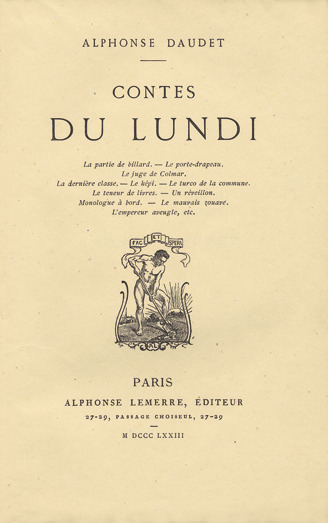
187316450Paris, Lemerre (Imprimerie Claye), 1873 ; in-18 (188118 mm), broché ; (8), 258 pp., (1) f. blanc, couverture imprimée.