Antiquariat.de

15 018 résultats
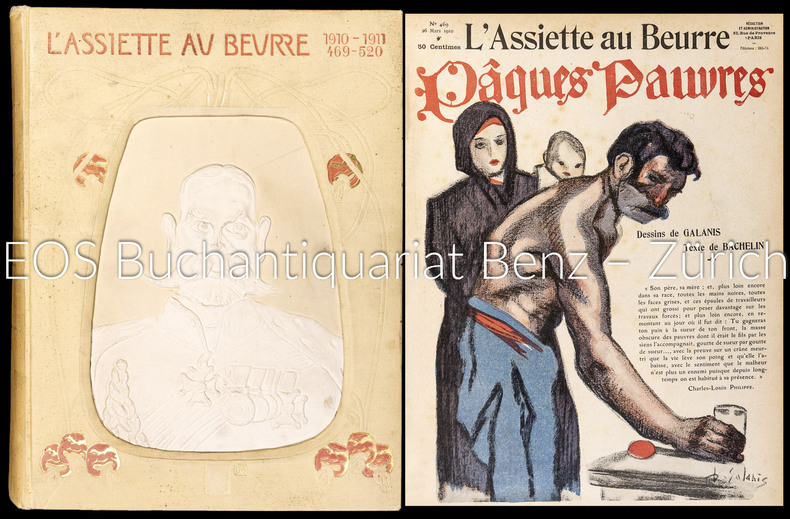
190131051ABParis, Schwarz, S., 1901-1912. 4° (33,5 x 25 cm). Mit über 9600 meist farbigen, teils ganzseitigen oder doppelblattgrossen Lithographien von Steinlen, Vallotton, F. Kupka, K. van Dongen, Gris, Cheret, Redon, Jossot Willette und vielen anderen Künstlern. Inkl. die Almanche für die Jahre 1907, 1908 sowie 3 Sonderhefte "Les Masques de l'Assiette au Beurre" und alle Nummern "hors série". Orginal Jugendstil-Verlegereinbanddecken mit verschiedenen reliefartig blindgeprägten Pappintarsien von V. Preissig. + Wichtig: Für unsere Kunden in der EU erfolgt der Versand alle 14 Tage verzollt ab Deutschland / Postbank-Konto in Deutschland vorhanden +, A 11 Bände, 3 Sonderhefte.
190131051AB11 Bände, 3 Sonderhefte. Paris, Schwarz, S. 1901-1912 4° (33,5 x 25 cm). Mit über 9600 meist farbigen, teils ganzseitigen oder doppelblattgrossen Lithographien von Steinlen, Vallotton, F. Kupka, K. van Dongen, Gris, Cheret, Redon, Jossot Willette und vielen anderen Künstlern. Inkl. die Almanche für die Jahre 1907, 1908 sowie 3 Sonderhefte "Les Masques de l'Assiette au Beurre" und alle Nummern "hors série". Orginal Jugendstil-Verlegereinbanddecken mit verschiedenen reliefartig blindgeprägten Pappintarsien von V. Preissig.
19356911935 - reliure - Sanjian Shuwu 三閒書屋 - Yinyu ji 引玉集 (« Recueil pour attirer le jade ») 木刻五十九幅 - Deuxième tirage, avril 1935 - In-8 (19,5 × 15,5 cm) reliure cartonnée de l'éditeur, dos noir, pièce de titre contrecollée sur le premier plat - 68 pages - 59 reproductions de gravures sur bois soviétiques imprimées au procédé collotype (珂羅版) d'après les tirages originaux fournis par les artistes - Comprend un texte de Chen Jie (陳節), traduction abrégée d'un essai de A. D. Chegodaev consacré à la gravure soviétique contemporaine - Tirage limité à 215 exemplaires, dont 15 exemplaires hors commerce - Diffusion assurée par la librairie Uchiyama (內山書店), Shanghai - Ouvrage en chinois - Avec des œuvres de Dmitri Isidorovich Mitrokhin, A. Kravchenko, N. Piskarev, Vladimir Andreevich Favorsky, P. Pavlinov, A. Goncharov, M. Pikov, Sergei Mikhalovich Mocharov, L. Khizhinsky, Nikolai Vasilievich Alekseev et Sergei Mikhailovich Pozharsky - A PROPOS : Rare anthologie consacrée à la gravure soviétique moderne, publiée à Shanghai par 三閒書屋 et diffusée par la librairie Uchiyama (內山書店). L'ouvrage réunit cinquante-neuf reproductions en collotype de gravures sur bois réalisées par plusieurs figures majeures de l'école russe et soviétique de la gravure des années 1920-1930, parmi lesquelles Vladimir Favorsky, Dmitri Mitrokhin, Alexei Kravchenko et Pavel Pavlinov. Accompagné d'une traduction abrégée par Chen Jie d'un essai de l'historien de l'art soviétique A. D. Chegodaev, ainsi que d'une préface, d'un catalogue des planches et d'une postface, le volume fut conçu comme une introduction à l'estampe contemporaine soviétique pour le public chinois. Témoignage remarquable des échanges artistiques sino-soviétiques dans le Shanghai républicain des années 1930, il s'inscrit dans le contexte du mouvement de la Nouvelle Gravure (新興木刻運動), alors en plein essor sous l'influence des milieux intellectuels de gauche et des réseaux culturels gravitant autour de la librairie Uchiyama et de la figure de Lu Xun. Les reproductions furent réunies à partir de documents et publications soviétiques découverts au début des années 1930, notamment par l'intermédiaire de la revue Graphika. /// ENGLISH: Sanjian Shuwu (三閒書屋) - Yinyu ji (引玉集, “Collection to Draw Forth Jade”): Fifty-Nine Woodcuts (木刻五十九幅) - Second printing, April 1935 - Octavo (19.5 × 15.5 cm), publisher's boards with black spine and mounted title label on upper cover - 68 pages - 59 collotype (珂羅版) reproductions of Soviet woodcuts printed from original impressions supplied by the artists - Includes a text by Chen Jie (陳節), an abridged translation of an essay by A. D. Chegodaev on contemporary Soviet printmaking - Limited edition of 215 copies, including 15 non-commercial presentation copies - Distributed by Uchiyama Bookstore (內山書店), Shanghai - Text in Chinese - Featuring works by Dmitri Isidorovich Mitrokhin, Alexei Kravchenko, Nikolai Piskarev, Vladimir Andreevich Favorsky, Pavel Pavlinov, Aleksandr Goncharov, Mikhail Pikov, Sergei Mikhailovich Mocharov, Leonid Khizhinsky, Nikolai Vasilievich Alekseev and Sergei Mikhailovich Pozharsky. ABOUT: Rare anthology devoted to modern Soviet wood engraving and printmaking, published in Shanghai by Sanjian Shuwu and distributed through Uchiyama Bookstore (內山書店). The volume gathers fifty-nine collotype reproductions of woodcuts by several leading figures of the Russian and Soviet printmaking revival of the 1920s and 1930s, including Vladimir Favorsky, Dmitri Mitrokhin, Alexei Kravchenko and Pavel Pavlinov. Accompanied by Chen Jie's abridged translation of an essay by Soviet art historian A. D. Chegodaev, as well as a preface, plate catalogue and postface, the work was conceived as an introduction to contemporary Soviet printmaking for Chinese readers. A remarkable testimony to Sino-Soviet artistic exchanges in Republican-era Shanghai, it belongs to the context of the New Woodcut Movement (新興木刻運動), then flourishing under the influence of left-wing intellectual circles and cultural networks associated with Uchiyama Bookstore and the figure of Lu Xun. The reproductions were assembled from Soviet books, periodicals and documentary sources discovered in the early 1930s, notably through the journal Graphika. /// 中文:三閒書屋出版 — 《引玉集:木刻五十九幅》 — 1935年4月再版 — 32開(19.5 × 15.5厘米)精裝本,黑色書脊,封面貼書名籤 — 68頁 — 收錄蘇聯木刻作品59幅,以珂羅版工藝依據藝術家提供之原拓本複製印製 — 附陳節摘譯 A. D. Chegodaev(契戈達耶夫)論蘇聯現代版畫藝術之文章 — 限印215部,其中15部為非賣贈送本 — 上海內山書店代售 — 中文版 — 收錄 Dmitri Isidorovich Mitrokhin、Alexei Kravchenko、Nikolai Piskarev、Vladimir Andreevich Favorsky、Pavel Pavlinov、Aleksandr Goncharov、Mikhail Pikov、Sergei Mikhailovich Mocharov、Leonid Khizhinsky、Nikolai Vasilievich Alekseev 及 Sergei Mikhailovich Pozharsky 等藝術家作品。關於本書:本書為三閒書屋於上海出版、由內山書店代售之珍稀蘇聯現代木刻版畫選集。全書收錄59幅以珂羅版精印之蘇聯木刻作品,作者均為1920至1930年代俄羅斯及蘇聯版畫復興運動的重要藝術家,其中包括弗拉基米爾·法沃爾斯基(Vladimir Favorsky)、德米特里·米特羅欣(Dmitri Mitrokhin)、阿列克謝·克拉夫琴科(Alexei Kravchenko)及帕維爾·帕夫利諾夫(Pavel Pavlinov)等人。書中除收錄陳節摘譯之蘇聯藝術史家 A. D. Chegodaev 論文外,尚附序言、圖版目錄及後記,旨在向中國讀者介紹蘇聯當代版畫藝術。本書不僅是研究俄蘇版畫的重要文獻,亦是1930年代上海中蘇藝術交流的珍貴見證。其出版背景與中國新興木刻運動(新興木刻運動)密切相關,反映了左翼知識界、內山書店文化網絡以及魯迅所倡導之版畫思想的深遠影響。書中圖版主要彙集自1930年代初傳入中國之蘇聯書籍、期刊及藝術資料,其中包括《Graphika》等重要出版物。
19402110502150415302Taiko Shrine Shiga Prefecture Hachiman Town 1940. Soft Cover. Fine. Number of copies: 162 copies Taiko Shrine (Shiga Prefecture Hachiman Town) paperback
19662110502151005279Publication of newspaper materials 1966. Soft Cover. Fine. Number of books: 44 Publication of newspaper materials paperback
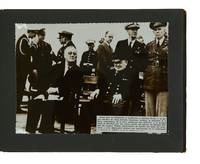
19414132<p>Buenos Aries Ahora Periodico Illustrado. 1941. Oblong. 210x278mm. 32 leaves with 31 black and white photographs pasted in. Each photograph has printed captions text in Spanish pasted onto the bottom edge. The first leaf has the title details printed on white paper pasted in. Each photograph has a glassine protective sheet. Contemporary string bound album covered in maroon cloth and stamped with the name of the owner "Mervyn F. Ryan" on the upper cover with "Ahora Periodico Illustrado" stamped at bottom right corner. Some slight rubbing to extremities and wear to corners but otherwise very good and in excellent condition internally with the photographs especially well preserved. This album or anything like seems to be unrecorded and we have found nothing similar in the auction records. This fascinating collection of is a rare photographic record of the signing of the Atlantic Charter by Roosevelt and Churchill. It was produced by the Argentinian illustrated periodical Ahora. This was a news magazine and these photographs are enlarged versions printed on good quality gloss photographic paper of the pictures used in a series of issues of the magazine between 22nd August and 5th September 1941. There is little staged about these images and they have the immediacy of a true journalistic record. Unsurprisingly Roosevelt and Churchill feature heavily – they were the two big beasts Churchill holding the line in Europe and Roosevelt playing a very delicate domestic game with American public opinion – but there is a strong sense of the broader picture with lots of other figures contributing to the bustle and urgency of a major diplomatic conference. The Atlantic Conference took place between 9th-12th August 1941 at the US Naval Base Argentia in Newfoundland and the declaration issued as a statement rather than as a written document was made on 14th August. Although it was in a sense merely one of a number of similar declarations and agreements made that year the Anglo-Soviet Agreement – Evelyn Waugh's "day of apocalypse for all the world" - had been signed the previous month the Atlantic Charter the name was coined by a British newspaper and it stuck had a greater immediate impact and has had a longer lasting effect. Arguably it led to Pearl Harbour the Japanese interpreting it as an act of aggression; its call for national self-determination set the ball of decolonization rolling; and it laid the foundations for NATO and the United Nations. A new world order was emerging. The recipient of this album given to him we assume by Ahora magazine was Mervyn Ryan an engineer who worked in railways in America Britain India and Argentina. He was in Argentina for most of his working life latterly advising the Argentine government on the management of the previously British-owned railways. With fingers in lots of pies and a prominent member of the British community in Buenos Aries the editors of Ahora no doubt thought that Ryan was the right audience for this specially produced record of a major political event.</p> [Buenos Aries] Ahora Periodico Illustrado. � hardcover
191258474[London, Cambridge University Press, 1912]. Gr.-8°. S. (425-)460, Späterer OKart.-Bd.
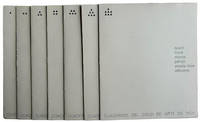
1964LL 638<p><strong><em>"Cuadernos del Ciclo de arte de hoy: Bosch Llucia Mensa Pellsjo Amelia Riera Valbuena.</em></strong> "</p><p>Folio; 7 vols. ALL PUBLISHED. Unbound as issued. With texts by Vicente Aguilera Cerni and Carlos Vivo among others; with original work in each issue; folders with loose sheets; Continuous pagination.</p><p>COMPLETE RUN OF THIS PRACTICALLY UNKNOWN CATALAN MODERN ART PERIODICAL. ALL ISSUES CONTAIN ORIGINAL ART BY DIFFERENT ARTISTS MAKING EACH ISSUE A UNIQUE COPY: Contents: 1. works by ALL participating artists; 2. with 1 work by Bosch; 3. with 1 work by Llucia; 4. with 1 work by Mensa; 5. with 1 work by Owe Pellsjo; 6. with 1 work by Amelia Riera; 7. with 1 work by Valbuena.</p><p><u>Collaborating artists</u>: Bosch i Cruanas Lluis 1929; Llucia Joaquim 1929-1973; Mensa Carlos 1936-1982; Pellsjo Owe 1937; Riera Amelia 1928-2019; Valbuena Francisco; Bosch i Cruañas LluiÌs 1929; LluciaÌ€ Joaquim 1929-1973; Mensa Carlos 1936-1982; Pellsjö Owe 1937; Riera AmeÌ€lia 1928-2019.</p><p>Issue # 1 contains original illustrations by all six of the founding artist collective members: LluÃs Bosch i Cruañas Joaquim Lluciá Carlos Mensa Owe Pellsjö Amèlia Riera and Francisco Valbuena. <u>Accompanying the illustrations are statements about art and form</u> which the collective has associated with six Modernist masters Pablo Picasso Emil Nolde Paul Klee Vasily Kandinsky Piet Mondrian and Wilhelm Lehmbruck. Also in this issue are statements and poems by other Catalan artists.</p><p><strong>EXTREMELY RARE AS WE FIND ONLY ISSUE # 1 ONLY AT MoMA AND NO OTHER COPIES IN LIBRARIES IN THE US</strong>.</p><p># WolrdCat US Libraries: No copies</p> Graficas El Tinell
1969c2305150105xbvkBerlin, überwiegend 1961-1969, minimal auch 2. Hälfte 50er bzw. Anfang 70er Jahre. Insgesamt etwas über 1.500 Original-Fotografien, meist 2 oder 3 meist (seltener 1 oder 4) einseitig auf schwarzen Kartons (meist lose in transparente Fotoecken gesteckt), ausserdem wenige Fotos von Hilfsmittel-Konstruktionszeichnungen und einige Typoskriptblätter zu deren Detailbeschreibung. - Die insgesamt ca. 500 gelochten Trägerkartons befinden sich in 8 grossen Leitz-Ordnern mit handschriftlichen Rückentiteln wie 'Fotos - Dysmelien - u.a.', 'Fotos - Hilfsmittel - Dysmelien' oder 'Fotos - Dysmeliehaus - Jan. 1969'; die Ordner überwiegend alphabetisch nach den Namen der abgebildeten Kinder sortiert.
19294393Pas de couverture 1ère Édition Mermod 1929 Lausanne 23x15,5 cm (plié)
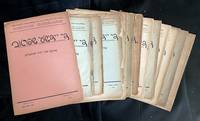
193042139Kiev: Katedr far Yidisher Kultur ba der Ukr. Visnshaftl. Akademye Filologishe Sektsye 1930. Paper Wrappers. 1st edition. Original printed publisher’s color paper wrappers 4to large ca 72-116 columns ca 36-58 pages per issue. 28 cm. In Yiddish. Title translates roughly as “The Yiddish Language.†Succeeded in 1931 by “Afn shprakhfront.â€Di Yidishe Shprakh was a “Yiddish linguistic journal published in Kiev from 1927 to 1930. A bimonthly journal Di yidishe shprakh The Yiddish Language was published by the cooperative publishing house Kultur-lige and was the main philological publication of the Kiev Yiddish academic center. Its editor was the veteran Yiddishist Nokhem Shtif a founder of YIVO who had returned to Kiev from Germany in 1926. The journal’s inaugural issue March–April 1927 was published under the auspices of the Central Yiddish Bureau of the Ukrainian Commissariat for Education. With the next issue Di yidishe shprakh was an organ of the Chair and from July to October 1929 it was an organ of the Institute for Jewish later Proletarian Jewish Culture at the Ukrainian Academy of Sciences. Initially defined as a 'journal for practical Yiddish linguistics' from May to June 1927 it appeared as simply a 'journal for Yiddish linguistics. 'Shtif distinguished three language registers: the vernacular of the old generation partly represented in the works of Sholem Aleichem and predecessors; the highbrow language of modern writers such as Dovid Bergelson; and the contemporary 'culture language' most notably of the press. Although Shtif sought to target speakers of the mass 'culture language' the journal’s circulation hovered around 500 copies read mainly by Yiddish teachers.Apart from Shtif who published articles on various language-planning problems the most active contributors to Di yidishe shprakh were Ber Slutski Ayzik Zaretski Elye Falkovitsh Lipe Reznik and Shimen Dobin. In early 1929 Moscow literary critic Aron Gurshteyn criticized the journal for its purist approach to language planning. In the July–October 1929 issue Shtif published his article 'Di sotsyale diferentsiatsye in yidish' The Social Differentiation in Yiddish heralding an intensification of Soviet linguists’ anti-Hebraist campaign. That issue of Di yidishe shprakh adopted completely reformed Soviet spelling omitting for example final consonant letters.Although the last—twenty-fifth—issue of the journal was dated November–December 1930 it included materials from the First All-Union Yiddish Language Conference convened in Kiev from 8 to 13 February 1931 that issue is present here. Published under the imprint of the Central Publishing House this issue also signaled the demise of the remaining vestiges of the Kiev Kultur-lige. Yoysef Liberberg’s article 'Far parteyishkayt in der yidisher visnshaft-arbet' For a Party Approach to Yiddish Linguistics marked a full break with YIVO scholars particularly with YIVO director Max Weinreich whom Liberberg ridiculed for presenting Yiddish as an emanation of the Ashkenazic Jews’ soul. The Yiddish Language Conference decided to change the name of the journal. Between 1931 and 1939 it appeared sporadically under the title Afn shprakhfront On the Language Front reflecting its new more aggressive and politically charged approach' Gennady Estraikh in YIVO Encyclopedia of Jews in Eastern Europe 2010. For more see David Shneer “Yiddish and the Creation of Soviet Jewish Culture 1918–1930†Cambridge and New York 2004. SUBJECTS: Yiddish language -- Periodicals. Title also listed on covers in Russian “Ievreis'ka Mova†and German “Jiddische Sprachâ€. OCLC: 22840298. Most holdings in OCLC appear to be fragmentary. Covers are browning and fragile as expected but are otherwise very well preserved with very little edgewear. Internal text pages are also toning but remain relatively strong as pulp paper. Very important journal scarce in this degree of completeness Note that Estraikh suggests a circulation of only 500!. B YID-43-5-E. Kiev: Katedr far Yidisher Kultur ba der Ukr. Visnshaftl. Akademye, Filologishe Sektsye unknown
19872111902160500109Not Available 1987. Soft Cover. Fine. Number of publications: Choi Shimbunsha Not Available paperback
1996ZB445765London: The Economist Newspaper Ltd. 1996. volumes 340 to 377 an uninterrupted run of complete volumes mostly in orignal pictorial softcovers ex library good. - If you are reading this this item is actually physically in our stock and ready for shipment once ordered. We are not bookjackers. Buyer is responsible for any additional duties taxes or fees required by recipient's country. Photos available upon request. London: The Economist Newspaper, Ltd. paperback
1972ZB394896London: Journal of Contemporary Asia 1972. volumes 3-5; 14; 18; 21-22; 24-30. 1972-2000. partly bound library markings textually clean & tight PRICE IS FOR THE LOT. - If you are reading this this item is actually physically in our stock and ready for shipment once ordered. We are not bookjackers. Buyer is responsible for any additional duties taxes or fees required by recipient's country. Photos available upon request. London: Journal of Contemporary Asia unknown
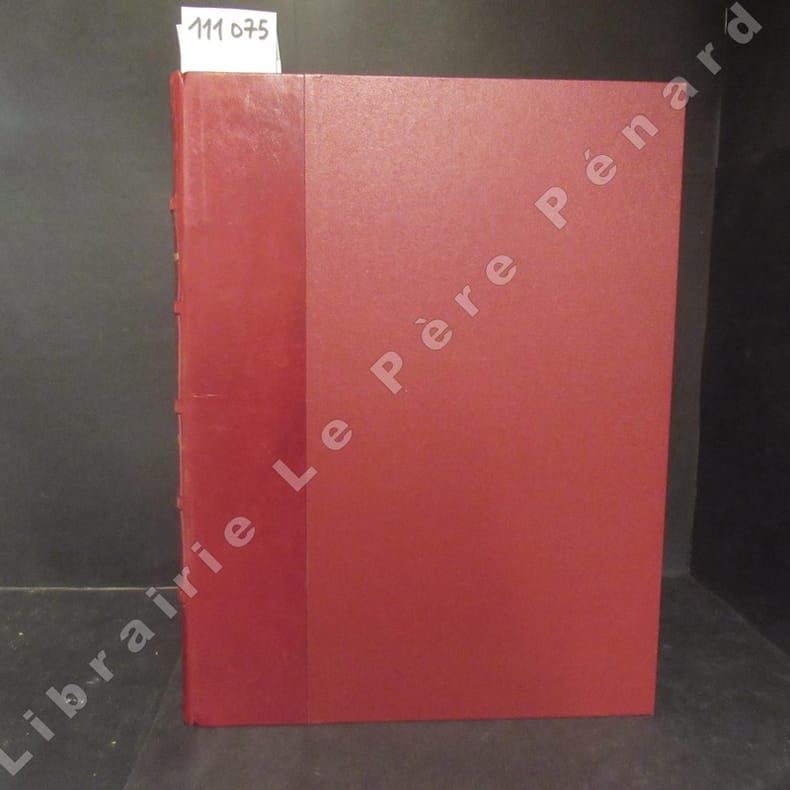
19441110751944 Janvier à Août 1944 - N° 5260/5261 à 5292/5293 - 102e année - Imprimerie de L'Illustration, Bobigny - Revue hebdomadaire illustrée - Grand in-4, demi basane rouge - Dos 5 nerfs avec titre et années en doré - p. 1 à 301 + quelques pages de publicités non paginées - Très nombreuses illustrations et reproductions photographiques en N&B avec quelques planches en couleurs hors texte - Complet, comprenant les numéros rares 5278/5279 (6 et 13 mai 1944 : Le Salon et le Maréchal à Paris) - 5290/5291 (dernier avec le bandeau rouge) puis 5292/5293 où la mention de Jacques de Lesdain comme rédacteur disparaît - Relié avec les premières de couverture et quelques pages de publicités
19378028EBParis, Verve, 1937-1939. Groß-4°. 35,5 x 26,5 cm. 112 Seiten, 8 Blatt. 128 Seiten. 132 Seiten. 140 Seiten. Original-Broschuren in privaten Pappschubern. [5 Warenabbildungen]
19453621BBZürich, 1945-1961. Folio. Mit vielen Illustrationen, zahlreiche davon in Farbe. Originial roter Leinenband (leicht berieben). + Wichtig: Für unsere Kunden in der EU erfolgt der Versand alle 14 Tage verzollt ab Deutschland / Postbank-Konto in Deutschland vorhanden + 23 Bände
1901bf2527Reliure 1901 123 pp. pour ce volume in-4 relié, demi-chagrin à coins. Ouvrage manuscrit, sur simili Japon, à l'encre noir, avec quelques lettrines à l'encre rouge, et 9 dessins d'ornement (cul-de-lampe, etc.) Récit d'une initiation amoureuse et sexuelle, écrit par Tomy (qui avoue 80 ans dans une préface postérieure, et espère que son récit pourra servir à la jeune génération). Il aurait été édité en 1902 par Hirsch et Dutel. Ex-libris prestigieux (Gérard Nordmann). [Réf. : Pia, Enfer, 692 (pour une édition de 1919) ; Perceau 307 ; Dutel 416 et 417 (éditions de 1902 et 1912)] Livraison a domicile (La Poste) ou en Mondial Relay sur simple demande.
19453621BB23 Bände Zürich, 1945-1961. Folio. Mit vielen Illustrationen, zahlreiche davon in Farbe. Originial roter Leinenband (leicht berieben).
199038932Tokyo Japan: Journal Mainichi. New. 1990. Paperback. FREE UPGRADE to Courier/Priority Shipping Upon Request IN STOCK AND IMMEDIATELY AVAILABLE FOR SHIPMENT - FLAWLESS COPY BRAND NEW PRISTINE NEVER OPENED - Text in French and Japanese. 150 works catalogued; many illustrations. Among the artists represented: Millet Diaz Gros David Oudry Pillement and many others. -- with a bonus offer-- . Journal Mainichi paperback
194057682Random House. As New. 1940. Hardcover. FREE UPGRADE to Courier/Priority Shipping Upon Request IN STOCK AND IMMEDIATELY AVAILABLE FOR SHIPMENT - AS NEW THE TEXT BLOCK IS PRISTINE CLEAN UNMARKED AND IN EXCELLENT CONDITION - - 48 pages -- with a bonus offer-- . Random House hardcover
19361138331936 Éditions SPE - 1936-1941 - 39 x 55 cm ( du N° 1 au n° 183 - 8 pages) - 39 x 55 cm (du N° 184 au N° 241 - 4 pages) - 6 volumes en chemise renfermant des numéros dans l'ordre chronologique reliés ensemble par une baguette à relier en plastique noir – Chemise en carton de réalisation amateur avec dos renforcé en toile ou en plastique de couleur mais comportant sur le premier plat une planche de TARZAN sur toute la surface -
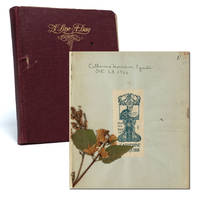
19116011US Germany 1911. Red cloth over card with gilt to front board. All edges stained read. Measuring 200 x 170mm and containing 186 handwritten pages across five years. Dried flowers and theatre program loosely inserted at front. Ownership signature and bookplate of Catherine Harrison Squibb to front pastedown and endpaper with signature of the same to rear endpaper. A research rich and densely written diary the present would be useful in fields including but not limited to intergenerational wealth and its relationship to emotional abuse women's education and educational travel early 20th century reading habits modern friendship courtship and romance and women's increased mobility and travel.<br /> <br /> The second daughter of Charles Fellow Squibb himself the second son of pharmaceutical boss Dr. E. R. Squibb Catherine Harrison Squibb was raised in economic privilege. Her earliest years were spent in the Brooklyn townhouse built for her parents by her grandfather while her teen years were split between her father's historic estate of Welwood and her boarding school in Dresden. At Welwood Charles always considered as "the lesser son" according to his E.R.'s journals followed in his father's controlling footsteps by "purchasing polo ponies setting about learning to jump" and "insisting his children do the same.to maintain the lifestyle of the landed gentry" Belcher. This is confirmed in the opening entry of the diary October 25 1906 near Catherine's 16th birthday where she reports "I rode side-saddle with Rosalie in the morning.rode again in the afternoon ist richerverlobt! er est 62 --- alt!!" The numerous rides do not seem to entirely please Catherine as she hides her frustration in the German parenthetical roughly "he is engaged to be a judge! he is 62 years old!!". Three days later on her birthday she spends her time significantly differently clowning with her brother and aunt and "playing tennis in the afternoon." This becomes something of a tradition as her birthday entries report several times "played tennis all afternoon" She also notes her time in French and German lessons -- with German becoming more frequent during and after her time at school in Dresden especially when she wants to obfuscate her thoughts from unwanted readers. <br /> <br /> If this diary is any indication music and reading travel and school became refuges for Catherine. And she claimed as much time as she could to find independence and develop herself outside of Charles' strict rules. Her reading preferences reflect this desire to immerse herself in Jane Austen's world of social visits and balls where family conflict is eventually smoothed by a woman's exit to a loving partner and home of her own. "Good day!" she writes on April 29 1908 "Stayed in bed all day. I finished Pride & Prejudice and began Emma." This is contrast against her reaction to Charlotte Bronte's work on May 1 of the same year: "Cold & windy. We came in on the 9.30. Aunts at Welwood.had music lesson.I began Jane Eyre. Dismal book!" Her tone and word choice reflect the most happiness in these circumstances whereas riding is reported like a duty -- she may report what time of day and what horse but no expressions of joy accompany them. <br /> <br /> While the diary concludes in 1911 when Catherine is 21 we know that she would return to Europe from 1917-1919 as a nurse in WWI watching her own country battle her beloved Germany. Within the time her father had sold his birthright in Squibb and with "his extravagant lifestyle eating through his money quickly.he was forced to sell Welwood.not long thereafter he went to France" and never returned to the US Belcher. In 1920 she would marry veteran and shoe manufacturing foreman Raymond Pratt moving with him to Pasadena California and becoming a civic leader.<br /> <br /> Much deeper work can be done on Catherine's lives and relationships especially considering the current cultural trends of novels films and series depicting both the glamour and the emotional squalor of the 1%. unknown
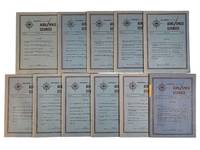
1959223131959. Journal of the Aerospace Sciences 1959 documents foundational research in American aerospace engineering during the early Cold War space race. Published the year after the establishment of NASA and amid intensified U.S. efforts to match Soviet rocket achievements following the 1957 launch of Sputnik these issues contain contemporary technical studies on hypersonic aerodynamics missile stability spacecraft propulsion and planetary trajectory design. Articles by scientists and engineers working at leading research institutions and government laboratories record the theoretical groundwork that would shape the next decade of American spaceflight including early analytical work on Mars trajectories reentry materials and competing propulsion systems for interplanetary travel.<br /> <br /> Journal of the Aerospace Sciences. Volume 26 numbers 1 2 4 5 6 7 8 9 10 11 and 12. New York: Institute of the Aeronautical Sciences 1959. Eleven issues from the journal's 1959 volume lacking only the March issue. The periodical served as the principal research forum of the Institute of the Aeronautical Sciences the professional organization that later became the American Institute of Aeronautics and Astronautics. Together these figures represent a cohort of scientists who would define American spaceflight theory and practice in the decade to come.Archive consists of 11 printed volumes in original wrappers approx. 50-80 pages per issue totaling over 800 pages.<br /> <br /> This archive includes:<br /> <br /> Volume 26 No. 1 January 1959: Features research on turbulent skin-friction drag at supersonic speeds jet nozzle structures nonlinear flutter problems and B-47 gust response. Includes Frank E. Goddard Jr. T.C. Adamson Jr. S.P. Shen.<br /> <br /> Vol. 26 No. 2 February 1959: Contains work on spiked bodies at hypersonic speeds reentry missile stability and panel flutter. Contributors include Seymour M. Bogdonoff E.V. Laitone and Frederick L. Ryder.<br /> <br /> Vol. 26 No. 4 April 1959: Publishes the Twenty-Second Wright Brothers Lecture by Maurice Roy of ONERA France. Other articles include thermal stresses hypersonic shock tunnels and boundary-layer transition.<br /> <br /> Vol. 26 No. 5 May 1959: Focuses on heat transfer at hypersonic speeds lift-drag ratios at supersonic speeds low-thrust spacecraft flight mechanics and chemically reacting boundary layers. Authors include A.J. Hanawalt Clinton E. Brown and Daniel E. Rosner.<br /> <br /> Vol. 26 No. 6 June 1959: Includes Hans Bethe's paper on the ablation of glassy materials structural matrix analysis and free-molecule flow dynamics.<br /> <br /> Vol. 26 No. 7 July 1959: Features M.A. Biot on thermomechanical reciprocity airplane turbulence responses and reentry motion. Also includes research on fatigue stress and laminar dissociated airflows.<br /> <br /> Vol. 26 No. 8 August 1959: Discusses transonic wing/body aerodynamics supersonic plate divergence mercury plasma tunnels and propellant burning models. Includes Hans U. Eckert.<br /> <br /> Vol. 26 No. 9 September 1959: Opens with Richard H. Battin's landmark article on planetary reconnaissance trajectories from MIT along with contributions on missile drag optimization rocket flight variational problems and real-gas flows.<br /> <br /> Vol. 26 No. 10 October 1959: Features George Paul Sutton's comprehensive comparison of interplanetary propulsion systems addressing ion rockets nuclear heating and solar sails. Also includes optimal aircraft climb paths and spherical cap snapping.<br /> <br /> Vol. 26 No. 11 November 1959: Includes studies on flutter energy equations jet-flap compressors porous-wall cooling and actuator disc dynamics in turbomachinery.<br /> <br /> Vol. 26 No. 12 December 1959: Closes the year with work on thermal buckling subsonic turbulence reattachment zoom climb optimization and hypersonic similitude. Contributors include Carl Gazley Jr. Wallace D. Hayes and George Gerard.<br /> <br /> In 1959 the Journal of the Aerospace Sciences served as the official scientific platform for cutting-edge American aerospace research marking the transition from aeronautical to astronautical engineering. That year saw sustained focus on hypersonics ballistic missile trajectories spacecraft propulsion and heat transfer under extreme atmospheric conditions as the U.S. sought to stabilize its strategic position after the 1957 Sputnik crisis and ahead of the 1960 Mercury program. Research in these volumes was underwritten by military contracts NASA collaboration established in 1958 and Cold War exigencies. Light foxing to several wrappers particularly July issue; some edge wear and surface abrasions. Two issues show sticker residue at spine or lower edge. Interiors uniformly clean bindings firm and covers largely bright and intact. Overall very good condition. The studies record the technical environment that produced early American satellite programs and later lunar navigation systems linking university laboratories defense contractors and federal research agencies. unknown
19943704BBPalo Alto (California), Annual Reviews Inc. (Leonard Machlis). 1956 -, 1994). 4°. Original cloth. Most of the volumes with dustwrapper). With owners stamp on the front fly leaf. + Wichtig: Für unsere Kunden in der EU erfolgt der Versand alle 14 Tage verzollt ab Deutschland / Postbank-Konto in Deutschland vorhanden + 39 volumes (volume 1 to 39).