435 résultats
1966RXzz0019(Prag, Ústredni Správa geodézie a kartografie 1966). gr.-2°. 16 S., 58 Kt. gef. mit Text, 9 S., OHLdr. mit Deckel- und Rückenpräg., Rücken am unt. Kapital stärker berieben. Text in tschechischer, englischer und russischer Sprache. With summaries in English and Russian.
191810036München, Georg Müller, 1918. Halbleder, gr-8°, 4 Bl, 270 S., 3 Bl, unbeschnitten, 14 ganzseitige Abbildungen auf Tafeln; -Kanten etwas berieben, Deckel uneinheitlich geblichen, Vorsätze leimschattig und etwas gebräunt.
1918RXzz0893Prag, Staatsdruckerei 1918 ff. gr.-8°. (1918:) XIV, 99 S., (ab 1919:) ca. 2000 S. je Jahrgang, 13 komplette Jahrgänge in 16 Bibl.-HLnBdn., papierbedingt durchgeh. gebräunt Umfangreiche Serie der deutschsprachigen Ausgabe. Die Sammlung erschien vom 4. November 1918 bis zum 9. Sept. 1939.
1995RXzz0794Vaterstetten, Hemmerle (früher verl. von Lerche, Gräfelfing / München) 1955-1995. je Heft 24, später 32 S., illustr., obrosch. Die Zeitschrift erschien von 1950-1977 monatlich, danach bis zu ihrer Einstellung (2001) 6 mal jährlich. Vorhanden sind 280 Hefte (darunter 22 vollständige Jahrgänge) sowie 2 Sonderhefte und 7 Mitteilungen des Adalbert-Stifter-Vereins. - Überaus gehaltvolle und informative Zeitschrift zur Erforschung der Prager und sudetendeutschen Geschichte und Literatur der ersten Jahrhunderthälfte.
190586273Brissago, 24. VI. 1905. Quer-kl.-8vo. 1 p. Postgelaufen.
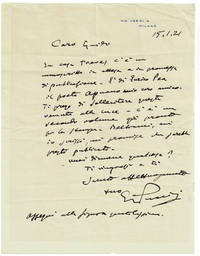
1921100261<p>Milano January 15 1921. 1921. Very good. - Over 60 words penned in Italian on 10-1/2 inch high by 8-1/4 inch wide cream "Via Verdi 4 Milano" stationery. Puccini writes to the publishers Fratelli Treves on behalf of his friend the writer Enrico Pea. He addresses Guido Treves the nephew of the firm's founder Emilio Treves who took over the company upon Emilio's death in 1916. Guido Treves ran the company with his wife Antonietta. Puccini writes that there is a manuscript awaiting publication at Treves' house. It is from his dear friend the Apuan region poet Enrico Pea. He asks that publication be expedited as there is a second volume ready for print. Puccini states that he wrote to Beltrami Giovanni Beltrami the managing director at Fratelli Treves who promised that it would be published soon. Signed "tuo yours G. Puccini" followed by his regards to Guido's wife. Folded horizontally and vertically for mailing the letter is slightly creased at the corners with a couple of minuscule chips to the edges. Once mounted there are remnants of archival tape along the top edge of the verso.</p><p>Giacomo Puccini often enjoyed a table at the Antico Caffe di Simo in Lucca with his friend Enrico Pea.</p><p>The book being discussed by Puccini is without doubt the first volume in Pea's "Trilogia del Moscardino" simply titled "Moscardino" published by Fratelli Treves in 1922. The book was translated into English by Ezra Pound. It was reviewed in the January 1 2005 edition of the New York Review of Books: "A small masterpiece Pea's lyrical autobiographical novel paints a fiery and intimate portrait of an old man through the brushstrokes of his grandson. The passions and tensions between the old eccentric and his brothers play themselves out in mythical sketches before a vivid backdrop of the hills of Lunigiana. Moscardino the first novella of his tetralogy Il romanzo di Moscardino is anarchic and haunting. Pound conducts Pea's vernacular song allowing images to flow from the land the flesh and beyond."</p><p>Little needs to be said about the life of the great Italian opera composer Giacomo Puccini 1858-1924 who composed several of the best known Italian operas. His works include "Manon Lescaut" "La Boheme" "Madama Butterfly" and "Turandot" among many other works.</p><p>The Italian poet novelist playwright and theatre impressario Enrico Pea 1881-1958 produced literary works that are said to be divided into two periods. The first being that of "Moscardino" and the second beginning with "Il Figlioccia" which takes on a softer delicate modulated style.</p> Milano, January 15, 1921.
1944RXzz0412Prag 1879-1944 (= WS. 1944 / 45). je Heft ca. 40-110 S., obrosch. Überaus umfangreiche, nahezu vollständige Serie der Vorlesungs- und Personalstandsverzeichnisse (diese erschienen bis 1939 jährlich separat). Vorhanden sind 112 Vorlesungsverzeichnisse und 49 Hefte »Personalstand« (1882 / 83-1937 / 38).
19443611132Brünn, Selbstverlag, 1897-1944. Mit zahlreichen Karten, Tafeln und Stammtafeln. Lwdbde.
1928STLE0108(Brünn) [ca. 1928]. 26 Orig.-Radierungen, Blattgröße 29 x 41 cm (Titelbl. 27 x 35), Plattengröße 9 x 12 cm bis 20 x 26 cm. Titelbl. stockfl., ansonsten fleckenfreie Abzüge. Dazu eine Porträtphotographie Rektorziks auf Karton montiert. In HLn.-Mappe m. mont. Orig.Radierung BLBL III,424; ÖBL IX,54; Thieme / B. 28,145. Franz Xaver Rektorzik (Brünn 1793-1851) war im Hauptberuf mährisch-schlesischer Gubernial-Expedits-Director in Brünn und betätigte sich aus Liebhaberei als Künstler. In seiner Kunst Autodidakt, fertigte er zahlreiche Radierungen im Geiste der Romantik, die u.a. in der Wiener Albertina und im Kupferstichkabinett in Dresden aufbewahrt werden. Gilt als einer der bedeutendsten Radierer Mährens. Seine hauptsächlichen Motive waren Landschaften und Tiere. Sein Werk umfaßt lediglich 83 Radierungen. Der Brünner Radierer August Potuczek (1882-1936) fertigte Abzüge von den Originalplatten an und gab diese in einer kalligraphisch beschrifteten Mappe in kleiner Auflage heraus. Beigegeben sind ein Zeitungsausschnitt "Franz Xaver Rektorzik. Anläßlich der Neuherausgabe seines Radierwerks durch Maler-Radierer August Potuczek" sowie 6 Postkarten mit Reproduktionen nach Radierungen aus dem Mappenwerk.Sohn e. Theatermalers, seit 1809 im Staatsdienst, 1832 Gubernial-Expeditionsdirektor. In seiner Kunst Autodidakt, fertigte er zahlreiche Radierungen im Geiste der Romantik, die u.a. in der Wiener Albertina und im Kupferstichkabinett in Dresden aufbewahrt werden. Gilt als einer der bedeutendsten Radierer Mährens. - DIESES OBJEKT UNTERLIEGT DER DIFFERENZBESTEUERUNG.
191086274Mailand [Poststempel], 29. X. 1910. Quer-kl.-8vo. 1 p. Postgelaufen.