56 résultats
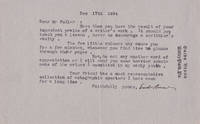
193434092Ridley Park PA: December 17th 1934. 1934. Very good. - 89 words typed on a sheet of his gray personalized letterhead 5 inches high by 8 inches wide with his address printed down the right margin. Signed "Guido Bruno". Folded once for mailing. Near fine. <p>Bruno's letter is sending examples of his work to a "Mr. Fuller". We speculate that this might be Buckminster Fuller who was not yet an architect at this time and who lived in Greenwich Village and knew the same people and frequented the same clubs and bars as Guido Bruno. "Here then you have the result of your imprudent praize sic of a writer's work. It should you sic teach you a lesson never to encourage a scribbler's vanity. The few little volumes may amuse you for a few minutes whenever you find time to glanze sic through their pages."<p>Guido Bruno 1884-1942 who at this date had moved to Ridley Park Pennsylvania where his adopted daughter lived was a well known Greenwich Village character and small-press publisher sometimes called "the Barnum of Bohemia". He was based at his "Garret on Washington Square" where tourists could pay an admission fee to observe "genuine Bohemian" artists at work. From the garret he published little magazines such as Bruno's Weekly Bruno's Monthly Bruno's Bohemia and Bruno Chap Books. Among authors he published were Alfred Kreymborg Djuna Barnes Marianne Moore Alfred Douglas and Sadakichi Hartmann. He was also a close associate of Frank Harris. For a brief time he operated the Little Thimble Theater with Charles Edison. Ridley Park, PA: December 17th, 1934. unknown
172015700AB1720. N.p. 1720. 305 : 345 cm. 5 engraved maps mounted on linen In calf slipcase. Parts 6 to 10 from Section B Showing part of regions of Boleslav Regni Hradec in the north east and part of Silesia. unknown
1598955341598. 1598. Fair. - An original holograph document attractively penned in an unknown hand on 13-1/4 inch high by 15-5/8 inch wide cream paper. Fifteen lines boldly penned with several flourishes signed "Christophorus Popel Barro a Lobcowicz" by Christoph Popel Baron of Lobkowicz who was Chief Steward of Bohemia under the Holy Roman Emperor Rudolf II. The document is further annotated with 8 lines penned across the center of the verso with an unidentified signature and another 8 lines penned vertically on the verso above the center panel also with an unidentified signature. The faint remnants and outline of a red wax seal are centered at the top and bottom edges of the verso. Folded twice vertically and four times horizontally with several tears along the folds. There is some foxing present especially at the top and bottom. Good. <p>The Chief Steward of Bohemia under Emperor Rudolf II Christoph Popel Baron of Lobkowicz 1549-1609 was a close friend of the celebrated court painter Hans von Aachen. Lobkowicz who was known for his language and diplomatic skills was tasked with welcoming visitors from within and without the Holy Roman Empire to the Emperor's Court and for negotiating alliances in the war against the Turks. Lobkowicz was responsible for the peace negotiations with the Polish King Sigismund. Lobkowicz spent considerable sums on art work for his residence and commissioned jewelry precious watches and valuable objects. He was buried in the chapel in the Prague Cathedral. [1598]. unknown
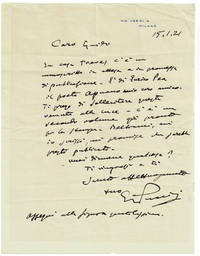
1921100261<p>Milano January 15 1921. 1921. Very good. - Over 60 words penned in Italian on 10-1/2 inch high by 8-1/4 inch wide cream "Via Verdi 4 Milano" stationery. Puccini writes to the publishers Fratelli Treves on behalf of his friend the writer Enrico Pea. He addresses Guido Treves the nephew of the firm's founder Emilio Treves who took over the company upon Emilio's death in 1916. Guido Treves ran the company with his wife Antonietta. Puccini writes that there is a manuscript awaiting publication at Treves' house. It is from his dear friend the Apuan region poet Enrico Pea. He asks that publication be expedited as there is a second volume ready for print. Puccini states that he wrote to Beltrami Giovanni Beltrami the managing director at Fratelli Treves who promised that it would be published soon. Signed "tuo yours G. Puccini" followed by his regards to Guido's wife. Folded horizontally and vertically for mailing the letter is slightly creased at the corners with a couple of minuscule chips to the edges. Once mounted there are remnants of archival tape along the top edge of the verso.</p><p>Giacomo Puccini often enjoyed a table at the Antico Caffe di Simo in Lucca with his friend Enrico Pea.</p><p>The book being discussed by Puccini is without doubt the first volume in Pea's "Trilogia del Moscardino" simply titled "Moscardino" published by Fratelli Treves in 1922. The book was translated into English by Ezra Pound. It was reviewed in the January 1 2005 edition of the New York Review of Books: "A small masterpiece Pea's lyrical autobiographical novel paints a fiery and intimate portrait of an old man through the brushstrokes of his grandson. The passions and tensions between the old eccentric and his brothers play themselves out in mythical sketches before a vivid backdrop of the hills of Lunigiana. Moscardino the first novella of his tetralogy Il romanzo di Moscardino is anarchic and haunting. Pound conducts Pea's vernacular song allowing images to flow from the land the flesh and beyond."</p><p>Little needs to be said about the life of the great Italian opera composer Giacomo Puccini 1858-1924 who composed several of the best known Italian operas. His works include "Manon Lescaut" "La Boheme" "Madama Butterfly" and "Turandot" among many other works.</p><p>The Italian poet novelist playwright and theatre impressario Enrico Pea 1881-1958 produced literary works that are said to be divided into two periods. The first being that of "Moscardino" and the second beginning with "Il Figlioccia" which takes on a softer delicate modulated style.</p> Milano, January 15, 1921.
elala2755Ghent: la Veuve Pierre De Goesin 1744. First Edition. Fête book celebrating the inauguration at Ghent on April 27 1744 of Maria Theresa as Countess of Flanders. The Archduchess of Austria and Queen of Hungary and Bohemia was presented on the occasion with a magnificent Ghent-made gown with a garniture of Flemish lace. She is shown wearing the gown in an oil painting by Martin Van Meytens which hangs in the city town hall. Cohen-De Ricci 868. Landwehr Splendid Ceremonies 209. Vinet 685. folio. pp. 43. title & head of dedication in red & black. woodcut arms on title. engraved frontis. portrait of Maria Theresa by Frans Pilsen after a painting by Philips Karel Marissal & large folding double-page engraved plate of the inauguration ceremony by Pilsen after David ‘t Kindt. contemporary calf imperial arms on upper cover arms of Flanders on lower cover covers with surface abrasions spine repaired at head & foot wormholes in outer margin – those in first few leaves neatly filled in the folding plate with half a dozen unobtrusive wormholes & some reinforcements of the folds but in very good condition nonetheless Ghent: la Veuve Pierre De Goesin, 1744 unknown
1769elala199Vienna: Johann Thomas Edlen von Trattnern 1769. 1769. folio. pp. 8 p.l. 282 lvi. 27 engravings in the text & 3 folding engraved plates incl. in pagination. woodcut ornaments & initials. full contemporary dark brown morocco lettered in gilt on upper cover: Constitutio Criminalis Theresiana Spectans Ad Antiquam Civitatem Voitsbergensem 1773 Antonius Josephus Schilcher P.T. Judex Civitatis Voitsberga bit rubbed some browning & foxing marginal dampstain to last section containing engravings folding plates dampstained & repaired -1 with some loss of text. Inscribed on front blank: "Mathias SchuemackerSuperioris Austriae Jo. J. Syndrins Voitsberga 1773". First Edition of the famous criminal code of Maria Theresa which redefined torture as "a subsidiary means of eliciting truth". Torture could be applied to obtain confessions only in cases where condemnation would have involved capital or severe corporal punishment. A remarkable publication including graphic illustrations of instruments and methods of torture thumb-screws stocks racks burning candles leg vices winches the Viennese shoe with detailed and precise instructions on their use. According to the Encyclopaedia Britannica 11th Edn. this illustrated edition was suppressed by Prince Kaunitz chancellor of state and advisor to the Empress a few days after its appearance. Torture was formally abolished in the empire in 1776. Signed by Authors. 1st Edition. Vienna: Johann Thomas Edlen von Trattnern, 1769. hardcover