Heckel, Erich - 1883 Döbeln - Radolfzell 1970Antiquariat.de

1 261 résultats
EN-146o.J. Lithographie, 1922, auf chamoisfarbenem Velin mit Wasserzeichen: Johann Wilhelm, mit Bleistift bezeichnet ?1. Druck?, signiert, datiert und bezeichnet ?Erich Heckel 22 / Probe?. Darstellungsgröße 49:38,3 cm, Blattgröße 64,5:50,2 cm. - Von großer Seltenheit! Eines von drei bekannten Exemplaren des ersten Zustandes. - Provenienz: Sammlung Hermann Gerlinger, Würzburg, Lugt 6032. - Literatur: Annemarie und Wolf-Dieter Dube, Erich Heckel: Das graphische Werk, Bd. 2: Radierungen, Lithographien, New York 1965, WVZ-Nr. L 270 I a (von III b); Renate Ebner, Andreas Gabelmann, Erich Heckel. Werkverzeichnis der Druckgraphik, Bd. 2: 1914-1968, München 2021, WVZ-Nr. 784 L I a (von III b); Heinz Spielmann (Hrsg.), Die Maler der Brücke. Sammlung Hermann Gerlinger, Stuttgart 1995, S. 312, SHG-Nr. 480 (m. Abb.); Hermann Gerlinger, Katja Schneider (Hrsg.), Die Maler der Brücke. Bestandskatalog Sammlung Hermann Gerlinger, Halle/Saale 2005, S. 222, SHG-Nr. 502 (Abb. S. 223). - Austellungen: Schleswig-Holsteinisches Landesmuseum, Schloss Gottorf, Schleswig (Dauerleihgabe aus der Sammlung Hermann Gerlinger, 1995-2001); Kunstmuseum Moritzburg, Halle an der Saale (Dauerleihgabe aus der Sammlung Hermann Gerlinger, 2001-2017); Buchheim Museum, Bernried (Dauerleihgabe aus der Sammlung Hermann Gerlinger, 2017-2022); Erich Heckel, Einfühlung und Ausdruck, Buchheim Museum, Bernried, 2020/2021, (Abb. S. 292). [2 Warenabbildungen]
EN-144o.J. Kohle, auf Bütten mit Wasserzeichen: MICHALLET FRANCE, mit Bleistift signiert und datiert ?George Grosz / 1937?. Blattgröße 63,2:48,1 cm. Zu den Rändern hin leicht fleckig. - Provenienz: Villa Grisebach, Berlin, A 254, Lot 1197, November 2015; Privatsammlung, Hessen.
EN-141o.J. Feder in Schwarz und Aquarell in Rot, auf chamoisfarbenem Velin, monogrammiert, bezeichnet und datiert ?peag / Berlin (19)30?, auf Karton montiert, dort betitelt, bezeichnet und datiert ?Café Lunte? / Orig. Zchg. / Berlin 1930? sowie signiert ?Peter-Anton Gekle.? - Dargestellt ist der Blick in das legendäre Café Lunte, dem Treffpunkt der Berliner Bohème der 1920er bis 1930er Jahre in der Eislebener Straße 11, an der Wand der dadaistische Spruch ?Anti chianti Chianti-Christ!?. - Die Eislebener Straße in Charlottenburg wurde ab 1893 angelegt und nach der Stadt Eisleben benannt, dem Geburts- und Sterbeort Martin Luthers. Sie ist nur 270 Meter lang und stellt eine der Verbindungsstraßen zwischen der Rankestraße und der Nürnberger Straße dar. Schon Anfang des 20. Jahrhunderts war die ?Eislebener? eine gutbürgerliche Adresse. Wie viele andere der umliegenden Straßen war auch die Eislebener Straße in den 1920er und frühen 1930er Jahren geprägt von der künstlerischen Bohème. In einem ehemaligen Zigarrenladen in der Eislebener Straße 11 residierte das kleine Café ?Die Lunte?. Man nannte sie ?wohl die verruchteste, billigste der Künstlerkneipen?, der renommierte Fotograf Umbo (d.i. Otto Umbehr, 1902-1980) fotografierte hier.
191086274Mailand [Poststempel], 29. X. 1910. Quer-kl.-8vo. 1 p. Postgelaufen.
1769elala199Vienna: Johann Thomas Edlen von Trattnern 1769. 1769. folio. pp. 8 p.l. 282 lvi. 27 engravings in the text & 3 folding engraved plates incl. in pagination. woodcut ornaments & initials. full contemporary dark brown morocco lettered in gilt on upper cover: Constitutio Criminalis Theresiana Spectans Ad Antiquam Civitatem Voitsbergensem 1773 Antonius Josephus Schilcher P.T. Judex Civitatis Voitsberga bit rubbed some browning & foxing marginal dampstain to last section containing engravings folding plates dampstained & repaired -1 with some loss of text. Inscribed on front blank: "Mathias SchuemackerSuperioris Austriae Jo. J. Syndrins Voitsberga 1773". First Edition of the famous criminal code of Maria Theresa which redefined torture as "a subsidiary means of eliciting truth". Torture could be applied to obtain confessions only in cases where condemnation would have involved capital or severe corporal punishment. A remarkable publication including graphic illustrations of instruments and methods of torture thumb-screws stocks racks burning candles leg vices winches the Viennese shoe with detailed and precise instructions on their use. According to the Encyclopaedia Britannica 11th Edn. this illustrated edition was suppressed by Prince Kaunitz chancellor of state and advisor to the Empress a few days after its appearance. Torture was formally abolished in the empire in 1776. Signed by Authors. 1st Edition. Vienna: Johann Thomas Edlen von Trattnern, 1769. hardcover
EN-145o.J. Lithographie, 1922, auf chamoisfarbenem Bütten, mit Bleistift nummeriert ?40/40? und signiert ?Grosz?. Darstellungsgröße 33,3:37,5 cm, Blattgröße 50:65,5 cm. Kleiner hinterlegter Einriss im rechten Blattrand, ansonsten sehr schönes Exemplar. - Literatur: Dückers E 79. ? Nach Dückers vermutlich im Selbstverlag, in einer Gesamtauflage von mindestens 53 Exemplaren, erschienen. Die Darstellung ist unter dem genannten Titel abgebildet in ?Ecce Homo?, 1923, Taf. 67, und wird dort ebenfalls auf 1922 datiert. [2 Warenabbildungen]
AN EXCEPTIONAL COPY OF THIS IMPORTANT LIVRE D'ARTISTE, WITH PENCIL-SIGNED ETCHINGS BY MAURICE UTRILLO AND HIS WIFE, LUCIE VALORE, AND UNSIGNED ETCHINGS BY PICASSO AND BERNARD LAMOTTE. This book is a collection of poems about Montmartre by Vertex (there is even a poem dedicated to Utrillo and Valore!), illustrated with reproductions of drawings by many artists associated with Montmartre, including Marie Laurencin, Dunoyer de Segonzac, Dignimont, Laprade, Charles GuÈrin, Roger Wild. and Vertex himself. Also illustrated with FOUR LOOSE HORS-TEXTE ETCHINGS, one each by Utrillo, Valore, Picasso, and Bernard Lamotte.. All four etchings are signed in the plate. THIS IS AN OUTSTANDING ASSOCIATION COPY printed for Robert Conchon. On the verso of the title-page is a fine presentation inscription to Conchon underneath the reproduced drawing by Vertex, which he has colored by hand in this copy. Furthermore, THE ETCHINGS BY UTRILLO AND VALORE ARE SIGNED IN PENCIL BY THE ARTISTS. Maurice Utrillo (1883-1955), among the greatest of modern artists, married his fellow artist (and former patron) Lucie Valore (1878-1967) in 1935, after she had been widowed. Utrillo made very few original prints, and signed impressions are of the utmost rarity. From a total edition of 110 numbered copies, this is ONE OF ONLY 15 BEAUTIFULLY PRINTED ON FINE MARAIS WOVE PAPER. From the private collection of Sylvan Cole (1918-2005), the leading American print dealer. Large folio. Loose as issued in wraps. UNCUT AND UNOPENED. A few creases to extreme margin of half-title, else FINE AND BRIGHT. In the original (somewhat worn) board chemise and slipcase. Utrillo was surely Montmartre's most emblematic artist, and the signed etchings by him and his wife make this a truly wonderful book. Since these etchings are loose (as issued), they are ready for framing.
1928STLE0108(Brünn) [ca. 1928]. 26 Orig.-Radierungen, Blattgröße 29 x 41 cm (Titelbl. 27 x 35), Plattengröße 9 x 12 cm bis 20 x 26 cm. Titelbl. stockfl., ansonsten fleckenfreie Abzüge. Dazu eine Porträtphotographie Rektorziks auf Karton montiert. In HLn.-Mappe m. mont. Orig.Radierung BLBL III,424; ÖBL IX,54; Thieme / B. 28,145. Franz Xaver Rektorzik (Brünn 1793-1851) war im Hauptberuf mährisch-schlesischer Gubernial-Expedits-Director in Brünn und betätigte sich aus Liebhaberei als Künstler. In seiner Kunst Autodidakt, fertigte er zahlreiche Radierungen im Geiste der Romantik, die u.a. in der Wiener Albertina und im Kupferstichkabinett in Dresden aufbewahrt werden. Gilt als einer der bedeutendsten Radierer Mährens. Seine hauptsächlichen Motive waren Landschaften und Tiere. Sein Werk umfaßt lediglich 83 Radierungen. Der Brünner Radierer August Potuczek (1882-1936) fertigte Abzüge von den Originalplatten an und gab diese in einer kalligraphisch beschrifteten Mappe in kleiner Auflage heraus. Beigegeben sind ein Zeitungsausschnitt "Franz Xaver Rektorzik. Anläßlich der Neuherausgabe seines Radierwerks durch Maler-Radierer August Potuczek" sowie 6 Postkarten mit Reproduktionen nach Radierungen aus dem Mappenwerk.Sohn e. Theatermalers, seit 1809 im Staatsdienst, 1832 Gubernial-Expeditionsdirektor. In seiner Kunst Autodidakt, fertigte er zahlreiche Radierungen im Geiste der Romantik, die u.a. in der Wiener Albertina und im Kupferstichkabinett in Dresden aufbewahrt werden. Gilt als einer der bedeutendsten Radierer Mährens. - DIESES OBJEKT UNTERLIEGT DER DIFFERENZBESTEUERUNG.
16676759Paris, Charles Angot, 1667, 3 tomes in-4 veau brun dos-à-nerfs très décoré et doré titre doré roulette sur les coupes tranche rouge (reliure de l'époque) ; (24) pp. y compris le titre, 540 pp., 47 figures. Lettres de Mr Descartes, où sont expliquées plusieurs belles difficultez touchant ses autres ouvrages. Nouvelle édition reveue et corrigée. Tome second. Paris, Charles Angot, 1666 ; (16), 564, (4) pp. et près d'une centaine de figures ou croquis. Lettres de Mr Descartes. Où il répond à plusieurs difficultez que luy ont esté proposées sur la Dioptrique, la Géométrie, et sur plusieurs autres sujets. Tome Troisième et dernier. Paris, Charles Angot, 1667 ; (24), 646 pp. et près de 180 figures ou croquis.
elala2755Ghent: la Veuve Pierre De Goesin 1744. First Edition. Fête book celebrating the inauguration at Ghent on April 27 1744 of Maria Theresa as Countess of Flanders. The Archduchess of Austria and Queen of Hungary and Bohemia was presented on the occasion with a magnificent Ghent-made gown with a garniture of Flemish lace. She is shown wearing the gown in an oil painting by Martin Van Meytens which hangs in the city town hall. Cohen-De Ricci 868. Landwehr Splendid Ceremonies 209. Vinet 685. folio. pp. 43. title & head of dedication in red & black. woodcut arms on title. engraved frontis. portrait of Maria Theresa by Frans Pilsen after a painting by Philips Karel Marissal & large folding double-page engraved plate of the inauguration ceremony by Pilsen after David ‘t Kindt. contemporary calf imperial arms on upper cover arms of Flanders on lower cover covers with surface abrasions spine repaired at head & foot wormholes in outer margin – those in first few leaves neatly filled in the folding plate with half a dozen unobtrusive wormholes & some reinforcements of the folds but in very good condition nonetheless Ghent: la Veuve Pierre De Goesin, 1744 unknown
In-folio; pp. (8), 146, (2) (l’ultima carta rifilata) completo delle 15 grandi tavole ripiegate incise su rame, di cui 13 carte geografiche incise da Winkler (Veduta degli Orti, Carta geografica di tutta la Boemia, Regio Egrana, Provincia pilsensis, Provincia prachinensis e le altre Province); graziose testatine xilografiche. Legatura in mezza pelle con angoli (dorao parzialmente lacunoso).Prima e unica edizione, assai rara da trovarsi completa, di questa interessante opera storica, geografica e topografica assai particolareggiata sulla Boemia e le sue province. Consuete leggere fioriture;due restauri al margine bianco, una gora di umidità molto leggera al front. Le tavole tutte in buone condizioni.
1944RXzz0412Prag 1879-1944 (= WS. 1944 / 45). je Heft ca. 40-110 S., obrosch. Überaus umfangreiche, nahezu vollständige Serie der Vorlesungs- und Personalstandsverzeichnisse (diese erschienen bis 1939 jährlich separat). Vorhanden sind 112 Vorlesungsverzeichnisse und 49 Hefte »Personalstand« (1882 / 83-1937 / 38).
19443611132Brünn, Selbstverlag, 1897-1944. Mit zahlreichen Karten, Tafeln und Stammtafeln. Lwdbde.
1598955341598. 1598. Fair. - An original holograph document attractively penned in an unknown hand on 13-1/4 inch high by 15-5/8 inch wide cream paper. Fifteen lines boldly penned with several flourishes signed "Christophorus Popel Barro a Lobcowicz" by Christoph Popel Baron of Lobkowicz who was Chief Steward of Bohemia under the Holy Roman Emperor Rudolf II. The document is further annotated with 8 lines penned across the center of the verso with an unidentified signature and another 8 lines penned vertically on the verso above the center panel also with an unidentified signature. The faint remnants and outline of a red wax seal are centered at the top and bottom edges of the verso. Folded twice vertically and four times horizontally with several tears along the folds. There is some foxing present especially at the top and bottom. Good. <p>The Chief Steward of Bohemia under Emperor Rudolf II Christoph Popel Baron of Lobkowicz 1549-1609 was a close friend of the celebrated court painter Hans von Aachen. Lobkowicz who was known for his language and diplomatic skills was tasked with welcoming visitors from within and without the Holy Roman Empire to the Emperor's Court and for negotiating alliances in the war against the Turks. Lobkowicz was responsible for the peace negotiations with the Polish King Sigismund. Lobkowicz spent considerable sums on art work for his residence and commissioned jewelry precious watches and valuable objects. He was buried in the chapel in the Prague Cathedral. [1598]. unknown
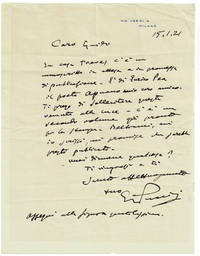
1921100261<p>Milano January 15 1921. 1921. Very good. - Over 60 words penned in Italian on 10-1/2 inch high by 8-1/4 inch wide cream "Via Verdi 4 Milano" stationery. Puccini writes to the publishers Fratelli Treves on behalf of his friend the writer Enrico Pea. He addresses Guido Treves the nephew of the firm's founder Emilio Treves who took over the company upon Emilio's death in 1916. Guido Treves ran the company with his wife Antonietta. Puccini writes that there is a manuscript awaiting publication at Treves' house. It is from his dear friend the Apuan region poet Enrico Pea. He asks that publication be expedited as there is a second volume ready for print. Puccini states that he wrote to Beltrami Giovanni Beltrami the managing director at Fratelli Treves who promised that it would be published soon. Signed "tuo yours G. Puccini" followed by his regards to Guido's wife. Folded horizontally and vertically for mailing the letter is slightly creased at the corners with a couple of minuscule chips to the edges. Once mounted there are remnants of archival tape along the top edge of the verso.</p><p>Giacomo Puccini often enjoyed a table at the Antico Caffe di Simo in Lucca with his friend Enrico Pea.</p><p>The book being discussed by Puccini is without doubt the first volume in Pea's "Trilogia del Moscardino" simply titled "Moscardino" published by Fratelli Treves in 1922. The book was translated into English by Ezra Pound. It was reviewed in the January 1 2005 edition of the New York Review of Books: "A small masterpiece Pea's lyrical autobiographical novel paints a fiery and intimate portrait of an old man through the brushstrokes of his grandson. The passions and tensions between the old eccentric and his brothers play themselves out in mythical sketches before a vivid backdrop of the hills of Lunigiana. Moscardino the first novella of his tetralogy Il romanzo di Moscardino is anarchic and haunting. Pound conducts Pea's vernacular song allowing images to flow from the land the flesh and beyond."</p><p>Little needs to be said about the life of the great Italian opera composer Giacomo Puccini 1858-1924 who composed several of the best known Italian operas. His works include "Manon Lescaut" "La Boheme" "Madama Butterfly" and "Turandot" among many other works.</p><p>The Italian poet novelist playwright and theatre impressario Enrico Pea 1881-1958 produced literary works that are said to be divided into two periods. The first being that of "Moscardino" and the second beginning with "Il Figlioccia" which takes on a softer delicate modulated style.</p> Milano, January 15, 1921.
[500 legaturaOrazioni-Volgare] (cm.25,3 x 17,5) interessante legatura originale in tutta pergamena tinteggiata color porpora, doppi filetti in oro ai piatti con fregi angolari e al centro, ma molto sbiaditi e poco leggibili, come pure il colore è in gran parte perduto. -cc. 4 nn., cc. 116; cc. 192, cc. 5 nn. (la 116 e la 192 sono bianche al verso. Elegante corsivo fregi e capilettera figurati. Esemplare particolare, curiosamente rilegato con la prima parte in fine. L'opera inizia con il frontis e la parte seconda, la prima parte, legata in fine, non contiene la dedica al Contarini e il frontis, le 5 carte con la "tavola" sono in fine. Non ne sappiamo il motivo ma l''opera è nata così, con i suoi capitelli originali tinteggiati in viola rossastro. E' senza dubbio un esemplare di dedica, unico così composto, con ben 6 cm. di margine in basso e di lato, stampato su carta grave nitidamente impresso e molto bello veramente. Piatti della legatura ottimamente restaurati per piccole mancanze alla cerniera e agli angoli. Seconda edizione assai pregiata, corretta e dimolto ampliata rispetto alla prima del 1561. Questa raccolta ebbe parecchie ristampe, la nostra ha la dedica del Sansovino al Sig. Paolo Contarini; contiene 51 orazioni sui più svariati argomenti civili e militari. Lingua toscana, libertà di Siena, lotta contra il Turco, fatti di Boemia, Urbino, Ferrara, Lucca, Genova, Inghilterra, Fiandra ecc. Fra i molti autori: il Della Casa, Tolomei, Trissino, Guidiccioni, ecc. L' orazione funebre del Bembo è del Varchi. Edizione abbastanza rara, manca a Razzolini, Poggiali, Choix, Passano ed Adams. * Gamba 1547, in nota con ampio commento; Cat. Libri (1861) n° 6465; Bertoloni " Nuova Serie de Testi di Lingua" 1846, pag. 119 n° G 1054, * BM. STC 607.[f81] Libro
17926102Mit 28 Abb. auf 5 gefalt. gest. Tafeln. Berlin, A. Mylius, 1789. 8vo. (19,4 x 11,4 cm). 77 S. - Vorgebunden: Rösler, Karl Anton. Bergmännische Nachrichten über die Gebirge und den Bergbau zu Joachimsthal. Nebst einigen Nachrichten über die Gebirge auf der Straße von Prag bis Joachimsthal, hrsg. von Johann Mayer. Dresden, Walther, 1792. 8vo. 126 S. Marmorierter Pappband d. Zt. mit zwei farbigen Rückenschildern. [6 Warenabbildungen]
190586273Brissago, 24. VI. 1905. Quer-kl.-8vo. 1 p. Postgelaufen.
in-8, (150x100mm), ff. 110, (2), legatura coeva in pergamena floscia, titolo ms al dorso. Impresa tipografica al frontespizio, caratt. corsivo. Prima edizione del volgarizzamento (senza indicazione del traduttore) delle ''Historiae Bohemicae'' di Enea Silvio Piccolomini (edite a Roma nel 1475). Quest'opera è tra i suoi lavori storici più notevoli, composto poco prima dell'assunzione al pontificato e felicemente intessuto di aneddoti e di reminiscenze personali, frutto del soggiorno da lui fatto in quelle regioni in qualità di legato pontificio nel 1452. Una delle non molte edizioni impresse da Bartolomeo detto l'Imperatore nel corso dei soli dieci anni della sua attività tipografica a Venezia. Esemplare genuino (forellino di tarlo al margine interno del titolo).. BMC STC p. 323. Adams, P 1346. Graesse, I, p. 27..
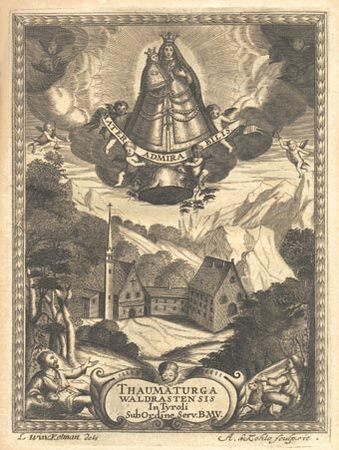
17084354Vetero-Pragae (Prague), Wolfgang Wickhart, 1708 ; in-4 ; cartonnage de papier marbré, pièce de titre havane (reliure fin XVIIIe - début XIXe siècle) ; (4) ff., 167 pp., (1) p. d'errata ; 8 magnifiques planches hors-texte de Johann Leonhard Winkelman, gravées par Antoine Kohl.
1627RXzz0200(Wien in Oesterreich, Gregor Gelbhar) 1627. 4 Bl., 506 S., 6 Bl., Titelkupfer (kais. Wappen), rücks. d. gest. Wappen Böhmens. PgtBd. d. Zt., Schließbänder fehlen, hintere Ecke unten stärker abgerieben, Titelbl. mit etw. Textverlust außen, alt restaur., ein Bl. d. Vorrede durch Photokopie ersetzt. Mit vielen u. umfangreichen Anmerkungen von alter Hand, meist zur Erläuterung u. Verdeutlichung des gedruckten Textes.- Die nach dem Sieg über die böhmischen Truppen am Weißen Berg (1620) erlassene Landes-Ordnung ersetze die Konföderationsakte, Böhmen wurde damit als fester Bestandteil der habsburgischen Erblande im monarchisch-absolutistischen Sinn umgestaltet.
1890j2p3c18xbvkParis, 'B. K. Edit.', not dated (early 1890ies). White stereo-photograph frames with blue text 'LE MOULIN ROUGE' in ornaments at both sides and a small red windmill at the top, the coloured rear (unveiling its effects only against a light) is originally protected (within the frames) by thin halftransparent paper; 9 x 18 cm overall.
1890j2p3c16xbvkParis, 'B. K. Edit.', not dated (around 1890). White stereo-photograph frames with blue text 'LE MOULIN ROUGE' in ornaments at both sides and a small red windmill at the top, the coloured rear (unveiling its effects only against a light) is originally protected (within the frames) by thin halftransparent paper; 9 x 18 cm overall.
0138050 Reliure Dédicacé par l'auteur
1995RXzz0794Vaterstetten, Hemmerle (früher verl. von Lerche, Gräfelfing / München) 1955-1995. je Heft 24, später 32 S., illustr., obrosch. Die Zeitschrift erschien von 1950-1977 monatlich, danach bis zu ihrer Einstellung (2001) 6 mal jährlich. Vorhanden sind 280 Hefte (darunter 22 vollständige Jahrgänge) sowie 2 Sonderhefte und 7 Mitteilungen des Adalbert-Stifter-Vereins. - Überaus gehaltvolle und informative Zeitschrift zur Erforschung der Prager und sudetendeutschen Geschichte und Literatur der ersten Jahrhunderthälfte.