( Scoutisme ) - Pierre Joubert - Simone Commandeur.Livre Rare Book

10 résultats
17218680Editions Alsatia / Collection " Signe de Piste " n° 172 de 1965. In-8 broché de 188 pages au format 13,5 x 19,5 cm. Belle couverture illustrée. Dos carré avec titre. Plats et intérieur frais. Frontispice et superbes illustrations inédites, en noir, hors texte par Pierre Joubert. Edition originale en superbe état général.
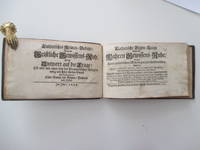
17339153AB1733. Augsburg Wolff 1733. 105 : 17 cm. 1 Blatt 122 Seiten 1 Blatt Lederband der Zeit mit reicher Rückenvergoldung. Der erste Titel - Lutherische Reimen-Gedicht - datiert 1698. - Gering gebräunt; Einband etwas berieben Vorderdeckel mit kleiner Fehlstelle. - Vgl. De Backer-S. V 822. unknown
1769105414Venetiis: apud Bertella et Perlini 1769. In-16 gr. mm. 198x128 cartoncino muto coevo con piccole mancanze pp. XVI125 segue Tentamen de morbis ex manustupratione da p. 127 a 189.Bruniture ai risg. Cfr. Castiglioni p. 830: Tissot 1728-1797 è uno dei due medici svizzeri che nel Settecento ebbero grandissima risonanza; nato a Losanna divenne celebre per i suoi studi su varie affezioni nervose.Risg. anneriti tracce d'uso sulle prime 4 cartem altrimenti esemplare con barbe ben conservato. apud Bertella et Perlini, unknown
177094901Venetiis: Typis Caroboli & Pompeati 1770. In-16 p. mm. 168x113 mz. pergamena coeva titolo oro su tassello al dorso piatti in cartoncino rustico pp. VIII212. Vi sono trattati vari argomenti: De Variolis - Apoplexia - Hydrope - Colica Saturnina - Morbo Nigro - Scirris Viscerum - Cephalea - Inoculatione - Irritabilitate - Cum Cadaverum Sectionibus.Lo svizzero Tissot 1728-97 ottenne nel 1780 "la chaire de médecine clinique de l'Université de Pavie dans laquelle il succéda au vénérable Borsieri" cosi' Biographie MédicaleVII341.Con qualche fioritura margin. ma certamente un buon esempalre. Typis Caroboli & Pompeati, unknown
1778115557Napoli: nella Stamperia di Gaetano Castellano 1778. In-16 p. mm. 154x88 2 opere in 1 volume p. pergamena coeva fregi e titolo oro su tassello al dorso. La prima interessante opera di pp. IV180 contiene in Appendice Della colica saturnina. La seconda: Dissertazione intorno la natura sensibile ed irritabile delle parti del corpo animale di Alberto HALLER Presidente della Società Reale delle Scienze di Gottinga ecc tradotta dal latino in francese dal Dotto Tissot con un di lui Discorso preliminare e nel fine varie sue osservazioni sopra la stessa materia. Traduzione dal Francese. Napoli 1785 di pp. 167.Cfr. Castiglioni p. 830: Tissot 1728-1797 è uno dei due medici svizzeri che nel Settecento ebbero grandissima risonanza; nato a Losanna divenne celebre per i suoi studi su varie affezioni nervose.Bruniture nella seconda opera solo qualche fioritura nella prima. nella Stamperia di Gaetano Castellano, unknown
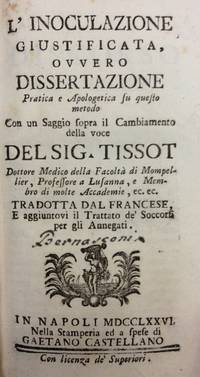
1776115556Napoli: nella Stamperia di Gaetano Castellano 1776. In-16 p. mm. 156x90 2 parti in 1 volume p. pergamena coeva fregi e titolo oro su tassello al dorso pp. 195; 120. La prima parte oltre allo studio sull'inoculazione giustificata vi sono contenuti: un saggio sopra il cambiamento della voce ed uno sui soccorsi per gli annegati. La seconda è dedicata a: Sopra l'origine degli animali - Varietà nella specie umana.Cfr. Castiglioni p. 830: Tissot 1728-1797 è uno dei due medici svizzeri che nel Settecento ebbero grandissima risonanza; nato a Losanna divenne celebre per i suoi studi su varie affezioni nervose.Con qualche fioritura ma discreto esemplare. nella Stamperia di Gaetano Castellano, unknown
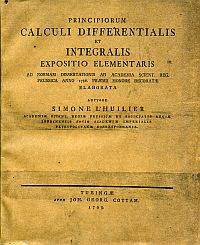
179585432BB1795 . Tubingae: Apud Joh. Georg. Cottam 1795. quer-Lex.-8°. XXVIII 339 1 S. 9 gestochene doppelseitige Tab. Interimsbroschur altersmässig gebräunt; zum Teil stockfleckig; Tabellen mit alten Wasserflecken; Titelblatt und Einband stark angestaubt Simone l'Huilier 1750-1840 Mathematiker stammte aus einer Genfer Hugenottenfamilie. unknown
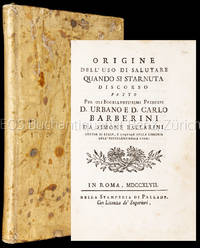
174731162AB1747. Roma Pallade 1747. 8°. 54 2 S. Mit radierter Vignette als Frontispiz und eine Titelholzschnitt-Vignette. Pergamentband der Zeit. Abhandlung über das Niesen. Simone Ballarini 17161772 römischer Bibliothekar und Antiquar war im Dienste mehrerer Kardinäle z.B. Monti und Barberini. Dieser kuriose Essay der in einem populären und angenehmen Stil geschrieben ist erklärt die Ursprünge des Brauchs beim Niesen zu grüssen und stützt sich dabei auf antike historische und literarische Quellen z. B. Apuleius Aristoteles Cicero Apuleius Petronius Plinius. Der vordere fliegende Vorsatz fehlt. Das Papier durchgehend fleckig und angestaubt. Der Pergamentbezug fleckig und mit alten Tuschzeichnungen. unknown
1703B7160Nuremburg: Berlegung Wolfgang Moritz Endters / Wolfgangue Maurice Endter. 1703. Interior clean and crisp. Binding: Full original vellum boards rebacked saving original spine. Spine with brown morocco label. Notes: Text in Latin German Italian and French each printed in single column with two columns per page; Italian and French on recto Latin and German on verso. Size: Folio 340 x 215mm Illustration: Near fine example of this quatro-lingual treatise on horses and horse breeding illustrated with 46 fine copperplate engravings plus engraved title. Detailed plates illustrating training mating behavioural presentation etc.; also including mating between horses and bulls donkeys etc.<br>PLATES:<br>1.104<br>2.124<br>3.223 44 plates<br> Provenance: Ex-Libris; bookplate of Fritz von Baroalaban mounted to front pastedown. Pages: P Engraved title. Blank. Latin/German title. Blank. Italian/French title. Blank. Dedication. Author’s dedication 3. Dedication title. Author’s second dedication 5. Note to the reader. Index 6. Blank. Title. Pp. 2-223. Category: Book Natural History; Berlegung Wolfgang Moritz Endters / Wolfgangue Maurice Endter. hardcover
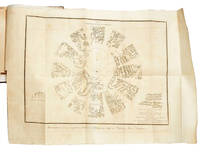
1790J1IBOS4BUCS1Padua 1790. Small folio 21.5 x 29.5 cm. Seminary printing office Contemporary green half calf gold-tooled spine marbled sides. With 3 large folding engraved plates. 16 CCXIX 9 pp. First and only edition of a rare study describing and illustrating with all elements needed to construction a 3D facsimile one of the most splendid Islamic globes ever made a celestial globe with Cufic lettering in the Borgia Museum at Velletri now at the Museo Nazionale di Capodimonte in Naples. The Syrian mathematician Qaysar ibn Abu al-Qasim 1178/79-1251 made the bronze globe with inlaid silver and copper 22 cm diameter in 622 AH 1225/26 CE for the fourth Ayyubid Sultan of Egypt al-Malik al-Kamil Muhammad ca. 1177-1238. The three folding plates show measured drawings apparently original size though without a scale of the components of the celestial globe with 1025 stars and 48 constellations designed so that they could be cut out and assembled around a globe body: the first shows the meridian and horizon rings with 2 gnomon scales for the base and a small view of the assembled globe the second shows the northern hemisphere and the third the southern hemisphere. Mediaeval Arabic astronomers used celestial globes to help solve various problems in astronomy far in advance of their European contemporaries. The seminary printing office in Padova established 1684 had its own typefoundry and had non-Latin types including Arabic cut for its first books published in 1685.Old library shelfmark label on the inside of the front board. The hinges and the head and foot of the spine somewhat worn. Otherwise in fine condition.l Brunet VI 8185; DG 7.9265; M. H. Fikri Treasures from the Arab Scientific Legacy in Europe no. 13 with full-page illustration; for Ahmed al-Farghani: DSB IV pp. 541-545. ABE CAT Astronomy & Cosmography unknown