6 résultats
15011801300043Carnegie Institute 1915-01-01. Hardcover. Good. 0x0x0. Interesting provenance previously owned by Donald H. Reiman. Hardcover. Good binding and cover. Hinges weak. Staining to gutter margins. Contemporary signature of Reiman on front end page. <br> Between 1965 and 2011 Donald Reiman was Editor later Co-Editor of Shelley and his Circle at what is now known as the Carl H. Pforzheimer Collection New York Public Library and for more than two decades an Adjunct Professor of English at the University of Delaware. As one of the premier Percy Bysshe Shelley scholars of the 20th century Don helped to shape the fields of British Romanticism and textual scholarship. <br> This is an oversized or heavy book which requires additional postage for international delivery outside the US. Carnegie Institute hardcover
15953367London:: printed by Thomas Creede for VVilliam Ponsonbie 1595. FIRST EDITION. The colophon reads: "London Printed by T.C. for William Ponsonbie. 1595.". Quarto:. 18 x 13 cm. 80 p. Signatures: A-K4 An attractive copy in early 20th c. calf. Very nice internally the last leaf with 16th c. verses in Latin and English on the verso of the final leaf. With a woodcut printer's device McKerrow 299 and decorative border to the title page and numerous head- and tailpieces throughout. A lovely copy of the first edition. This copy has the second state of sheet C with the reading "worthily" on C1r line 24. With a dedicatory epistle to "The Right worthy and noble Knight Sir Walter Raleigh" dated "from my house of Kilcolman the 27. Of December. 1591." In addition to "Colin Clout" this volume also includes Spenser's "Astrophel: A pastorall Elegie upon the death of the most Noble and valorous Knight Sir Phillip Sidney" dedicated to Sidney's widow who had by then become the Countess of Essex; An untitled poem beginning "Ay me to whom shall I complaine…" often referred to as "The dolefull lay of Corinda"; "The mourning Muse of Thestylis" by Ludowick Bryskett; "A pastorall Aeglogue upon the death of Sir Phillip Sidney Knight" signed L.B. Ludowick Bryskett; "An Elegie or friends passion for his Astrophill" by Matthew Roydon; "An Epitaph upon the right honourable sir Phillip Sidney Knight: Lord governor of Flushing" by Walter Raleigh; "Another of the Same" almost certainly by Sir Edward Dyer.Spenser's "Colin Clout's Come Home Again' a pastoral poem in the tradition of Petrarch was inspired by the poet's visit to England from 1590 to 1591 a journey undertaken at the urging of Walter Raleigh. Spenser wrote the poem dedicated to Raleigh upon his return to Kilcolman castle in Ireland –the 'Home' referred to in the poem's title. Spenser's adoption of an Anglo-Irish identity was publicly expressed in the title poem where the 'home' that Colin refers to rather bitterly in the poem is Ireland not England. At the same time the elegies on Sidney as the English nation's poet imply Spenser's claim to be his successor. The poem has been called Spenser's most biographical and indeed it includes not only the visit from Raleigh to Spenser's home in Ireland in 1589 but also an account of Spenser's sea voyage and his time in England during which he presented the first three books of his 'Faerie Queen' to Queen Elizabeth.The poem fits neatly into a tradition of advice literature that exempts the monarch from the general failings of his or her courtiers and includes strong criticisms of the court as well as attacks on the vanity ignorance and greed of courtiers in general. It is possible that Colin Clout was intended as a criticism of Elizabeth's regime in the 1590s especially if we bear in mind Spenser's own lack of preferment in England and his posthumous criticisms of the queen in 'Two cantos of Mutabilitie' A. Hadfield Edmund Spenser's Irish Experience 1997 chap. 6 Ashley V 194; Pforzheimer 967; STC 23077 printed by Thomas Creede for VVilliam Ponsonbie, books
15953120London:: printed by Thomas Creede for VVilliam Ponsonbie 1595. FIRST EDITION. The colophon reads: "London Printed by T.C. for William Ponsonbie. 1595.". Quarto:. 18 x 13 cm. 80 p. Signatures: A-K4 A wonderful copy bound in fine early 20th c. burgundy morocco by Riviere & Sons. Very nice internally the last leaf carefully washed. With a woodcut printer's device McKerrow 299 and decorative border to the title page and numerous head- and tailpieces throughout. A lovely copy of the first edition. This copy has the second state of sheet C with the reading "worthily" on C1r line 24. With a dedicatory epistle to "The Right worthy and noble Knight Sir Walter Raleigh" dated "from my house of Kilcolman the 27. Of December. 1591." In addition to "Colin Clout" this volume also includes Spenser's "Astrophel: A pastorall Elegie upon the death of the most Noble and valorous Knight Sir Phillip Sidney" dedicated to Sidney's widow who had by then become the Countess of Essex; An untitled poem beginning "Ay me to whom shall I complaine…" often referred to as "The dolefull lay of Corinda"; "The mourning Muse of Thestylis" by Ludowick Bryskett; "A pastorall Aeglogue upon the death of Sir Phillip Sidney Knight" signed L.B. Ludowick Bryskett; "An Elegie or friends passion for his Astrophill" by Matthew Roydon; "An Epitaph upon the right honourable sir Phillip Sidney Knight: Lord governor of Flushing" by Walter Raleigh; "Another of the Same" almost certainly by Sir Edward Dyer.Spenser's "Colin Clout's Come Home Again' a pastoral poem in the tradition of Petrarch was inspired by the poet's visit to England from 1590 to 1591 a journey undertaken at the urging of Walter Raleigh. Spenser wrote the poem dedicated to Raleigh upon his return to Kilcolman castle in Ireland –the 'Home' referred to in the poem's title. Spenser's adoption of an Anglo-Irish identity was publicly expressed in the title poem where the 'home' that Colin refers to rather bitterly in the poem is Ireland not England. At the same time the elegies on Sidney as the English nation's poet imply Spenser's claim to be his successor. The poem has been called Spenser's most biographical and indeed it includes not only the visit from Raleigh to Spenser's home in Ireland in 1589 but also an account of Spenser's sea voyage and his time in England during which he presented the first three books of his 'Faerie Queen' to Queen Elizabeth.The poem fits neatly into a tradition of advice literature that exempts the monarch from the general failings of his or her courtiers and includes strong criticisms of the court as well as attacks on the vanity ignorance and greed of courtiers in general. It is possible that Colin Clout was intended as a criticism of Elizabeth's regime in the 1590s especially if we bear in mind Spenser's own lack of preferment in England and his posthumous criticisms of the queen in 'Two cantos of Mutabilitie' A. Hadfield Edmund Spenser's Irish Experience 1997 chap. 6 Ashley V 194; Pforzheimer 967; STC 23077 printed by Thomas Creede for VVilliam Ponsonbie, books
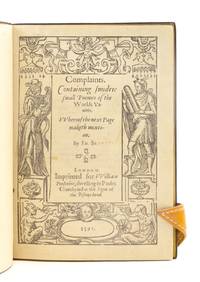
1591ST18266London: Imprinted for William Ponsonbie dwelling in Paules Churchyard at the signe of the Bishops head 1591. FIRST EDITION. 182 x 130 mm. 7 1/4 x 5 1/4". 91 leaves lacking blank Z4. <br/> Late 19th century green crushed morocco by Riviere & Son stamp-signed on front turn-in covers with decorative gilt lozenge centerpiece raised bands gilt lettering gilt-ruled turn-ins. Housed in a modern brown buckram chemise and attractive morocco-backed slipcase. Main title page with woodcut border McKerrow & Ferguson 117 section titles for three of the poems with woodcut frame woodcut initials head- and tailpieces. Front pastedown with engraved armorial bookplate of Charles Lilburn and ex-libris of Kenneth Rapoport see below. Langland to Wither 235; Hayward 23; Johnson 14; Pforzheimer 968; STC 23078; ESTC S111266. The Rosenbach Company catalogue 45 #690 this copy. Spine sunned to olive brown faint fading and soiling to covers just a hint of rubbing to corners and spine ends contents lightly washed and pressed in keeping with bibliophilic fashion at the time of binding occasional small spot or other trivial imperfection but an excellent copy clean and fresh internally in a perfectly pleasant binding.<br/> <br/> This is an appealing copy with star-studded provenance of one of the less frequently encountered first editions of Edmund Spenser ca. 1552-99 the first modern English poet to achieve major stature during his lifetime. It comprises a collection of six poems and three translations assembled by publisher William Ponsonby in order to capitalize on the recently experienced success of "The Faerie Queene." In the preface Ponsonby describes these poems as "complaints and meditations of the worlds vanitie very grave and profitable." The included works some dating back to Spenser's college days are: "The Ruines of Time" "The Teares of the Muses" "Virgils Gnat" "Proposia Or Mother Hubberds Tale" "Ruines of Rome" "Muiopotmos or the Fate of the Butterflie" "Visions of the Worlds Vanitie" "Bellayes Visions" and "Petrarches Visions." Six of these are original poems all previously unpublished and three are translations one unpublished and two revised. Unfortunately "Proposia" was a political satire on the attempts to arrange a marriage between Elizabeth I and the Duc d'Alençon that resulted in the entire volume being banned. That poem was omitted from early editions of the collected minor poems. Day says Spenser demonstrated "with his fluency in many meters and stanzaic forms . . . that English was at least the equal to any other language as a vehicle of great poetry." Although his poetry particularly "The Faerie Queene" looks backward--as the culmination of the allegorical verse tradition of the Pearl Poet Langland and Chaucer--Spenser has influenced with "his fertile imagination and especially his sensuous imagery and melodic language" nearly every important English poet who followed him. Our volume has distinguished provenance four times over. The first known owner here Charles Lilburn Esq. 1842-91 was an antiquary businessman Justice of the Peace and Fellow of the Society of Antiquaries of Newcastle-upon-Tyne. George Neasham in "North-Country Sketches" 1893 calls Lilburn "bibliomaniacal" but also "one of nature’s gentlemen." In 1888 the "Proceedings of the Society of Antiquaries of Newcastle-upon-Tyne" claimed that Lilburn’s library "would have charmed the heart of Dibdin himself." The present copy then apparently became the subsequent property of Sir Israel Gollancz 1863-1930 distinguished Shakespearian scholar and editor of early English literature at least he is named as a previous owner when this copy was sold by Swann Galleries in May of 2022 at the Rapoport sale. The book appeared later in the inventory of the rare book firm of A. S. W. Rosenbach 1876-1952 of Philadelphia where it was listed in the 1941 catalogue as item #690 priced at $300. Finally it became part of the library of Ken Rapoport who amassed an outstanding collection over 50 years with special emphasis on works of drama and poetry by English and Spanish authors among them Shakespeare Spenser and Cervantes. "Complaints" is scarce is virtually never found except in a modern binding and is usually seen in unappealing internal condition. Imprinted for William Ponsonbie, dwelling in Paules Churchyard at the signe of the Bishops head unknown
15913119London:: Imprinted by Thomas Orwin for VVilliam Ponsonbie dwelling in Paules Churchyard at the signe of the Bishops head 1591. FIRST EDITION. . Quarto: . 18.5 x 14 cm. 184 p. Collation: A-Z4 lacking final blank Z4 Bound in fine early 20th c. green morocco with gilt turn-ins and the words “Complaints – Edmund Spenser – 1591†tooled in gold on the front board. The same neatly tooled on the spine. A nice copy never washed or pressed with wide outer margins. The edge of the title is a little frayed far from the woodcut there are light damp-stains in signatures D and S and a very faint one in the final signature. A few other trivial stains. It is highly unusual to find Spenser quartos in such condition the majority of the surviving copies having been washed and trimmed. Fortunately the binder of this copy resisted that temptation. The general title has a fine woodcut border with figures of David and Moses. There are separate title pages using the same woodcut border for “The Teares of the Muses†“Prosopopoia. Or Mother Hubberds Tale†and “Mviopotmos. Or The Fate of the Butterflieâ€. There are also a few attractive woodcut head-pieces and initials. The contents are as follows: 1. The Ruines of Time. 2. The Teares of the Muses. 3. Virgils Gnat. 4. Prosopopoia or Mother Hubberds Tale. 5. The Ruines of Rome: by Bellay. 6. Muiopotmos or The Tale of the Butterflie. 7. Visions of the Worlds vanitie. 8. Bellayes visions. 9. Petrarches visions. “Of the nine poems in the volume four are sonnet sequences while the others are in rhyme royal ottava rima sixaines or couplets. Each appears with a separate title page: five are dedicated to prominent courtiers or patrons and four are printed with no dedication. The first ‘The Ruines of Time’ is a lament on the destruction of the Roman city of Verulamium followed by an elegy on the deaths of Robert Dudley the earl of Leicester and Sir Philip Sidney. It is followed by ‘The Teares of the Muses’ a series of nine laments that deplore the corruption of learning and poetry. ‘Virgil’s Gnat’ the tale of a shepherd’s rescue by a humble gnat is an elaborate mock-heroic complaint translated from the pseudo-Virgilian ‘Culex.’ Next ‘Prosopoia or Mother Hubberds Tale’ takes the form of an allegorical beast-fable; its satire generally assumed to have been directed against Lord Burleigh was probably the reason that ‘Complaints’ was recalled shortly after its publication and that the poem was subsequently omitted from the 1611 folio of Spenser’s works see the following item. The volume continues with ‘The Ruines of Rome’ a translation of Joachim Du Bellay’s lament on the corruption of the modern city and ‘Muiopotmos’ a mock-heroic fable of the entrapment of a butterfly by a spider. The three sonnet sequences two of which are translations conclude the volume: ‘Visions of the Worlds Vanitite’ ‘The Visions of Bellay’ and ‘The Visions of Petrarch.’ For a thorough analysis see Katharine A. Craik Spenser's "Complaints" and the New Poet in Huntington Library Quarterly Vol. 64 No. 1/2 2001 pp. 63-79. Johnson A Critical Bibliography of the Works of Edmund Spenser printed before 1700 No. 14; STC 2nd ed. 23078; Pforzheimer 968 Imprinted by Thomas Orwin for VVilliam Ponsonbie, dwelling in Paules Churchyard at the signe of the Bishops head, unknown books
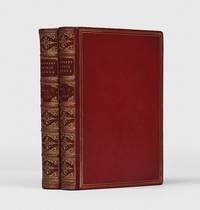
1596165717London: Printed for William Ponsonbie 1596. For there is nothing lost that may be found if sought First complete edition comprising the first edition of the second part and the second edition of the first part. Written in praise of Elizabeth I and dedicated to her Spenser's allegorical masterpiece follows the adventures of six medieval knights drawing on Arthurian legend Italian romance classical epic and Chaucer. John Dryden notes that "Spencer more than once insinuates that the Soul of Chaucer was transfus'd into his Body; and that he was begotten by him Two hundred years after his Decease" Dryden f. A1. In its mingling of genres the poem represented a new departure in English poetry for which Spenser invented a new stanza "a hybrid form adopted from the Scots poetry of James I 'rhyme royal' and Italian 'ottava rima'" ODNB. Spenser began composing the work in the 1570s sharing "parcels" of it among friends. Though no rough drafts autograph copies or foul papers for the poem have survived the poet alludes to a manuscript copy as early as 1580 when in a letter to Gabriel Harvey he asks for one to be returned to him: "I wil in hande forthwith with my Faery Queene whyche I praye you hartily send me with al expedition: and your frendly Letters and long expected Iudgement wythal" Three Proper and wittie familiar Letters. The poem or some part of it was almost certainly circulating in manuscript in London in 1588 when Abraham Fraunce quotes a stanza in his Arcadian Rhetorick correctly citing its book and canto "Spencer in his Faerie queene.2.book.cant.4". The first part was finally printed in 1590 - possibly intended to coincide with the publication of Philip Sidney's Arcadia - and the second part followed with a new edition of the first in 1596. Spenser likely composed some of the second part around 1593 as the conversion of Henry IV of France to Catholicism that year provides the historical basis for the Burbon episode in Book V. The poem now six books was entered into the Stationers' Register on 20 January 1596 suggesting publication had been planned to fall during Elizabeth I's Grand Climacteric - her 63rd year thought by astrologers to be critical - which had begun on 7 September 1595. In 1599 with only six of his twelve planned books completed Spenser died - his two fragmentary Cantos of Mutabilitie thought to be intended for Book VII are the only additional material published with the first folio edition of 1609. Provenance: from the library of Henry White 1822-1900 of Queen's Gate London with his armorial bookplate on the front pastedowns and sold in his 1902 Sotheby's sale lot 2028. The book was bound likely for White himself by Roger de Coverly 1831-1914 the London binder under whom T. J. Cobden-Sanderson trained. An old description mounted on the front pastedown of the first volume likely from a turn-of-the-century exhibition notes that the books were "lent by H. White Esq.". 2 vols small quarto 195 x 145 mm. Woodcut device of printer Richard Field to title pages full-page woodcut to M5 verso. Bound by Roger de Coverly in late 19th-century red crushed morocco spines with five raised bands lettered in gilt direct to second and third compartments remaining compartments richly gilt triple gilt fillet border to covers edges and turn-ins gilt marbled endpapers gilt edges. Spines slightly darkened upper margins closely trimmed touching a couple of headings outer leaves of vol. I faintly soiled a few spots to vol. II else clean and fresh within. An excellent copy handsomely bound. Pforzheimer 970; ESTC S117748. John Dryden "Preface" in Fables Ancient and Modern 1700; Edmund Spenser Three Proper and wittie familiar Letters 1580. hardcover