241 résultats
0151784558.Ghardcover. Good. Access codes and supplements are not guaranteed with used items. May be an ex-library book. hardcover
1988110952Norwalk CT: The Easton Press 1988. Leather. As New with no dust jacket. The Easton Press Collector's Edition bound in genuine leather The Rommel Papers edited by B. H. Liddell Hart with the assistance of Lucid-Maria Rommel Manfred Rommel General Fritz Bayerlein. Translated by Paul Findlay. All page edges gilt gold lettering with gold decorative covers silk moire endpages. Laid in is The Easton Press The Leather-Bound Library of Military History Collector's Notes sheet along with The Easton Press Military History unused unmarked bookplate. ; 6 1/4 x 9 1/4"; 545 pages. The Easton Press unknown
1984G0099335700I5N00Arrow Books 1984. Paperback. Acceptable. Disclaimer:Readable copy. Pages may have considerable notes/highlighting. ~ ThriftBooks: Read More Spend Less.Dust jacket quality is not guaranteed. Arrow Books paperback
1953830New York: Harcourt Brace and Company 1953. Presumed First U. S. Edition First printing. Hardcover. Good/Fair. xxx 545 5 pages. Endpaper maps. Footnotes. Illustrations. Maps incl. 2 fold-out. Appendix. Index. Index to Editorial Notes by General Bayerlein. DJ is in a plastic sleeve. It has wear tears soiling and chips. Embossed stamp of previous owner on title page. Contents include: Introduction The Story of the Rommel Papers by Manfred Rommel Editorial Note Part One: France 1940; Part Two: The War in Africa--First Year; Part Three: The War in Africa--Second Year; Part Four: Italy; Part Five: Invasion. The Rommel Papers is the collected writings by the German World War II field marshal Erwin Rommel published in 1953. The book included Rommel's writings of the war edited by the British strategist and historian B. H. Liddell Hart the former Wehrmacht officer Fritz Bayerlein who served on Rommel's staff in North Africa and Rommel's widow and son. The volume contained an introduction and commentary by Liddell Hart. Liddell Hart had a personal interest in the work: by having coaxed Rommel's widow to include material favorable to himself he could present Rommel as his "pupil" when it came to mobile armored warfare. Thus Liddell Hart's "theory of indirect approach" became a precursor to the German blitzkrieg "lightning war". The controversy was described by the political scientist John Mearsheimer in his work The Weight of History who concluded that by "putting words in the mouths of German Generals and manipulating history" Liddell Hart was in a position to show that he had been at the root of the dramatic German successes in 1940. The historian Mark Connelly argues that The Rommel Papers was one of the two foundational works that lead to a "Rommel renaissance" the other being Desmond Young's biography Rommel: The Desert Fox. The book contributed to the perception of Rommel as a brilliant commander; in an introduction Liddell Hart drew comparisons between Rommel and Lawrence of Arabia "two masters of desert warfare. Johannes Erwin Eugen Rommel 15 November 1891 - 14 October 1944 was a German general during World War II. Popularly known as the Desert Fox he served as field marshal in the Wehrmacht armed forces of Nazi Germany as well as serving in the Reichswehr of the Weimar Republic and the army of Imperial Germany. Rommel was a highly decorated officer in World War I and was awarded the Pour le Mérite for his actions on the Italian Front. In 1937 he published his classic book on military tactics Infantry Attacks drawing on his experiences in that war. In World War II he commanded the 7th Panzer Division during the 1940 invasion of France. His leadership of German and Italian forces in the North African campaign established his reputation as one of the ablest tank commanders of the war and earned him the nickname "the Desert Fox". Among his British adversaries he had a reputation for chivalry and his phrase "war without hate" has been uncritically used to describe the North African campaign. He later commanded the German forces opposing the Allied cross-channel invasion of Normandy in June 1944. With the Nazis gaining power in Germany Rommel gradually came to accept the new regime with historians giving different accounts on the specific period and his motivations. He was a supporter of Adolf Hitler at least until near the end of the war if not necessarily sympathetic to the party and the paramilitary forces associated with it. In 1944 Rommel was implicated in the 20 July plot to assassinate Hitler. Because of Rommel's status as a national hero Hitler desired to eliminate him quietly instead of immediately executing him as many other plotters were. Rommel was given a choice between committing suicide in return for assurances that his reputation would remain intact and that his family would not be persecuted following his death or facing a trial that would result in his disgrace and execution; he chose the former and committed suicide using a cyanide pill. Rommel was given a state funeral and it was announced that he had succumbed to his injuries from the strafing of his staff car in Normandy. Rommel has become a larger-than-life figure in both Allied and Nazi propaganda and in postwar popular culture with numerous authors considering him an apolitical brilliant commander and a victim of Nazi Germany. Rommel's reputation for conducting a clean war was used in the interest of the West German rearmament and reconciliation between the former enemies - the United Kingdom and the United States on one side and the new Federal Republic of Germany on the other. Several of Rommel's former subordinates notably his chief of staff Hans Speidel played key roles in German rearmament and integration into NATO in the postwar era. The German Army's largest military base the Field Marshal Rommel Barracks Augustdorf is named in his honor. The longtime mayor of Stuttgart Germany and namesake of Stuttgart Airport Manfred Rommel was his son. Harcourt, Brace and Company hardcover
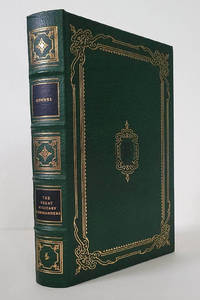
199335182Easton Press. Very Good. 1993. Hardcover. The Great Military Commanders series. Full leather with gilt decorations all edges gilt silk endpapers ribbon bookmark. Owner name on reverse of flyleaf scratches in lower page edge gilding else clean tight VG. . Easton Press hardcover
19461391158London: Faber and Faber 1946. Hardcover. Octavo 99 pages. In Good minus condition. Ex-library with white ink call number on spine library stamps to front endpapers and title page.Spine is green with red print. Boards in green cloth. Light wear to spine caps and corners toning to spine peripheral toning. <br /> <br /> NOTE: Shelved in Netdesk Column P. 1391158. FP New Rockville Stock. Faber and Faber hardcover
19461109London: Faber and Faber Ltd 1946. First U.K. Edition. fair to good ex-lib. 99 index spine faded bds scuffed lib plate & stamp ins fr bd lib stamp on p. 4 text clean. Faber and Faber Ltd unknown
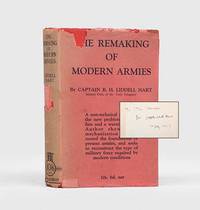
1927181926London: John Murray 1927. First edition presentation copy inscribed by the author on the front free endpaper "To 'Tim' Harington from B. H. Liddell Hart 15 July 1927." General Sir Charles Harington 1872-1940 distinguished himself on the western front serving in the Second Army under Plumer his "brilliant staff work complementing Plumer's powers as a commander" ODNB. Liddell Hart inscribed this copy a few months after Harington's promotion to full general. Five years later Harington was one of the names he proposed when asked by Maurice Hankey the secretary to the Cabinet to suggest a replacement for George Milne as Chief of the Imperial General Staff. Between 1918 and 1920 Harington had served as Deputy CIGS. In Remaking one of his regular collections of published articles Liddell Hart stresses the importance of mobility. "Its moral is that nothing less than rebirth can revive mobility in armies and in warfare. And without mobility an army is but a corpse - awaiting burial in a trench" p. x. Octavo. Original red cloth spine lettered in gilt. With dust jacket. Hint of bowing spine sunned through gaps in jacket gilt tarnished; jacket flaps without price as issued losses to spine and front panel touching first word of title on latter short splits along folds: a very good copy in good jacket. hardcover
1927316845London: John Murray 1927. First Edition. Hardcover. Provenance: Brian Winch's library copy. Fine copy rebound in original gilt-blocked cloth. Minor browning to the pages. Remains particularly well-preserved overall. Physical description: xii 315 pages; 23 cm. Notes: Includes index. Subjects: Great Britain. Army. France. Armies. Military art and science. Armies. Genre: Military History. London: John Murray hardcover
19281826Boston MA: Little Brown and Company 1928. First U.S. Edition. fair to good. 315 figures chart index weakness to front board some wear to top and bottom edges of spine. Little, Brown and Company unknown
19272050London: John Murray 1927. First Edition. fair ex-lib. 315 figures chart index foxing to text and fore-edge rough spot inside rear board boards soiled spine faded. John Murray hardcover
192746860London: John Murray 1927. 1st edition. Very Good. octavo. orig. cloth xii 315pp. index Fascinating analysis by a great Military Strategist. Key word is mobility the rebirth of the cavalry via the Tank. Browning to first & last pages o/w nice bright tight copy. Scarce John Murray hardcover
19560012724Harcourt Brace And Company 1956. Hardcover. Fine. A superb copy . Dust jacket is protected with a mylar cover . Harcourt , Brace And Company hardcover
195610071New York: Harcourt Brace and Company 1956. First American Edition. good good. 480 illus. maps index slight discolor ins bds some foxing to fore-edge ink name & date ins fr bd DJ somewhat scuffed & soil. Harcourt, Brace and Company unknown
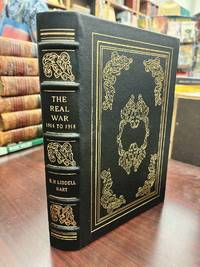
193087804London: Faber and Faber 1930. First U.K. Edition presumed First Printing. Hardcover. Fair due to map repair--otherwise in good condition. 539 1 pages Maps including two folding maps at the back one repaired with tape. Bibliography. Index. Some wear to cover. Spine lettering faded. No DJ. Some endpaper and page discoloration. Previous owner's name on fep No DJ present. Sir Basil Henry Liddell Hart 31 October 1895 - 29 January 1970 commonly known as Captain B. H. Liddell Hart was a British soldier military historian and military theorist. He wrote a series of military histories that proved influential among strategists. Arguing that frontal assault was bound to fail at great cost in lives as proven in World War I he recommended the "indirect approach" and reliance on fast-moving armored formations. His pre-war publications are known to have influenced German World War II strategy. He also helped promote the "clean Wehrmacht" argument for political purposes when the Cold War necessitated the recruitment of a new West German army. His experiences on the Western Front affected him for the rest of his life. He wrote several booklets on infantry drill and training which came to the attention of General Sir Ivor Maxse commander of the 18th Division. After the war he transferred to the Royal Army Educational Corps where he prepared a new edition of the Infantry Training Manual. He retired from the Army in 1927. He spent the rest of his career as a theorist and writer. In 1924 he became a military correspondent for The Morning Post. He was the military correspondent of The Daily Telegraph from 1925 to 1935 and of The Times from 1935 to 1939. In 1954 Liddell Hart published his most influential work Strategy. Captain B. H. Liddell Hart is the foremost authority on World War I. In The Real War the author has fused exhaustive research and creative brilliance with brevity and precision. Thus we have in one volume the war transformed into literature - an understandable kaleidoscopic masterwork of military history. Faber and Faber hardcover
1994mon0003817041Easton Press 1994T. hardcover. Very Good. . Fine copy bound in full leather with raised bands and gilt decoration. All edges gilt pages clean. Easton Press hardcover
1025941497.Ghardcover. Good. Access codes and supplements are not guaranteed with used items. May be an ex-library book. hardcover
1025942078.Ghardcover. Good. Access codes and supplements are not guaranteed with used items. May be an ex-library book. hardcover
1025946103.Gpaperback. Good. Access codes and supplements are not guaranteed with used items. May be an ex-library book. paperback
102594626X.Gpaperback. Good. Access codes and supplements are not guaranteed with used items. May be an ex-library book. paperback
53315629like new. unknown
1994232405Easton Press 1994. hardcover. Very Good. 0x0x0. Full leather with gilt board design and page edges. Three raised bands to the spine. Clean has a good binding no marks or notations. Includes the Easton Press Collector's Notes sheet. 508 pages. Easton Press hardcover
19942112046<p>Collector's Edition. EASTON PRESS books are among the highest quality leather bound books ever produced. Bound in full genuine leather with hubbed spine accented with 22kt gold lettering and designs printed on archival paper acid neutral with gilded edges smyth sewing and concealed muslin joints. Lustrous silk moire endpapers. A silk page marker is sewn into the binding. This book in pristine condition belongs to the Military History series. Collector's Notes laid in.</p> The Easton Press hardcover
1994mon0003244010Easton Press 1994T. hardcover. Very Good. . Luxury binding with gilt decorations in full leather with raised bands on the spine all edges gilt ribbon bookmark and decorative endpapers. Shows minor wear some rubbing and soiling to the cover. Easton Press hardcover
19301828Boston MA: Little Brown and Company 1930. fair. 508 maps bibliography index bds scuffed & cloth wrinkled top & bottom edges of spine worn discolor ins bds pgs sl wrinkled. Little, Brown, and Company hardcover