Saga, JunichiBiblio.com
The Gambler's Tale: A Life in Japan's Underworld
4770015402.Ghardcover. Good. Access codes and supplements are not guaranteed with used items. May be an ex-library book. hardcover

Bonita · États-Unis61,75 $US≈ 52,25 €
924 résultats
19372082402113509415Not Available 1937. Soft Cover. Fine. The book is in fine condition. Not Available paperback
6raycJohn Charles McSeveney. First Edition. Hardcover. Very Good/No Jacket. Privately published c1993. Appears to be Signed by the Author John Charles McSeveney and Name of the previous owner written on the front free end paper page. Heavy book may require extra postage unless posted within South Africa. No date stated c1940. Publication of 193 pages. Large book. There is Gilt on the front cover. The boards are a little shelf rubbed. There are minor marks around the block of the book. The text is legible. The binding is excellent. GK. Our orders are shipped using tracked courier delivery services. John Charles McSeveney hardcover
19852081402110000459Kyushu University Literature Department 1985. Soft Cover. Fine. Number of books: 4 Kyushu University Literature Department paperback
19812080502106903998Not Available 1981. Soft Cover. Fine. The book is in fine condition. Not Available paperback
19652082402113508786Not Available 1965. Soft Cover. Fine. Volume: 1 Not Available paperback
4770015402.Ghardcover. Good. Access codes and supplements are not guaranteed with used items. May be an ex-library book. hardcover
19712080202102800362Japan Reader's Digest 1971. Soft Cover. Fine. The book is in fine condition. Japan Reader's Digest paperback
200644615Ikebana Saga Goryu Kado Soshisho. NF; Paperback in Near Fine condition. 2006. Paperback. 8vo 8" - 9" tall; 64 pages . Ikebana Saga Goryu Kado Soshisho paperback
19802080302106808643Not Available 1980. Soft Cover. Fine. The book is in fine condition. Not Available paperback
2081402109701056Saga Prefecture Museum N.A. Soft Cover. Fine. Number of pages: 108 Size: 26.3 Saga Prefecture Museum paperback
19932081502112304505Saga Prefecture Nagoya Castle Museum 1993. Soft Cover. Fine. Number of pages: 46p Size: 30cm Saga Prefecture Nagoya Castle Museum paperback
2080502106915615Not Available N.A. Soft Cover. Fine. The book is in fine condition. Not Available paperback
19892091502135203302Saga Museum of Art 1989. Soft Cover. Fine. Size: 27cm Number of books: 1 Saga Museum of Art paperback
19962080502106907851Not Available 1996. Soft Cover. Fine. The book is in fine condition. Not Available paperback
2081502112303546Established SAGA Yokatoko a specified non-profit organization N.A. Soft Cover. Fine. The book is in fine condition. Established SAGA Yokatoko, a specified non-profit organization paperback
19972080502106913889Not Available 1997. Soft Cover. Fine. The book is in fine condition. Not Available paperback
19332080502106511333Imperial Chamber of Commerce 1933. Soft Cover. Fine. Volume: 1 Imperial Chamber of Commerce paperback
19892080502106911318Not Available 1989. Soft Cover. Fine. The book is in fine condition. Not Available paperback
19732091502135307454Same County Board of Education 1973. Soft Cover. Fine. Volume: 1 Same County Board of Education paperback
19732080502106910190Not Available 1973. Soft Cover. Fine. The book is in fine condition. Not Available paperback
19692090502113717484Not Available 1969. Soft Cover. Fine. The book is in fine condition. Not Available paperback
19752080502106406431Saga Prefecture Reclamation Association 1975. Soft Cover. Fine. Number of pages: 10 10 475p Saga Prefecture Reclamation Association paperback
19822080702109503362Saga Prefecture Museum 1982. Soft Cover. Fine. Number of pages: 1 volume without pages Size: 26cm Saga Prefecture Museum paperback
20062080502106914371Not Available 2006. Soft Cover. Fine. The book is in fine condition. Not Available paperback
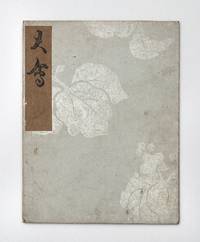
1117114 pages of text & two pages forming paste-downs of varying shades of pale pink & cream gofun biki torinoko mica-printed paper all printed with mica patterns endpapers printed with mica patterns of plum flowers on branches & autumnal weeds bound in two “quires†& sewn together. Small 4to 240 x 180 mm. orig. pale gray semi-stiff wrappers with mica woodblock-printed designs of hydrangea leaves orig. printed label on upper cover. Saga near Kyoto: about 1608 or shortly thereafter.<br /> <BR> <BR> An ultimate luxury copy tokusei bon 特製本 in very fine condition with mica-printed text leaves and covers using paper of shades of pale pink cream and gray. This is the second time we have handled a copy of a KÅetsu utai bon in the most luxurious state of three.<br /> <BR> <BR> This is one of the series of 100 Noh plays produced at the famous private press in Saga just north of Kyoto. These sumptuous luxury editions were printed for the wealthy and enlightened merchant Suminokura Soan 1571-1632 in collaboration with his calligraphy teacher KÅetsu a leading cultural figure of his day famous as an artist potter lacquerer and connoisseur. These books are amongst the most remarkable printed works created in Japan or anywhere else; their design is far in advance of anything produced in the West. Issued in limited numbers they were intended for private distribution to an elite audience friends and acquaintances of the creators who formed the patrons of the Saga artistic community.<br /> <BR> <BR> Printed with movable type on luxurious thick paper the books have according to Hillier a modernity in design matched only by the works of William Blake and the French artists’ books of the late 19th and early 20th centuries. They reveal the beauty of native Japanese calligraphy. The movable type is based on the calligraphy of KÅetsu.<br /> <BR> <BR> This series of mostly chants from Noh plays comprises “small pamphlet-size books each of about twelve or thirteen sheets whose outstanding feature is the decoration invariably of mica-printed patterns on stained or dyed paper which is of a distinction that immediately links them with the collaborative scroll works by KÅetsu and SÅtatsu and which has led to their being called KÅetsu-bon…These designs resulting from a sophisticated adaptation or distortion of natural forms are notable examples of one of the unique contributions of Japan to world art…<br /> <BR> <BR> “But decoration apart these No booklets are remarkable in other ways. An unusually thick and opaque kind of paper was used no doubt made specially for these editions and contrary to normal practice it was printed on both sides of the sheet. This ruled out the normal construction of a book whereby the sheets printed on one side only were folded in two and bound at the loose edges. The majority of the KÅetsu-bon were made up by an entirely different method. A number of sheets usually six in this copy three in the first “quire†and two in the second the outer leaves used as paste-downs were placed flat one above the other and the batch was then folded in two; two such sections would form a complete book. The binding again was unusual. The outer covers though printed first as a single sheet invariably with a mica-printed design were cut in two and each given a folded turnover along one edge in which one batch of the folded sheets was lodged. The two halves were then sewn together through the turn-overs of the two halves of the cover brought together at the inner edge. This is a binding method unique to Japan and is known as Yamato-toji or recchÅsÅ…<br /> <BR> <BR> “These KÅetsu-bon represent an astonishing leap forward to something entirely unprecedented in the history of the illustrated or decorated book. This was the first time a book had been conceived as a single unified work of printed decorative art…not until we come to William Blake’s Prophetic Books do we encounter anything remotely comparable and the creation in the West on any appreciable scale of books composed as homogeneously decorated printed works of art did not occur until the appearance of the French livres d’artiste in the late nineteenth and early twentieth centuries.â€â€“Hillier The Art of the Japanese Book pp. 51-54.<br /> <BR> <BR> The KÅetsu utai bon were produced in three levels of luxury. The finest such as our example has mica patterns or images printed on the text leaves and covers before the text was printed with movable type. The next level also had mica-printed covers but employed papers of different colors with no mica printing on the text pages. The least luxurious version used only cream-colored text paper and had mica patterns printed on the covers.<br /> <BR> <BR> The covers of our copy are mica-printed with images of bamboo and with backgrounds of sprinkled mica. Each of the five sheets with text exhibits different mica-printed images including grass adorned with dew in the field Japanese pampas grass plum blossoms on branches and waves.<br /> <BR> <BR> The movable type characters are based on the calligraphy of Hon’Ami KÅetsu 1558-1637; this type is called hiragana majiri a combination of kanji and kana accompanied by dashes next to each syllable. These dashes are the notations for the pitches to be sung. The notes are not written as specifically as they are in Western sheet music. If the dash goes up the pitch is raised; if it is straight the same pitch is continued; and if it goes down the pitch is lowered.<br /> <BR> <BR> A very fine and fresh copy preserved in a wooden box. These KÅetsu utai bon are very rare on the market especially when in excellent condition like our example. Covers a bit dusty and a few unimportant marks.<br /> <BR> <BR> ⧠Fischer et al. The Art of Hon’Ami Koetsu Japanese Renaissance Master pp. 174-75–“The deluxe editions of utai-bon that were printed at the Saga presses where Koetsu and Suminokura Soan collaborated to produce classics of earlier Japanese literature were intended for amateur connoisseurs like themselves. The thick paper mica-printed motifs and carved wood type were all part of an artistic whole meant to complement the aesthetic pleasure of the utai vocal performance.†Murase Tales of Japan. Scrolls and Prints from the New York Public Library pp. 157-59. unknown