Ellis, HavelockMareMagnum

874 résultats
A clean, unmarked book with a tight binding. 230 pages. Full black cloth boards show slight edge wear and fading, especially on spine edge.
19911697AMünchen, Zürich, Piper, (1991). 2. Auflage. Gr.8°. 868 S. mit umfangreichem Personenregister im Anhang. Orig.-Leinen mit illustr. Orig.-Umschlag. 2
Very Good Turkish, Ottoman (1500-1928) Contemporary cloth bdg. Rebacked spine. Roy. 8vo. (23 x 14 cm). In Ottoman script (Old Turkish with Arabic letters). 143 p. Slight tear on two leaves, wear on extremities of original marbled boards, otherwise a good copy. Early printed edition of this exceedingly rare collection of early Ottoman erotic poems of homosexuality and bisexuality, of the 18th century including the multiple works of Enderunlu Fazil and Sünbülzâde Vehbi. This book includes five works originally: Defter-i ask [i.e. The book of love] (pp. 1-21); Hubannâme [i.e. The book of male lovers] (pp. 22-55); Zenannâme [i.e. The book of beautiful women] (as well as "Çenginâme" of Fazil Bey in Zenannâme, pp. 102-111); and Sevkengiz [i.e. Inspiring] (pp. 112-143). "Defter-i ask" [i.e. The book of love] by Fazil, in which he tells about his own romances, is a mathnavi of 438 couplets. It begins with a description of divine love and tells the story of the poet's romances, which he fell into only to regret and repent afterward. "Hubannâme" [i.e. The book of male lovers] consists of 796 couplets with various titles and it has a mystical analysis of beauty in the first chapter. After an introduction that gives geographical information that may be considered novel for its period, it describes the beauties of male bodies in many countries from India to America. This style is unique and the first in Turkish / Ottoman literature. In the work titled "Zenannâme" [i.e. The book of beautiful women], which is a mathnavi of 1101 couplets, women of various nations are described. The poet indicated in the introduction of his work that he does not want to talk about women, and that he has no orientation towards women. Enderunlu Fazil was an Ottoman poet who depicted the beauty of men from various lands of the Ottoman Empire. He achieved fame through his erotic works, which were published posthumously. Among his most famous works is The Book of Women, which was banned in the Ottoman Empire. The book describes the advantages and disadvantages of women from different nations. Fazil was born in Acre into an Arab family originally from Medina. He spent his early years in Safed in Ottoman Palestine. His grandfather Zahir al-Umar and his father Ali Tâhir were both executed (in 1775 and 1776, respectively ) for participating in a rebellion. After his father's death, Fazil moved to Istanbul. There, he was admitted to the Enderun palace school (thus taking on the name Enderuni or Enderûnlu) but was expelled in 1783 as a result of his love affairs with other men there. In 1799, he was exiled to Rhodes because of his satirical writings and was only allowed to return to Istanbul after becoming blind. He spent the rest of his life there, ill and bedridden. Sümbülzâde's "Sevkengiz" [i.e. The Inspiring] is an erotic and mystical poem in which heterosexual and bisexual narratives compare male and female beauties and eventually turn to divine love. It has 770 couplets in the "münâzara" genre. Özege 7711.
Very Good Turkish, Ottoman (1500-1928) Contemporary quarter leather binding with gilt decorations without title lettering. Demy 8vo. (22 x 14 cm). In Ottoman script (Old Turkish with Arabic letters). Seven different books and tractates (nine works) in one volume: (235, [1] p., 24 p., 143 p., 80 p., [6], 71 p., 84 p., 22 p.). Two leaves are torn from the hinge in the first book but not missing, one tractate is trimmed by margins, the board's extremities are worn, overall a good volume including multiple books. First editions (except for one) of these exceedingly rare poetic tractates collected together contemporarily in one handsome volume, reflecting early Ottoman poetic pleasure, including thematic mystic and erotic poetry mostly printed in the early 19th century. This volume includes the multiple works of Enderunlu Fazil and Sünbülzâde Vehbi, which are the earliest erotic and homosexual poems that seem to have been concealed by adding Keçecizâde's works to the beginning and the end of the volume. "Defter-i ask" [i.e. The book of love] by Fazil, in which he tells about his own romances, is a masnavi of 438 couplets. It begins with a description of divine love and tells the story of the poet's romances, which he fell into only to regret and repent afterward. "Hubannâme" [i.e. The book of beautiful young men] consists of 796 couplets with various titles and it has a mystical analysis of beauty in the first chapter. After an introduction that gives geographical information that may be considered novel for its period, it describes the beauties of male bodies of many countries from India to America. This style is unique and the first in Turkish / Ottoman literature. In the work titled "Zenannâme" [i.e. The book of women], which is a masnavi of 1101 couplets, women of various nations are described. The poet indicated in the introduction of his work that he does not want to talk about women, and that he has no orientation towards women. Enderunlu Fazil was an Ottoman poet who depicted the beauty of men from various lands of the Ottoman Empire. He achieved fame through his erotic works, which were published posthumously. Among his most famous works is The Book of Women, which was banned in the Ottoman Empire. The book describes the advantages and disadvantages of women from different nations. Fazil was born in Acre into an Arab family originally of Medina. He spent his early years in Safed in Ottoman Palestine. His grandfather Zahir al-Umar and father Ali Tâhir were both executed (in 1775 and 1776, respectively ) for participating in a rebellion. After his father's death, Fazil moved to Istanbul. There, he was admitted to the Enderun palace school (thus taking on the name Enderuni or Enderûnlu), but was expelled in 1783 as a result of his love affairs with other men there. In 1799, he was exiled to Rhodes because of his satirical writings and was only allowed to return to Istanbul after becoming blind. He spent the rest of his life there, ill and bedridden. Other books in the volume: Manzumetü'l-müsemma be-mihnet-kesan, Ceride-i Havadis Matbaasi, Ist., AH 1269 = AD 1853. 235 p., 1 portrait of Keçecizâde. Lithography. Özege 13354.; Two copies are located in OCLC 57242940 - 51281526. This work is a social satire type masnavi in which Izzet Molla was exiled to Kesan, telling of the troubles he suffered there, and his pardon and returns to Istanbul. Destar-i hayâl., Osman Nevres Efendi (1820-1876), Matbaa-i Âmire, Ist., AH 1289 = AD 1872. 24 p., Özege 3899. First and Only Edition. This rare work is a masnavi consisting of six stories. Defter-i ask, Hubannâme, Zenânnâme and Sevkengîz., Enderuni Fazil (1757-1810) and Sümbülzâde [or Sünbülzâde] Vehbi, (1718-1809)., Darü't-Tibaatü'l-Âmire, Ist., AH 1253 = AD 1837., 143 p. (pp. 1-20 Defter-i ask; pp. 22-55 Hubânnâme; pp. 56-111 Zenânnâme; pp. 112-143 Sevkengîz.). Özege 18902. First Edition. Tuhfe-i Dilkes Nâli, Yusuf Nabi [sic] [Nâlî, Muhammed b. Osman el-Konevî, (For more info please visit our website)
2010179955Esr Esr, 2010. In-8 broché de 116 pages. Petites taches sur les tranches sinon bon état
1976CCC-133657. Edition de l’arche 1976. Avec la collaboration amicale de Karl lagerfeld et Pierre de rohan chabot, nombreuses photos en noir et blanc , texte en français. Photos possible
19893912AMünchen, Goldmann, 1989. Kl.8°. 158 S. Taschebuch mit illustriertem Cover.
Fine Turkish Paperback. Cr. 8vo. (19 x 12 cm). In Turkish. 239 p. color ills. 80'lerde lubunya olmak. Transcripts of oral interviews with gays and transsexuals.
Very Good Turkish Paperback. Cr. 8vo. (19 x 12 cm). In Turkish. 370 p., color ills. 90'larda lubunya olmak. Transcripts of oral interviews with gays and transsexuals.
1999RO80131563FAYARD. 1999. In-8. Broché. Très bon état, Couv. fraîche, Dos satisfaisant, Intérieur frais. 526 pages.. . . . Classification Dewey : 306.766-Homosexualité
Broch?. 526 pages.
19474509Paris Gallimard 1947 1 vol. Broché in-12, broché, 260 pp. Nouvelle édition. Un des 8 exemplaires de tête numérotés sur vélin de Hollande, et parmi ceux-ci l'un des 3 hors commerce. En parfait état.
19474509Paris Gallimard 1947 1 vol. Broché in-12, broché, 260 pp. Nouvelle édition. Un des 8 exemplaires de tête numérotés sur vélin de Hollande, et parmi ceux-ci l'un des 3 hors commerce. En parfait état.
1975RO20034454HAMEAU. 1975. In-8. Broché. Bon état, Couv. légèrement passée, Dos satisfaisant, Intérieur frais. 219 pages. Couverture rempliée.. . . . Classification Dewey : 306.766-Homosexualité
197034190Payot 1970 Préface du Docteur Michaël Balint, 10 feuillets avec fortes soulignures au feutre rouge.
181646402726Paris, Le Normant, 1816 ; in-8, broché, couverture bleue mouchetée, muette, entièrement non rogné. (État de parution) X pp., 470 pp., 1 f.ÉDITION ORIGINALE dédiée “aux vrais Français”.Parce qu’en 1813 Fievée fut nommé préfet de la Nièvre, il figure dans les biographies nivernaises. Voir Née de La Rochelle I, p. 35 et Bibl. de Nevers. Les auteurs nivernais de 1715 à 1815 p. 97.Parce qu’il fut un homosexuel déclaré “quant on a un vice, il faut savoir le porter” disait-il, il figure dans les répertoires des homosexuels célèbres, celui de M. Larivière, entre autres. Fievée s’affichait ouvertement avec son amant, Théodore Leclercq, l’auteur des Proverbes, et lui confiait le rôle de maîtresse de maison, faisant les honneurs de la Préfecture à tous les notables du département.Né en 1767 dans une famille d’hoteliers-restaurateurs parisiens, Fievée débuta comme imprimeur-journaliste. Son journal, La Chronique de Paris, qui affichait des opinions girondines lui valut d’être incarcéré pendant la Terreur. Proscrit du Directoire, il se cache en province et écrit La Dot de Suzette, un gentil roman qui devint un des grands succès littéraires de l’époque. Il se ralliera à Bonaparte qui apprécie son indépendance d’esprit et lui confie une mission secrète en Angleterre. Après la première abdication de Napoléon, l’agent secret transmet sans hésitation ses rapports à Louis XVIII. Exceptionnelle tolérance de la Restauration (on prête à Louis XVIII des amours masculines avec le Cte d’Auvray et avec le duc de Blacas !), le couple formé par le préfet et son amant est reçu par les aristocrates les plus ultras. Révoqué durant les Cent Jours, il retrouvera sa préfecture à la seconde Restauration. D’abord partisan des ultras, il glissera vers le libéralisme. En 1818 sa défense de la liberté de la presse lui vaut un nouvel emprisonnement. Sa qualité de roturier et sa liaison avec Leclercq déplairont à Charles X qui n’avait pas les mêmes raisons que Louis XVIII d’être tolérant. Ecarté de l’administration, le couple vivra de la fortune personnelle de Leclercq. En 1830 Fievée se rallie à Louis-Philippe et meurt oublié en 1839.Dans ce livre politique, il donne ses opinions sur le pouvoir démocratique, le pouvoir aristocratique, sur les prétentions des royalistes et des révolutionnaires et analyse les divers points de la Session de 1815, les lois de sûreté, l’épuration, les libertés, l’amnistie, la loi des finances, etc.Bel exemplaire à l’état de parution.
1903AMA-253London, Hacon & Ricketts [the Vale Press]; New York, John Lane. 1903. in 8°, reliure cartonnée de l’éditeur, décor du papier des plats représentant des paons d’après un dessin de Charles Ricketts, mors fendillés, coins émoussés. lii-(1)f.,
Broch?. 228 pages.
A clean, unmarked book with a tight binding. 222 pages. Wear to cover. "Pete Fisher, author of The Gay Mystique and Special Teachers/Special Boys has written his wildest, sexiest and most involving book. Dreamlovers charts one gay man's search to turn fantasy into reality--despite a lover, a career, and uncomprehending friends."
5003305441018 Sans date.
198318936Réunion des musées nationaux 1983 Paris, éditions de la Réunion des musées nationaux, 1983. Catalogue d'exposition comprenant de nombreuses illustrations dont 4 en couleurs à pleine page. In-8 broché de 183 pp., 199 notices décrites, certaines très détaillées. Cadre historique et bibliographie in fine. Couverture illustrée en couleurs. Un pli de lecture au dos sinon très bon état.
in-16, 279 p., broche, couverture illustree. Bel exemplaire. [PM-LP0]
2004143670Asphodel Editions, London, second, revised and enlarged edition 2004. 115 pages. Red original cloth binidng in very good condition. 22x15 cm
78528Paris, A l'Enseigne des Deux Sabots, 1947, in 12 broché, 127 pages ; non coupé.
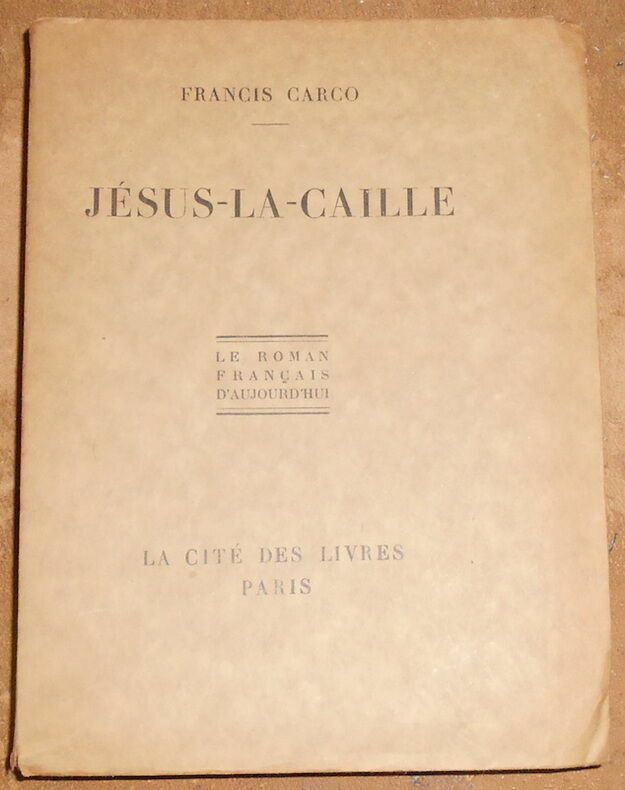
1926177381926. Paris La Cité des Livres 1926 1/50 ex. num. (n°40) sur Grand Vergé de Hollande 2ème papier après 20 Japon - Broché 16 cm x 21 cm 205 pages - Texte de Francis Carco- Très bon état