874 résultats
Very Good Turkish Paperback. Cr. 8vo. (19 x 12 cm). In Turkish. 370 p., color ills. 90'larda lubunya olmak. Transcripts of oral interviews with gays and transsexuals.
Very Good Turkish, Ottoman (1500-1928) Contemporary cloth bdg. Rebacked spine. Roy. 8vo. (23 x 14 cm). In Ottoman script (Old Turkish with Arabic letters). 143 p. Slight tear on two leaves, wear on extremities of original marbled boards, otherwise a good copy. Early printed edition of this exceedingly rare collection of early Ottoman erotic poems of homosexuality and bisexuality, of the 18th century including the multiple works of Enderunlu Fazil and Sünbülzâde Vehbi. This book includes five works originally: Defter-i ask [i.e. The book of love] (pp. 1-21); Hubannâme [i.e. The book of male lovers] (pp. 22-55); Zenannâme [i.e. The book of beautiful women] (as well as "Çenginâme" of Fazil Bey in Zenannâme, pp. 102-111); and Sevkengiz [i.e. Inspiring] (pp. 112-143). "Defter-i ask" [i.e. The book of love] by Fazil, in which he tells about his own romances, is a mathnavi of 438 couplets. It begins with a description of divine love and tells the story of the poet's romances, which he fell into only to regret and repent afterward. "Hubannâme" [i.e. The book of male lovers] consists of 796 couplets with various titles and it has a mystical analysis of beauty in the first chapter. After an introduction that gives geographical information that may be considered novel for its period, it describes the beauties of male bodies in many countries from India to America. This style is unique and the first in Turkish / Ottoman literature. In the work titled "Zenannâme" [i.e. The book of beautiful women], which is a mathnavi of 1101 couplets, women of various nations are described. The poet indicated in the introduction of his work that he does not want to talk about women, and that he has no orientation towards women. Enderunlu Fazil was an Ottoman poet who depicted the beauty of men from various lands of the Ottoman Empire. He achieved fame through his erotic works, which were published posthumously. Among his most famous works is The Book of Women, which was banned in the Ottoman Empire. The book describes the advantages and disadvantages of women from different nations. Fazil was born in Acre into an Arab family originally from Medina. He spent his early years in Safed in Ottoman Palestine. His grandfather Zahir al-Umar and his father Ali Tâhir were both executed (in 1775 and 1776, respectively ) for participating in a rebellion. After his father's death, Fazil moved to Istanbul. There, he was admitted to the Enderun palace school (thus taking on the name Enderuni or Enderûnlu) but was expelled in 1783 as a result of his love affairs with other men there. In 1799, he was exiled to Rhodes because of his satirical writings and was only allowed to return to Istanbul after becoming blind. He spent the rest of his life there, ill and bedridden. Sümbülzâde's "Sevkengiz" [i.e. The Inspiring] is an erotic and mystical poem in which heterosexual and bisexual narratives compare male and female beauties and eventually turn to divine love. It has 770 couplets in the "münâzara" genre. Özege 7711.
Very Good Turkish, Ottoman (1500-1928) Contemporary quarter leather binding with gilt decorations without title lettering. Demy 8vo. (22 x 14 cm). In Ottoman script (Old Turkish with Arabic letters). Seven different books and tractates (nine works) in one volume: (235, [1] p., 24 p., 143 p., 80 p., [6], 71 p., 84 p., 22 p.). Two leaves are torn from the hinge in the first book but not missing, one tractate is trimmed by margins, the board's extremities are worn, overall a good volume including multiple books. First editions (except for one) of these exceedingly rare poetic tractates collected together contemporarily in one handsome volume, reflecting early Ottoman poetic pleasure, including thematic mystic and erotic poetry mostly printed in the early 19th century. This volume includes the multiple works of Enderunlu Fazil and Sünbülzâde Vehbi, which are the earliest erotic and homosexual poems that seem to have been concealed by adding Keçecizâde's works to the beginning and the end of the volume. "Defter-i ask" [i.e. The book of love] by Fazil, in which he tells about his own romances, is a masnavi of 438 couplets. It begins with a description of divine love and tells the story of the poet's romances, which he fell into only to regret and repent afterward. "Hubannâme" [i.e. The book of beautiful young men] consists of 796 couplets with various titles and it has a mystical analysis of beauty in the first chapter. After an introduction that gives geographical information that may be considered novel for its period, it describes the beauties of male bodies of many countries from India to America. This style is unique and the first in Turkish / Ottoman literature. In the work titled "Zenannâme" [i.e. The book of women], which is a masnavi of 1101 couplets, women of various nations are described. The poet indicated in the introduction of his work that he does not want to talk about women, and that he has no orientation towards women. Enderunlu Fazil was an Ottoman poet who depicted the beauty of men from various lands of the Ottoman Empire. He achieved fame through his erotic works, which were published posthumously. Among his most famous works is The Book of Women, which was banned in the Ottoman Empire. The book describes the advantages and disadvantages of women from different nations. Fazil was born in Acre into an Arab family originally of Medina. He spent his early years in Safed in Ottoman Palestine. His grandfather Zahir al-Umar and father Ali Tâhir were both executed (in 1775 and 1776, respectively ) for participating in a rebellion. After his father's death, Fazil moved to Istanbul. There, he was admitted to the Enderun palace school (thus taking on the name Enderuni or Enderûnlu), but was expelled in 1783 as a result of his love affairs with other men there. In 1799, he was exiled to Rhodes because of his satirical writings and was only allowed to return to Istanbul after becoming blind. He spent the rest of his life there, ill and bedridden. Other books in the volume: Manzumetü'l-müsemma be-mihnet-kesan, Ceride-i Havadis Matbaasi, Ist., AH 1269 = AD 1853. 235 p., 1 portrait of Keçecizâde. Lithography. Özege 13354.; Two copies are located in OCLC 57242940 - 51281526. This work is a social satire type masnavi in which Izzet Molla was exiled to Kesan, telling of the troubles he suffered there, and his pardon and returns to Istanbul. Destar-i hayâl., Osman Nevres Efendi (1820-1876), Matbaa-i Âmire, Ist., AH 1289 = AD 1872. 24 p., Özege 3899. First and Only Edition. This rare work is a masnavi consisting of six stories. Defter-i ask, Hubannâme, Zenânnâme and Sevkengîz., Enderuni Fazil (1757-1810) and Sümbülzâde [or Sünbülzâde] Vehbi, (1718-1809)., Darü't-Tibaatü'l-Âmire, Ist., AH 1253 = AD 1837., 143 p. (pp. 1-20 Defter-i ask; pp. 22-55 Hubânnâme; pp. 56-111 Zenânnâme; pp. 112-143 Sevkengîz.). Özege 18902. First Edition. Tuhfe-i Dilkes Nâli, Yusuf Nabi [sic] [Nâlî, Muhammed b. Osman el-Konevî, (For more info please visit our website)
7629Sans lieu, sans nom, sans date. Grand in-8 à l'italienne non paginé, pleine percaline verte et muette. 3 minuscules chocs en bords inférieurs, rares rousseurs.
1926AMO-2219Chas Laborde ? Suite complète en noir des 15 eaux-fortes pour illustrer les Chansons érotiques de Béranger (1926). Rare. Pierre-Jean BÉRANGER. Illustrations libres de VIROT [peut-être CHAS-LABORDE ?]. [SUITE COMPLÈTE DE 15 EAUX-FORTES ÉROTIQUES POUR LES CHANSONS ÉROTIQUES de P.-J. de Béranger, ornées de quatorze planches gravées à l'eau-forte et coloriées.]. [Aux dépens d'un amateur, 1923 [i.e. avril 1926]. Format des feuillets : 22,5 x 16,5 cm - gravure : 15 x 13 cm env. Papier vélin de cuve Montgolfier Annonay. Cette suite en noir provient de l'édition clandestine pour les bibliophiles vendue sous le manteau et dont le tirage était limité à 260 exemplaires. Le détail du tirage est de 5 exemplaires sur Japon impérial, 250 exemplaires sur vélin blanc de Montgolfier et 5 exemplaires de collaborateurs hors commerce. Dans l'exemplaire sur Japon que nous avons eu en mains les gravures étaient tirées en couleurs. Cette suite de 15 eaux-fortes en noir provient du tirage à 250 exemplaires sur vélin blanc de Montgolfier. Le prospectus de cette édition (que nous avons déjà eu en mains) nous apprend que la date imprimée (1923) est erronée et que l'ouvrage n'est en réalité sorti des presses, au plus tôt, qu'en avril 1926. Ces illustrations sont de Virot (non signées - nous avons eu un dessin original signé de ce pseudonyme dans un autre exemplaire du même ouvrage). On y sent néanmoins le style de Chas Laborde même si les bibliographes ne s'accordent pas sur cette attribution. Pia, dans sa bibliographie "Les livres de l'Enfer" ne donne pas le nom de l'illustrateur qu'il ne semble pas avoir découvert, pas plus que Dutel d'ailleurs (1193). Luc Monod, dans son "Manuel de l'amateur de livres illustrés modernes" (t.1, p. 214), attribue ces dessins à Chas Laborde. Il s'agirait du seul ouvrage résolument érotique illustré par cet artiste. Bel ensemble de la suite complète en noir.
179846404936Paris, Maradan, an sixième (1798) ; in-24, demi-basane brune, dos lisse orné de roulettes, amphores et fleurons dorés. (Reliure de l’époque). xij pp., 222 pp. fontispiceÉdition parue en même temps que l’originale Mylne Martin 98.41. Ce roman “d’une vérité et d’une simplicité attachantes” raconte la vie et les amours d’une jeune fille pendant la Révolution. Il fit les délices des lecteurs dès sa parution et connut le succès jusqu’à la fin du XIXe siècle Giraud de Saint Fargeau. Fiévée fut journaliste et imprimeur, son journal, La Chronique de Paris qui affiche des opinions girondines est considéré contre-révolutionnaire ce qui lui vaut d’être incarcéré sous la Terreur. Suspect de conspirer avec les royalistes, il est proscrit par le Directoire, et se cache alors en province où il écrit La Dot de Suzette. Il se rallie finalement à Bonaparte qui lui confie des missions délicates dans l’espionnage puis le nomme au Conseil d’État et finalement, en 1813, préfet de la Nièvre. Voir à ce sujet : “Les Auteurs nivernais de 1715 à 1815. Bibl. munic. de Nevers 2004 pp. 97-99. Jean Tulard qui lui a consacré une biographie, a montré le rôle joué par Fiévée dès le Consulat, auprès de Napoléon Ier.“Homosexuel déclaré, Fiévée s’affiche ouvertement avec Théodore Leclerq, auteur des Proverbes et transforme son amant en maitresse de maison qui fait les honneurs de la Préfecture à tous les notables du département...” Nous apprend Michel Larivière dans Le dictionaire des homosexuels et bisexuels célèbres.Bel ex-libris armorié de l’époque avec la devise “dum spiro spero” de Robert de Larzac. Épidermures sans gravité aux mors.
Light wear to cover and creases on spine. Age-toned paper. Stated First Edition/First Printing. 303 pages. "This book is about the lives of four gay men. Three are in their sixties, one is in his seventies. This book is a chronicle of their lives as gay people, and of the 'family' they have been to one another over four decades."
Broch?. 267 pages. Couverture tach?e.
Gallimard, 1990, 267 pp., broché, très légères traces d'usage, couverture empoussiérée, état correct.
1987R200114021Régine Desforges. 1987. In-8. Broché. Bon état, Couv. convenable, Dos satisfaisant, Intérieur frais. 175 pages. Quelques illustrations en noir et blanc, dans le texte.. . . . Classification Dewey : 306.766-Homosexualité
1896212405London 1896. Second pirated edition. One of 100 copies unnumbered. viii 135 pp. 1 vols. 8vo. Green cloth. Ex-library bookplate on front pastedown small trace of slip removal on lower pastedown. Ink annotations throughout. Very good. Second pirated edition. One of 100 copies unnumbered. viii 135 pp. 1 vols. 8vo. Symonds' groundbreaking essay was first printed privately in 1891 then pirated here. It is "the first 'scientific' psychological-sociological analysis of homosexuality in English exposing vulgar errors by a well-judged mixture of sarcasm science and common sense" ODNB<br /> Includes a chapter on Walt Whitman; Symonds also published Walt Whitman. A Study 1893. unknown
1896212405London 1896. Second pirated edition. One of 100 copies unnumbered. viii 135 pp. 1 vols. 8vo. Green cloth. Ex-library bookplate on front pastedown small trace of slip removal on lower pastedown. Ink annotations throughout. Very good. Second pirated edition. One of 100 copies unnumbered. viii 135 pp. 1 vols. 8vo. Symonds' groundbreaking essay was first printed privately in 1891 then pirated here. It is "the first 'scientific' psychological-sociological analysis of homosexuality in English exposing vulgar errors by a well-judged mixture of sarcasm science and common sense" ODNB<br/>Includes a chapter on Walt Whitman; Symonds also published Walt Whitman. A Study 1893. unknown books
1994RO20264947GRASSET. 1994. In-8. Broché. Etat d'usage, Couv. convenable, Dos satisfaisant, Quelques rousseurs. 302 pages. . . . Classification Dewey : 306.766-Homosexualité
1986303BNew York, Viking, 1986. Folio. 130 nn. S. Orig.-Leinen mit RTitel und illustr. OU. 1
2013AFRIQUE550323Paris, L'Harmattan, 2013, 15,5 x 24, 272 pages sous couverture souple illustrée. Iconographie noir & blanc.
ORD-17378Florence et Paris. Léon Vanier. 1907. In-8 (172 x 215 mm) broché, couverture imitation parchemin, imprimée en rouge et noir et fermée par des cordons de cuir, 61 pages. Couverture un peu insolée, petites marques sur les gardes correpondant à l'attache des cordons, très bon état intérieur. Peu courant.
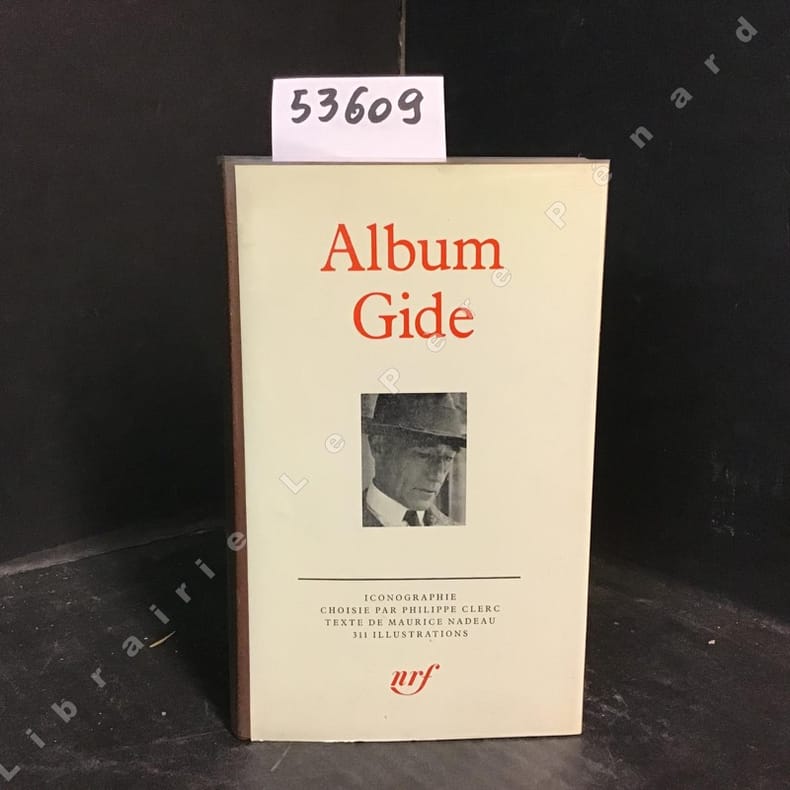
1985536091985 Ed. nrf. Gallimard - coll. La Pléiade - 1985 - In-12, reliure plein cuir marron, dos lisse orné de titres et filets horizontaux dorés, avec sa demi jaquette et son rhodoïd - 254 pages - Avec 311 illustrations en N&B
14511Paris, Plon, 1952 ; in-12, broché. 191 pp.-1 f. Non coupé, légères rousseurs sur les tranches si non très bel exemplaire.
2002100151185Stock 2002 in8. 2002. Broché. Le livre 'Algérie l'extase et le sang' de Michel del Castillo évoque la figure du poète algérien Jean Sénac assassiné en 1973 à travers une pièce de théâtre intitulée 'Une répétition'. L'auteur établit un parallèle entre le destin de Sénac et celui de Pier Paolo Pasolini et s'interroge sur la dérive d'une société sans repères privée de tout lien symbolique dans le contexte de la guerre civile algérienne des années 1990
In-8, 217p. Exemplaire à l'état de neuf.
In-8, XIII-244p. Réédition de ce roman saphique paru pour la première fois en 1902. Bel exemplaire. Peu courant.
1946RO20039825STOCK. 1946. In-12. Broché. Bon état, Couv. convenable, Dos satisfaisant, Non coupé. 283 pages. Intérieur acceptable.. . . . Classification Dewey : 306.766-Homosexualité
1945RO80110237STOCK. 1er octobre 1945. In-12. Relié. Etat passable, Couv. défraîchie, Dos satisfaisant, Intérieur acceptable. 283 pages. Reliure de bibliothèque : dos renforcé par une bande papier, code sur la coiffe en-tête, tampons sur la page de titre et dans quelques marges.. . . . Classification Dewey : 306.766-Homosexualité
200252652Japon, Gentosha Co., 2002, Cartonnage éditeur, sous rodhoïd illustré et bandeau., 159 pages. Bon état.
11948S.l. (Bordeaux) Éditions Raymond Picquot 1955 - Broché 12 cm x 19 cm 119 pages - Texte de Maurice Marsalet bibliographie bien complet de la bande-annonce : la culpabilité secrète d'André Gide- Très bon état