812 résultats
193613197JNew York: Macmillan 1936. First Edition First Issue. Signed by Margaret Mitchell on the flyleaf. Laid into the book is what is considered the finest Clark Gable letter extant an amazing reflection all about Gone With the Wind. Dated January 25 1960 it is a Typed Letter Signed in blue ink by Clark Gable on his printed stationery with the original stamped envelope which is written to the News Editor of the Atlanta Constitution newspaper Mr. Actor Cordell Jr. who had asked for Gable’s remarks on Gone With the Wind twenty years after the release of the film classic and to which Clark Gable wrote this amazing response: "Dear Mr. Cordell: I have received your letter of December 29 and will answer your questions in the order which you ask them. - Yes it does seem like 20 years. - I feel about GONE WITH THE WIND as being one of the greatest pictures ever made not because I played a leading role in it but because of the great story the way the story was brought to the screen the production it received and because of its very fine cast. When I look at the picture now after 20 years I still feel it is one of the finest motion pictures ever made. - Yes I think Rhett Butler is my favorite role and I am associated more with GONE WITH THE WIND than with any of my other pictures. - As to suggestions for the casting of Rhett in the forthcoming stage musical this is a little out of my line. I am sure the producer and the director will be completely capable of finding a very fine Rhett Butler. - Of the late Margaret Mitchell I would like to say that in addition to writing a wonderful novel she was of great help to me before I started working in the picture advising me of the manner in which she thought I should attempt to portray Butler. I listened to her and followed her advice and fortunately for me everything she told me was right. Naturally she was the one to whom I went for advice because she was the one who had created the character. I am forever grateful to Margaret Mitchell. - Most sincerely Signed Clark Gable.†This letter was written shortly before Gable left to film his final motion picture the late masterwork The Misfits co-starring Marilyn Monroe and Montgomery Clift directed by John Huston using an original screenplay by Monroe’s husband Arthur Miller. Gable died in November a few days after shooting his last scene. This articulate and fascinating letter therefore remains his final observations about Gone With the Wind. The book itself is a near fine first edition in original cloth in a very good first issue dust jacket with some minor expert restoration by a paper conservationist. A truly historic piece enclosed in a very handsome custom morocco and cloth custom box. Macmillan hardcover books
193613198JNew York: Macmillan 1936. First Edition First Issue. Signed by Margaret Mitchell on the flyleaf. Laid into the book is what is considered the finest Clark Gable letter extant an amazing reflection all about Gone With the Wind. Dated January 25 1960 it is a Typed Letter Signed in blue ink by Clark Gable on his printed stationery with the original stamped envelope which is written to the News Editor of the Atlanta Constitution newspaper Mr. Actor Cordell Jr. who had asked for Gable’s remarks on Gone With the Wind twenty years after the release of the film classic and to which Clark Gable wrote this amazing response: "Dear Mr. Cordell: I have received your letter of December 29 and will answer your questions in the order which you ask them. - Yes it does seem like 20 years. - I feel about GONE WITH THE WIND as being one of the greatest pictures ever made not because I played a leading role in it but because of the great story the way the story was brought to the screen the production it received and because of its very fine cast. When I look at the picture now after 20 years I still feel it is one of the finest motion pictures ever made. - Yes I think Rhett Butler is my favorite role and I am associated more with GONE WITH THE WIND than with any of my other pictures. - As to suggestions for the casting of Rhett in the forthcoming stage musical this is a little out of my line. I am sure the producer and the director will be completely capable of finding a very fine Rhett Butler. - Of the late Margaret Mitchell I would like to say that in addition to writing a wonderful novel she was of great help to me before I started working in the picture advising me of the manner in which she thought I should attempt to portray Butler. I listened to her and followed her advice and fortunately for me everything she told me was right. Naturally she was the one to whom I went for advice because she was the one who had created the character. I am forever grateful to Margaret Mitchell. - Most sincerely Signed Clark Gable.†This letter was written shortly before Gable left to film his final motion picture the late masterwork The Misfits co-starring Marilyn Monroe and Montgomery Clift directed by John Huston using an original screenplay by Monroe’s husband Arthur Miller. Gable died in November a few days after shooting his last scene. This articulate and fascinating letter therefore remains his final observations about Gone With the Wind. The book itself is a near fine first edition in original cloth in a very good first issue dust jacket with some minor expert restoration by a paper conservationist. A truly historic piece enclosed in a very handsome custom morocco and cloth custom box. Macmillan hardcover books
1932124744London: Jarrolds Publishers 1932-1934. First editions of each volume of Gibbon's classic trilogy describing the life of Chris Guthrie a woman from the north-east of Scotland during the early 20th century each volume inscribed by him to George Malcolm Thomson. Octavo original cloth 3 volumes. Sunset Song is inscribed on the title page "For G. Malcolm Thomson L. Grassic Gibbon." Cloud Howe is the dedication copy inscribed on the title page "For the 'dedicatee' with kind regards. L. Grassic Gibbon." Grey Granite is inscribed on the title page "For George Malcolm Thomson with good wishes L. Grassic Gibbon." Each are in very good condition. Rare and desirable signed and inscribed. A Scots Quair is revolutionary - innovative in its form deft and humorous in its use of language courageous in its characterization and politics. Central to the trilogy is Chris Guthrie one of the most remarkable female characters in modern literature. In Sunset Song Gibbon's finest achievement the reader follows Chris through her girlhood in a tight-knit Scottish farming community: the seasons the weddings the funerals the grind of work the gossip. As the Great War takes its toll machines replace the old way of life. Cloud Howe and Grey Granite take Chris from her rural homeland to life in an industrial Scotland and the desperate years of the Depression. Gibbon attracted attention from his earliest attempts at fiction notably from H. G. Wells but it was his trilogy entitled A Scots Quair and in particular its first book Sunset Song with which he made his mark. A Scots Quair with its combination of stream-of-consciousness lyrical use of dialect and social realism is considered to be among the defining works of the 20th century Scottish Renaissance. All three parts of the trilogy have been turned into serials by BBC Scotland written by Bill Craig with Vivien Heilbron as Chris. Additionally Sunset Song has been adapted into a film released in 2015. Jarrolds Publishers hardcover books
19362011509MacMillan 1936. First edition. hardcover. Very good/Very good. First edition first issue book May 1936 on copyright page in a first issue dust jacket lower position of listing for this title inscribed and dated by Margaret Mitchell in Atlanta 1936. Very good in a very good price-clipped first issue dust jacket with Housed in a custom-made slipcase. MacMillan unknown books
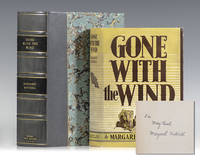
1936117051New York: The Macmillan Company 1936. First edition of Mitchell's masterpiece. Octavo original gray cloth. First printing with "Published May 1936" on the copyright page and no mention of other printings. Presentation copy inscribed by the author on the front free endpaper "For Mary Buck Margaret Mitchell." Near fine in the rare original dust jacket which is in near fine condition. Housed in a custom half morocco clamshell box. A superior example. In 1923 Margaret Mitchell became a feature writer for the Atlanta Journal and in 1925 married John Marsh a public relations officer for Georgia Power. She found most of her assignments unfulfilling and she soon left to try writing fiction more to her own taste. Her own harshest critic she would not try to get her work published. She began to write Gone with the Wind in 1926 while recovering from an automobile accident. Over the next eight years she painstakingly researched for historical accuracy. She accumulated thousands of pages of manuscript. Here is how she later described her life's labor: "When I look back on these last years of struggling to find time to write between deaths in the family illness in the family and among friends which lasted months and even years childbirths not my own divorces and neuroses among friends my own ill health and four fine auto accidents . it all seems like a nightmare. I wouldn't tackle it again for anything. Just as soon as I sat down to write somebody I loved would decide to have their gall-bladder removed. . " In 1934 an editor from Macmillan's Publishers came to Atlanta seeking new authors. He was referred to John and Margaret Marsh as people who knew Atlanta's literary scene. She steered him to several prospects but didn't mention her own work. A friend told him that she was writing a novel but she denied it. On the night before he was to leave Atlanta she appeared at his hotel-room door with her still imperfect mountainous manuscript and left it with him for better or for worse. "This is beyond doubt one of the most remarkable first novels produced by an American writer. It is also one of the best" New York Times. Gone With the Wind is said to be the fastest selling novel in the history of American publishing 50000 copies in a single day and went on to win the Pulitzer Prize. The Macmillan Company hardcover books
1960140940127New York: Tiber Press 1960. First Edition. Fine. Complete in four folio volumes each measuring 17½" x14¼". Each volume with three full-page color silkscreen prints and additional prints at title page and upper cover original cloth-backed illustrated boards. First Edition. No. 47 of 200 copies. Each volume signed by the poet and artist on the limitation page. A Fine set bright and sharp in publisher's thick acetate jackets housed in cloth slipcase with light shelf wear.<br /> <br /> <p>A visionary collaboration between the leading lights of the New York School of poetry and four second generation abstract expressionist artists produced at the height of their creative collective powers. A heady encapsulation of the New York literary and visual avant garde at the dawning of the '60s. Tiber Press unknown books
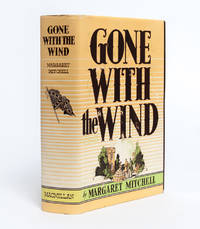
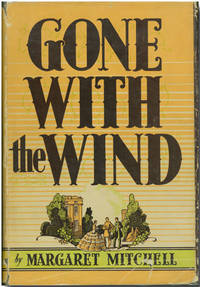
19363055New York: Macmillan 1936. First edition. Fine/Near Fine. First printing May 1936 in first issue jacket. A Fine copy of the book in a lovely Near Fine dust jacket. Jacket with slight rubbing to the front panel a small chip at the lower front corner and one small tear with a tape repair on the verso. Overall a very clean and attractive example.<br/><br/>Set in Georgia during the Civil War and Reconstruction the novel follows the fall of the South and its gentility as experienced by Scarlett O'Hara one of literature's most ruthlessly optimistic characters. More than a war story Gone With the Wind is a reflection on humanity. "Mitchell carefully analyzes the nature of human resilience and hold up hopefulness as the critical tool for getting through the worst of times" The Guardian. Popular from its release and an almost-immediate best-seller Gone With the Wind won the Pulitzer Prize the following year and would be transformed into one of the most iconic Hollywood golden-era films starring Vivien Leigh and Clark Gable. No other work of literature more fully captures the old Southern gentility than Gone With the Wind. "This is beyond a doubt one of the most remarkable first novels produced by an American writer. It is also one of the best" contemporary New York Times Book Review. Fine in Near Fine dust jacket. Macmillan unknown books
19881653591988. MITCHELL Joan. Smoke. Poems by Charles Hine. Illustrated with 16 sugarlift and spitbite aquatints by Joan Mitchell. Folio loose as issued laid-in to a cloth folding box. San Francisco: Limestone Press 1988. Comprised of 16 diptych etchings by Mitchell and accompanied by poems of Charles Hine this book is the result of a wonderful collaboration between the artist poet and publisher. Mitchell a celebrated American abstract expressionist created the etchings using sugarlift and spitbite aquatint technique. Signed on the colophon by Mitchell and Hine. One of 80 copies. hardcover books
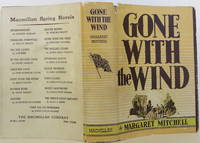
1936WRCLIT51586New York: Macmillan 1936. Thick octavo. Gray cloth lettered in blue. Modest rubbing at corners with a few small smudges to cloth usual light tanning to endsheets but a very good tight copy in shelfworn dust jacket with a creased edge tear two large chips to the spine panel and a clean split part way up the lower joint. Half morocco folding slipcase. First edition first printing. Signed by Mitchell on the front free endsheet. The dust jacket is price-clipped but is in the preferred state with the "Spring Novels" advert on the lower panel showing this work as the second title in the right hand column. "The book that lives on and on decried by the devotees of higher criticism scorned by the intellectuals and loved by the public. It was awarded a Pulitzer Prize in 1937" - Harwell. WILLINGHAM & HARWELL 120. Harwell IN TALL COTTON 125. Macmillan hardcover books
1936140938421New York: The Macmillan Company 1936. First Edition. Near Fine/Poor. First edition first printing with "Published May 1936" on the copyright page. Signed by Margaret Mitchell on the front free endpaper. Very Good with a short tear to the cloth at the top of the spine light general rubbing and light wear and toning to the pages. With remnants of the tattered first issue dust jacket present though in rather poor condition. A lovely copy of the first printing signed by the author. The Macmillan Company unknown books
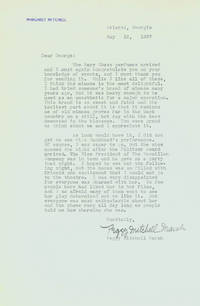
1937252027Atlanta Georgia 1937. One page on personal letterhead. 4to. light creasing and toning esle fine. One page on personal letterhead. 4to. To Cukor on "old mimosa groves" - "bees demented in the blossoms" -- and Tallulah. Mitchell thanks Cukor for the gift of Mary Chess perfumes and especially the "mimosa":<br/><br/>"I had tried someone's brand of mimosa many years ago but it was heavy enough to be used as an anesthetic for a major operation. This brand is so sweet and faint and the lovliest part about it is that it reminds me of old mimosa groves far in the back country on a still hot day with the bees demented in the blossoms."<br/><br/>She then goes on to discuss Tallulah Bankhead's recent performance in Atlanta which she unfortunately missed:<br/><br/>'Of course I was eager to go but the show opened the night after the Pulitzer Award arrived. The Vice President of The Macmillan Company was in town and he gave me a party that night. I hoped to see her the following night but the house was so filled with friends and excitement that I could not go to the theatre. I was very disappointed for everyone was charmed with her. So few people here had liked her in her films and I am afraid many of them went to see her play determined not to like it. But everyone was most enthusiastic about her and the phone rang all day long as people told me how charming she was. "<br/><br/>Mitchell won the Pulitzer Prize in 1937 for her novel GONE WITH THE WIND; and George Cukor was David Selznick's first choice as director of the film. unknown books
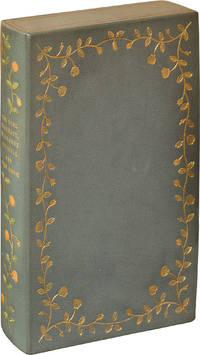
1936Embry 177556The Macmillan Company 1936. First edition first printing. Rebound fine thus in custom slipcase with matching leather title label. Rebound in full confederate gray morocco by master binder Glenn Fukunaga spine panels with double gilt surrounds and crossed confederate swords central device. Briefly inscribed "Foir Gunvor Svendsen Margaret Mitchell." The Macmillan Company, 1936. First edition, first printing. hardcover books
19361511033MacMillan 1936. 1st Edition. Hardcover. Fine/Very Good. A fine first edition in a very good dust jacket. May 1936 on copyright page. First issue dust jacket with book title in second column and original price of $3 on front flap. Housed in a custom-made collector's slipcase. MacMillan hardcover books
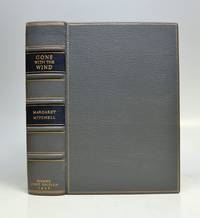
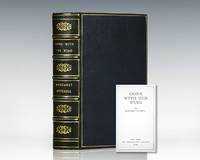
1936282730New York: Macmillan 1936. First. hardcover. fine. Thick 8vo re-bound in gray leather with black spine labels lettered in gilt. N.Y.: Macmillan 1936. First Edition.<br/><br/> Published in May 1936. Autographed by Mitchell with a 1936 ownership inscription.<br/><br/> Macmillan unknown books
1936WRCLIT54197New York: Macmillan 1936. Thick octavo. Gray cloth lettered in blue. Spine extremities worn and bumped with 2cm creased snag at crown of spine usual slight tanning to endsheets but internally a very good copy. First edition first "May 1936" printing. Inscribed and signed by Mitchell on the front free endsheet: "For Charles J. Trenkle Margaret Mitchell" and with the recipient's bookplate on the front pastedown. A modest albeit inscribed and signed copy suitable for craft binding in stars and bars perhaps as seems to have become fashionable. "The book that lives on and on decried by the devotees of higher criticism scorned by the intellectuals and loved by the public. It was awarded a Pulitzer Prize in 1937" - Harwell. WILLINGHAM & HARWELL 120. IN TALL COTTON 125. Macmillan hardcover books
19492060Atlanta Georgia: Margaret Mitchell in reaction to The Reader's Digest & The Atlanta Journal 1949. Original 3 pieces. Envelope. Very Good/Envelope Good. Autograph Letter Penned & Signed characteristically "M.M.M." Margaret Mitchell Marsh by the famed American Author on a Small Folio 8.5" x 14" page copied from "The Atlanta Journal" June 19 1949; with a marginal ink note in the left margin of "The Atlanta Journal" from the recipient Dr. Mayo docketed "July 5 - 1949"; accompanied by the original envelope addressed by Mitchell to "Dr. C.E. Mayos / 612 West 13 St. / Davenport / Iowa." stamp and partial postmark cut away leaving only "5 ATLA. Jul /10.19./ G; with Mitchell's return address on the envelope flap preprinted as: "1268 Piedmont Avenue N. E. / Apartment 3 / Atlanta 5 Georgia." Dr. Mayos has written on the envelope: "Letters from / Margaret Mitchell slight paper loss / Please save." plus a copy of the July1949 edition of "The Reader's Digest" containing a short entry under "Facts to the Contrary"page 18 in which contributor Clemmie R. Galloway pointed out a "discrepancy in time between the death of Melanie's husband in the Battle of Gettysburg July 1 1863 and the birth of her son during the siege of Atlanta September 3 1864." We offer Margaret Mitchell's irritated reaction to a late-blooming literary SCANDAL over whether RHETT Butler had been the REAL FATHER of Melanie's child Because of Mitchell's supposedly faulty internal chronology in Gone With The Wind some readers thought that Melanie's husband Ashley had died at Gettysburg during early July of 1863--more than a year before Melanie had borne a son during the siege of Atlanta on September 3rd 1864. As a consequence of this supposed mistake enthusiasts of the novel and its larger-than-life characters eagerly speculated that dashing Rhett had had a compromising affair with saintly Melanie during her husband's absence! In the July 1949 edition of "The Reader's Digest" contributor Clemmie R. Galloway published a small entry under "Facts to the Contrary" in which he accused Mitchell of a "discrepancy in time between the death of Melanie's husband in the Battle of Gettysburg July 1 1863 and the birth of her son during the siege of Atlanta September 3 1864." The entry was read by many! Galloway went on to say that "When the publisher called Margaret Mitchell's attention to the timing the author was silent for a moment; then she said 'Well I know the Yankees will never change the date of the Battle of Gettysburg and I'm certainly not going to change the date of the Battle of Atlanta.' The publisher moved uncomfortably in his chair 'But--how will we explain it to the public Miss Mitchell' Miss Mitchell shrugged 'Let's hope they will be so interested in the story they will overlook the discrepancy of time if not' she added 'we'll just say that southern women do things more leisurely.'" Penned shortly before her untimely death a few weeks later on August 16th Mitchell penned a quick note in the lower right of this broadside reprinting the June 19 1949 scandalous edition of "The Atlanta Journal" which was headlined "Row Over Melanie's Baby / Peggy Mitchell Hits / Magazine 'Falsity.'" Addressed to "Dr. M" Dr. Mayos a psychiatrist with whom she had corresponded since the mid-1930's Mitchell expressed her disbelief and ire regarding Galloway's slanderous write-up. In full: "Dear Dr. M -- This is one of the reasons why I haven't answered your nice letter. This stupid false hood is causing us a lot of trouble. May be you can figure why they'd print such an error but I can't! Don't forget to let us know before you come through Atlanta next time. We'd love to meet you. M.M.M. meaning: Margaret Mitchell Marsh a characteristic initialled signature used by the author." On the envelope is a penned ink note from Dr. Mayo: "Letter from / Margaret Mitchell / Please save." "The Atlanta Journal "article includes Margaret Mitchell's rebuttal in which she notes that Ashley DID NOT DIE at Gettysburg on July 3-4-5 1863 but "As a matter of fact Ashley never did die in the book." Indeed he was interned as a POW in notorious Rock Island Prison Illinois after which he was released and returned home. As noted we offer three companion pieces: 1 an Autograph Letter Signed by Margaret Mitchell November 8 1900 -- August 16 1949 on a personally embarrassing and aggravating copy of "The Atlanta Journal" headline article from "The Atlanta Journal" sheet with the ink date "july 5 - / 1949" in its left margin. r June 19 1949; & 2 her personal envelope of transmission addressed by the renowned author to a longtime friend psychiatrist Dr. C.E. Mayos of 612 West 13 St Davenport Iowa; annotated by him "Letter from Margaret Mitchell"; plus 3 a copy of "The Reader's Digest" for July 1949 containing the brief entry under "Facts to the Contrary" p.18 about the chronological error supposedly made by Mitchell in Gone With The Wind that had unexpected embarrassing ripple-effects. Condition: Margaret Mitchell's letter is in very good condition with three horizontal mailing folds on "The Atlanta Journal" small folio sheet on which her letter has been penned. The folds have been professionally strengthened verso. Some light soiling and age-toning; faint rust mark from a paperclip upper left corner. Her envelope of transmission has some tears with slight wear and soil. The July 1949 copy of "The Reader's Digest" is surprisingly bright clean and tight. We shall provide a Certificate of Authenticity and another from the party from whom we obtained this very special piece. Margaret Mitchell (in reaction to The Reader's Digest & The Atlanta Journal) unknown books
1943279509New York: Duell Sloan Pearce 1943. First. hardcover. fine/good. 8vo red cloth d.w. New York: Duell Sloan & Pearce 1943. First Edition.<br/><br/> Inscribed for Edith Oliver the drama critic of the New Yorker "with love Joe Mitchell July 29 1943". The dust wrapper has a fine front cover but is missing half the spine. The front flap is detached but price intact. A scarce title to find inscribed.<br/><br/> Duell Sloan Pearce unknown books
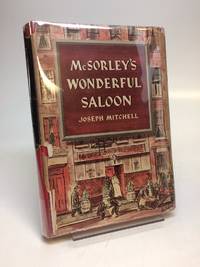
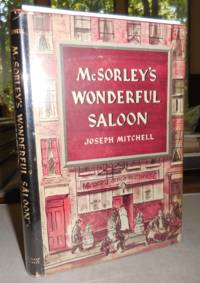
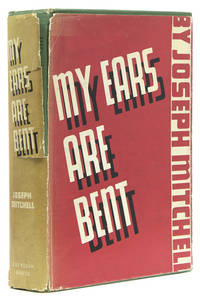
194322187New York: Duell Sloan & Pearce 1943. First edition. Hardcover. Near Fine/very good. First edition of this iconic book on New York's oldest and most famous saloon. A superb near fine example in a bright very good price intact dustwrapper. Nicely INSCRIBED by Mitchell to artist and New Yorker magazine illustrator Richard Merkin. Easily the author's scarcest title and rarely found signed or inscribed. <br/><br/> Duell, Sloan, & Pearce hardcover books
1917136302Chicago: The Reilly and Britton Co 1917. First Edition. First Edition. Blank book-style yearbook largely still blank belonging to Elizabeth Floding with numerous inscriptions and well wishes from various students and faculty including a four-line Gellett Burgess poem written to Floding by Margaret Mitchell: "I never saw a purple cow I never hope to see one I'll tell you one thing anyhow I'd rather see than be one! Ha! Ha! Margaret Mitchell." Additional ephemera also laid in including a piano recital program and various small photographs. <br/><br/>"Gone With the Wind" writer Mitchell attended private girls' school Washington Seminary in Atlanta Georgia where presumably Floding was a classmate. The book also contains an inscription to Floding from English teacher Eva Paisley whom Mitchell would credit as the first to recognize her writing talent. Floding would go on to attend Emory University. <br/><br/>Very Good plus housed in a custom gray cloth chemise and gray leather slipcase decorated with gilt titles and decorative gilt roses. The Reilly and Britton Co unknown books
1939002577Various: By the authors 1939. First Edition. Very good. Comprised of three letters and a manuscript memoir the archive covered three continents and intertwined the lives of royals reformers and exiles. Nina Cornelia Mitchell 1854 - 1958 was an activist and an ardent relief worker in Europe during and after the First World War. She was also the first cousin of author and artist Miss Violet nee Serena Catherine Dandridge with whom she lived in the historic "Rosebrake" mansion in Shepherdstown West Virginia after her return to the United States. Paul Underwood Kellogg 1879 - 1958 was a social reformer journalist and co-founder of the American Civil Liberties Union. He was the editor of "Survey" magazine which he had managed to turn into the country's leading social work journal in a very short period of time. Mitchell had been visiting her friends - Prince Aleksandr Eristov Georgian Lieutenant-Genaral and his wife who were living in exile in Paris when she met Count Piotr Vassilievich Hendrikov former Governor of the Orel Province and brother of Countess Anastasiia Hendrikova Lady of Honor to Empress Aleksandra Feodorovna. He gave Nina a memoir written first in Russian and then in French to translate and write into English. Through his sister's stories and his personal visits to the Romanov family Hendrikov was intimately familiar with the sovereigns' lives and suffered through their assasinations which included his sister's. The memoir emotional and painful to read revealed some lesser known facts about Nicholas' family. Hendrikov stated that although Aleksandra was thought to be cold and aloof she was in reality just profoundly shy. He also gave examples of the Emperor's love and compassion for his people including an instance when having been presented with new war equipment for the infantry he feared it would be too heavy for his soldiers so he strapped it on and walked 15 kilometers to test it. The narrative followed the family's daily life before and after their arrests their work their devotion to each other the births of the children and their coping with son Aleksei Nikolaevich' terrible disease. Later on Hendrikov described Nicholas' abdication the reaction of the people the exile and the terrible treatment the family received from their guards his meetings with representatives of Duma and finally their murders together with those of the closest to them people court and servants who had followed them through the last year of their lives. In her first letter to Kellogg Mitchell gave the prehistory of the memoir asked him to read it and possibly assist with finding a publisher for it mentioned her better understanding of the situation in Russia and inquired about getting a subscription to the "Survey" for her friend Helen Pendleton. In his response Kellogg promised to read the papers told Mitchell he would love to hear about her work in Europe and confirmed Helen Pendleton's subscription to his magazine. In Nina's second and last letter she stated she would await the editor's criticism of the memoir talked about her friends the Eristovs and invited the Kelloggs to visit her in the "City of the Shepherds in the Valley of the Daugther of the Stars." - Two ALS signed by Nina Cornelia Mitchell dated July 18 1939 and August 14 1939; 6 1/2 x 5 and 7 x 5 1/2; pp. 12 and 4 respectively; off-white textured stock black ink and red pencil; light age-toning; two rust spots from removed paper clips; very good condition. - Typed letter by Paul Kellogg dated July 19 1939; 11 x 8 1/2; single sheet text to recto only; small handwritten note in pencil; a few nicks and chips to edges; good condition. - Manuscript memoir in two parts; 11 1/2 x 8 1/2 and 9 3/4 x 8 1/4; loose sheets pp. 13 and 16 respectively; text to recto only; the first part a bit fragile with several small nicks to corners; overall in very good condition. By the authors unknown books
193674052New York: Macmillan 1936. First edition of the author's classic novel. First printing with "Published May 1936" on the copyright page and no mention of other printings. Octavo bound in full morocco gilt titles and tooling to the spine gilt ruled to the front and rear panels marbled endpapers. In fine condition. In 1923 Margaret Mitchell became a feature writer for the Atlanta Journal and in 1925 married John Marsh a public relations officer for Georgia Power. She found most of her assignments unfulfilling and she soon left to try writing fiction more to her own taste. Her own harshest critic she would not try to get her work published. She began to write Gone with the Wind in 1926 while recovering from an automobile accident. Over the next eight years she painstakingly researched for historical accuracy. She accumulated thousands of pages of manuscript. Here is how she later described her life's labor: "When I look back on these last years of struggling to find time to write between deaths in the family illness in the family and among friends which lasted months and even years childbirths not my own divorces and neuroses among friends my own ill health and four fine auto accidents . it all seems like a nightmare. I wouldn't tackle it again for anything. Just as soon as I sat down to write somebody I loved would decide to have their gall-bladder removed. . " In 1934 an editor from Macmillan's Publishers came to Atlanta seeking new authors. He was referred to John and Margaret Marsh as people who knew Atlanta's literary scene. She steered him to several prospects but didn't mention her own work. A friend told him that she was writing a novel but she denied it. On the night before he was to leave Atlanta she appeared at his hotel-room door with her still imperfect mountainous manuscript and left it with him for better or for worse. "This is beyond doubt one of the most remarkable first novels produced by an American writer. It is also one of the best" New York Times. Gone With the Wind is said to be the fastest selling novel in the history of American publishing 50000 copies in a single day and went on to win the Pulitzer Prize. Macmillan unknown books
193643084New York: Macmillan 1936. First edition of the author's classic novel. First printing with "Published May 1936" on the copyright page and no mention of other printings. Octavo bound in full morocco gilt titles to the spine gilt ruled to the front and rear panels marbled endpapers all edges gilt. In fine condition. In 1923 Margaret Mitchell became a feature writer for the Atlanta Journal and in 1925 married John Marsh a public relations officer for Georgia Power. She found most of her assignments unfulfilling and she soon left to try writing fiction more to her own taste. Her own harshest critic she would not try to get her work published. She began to write Gone with the Wind in 1926 while recovering from an automobile accident. Over the next eight years she painstakingly researched for historical accuracy. She accumulated thousands of pages of manuscript. Here is how she later described her life's labor: "When I look back on these last years of struggling to find time to write between deaths in the family illness in the family and among friends which lasted months and even years childbirths not my own divorces and neuroses among friends my own ill health and four fine auto accidents . it all seems like a nightmare. I wouldn't tackle it again for anything. Just as soon as I sat down to write somebody I loved would decide to have their gall-bladder removed. . " In 1934 an editor from Macmillan's Publishers came to Atlanta seeking new authors. He was referred to John and Margaret Marsh as people who knew Atlanta's literary scene. She steered him to several prospects but didn't mention her own work. A friend told him that she was writing a novel but she denied it. On the night before he was to leave Atlanta she appeared at his hotel-room door with her still imperfect mountainous manuscript and left it with him for better or for worse. "This is beyond doubt one of the most remarkable first novels produced by an American writer. It is also one of the best" New York Times. Gone With the Wind is said to be the fastest selling novel in the history of American publishing 50000 copies in a single day and went on to win the Pulitzer Prize. Macmillan unknown books
1938007836Sheridan House 1938. Book. Fine. Cloth. First Edition. 8vo - over 7¾" - 9¾" tall. Fine Copy Without Wear in Very Good Price Clipped Jacket. Inch Chip on Front Panel of Jacket. Author's Scarce First Book. First Edition Copy Very Rare In Jacket Excellent Fresh Copy. Sheridan House Hardcover books
1938307462New York: Sheridan House 1938. First edition of the author's first book. Illustrated with photographs. 284 pp. 1 vols. 8vo. Green cloth. Front inner hinge cracked but holding. Very good in very good dust jacket spine panel faded short split at top of front spine fold. First edition of the author's first book. Illustrated with photographs. 284 pp. 1 vols. 8vo. Evidentiary Copy. Joseph Mitchell's elusive first book decidedly uncommon in dust jacket.<br/><br/>This copy from the files of Sheridan House publisher Lee Furman is an evidentiary copy of a previously unknown second state dust jacket with publisher's reviews on the front inner flap and a publisher's ad on back inner flap. Provenance: from the files of Lee Furman publisher Sheridan House unknown books
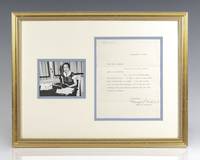
19361093711936. An original typed letter signed by the author of Gone With The Wind Margaret Mitchell dated 5 September 1936. It is on <span class="match">Mitchell</span>'s letterhead and reads "Dear Mrs. Simpson: Thank you for your letter and your interest. No I am not contemplating any lecture tour. In fact I have turned down many invitations to speak. I do not intend ever to make any speeches for I realize that writing books and making speeches are two very different affairs Sincerely Margaret Mitchell." Matted and framed with a portrait of <span class="match">Mitchell</span> at her typewriter 6. The entire piece measures 19 inches by 14.5 inches. Margaret Mitchell was an American novelist and journalist. Mitchell wrote only one novel published during her lifetime the Civil War-era novel Gone with the Wind for which she won the National Book Award for Most Distinguished Novel of 1936 and the Pulitzer Prize for Fiction in 1937. unknown books